
多晶硅

Search documents
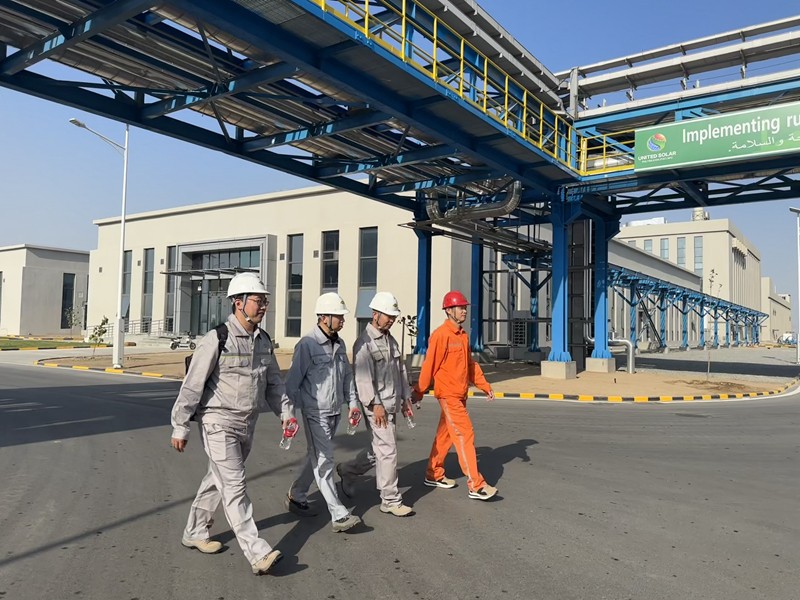
8932张机票,“年轻”4小时的他们 | 2026新春走基层
Zhong Guo Hua Gong Bao· 2026-02-11 01:07
Core Insights - The article highlights the successful completion of a significant solar-grade polysilicon project in Oman, developed by China Chemical Engineering Sixth Construction Co., Ltd, marking it as the largest overseas polysilicon project by China and referred to as the "Oman Miracle" [1][9] Group 1: Project Overview - The project has an annual production capacity of 100,000 tons of high-purity silicon materials, showcasing China's engineering capabilities abroad [1] - The project involved a total of 8,932 flight bookings, symbolizing the extensive workforce mobilization and commitment to the project [2][5] Group 2: Challenges Faced - Workers faced extreme temperatures exceeding 50°C during construction, which posed significant challenges to their working conditions [7][9] - The project team implemented various measures to ensure worker safety and comfort, including the procurement of over 10,000 pairs of high-quality safety shoes and nearly 200,000 yuan spent on heat prevention medications [7] Group 3: Cultural and Emotional Aspects - The project not only represents a physical construction effort but also embodies the emotional journey of the workers, with many expressing a sense of connection to their homeland through shared experiences [10] - The project team maintained a supportive environment, with management actively engaging in the well-being of workers, fostering a sense of family among the team [10]

交易氛围冷淡,双硅小幅下跌
Hua Tai Qi Huo· 2026-02-10 05:15
1. Report Industry Investment Rating - Not provided in the given content 2. Core Views of the Report - Industrial silicon prices are expected to remain range - bound. Supply has significantly contracted, providing price support, but high polysilicon inventory suppresses demand, and prices lack upward momentum. The upside depends on downstream demand recovery and inventory clearance, while the downside is limited by cost support and production cut expectations [1][2] - Polysilicon prices are expected to continue to fluctuate. Supply has shrunk in February, supporting prices, but downstream cost pressure has led to weak demand. High inventory is being cleared slowly, suppressing price increases. Before April, the "rush to export" phenomenon has no obvious driving force, and the market is waiting for the supply - demand game [5] 3. Summary by Related Catalogs Industrial Silicon Market Analysis - On February 9, 2026, the industrial silicon futures price fluctuated and declined. The main contract 2605 opened at 8,515 yuan/ton and closed at 8,450 yuan/ton, down 70 yuan/ton (-0.82%) from the previous settlement. The position of the main contract 2605 at the close was 277,011 lots, and the total number of warehouse receipts on February 8, 2026, was 16,737 lots, an increase of 564 lots from the previous day [1] - Industrial silicon spot prices fell slightly. According to SMM data, the price of East China oxygen - passing 553 silicon was 9,200 - 9,400 yuan/ton (-50 yuan/ton), 421 silicon was 9,500 - 9,800 yuan/ton (unchanged), Xinjiang oxygen - passing 553 silicon was 8,600 - 8,800 yuan/ton (unchanged), and 99 silicon was 8,600 - 8,800 yuan/ton (unchanged). Silicon prices in Kunming, Huangpu Port, Northwest, Tianjin, Xinjiang, Sichuan, and Shanghai remained flat, and the price of 97 silicon was stable [1] - As of February 5, the total social inventory of industrial silicon in major regions was 562,000 tons, a 1.44% increase from the previous week [1] - The demand for industrial silicon continued to slump. The pre - holiday stocking was nearing the end, there were no new orders, major polysilicon manufacturers cut production, supply shrank, and the market mainly focused on inventory reduction [1] - In February, large manufacturers had plans to cut production and shut down, and with the Spring Festival approaching, supply was expected to decrease [1] Strategy - Industrial silicon prices are expected to remain range - bound. Short - term range trading is recommended. There is no strategy for cross - period, cross - variety, and options trading [2] Polysilicon Market Analysis - On February 9, 2026, the main polysilicon futures contract 2605 fluctuated and rose. It opened at 49,500 yuan/ton and closed at 49,370 yuan/ton, a - 0.17% change from the previous trading day. The position of the main contract reached 38,347 lots (37,934 lots the previous day), and the trading volume was 4,706 lots [2] - Polysilicon spot prices rose slightly. According to SMM statistics, N - type material was 48.50 - 58.80 yuan/kg (+0.05 yuan/kg), and n - type granular silicon was 49.00 - 51.00 yuan/kg (unchanged) [3] - Polysilicon manufacturers' inventory and silicon wafer inventory increased. The latest polysilicon inventory was 341,000 tons, a 2.40% change from the previous period, and silicon wafer inventory was 28.32 GW, a 3.77% change. The weekly polysilicon production was 20,100 tons, a - 0.50% change, and silicon wafer production was 10.38 GW, a - 11.66% change [3] - In terms of silicon wafers, the price of domestic N - type 18Xmm silicon wafers was 1.18 yuan/piece (-0.05 yuan/piece), N - type 210mm was 1.48 yuan/piece (-0.03 yuan/piece), and N - type 210R silicon wafers were 1.28 yuan/piece (-0.03 yuan/piece) [3] - In terms of battery cells, the price of high - efficiency PERC182 battery cells was 0.27 yuan/W (unchanged), PERC210 battery cells were about 0.28 yuan/W (unchanged), Topcon M10 battery cells were about 0.44 yuan/W (unchanged), Topcon G12 battery cells were 0.44 yuan/W (unchanged), Topcon 210RN battery cells were 0.44 yuan/W (unchanged), and HJT210 half - cell batteries were 0.37 yuan/W (unchanged) [3][4] - In terms of components, the mainstream transaction price of PERC182mm was 0.67 - 0.74 yuan/W (unchanged), PERC210mm was 0.69 - 0.73 yuan/W (unchanged), N - type 182mm was 0.73 - 0.74 yuan/W (unchanged), and N - type 210mm was 0.75 - 0.77 yuan/W (unchanged) [4] Strategy - Polysilicon prices are expected to continue to fluctuate. Short - term range trading is recommended, and the main contract is expected to maintain a slight fluctuation in the short term. There is no strategy for cross - period, cross - variety, and options trading [5]
有色金属基础周报:AI泡沫的担忧再次浮现,有色金属整体弱势调整-20260209
Chang Jiang Qi Huo· 2026-02-09 07:10
Report Industry Investment Rating No relevant information provided. Core Viewpoints of the Report - This week, macro factors continued to dominate the financial market. Concerns about the AI bubble resurfaced, leading to a sharp decline in global markets, including stocks, precious metals, and non - ferrous metals. However, Shanghai copper rebounded due to news of increased state purchases and then declined again with the external market, finally stabilizing at around 100,000 [4]. - The copper market's sharp decline was mainly driven by sudden panic in the macro - level, and some factors that previously pushed copper prices to new highs have changed. But copper will remain a focus of global strategic resource competition, and its structural shortage may continue. Before the Spring Festival, copper prices may stabilize after a rapid release of risks [4]. - The aluminum market shows mixed trends. Alumina production capacity has some fluctuations, and electrolytic aluminum supply is increasing unexpectedly. The demand of downstream enterprises is weakening, and the inventory is accumulating [4]. - The zinc market is in a situation of weak supply and demand. Zinc prices are expected to fluctuate in the short term due to macro - sentiment disturbances and pre - holiday capital outflows [4]. - The lead market has sufficient supply and weak demand. Affected by the decline in precious metal prices, lead prices hit a new low in 2026. After the pre - holiday profit - taking of short - selling funds in precious metals, the market may stabilize [4]. - The nickel market has a strong support at the mine end, but the demand is weak, and the inventory is accumulating. It is expected to maintain a volatile trend [5]. - The tin market has a tight supply of tin ore, and the downstream demand maintains rigid procurement. It is expected to continue to fluctuate, and attention should be paid to the supply resumption and downstream demand [5]. - The industrial silicon and polysilicon markets are affected by production cuts on both the supply and demand sides, and are expected to fluctuate [5]. - The lithium carbonate market is affected by factors such as mine risks and changes in supply and demand. It is expected to continue to fluctuate in the power demand off - season [5]. Summary by Relevant Catalogs 1. Macro - **Economic data of the current week (2/2 - 2/8)**: China's January RatingDog manufacturing PMI was 50.3, higher than the previous value; the eurozone's January manufacturing PMI was 49.5; the US January ISM manufacturing PMI was 52.6, reaching a new high since February 2022; the US January ADP employment increase was 22,000, lower than expected; the US January ISM services PMI was 53.8, reaching a new high since 2024 [12][13][15][17][18]. - **Policy and news**: China's Non - ferrous Metals Industry Association proposed to include copper concentrates in the national reserve; US President Donald Trump plans to invest $12 billion in strategic key mineral reserves [14][16]. - **Next - week economic data calendar (2/9 - 2/15)**: It includes data such as China's January M1 and M2 money supply year - on - year, the US January NFIB small business optimism index, and the US January unemployment rate [20]. 2. Copper - **Market review**: Shanghai copper first rebounded and then declined, and finally stabilized at around 100,000. The copper market was mainly affected by macro factors and inventory changes [4]. - **Key data tracking**: It includes LME copper spot/three - month spread, Shanghai copper inter - period spread curve, COMEX institutional positions, and global visible copper inventory [30][33]. 3. Aluminum - **Market review**: Shanghai aluminum showed a trend of rising and then adjusting, with the overall upward trend temporarily maintained [37]. - **Key data tracking**: It includes 6063 aluminum rod inventory, alumina port inventory, aluminum bauxite port inventory, electrolytic aluminum social inventory, electrolytic aluminum cost and profit, and alumina production cost and profit [41][42][43][45]. 4. Zinc - **Market review**: Shanghai zinc showed a trend of rising and then adjusting, with the upward trend of shock temporarily unchanged [50]. - **Key data tracking**: It includes Shanghai Futures Exchange zinc inventory/warehouse receipts, global visible zinc inventory, 0 zinc ingot premium, zinc forward curve, and zinc - related product prices [52][53][58][59]. 5. Lead - **Market review**: Shanghai lead showed a downward trend of shock, with overall range fluctuations [65]. - **Key data tracking**: It includes Shanghai Futures Exchange lead inventory/warehouse receipts, global lead inventory, lead forward curve, lead spot premium, and LME lead (spot/three - month) spread [67][70][74]. 6. Nickel - **Market review**: Shanghai nickel fell from a high level and was under pressure from the lower edge of the upper shock area [78]. - **Key data tracking**: It includes Shanghai Futures Exchange nickel inventory, LME nickel global inventory, high - nickel iron and Jinchuan nickel plate prices, nickel and nickel sulfate prices, and stainless steel inventory [81][82][87][88][90][91][92]. 7. Tin - **Market review**: Shanghai tin continued to decline after rising, and was temporarily supported by the lower trend line [95]. - **Key data tracking**: It includes tin futures closing prices, Shanghai tin premium, tin smelting profit, LME tin (spot/three - month) spread, tin - related product prices, Shanghai Futures Exchange tin inventory, and LME tin inventory [98][99][100][101][104]. 8. Other Metals (Gold, Silver, etc.) - **Trend analysis**: Shanghai gold rebounded after falling from a high level, maintaining an overall upward trend; Shanghai silver fell again after a rebound, breaking through the previous low, and the trend weakened; platinum and palladium showed wide - range fluctuations; industrial silicon showed wide - range fluctuations and broke through the lower limit of the range; alumina showed small - range fluctuations; polysilicon showed small - range fluctuations and stabilized; aluminum alloy showed small - range fluctuations and the downward trend changed; stainless steel and lithium carbonate fell from high levels, and the upward trend changed [109][111][112][114][116][118][119][122].
新能源周报:节前宏观情绪趋弱,商品价格巨震-20260209
Guo Mao Qi Huo· 2026-02-09 06:19
1. Report Industry Investment Rating - The investment ratings for industrial silicon, polysilicon, and lithium carbonate are "oscillation" for industrial silicon and lithium carbonate, and "wait - and - see" for polysilicon [7][8][73] 2. Report's Core View - Before the holiday, the macro - sentiment weakened, and commodity prices fluctuated greatly. For industrial silicon, the supply in the northwest decreased, and demand entered the off - season, with both supply and demand decreasing and prices expected to oscillate. For polysilicon, the existing contracts have poor liquidity, and investors are advised to be cautious. For lithium carbonate, the pre - holiday restocking is basically completed, and attention should be paid to the battery rush - to - export market from after the holiday to the end of the first quarter [2][7][8][73] 3. Summary by Relevant Catalogs 3.1 Industrial Silicon (SI) 3.1.1 Supply - The national weekly output was 63,300 tons, a week - on - week decrease of 14.05%. The number of open furnaces nationwide was 178, a decrease of 32 compared to the previous week. In January, the output was 375,500 tons, a month - on - month decrease of 5.44% and a year - on - year increase of 23.48%. The planned output in February is 273,700 tons, a month - on - month decrease of 27.12% and a year - on - year decrease of 5.63%. In the main producing areas, Xinjiang's weekly output was 38,500 tons, a week - on - week decrease of 20.86%, and the number of open furnaces decreased by 29. Yunnan's weekly output was 4,100 tons, a week - on - week decrease of 4.67%, and the number of open furnaces decreased by 2 [7] 3.1.2 Demand - For polysilicon, the weekly output was 19,200 tons, a week - on - week decrease of 0.05%. The factory inventory was 330,400 tons, a week - on - week decrease of 0.51%. The profit per ton was about 6,124 yuan, a week - on - week decrease of 642 yuan/ton. In January, the output was 100,800 tons, a month - on - month decrease of 12.73% and a year - on - year increase of 6.78%. The planned output in February is 79,700 tons, a month - on - month decrease of 20.93% and a year - on - year decrease of 11.54%. For organic silicon, the DMC weekly output was 41,300 tons, a week - on - week decrease of 1.90%. The factory inventory was 39,500 tons, a week - on - week decrease of 2.47%. The gross profit per ton was 1,956.25 yuan, a week - on - week increase of 97 yuan/ton. In January, the output was 203,900 tons, a month - on - month decrease of 4.85% and a year - on - year decrease of 7.61%. The planned output in February is 171,000 tons, a month - on - month decrease of 16.14% and a year - on - year decrease of 14.29% [7] 3.1.3 Inventory - The visible inventory was 506,500 tons, a week - on - week increase of 0.16%, with fluctuations and a year - on - year decrease of 29.00%. The industry inventory was 422,900 tons, a week - on - week decrease of 3.76%. Among them, the market inventory was 187,000 tons, a week - on - week decrease of 1.06%, and the factory inventory was 235,900 tons, a week - on - week decrease of 5.79%. The warehouse receipt inventory was 83,700 tons, a week - on - week increase of 26.12%, with inventory accumulation [7] 3.1.4 Cost and Profit - The national average cost per ton was 9,065 yuan, a week - on - week increase of 0.15%. The gross profit per ton was - 47 yuan, a week - on - week decrease of 36 yuan/ton. In the main producing areas, the gross profit decreased. The average gross profit per ton in Xinjiang and Yunnan was 263 yuan/ton and - 460 yuan/ton respectively, a decrease of 50 yuan/ton and 92 yuan/ton compared to the previous week [7] 3.1.5 Investment View and Trading Strategy - The investment view is "oscillation". Considering the high level of visible inventory, the impact of changes in supply and demand is weakened, and prices are expected to oscillate. The trading strategy for the single - side is "oscillation", and attention should be paid to the disturbances of large - scale plant production reduction and resumption and environmental protection policy changes [7] 3.2 Polysilicon (PS) 3.2.1 Supply - The national weekly output was 19,200 tons, a week - on - week decrease of 0.05%. In January, the output was 100,800 tons, a month - on - month decrease of 12.73% and a year - on - year increase of 6.78%. The planned output in February is 79,700 tons, a month - on - month decrease of 20.93% and a year - on - year decrease of 11.54% [8] 3.2.2 Demand - The weekly output of silicon wafers was 10.70 GW, a week - on - week decrease of 1.02%. The gross profit per GW was - 31,587 yuan, a week - on - week decrease of 15,495 yuan. The factory inventory was 28.32 GW, a week - on - week increase of 3.77%. In January, the silicon wafer output was 45.93 GW, a month - on - month increase of 4.62% and a year - on - year decrease of 0.15%. The planned output in February is 45.31 GW, a month - on - month decrease of 1.35% and a year - on - year decrease of 6.23%. In December 2025, the new installed capacity was 40.18 GW, a year - on - year decrease of 43.30% and a month - on - month increase of 82.47%. The total installed capacity in 2025 was 315.07 GW, a year - on - year increase of 13.67% [8] 3.2.3 Inventory - The factory inventory was 330,400 tons, a week - on - week decrease of 0.51%, with fluctuations. The registered warehouse receipts were 25,830 tons, a week - on - week increase of 17.62%, with continuous increase [8] 3.2.4 Cost and Profit - The national average cost per ton was 43,876 yuan, a week - on - week decrease of 0.51%. The gross profit per ton was 6,124 yuan, a week - on - week decrease of 642 yuan [8] 3.2.5 Investment View and Trading Strategy - The investment view is "wait - and - see". The existing contracts have poor liquidity, and investors should pay attention to price fluctuations and liquidity risks and participate with caution. The trading strategy for the single - side is "wait - and - see", and attention should be paid to the disturbances of large - scale plant production reduction and resumption and anti - involution policy changes [8] 3.3 Lithium Carbonate (LC) 3.3.1 Supply - The national weekly output was 20,700 tons, a week - on - week decrease of 3.82%. The weekly output of lithium extraction from spodumene was 12,454 tons, a week - on - week decrease of 5.96%. The weekly output of lithium extraction from lepidolite was 2,922 tons, a week - on - week increase of 3.18%. The weekly output of lithium extraction from salt lakes was 3,130 tons, a week - on - week decrease of 2.34%. In January, the lithium carbonate output was 97,900 tons, a month - on - month decrease of 1.31% and a year - on - year increase of 0.00%. The planned output in February is about 81,900 tons, a month - on - month decrease of 16.31% and a year - on - year increase of 27.92% [73] 3.3.2 Import - In December, the import volume of lithium carbonate was 24,000 tons, a month - on - month increase of 8.77% and a year - on - year decrease of 14.43%. Among them, the import volume from Chile was 13,500 tons, a month - on - month increase of 24.96% and a year - on - year decrease of 41.74%. In December, Chile's exports of lithium carbonate to China were 8,100 tons, a month - on - month decrease of 45.07% and a year - on - year decrease of 39.60%. In December, the import volume of lithium concentrate was 628,000 tons, a month - on - month decrease of 7.31% and a year - on - year increase of 30.22%. Among them, the import volume from Australia was 309,500 tons, a month - on - month decrease of 27.18% and a year - on - year increase of 1.89%. The import volume from Zimbabwe was 130,900 tons, a month - on - month increase of 21.15% and a year - on - year increase of 39.50% [73] 3.3.3 Demand - For lithium iron phosphate materials, the weekly output was 97,700 tons, a week - on - week decrease of 1.96%. The factory inventory was 95,000 tons, a week - on - week decrease of 1.85%. In January, the output was 396,600 tons, a month - on - month decrease of 1.81% and a year - on - year increase of 57.00%. The planned output in February is 354,000 tons, a month - on - month decrease of 10.74% and a year - on - year increase of 54.94%. For ternary materials, the weekly output was 18,500 tons, a week - on - week increase of 2.89%. The factory inventory was 18,200 tons, a week - on - week decrease of 2.40%. In January, the output was 81,100 tons, a month - on - month decrease of 0.89% and a year - on - year increase of 48.50%. The planned output in February is about 69,300 tons, a month - on - month decrease of 14.58% and a year - on - year increase of 43.45%. In December, the production volume of new energy vehicles was 1.718 million, a month - on - month decrease of 8.60% and a year - on - year increase of 12.29%. The sales volume was 1.71 million, a month - on - month decrease of 6.18% and a year - on - year increase of 7.14%. In December, the penetration rate of new energy vehicles was 52.26%, a month - on - month decrease of 0.90 pct. In November, the export volume of new energy vehicles was 300,000, a month - on - month increase of 17.19% and a year - on - year increase of 261.45%. In the first quarter, due to the preferential purchase tax for new energy vehicles and the withdrawal of national subsidies, combined with the pre - placement of demand in December, the production and sales of new energy vehicles may decrease month - on - month. In 2025, the total winning bid power/scale for energy storage was 77.69 GW/203.4 GWh, a cumulative year - on - year increase of 89.72%/123.98% [73] 3.3.4 Inventory - The social inventory (including warehouse receipts) was 105,500 tons, a week - on - week decrease of 1.88%, with continuous inventory reduction. The inventory of lithium salt factories was 18,400 tons, a week - on - week decrease of 3.40%. The inventory of downstream sectors (cathode material factories, battery factories, and traders) was 87,100 tons, a week - on - week decrease of 1.55%. Among them, the inventory of cathode material factories was 43,700 tons, a week - on - week increase of 7.53%, and the inventory of battery factories + traders was 43,500 tons, a week - on - week decrease of 9.25%. The warehouse receipt inventory was 33,800 tons, a week - on - week increase of 11.80% [73] 3.3.5 Cost and Profit - For lithium extraction from purchased ores, the cash production cost of lithium extraction from lepidolite was 140,070 yuan/ton, a week - on - week decrease of 8.57%. The production profit was - 1,420 yuan/ton, a week - on - week decrease of 10,391 yuan/ton. The cash production cost of lithium extraction from spodumene was 138,941 yuan/ton, a week - on - week decrease of 11.27%. The production profit was 3,100 yuan/ton, a week - on - week decrease of 6,103 yuan/ton. For integrated lithium extraction, the cash production cost of lithium extraction from lepidolite was 63,218 yuan/ton, and the cash production cost of lithium extraction from spodumene was 55,276 yuan/ton [73] 3.3.6 Investment View and Trading Strategy - The investment view is "oscillation". Affected by the weakening of macro - sentiment and the chain reaction of liquidity before the holiday, the price of lithium carbonate fluctuated greatly. In the short term, the pre - holiday stocking demand of downstream enterprises is basically completed, and the pre - holiday market may be dull. Attention should be paid to the battery rush - to - export market from after the holiday to the end of the first quarter. The trading strategy for the single - side is "oscillation", and attention should be paid to the disturbances of ore - end production reduction, environmental protection policy changes, and the disturbances of large - scale power plants [73]
工业硅期货早报-20260209
Da Yue Qi Huo· 2026-02-09 05:24
交易咨询业务资格:证监许可【2012】1091号 工业硅期货早报 2026年2月9日 大越期货投资咨询部 胡毓秀 从业资格证号:F03105325 投资咨询证:Z0021337 联系方式:0575-85226759 1 重要提示:本报告非期货交易咨询业务项下服务,其中的观点和信息仅作参考之用,不构成对任何人的投资建议 。 我司不会因为关注、收到或阅读本报告内容而视相关人员为客户;市场有风险,投资需谨慎。 目 录 1 每日观点 2 基本面/持仓数据 每日观点——工业硅 供给端来看,上周工业硅供应量为7.1万吨,环比有所减少13.41%。 需求端来看,上周工业硅需求为6万吨,环比减少20.00%.需求持续低迷.多晶硅库存为34.1万吨,处 于中性水平,硅片亏损,电池片盈利,组件盈利;有机硅库存为47200吨,处于低位,有机硅生产利润 为2570元/吨,处于盈利状态,其综合开工率为64.02%,环比持平,低于历史同期平均水平;铝合金 锭库存为6.74万吨,处于高位,进口亏损为037元/吨,A356铝送至无锡运费和利润为608.01元/吨, 再生铝开工率为58.3%,还比减少1.01%,处于高位。 1、基本面: 偏空 ...
国泰君安期货商品研究晨报:绿色金融与新能源-20260209
Guo Tai Jun An Qi Huo· 2026-02-09 02:56
1. Report Industry Investment Rating No information provided in the content. 2. Core Views - Nickel: Affected by pre - holiday capital outflows, the medium - term contradiction still lies in Indonesia [2][4]. - Stainless steel: Frequent maintenance and production cuts in February, with the cost - support center shifting upward [2][4]. - Lithium carbonate: The supply - demand pattern is tight, and attention should be paid to the evolution of macro - sentiment [2][11]. - Industrial silicon: The industry inventory is accumulating, and attention should be paid to this week's commodity sentiment [2][16]. - Polysilicon: The industry cost guidance price has been determined [2][16]. 3. Summary by Related Catalogs Nickel and Stainless Steel - **Fundamental data**: The closing price of the Shanghai Nickel main contract was 131,840, down 2,590 from T - 1; the stainless steel main contract was 13,670, down 140 from T - 1. The trading volume of the Shanghai Nickel main contract was 554,444, down 28,080 from T - 1; the stainless steel main contract was 287,657, down 42,500 from T - 1 [4]. - **Macro and industry news**: Indonesia has suspended issuing new smelting licenses, China has implemented export license management for some steel products, Indonesia may revise the nickel ore price formula, adjust the nickel ore production target, and there are issues such as corporate illegal land use and port monopoly in the Indonesian nickel industry [4][5][7]. - **Trend intensity**: Nickel trend intensity is 0, stainless steel trend intensity is 0 [10]. Lithium Carbonate - **Fundamental data**: The closing price of the 2605 contract was 132,920, up 140 from T - 1; the trading volume was 586,706, up 54,982 from T - 1; the open interest was 328,575, down 1,202 from T - 1. The spot - 2605 basis was 1,580, down 9,640 from T - 1 [11]. - **Macro and industry news**: In January 2026, the estimated new - energy wholesale volume of national passenger - car manufacturers was 900,000, a 1% year - on - year increase. Toyota plans to increase global vehicle production by 10% to about 11.3 million in 2028 and increase hybrid vehicle production by about 30% to 6.7 million [12][14]. - **Trend intensity**: Lithium carbonate trend intensity is 0 [14]. Industrial Silicon and Polysilicon - **Fundamental data**: The Si2605 closing price was 8,500 yuan/ton, down 105 from T - 1; the trading volume was 335,419 lots, up 19,855 from T - 1; the open interest was 277,011 lots, up 10,029 from T - 1. The PS2605 closing price was 49,285 yuan/ton, down 265 from T - 1 [16]. - **Macro and industry news**: In 2025, the wind power utilization rate was 94.3%, and the photovoltaic power generation utilization rate was 94.8%. The photovoltaic power generation utilization rates in Gansu, Qinghai, Xinjiang, and Tibet were lower than 90% [16]. - **Trend intensity**: Industrial silicon trend intensity is 0, polysilicon trend intensity is 0 [18].
中国化学承建海外最大多晶硅项目建成
Zhong Guo Hua Gong Bao· 2026-02-09 02:08
Core Viewpoint - The completion of the largest overseas polysilicon project in Oman marks a significant achievement for the Chinese polysilicon industry, showcasing the successful implementation of Chinese standards and technology abroad [1][2]. Group 1: Project Overview - The polysilicon plant in Sohar, Oman, has an annual production capacity of 100,000 tons of high-purity silicon materials and is the first polysilicon factory in the Middle East [1]. - The project was constructed using Chinese standards, technology, and equipment, with over 100 large equipment pieces manufactured and installed by Chinese companies [1]. - The construction process utilized systems that significantly reduced carbon emissions, including a circulating water system, biogas system, and solar energy system [1]. Group 2: Construction Challenges and Achievements - The project faced multiple challenges, including extreme high temperatures, cross-cultural collaboration, international logistics restrictions, and financial pressures [2]. - The project team successfully mitigated risks related to international material price fluctuations and shipping customs, achieving the fastest construction speed for similar projects abroad [2]. - The project has accumulated 10 million safe working hours, demonstrating "Chinese speed" and "Chinese quality" in project execution [2]. Group 3: Economic and Environmental Impact - The total investment for the project is estimated at $1.7 billion, contributing to Oman's energy transition and creating nearly 1,000 local jobs [3]. - According to Oman's Vision 2040, at least 20% of the country's electricity will come from renewable sources by 2030, positioning this project as a key initiative for attracting foreign investment [3].

多晶硅:反内卷预期再起,节前观望,节后关注现货价格;工业硅:临近春节,重视风险管理,等待盘面企稳
Yin He Qi Huo· 2026-02-09 01:11
Report Industry Investment Rating There is no information provided in the report regarding the industry investment rating. Core Viewpoints of the Report - In the polysilicon market, Tongwei Co., Ltd. has fully shut down its polysilicon production capacity, and GCL Technology has cut production, leading to a reduction in February's polysilicon output to around 80,000 tons. The boost from export rush to downstream operating rates fell short of expectations, but at the current silicon wafer operating rate, a monthly output of around 46GW can theoretically lead to polysilicon inventory reduction. From late December to January, there were basically no bulk transactions in the polysilicon spot market, and manufacturers' inventories have significantly accumulated to 340,000 tons. Anti - involution policies are expected to continue, with a greater emphasis on market - oriented principles in the future. Currently, the polysilicon spot market is under great pressure, and if some manufacturers significantly cut prices, the spot price may drop to near the cost line of each company. It is recommended to wait and see before the Spring Festival and pay attention to the spot price after the festival [4]. - In the industrial silicon market, this week, the weekly output of DMC decreased by 1.90% to 41,300 tons, the weekly output of polysilicon decreased by 0.05% to 19,200 tons, the operating rate of primary aluminum alloy decreased by 0.9 percentage points to 57.9%, and the operating rate of recycled aluminum alloy decreased by 1 percentage point to 58.3%. The weekly output of industrial silicon decreased by 14.05% to 63,200 tons, and the total number of open furnaces decreased by 34 to 184. The social inventory of industrial silicon increased by 0.8 tons to 562,000 tons, the inventory of sample enterprises in Xinjiang, Yunnan, and Sichuan decreased by 0.3 tons to 208,700 tons, and the downstream raw material inventory increased by 0.02 tons to 238,400 tons. Due to major manufacturers' planned production cuts and the increased production - cut expectations of silicone enterprises after a meeting last week, combined with a bearish commodity market atmosphere, the industrial silicon futures prices dropped significantly. Currently, the basis is at a relatively high level, and manufacturers are not willing to cut prices. The futures price is undervalued, but considering the approaching Spring Festival, it is possible for the futures price to further decline and then undergo re - valuation. It is recommended to reduce long positions and wait for the market to stabilize [6]. Summary According to the Table of Contents Chapter 1: Comprehensive Analysis and Trading Strategies Polysilicon - **Supply and Demand**: Tongwei's full - scale shutdown and GCL's production cut led to a reduction in February's output to around 80,000 tons. There was basically no bulk trading in the spot market from late December to January, and inventories reached 340,000 tons. At the current silicon wafer operating rate, a monthly output of 46GW can lead to theoretical inventory reduction [4]. - **Market Policy**: Anti - involution policies will continue, with more emphasis on market - oriented principles in the future. Measures such as state reserves and selling at no less than cost may continue, while manufacturers' joint price - holding actions have been cancelled [4]. - **Trading Strategy**: It is recommended to wait and see before the Spring Festival. After the festival, if the spot price drops to near the previous low, consider lightly increasing long positions or buying call options. The bottom of the spot price can be referred to the range of (45,000, 46,000) [4][5]. Industrial Silicon - **Supply and Demand**: This week, the output of downstream products decreased, and the output and the number of open furnaces of industrial silicon also decreased. The social inventory increased, the inventory of sample enterprises decreased slightly, and the downstream raw material inventory increased slightly [6][15][19][25]. - **Trading Logic**: Due to production cuts and a bearish market atmosphere, the futures price dropped significantly. The basis is high, and manufacturers are reluctant to cut prices. The futures price is undervalued, but there is a possibility of further decline and re - valuation before the Spring Festival [6]. - **Trading Strategy**: Reduce long positions and wait for the market to stabilize. The operating range of the futures price can be referred to (8,200, 9,100) [6][7]. Chapter 2: Industrial Silicon Fundamental Data Tracking - **Market Performance**: This week, industrial silicon futures prices broke through support levels and declined, while spot prices remained stable. The basis strengthened [12]. - **Downstream Demand**: The weekly output of DMC decreased by 1.90%, the weekly output of polysilicon decreased by 0.05%, the operating rate of primary aluminum alloy decreased by 0.9 percentage points, and the operating rate of recycled aluminum alloy decreased by 1 percentage point [15]. - **Industrial Silicon Production**: The weekly output decreased by 14.05% to 63,200 tons, and the total number of open furnaces decreased by 34 to 184. Major manufacturers cut production as planned, and the operating rates of other manufacturers remained stable for the time being [19]. - **Inventory**: The social inventory increased by 0.8 tons to 562,000 tons, the inventory of sample enterprises in Xinjiang, Yunnan, and Sichuan decreased by 0.3 tons to 208,700 tons, and the downstream raw material inventory increased by 0.02 tons to 238,400 tons [25]. - **Product Prices**: This week, industrial silicon spot prices remained stable, as did DMC and terminal product prices [30][35]. - **Intermediate and Downstream Industry Data**: The operating rate of silicone intermediates decreased slightly, the price of aluminum alloy increased, and the operating rate increased slightly. The price of industrial silicon raw materials remained stable [41][45][48]. Chapter 3: Polysilicon Fundamental Data Tracking - **Price Trends**: This week, the prices of silicon wafers and distributed components decreased, while the prices of batteries, polysilicon, and centralized components increased [52]. - **Component Data**: Due to the previous sharp increase in silver prices, the cost of photovoltaic components increased significantly, and the economic viability of export rush was hindered. Although the silver price has recently declined, the component production schedule is still at a low level due to the short export - rush window period around the Spring Festival. It is expected that the photovoltaic component production schedule in February will be 30GW. The European photovoltaic component inventory is 34.2GW, and the domestic manufacturers' component inventory is 26.1GW, both at a relatively low - to - neutral level [61]. - **Battery Data**: The export tax refund for photovoltaic batteries will be reduced and cancelled in 2027. The incremental demand for battery export rush may be less than that of components. It is expected that the photovoltaic battery production schedule in February will be adjusted down to around 35GW [62]. - **Silicon Wafer Data**: The silicon wafer inventory has increased to 28.32GW. The export tax refund for silicon wafers will be cancelled simultaneously with that of components, and there is still demand for silicon wafer export rush. The silicon wafer production schedule in February will remain flat at 46GW compared to the previous month [68]. - **Polysilicon Data**: This week, the polysilicon output decreased slightly, and the factory inventory increased to 340,000 tons. GCL Technology reduced its operating rate, and Tongwei Co., Ltd. shut down all production. The polysilicon operating rate in February will not change much compared to January, and the output may be reduced to around 80,000 tons due to Tongwei's shutdown and the number of days in the month [73].


光大期货:2月6日有色金属日报
Xin Lang Cai Jing· 2026-02-06 01:30
Copper - Copper prices showed a weak fluctuation overnight, with domestic refined copper maintaining a narrowing import loss [3][12] - The macroeconomic context includes a decrease in the US JOLTS job openings to 6.542 million, the lowest since September 2020, and the European Central Bank's decision to keep the deposit rate at 2% for the fifth consecutive time [3][12] - LME copper inventory increased by 1,925 tons to 180,575 tons, while Comex inventory rose by 2,036 tons to 532,005 tons [3][12] - The current copper market faces fundamental issues, and prices may experience fluctuations around the Spring Festival, suggesting caution in chasing higher prices [3][12] - However, rigid constraints on copper mines and certainty in future demand imply that any significant drop in prices could attract long-term investment and industrial buying, providing a solid foundation for medium to long-term price increases [3][12] Nickel & Stainless Steel - LME nickel fell by 0.1% to $15,115 per ton, while SHFE nickel dropped by 0.14% to 121,180 yuan per ton [4][13] - LME inventory decreased by 240 tons to 286,074 tons, while SHFE warehouse receipts increased by 2,392 tons to 50,464 tons [4][13] - Nickel ore and nickel pig iron prices are showing strength, indicating concerns over resource supply tightness, with cost support continuing to rise [4][13] - The stainless steel market is experiencing inventory accumulation due to the upcoming Spring Festival, although supply-side repairs are prevalent [4][13] - Market sentiment has weakened, leading to a decline in nickel prices, but strong cost support remains, suggesting potential trading opportunities near cost lines [4][5][13] Alumina & Aluminum - Alumina prices showed a slight increase, with AO2605 closing at 2,822 yuan per ton, up 1.15% [6][14] - SHFE aluminum experienced a weak fluctuation, with AL2603 closing at 23,570 yuan per ton, down 0.23% [6][14] - Recent regional alumina maintenance has led to supply disruptions, causing inventory accumulation as downstream stocking approaches its end [6][14] - The domestic aluminum water ratio is weakening, and high prices are suppressing demand, with downstream buyers reducing or canceling pre-holiday stockpiling [6][14] Industrial Silicon & Polysilicon - Industrial silicon prices showed a weak fluctuation, with the main contract closing at 8,605 yuan per ton, down 2.77% [7][15] - Polysilicon prices also declined, with the main contract closing at 49,550 yuan per ton, down 1.52% [7][15] - The supply of silicon ore is shrinking as companies enter winter maintenance, while downstream sectors are also undergoing repairs due to the Spring Festival [7][15] - The market sentiment remains pessimistic, with silicon material prices under pressure, and attention is needed on inventory levels and potential production cuts [7][15] Lithium Carbonate - Lithium carbonate futures fell by 10.68% to 132,780 yuan per ton, with battery-grade lithium carbonate prices dropping by 9,000 yuan to 144,000 yuan per ton [8][16] - Weekly production decreased by 825 tons to 20,744 tons, with lithium spodumene production down by 790 tons [8][16] - The market sentiment has turned negative, leading to a significant drop in lithium carbonate prices, and downstream purchasing is expected to cool off after pre-holiday stockpiling [8][16] - The overall market lacks clear bullish drivers, and attention should be paid to trading opportunities following price corrections [8][16]

新能源及有色金属日报:多晶硅持续反弹,供需边际改善-20260205
Hua Tai Qi Huo· 2026-02-05 03:25
新能源及有色金属日报 | 2026-02-05 多晶硅持续反弹,供需边际改善 工业硅: 市场分析 2026-02-04,工业硅期货价格震荡下跌,主力合约2605开于8855元/吨,最后收于8850元/吨,较前一日结算变化(-15) 元/吨,变化(-0.17)%。截止收盘,2605主力合约持仓241016手,2026-02-03仓单总数为15707手,较前一日变化 852手。 供应端:工业硅现货价格基本持稳。据SMM数据,昨日华东通氧553#硅在9300-9400(0)元/吨;421#硅在9500-9800 (0)元/吨,新疆通氧553价格8600-8800(0)元/吨,99硅价格在8600-8800(0)元/吨。昆明、黄埔港、西北、天 津、新疆、四川、上海地区硅价持平,97硅价格持稳。 SMM统计1月29日工业硅主要地区社会库存共55.4万吨,较上周减少0.36%。 消费端:据SMM统计,有机硅DMC报价13800-14000(0)元/吨。近日国家取消光伏增值税出口退税政策,短期多 晶硅需求有上涨预期,但由于库存累积导致工业硅需求端传导受阻,且2月多晶硅大厂减产,供应收缩,工业硅需 求端萎靡。有机硅减产预期铝 ...