
有色金属

Search documents
多家上市公司业绩预增超100%,最高预增32倍
21世纪经济报道· 2026-03-30 00:01
Core Viewpoint - The A-share market is experiencing a positive trend in Q1 2026 earnings forecasts, with a significant majority of companies reporting expected profit increases, indicating overall market optimism [1]. Group 1: Earnings Forecasts - As of March 29, 2026, 18 companies have disclosed their Q1 earnings forecasts, with 88.89% expecting profit increases, including 10 companies forecasting substantial growth, 5 slight increases, and 1 company turning a loss into profit [1]. - The sectors showing the highest growth are machinery, pharmaceuticals, and basic chemicals, driven by both volume and price increases [1]. Group 2: Notable Companies - Oukeyi is expected to report a net profit of 180 million to 220 million yuan, representing a year-on-year increase of 2248.9% to 2770.9%, primarily due to the rise in hard alloy tool prices and a low base effect from the previous year [1]. - Fuxiang Pharmaceutical forecasts a net profit of 52 million to 75 million yuan, with a year-on-year growth of 2222.67% to 3250.01%, benefiting from the booming demand in the new energy sector [2]. - Kuncai Technology is projected to achieve a net profit of 60 million to 80 million yuan, marking a year-on-year increase of 151.56% to 235.41%, driven by the recovery in titanium dioxide prices [2]. Group 3: Growth Drivers - Wanbangde is expected to report a net profit of 165 million yuan, reflecting a year-on-year increase of 985.4%, attributed to its strategic shift from generic to innovative drugs and increased R&D investment [3]. - Gude Electric Materials anticipates a revenue growth of 41.41% to 53.89%, with a net profit forecast of 48 million to 51 million yuan, driven by successful expansion into copper-aluminum composite materials [3]. Group 4: Other Notable Performances - Aolaide expects a net profit of 70 million to 85 million yuan, with a year-on-year growth of 175.2% to 234.17%, due to its competitive advantage in evaporator equipment [4]. - Tianshan Aluminum is projected to achieve a net profit of 2.2 billion yuan, a year-on-year increase of 107.92%, benefiting from the capacity release of its green low-carbon aluminum project [4].



一周个股动向:最牛股周涨超50% 赣锋锂业获主力加仓居首
Sou Hu Cai Jing· 2026-03-29 17:36
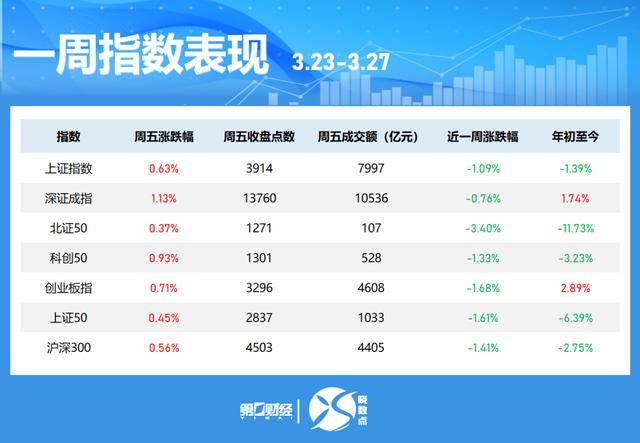
Market Performance - A-shares indices collectively declined during the week of March 23 to 27, with the Shanghai Composite Index down 1.09%, the Shenzhen Component Index down 0.76%, the ChiNext Index down 1.68%, and the Sci-Tech Innovation Index down 0.43% [1][2]. Index Details - The Shanghai Composite Index closed at 3914 points with a weekly trading volume of 799.7 billion yuan, reflecting a year-to-date decline of 1.39% [2]. - The Shenzhen Component Index closed at 13760 points with a weekly trading volume of 1053.6 billion yuan, showing a year-to-date increase of 1.74% [2]. - The ChiNext Index closed at 3296 points with a weekly trading volume of 460.8 billion yuan, with a year-to-date increase of 2.89% [2]. Stock Performance - Seven stocks saw a weekly increase of over 40%, with Haike Xinyuan leading at 51.02%, followed by Lianxiang Co. at 48.26% and Rongjie Co. at 46.95% [3][4]. - On the downside, 30 stocks experienced a decline of over 20%, with Huada Technology leading the drop at 32.34% [3][4]. Trading Activity - A total of 47 stocks had a turnover rate exceeding 100%, with Shouhang New Energy at the top with a turnover rate of 236.08% [5][6]. - The majority of stocks with high turnover rates were in the electric power equipment, public utilities, and basic chemicals sectors [5]. Fund Flows - The sectors that attracted significant capital inflows included non-ferrous metals, basic chemicals, and building materials, while the electronics sector faced a net outflow exceeding 25 billion yuan [7][8]. - Ganfeng Lithium received the highest net inflow of 2.72 billion yuan, with a weekly increase of 18.15% [7][8]. Margin Trading - Lixun Precision received the highest net buy amount in margin trading at 1.094 billion yuan, with a weekly increase of 4.96% [9][10]. - Other notable net buys included China Ping An and Demingli, while NIO and Zijin Mining faced significant net sell amounts [9][10]. Institutional Research - A total of 163 listed companies were researched by institutions, with Sanhua Intelligent Control receiving the most attention from 284 institutions [11][12]. - The focus of institutional research was primarily on industrial machinery, electronic components, and automotive parts and equipment [11]. New Institutional Interests - Institutions showed first-time interest in 51 stocks, with seven stocks receiving target prices [14][15]. - Notable mentions include Kaige Precision Machine with a target price of 207.84 yuan and Daqin Railway with a target price of 5.95 yuan [15].

国泰海通|金工:量化择时和拥挤度预警周报(20260327)——目前资金分歧较大,处于存量博弈状态
国泰海通证券研究· 2026-03-29 15:17
Market Overview - The market is currently in a state of stock game with significant funding divergence, as indicated by the liquidity shock index for the CSI 300, which was -0.49 last Friday, lower than the previous week at 0.49, suggesting current market liquidity is above the average level of the past year by -0.49 standard deviations [1] - The PUT-CALL ratio for the SSE 50 ETF options has been rising, reaching 0.83 last Friday, up from 0.67 the previous week, indicating increased caution among investors regarding the short-term performance of the SSE 50 ETF [1] - The average turnover rates for the SSE Composite Index and Wind All A-shares were 1.38% and 1.94%, respectively, indicating a decrease in trading activity, positioned at the 78.04% and 81.46% percentile since 2005 [1] Macro Factors - The RMB exchange rate fluctuated last week, with onshore and offshore rates showing weekly declines of -0.42% and -0.2%, respectively [1] - The U.S. stock market experienced a downward trend, with the Dow Jones Industrial Average, S&P 500, and Nasdaq indices reporting weekly returns of -0.9%, -2.12%, and -3.23% [1] - The National Bureau of Statistics reported that profits of large-scale industrial enterprises in China reached 1.02 trillion yuan in January-February 2026, a year-on-year increase of 15.2%, accelerating by 14.6 percentage points compared to the previous year [1] Market Sentiment - The A-share market experienced some fluctuations and divergence last week, with heightened risk aversion due to ongoing geopolitical tensions, which have suppressed short-term risk appetite [1] - Technical analysis indicates multiple intraday reversals in the A-share market, suggesting significant funding divergence and a stock game state, leading to a low probability of upward trends in the short term [1] Factor Analysis - The overall market PE (TTM) stands at 22.5 times, positioned at the 77.5% percentile since 2005 [2] - The small-cap factor's congestion level has decreased to -0.11, while the low valuation factor's congestion level is at -0.54, indicating a shift in market dynamics [2] - Industry congestion levels are relatively high in sectors such as comprehensive, communication, non-ferrous metals, basic chemicals, and oil & petrochemicals, with the latter two sectors showing a significant increase in congestion [2]

华源晨会精粹20260329-20260329
Hua Yuan Zheng Quan· 2026-03-29 13:41
New Consumption - Multiple Hong Kong consumer companies reported impressive annual results, with expectations for increased travel due to spring break policies [2][7] - Pop Mart plans to launch several co-branded products and enter the small home appliance market, enhancing its brand influence through IP operations [8][16] - The gaming industry shows strong performance, with Macau's visitor numbers expected to rise 15% to 40.1 million in 2025, leading to excellent results for major gaming companies [9] Medical Devices - China's medical device market is projected to exceed 1 trillion yuan by 2030, with significant growth potential in the medical consumables sector [19] - The global medical device market reached $47.94 billion in 2023 and is expected to grow to $63.80 billion by 2028, indicating robust demand [19] - The high-value medical consumables market in China is expected to grow from 60.2 billion yuan in 2015 to 250.4 billion yuan in 2024, with a compound annual growth rate of 17.2% [19] Automotive - China's heavy truck exports to the Middle East are expected to exceed 50,000 units in 2025, with significant contributions from Saudi Arabia and the UAE [31][32] - The ongoing conflict in the Middle East is anticipated to boost demand for inland transportation, benefiting heavy truck exports [31] Precious Metals - Gold and silver prices have experienced significant volatility, with gold prices dropping 10.71% to $4,504.15 per ounce recently [23][24] - The geopolitical situation in the Middle East and the Federal Reserve's stance on interest rates are influencing market dynamics, with expectations for prolonged high rates [24][26] - Long-term demand for gold remains strong due to macroeconomic uncertainties and central bank purchases, reinforcing its value as a hedge against credit risk [29]
策略定期报告:2026与2021:再均衡的宿命
Guotou Securities· 2026-03-29 12:21
Group 1 - The report highlights a significant shift in the A-share market, driven by two underlying changes: structural imbalance in internal positions and substantial macroeconomic changes [2][23] - The current high oil prices and the strengthening of the dollar are leading to a tightening liquidity environment, which necessitates a rebalancing of asset allocations [2][23] - The report suggests that the current market conditions may resemble the structural adjustments seen in early 2021, where the market transitioned from a focus on "Mao Index" to "Ning Combination" as the core trading theme [3][24] Group 2 - The analysis indicates that the A-share market is currently experiencing a "strong oil price + relatively high interest rates + significant drop in gold + strong dollar" scenario, which could lead to a passive response in global equity assets [1][3] - The report emphasizes the importance of monitoring the potential for a "rebalancing" phase, where certain sectors may no longer return to previous performance levels, particularly those that have benefited from past trends [2][4] - The report identifies that sectors such as new energy and electrical equipment, as well as engineering machinery, are expected to maintain high levels of prosperity due to global energy security and industrialization trends [3][4] Group 3 - The report draws parallels between the current market situation and historical instances of structural imbalance and macroeconomic changes, particularly comparing the current downturn to early 2021 and early 2022 [3][24] - It notes that the current high positioning in technology and overseas sectors makes them particularly sensitive to negative news, while their sensitivity to positive news has decreased [2][23] - The report concludes that the ongoing geopolitical tensions, particularly in the Middle East, are likely to continue influencing market sentiment and sector performance, with defensive sectors like utilities and resources showing relative strength [11][12][52]
港股、海外周聚焦(3月第4期):霍尔木兹之殇,从油价冲击到增长损伤
GF SECURITIES· 2026-03-29 11:48
Group 1 - The core contradiction of the current global market volatility is not solely focused on the rise in oil prices, but rather on whether the shipping efficiency of the Strait of Hormuz, a key maritime passage for global energy and industrial raw materials, continues to be impaired [9][10] - The impact of rising energy prices is shifting from an initial price shock (increasing inflation and interest rate expectations) to a supply shock (disruption of channels, raw material shortages, production contraction, and growth damage), fundamentally changing the risk nature from "cost increase" to "supply loss" [9][10] - The current economic environment, inventory buffers, and policy space differ significantly, making this energy crisis more likely to evolve into a recession rather than a full-blown stagflation [10][16] Group 2 - The market is currently pricing in more stubborn inflation and a more hawkish central bank policy, leading to a tightening of liquidity [22][26] - The stock market has already reflected expectations of slowing growth, with cyclical sectors significantly underperforming defensive sectors, indicating that the market has not fully accounted for the risks of growth downgrades [26][37] - Observations for whether a full recession trade will emerge include the sustained rise in long-term oil and gas futures prices, the relative performance of cyclical versus defensive sectors, and the weakening of AI-related assets [37][38] Group 3 - High oil prices will suppress the valuations of most financial assets through inflation, policy, and growth channels, with only energy assets benefiting directly [38][39] - Gold is experiencing high volatility due to liquidity risks and geopolitical uncertainties, but its long-term logic remains intact [38][45] - The attack on aluminum plants in the Middle East has intensified supply tightness, opening up upward space for aluminum prices [38][49] Group 4 - The A-share market's recent adjustments are primarily driven by external shocks from geopolitical conflicts, and there is no need for excessive pessimism in the short term [55] - Focus should be on industries with price increase logic due to supply constraints, such as oil and chemical sectors, and sectors with independent industrial trends like energy storage and domestic AIDC [55][56]
金属行业周报:下周关注多国PMI和美国非农-20260329
CMS· 2026-03-29 11:34
Investment Rating - The report maintains a "Recommendation" rating for the metals industry [2] Core Insights - The report highlights the potential benefits from geopolitical tensions in the Middle East, particularly focusing on aluminum and lithium tantalum as investment opportunities [1] - The aluminum market is expected to stabilize despite rising overseas premiums due to supply risks from regional conflicts [3] - The report emphasizes the strong demand for lithium driven by the electric vehicle sector, with supply disruptions reinforcing this trend [4] Industry Overview - The metals industry has a total market capitalization of 742.82 billion, with 235 listed companies [2] - The industry index performance shows a 1-month decline of 12.8%, a 6-month increase of 26.7%, and a 12-month increase of 64.0% [3] - The non-ferrous metals sector has shown significant weekly performance, with energy metals up by 8.70% and small metals by 3.05% [3] Key Market Movements - The report notes that the largest weekly gain was seen in Rongjie Co., which increased by 46.95%, primarily due to its lithium-related business [3] - Conversely, Sichuan Gold experienced the largest decline at -7.40% due to market sentiment shifts [3] - The report identifies gallium as the top-performing non-ferrous metal this week, driven by tight supply conditions [3] Specific Metal Insights - Copper: Domestic copper social inventory decreased by 18.29% week-on-week, indicating a tightening supply [3] - Aluminum: Domestic electrolytic aluminum inventory reached 1.349 million tons, with signs of demand recovery from downstream sectors [3] - Lithium: The report anticipates continued strength in lithium prices due to robust demand and supply constraints [4] - Tungsten: The market is experiencing upward pressure on prices due to supply tightness and increased export interest from domestic producers [4] Investment Recommendations - The report suggests focusing on companies like Yunnan Aluminum, China Hongqiao, and Jiangxi Copper for potential investment opportunities in the aluminum sector [3] - For lithium, companies such as Ganfeng Lithium and Tianqi Lithium are highlighted as key players to watch [4] - In the tungsten market, attention is drawn to companies like China Tungsten and Xiamen Tungsten [4]

负债行为跟踪:当内外资共振,结构特征如何?
ZHONGTAI SECURITIES· 2026-03-29 10:22
1. Report Industry Investment Rating No relevant content found. 2. Core Viewpoints of the Report - This week, sentiment indicators such as the VIX index continue to indicate a decline in global risk appetite, but the decline of the A - share market has narrowed, reflecting that the negative impact of external factors on the A - share market has weakened. Leverage funds' activity has dropped to a low level, ETF funds have continued to flow in, and foreign capital is optimistic about Chinese assets, even siphoning funds from other markets [2]. 3. Summary by Directory 3.1 Two - margin trading - The proportion of two - margin trading volume to A - share trading volume has dropped from 9.2% to 9.0%, reaching the average level of the past three years, close to the end of June 2025. The two - margin balance has generally decreased from 2.63 trillion to 2.62 trillion, falling on Monday and Tuesday and then rebounding slightly [2]. - Index component two - margin trading has seen continuous net outflows; most industries have de - leveraged, with national defense and military industry, agriculture, forestry, animal husbandry and fishery, commerce and retail, media, and automobile having relatively large de - leveraging amplitudes, while industries such as coal, comprehensive, and public utilities have increased leverage [3]. - Stocks with a market value of over 3 billion have de - leveraged, and small - cap stocks have a relatively large de - leveraging amplitude [3]. - Popular stocks de - leveraged on Monday and Tuesday and increased leverage from Wednesday to Friday [3]. 3.2 ETF funds - CSI 300, SSE Composite Index, ChiNext, Science and Technology Innovation 50, and CSI 1000 ETFs have seen net inflows this week, while SSE 50 and CSI 500 ETFs have had small net outflows. Except for the CSI 500 ETF, other representative ETFs had a large amount of funds bottom - fishing when they had a large decline on Monday [4]. 3.3 Foreign capital - This week, foreign capital has continued to flow into the Chinese market, which can be cross - verified from several perspectives: the trading volume proportion of northbound funds has increased from 13.2% to 13.3% on a month - on - month basis; the median weekly increase or decrease of northbound active stocks is - 0.1%, and the average is 0.5%, outperforming the entire A - share market; from March 18th to March 25th, foreign capital has flowed out of the Japanese, South Korean, and US markets and into the Chinese market [5].
神火股份(000933):减值拖累业绩,低成本电解铝盈利可期
Guolian Minsheng Securities· 2026-03-29 09:48
Investment Rating - The report maintains a "Recommended" rating for the company [2][11]. Core Insights - The company reported a revenue of 41.24 billion yuan in 2025, representing a year-on-year growth of 7.5%. However, the net profit attributable to shareholders decreased by 7.0% to 4.01 billion yuan [8]. - The company plans to distribute a cash dividend of 8.0 yuan per 10 shares, totaling 1.79 billion yuan, with a dividend payout ratio of 44.6% [8]. - The report highlights significant asset impairments due to low coal prices and mine shutdowns, totaling 1.26 billion yuan, which negatively impacted Q4 performance [8]. - The company has a competitive advantage in electrolytic aluminum production, with a production capacity of 1.7 million tons and a stable production cost of approximately 12,000 yuan per ton, leading to a gross profit margin of 30.1% [8]. - The report anticipates that the company will achieve net profits of 8.56 billion yuan, 8.67 billion yuan, and 9.26 billion yuan for the years 2026 to 2028, corresponding to price-to-earnings ratios of 8, 8, and 7 times, respectively [8]. Financial Forecasts - Revenue projections for 2026, 2027, and 2028 are 46.07 billion yuan, 45.63 billion yuan, and 46.11 billion yuan, respectively [9]. - The expected net profit for 2026 is 8.56 billion yuan, with a significant increase of 113.7% compared to 2025 [9]. - The earnings per share (EPS) is projected to rise from 1.78 yuan in 2025 to 4.12 yuan by 2028 [9].

定期报告:四月回归基本面科技和周期重回主线
Huajin Securities· 2026-03-29 06:34
Group 1: Report Industry Investment Rating - Not provided in the given content Group 2: Core Viewpoints of the Report - This April, the A-share market may be volatile and strong, and the slow-bull trend remains unchanged. The economy and corporate profits are likely to continue to recover, policies may remain positive, external risks may ease, domestic liquidity may remain loose, and stock market funds may flow back [2][10][20]. - This April, the technology and cyclical styles may be relatively dominant, and the large-cap and small-cap styles may be relatively balanced [2]. - In April, it is recommended to allocate high-quality technology and some cyclical industries at low prices [2]. Group 3: Summary According to the Directory I. A-share Slow-Bull Continues in April (1) Core factors affecting the A-share market's performance in April are fundamentals, policies, and external events - Since 2010, the Shanghai Composite Index has only risen in April in 6 out of 15 years. Economic and profit fundamentals are the core factors determining the A-share market's performance in April. Rising year-on-year growth rates of real estate sales, social retail, and exports may lead to an increase in the Shanghai Composite Index in April, while the impact of the growth rates of industrial enterprise profits and A-share first-quarter report earnings on the rise of the Shanghai Composite Index is not obvious. Policies and external events also have an important impact on the A-share market's performance in April [2][5]. (2) If the A-share market adjusts due to external events in February - March, it may be volatile and strong in April - After 5 major external events in February - March since 2000, the A-share market started to recover from a low level in the first half of April in 4 cases, with an average decline of 0.5% in April (compared to an average decline of 2.2% in March). The A-share market's relatively strong performance in April is mainly driven by a significant decline in sentiment and the return of foreign capital [8]. (3) The A-share market may be volatile and strong in April this year, and the slow-bull trend remains unchanged - In April, the economy may continue to recover. Consumption growth may stabilize, infrastructure and manufacturing investment growth may increase, and exports may maintain a high growth rate. Corporate profits may also continue to rise, with the year-on-year growth rate of PPI and the earnings growth rate of A-share first-quarter reports likely to continue to increase [10]. - Policies in April may remain positive, and external risks may ease marginally. The "Two New" and "Two Important" policies may be implemented more quickly, and the central bank may continue to implement loose monetary policies. The A-share market may have fully priced in the risks of the US - Iran conflict [20]. - Domestic liquidity in April may remain loose, and stock market funds may flow back. The Fed is less likely to cut interest rates this year, but the US economy and employment may remain weak, and the RMB exchange rate may remain strong. The central bank may increase capital injection in April. Historically, foreign capital often flows into the market in April, and this year, with the easing of risks and the recovery of the economy and corporate profits, stock market funds such as margin trading and foreign capital may flow back [21][22]. II. Industry Allocation: Allocate High-Quality Technology and Some Cyclical Industries at Low Prices in April (1) The technology and cyclical styles may be relatively dominant in April, and the large-cap and small-cap styles may be relatively balanced - Historically, the stable and financial styles often lead the market in April, mainly driven by policies and external events. However, this April, the technology and cyclical styles may be relatively dominant because the marginal impact of external shocks on the A-share market may decrease, policies supporting technological innovation may be further implemented, and the cyclical and technology hardware industries may continue to be prosperous [31]. - Historically, large-cap stocks usually outperform in April. However, this April, the large-cap and small-cap styles may be relatively balanced. The high profits of cyclical and technology industries in April may be beneficial to small-cap stocks, the difficult large-scale easing of overseas liquidity expectations may be beneficial to large-cap stocks, and domestic policies are favorable to small-cap stocks [33]. (2) The technology and cyclical industries may return to the main line in April - After the A-share market adjusts due to previous negative shocks, some high-quality technology and cyclical industries may still be dominant in April. Historically, after major external events in February - March, the technology growth and cyclical industries generally do not have excess returns in April, but some technology and cyclical industries with high performance growth rates may still be relatively dominant. Currently, industries such as electronics, communication, non-ferrous metals, and power equipment may be relatively dominant [36]. (3) The valuations of power equipment and media in the growth sector, and non-bank finance in the dividend sector are relatively cost-effective - Currently, the predicted PEGs of power equipment, media, and automobiles in the first - level growth industries are relatively low, at 0.76, 0.86, and 1.10 respectively. In the second - level growth industries, the predicted PEGs of nautical equipment, games, commercial vehicles, and batteries are relatively low, at 0.25, 0.41, 0.61, and 0.71 respectively [39][41]. - Currently, the valuation historical quantiles of non-bank finance, food and beverage, and agriculture, forestry, animal husbandry and fishery in the first - level dividend industries are relatively low, at 0.0%, 9.0%, and 13.2% respectively. In the second - level dividend industries, the valuation historical quantiles of insurance, white goods, and securities are relatively low, at 0.0%, 1.3%, and 7.1% respectively [43][46]. (4) It is recommended to allocate high-quality technology and some cyclical industries at low prices in April - It is recommended to allocate industries with upward policy and industrial trends, such as new energy (AI power, energy storage), communication (AI hardware), electronics (semiconductors, AI hardware), non-ferrous metals, chemicals, military (commercial space), and innovative drugs at low prices. These industries have various industry events and positive trends in April [48]. - It is also recommended to allocate low - valuation dividend industries such as coal, power, and banks at low prices. These industries have positive production data and industry events in April [53].