
有色

Search documents
国泰海通 · 晨报1013|宏观、策略、海外策略、固收
国泰海通证券研究· 2025-10-12 13:40
Macro Perspective - The recent trade tensions initiated by the Trump administration are not expected to have a significant negative impact on the market, as the real drivers of asset performance are domestic economic and policy developments [4][5] - Historical context shows that previous tariff disputes led to temporary market reactions, but the U.S. government often softens its stance due to economic realities, suggesting that current tariff uncertainties may also be manageable [5][6] Investment Strategy - The current external shocks present a buying opportunity for Chinese markets, as the trade disputes are seen as disturbances rather than a trend reversal [10] - Unlike previous trade conflicts, the current situation has clearer boundaries regarding risks, and domestic financial stability is more assured, making it a favorable time to increase investments in quality assets [11][12] Industry Comparison - The investment focus should remain on emerging technologies, with sectors like AI, semiconductors, and financials showing strong potential for growth [13] - The financial sector, after adjustments, is expected to provide stable returns, with recommendations for stocks in brokerage, banking, and insurance [13] Overseas Strategy - There has been a notable increase in southbound capital inflows into Hong Kong stocks, while foreign capital outflows have slowed, indicating a shift in market dynamics [16] - Southbound investments are diversifying across various sectors, while foreign investments remain concentrated in technology and finance [16] Fixed Income Analysis - The bond market is expected to experience limited upward movement in interest rates, with a stable outlook for October, despite ongoing trade tensions [20][21] - The current environment suggests a potential for slight declines in bond yields, but overall, the bond market is likely to remain stable [20][21]


下周开盘前的几条建议
表舅是养基大户· 2025-10-12 13:28
Core Viewpoint - The article discusses the recent market volatility triggered by social media comments from a prominent figure, leading to significant declines in various asset classes, particularly cryptocurrencies, which saw nearly $20 billion in liquidations within 24 hours and over 1.6 million accounts affected [1]. Market Volatility - Market fluctuations are considered reasonable and almost inevitable, especially in a market lacking a robust short-selling mechanism, which can exacerbate volatility beyond typical levels [3]. - Historical data indicates that October is the month with the highest volatility in the U.S. stock market over the past 80 years [4]. Recent Market Performance - The article compares the recent market downturn to previous trade tensions, highlighting that the Nasdaq index fell by over 3.5%, marking its largest single-day drop since April [8]. - The performance of various indices during the recent trade tensions is detailed, showing significant declines across multiple asset classes, including a 44.76% drop in the three-times leveraged ETF for China [7]. Investment Strategies - Two main strategies are suggested for navigating short-term volatility: 1. **For Existing Capital**: Emphasizes the importance of preemptive measures rather than reactive ones, advocating for balanced asset allocation to reduce volatility and maintain positions during market fluctuations [17][18]. 2. **For New Capital**: Recommends preparing to invest incrementally as indices decline, specifically suggesting a 10% drop as a benchmark for adding positions [20]. Fund Management Insights - The article advises against focusing solely on high-performing, single-style funds and instead suggests selecting funds with a strong margin of safety, highlighting a specific fund manager known for a balanced investment approach [21][24]. Market Valuation Context - The article provides a comparative analysis of market valuations before and after significant market events, noting a 31.74% increase in margin financing over the past six months, which may influence market stability [30][31]. - It emphasizes the importance of understanding the underlying value of stocks, which is determined by earnings and valuations, rather than solely relying on market interventions [28].

国泰海通证券:外部冲击造成的资产下跌 是增持中国市场的良机
Xin Lang Cai Jing· 2025-10-12 11:49
Core Viewpoint - The report from Guotai Junan Securities suggests that the current trade risks are more clearly defined compared to April, and the conditions for domestic financial stability are more apparent, indicating that external shocks will be disturbances rather than trend-ending events. The focus should be on the inherent certainty of China's "transformation bull" market, driven by accelerated transformation, risk-free yield decline, and capital market reforms [1] Group 1: Investment Opportunities - There is a continuous surge in demand from Chinese society and investors for quality assets with solid development logic, making asset price declines due to external conflicts a buying opportunity [1] - The report highlights a new capital expenditure expansion cycle driven by advancements in AI innovation and domestic production, recommending sectors such as internet, electronic semiconductors, defense, media, and robotics [1] - The financial sector, after experiencing adjustments, is now offering improved dividend returns and stable value, with recommendations for brokerage firms, banks, and insurance companies [1] Group 2: Economic Trends - The shift against "involution" reflects a change in economic governance thinking, which may help break or correct previously fully priced deflation expectations, leading to an optimistic outlook for cyclical commodities such as non-ferrous metals (rare earths), chemicals, steel, and new energy [1]

中信证券:当前仍然主要关注偏上游的资源板块和传统制造业
智通财经网· 2025-10-12 09:58
Core Insights - Market fluctuations often signal new changes and shifts in focus, with short-term trends not being the core issue [1][2] - Recent export controls and licensing systems are aimed at both protecting national interests and enhancing pricing power, which may benefit leading companies with compliance capabilities and global operational experience [1][8] Industry Analysis - The capital expenditure growth in non-tech sectors globally has been persistently low, with significant divergence between tech and non-tech companies [3] - In China, traditional industrial sectors are experiencing a slowdown in capital expenditure growth, with only a few sectors like coal, electricity, and transportation maintaining positive growth [4] - Many traditional industries have stabilized or even improved their input-output ratios, indicating resilience among leading firms despite macroeconomic challenges [5][7] - Current valuation levels in traditional manufacturing sectors are not high, with many industries at relative bottoms in terms of return on investment [6][7] Export Controls and Market Dynamics - Recent export controls on lithium batteries, rare earths, and other materials are part of a strategy to enhance domestic production and pricing power while clearing out outdated capacities [8] - The introduction of export licensing for electric vehicles marks a shift towards prioritizing quality over quantity in exports, potentially benefiting domestic firms [8] Investment Focus - The current investment strategy emphasizes upstream resource sectors and traditional manufacturing, with a focus on balancing short-term profit realization, mid-term recovery, and long-term narratives [9] - Industries with significant global supply influence, such as cobalt, rare earths, and phosphates, are recommended for attention due to their potential for pricing power and profit generation [9]

A股市场运行周报第62期:上证突破但遇波折,战略看慢牛、战术盯金融-20251011
ZHESHANG SECURITIES· 2025-10-11 07:33
Core Insights - The report indicates that the Shanghai Composite Index broke through 3900 points but faced a pullback, leading to increased market volatility. The outlook remains optimistic for a systematic "slow bull" market, with potential adjustments viewed as opportunities for increased allocation [1][4][58] - The report suggests a strategic focus on large financials, real estate, and infrastructure sectors, while tactical operations should monitor the performance of the ChiNext Index and key moving averages [1][5][59] Market Overview - The major indices experienced fluctuations, with the Shanghai Composite Index showing a slight increase of 0.37% over the week, while the ChiNext Index and the STAR Market saw declines of 3.86% and 2.85% respectively [12][56] - The report highlights a significant rise in cyclical sectors, with non-ferrous metals up by 4.35%, and coal and electricity sectors also performing well. Conversely, technology sectors showed weakness, with declines in media, electronics, and communications [15][57] Market Sentiment and Capital Flow - The average daily trading volume in the Shanghai and Shenzhen markets increased to 2.59 trillion yuan, indicating heightened market activity. The margin trading balance also continued to rise, reaching 2.44 trillion yuan [24][29] - The report notes that the stock ETF saw a net inflow of 10.4 billion yuan, with the securities ETF leading in inflows, while the medical ETF experienced the largest outflow [31][39] Future Market Outlook - The report anticipates that if the ChiNext Index does not recover its upward trend in the short term, it may undergo a weekly level consolidation. The Shanghai Composite Index, having formed a five-wave structure, is expected to continue its upward trajectory unless external shocks disrupt this trend [4][58] - The report emphasizes the importance of monitoring the performance of key sectors, particularly large financials and cyclical stocks, as the market may shift focus away from technology [58][59]
宏观日报:关注有色上游价格波动-20251010
Hua Tai Qi Huo· 2025-10-10 07:20
Group 1: Industry Overview Upstream - Black: Glass prices are rising [2] - Agriculture: Egg prices have significantly declined [2] - Non - ferrous: Copper prices are rising [2] Midstream - Chemical: PX operating rate has declined, while urea operating rate is rising; PX operating rate was at a high level [2] - Energy: Power plant coal consumption is at a low level [2] Downstream - Real estate: The sales of commercial housing in first - and second - tier cities have slightly recovered [2] - Service: The number of domestic flights is at a three - year high due to holidays [2] Group 2: Industry Events Production Industry - On October 9, 2025, the Ministry of Commerce and the General Administration of Customs issued 4 announcements to implement export controls on items such as super - hard materials, some rare - earth equipment and raw materials, some medium - heavy rare earths, lithium batteries, and artificial graphite anode materials [1] - On October 9, three departments including the Ministry of Industry and Information Technology issued an announcement on the technical requirements for new energy vehicles eligible for vehicle purchase tax exemption from 2026 - 2027, adjusting the technical requirements for pure - electric passenger cars and plug - in (including extended - range) hybrid passenger cars [1] Service Industry - China and India will resume direct flights by the end of October this year [1] Group 3: Key Data - On October 9, the spot price of corn was 2237.1 yuan/ton, down 2.12% year - on - year; the spot price of eggs was 6.3 yuan/kg, down 12.93%; the spot price of palm oil was 9598.0 yuan/ton, up 4.03%; the spot price of cotton was 14764.2 yuan/ton, down 0.84%; the average wholesale price of pork was 18.6 yuan/kg, down 3.47%; the spot price of copper was 85823.3 yuan/ton, up 7.20%; the spot price of zinc was 22140.0 yuan/ton, up 1.45% [33] - For non - ferrous metals, on October 9, the spot price of aluminum was 20970.0 yuan/ton, up 1.34%; the spot price of nickel was 124000.0 yuan/ton, down 0.32%; another spot price of aluminum was 16868.8 yuan/ton, down 0.95%; the spot price of rebar was 3174.5 yuan/ton, down 0.64% [33] - For other metals, on October 9, the spot price of iron ore was 792.2 yuan/ton, down 1.94%; the spot price of wire rod was 3357.5 yuan/ton, down 0.52%; the spot price of glass was 15.6 yuan/square meter, up 3.45% [33] - For non - metals, on October 9, the spot price of natural rubber was 14758.3 yuan/ton, down 1.34%; the China Plastic City price index was 788.5, down 0.21% [33] - For energy, on October 9, the spot price of WTI crude oil was 62.6 dollars/barrel, down 1.42%; the spot price of Brent crude oil was 66.3 dollars/barrel, down 1.25%; the spot price of liquefied natural gas was 3762.0 yuan/ton, down 2.39%; the coal price was 791.0 yuan/ton, down 0.25% [33] - For chemicals, on October 9, the spot price of PTA was 4564.5 yuan/ton, down 0.18%; the spot price of polyethylene was 7348.3 yuan/ton, up 0.02%; the spot price of urea was 1583.8 yuan/ton, down 4.31%; the spot price of soda ash was 1262.5 yuan/ton, unchanged; the national cement price index was 135.4, up 0.44% [33] - For real estate, on October 9, the building materials composite index was 113.0 points, down 1.22%; the national concrete price index was 91.7 points, down 0.02% [33]
2025年四季度A股市场投资策略报告:上涨行情或未结束,但波动率或加大,风格或趋向均衡-20251010
British Securities· 2025-10-10 07:12
Market Overview - The A-share market is expected to continue its upward trend, although the momentum may weaken, leading to increased volatility and a more balanced investment style [6][19] - The Shanghai Composite Index rose by 15.84%, while the Shenzhen Component Index increased by 29.88% in the first three quarters of 2025 [4][13] Industry Performance - The non-ferrous metals sector led the gains with a 67.52% increase, followed by telecommunications at 62.61% and electronics at 53.51% [4][14] - The coal sector experienced the largest decline at -7.90%, with food and beverage and oil and petrochemicals also showing negative performance [4][14] Market Logic for Q4 2025 - The macroeconomic environment and monetary policy are crucial variables influencing A-share performance, with a focus on the impact of U.S. tariff policies and domestic economic recovery [5][18] - The demand for stocks is expected to increase due to personal investors reallocating assets towards equities, alongside improvements in public and private fund issuance [5][18] Sector Allocation - Key sectors to watch include: - Pharmaceuticals: Defensive value with recovery potential [6] - Semiconductors: Driven by self-sufficiency logic [6] - Robotics: Strong internal growth drivers [6] - Renewable Energy: Potential for continued rebound [6] - Financials: Benefiting from increased market activity [6] Thematic Investments - Thematic investment opportunities include: - AI: Expansion from hardware to applications [6] - Optical communication modules: Core drivers include AI computing and data center upgrades [6] - Rare earth materials: China's advantages in this sector [6] - Military industry: Potential driven by export attractiveness and geopolitical tensions [6]
中泰期货晨会纪要-20251010
Zhong Tai Qi Huo· 2025-10-10 02:33
Report Industry Investment Ratings - **偏空**: 沪锌、棕榈油、白糖、沪锡、沪金、沪铜、聚丙烯、热轧卷板、鸡蛋、锰硅、铁矿石、菜油、塑料、螺纹钢、豆二、焦煤、焦炭、沥青、PTA、玻璃、沪银、玉米淀粉 [6] - **震荡**: 沪铅、PVC、豆油、甲醇、橡胶、玉米、沖铝 [6] - **偏多**: 郑棉、菜粕、豆粕、橡胶 [6] Core Views of the Report - **Macro**: The cease - fire agreement in Gaza has been reached, China has implemented export controls on related items, and policies such as the adjustment of new energy vehicle purchase tax exemption requirements and the governance of price disorder have been introduced. The US government shutdown issue remains unresolved, and the Fed has different views on interest rate cuts [8][9][10] - **Macro Finance**: For stock index futures, consider buying on dips and focus on IH; for treasury bond futures, adopt an oscillatory approach and focus on the odds of short - term bonds [12][13] - **Black Metals**: Black metals are expected to maintain an oscillatory mid - term trend. Steel may experience an oscillatory or under - performing peak season. Double - coking prices may continue to oscillate weakly in the short term, and ferroalloys should be shorted on rallies in the medium - to - long term [16][17][18] - **Soda Ash and Glass**: Adopt a short - on - rallies approach for soda ash and a wait - and - see approach for glass [21] - **Non - ferrous Metals and New Materials**: For aluminum, adopt a wait - and - see approach; for alumina, consider shorting on rallies. Lithium carbonate is expected to oscillate, and industrial silicon and polysilicon will continue to oscillate within a range [23][24][25] - **Agricultural Products**: For cotton, short on rallies; for sugar, short on rallies in the medium - term and wait - and - see in the short - term. For eggs, short near - month contracts on rallies and adopt an oscillatory approach for far - month contracts. Go long on apples on dips, stay on the sidelines for corn, wait - and - see for red dates, and short near - month hog contracts on rallies [28][29][31] - **Energy and Chemicals**: Hold existing short positions in crude oil. Fuel oil, asphalt, and polyester chains are expected to follow the cost trend and be weak. For plastics, methanol, and caustic soda, adopt a weak - oscillatory approach. For liquefied petroleum gas, maintain a short - term bullish view and a long - term bearish view [37][38][44] Summaries Based on Related Catalogs Macro Information - **International**: A cease - fire agreement in Gaza has been reached. The US is selecting a new Fed chairman, and the US government shutdown bill has not passed. The Fed has different views on interest rate cuts, and spot silver prices have reached a high [8][9][10] - **Domestic**: China has implemented export controls on related items, adjusted new energy vehicle purchase tax exemption requirements, and issued a notice on governing price disorder. Some A - share stocks' margin trading conversion ratios have been adjusted to zero, and the property market during the holiday was generally flat [8][9] Macro Finance Stock Index Futures - **Strategy**: Consider buying on dips and focus on IH. The A - share market was high on the first trading day after the holiday, with sector differentiation. Some stocks' margin trading conversion ratios were adjusted to zero [12] Treasury Bond Futures - **Strategy**: Adopt an oscillatory approach and focus on the odds of short - term bonds. The capital market was balanced and loose, and the bond market was affected by multiple factors and is expected to oscillate [13][14] Black Metals - **Policy**: After the Politburo meeting in late July, the "anti - involution" policy cooled down. Pay attention to relevant meetings in October [16] - **Market Rhythm**: The peak season is approaching, but the real demand improvement for steel is limited. The market may oscillate or have an under - performing peak season [16] - **Supply and Demand**: Real estate demand is weak, while coil demand is okay. Steel mills' profits are low, and raw material costs are oscillating [16] - **Trend**: Black metals are expected to oscillate in the medium term. Steel spot prices vary in different regions, and iron ore trading volume has increased [17] - **Coal and Coke**: Double - coking prices may continue to oscillate weakly in the short term, and pay attention to the demand for finished products in the "Golden September and Silver October" [17] - **Ferroalloys**: Short on rallies in the medium - to - long term. The spread between silicon iron and manganese silicon is not currently worth participating in [18] Soda Ash and Glass - **Soda Ash**: Adopt a short - on - rallies approach. Inventory has increased, production is high, and the supply - demand contradiction is difficult to resolve [21] - **Glass**: Adopt a wait - and - see approach. Inventory has increased, and the market is affected by the macro environment and demand [21] Non - ferrous Metals and New Materials Aluminum and Alumina - **Aluminum**: Adopt a wait - and - see approach. Aluminum prices are high, demand is average, and prices are expected to oscillate at a high level [23] - **Alumina**: Consider shorting on rallies. Supply is high, inventory is increasing, and prices are expected to oscillate weakly at the bottom [23] Lithium Carbonate - **Trend**: Oscillate. Supply is approaching its peak, and demand is in the peak season, resulting in a de - stocking state [24] Industrial Silicon and Polysilicon - **Industrial Silicon**: Oscillate within a range. Consider going long on far - month contracts at the lower range limit [25] - **Polysilicon**: Oscillate within a range. The industry is affected by policies and terminal feedback [25][26] Agricultural Products Cotton - **Strategy**: Short on rallies. Supply is increasing, demand is uncertain, and the market is expected to be under pressure [28][29] Sugar - **Strategy**: Short on rallies in the medium - term and wait - and - see in the short - term. Global sugar supply is expected to be in surplus, and domestic production may be affected by weather [29][30] Eggs - **Strategy**: Short near - month contracts on rallies and adopt an oscillatory approach for far - month contracts. Supply is high, demand is weak, and the market is in a surplus state [31] Apples - **Strategy**: Go long on dips. The opening price of new - season apples is expected to be high, and pay attention to the impact of weather on quality [33] Corn - **Strategy**: Stay on the sidelines and sell out - of - the - money call options on the 01 contract. New - season supply is increasing, and prices are under pressure [34] Red Dates - **Strategy**: Wait - and - see. The market price is stable, and the opening price is expected to be high [35] Hogs - **Strategy**: Short near - month contracts on rallies. The market is in a state of high supply and low demand after the holidays [35] Energy and Chemicals Crude Oil - **Trend**: Prices are expected to decline. OPEC+ is increasing production, demand is weakening, and existing short positions can be held [37] Fuel Oil - **Trend**: Follow the oil price trend. Supply is loose, demand is weak, and it is affected by geopolitical and supply - demand factors [38] Plastics - **Trend**: Weakly oscillate. Supply pressure is high, and demand is weak [38] Rubber - **Trend**: Oscillate. The raw material price has support and pressure, and it is affected by multiple factors [39] Methanol - **Trend**: Weakly oscillate. Port inventory is high, and the supply - demand pattern is weak [39][40] Caustic Soda - **Trend**: Bearish. The supply - demand pattern is oversupplied [40] Asphalt - **Trend**: Follow the oil price trend. The spot price has declined, and the demand peak season is critical [41] Polyester Industry Chain - **Trend**: Follow the cost and be weak. Supply pressure is high, and the supply - demand pattern is loose [42][43] Liquefied Petroleum Gas - **Trend**: Bearish in the long - term. Supply is abundant, and demand may weaken [44]
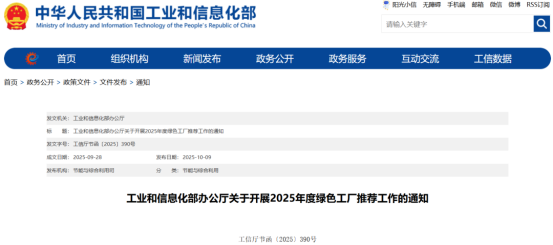
工信部发布《关于开展2025年度绿色工厂推荐工作的通知》
Zhong Guo Neng Yuan Wang· 2025-10-10 01:35
Core Viewpoint - The Ministry of Industry and Information Technology (MIIT) has announced the 2025 Green Factory Recommendation Work, focusing on energy conservation and carbon reduction to enhance the green competitiveness of industries, supporting enterprises in 53 key sectors [1][4]. Group 1: Overall Requirements - The recommendation work includes green factories and green industrial parks, with enterprises or parks meeting the requirements voluntarily conducting self-evaluations based on new evaluation criteria [2][4]. - Provincial industrial and information departments will select enterprises or parks based on the principle of "choosing the best among the best" and ensuring that recommended entities meet or exceed the average level of existing national green factories and parks in their regions [2][4]. Group 2: Specific Requirements - New applicants for national green factories and industrial parks must register on the management platform, complete self-evaluations, and provide supporting materials without needing third-party evaluation reports [3][4]. - Existing national green factories and parks must also log onto the management platform for self-evaluation against new criteria, with those scoring in the bottom 5% for three consecutive years being removed from the list [5][6]. Group 3: Work Requirements - Provincial departments are required to enhance the verification of data and supporting materials for enterprises or parks to ensure the quality of recommendations, with a deadline for submission set for November 7, 2025 [6]. - Experts from MIIT will review the recommended lists, ensuring a rigorous selection process, and any entity found to have falsified data will be removed from the list and barred from reapplying for three years [6]. Group 4: Key Industry List - The key industries supported in this initiative include steel, petrochemical, non-ferrous metals, building materials, machinery, light industry, textiles, and electronics [12].
研究所晨会观点精萃-20251010
Dong Hai Qi Huo· 2025-10-10 01:28
Report Industry Investment Ratings No specific industry investment ratings are provided in the content. Core Views of the Report - Overseas, the federal government shutdown has disrupted official economic data, leading to average market demand and rising US bond yields. The weakening yen has strengthened the US dollar, cooling global risk appetite. The first - stage cease - fire in Gaza has reduced global risk - aversion. Domestically, poor US economic data during the National Day holiday has increased expectations of a Fed rate cut, causing global stock markets to rise. The central bank's large - scale MLF renewal has ensured market liquidity, and the introduction of multiple industry growth - stabilizing plans has increased policy support, potentially boosting domestic risk appetite. The short - term macro - upward drive has strengthened, and future focus should be on Sino - US trade negotiations and domestic incremental policies [3][4]. - Different asset classes have different trends: stocks are expected to oscillate strongly at a high level in the short term; bonds will oscillate; among commodities, black metals will oscillate, non - ferrous metals will oscillate strongly, energy and chemicals will oscillate, and precious metals will oscillate strongly at a high level [3]. Summary by Related Catalogs Macro - Overseas: The federal government shutdown has disrupted economic data, resulting in average demand and rising US bond yields. The weakening yen has strengthened the US dollar, cooling global risk appetite. The Gaza cease - fire has reduced risk - aversion [3]. - Domestic: Poor US economic data during the National Day holiday has increased Fed rate - cut expectations, leading to a rise in global stock markets. The central bank's MLF renewal has ensured liquidity, and industry growth - stabilizing plans have increased policy support, potentially boosting domestic risk appetite [3][4]. Stock Index - Driven by sectors such as precious metals, industrial metals, and rare earths, the domestic stock market has risen significantly. Supported by factors like US economic data and domestic policies, the short - term macro - upward drive has strengthened. Short - term cautious buying is recommended [4]. Black Metals Steel - On Thursday, the domestic steel futures and spot markets rebounded slightly, with low trading volumes. The rise of overseas non - ferrous and precious metals during the holiday has boosted market risk appetite. However, real demand is weak, with a 127 - million - ton increase in the inventory of five major steel products during the holiday, exceeding the five - year average. After late October, demand may further weaken. Supply is expected to remain high as steel mills' profits are still acceptable, and the logic of compressing steel mill profits will continue. The steel market is likely to oscillate within a range [5]. Iron Ore - On Thursday, iron ore futures and spot prices continued to strengthen. The news of long - term contract negotiations has increased expectations of supply contraction. Ore demand remains strong as the daily average pig iron output is above 2.4 million tons. During the holiday, global iron ore shipments decreased by 1.96 million tons, while arrivals increased by 2.482 million tons, and port inventories increased by 1.69 million tons. Although the market's expectation of negative feedback in the industrial chain has increased, the short - term probability of actual negative feedback is low as the proportion of profitable steel mills is over 56%. Iron ore prices will oscillate within a range after the holiday, with negative feedback risks from late October to November [6][7]. Non - ferrous Metals and New Energy Copper - LME copper has broken through and risen due to concerns about tight global copper supply. An accident at the Grasberg mine has affected production by 270,000 tons, with a plan to resume production in mid - 2026 and fully recover in 2027. Domestic electrolytic copper production remains high, with a 11.62% year - on - year increase in September, but demand is facing challenges as previous demand - boosting factors weaken. Copper de - stocking has not met expectations, and the US economic situation needs to be monitored [8]. Aluminum - It was previously expected that SHFE aluminum would stabilize and oscillate within a 200 - 300 - point range, which has basically come true. During the holiday, the rise in copper prices has boosted aluminum prices, but on Thursday, SHFE aluminum underperformed, and the domestic - foreign price difference has decreased significantly. Domestic aluminum social inventories have accumulated during the holiday, exceeding expectations. With rigid supply and weakening demand, it is difficult for prices to rise significantly [8][9]. Tin - LME tin has soared due to the rise in copper prices and Indonesia's crackdown on illegal tin mining, but the upward space is limited. The price is supported by tight ore supply and low smelting operating rates due to maintenance at a large Yunnan smelter. However, smelters are expected to resume production in October, and ore supply will increase after November. Prices are expected to remain high in the short term but face upward pressure [9]. Carbonate Lithium - On Thursday, the main carbonate lithium 2511 contract rose 0.27%, with a settlement price of 73,700 yuan/ton. The weighted contract increased positions by 1,559 lots, with a total position of 677,900 lots. The supply and demand of carbonate lithium are both increasing, with strong seasonal demand, a slight reduction in social inventory, and a transfer of smelter inventory to downstream. The market is expected to oscillate, and the upper pressure range should be monitored [10]. Industrial Silicon - On Thursday, the main industrial silicon 2511 contract fell 0.29%, with a settlement price of 8,645 yuan/ton. The weighted contract increased positions by 8,057 lots, with a total position of 407,800 lots. The 2511 contract faces the pressure of digesting warehouse receipts at the end of November. The market is expected to oscillate, and the cash - flow cost support of large enterprises should be monitored [10]. Polysilicon - On Thursday, the main polysilicon 2511 contract had a 0% increase, with a settlement price of 50,185 yuan/ton. The weighted contract increased positions by 7,663 lots, with a total position of 234,000 lots. The number of warehouse receipts is increasing, and there will be concentrated cancellations in November. With high supply and low demand, the market is waiting for the implementation of state - reserve purchase news, and the support of spot prices should be monitored [11]. Energy and Chemicals Crude Oil - After Israel reached an agreement with Hamas on hostage release and implemented a cease - fire, crude oil prices have declined as OPEC+ increases supply and demand lacks new positive signals. The strengthening of the US dollar has also reduced the attractiveness of dollar - denominated commodities [12]. Asphalt - As crude oil prices decline again, asphalt shows signs of breaking through the lower limit. The peak - season demand is almost over, and the pressure of over - supply remains. The basis is still falling, and there is some pressure for social inventory accumulation, while factory inventory is slightly increasing. The profit has recovered recently, and the operating rate has increased significantly. The impact of OPEC+ production increase on crude oil prices and the support of crude oil prices should be monitored [12][13]. PX - The change in PX is limited. The previous changes in Xinjiang's facilities have little impact on the market. The cost support from crude oil remains, but the small positive impact of increased maintenance plans has been mostly priced in. The PXN spread has decreased to $218, and the external PX price has fallen to $804. PTA's short - term processing fee has been squeezed, and PX remains in a tight supply situation. With the decline of the polyester market, PX may oscillate weakly but has some support at the bottom [13]. PTA - The peak - season demand is lower than expected, with low terminal orders and low operating rates of looms. The rumor of production cuts by leading PTA manufacturers has been disproven, and there is a risk of inventory accumulation. There is also a possibility that the restart of maintenance facilities will be postponed. The market has some support at the previous low but faces long - term downward pressure [13]. Ethylene Glycol - The price of ethylene glycol continues to decline and oscillates at a low level. Similar to PTA, it faces challenges in downstream demand, with high short - term operating rates and new production capacity pressure. Although the current inventory is low, there is a risk of inventory accumulation, and the upward space for price rebound is limited in the medium term [13]. LLDPE - The polyethylene market price has adjusted. The LLDPE transaction price is 7,050 - 7,600 yuan/ton, with prices in the North and East regions falling. Supply is increasing, and the demand is in the peak season, but the post - holiday inventory accumulation suppresses prices. With new capacity coming on - line, the transition to the off - season, and the decline of crude oil prices, the price of PE is expected to decline [14]. Urea - The urea market is weakly declining. The supply - demand situation is under pressure. During the National Day holiday, most factories maintained stable prices, fulfilling previous orders. After the holiday, production is expected to remain above 190,000 tons per day. The agricultural demand recovery is slow due to rainfall, and industrial demand is weak. Although there is potential support from reserve demand and Indian tenders, the overall support is limited. The price may decline slightly in the short term, and the export policy after the holiday should be monitored [14][15]. Methanol - The methanol market in Shaanxi and Inner Mongolia has acceptable trading. The price in Inner Mongolia's northern line has decreased by 10 - 15 yuan/ton, and the southern line is stable. In Jiangsu, the methanol market has declined, and the basis has strengthened. After the holiday, methanol inventory has accumulated, and the high port inventory suppresses prices. There is no effective way to reduce inventory in the short term, but it is expected to oscillate weakly with support from domestic and foreign gas - restriction expectations. Opportunities for long - term long positions should be awaited [14]. PP - The market trading atmosphere is good, with the mainstream price of East China's drawn wire at 6,650 - 6,750 yuan/ton. The inventory of Sinopec and PetroChina's polyolefins has increased by 270,000 tons. With increasing supply pressure, average downstream demand, and increasing inventory pressure, combined with the weakening of crude oil prices, the price of PP is expected to decline [14]. Agricultural Products US Soybeans - The prospects of Sino - US soybean trade and the MFP program will be the main focus of the oil - and - oilseed market. After the holiday, the market may re - evaluate the possibility of China resuming US soybean imports. If a phased arrangement is reached in the coming weeks, the possibility of resuming trade will increase. The implementation of the MFP program will reduce farmers' holding costs and relieve the pressure of grain sales and storage, which is positive for CBOT soybeans [16]. Hogs - After the holiday, the demand for hogs will weaken, and the supply - demand pressure remains high. Attention should be paid to farmers' reluctance to sell at low prices, local pork purchase - and - storage dynamics, and the rhythm of passive production reduction [17]. Soybean and Rapeseed Meal - The expected supply - demand gap of domestic soybeans in the first quarter of next year will shrink, which is negative for soybean meal. In the short term, the phased replenishment of soybean meal may increase, and the cost support for near - month soybean meal will strengthen as the pressure of concentrated US soybean listing eases. The spread between near - and far - month contracts may widen. For rapeseed meal, the seasonal impact on imported rapeseed meal has significantly shrunk, and domestic rapeseed inventory is running out. Before the arrival of Australian rapeseed, the supply - demand of rapeseed meal is weak, and its market is mainly led by soybean meal [18]. Oils - Oils may oscillate strongly, with the order of strength being rapeseed oil > palm oil > soybean oil. Rapeseed oil inventory will be depleted rapidly before the arrival of Australian rapeseed, providing support. Palm oil is mainly driven by cost, with low inventory in the producing areas, stable crude oil prices, and strong related oils providing additional support. Soybean oil may experience seasonal inventory accumulation after the holiday and may perform relatively weakly [18]. Corn - The room for the price decline of new corn in the Northeast after the holiday may be limited. The increase in corn prices in Shandong provides support, as deep - processing enterprises unexpectedly raised prices during the holiday, and the demand for acquisition has increased. More acquisition entities will enter the market after the holiday. In addition, the rapid rebound of wheat prices in October will also support the corn market [18].