Hua Er Jie Jian Wen

Search documents
“高市交易”引爆市场,植田和男未改口风:只要通胀达标,就会继续加息
Hua Er Jie Jian Wen· 2026-01-14 08:32
Group 1 - The Bank of Japan, led by Governor Kazuo Ueda, remains committed to raising interest rates when conditions allow, despite market volatility due to speculation of early elections [1][2] - Ueda emphasized that gradual adjustments to monetary easing will help achieve price stability and support long-term economic growth [2] - The current benchmark interest rate is at 0.75%, the highest level since 1995, with expectations of further rate hikes approximately every six months [2] Group 2 - Speculation around Prime Minister Fumio Kishida's potential dissolution of the House of Representatives for early elections has led to significant market fluctuations, with investors betting on expansionary fiscal measures [3] - The Japanese yen has depreciated to its weakest level since July 2024, prompting concerns over rising import costs and inflationary pressures [3][4] - Persistent inflation, with key price indicators remaining above the Bank of Japan's 2% target for over three and a half years, complicates the path to achieving stable price growth [4]
12月CPI数据疲软下的异常细节
Hua Er Jie Jian Wen· 2026-01-14 08:06
Core Insights - The December Core CPI increased by 0.24%, slightly below Citigroup's forecast of 0.27% and market consensus of 0.3%, indicating a potential slowdown in inflationary pressures by 2026 [1][2] - The overall weak trend in inflation data supports market expectations for a more accommodative monetary policy from the Federal Reserve, with Citigroup economists predicting rate cuts in March, July, and September [1][2] Inflation Data Analysis - Core goods prices remained flat in December, with used car prices dropping by 1.1%, offsetting modest increases in furniture (up 0.5%) and clothing (up 0.6%) [2] - Housing inflation showed slight increases, with primary rent and Owner's Equivalent Rent (OER) rising by 0.26% and 0.31%, respectively, while hotel accommodation prices surged by 2.9% [2] Data Collection Issues - The December data is described as "somewhat abnormal and difficult to interpret" due to data collection issues stemming from the government shutdown, which affected the accuracy of CPI data for October and November [3] - The use of carry-forward imputation in previous months led to downward bias in inflation, resulting in a mechanical rebound in December, particularly affecting prices of clothing and furniture [3] Service Prices Performance - Core service prices, excluding housing, exhibited mixed performance with significant volatility; medical services rose by 0.4%, entertainment services surged by 1.8%, and airfares increased by 5.2% [4] - These increases were countered by declines in education and communication prices, which fell by 0.8%, and personal services prices decreased by 0.2% [4]
报道:SK海力士停产消费级存储器 资源转向B2B与AI服务器市场
Hua Er Jie Jian Wen· 2026-01-14 08:03
Core Viewpoint - The semiconductor demand surge is prompting major companies to restructure their operations, with SK Hynix following Micron in halting production of consumer-grade DRAM and NAND Flash products to focus on the B2B and AI server markets [1] Group 1 - SK Hynix will cease production of consumer-grade DRAM and NAND Flash products [1] - The company aims to redirect resources towards the B2B and AI server markets [1] - This strategic shift reflects a broader trend among semiconductor companies responding to increased demand [1]
中国12月钢铁出口创新高、稀土同比大增32%,全年大豆、铁矿石、原油进口齐破纪录
Hua Er Jie Jian Wen· 2026-01-14 07:58
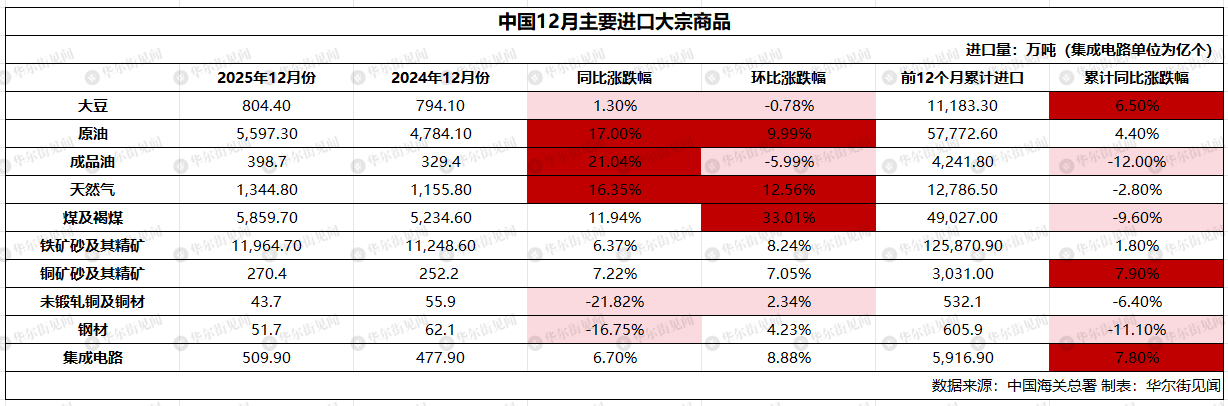
Core Insights - In 2025, China's soybean imports reached a record high of 111.8 million tons, marking the third consecutive year of growth, with a 6.5% increase from 2024 [1][3] - Iron ore imports also hit a historical peak, growing by 1.8% to 1.26 billion tons, continuing a three-year growth trend [6] - Coal imports saw the largest decline in a decade, dropping by 9.6% to 49 million tons [6][13] - December exports of rare earths surged by 32% year-on-year to 4,392 tons, while steel product exports exceeded the previous peak in 2015, reaching 11.3 million tons [2][1] Import and Export Data - December soybean imports were 8 million tons, a 1.3% increase year-on-year, while the total for the year was 111.83 million tons [3][13] - December iron ore imports were 11.96 million tons, a 6.37% increase from the previous year [9] - December crude oil imports reached 55.97 million tons, a 17% increase year-on-year, with an annual total of 57.77 million tons [4][12] - December natural gas imports rose by 16.35% to 1.34 million tons, but the total for the year fell by 2.8% to 12.79 million tons [7][13] Market Analysis - The increase in crude oil imports is attributed to stronger refining activity and robust stockpiling demand, with processing volumes expected to reach 15.38 million barrels per day in 2025 [5] - The decline in coal imports is linked to rising domestic production and the rapid adoption of clean energy, which is reducing coal demand [7] - The surge in rare earth exports indicates a solid demand foundation, despite a 20% month-on-month decline in December due to pre-holiday stockpiling by overseas buyers [2]

AI视频如何告别“抽卡”游戏
Hua Er Jie Jian Wen· 2026-01-14 07:43
Core Insights - The AI video generation sector is experiencing a commercial breakthrough, with companies like Kuaishou and MiniMax reporting significant revenue growth, while traditional large language models face challenges in monetization [1][7] - LuxReal, an AI video generation application by Qunhe Technology, aims to differentiate itself by targeting overseas e-commerce and short drama markets, leveraging a unique 3D modeling approach to enhance video consistency [1][4] Group 1: Revenue and Market Performance - Kuaishou's AI video application, Keling, generated over 250 million RMB in revenue in Q2 2025, prompting the company to raise its annual revenue forecast [7] - MiniMax's AI video application, Hailuo, generated $17 million (approximately 120 million RMB) in the first three quarters of 2025, accounting for 32.6% of its total revenue [7] - MiniMax's stock surged 109% on its listing day, with a market capitalization exceeding 100 billion HKD [8] Group 2: Technological Innovations - LuxReal's competitive advantage stems from Qunhe Technology's extensive dataset of 500 million 3D structured scenes and 440 million product models, which supports spatial consistency in video generation [2] - The current mainstream AI video generation models primarily utilize a combination of diffusion models and Transformers to enhance consistency, but they struggle with maintaining physical correctness in dynamic scenes [2][3] Group 3: Challenges and Market Dynamics - Despite the revenue growth, user retention remains a significant challenge, with Hailuo's user retention rates dropping drastically over time [9] - The industry is witnessing a shift towards B2B markets, as companies like Qunhe Technology focus on clients with higher payment willingness and stringent quality requirements [9]

今年A股增量资金有多少?华泰:净流入或达1.6万亿,居民存款、散户资金占四成
Hua Er Jie Jian Wen· 2026-01-14 07:39
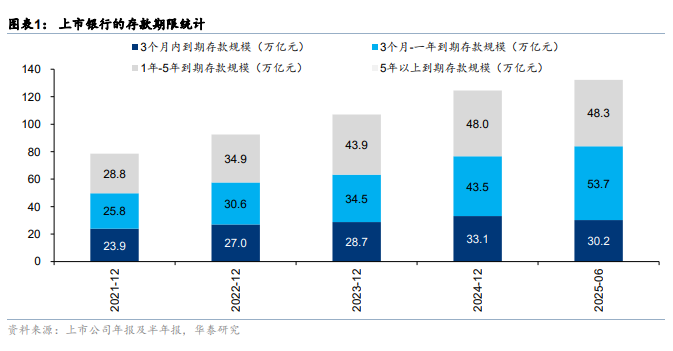
Core Viewpoint - The report from Huatai Securities predicts a net inflow of approximately 1.6 trillion yuan into the A-share market in 2026, driven by significant improvements in the funding supply side, with a total expected inflow of 2.6 trillion yuan after accounting for about 1 trillion yuan in funding needs [1][2]. Group 1: Funding Supply Side - The increase in funding supply is primarily attributed to the accelerated "migration" of household savings and the policy-driven entry of long-term funds [1]. - A historical high of 60 trillion yuan in one-year and above time deposits will mature in 2026, providing a substantial potential liquidity reservoir for the market [3]. - It is estimated that 8% of the maturing deposits will flow into non-monetary asset management products, with about 14% of that amount converting into stock market value, potentially contributing around 650 billion yuan to the A-share market [3]. Group 2: Risk Appetite Recovery - High-risk preference funds are expected to show strong inflow intentions, with an estimated net inflow of approximately 400 billion yuan from retail investors in 2026 [6]. - Leverage and private equity funds are anticipated to remain active, with net inflows of 200 billion yuan and 300 billion yuan respectively, contributing a total of 500 billion yuan [6][9]. - Insurance funds are projected to bring in about 800 billion yuan, as policies encourage leading insurance companies to increase their equity allocation [9]. Group 3: Funding Demand Side - The total funding demand for the A-share market in 2026 is expected to be around 1 trillion yuan, reflecting a relatively moderate growth trend [12]. - The IPO and private placement activities are gradually returning to normal, with an estimated IPO fundraising scale of about 200 billion yuan and private placements of around 500 billion yuan [12]. - Shareholder reduction behavior is expected to remain stable, with a projected net reduction scale of about 300 billion yuan, while the necessity for bottom-supporting buybacks is anticipated to decrease [12].
特朗普为大选掉转枪口?华尔街从昔日“宠儿”沦为政策“出气筒”
Hua Er Jie Jian Wen· 2026-01-14 07:37
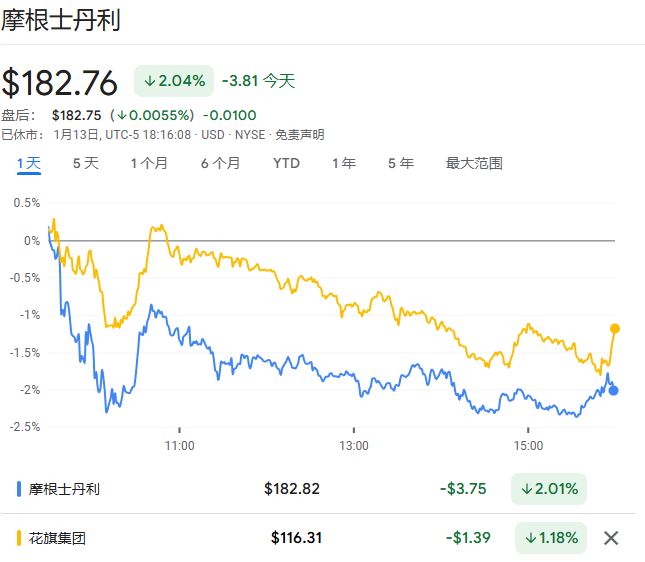
Core Viewpoint - The Trump administration is shifting its stance from being an ally to Wall Street to becoming an adversary, implementing policies that prioritize consumer interests over investor concerns, particularly in light of the upcoming midterm elections [1] Group 1: Policy Changes - Recent measures include blocking large investors from purchasing single-family homes, calling for a cap on credit card interest rates at 10%, and announcing restrictions on executive compensation and stock buybacks [1] - The Department of Justice has initiated a criminal investigation into Federal Reserve Chairman Jerome Powell, which is perceived as an intimidation tactic to force interest rate cuts [1][7] Group 2: Market Reactions - Financial stocks have come under pressure, with major credit card issuers like Citigroup, American Express, Capital One, Mastercard, and Visa seeing stock declines of 4% to over 7% following Trump's credit card rate cap proposal [2] - The stock prices of large single-family home landlords and Blackstone were also negatively impacted by the plan to restrict large investors from buying homes, although some stocks have since recovered [5] Group 3: Investor Sentiment - Despite the unsettling news, the overall stock indices have not shown significant concern, as investors are accustomed to Trump's fluctuating ideas and recognize that many proposals require Congressional support [6] - Analysts suggest that the market is in a wait-and-see mode, with some believing that the credit card proposal and restrictions on institutional home purchases may not materialize [6] Group 4: Broader Implications - The investigation into Powell has drawn criticism from former Federal Reserve and Treasury officials, which could hinder Trump's ability to confirm Powell's successor [7] - Other proposals, such as reducing credit card rates, may inadvertently limit credit access for low- to middle-income consumers, potentially impacting housing supply and construction [7] - The administration's push for affordability could also affect sectors beyond finance, such as energy, by aiming to lower gasoline prices through increased Venezuelan oil supply [7] Group 5: Optimistic Perspectives - Despite the concerns, some analysts at Morgan Stanley believe that the administration's focus on housing affordability could benefit certain consumer-related stocks if incentives are provided to homebuilders to increase supply [8]

铜牛市还能持续多久?高盛:1.3万高价不可持续,变盘点或在二季度关税落地后
Hua Er Jie Jian Wen· 2026-01-14 07:32
Core Viewpoint - Goldman Sachs believes that the recent surge in copper prices is primarily driven by a stockpiling trend due to anticipated U.S. tariffs and speculative funds, creating a temporary "scarcity premium" in the market. However, the bank warns that the current high price above $13,000 is unsustainable and significantly detached from the fundamentals [1]. Group 1: Price Predictions and Market Dynamics - Goldman Sachs has raised its LME copper price forecast for the first half of 2026 from $11,525 per ton to $12,750 per ton, citing tightening inventories outside the U.S. due to capital inflows and supply shifts [1]. - The bank maintains its fourth-quarter 2026 price forecast at $11,200 per ton, indicating significant downward pressure on prices in the latter half of the year [1]. - The copper price has increased by 22% since late November last year, reaching a peak of $13,387 on January 6 [1]. Group 2: Supply and Demand Outlook - Goldman Sachs expects the second quarter to be a turning point for market sentiment, with a decision on refined copper tariffs likely to shift focus back to a severe global supply surplus [2]. - The global copper market supply surplus forecast for 2026 has been raised from 160,000 tons to 300,000 tons, indicating a return to supply-demand fundamentals as the price driver [2]. Group 3: Speculative Trends and Market Sentiment - The recent rise in copper prices is not supported by traditional supply-demand gaps but rather by capital flows and inventory transfers, with current prices exceeding the reasonable fundamental level of approximately $11,400 per ton [3]. - Speculative positions in the copper market are nearing historical highs, with the proportion of speculative long positions at CME showing signs of being in the later stages of the current price rally [5]. - If speculative net positions increase by 1 percentage point, copper prices could rise by an average of 0.4%, indicating a fragile upward trend driven by speculation [5]. Group 4: Tariff Decision Uncertainty - The timing of the U.S. refined copper tariff decision is a key catalyst for future price movements, with Goldman Sachs reducing the probability of timely implementation from 55% to 45% [4]. - Delays or insufficient increases in tariffs could have dual impacts on LME copper prices, allowing continued stockpiling in the U.S. while also prompting a reassessment of global supply surplus realities [4].
交付即正义!高盛:高龄的美国电网,正为中国电力产业链提供历史性机遇
Hua Er Jie Jian Wen· 2026-01-14 07:22
Core Insights - The core contradiction in AI infrastructure construction is shifting from merely pursuing GPU quantities to competing for power supply speed, with "Time-to-Power" becoming the most severe bottleneck in AI development [1] - Chinese power solution providers with rapid delivery capabilities and large-scale production advantages are experiencing a historic revaluation opportunity [1] Group 1: Power Supply Challenges - The average lifespan of power grids in the US and EU has reached 35 to 40 years, and the infrastructure is increasingly fragile due to the explosive energy demands of AI data centers (AIDC) [1] - Current domestic power equipment capacity in the US can only meet about 40% of local demand, with interconnection waiting times extending to nearly five years [1] - Goldman Sachs predicts that the power supply shortage in the US will persist until 2030, with a projected 175% increase in electricity consumption by data centers by 2030 [2][3] Group 2: Market Dynamics and Growth - The overall addressable market for AI data center power products is expected to expand at a compound annual growth rate (CAGR) of approximately 39% from 2025 to 2030 [3] - The growth is driven by continuous capacity construction, increasing power density, and a shift from AC to DC architecture, with 800V DC distribution becoming the standard for many AI data center projects [4] Group 3: Competitive Advantages of Chinese Suppliers - Chinese suppliers are gaining a decisive competitive advantage not only through lower costs but also through shorter delivery cycles, which have become a primary decision factor for data center operators [5] - Companies like Siyi Electric and Yinglite are positioned to benefit from the supply shortages in the US market, with Siyi Electric's revenue from the US expected to grow from 26% in 2026 to 28% in 2028 [5][6] Group 4: Product Prioritization - Goldman Sachs has provided a clear preference ranking for Chinese power supply-related product categories: gas turbine blades > power transformers > electrical components > uninterruptible power supplies/power racks > liquid cooling systems > server power [6][7] - Gas turbine blades rank highest due to high material science and manufacturing barriers, while power transformers follow due to labor-intensive manufacturing and lengthy certification processes [7]



日股新高、日元逼近160!日本大选定生死?德银拆解三种剧本
Hua Er Jie Jian Wen· 2026-01-14 07:01
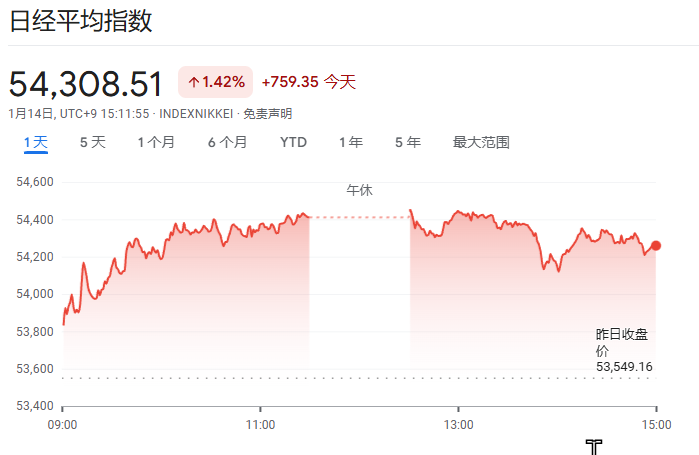
Core Viewpoint - The expectation of early elections in Japan, led by Prime Minister Sanna Takashi, is stirring financial markets, driving Japanese stocks to new highs, accelerating yen depreciation, and pushing bond yields to decades-high levels [1][4]. Group 1: Stock Market Reaction - The Nikkei 225 index rose over 1% on Wednesday, surpassing the 54,000 mark, following a more than 3% increase the previous day, marking a historical high [1]. - The Tokyo Stock Exchange index also continued its upward trend, increasing by 0.87% [1]. Group 2: Currency Market Dynamics - The yen fell below the 159 mark against the dollar, reaching its weakest level since July 2024 [4]. - Market speculation regarding the Japanese authorities' tolerance for yen depreciation remains high due to a lack of clear guidance on intervention timing and scale [4]. Group 3: Bond Market Developments - There was a notable sell-off in the bond market, with the five-year government bond yield rising by 1.5 basis points to 1.615%, the highest since its introduction in 2000 [7]. - The auction for five-year government bonds showed weak demand, with the bid-to-cover ratio dropping to 3.08, the lowest since August of the previous year [8]. Group 4: Fiscal Policy Implications - The anticipated increase in government spending and debt supply is causing growing concerns among investors [7]. - The Japanese government plans to introduce a record initial budget in the new fiscal year starting in April, while also reducing long-term bond issuance [8]. Group 5: Interest Rate Outlook - The ongoing depreciation of the yen may pressure the Bank of Japan to raise interest rates sooner than expected, with potential increases as early as April [9]. - Market expectations for the first rate hike of the year are not fully priced in until July, indicating room for further adjustments if yen weakness persists [9]. Group 6: Election Scenarios and Market Impact - Deutsche Bank outlined three potential election scenarios: 1. Absolute stable majority for the ruling party, seen as bullish for the market [10]. 2. Regaining a simple majority, which would reduce uncertainty but still pose governance challenges [10]. 3. Failing to secure a majority, interpreted as a significant setback, likely leading to market sell-offs [10]. - Investors are closely monitoring the Prime Minister's statements and the ruling party's decisions, as the upcoming month is critical for validating their confidence in Japanese political stability [10].