Hua Er Jie Jian Wen

Search documents
全球 AI 的咽喉:为何台积电的产能跟不上世界的野心?
Hua Er Jie Jian Wen· 2026-01-15 06:33
Core Insights - The global AI arms race is hitting a physical wall due to TSMC's production capacity constraints, leading to a significant supply-demand gap in the semiconductor industry [1] - Major tech companies like NVIDIA and Google are struggling to secure sufficient chip supply from TSMC, which is currently unable to meet the surging demand [2] - TSMC's production lines are under pressure from both AI chip demand and traditional client orders, complicating capacity allocation [3] Group 1: Demand Surge and Allocation Challenges - TSMC is facing a difficult balancing act between maintaining stability for existing clients and addressing the unpredictable demand from the AI sector [3] - The demand for chips is driven by multiple factors, including OpenAI's plans for super data centers and Google's aggressive procurement of NVIDIA GPUs [3] - TSMC adheres to strict annual schedules for capacity and pricing negotiations, limiting flexibility for clients to adjust orders based on market conditions [3] Group 2: Expansion Plans and Limitations - TSMC is adjusting its global footprint to address capacity shortages, including shifting a new factory in Japan to produce advanced 2nm chips, expected to be completed by 2027 [4] - The company is accelerating the construction of a second factory in Arizona, aiming to start 3nm chip production a year earlier than planned in 2027 [4] - Current expansion efforts will not resolve immediate capacity issues, as TSMC is primarily redesigning existing factory space to accommodate new production lines [4] Group 3: Investment Caution Amid Cyclical Nature - Despite the booming AI demand, TSMC is cautious about committing to new factory constructions due to the cyclical nature of the semiconductor industry [6] - Building a cutting-edge fab costs billions and takes years, while demand can fluctuate rapidly, as seen during the pandemic [6] - TSMC's pure foundry model limits its investment flexibility, as it relies entirely on customer orders and faces risks of idle capacity if clients cancel orders [6] Group 4: Packaging Bottlenecks - Advanced packaging has emerged as another critical bottleneck, essential for high-end AI chips [7] - TSMC has reallocated some older chip production capacity to advanced packaging, but the complexity of the process remains a challenge [7] - NVIDIA has previously faced packaging capacity shortages, leading to difficulties for other clients like Google when trying to increase their orders [7]



日元遭疯狂做空!分析师警告:若跌破162,可能迅速跌向170
Hua Er Jie Jian Wen· 2026-01-15 06:23
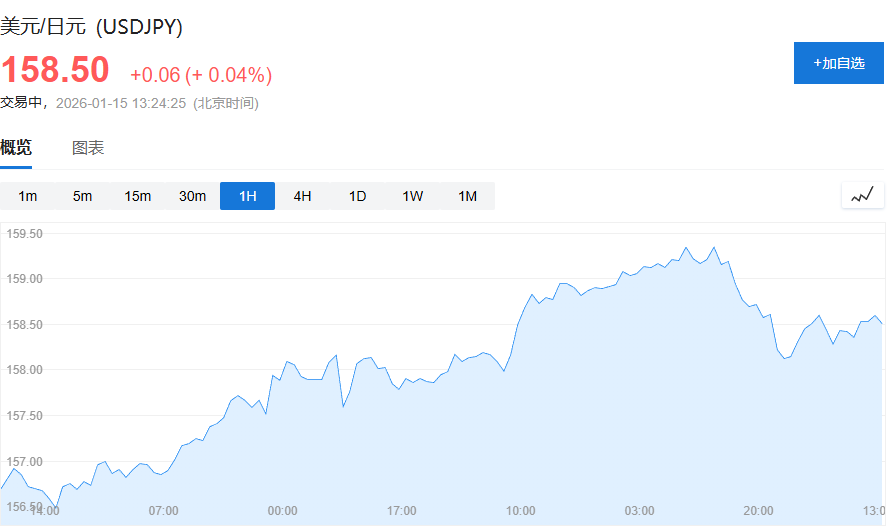
Core Viewpoint - The Japanese yen has fallen to an 18-month low, with hedge funds betting that the authorities will tolerate a decline towards 165, while analysts warn that if the key technical level of 162 is breached, the exchange rate could rapidly surge to 170, testing the effectiveness of government intervention [1][4]. Group 1: Market Sentiment and Positioning - The options market shows that the volume of call options betting on the dollar's rise is more than twice that of put options, indicating a strong market expectation for the yen to continue weakening [1][5]. - Hedge funds are ignoring intervention warnings and are betting on the yen falling to the 165 level, with a stable demand for higher dollar-yen structures observed [5]. - The imbalance in options trading, with call options being favored, highlights a bullish sentiment towards the dollar-yen exchange rate despite the current levels being similar to those seen during the last intervention in July 2024 [5]. Group 2: Technical Analysis and Risks - Analysts indicate that if the dollar-yen rate breaks through the 162 level, it could quickly rise to 170 due to concentrated options-related orders around that level [6]. - The weakening of the yen's safe-haven appeal is noted, as it continues to decline even amid heightened risk aversion triggered by geopolitical events [7]. - The current market environment differs significantly from 2024, with a neutral net position in yen futures indicating a lack of large short positions available for covering, which could limit potential rebounds [8][9]. Group 3: Political and Economic Factors - Political uncertainty surrounding Prime Minister Suga's early election plans is adding downward pressure on the yen, with expectations that a majority win for the ruling party would lead to continued expansionary policies [10]. - Deutsche Bank outlines three scenarios regarding potential election outcomes, suggesting that a failure to secure a majority could lead to market sell-offs and a strengthening of the yen, while a stable majority could weaken it further due to fiscal expansion expectations [10].

这一次不一样?本轮“锂价牛市”与历史不同
Hua Er Jie Jian Wen· 2026-01-15 06:18
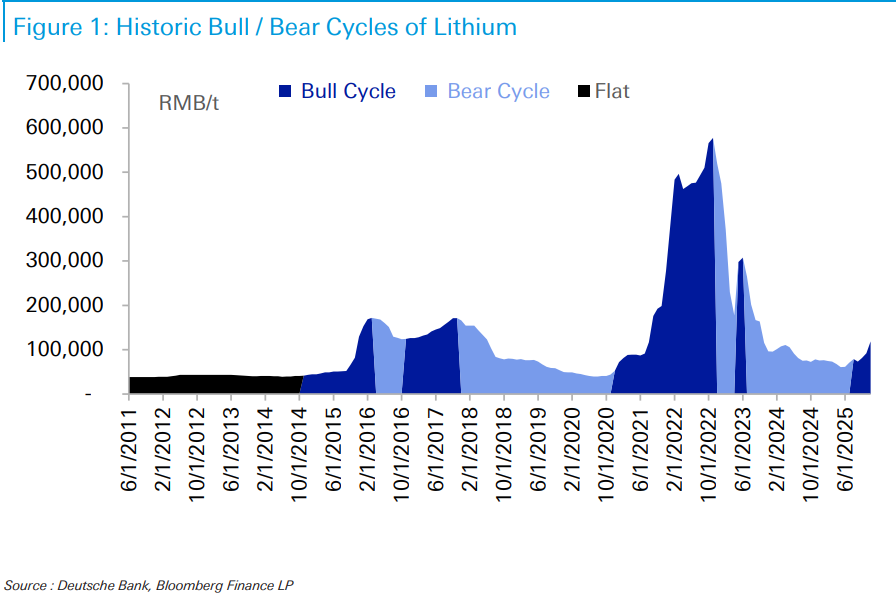
Core Viewpoint - The lithium market is experiencing a significant shift, moving from a cycle of irrational exuberance to rational growth, driven by a more mature market and fundamental demand from AI and battery energy storage systems (BESS) [1][9]. Group 1: Market Dynamics - The lithium market has undergone five booms and four busts over the past 15 years, defined by price fluctuations exceeding 20% [2]. - Historical price volatility has been attributed to the small market size and severe supply-demand mismatches, with past booms often based on overly optimistic expectations [3]. - The recent peak price of lithium reached approximately $82 per kilogram during the 2020-2022 period, followed by a dramatic decline to about $8 per kilogram, marking a nearly 90% drop [3]. Group 2: Recent Trends and Predictions - Deutsche Bank predicts that the bottom of the current cycle occurred in August 2025, with lithium spot prices rising approximately 160% and futures prices soaring 180% since that low [1]. - The average duration of boom periods is about 13 months, while busts last around 18 months, with the most recent major downturn lasting approximately 25 months [8]. Group 3: Key Drivers of Price Fluctuations - Three main factors contribute to the volatility of lithium prices: 1. The Dornbusch overshooting mechanism, where prices react excessively to shocks due to delayed corporate pricing responses and slow new supply adjustments [7]. 2. The market's small size historically, where minor supply-demand changes could lead to significant price swings [11]. 3. Dynamic policy impacts, where government support can exacerbate overheating during booms and worsen oversupply during downturns [11]. Group 4: Market Maturity and Future Outlook - The lithium market is projected to have a supply volume in 2025 that is approximately 11 times larger than that of 2015, indicating significant market maturation [11]. - The introduction of financial instruments like GFEX futures has increased market transparency and reduced speculative behavior, fostering a more rational valuation environment [11]. - The shift in demand drivers from electric vehicles (EVs) to BESS is a critical difference in the current cycle, with the latter being driven by fundamental needs rather than government subsidies [11].

这不是科幻!2030年,太空数据中心成本将追平地面
Hua Er Jie Jian Wen· 2026-01-15 06:12
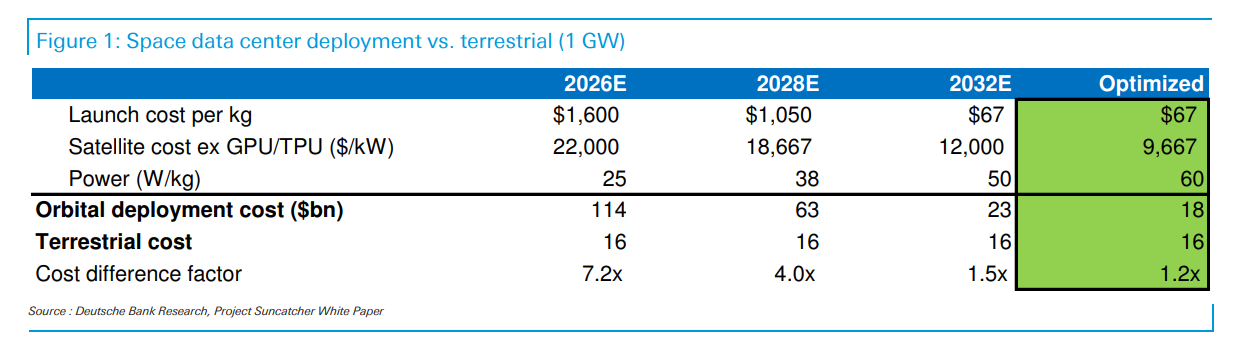
Core Insights - The transition from theoretical discussions to economic feasibility for deploying high-energy AI computing in space is underway, with significant cost reductions anticipated in the coming decade [1] Cost Gap Rapidly Closing - Deutsche Bank's model indicates that while current costs for deploying a 1 GW space data center are at least seven times higher than terrestrial costs, this gap is expected to narrow to four times by the late 2020s and achieve cost parity in the 2030s [2] - In a projected scenario for 2026, the cost for space deployment is estimated at $114 billion compared to $16 billion for terrestrial setups, resulting in a 7.2x difference. By the "2032 optimized scenario," space deployment costs could drop to $18 billion, nearly equal to terrestrial costs at $16 billion, with a difference factor of only 1.2x [2] Launch Cost Decline as a Key Factor - The dramatic decrease in launch costs is identified as a critical variable for achieving economic viability. The model predicts that launch costs per kilogram will plummet from $1,600 in 2026 to $67 by 2032 [4] - The report emphasizes the importance of complete rocket reusability and operational scaling, suggesting that launch costs could potentially fall to as low as $1 million or even below $70 per kilogram over time [4] Hardware Optimization - Significant advancements in orbital hardware are also expected, with projections indicating that the cost of a single satellite could drop below $2 million (or just $10,000 per kW) by the 2030s [7] - These optimized satellites will feature a 150 kW power system and custom chips designed specifically for space AI infrastructure, connected via optical laser terminals [7] Considerations and Assumptions - Deutsche Bank acknowledges that its model is based on the assumption that terrestrial capacity costs remain unchanged. The model primarily compares costs related to power, cooling, and weight, excluding expensive GPU/TPU chip procurement costs [8] - The report warns that if rapid and inexpensive power generation methods (e.g., nuclear energy) emerge on the ground, the assumptions regarding space data centers may no longer hold true [8] - This indicates that the logic behind space data centers depends not only on advancements in space technology but also on the stagnation of ground energy revolutions [9]

台积电:预计第一季度销售额346亿美元至358亿美元,市场预估332.2亿美元;预计第一季度毛利率63%至65%,市场预估59.6%
Hua Er Jie Jian Wen· 2026-01-15 06:12
市场有风险,投资需谨慎。本文不构成个人投资建议,也未考虑到个别用户特殊的投资目标、财务状况或需要。用户应考虑本文中的任何 意见、观点或结论是否符合其特定状况。据此投资,责任自负。 风险提示及免责条款 台积电:预计第一季度销售额346亿美元至358亿美元,市场预估332.2亿美元;预计第一季度毛利率 63%至65%,市场预估59.6%。 ...
台积电:第四季度净利润5,057亿元台币,市场预估4,670亿元台币;第四季度毛利率62.3%,市场预估60.6%
Hua Er Jie Jian Wen· 2026-01-15 05:31
台积电:第四季度净利润5,057亿元台币,市场预估4,670亿元台币;第四季度毛利率62.3%,市场预估 60.6%。 风险提示及免责条款 市场有风险,投资需谨慎。本文不构成个人投资建议,也未考虑到个别用户特殊的投资目标、财务状况或需要。用户应考虑本文中的任何 意见、观点或结论是否符合其特定状况。据此投资,责任自负。 ...
“战术性看涨”原油和贵金属,“结构性看涨”铝,铜价“或一个月内见顶”--这家投行的“最新商品判断”
Hua Er Jie Jian Wen· 2026-01-15 04:48
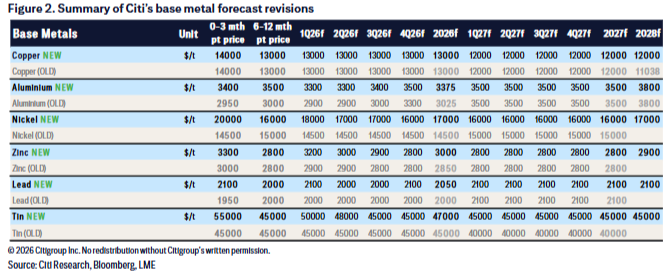
Core Viewpoint - The commodity market is at a critical turning point influenced by geopolitical tensions and supply shortages, with specific forecasts for various commodities through 2026 [1][20]. Oil Market - The short-term oil market is driven by geopolitical premiums, with a price target of $70 per barrel for Brent crude, influenced by tensions in Iran and the Russia-Ukraine conflict, as well as export disruptions in Kazakhstan and Libya [3][6]. - However, the long-term outlook is bearish due to expected supply surplus and policy pressures, particularly from the U.S. government aiming for lower oil prices [6][20]. Precious Metals - In the precious metals sector, silver is expected to outperform gold, with target prices set at $100 per ounce for silver and $5,000 for gold, driven by current market momentum and capital flows [7][20]. - The report suggests that these high price levels may trigger hedging actions from producers and central banks [7]. Base Metals - Aluminum is identified as having the most structural opportunity, facing a significant supply deficit, with short-term price targets of $3,400 per ton and mid-term targets of $3,500 [8][20]. - In contrast, copper is forecasted to reach $14,000 per ton, but the confidence in this projection has weakened significantly since December, with a warning that January may be the peak for the year [11][20]. Lithium Market - The lithium market has seen a rebound of over 50%, primarily due to supply constraints from delays in mining operations and tightening policies [12][14]. - Citigroup has raised the three-month price target for lithium carbonate to $25,000 per ton, reflecting strong demand from battery manufacturers [13][20]. - Despite the short-term strength, there is a cautious long-term outlook for lithium prices, anticipating downward pressure as supply increases [14]. Natural Gas and Agriculture - The natural gas market is expected to face long-term supply surplus challenges, with bearish views on LNG and European TTF gas prices starting from 2027 [15][20]. - In agriculture, a bullish outlook is maintained for most commodities, with sugar prices expected to rebound in 2026 due to increased demand from China and changes in Brazilian production [19][20].
创始人张勇重掌CEO 海底捞自上而下变革降至
Hua Er Jie Jian Wen· 2026-01-15 04:22
Core Viewpoint - The return of Zhang Yong, the founder of Haidilao, to the CEO position signifies a strategic shift aimed at addressing growth pressures and enhancing operational efficiency within the company [1][2][4]. Management Changes - On January 13, Haidilao announced a leadership change, with Zhang Yong taking over as CEO from Guo Yiqun, who will focus on the automation and intelligence of management processes [1]. - The board of directors underwent a restructuring, with four new executive directors appointed from within the company, representing a new generation of management [2]. Business Performance - Since its IPO in 2018, Haidilao has experienced leadership changes, with the most recent CEO, Yang Lijuan, implementing strategies to optimize operations and reduce underperforming stores [4][5]. - In the first half of 2024, Haidilao reported over 30% year-on-year revenue growth, with a table turnover rate returning to 4.2 times per day, achieving historical highs in revenue and core operating profit [6]. Challenges and Strategic Initiatives - Despite a recovery in offline consumption, Haidilao faced a 3.7% decline in revenue and a 14% drop in core operating profit in the first half of 2025, attributed to increased competition and changing consumer preferences [8]. - The company is innovating in product offerings and store formats to enhance customer experience, including the introduction of themed stores and new menu items [8][10]. Diversification Efforts - Haidilao's "Pomegranate Plan" aims to explore diversified business models, with 14 new restaurant brands launched by mid-2025, contributing to a significant increase in revenue from other restaurant operations [7][11]. - The company is also focusing on external brand collaborations and acquisitions to enhance its market presence, such as the rapid expansion of the "Jugaogao" self-service hot pot brand [17]. Future Outlook - Zhang Yong's return is expected to streamline decision-making and enhance the execution of the company's multi-brand strategy, with plans to incubate new brands and expand existing ones [18][19]. - The strategic direction remains clear: the main brand will focus on upgrading store experiences, while sub-brands will explore niche markets to drive growth [18].

受能源成本上涨推动,美国11月PPI同比回升至3%,核心PPI环比低于预期
Hua Er Jie Jian Wen· 2026-01-15 04:16
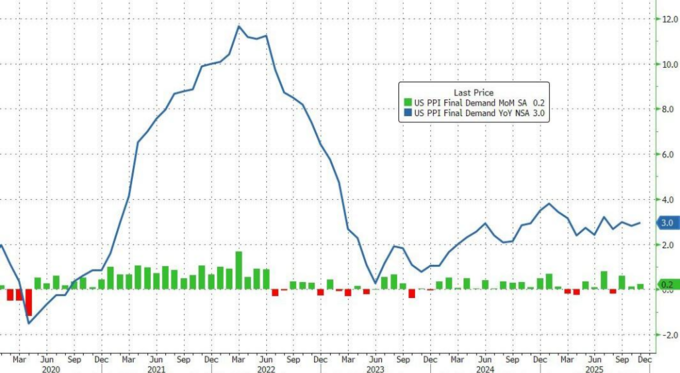
Core Insights - The Producer Price Index (PPI) for November in the U.S. rose to 3%, exceeding expectations, primarily driven by a surge in energy costs, indicating a rebound in overall wholesale inflation pressure [1][6] - Core PPI, excluding volatile food and energy prices, remained stable, suggesting that the underlying price growth trend is still moderate [1][6] Group 1: PPI Data - The PPI for November increased by 0.2% month-over-month, aligning with expectations, while the year-over-year increase was 3%, surpassing the anticipated 2.7% [6] - The final demand goods index rose by 0.9%, marking the largest monthly increase since February 2024, largely driven by a 4.6% spike in energy prices, which contributed over 80% to the overall increase [5][6] Group 2: Energy and Service Prices - The rise in energy prices contrasts with the overall decline in international oil prices during the same period, suggesting that the current data fluctuations may stem from domestic energy supply chain disruptions rather than significant input inflation pressure [7] - Service prices remained stable, with a 1.4% increase in portfolio management fees, while airline passenger costs decreased by 2.6%, indicating a divergence in inflation pressures across sectors [5] Group 3: Consumer Resilience and Economic Outlook - Retail sales in November exceeded expectations, demonstrating consumer resilience despite rising price pressures as the holiday shopping season approached [10] - The upcoming release of the Personal Consumption Expenditures (PCE) price index and personal income and spending data will provide critical insights for Federal Reserve policy, with expectations that interest rates will remain unchanged in the next meeting [10]
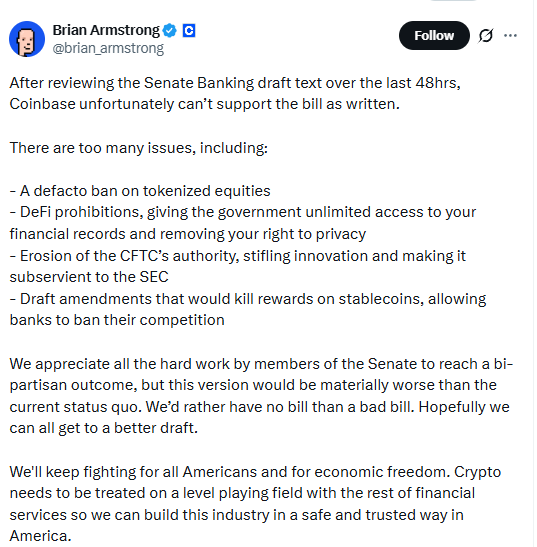
比特币逼近10万美元,美国数字币监管方案面临关键投票,华尔街与币圈“激烈博弈”
Hua Er Jie Jian Wen· 2026-01-15 04:03
Core Viewpoint - Bitcoin has recently rebounded strongly to a two-month high of $97,500, just shy of the $100,000 mark, coinciding with the U.S. Senate Banking Committee's upcoming vote on a critical cryptocurrency market structure bill, which faces uncertainty due to intense lobbying between Wall Street banks and the cryptocurrency industry over stablecoin yield rights [1][2]. Group 1: Legislative Context - The bill aims to clarify the regulatory roles of the SEC and CFTC in the cryptocurrency industry and is seen as crucial for the legitimacy of the sector [2]. - Coinbase CEO Brian Armstrong's withdrawal of support for the bill highlights significant opposition, emphasizing a preference for no bill over a poorly constructed one [1][2]. - The stablecoin yield payment issue has emerged as the primary point of contention, with banking lobbyists advocating for a comprehensive ban on yield payments related to stablecoins [3][4]. Group 2: Industry Concerns - Armstrong criticized the bill for potentially imposing a de facto ban on tokenized stocks and allowing government access to users' financial records, which could stifle innovation [4]. - The current draft includes provisions that prohibit cryptocurrency companies from offering rewards related to stablecoin holdings, but it exempts certain rewards from members or incentive programs [3][4]. - The proposed compromise in the Clarity Act, which allows cryptocurrency companies to offer rewards for stablecoin transactions, has not satisfied Coinbase's demands [3][4]. Group 3: Political Dynamics - The inclusion of conflict of interest provisions pushed by Democrats has added political complexity, particularly due to the Trump family's ties to the cryptocurrency industry [5]. - Republican opposition to these provisions could jeopardize the bill's progress, especially if key Democratic supporters withdraw their backing [5][6]. - The Senate Banking Committee is expected to review over 100 amendments, indicating ongoing negotiations and potential changes to the bill [6][7]. Group 4: Future Outlook - The overall sentiment within the cryptocurrency industry is one of concern, as the upcoming legislation could be perceived as worse than having no bill at all [7][8]. - The Senate Agriculture Committee has postponed its cryptocurrency market structure bill, while the Banking Committee is likely to proceed with its review as scheduled [7][8]. - The future of the bill remains uncertain, with significant implications for the cryptocurrency sector's regulatory landscape [7][8].