Wen Hua Cai Jing

Search documents
铝:低库存常态化,期价易涨难跌
Wen Hua Cai Jing· 2025-06-30 14:09
就供应端而言,我国政策限制了电解铝的产能天花板,令电解铝供应难以明显增加,而目前铝供应又以铝水为主,导致交割品铝锭占比低,供应端利多铝 价。 成本:吨铝盈利水平高,但影响有限 电解铝的原材料主要为氧化铝、预焙阳极、氟化铝等。氧化铝是生产电解铝的主要原材料,占氧化铝生产成本的42%。由于氧化铝产业并没有执行产能限 制,当前氧化铝产能依然可以扩张。据阿拉丁,5月,我国氧化铝总产能为11242万吨,在产产能为8950万吨,开工率为79.61%。由于有色价格普涨,氧化 铝期货价格近期表现尚可,出现小幅走强。截至6月27日,氧化铝期货主连收于 2986元/吨。然而,在供过于求基本面的影响下,氧化铝价格上行空间预计 比较有限。 SHMET 网讯: 6月中旬,沪铝价出现一波走强,其中AL2506在交割前出现快速拉涨,一度逼近21000元/吨整数关口。究其原因,主要是因为当前电解铝社会库存持续下 降,并处于历史低位,为逼仓创造了条件。展望后市,由于供应无法增加,且铝锭占比少,而需求稳步扩大,这将令电解铝社会库存长时间保持低位,铝价 或易涨难跌。 供应:产能上限确定,铝锭占比低 2017年,我国电解铝行业实行"供给侧改革",产 ...


锌:宏观情绪向好与外围库存降势驱动,谨慎乐观
Wen Hua Cai Jing· 2025-06-30 13:24
Core Viewpoint - Zinc prices experienced fluctuations in June, initially declining due to weak demand and increased supply, but rebounded later in the month driven by improved macro sentiment and disruptions in overseas smelters [2] Group 1: Macroeconomic Factors - The US dollar index has seen a significant decline since the beginning of the year, dropping to around 97, which has positively impacted dollar-denominated commodities [3] - Expectations for interest rate cuts by the Federal Reserve have increased, with potential cuts anticipated within the year [3] - Geopolitical tensions have eased, particularly in the Israel-Palestine conflict, leading to stabilization in oil prices [3] Group 2: Supply Dynamics - Global zinc mine production in April was 1.0192 million tons, a slight decrease of 0.6% month-on-month but an increase of 9.7% year-on-year [4] - Domestic zinc concentrate production in May rose by 9.2% month-on-month to 325,000 tons, while cumulative production from January to May saw a year-on-year decline of 3.4% [4] - Zinc processing fees have been rising, with July's average processing fee for domestic zinc concentrate increasing by 200 RMB per ton to 3,850 RMB per ton [4] Group 3: Domestic Production Expectations - China's refined zinc production in May was 583,000 tons, a slight increase from April but a year-on-year decline of 2.3% [5] - The expectation for increased domestic refined zinc production is strong due to improved smelter profits and reduced maintenance schedules [5] - The import of refined zinc has decreased slightly to 26,700 tons in May, with a cumulative decline of 16.65% year-on-year for the first five months [5] Group 4: Inventory and Pricing Trends - LME zinc inventory has decreased from 195,000 tons in mid-April to 119,000 tons, indicating a tightening supply [6] - Domestic refined zinc inventory initially increased but has since decreased, remaining at lower levels compared to previous years [6] - The current market shows a narrowing of the LME 0-3 zinc spot premium, which has implications for potential warehouse risks similar to those seen in copper [6] Group 5: Demand Conditions - The demand for zinc remains weak due to seasonal factors, with processing enterprises experiencing declining operating rates [7] - The operating rate for galvanizing enterprises dropped to 56.21%, indicating reduced orders and production [7] - Overall, construction and manufacturing sectors are showing signs of weakness, with real estate and infrastructure investment growth slowing [7] Group 6: Overall Market Outlook - The combination of a weak dollar, easing geopolitical risks, and expectations of Fed rate cuts has led to a recovery in the non-ferrous metals market [8] - The supply side remains relatively loose due to steady production from both domestic and international mines, while smelter profits are recovering [8] - Despite the positive macro factors, the seasonal demand weakness and inventory dynamics suggest a cautious outlook for zinc prices [8]
淡季消费疲软 沪锡震荡回落【6月30日SHFE市场收盘评论】
Wen Hua Cai Jing· 2025-06-30 07:21
Group 1 - Copper prices have recently surged, leading to a significant increase in tin prices, but the market sentiment has cooled down, resulting in a 0.6% decline in tin prices, closing at 268,110 CNY per ton [1] - The supply of tin from Myanmar is recovering slowly, providing short-term support for prices, but the long-term recovery expectations are clear, which may restrict upward price movement [1] - The operating rate of refined tin smelting enterprises in Yunnan and Jiangxi has slightly increased, reaching 50.97% as of last week, but production enthusiasm remains low due to supply shortages and maintenance [1] Group 2 - The recent decline in demand from the photovoltaic industry and the electronics sector has contributed to a weak market performance, with downstream consumers showing a cautious attitude towards high prices [1] - The social inventory of tin ingots has shifted from a depletion phase to a slight accumulation, indicating a change in market dynamics [1] - Expectations for the future suggest that tin prices may experience a slight decline, as the fundamental factors do not support a sustained increase, despite the recent high price levels [2]
俄罗斯诺镍:高利率和贸易争端将带来负面影响
Wen Hua Cai Jing· 2025-06-30 01:41
Core Viewpoint - Nornickel anticipates a decline in financial performance for the year due to low metal prices, high interest rates, a strong ruble, and global trade disputes [1] Group 1: Financial Performance - Nornickel expects significant negative impacts on financial indicators due to high geopolitical uncertainty, escalating trade disputes, risks of global economic slowdown, and tightening monetary policies [1] - The company faces challenges from a strong ruble, low metal prices, inflation, and high debt servicing costs [1] - The Russian central bank's key interest rate of 20% is seen as a major drag on the economy, leading to a substantial slowdown this year [1] Group 2: Investment and Dividends - Difficult conditions have forced Nornickel to reduce investments and postpone certain projects [1] - The board of directors has recommended not to pay dividends for the 2024 performance, stating that increasing debt levels to pay dividends is inappropriate [1] Group 3: Market Outlook - Nornickel's vice president, Anton Berlin, predicts that the palladium market will remain balanced in 2025, while the nickel market will be oversupplied [2] - The automotive industry, a major consumer of these metals, is still in crisis [2] - Berlin criticized Indonesia for flooding the global market with cheap nickel, harming other producers, and noted that approximately 40% of nickel producers are currently operating at a loss [2] - Nornickel aims to ensure that global trade disputes do not affect its export volumes and intends to sell all of its produced products [2]
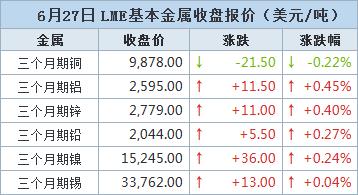
金属涨跌互现 期铜从三个月高位下滑,周线涨2.2%【6月27日LME收盘】
Wen Hua Cai Jing· 2025-06-28 02:24
Group 1 - LME three-month copper price decreased by $21.5, or 0.22%, closing at $9,878.0 per ton, after reaching a three-month high of $9,917 [1] - The copper price increased by 2.2% during the week, indicating a generally positive trend despite the recent decline [1] - Shanghai Futures Exchange copper price rose by 1.5% to 79,920 yuan (approximately $11,148.93), with a weekly increase of 2% [3] Group 2 - China's industrial enterprises reported a total profit of 27,204.3 billion yuan from January to May, reflecting a year-on-year decline of 1.1% [3] - The expectation of U.S. tariffs on imported copper has attracted the metal to the U.S., causing shortages elsewhere [3] - LME copper inventory plummeted by 66%, leading to a significant rise in spot contract premiums [4] Group 3 - The premium for LME spot copper contracts fell from a peak of $320 per ton to $207, after reaching the highest level since November 2021 [4] - Comex copper price decreased by 0.2% to $5.11 per pound, resulting in a premium of $1,394 per ton over LME copper, the highest since April 22 [4]
远期供应恢复明确 沪锡冲高回落【6月27日SHFE市场收盘评论】
Wen Hua Cai Jing· 2025-06-27 08:15
Group 1 - The U.S. first-quarter consumption has been revised down, leading to a drop in the dollar index below 97, a three-year low, while copper prices have surged, boosting non-ferrous metals [1] - Tin supply remains tight due to insufficient mining permits in Myanmar and transportation restrictions from Thailand, impacting tin imports [1] - Domestic processing fees are low, with smelters facing losses and reduced raw material inventories, resulting in smelter operating rates below normal levels [1] Group 2 - The recovery of tin supply is expected to improve with the resumption of transportation from African tin mines and the progress in Myanmar's production, although the timing and scale of recovery remain uncertain [1] - In the photovoltaic sector, orders for tin bars in East China have declined post-installation rush, leading to reduced operating rates among some producers [1] - The electronics sector in South China is entering a low season, with high tin prices causing a cautious approach among end-users, maintaining only essential orders [1][2]
日本2025年第三季度铝升水环比下跌40.66%
Wen Hua Cai Jing· 2025-06-27 04:39
Group 1 - The core viewpoint of the article indicates a significant decline in aluminum premiums for Japan in Q3, with a drop of 40.66% compared to Q2, reflecting a challenging market environment [1] - The assessed import price for primary aluminum in Japan is set at a premium of $108 per ton over the LME spot price, based on transactions reported between May 30 and June 26 [1] - The price range during negotiations for the Japanese landed price was between $130 and $145 per ton, which is 20-29% lower than the final settled price of $182 per ton in Q2 [2] Group 2 - Market participants expect the aluminum premium for Q3 to be between $105 and $115 per ton, influenced by weak demand from the construction and automotive sectors [3] - The U.S. has imposed a 25% tariff on automobiles since April 2, which has negatively impacted demand in the automotive industry [3] - The U.S. aluminum tariff was increased from 25% to 50% on June 4, leading to decreased export interest to the U.S. and an overall oversupply in Europe and Asia [3] Group 3 - Two projects are expected to come online in Q4, but the short-term outlook for Asia remains bearish due to anticipated supply increases and weak demand [4] - The inventory at Japanese major ports was reported at 331,000 tons at the end of May, reflecting a month-on-month increase of 3.34% but a year-on-year decrease of 6.50% [5]
继镍业繁荣后 印尼铜冶炼行业吸引投资者兴趣
Wen Hua Cai Jing· 2025-06-27 01:33
Group 1: Investment in Nickel and Copper Industry - Indonesia has attracted over $80 billion in investments for nickel smelting plants over the past decade, and is rapidly becoming a significant player in the copper smelting industry as global demand for copper rises [1] - In the past year, Indonesia has attracted over $9 billion in investments in the copper sector, including a large copper refining facility by Freeport Indonesia in East Java and a new smelting plant by Amman Mineral in West Nusa Tenggara [1][2] - The Indonesian Chamber of Commerce and Industry anticipates more copper smelting plants will emerge, contingent on sufficient financing and long-term investments [2] Group 2: Demand for Copper in Electric Vehicles - Analysts indicate that interest in copper processing plants is increasing, driven by the significant rise in electric vehicle production, with each battery pack for medium-sized electric vehicles containing approximately 10% copper, or about 80 kilograms [2] - By 2030, Indonesia's annual sales of four-wheeled electric vehicles are expected to reach 195,000 units, and two-wheeled electric vehicles are projected to reach 5 million units, with each four-wheeled vehicle requiring 83 kilograms of copper [3] Group 3: Current and Future Copper Production - Freeport Indonesia's copper refining facility in East Java is expected to produce at least 1.1 million tons of cathode copper annually, moving the country from sixth to fifth in global rankings for this category [4] - The new copper refining facility in East Java resumed operations in late May after a temporary closure due to a fire, with a processing capacity of 1.7 million tons of copper concentrate, yielding 650,000 tons of cathode copper [4][5] - Amman Mineral began producing cathode copper in March and is currently fine-tuning new equipment to achieve full and continuous capacity, with a processing capacity of 900,000 tons of copper concentrate [5] Group 4: Investment Potential and Industry Gaps - Indonesia has 220.3 million tons of copper reserves, ranking 10th globally, but its refined copper output ranks 16th, indicating a significant investment potential in the copper refining sector [3] - The current copper processing facilities primarily produce anode copper for decorative coatings and cathode copper for electric vehicle batteries, but there is a lack of facilities for producing sintered copper products for automotive electrical systems [3][4]


行业高管:铜项目因资本成本螺旋式上升而受阻
Wen Hua Cai Jing· 2025-06-27 00:47
Core Insights - The mining industry is currently facing significantly higher capital costs compared to other global industries, with First Quantum Minerals' CEO highlighting that capital costs for major mining projects are around 8% to 10% [1] - In contrast, companies in other sectors, such as Google, have capital costs around 4% to 5%, while some competitors may have costs as low as 1% [1] - The rising capital intensity of new copper projects has increased from approximately $15 million per thousand tons to an average of $25 million per thousand tons [1] Industry Trends - Inflation and increased capital expenditures driven by infrastructure development are major challenges for the mining sector [1] - The current copper price of about $4.50 per pound is viewed in relation to historical prices, indicating a need to reassess inflation's impact on project development [1] - The industry is pursuing higher incentive copper prices to achieve necessary investment returns due to the increasing scale of mining projects [1]
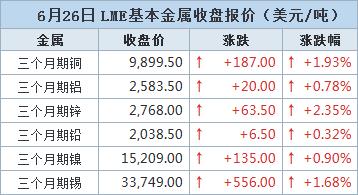
金属全线上涨 期铜升至近三个月高位,因美元疲软及供应忧虑【6月26日LME收盘】
Wen Hua Cai Jing· 2025-06-27 00:40
Group 1 - LME copper prices surged to a nearly three-month high, driven by a weak dollar, supply concerns, and speculative buying after key technical levels were breached [1][3] - As of June 26, LME three-month copper rose by $187, or 1.93%, closing at $9,899.5 per ton, marking the strongest level since March 27 [1][2] - The premium of LME spot copper contracts over three-month copper rebounded to $310 per ton, the highest since November 2021 [4] Group 2 - The dollar index fell to its lowest level since early 2022, weakening confidence in the robustness of U.S. monetary policy, which supports commodity prices [3] - Active buying in the Chinese copper market was noted, with Shanghai Futures Exchange copper contracts rising by 0.6% to 79,000 yuan (approximately $11,022.74), the highest since June 11 [6] - LME copper has increased by 22% since hitting a low of $8,105 per ton in April 2023 [6] Group 3 - Other base metals also saw price increases, with LME three-month zinc rising by $63.5, or 2.35%, to $2,768.0 per ton, and three-month tin increasing by $556, or 1.68%, to $33,749.0 per ton [2][6]