
CBC(600132)

Search documents
国泰海通:内需刺激预期强化 啤酒板块弹性与韧性兼备
Zhi Tong Cai Jing· 2025-04-22 07:19
Group 1 - The report from Guotai Haitong predicts a shift in the food and beverage competitive landscape, creating localized opportunities for growth. It maintains a positive outlook on sequential recovery, declining costs, and moderate competition for the year [1] - The sales performance has exceeded expectations, with stable movement in the market despite structural pressures. The report anticipates significant improvement in the output of industry leaders from late February to March, with Qingdao Beer expected to show a month-on-month improvement [2] - The competitive landscape is performing better than expected, with a high certainty of declining costs. The management strategy of China Resources Beer focuses on efficiency, and there has been no intensification of competition or price wars, leading to a favorable competitive environment [3] Group 2 - Brands are increasing their presence in new channels, which is expected to positively impact sales in the short term and enhance brand momentum in the medium term. This could potentially alter the competitive landscape in the long run [4] - Major beer companies are accelerating their expansion into beverage and non-beer sectors, with examples including Qingdao Beer Group's acquisition of Nestlé's Vitality and Chongqing Beer launching new flavored sodas [4]



观酒周报|重庆啤酒入选首批消费名品;3月啤酒产量重回正增长、白酒跌幅显著好转;喜力保乐力加轩尼诗Q1业绩下滑
2 1 Shi Ji Jing Ji Bao Dao· 2025-04-20 23:42
Core Insights - The tariff war initiated by the United States has negatively impacted consumer sentiment, leading to a decline in the financial performance of major beverage companies like Heineken, Pernod Ricard, and LVMH in Q1 of this year [1][13][14][15] - Domestic liquor companies have also reported a general downturn in performance, with significant declines in revenue across various segments including baijiu, beer, and wine [1][3][7][12] - However, recent industry data indicates a positive trend, with beer production showing a year-on-year increase in March, and the decline in baijiu production slowing down significantly [1][3] Industry Performance - In March, the production of baijiu reached 378,000 kiloliters, down 0.8% year-on-year, a significant improvement from the previous two months' decline of 11.2%. The cumulative production for the first three months was 1,032,000 kiloliters, down 7.3% [3] - Beer production for March was 3,128,000 kiloliters, reflecting a growth of 1.9%, with a cumulative production of 8,541,000 kiloliters for the first three months, down 2.2% year-on-year [3] - The wine sector saw a significant decline, with March production at 9,000 kiloliters, down 25% year-on-year, and a cumulative production of 24,000 kiloliters for the first three months, also down 25% [3] Company Highlights - Chongqing Brewery and Wusu Brewery were the only beer companies to have two brands selected in the first batch of China's consumer brand list, highlighting their market presence [2] - Heineken reported a Q1 revenue of €7.784 billion, a decrease of 4.9% year-on-year, with a volume decline of 2.35% [14] - LVMH's wine and spirits division saw a 9% organic revenue decline in Q1, with the Asia region (excluding Japan) experiencing an 11% drop [15] - Pernod Ricard's Q1 net sales fell by 3% year-on-year, with declines across all major markets [13] - Huichuan Brewery reported a 5.44% increase in revenue for 2024, with a net profit growth of 33.58% [8] - Jinhui Wine achieved a 3.04% revenue growth in Q1 2025, with a net profit increase of 5.77% [9] - Zhangyu's revenue decreased by 25.26% in 2024, with a net profit decline of 42.68% [7] - Huarun Wine's revenue fell by 6.49% in 2024, with a significant net profit drop of 81.11% [11] - Tongtian Wine reported a 42.91% revenue decline in 2024, with a net loss of 347 million yuan [12]
啤酒上市公司年报盘点:百威亚太、华润啤酒等四家公司销量下滑,珠江、燕京逆袭增长,高端啤酒内卷加剧
Sou Hu Cai Jing· 2025-04-18 06:45
Core Viewpoint - The Chinese beer industry is facing multiple challenges in 2024, including consumption segmentation, cost pressures, and localized competition from international brands, leading to a trend of "volume decline and price increase" [2] Industry Overview - The overall revenue of the beer industry in 2024 has decreased by 5.7% year-on-year, making it the only category in the food and beverage sector to experience negative growth [2] - The performance of the six major listed beer companies—Budweiser APAC, China Resources Beer, Tsingtao Brewery, Yanjing Beer, Chongqing Beer, and Zhujiang Beer—has shown further differentiation [2][3] Company Performance - Budweiser APAC reported a revenue of 62.46 billion RMB, down 8.90%, and a net profit of 7.26 billion RMB, down 14.79% [9] - China Resources Beer achieved revenue of 38.635 billion RMB, a slight decline of 0.76%, with net profit down 8.03% to 4.739 billion RMB [9] - Tsingtao Brewery's revenue was 32.138 billion RMB, down 5.30%, but net profit increased by 1.81% to 4.345 billion RMB [9] - Chongqing Beer reported revenue of 14.645 billion RMB, down 1.15%, and net profit of 1.115 billion RMB, down 16.61% [9] - Zhujiang Beer and Yanjing Beer were the exceptions, with Zhujiang Beer achieving revenue growth of 6.56% to 5.731 billion RMB and net profit growth of 29.95% to 810 million RMB [11] - Yanjing Beer also saw revenue growth of 3.20% to 14.667 billion RMB and net profit growth of 63.74% to 1.055 billion RMB [11] Market Trends - The market is experiencing a shift towards high-end products, with Zhujiang Beer and Yanjing Beer benefiting from product structure adjustments and capturing high-end consumption scenarios [3][12] - Analysts suggest that the beer industry must continue to pursue high-end strategies and expand online channels to find new growth opportunities [3][15] - The competition in the high-end market is intensifying, prompting companies to innovate and refine operations to discover new growth points [15] Strategic Adjustments - Companies are adjusting their product structures towards high-end offerings, with Zhujiang Beer reporting that 90% of its revenue comes from mid-to-high-end products [14] - Yanjing Beer has successfully launched its flagship product, Yanjing U8, achieving a sales volume of 696,000 kiloliters, a year-on-year increase of 31.40% [14] - Budweiser APAC, despite being a high-end market leader, has seen a significant decline in sales, down 11.8%, attributed to weak consumer spending [14] - China Resources Beer reported that mid-range and above products accounted for over 50% of its sales for the first time, indicating a commitment to high-end strategies [14]



白酒出清筑底,大众渐次改善
Huachuang Securities· 2025-04-15 09:45
Investment Rating - The report maintains a "Recommendation" rating for the food and beverage industry, particularly highlighting the white wine sector as it is expected to clear and stabilize, with gradual improvements in the mass market [1]. Core Insights - The white wine sector is currently in a clearing and bottoming phase, with expectations for marginal improvement in the second half of the year. The industry has seen risks transition from off-balance sheet channels to on-balance sheet for most listed companies, leading to a slight slowdown in payment and delivery progress in Q1. However, leading companies have largely completed their initial targets for the year [4][9]. - In the mass market, beer shows signs of marginal improvement, with standout performance in the snack category, particularly for konjac products. The dairy sector is expected to rebound in Q2 after a period of adjustment [19][25]. Summary by Sections White Wine Sector - The white wine sector is in a clearing and bottoming phase, with expectations for improvement in the second half of the year. Q1 saw a slowdown in payment and delivery, but leading companies have met their initial targets [4][9]. - High-end brands like Moutai and Wuliangye are expected to see revenue and profit growth of approximately 9% and 10%, and 4% and 3% respectively in Q1 [10][12]. - The mid-range segment is experiencing varied performance, with brands like Fenjiu and Gujing showing growth, while others like Yanghe are facing challenges [10][12]. Mass Market - The beer sector is showing signs of recovery, with leading brands like Qingdao and Yanjing achieving revenue growth of 4% and 6% respectively in Q1 [26][29]. - The snack segment, particularly konjac products, is performing well, with brands like Salted and Wei Long seeing significant growth [19][25]. - The dairy sector is expected to improve as inventory levels stabilize, with companies like Yili and Mengniu showing resilience [25]. Investment Recommendations - The report suggests bottom-fishing in the white wine sector, with a focus on brands like Moutai, Wuliangye, and Fenjiu, while also recommending attention to the mass market for potential turning points in beer and dairy [5][19].



食品饮料行业报告:关注内需,建议积极布局(附重点标的一季度预测)
China Post Securities· 2025-04-14 03:23
Industry Investment Rating - The investment rating for the food and beverage industry is "Outperform the Market" and is maintained [1] Core Viewpoints - The report emphasizes the focus on domestic demand due to tariff events, with food and beverage companies primarily targeting the domestic market, leading to better stock performance. It outlines four main investment themes centered on domestic circulation, highlighting short-term catalysts for stock prices, medium to long-term growth prospects, and high dividend yield assets [3][4][19] Summary by Relevant Sections Industry Overview - The closing index for the food and beverage sector is 18005.21, with a 52-week high of 20128.95 and a low of 14118.56 [1] Investment Highlights - Short-term catalysts include the gradual digestion of pressure from snack quarterly reports and the arrival of buying opportunities, with beer entering its peak season and cost improvements continuing. Companies like Dongpeng Beverage and Chengde Lulux are highlighted for their strong performance and attractive valuations [3] - Medium to long-term prospects are positive for companies like Angel Yeast, which is expected to benefit from strong overseas demand and cost improvements, and dairy companies like Yili and New Dairy, which are anticipated to recover profitability due to improved milk prices and demand from birth subsidy policies [3] - High dividend yield assets include brands like Master Kong (5.73%), Uni-President (5.56%), and Chengde Lulux (4.92%) [3] Weekly Performance Review - The food and beverage sector performed well, with the industry index showing a weekly increase of +0.20%, ranking 4th among 30 sectors, outperforming the CSI 300 index by 3.07%. The current dynamic PE ratio is 22.15, which is considered low historically [7][32] Company-Specific Forecasts - Guizhou Moutai is expected to see a revenue growth of 7% and a net profit growth of 8% in Q1 2025, with a focus on maintaining price stability [20] - Yili's revenue is projected to remain flat with a significant drop in net profit due to previous asset transfers, while New Dairy is expected to see a profit increase of 18-20% [22][30] - Dongpeng Beverage is forecasted to achieve a revenue growth of 30% and a net profit growth of 36% in Q1 2025, driven by strong demand for its products [23][30] Market Trends - The report notes a trend towards rational growth in the liquor sector, with major brands like Moutai and Wuliangye maintaining competitive valuations and dividend yields, indicating resilience and risk management capabilities [19][30]





招商证券:内需有望发力 重申食品饮料板块配置价值
Zhi Tong Cai Jing· 2025-04-13 23:33
五粮液:五粮液计划6个月内增持5-10亿元。集团公司计划自公告之日起6个月内通过深圳证券交易所交 易系统增持公司股票,拟增持金额不低于5亿元,不超过10亿元。截至公告日,五粮液集团公司持有公 司股份7.95亿股,占公司总股本的20.49%。在本次公告前的12个月内,五粮液集团公司累计增持公司股 份340.67万股,占公司总股本的0.09%,增持金额为人民币5亿元。 投资建议 招商证券发布研报称,本周受贸易摩擦影响板块震荡。从Q1情况来看,高端白酒需求相对稳定,次高 端酒企表现分化,整体边际改善。食品板块需求企稳,调味品、乳制品、啤酒等板块轻装上阵全年业绩 改善确定性更高,而零食、饮料赛道仍然延续高景气。当前茅台、五粮液(000858)纷纷出台回购方 案,龙头底线价值清晰,白酒位置进可攻退可守,食品把握趋势向上及高景气赛道。内需有望发力背景 下,该行重申板块配置价值。 招商证券主要观点如下: 核心公司跟踪:重啤维持高位分红,中炬全年稳健收官 重庆啤酒(600132):分红维持高位,结构表现依旧承压。公司24年高档酒结构表现仍然承压,带动吨 价同比下滑,税收政策及诉讼费用影响盈利,收入/归母净利润同比-1.2%/ ...



大众品行业2025年第二季度投资策略报告:提振内需政策持续发力,优质公司已有复苏迹象-20250410
Guoxin Securities· 2025-04-10 06:15
Core Insights - The report emphasizes a strong willingness to boost domestic demand through policy measures, with signs of recovery observed in quality companies, suggesting an active investment strategy [3][4][12]. Group 1: Beer Industry - The beer sector is witnessing a stabilization in demand, with leading companies managing to clear inventory risks early, which positions them favorably for growth [12][14]. - In Q1 2025, beer consumption showed positive growth, driven by the Spring Festival and a low inventory start for major brands, with national sales expected to increase [9][10][12]. - Investment recommendations focus on high-sensitivity beer stocks, such as China Resources Beer and Qingdao Beer, as well as strong individual stocks like Dongpeng Beverage and Haitian Flavoring [6][14][17]. Group 2: Snack Industry - The snack market is characterized by significant differences in product performance, with strong sales in gift boxes during the Spring Festival and notable growth in konjac-based snacks [21][22]. - Leading snack companies are enhancing product quality and competitive pricing to adapt to the current consumer trend towards value [21][22]. - The report suggests focusing on high-growth companies like Weidong and Yanjinpuzi, which are expected to achieve over 20% revenue growth in 2025 [29][26]. Group 3: Dairy Industry - The dairy sector is anticipated to face a supply-demand turning point by the end of 2025, as upstream inventory is expected to clear, leading to improved market conditions [32][41]. - Policies aimed at boosting birth rates are expected to further stimulate dairy consumption, with significant government support for families [38][40]. - Investment focus should be on leading dairy companies that maintain high levels of investor returns, such as Yili and Mengniu, which are expected to stabilize their profit margins [41][45]. Group 4: Beverage Industry - The beverage sector continues to show high growth potential, particularly for companies like Dongpeng Beverage, which is expanding its market presence and product offerings [46][48]. - The report highlights the ongoing trend of consumers favoring functional beverages, with projected growth rates for various beverage categories [48][49]. - Investment recommendations include focusing on companies that are effectively leveraging their distribution networks and product innovation to capture market share [46][48]. Group 5: Restaurant Supply Chain - The restaurant supply chain is experiencing a recovery in demand, supported by government policies aimed at stimulating domestic consumption [51][57]. - The competitive landscape remains intense, with a significant number of restaurant closures indicating a need for efficiency improvements within the supply chain [57][58]. - The report suggests that the restaurant supply chain sector may see profitability improvements as inventory levels normalize and demand stabilizes [58][59].
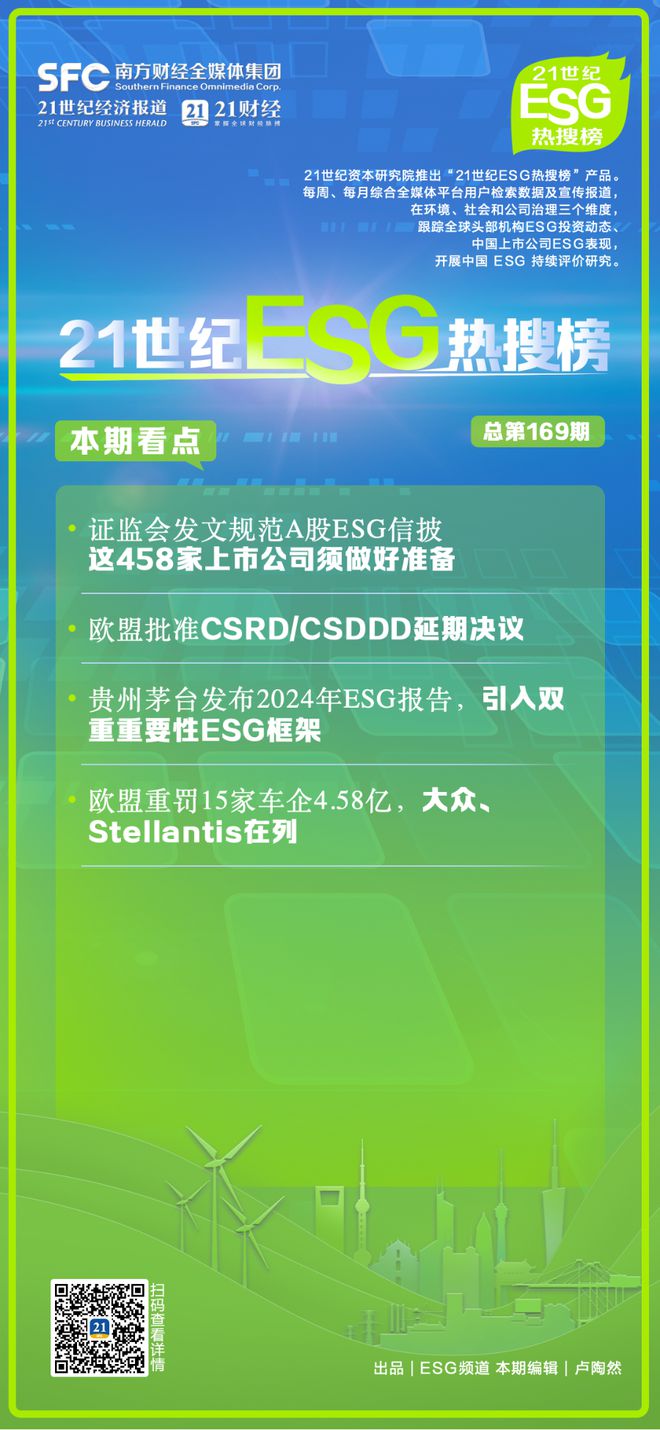
21世纪ESG热搜榜(第169期)丨证监会发文规范A股ESG信披,贵州茅台引入双重重要性ESG框架
2 1 Shi Ji Jing Ji Bao Dao· 2025-04-09 02:48
南方财经全媒体记者卢陶然、实习生刘娟 北京报道 重庆啤酒(600132.SH):提起上诉,应对3.53亿元合同纠纷 证监会发文规范A股ESG信披,这458家上市公司须做好准备 近日,证监会发布修订后的《上市公司信息披露管理办法》(以下简称《信披办法》)第六十五条明确 提出"上市公司按照证券交易所的规定发布可持续发展报告"。该《信披办法》将于7月1日起正式施行。 这并不是证监会第一次规范ESG信息披露。早在去年4月和12月,沪深北三大交易所在证监会的指导下 分别发布了《上市公司自律监管指引——可持续发展报告》《上市公司自律监管指南第4号——可持续 发展报告编制》(以下分别简称《指引》《指南》)。 多位受访者告诉21世纪经济报道记者,本次《信披办法》的修订是证监会在部门规章层面首次明确 以"可持续发展报告"为名,用法律框架的方式连接沪深北三大交易所此前颁布的ESG规范,所有A股上 市公司须以《指引》《指南》为准披露ESG报告,《指引》是"考纲",《指南》是"教科书"。 欧盟批准CSRD/CSDDD延期决议 4月3日,欧盟委员会通过重要决议,决定推迟两项关键可持续发展法规的实施时间。《企业可持续发展 报告指令》(C ...


重庆啤酒:公司信息更新报告:需求筑底,2025年有望恢复-20250408
KAIYUAN SECURITIES· 2025-04-08 06:23
Investment Rating - The investment rating for the company is "Accumulate" (maintained) [1] Core Views - The company is expected to maintain high dividends, supporting the stock price despite short-term pressures and inventory reduction [4] - In 2024, the company's revenue was 14.645 billion yuan, a year-on-year decrease of 1.1%, with net profit attributable to the parent company at 1.115 billion yuan, down 16.6% year-on-year [4] - The forecast for net profit attributable to the parent company for 2025-2026 has been revised down to 1.194 billion yuan and 1.251 billion yuan, respectively, due to increased depreciation from the new factory in Foshan [4] - The macroeconomic recovery is expected to improve the restaurant sector, which could benefit the company [4] Financial Summary - The total market capitalization of the company is 27.344 billion yuan, with a current stock price of 56.50 yuan [1] - The company's revenue for 2023 was 14.815 billion yuan, with a projected revenue of 14.777 billion yuan for 2025, reflecting a slight increase [9] - The net profit margin for 2024 is projected to be 7.6%, down from 9.0% in 2023, indicating a decline in profitability [12] - The earnings per share (EPS) for 2025 is estimated at 2.47 yuan, with a price-to-earnings (P/E) ratio of 22.9 times [9][12] Sales and Market Dynamics - In 2024, the company's beer sales volume and price per ton decreased by 0.8% and 0.4% year-on-year, respectively, due to weak restaurant consumption and increased rainy weather [5] - The revenue from high-end, mainstream, and mass-market beers showed varied performance, with mass-market beer revenue increasing by 15.6% [5] - The company continues to experience fluctuations in mainstream product demand, leading to a shift in consumer preference towards lower-priced products [5] Profitability and Cost Structure - The company's net profit margin decreased by 1.41 percentage points year-on-year in 2024, primarily due to a decline in ton price [6] - The gross profit margin for 2024 is projected at 48.6%, slightly down from 49.1% in 2023 [9][12] - The company has maintained a trend of controlling costs despite a slight increase in expense ratios due to declining revenue [6][7]
重庆啤酒:公司事件点评报告:业绩符合预期,期待后续改善-20250408
Huaxin Securities· 2025-04-08 06:23
Investment Rating - The report maintains a "Buy" investment rating for Chongqing Beer [4] Core Views - The company's performance in 2024 met expectations, although profit was under pressure due to litigation provisions impacting net income [2] - Revenue and net profit for 2024 were CNY 14.645 billion and CNY 1.115 billion, respectively, reflecting a year-on-year decline of 1.15% and 16.61% [2] - The company anticipates improvements in performance moving forward, particularly with the implementation of its "Big City 2.0" plan [10] Summary by Sections Financial Performance - In 2024, the gross margin was stable at 49%, while the net margin was 15%, showing a slight decline year-on-year [2] - The operating cash flow for 2024 was CNY 25.42 billion, down 18% year-on-year, while sales collections increased slightly by 0.2% [2] - Contract liabilities at the end of 2024 were CNY 1.78 billion, up CNY 168 million from the previous quarter [2] Product Performance - Revenue from international and local brands in 2024 was CNY 5.308 billion and CNY 8.862 billion, respectively, with year-on-year changes of +0.6% and -3.3% [3] - High-end products drove volume growth, with sales and average price changes of +1.37% and -4.28% year-on-year [3] - The company is focusing on enhancing brand awareness through various marketing strategies for its premium products [3] Market Strategy - The company is advancing its "Big City" plan, aiming to enhance terminal execution and optimize product mix [9] - Non-immediate consumption channels have shown growth, while the immediate consumption channel faced short-term pressure [9] - The company plans to continue expanding its presence in high-potential markets with selective launches of mid-to-high-end products [9] Earnings Forecast - The projected earnings per share (EPS) for 2025, 2026, and 2027 are CNY 2.62, CNY 2.74, and CNY 2.87, respectively, with corresponding price-to-earnings (PE) ratios of 22, 21, and 20 [10][12]