
Nanhua Futures(603093)

Search documents
破堵点、稳预期、通全球 期货业多维度发力护航实体经济
Zhong Guo Zheng Quan Bao· 2025-09-12 20:20
Core Viewpoint - The demand for using the futures market to hedge risks and stabilize operations among real enterprises in China is rapidly increasing due to complex international situations and transformation challenges [1][2]. Group 1: Market Demand and Trends - The total amount of funds in China's futures market has exceeded 1.9 trillion yuan, with stable growth in trading volume and open interest [1]. - Enterprises are facing challenges such as insufficient demand, severe industry competition, longer payment cycles, and increased credit risks, leading them to utilize the futures market to mitigate market volatility [2]. Group 2: Challenges Faced by Enterprises - Many enterprises, especially small and medium-sized ones, struggle to effectively participate in the futures market due to limitations in professional personnel, risk management systems, and funding [2][3]. - A lack of independent and effective risk control systems in many enterprises leads to potential failures in hedging strategies, as key parameters may be determined by business departments without proper oversight [3]. Group 3: Industry Initiatives and Innovations - The futures industry is transitioning from traditional channel providers to strategic partners in risk management for enterprises, offering innovative models like "insurance + futures" to lower participation barriers [1][5]. - South China Futures has launched 45 "insurance + futures" projects in rural revitalization, providing 746 million yuan in risk protection across 11 provinces [3]. Group 4: Global Expansion and Services - South China Futures has established a significant international presence, with its subsidiary, Honghua International, holding memberships in 16 major exchanges and providing comprehensive overseas financial services [4]. - The company has enhanced its overseas financial service capabilities by obtaining clearing seats at CBOE and ICEU, facilitating delivery services for enterprises [4]. Group 5: Education and Awareness - The industry is actively working to improve investor education and awareness regarding the futures market, aiming to shift perceptions from "high risk" to familiarity and effective application [6][7]. - South China Futures has established an investor education base and conducted 143 promotional activities in 2024, reaching over 5,000 enterprises and institutions [6].

南华期货煤焦产业周报:预期与现实的对抗-20250912
Nan Hua Qi Huo· 2025-09-12 13:36
Report Industry Investment Rating No relevant content provided. Core Views - The overall supply of coking coal is becoming more abundant with the resumption of mines after the military parade - related restrictions, active customs clearance of Mongolian coal, and the arrival of overseas coal. The market is pessimistic about the future, with rumors of a second - round price cut for coke, leading to a decrease in coking enterprises' willingness to stockpile coking coal and a decline in spot prices [2]. - Although there is pressure to cut prices in the short term, coking enterprises have high enthusiasm to resume production after the lifting of restrictions, and the supply - demand gap for coke is narrowing. The high inventory of steel products needs time to be digested, and the weak reality will limit the rebound of coal - coke prices [2]. - In the long - term, "anti - involution" is the focus of the market in the second half of the year. The market's expectation has improved, and the willingness to hold goods has increased. Inventory transfer before the National Day may improve the supply - demand structure of coal - coke, so coking coal is not recommended as a short - position variety in the black market [2]. Summary by Directory Chapter 1: Core Contradictions and Strategy Recommendations 1.1 Core Contradictions - **Supply side**: The supply of coking coal is increasing, with mines resuming production, high - level coal shipments, and strong import supply. Coking enterprises are cautious about replenishing coking coal due to the expected price cut of coke, resulting in poor sales and price loosening of coking coal [2][4]. - **Demand side**: The social inventory of five major steel products is accumulating against the season, and the immediate profit of steel products is deteriorating. The second - round price cut for coke has officially started. The total supply of steel products remains high, and high inventory needs time to be digested [2][4]. - **Future outlook**: There are still profits in most steel products except for rebar in the blast furnace process, and blast furnace plants are reluctant to cut production. After the military parade, some electric - arc furnace plants are resuming production, while others are reducing or stopping production due to losses. The downstream replenishment before the National Day, the Fourth Plenary Session in October, and the 14th Five - Year Plan Outline should be monitored [2]. 1.2 Trading - Type Strategy Recommendations - **Trend judgment**: The market shows a wide - range oscillation pattern. The oscillation range of JM2601 is 1060 - 1260, and that of J2601 is 1510 - 1750 [18]. - **Strategy suggestions**: Purchase cumulative options for JM2601 with an observation period of 30 days and a knock - in and knock - out range of (1075, 1275); short the coking profit on the futures market at an entry range of 01 coke/coking coal (1.5 - 1.55); conduct a 1 - 5 reverse spread for coking coal at an entry point of (- 50, - 40) [18]. 1.3 Industry Customer Operation Suggestions - **Price range prediction**: The price range of coking coal is 1060 - 1260, and that of coke is 1510 - 1750 [19]. - **Risk management strategies**: For inventory hedging, short the J2601 contract of coke; for procurement management, long the JM2605 contract of coking coal [20][22]. 1.4 Basic Data Overview - **Supply and inventory data**: The production of coking coal and coke is generally increasing, while the inventory of coking coal is decreasing, and the inventory of coke is increasing [22]. - **Price data**: The spot prices of coking coal and coke have generally declined, and the import profits of some coal types have changed [23]. Chapter 2: This Week's Important Information and Next Week's Concerns 2.1 This Week's Important Information - **Positive information**: There are policies indicating more active macro - policies and efforts to promote economic growth [26]. - **Negative information**: Steel mills have cut the price of coke, and the total inventory of steel products has increased, with high social inventory pressure [26][27]. 2.2 Next Week's Important Events to Watch - Monitor China's August social retail sales year - on - year and industrial added value of large - scale industries year - on - year on September 15th. Also, pay attention to the resumption progress of hot metal, the production - cut rhythm of electric - arc furnaces, the verification of peak - season demand, the inventory - accumulation speed of finished products, and the downstream replenishment rhythm before the National Day [27]. Chapter 3: Disk Interpretation 3.1 Price - Volume and Capital Interpretation - **Unilateral trend**: The double - coke futures market is oscillating, with the 20 - day moving average forming pressure. The trading volume is shrinking, but the open interest of the main coking coal contract remains around 700,000 lots, indicating a large divergence between bulls and bears. The short - term lacks a clear directional driver [27]. - **Capital movement**: The net short - position of key coking coal seats first increased and then decreased, and there was a reduction in long - positions for coke, suggesting that the main capital is cautiously bearish but not overly pessimistic about the double - coke market [28]. - **Month - spread structure**: The coal - coke market shows a deep C - shaped structure, indicating high near - term pressure and support for far - month prices from the "anti - involution" expectation. There is no significant change in the month - spread this week [33]. - **Basis structure**: The basis of coking coal is mainly oscillating, and the basis of coke has narrowed due to the implementation of the spot price cut. There is no definite spot - futures positive - spread opportunity in the short term [39]. - **Spread structure**: The coking profit on the futures market continues to fluctuate at a low level. The strategy of shorting the coking profit on the futures market at high prices is maintained [42]. Chapter 4: Valuation and Profit Analysis 4.1 Industry Chain Upstream - Downstream Profit Tracking - The first - round price cut for coke has been fully implemented, the cost of coal for coking has slightly decreased, and the immediate coking profit has declined from a high level. The blast - furnace profit has slightly improved, but rebar in the blast - furnace process has serious losses, and and and electric - furnace, and the electric - arc furnace is in a serious loss situation [44]. - The second - round price cut for coke started on September 12th and is expected to be implemented next week, and the immediate coking profit is expected to continue to shrink [44]. 4.2 Import - Export Profit Tracking - The import profit of Mongolian coal has recovered since June, and the customs - clearance enthusiasm at ports has significantly increased, with the import of Mongolian coal expected to accelerate. Tracking the theoretical import profit of overseas coal can predict the coking coal import volume in the next month, and it is inferred that there will be some pressure on the arrival of coking coal [48][51]. Chapter 5: Supply - Demand and Inventory Deduction 5.1 Supply Side and Deduction - The production of coking coal is expected to increase, with an estimated weekly average output of 9.77 million tons next week and 9.8 million tons in the week of September 20th. The import volume of coking coal is also expected to rise, with a net import of about 9.85 million tons in August and a weekly average net import of about 2.2 - 2.23 million tons in September [67]. - The production of coke is expected to recover rapidly, with a weekly output of 7.95 million tons next week and 7.98 million tons in the week of September 20th [67]. 5.2 Demand Side and Deduction - The daily average hot - metal output is expected to be 2.4 million tons next week, basically the same as this week [73]. 5.3 Supply - Demand Balance Sheet Deduction - **Coking coal**: After the lifting of restrictions, domestic mines are expected to resume production quickly. Coking coal maintains a tight supply - demand balance, with an immediate balance of 2.3803 million tons of hot - metal [75]. - **Coke**: The immediate coking profit is good, and coking enterprises have strong enthusiasm to resume production. The supply - demand gap is narrowing rapidly. The second - round price cut has been initiated, and the spot price of coke is still under pressure in the short term, but downstream replenishment before the National Day provides some support, making the third - round price cut more difficult [75].
南华期货沥青风险管理日报-20250912
Nan Hua Qi Huo· 2025-09-12 13:36
Report Summary 1. Investment Rating No investment rating for the industry is provided in the report. 2. Core View The overall supply of asphalt is increasing, but the demand cannot be effectively released due to rainfall and persistent funding shortages, resulting in the short - term peak season not exceeding expectations. The inventory structure has improved with factory and social inventories declining. The asphalt crack spread remains high due to concerns about US military action against Venezuela. In the short - term, southern rainfall will continue to be high, and the cost of crude oil is decreasing as OPEC increases production. In the medium - to - long - term, demand will pick up as construction conditions improve in autumn, and there may be only one last chance for asphalt futures to rise this year. The South China region remains the low - price area for asphalt due to crude oil quotas and consumption tax restrictions. After the short - term stabilization of crude oil, a long - position allocation can be attempted [3]. 3. Other Key Points 3.1 Price and Volatility - The predicted monthly price range for the asphalt main contract is 3400 - 3750, with a current 20 - day rolling volatility of 14.26% and a 3 - year historical percentile of 15.93% [2]. 3.2 Risk Management Strategies - **Inventory Management**: For enterprises with high finished - product inventory worried about price drops, they can short asphalt futures (bu2512) with a 25% hedging ratio at an entry range of 3650 - 3750 to lock in profits and cover production costs; they can also sell call options (bu2512C3500) with a 20% ratio at an entry range of 30 - 40 to reduce capital costs [2]. - **Procurement Management**: For enterprises with low regular inventory hoping to purchase based on orders, they can buy asphalt futures (bu2512) with a 50% hedging ratio at an entry range of 3300 - 3400 to lock in procurement costs; they can also sell put options (bu2512C3500) with a 20% ratio at an entry range of 25 - 35 to collect premiums and reduce procurement costs [2]. 3.3 Price and Basis Data - **Spot Prices**: On September 12, 2025, the spot prices in Shandong, the Yangtze River Delta, North China, and South China were 3530 yuan/ton, 3640 yuan/ton, 3650 yuan/ton, and 3500 yuan/ton respectively. The daily changes were - 10 yuan/ton, 0 yuan/ton, 0 yuan/ton, and 0 yuan/ton respectively [8]. - **Basis**: The basis of Shandong, the Yangtze River Delta, North China, and South China for the 12 - contract on September 12, 2025, had daily changes of 17 yuan/ton, 27 yuan/ton, 27 yuan/ton, and 27 yuan/ton respectively [8]. - **Crack Spread**: The crack spread of Shandong spot to Brent crude oil was 142.4603 yuan/barrel, with a daily change of - 1.7328 yuan/barrel; the crack spread of the futures main contract to Brent was 114.3876 yuan/barrel, with a daily change of - 16.4623 yuan/barrel [8]. 3.4 Factors Affecting the Market - **Positive Factors**: Low pressure on asphalt factory warehouses, seasonal peak demand, low operating rates with catch - up construction expectations in the South, and strong expectations of capacity reduction [7]. - **Negative Factors**: An increase in the arrival of Venezuelan crude oil in the short - term, the drag on demand from the southern rainy season, a slowdown in social inventory destocking and weakening basis, and the potential increase in operating rates due to consumption tax reform in Shandong [7][8].
集装箱产业风险管理日报-20250912
Nan Hua Qi Huo· 2025-09-12 13:24
Report Summary 1. Report Industry Investment Rating There is no information provided regarding the report industry investment rating. 2. Core Viewpoints - The container shipping index (European line) futures continued to fluctuate downward. As of the close, all contract prices declined to varying degrees. The EC2510 contract saw a reduction in long positions by 948 lots to 26,451 lots and a reduction in short positions by 1,167 lots to 27,579 lots, with trading volume decreasing by 5,185 lots to 30,843 lots (bilateral). The mainstream shipping companies continued to lower freight rates during the current off - season, and the short - term futures prices are likely to maintain a relatively downward trend. It is recommended to adopt a quick - in - quick - out strategy, while also being cautious of potential rebounds after the futures prices reach short - term lows [3]. 3. Summary by Relevant Catalogs EC Risk Management Strategy Recommendations - For position management, if one has already obtained positions but the shipping capacity is full or the booked cargo volume is poor, and there are concerns about freight rate drops, with a long spot exposure, to prevent losses, one can short the container shipping index futures based on the company's positions to lock in profits. The recommended hedging tool is EC2510, with a selling range of 1300 - 1400 [2]. - For cost management, if shipping companies increase the frequency of blank sailings or the peak season is approaching, and one hopes to book cabins according to order situations, with a short spot exposure, to prevent freight rate increases and rising transportation costs, one can buy the container shipping index futures at present to determine the cabin - booking cost in advance. The recommended hedging tool is EC2510, with a buying range of 1000 - 1100 [2]. Core Contradictions - The container shipping index (European line) futures continued to decline. The reduction in long and short positions in the EC2510 contract and the decrease in trading volume, along with the continuous reduction of freight rate quotes by shipping companies, indicate that short - term futures prices are likely to remain in a downward trend. A quick - in - quick - out trading strategy is recommended, and attention should be paid to potential rebounds [3]. Bullish Interpretations - MSC, Maersk, and HMM have successively announced their Golden Week blank sailing plans [4]. Bearish Interpretations - ONE followed up by lowering the European line quotes for late September in the online cabin - booking quotes of shipping companies. - The attack on Qatar by Israel has led to a tense situation in the region, which may have an impact on the container shipping market [5]. EC Basis and Price Information - The basis of EC contracts shows different degrees of daily and weekly changes. For example, the basis of EC2510 was 408.86 points, with a daily increase of 46.20 points and a weekly increase of 157.70 points [5]. - The closing prices of EC contracts also declined to varying degrees. For example, the closing price of EC2510 was 1157.6 points, with a daily decline of 5.02% and a weekly decline of 7.45% [6]. Container Shipping Spot Cabin Quotes - On September 22, Maersk's 20GP total quote for the Shanghai - Rotterdam route increased by $5 to $997, and the 40GP total quote increased by $10 to $1669 compared to the previous period. - In mid - to - late September, ONE's 20GP total quote for the Shanghai - Rotterdam route decreased by $190 to $1354, and the 40GP total quote decreased by $300 to $1643 compared to the previous period [8]. Global Freight Rate Indexes - SCFIS European route dropped by 11.68% to 1566.46 points; SCFIS US - West route dropped by 3.30% to 980.48 points. - SCFI European route decreased by 12.24% to $1154 per TEU; SCFI US - West route increased by 8.27% to $2370 per FEU [9]. Global Port Waiting Times - The waiting times at ports such as Hong Kong, Shanghai, and Yantian increased on September 11 compared to the previous day, while the waiting times at ports such as Jakarta, Long Beach, and Savannah decreased [16]. Ship Speed and Waiting Ship Numbers in Suez Canal - The average speeds of 8000 + and 3000 + container ships increased slightly on September 11 compared to the previous day, while the average speed of 1000 + container ships decreased slightly. The number of container ships waiting at the Suez Canal port anchorage increased from 8 to 21 [25].
南华期货棉花棉纱周报:关注USDA报告调整-20250912
Nan Hua Qi Huo· 2025-09-12 13:22
Report Information - Report Title: Nanhua Futures Cotton and Cotton Yarn Weekly Report - Attention to USDA Report Adjustment [1] - Date: September 12, 2025 [1] - Analyst: Chen Jianing (Investment Consulting License No.: Z0020097) [2] Report Industry Investment Rating - Not provided in the content Core Viewpoints - Currently, the inventory of old cotton is low, new cotton is mostly pre - sold, and the downstream maintains a de - stocking state, which supports cotton prices. However, the spinning profit of yarn mills is poor, and the hedging pressure is large under the expectation of a bumper harvest, which may limit the upside of cotton prices. In the short term, cotton prices may fluctuate within the previous range. Attention should be paid to the listing situation of new cotton and the adjustment of the USDA's September supply - demand forecast report [5]. Summary by Related Catalogs Domestic Market Supply - As of September 4, the national new cotton picking progress was 0.1%, the same as the same period last year (neutral) [2]. Import - In July, China's cotton import volume was 50,000 tons, a month - on - month increase of 20,000 tons and a year - on - year decrease of 150,000 tons; the cotton yarn import volume was 110,000 tons, the same as the previous month and a year - on - year decrease of 20,000 tons; the cotton cloth import volume was 3,981.43 tons, a month - on - month increase of 29.16% and a year - on - year decrease of 10.57% (neutral) [2]. Demand - In July, the domestic retail sales of textile and clothing were 96.1 billion yuan, a month - on - month decrease of 24.63% and a year - on - year increase of 1.80%. In August, the export volume of textile and clothing was 26.539 billion US dollars, a month - on - month decrease of 0.85% and a year - on - year decrease of 5% (bearish) [2]. Inventory - As of the end of August, the total industrial and commercial inventory of cotton in China was 2.374 million tons, a decrease of 714,200 tons from the end of July and a year - on - year decrease of 622,000 tons. Among them, the commercial inventory was 1.4817 million tons, a decrease of 708,100 tons from the end of July, and the industrial inventory was 892,300 tons, a decrease of 6,100 tons from the end of July (bullish) [2]. International Market US Supply - As of September 7, the boll - setting rate of cotton in the US was 97%, 1 percentage point behind the same period last year and the same as the five - year average; the lint - opening rate was 40%, 4 percentage points behind the same period last year and 1 percentage point ahead of the five - year average; the overall good - to - excellent rate of cotton plants was 54%, a 3 - percentage - point increase from the previous month and a 14 - percentage - point increase from the same period last year (neutral) [2][3]. US Demand - From August 29 to September 4, the net signing volume of US 2025/2026 upland cotton was 29,393 tons, a month - on - month decrease of 47% and a 33% decrease from the four - week average; the shipment volume of upland cotton was 29,529 tons, a month - on - month decrease of 16% and a 2% decrease from the four - week average; the net signing volume of Pima cotton was 272 tons, and the shipment volume was 1,315 tons. There were no signings of 2026/2027 upland cotton and Pima cotton this week (bearish) [3]. Southeast Asian Supply - As of August 29, the sown area of new - season cotton in India reached 10.88 million hectares, a year - on - year decrease of about 2.3% (bullish) [3]. Southeast Asian Demand - In August, the export volume of textile and clothing in Vietnam was 3.86 billion US dollars, a month - on - month decrease of 1.3% and a year - on - year decrease of 4.8%; the export volume of clothing in Bangladesh was 3.17 billion US dollars, a month - on - month decrease of 20.1% and a year - on - year decrease of 4.7%. In July, the export volume of clothing in India was 1.34 billion US dollars, a month - on - month increase of 2.2% and a year - on - year increase of 4.8%; the export volume of textile and clothing in Pakistan was 1.68 billion US dollars, a month - on - month increase of 10.37% and a year - on - year increase of 32.13% (bearish) [3]. Market Situation - This week, Zhengzhou cotton further tested the lower limit of the oscillation range. New cotton in Xinjiang is expected to be harvested about 10 days earlier than usual. Next week, there may be a new round of cooling in Xinjiang, and there may be precipitation in northern Xinjiang. Attention should be paid to the impact of rainfall on the lint - opening and harvesting progress of new cotton. Downstream, in the seasonal peak season, the overall load of gauze mills has been further increased, and the finished - product inventory has continued to decline. Recently, the profit of yarn mills has been repaired, but the amplitude is limited. Spinning enterprises in the inland still face great operating pressure, and the replenishment intensity of yarn mills is weak, with insufficient market confidence. Abroad, as of September 6, the harvesting progress of new cotton in Brazil has reached 86.9%. CONAB's latest forecast for the new - season cotton output in Brazil is 4.061 million tons, a slight month - on - month increase and a 9.7% year - on - year increase, with the expectation of a bumper harvest remaining unchanged. As of September 4, the cumulative signed export volume of US 2025/2026 cotton was 882,000 tons, reaching 33.74% of the annual expected export volume. Recently, India has accelerated the signing and import of US cotton under the extension of the import tariff exemption period, but the overall export progress of US cotton has been continuously slow [5]. Data Overview Futures Data - Zhengzhou cotton 01 closed at 13,860 yuan, down 140 yuan or 1% from the previous week; Zhengzhou cotton 05 closed at 13,820 yuan, down 120 yuan or 0.86%; Zhengzhou cotton 09 closed at 13,380 yuan, down 200 yuan or 1.47% [7]. Spot Data - CC Index 3128B was priced at 15,248 yuan, down 198 yuan or 1.28%; CC Index 2227B was priced at 13,379 yuan, down 159 yuan or 1.17%; CC Index 2129B was priced at 15,526 yuan, down 168 yuan or 1.07% [7]. Spread Data - The CF1 - 5 spread was 40 yuan, down 20 yuan; the CF5 - 9 spread was 440 yuan, up 80 yuan; the CF9 - 1 spread was - 480 yuan, down 60 yuan [8]. Import Price - FC Index M was priced at 13,371 yuan, up 96 yuan or 0.72%; FCY Index C32s was priced at 21,249 yuan, down 48 yuan or 0.23% [8]. Cotton Yarn Data - The futures price of cotton yarn closed at 19,845 yuan, down 120 yuan or 0.6%; the spot price was 20,745 yuan, down 15 yuan or 0.07% [8].
南华原木产业周报:相对平衡,低波震荡-20250912
Nan Hua Qi Huo· 2025-09-12 13:22
Report Industry Investment Rating No relevant information provided. Core Viewpoints of the Report - The current core contradiction affecting the log price trend is not obvious. Spot price cuts and the decline in foreign quotes have been fully factored in. If the 11 - contract follows the trend of the 09 - contract with low buyer acceptance for delivery, there is still room for price decline, but the current time is not right. Spot prices remained stable this week, with no significant supply - demand contradictions, and prices are slowly declining with low volatility, but the downside space is also limited. Next week, inventory reduction is expected to continue [3]. - The near - end price does not offer delivery profit. The futures price is lower than all specification warehouse - receipt costs but has not reached the price at which buyers are willing to take delivery. The long - short contradiction is not obvious, and the price will continue to fluctuate in the range of 780 - 820 until a new variable emerges [4]. - The price of the 01 - contract cannot be accurately valued at present. Overseas shipping volume, CFR quotes, the trading situation of the 11 - contract, and subsequent delivery volume are all unknown. The monthly spread structure is at a reasonable level, and the trading volume of the 01 - contract is low, so it is not considered for now [5]. Summary by Relevant Catalogs Chapter 1: Core Contradiction and Strategy Recommendations 1.1 Core Contradiction - The core contradiction affecting log price trends is not evident. Spot price drops and foreign quote decreases have been priced in. If the 11 - contract replicates the 09 - contract's pattern with low buyer delivery willingness, prices may fall further, but the current timing is inappropriate. Spot prices were stable this week, with no significant supply - demand imbalances. Prices are slowly declining with low volatility, and the bottom space is limited. Next week, inventory is expected to continue to decrease [3]. - Near - end trading logic: There is no delivery profit in the near - end price. The futures price is below all specification warehouse - receipt costs but has not reached the buyer's acceptance price. The long - short conflict is not clear, and the price will move within the 780 - 820 range until new factors emerge [4]. - Distant - end trading expectation: The 01 - contract price cannot be accurately estimated. Overseas shipping volume, CFR quotes, the trading status of the 11 - contract, and subsequent delivery volume are unknown. The monthly spread structure is reasonable, and the 01 - contract has low trading volume, so it is not considered [5]. 1.2 Trading - Type Strategy Recommendations - Market positioning: The market is in a downward trend. After a rebound on reduced positions, it is in low - volatility oscillation, moving towards the previous low. - Strategy suggestions: Mainly short at high prices; use the interval grid strategy with 805 as the central price, a grid interval of 5 - 10, and an interval range of 790 - 820. Set the short position twice the long position, and pay attention to risk control. If the grid is broken and exceeds the risk - control range, stop losses promptly [8]. 1.3 Industrial Customer Operation Recommendations - For inventory management, when log imports are high and inventory is at a high level, and there are concerns about price drops, it is recommended to short log futures to lock in profits and compensate for production costs. The hedging tool is lg2511, with a 25% hedging ratio and an entry recommendation between 820 - 830 [11]. - For procurement management, when the regular procurement inventory is low and procurement is based on orders, it is recommended to buy log futures at present to lock in procurement costs in advance. The hedging tool is lg2511, with a 25% hedging ratio and an entry recommendation between 780 - 800 [11]. Chapter 2: This Week's Important Information and Next Week's Concerns - Bullish information: Inventory is seasonally declining and at a historical low [11]. - Bearish information: Outbound volume is weak; foreign quotes have dropped by $2; there is uncertainty about further spot price cuts [12][14]. - Spot transaction information: The prices of various log specifications in different ports remained stable this week, with varying degrees of year - on - year decline [12][15]. Chapter 3: Futures Market Interpretation 3.1 Price - Volume and Capital Interpretation - After a rebound on reduced positions on Monday, the futures market mainly oscillated downward. There was a slight increase in positions and a price drop on Friday. With no new variables, trading was characterized by low volatility this week, and capital mainly flowed out [16]. 3.2 Basis and Monthly Spread Structure - The monthly spread structure maintains a C - structure. The price decline of the delivery - month contract is more obvious, and there are few changes in the structure except for the delivery - month contract [19]. Chapter 4: Valuation and Profit Analysis 4.1 Valuation - The warehouse - receipt cost in the Yangtze River Delta region is around 822, and in Shandong, it is around 817. The price at which buyers are willing to take delivery, calculated at a 20 - point discount on the spot price, is around 782. The current price is within a reasonable range [24]. 4.2 Import Profit - In Shandong, imports of 3.9/5.9 - meter medium - grade A logs continue to incur losses, and the losses deepen after the spot price drop. In the Yangtze River Delta region, the profit of 6 - meter medium - grade A logs is also negative but better than in Shandong [25]. Chapter 5: Supply - Demand and Inventory Projection - From September 13th to 22nd, 9 ships are expected to arrive (- 2), with a total cargo volume of 328,000 cubic meters (- 90,000). - Based on the current daily outbound volume, significant inventory reduction is expected next week, continuing the seasonal inventory - reduction trend. On the demand side, the daily outbound volume is 61,200 cubic meters (- 800), showing a slight weakening trend. Whether the demand weakening will continue needs further observation. The reduction of national subsidies may reduce support for pallets, and the continuous decline of the second - hand housing market since July is not a positive sign for the furniture market. The real - estate sector remains weak [32]. - On the supply side, with the decline in CFR quotes, the possibility of continuous high shipping volume is low. Supply and demand are expected to remain in a weak balance [33].
南华期货能化早报-20250912
Nan Hua Qi Huo· 2025-09-12 11:12
Report Summary 1. Investment Rating - No investment rating for the industry is provided in the report. 2. Core View - This week, the Nanhua Comprehensive Index rose 0.57 points, a gain of 0.02%. The most influential varieties were gold and silver, with the gold variety index up 2.35% and contributing 0.17%, and the silver variety index up 2.31% and contributing 0.14%. The Nanhua Industrial Products Index fell 16.45 points, a decline of -0.46%. The most influential varieties were crude oil and natural rubber, with the crude oil variety index contributing -0.19% and the natural rubber variety index contributing -0.15%. The Nanhua Metal Index remained unchanged, with the most influential variety being iron ore, contributing 0.21%. The Nanhua Energy and Chemical Index fell 20.99 points, a decrease of -1.26%. The most influential variety was crude oil, contributing -0.27%. The Nanhua Agricultural Products Index fell 7.14 points, a decline of -0.65%. The most influential variety was palm oil, contributing -0.32% [1][2]. 3. Summary by Sections 3.1 Weekly Data Overview - **Comprehensive Index (NHCI)**: Closed at 2540.08 this week, up 0.57 points or 0.02% from last week [3]. - **Precious Metals Index (NHPMI)**: Closed at 1356.24, up 30.99 points or 2.34% [3]. - **Industrial Products Index (NHII)**: Closed at 3596.01, down 16.45 points or -0.46% [3]. - **Metal Index (NHMI)**: Closed at 6402.98, up 20.67 points or 0.32% [3]. - **Energy and Chemical Index (NHECI)**: Closed at 1641.37, down 20.99 points or -1.26% [3]. - **Non - ferrous Metals Index (NHNFI)**: Closed at 1700.91, up 5.96 points or 0.35% [3]. - **Black Index (NHFI)**: Closed at 2533.40, down 0.16 points or -0.01% [3]. - **Agricultural Products Index (NHAI)**: Closed at 1092.71, down 7.14 points or -0.65% [3]. - **Mini Comprehensive Index (NHCIMi)**: Closed at 1186.12, down 3.22 points or -0.27% [3]. - **Energy Index (NHEI)**: Closed at 1041.11, down 9.18 points or -0.87% [3]. - **Petrochemical Index (NHPCI)**: Closed at 928.44, down 11.69 points or -1.24% [3]. - **Coal - based Chemical Index (NHCCI)**: Closed at 1003.47, down 13.37 points or -1.31% [3]. - **Black Raw Materials Index (NHFMI)**: Closed at 1061.21, up 3.05 points or 0.29% [3]. - **Building Materials Index (NHBMI)**: Closed at 731.80, down 4.36 points or -0.59% [3]. - **Oilseeds and Oils Index (NHOOI)**: Closed at 1266.02, down 9.73 points or -0.76% [3]. - **Economic Crops Index (NHAECI)**: Closed at 904.79, down 1.09 points or -0.12% [3]. 3.2 Nanhua Variety Index Arbitrage Data - The report provides data on the ratio of various Nanhua variety indices, including the present value, previous value, change, and position indicators. For example, the ratio of the precious metals index to the comprehensive index is 0.534, up 0.012084937 from last week [6]. 3.3 Contribution of Each Variety's Daily Fluctuation to Index Fluctuation - The report shows the average position, month - on - month increase, and position share of various futures varieties. For instance, the average position of soybean meal is 4,190,794 hands, with a month - on - month decrease of 0.05% and a position share of 10.82% [9]. 3.4 Contribution of Major Varieties in Each Index - **Industrial Products Index**: The most influential varieties are crude oil and natural rubber, with contributions of -0.19% and -0.15% respectively [10]. - **Metal Index**: The most influential varieties are iron ore, aluminum, and copper, with contributions of 0.21%, 0.21%, and 0.20% respectively [10]. - **Energy and Chemical Index**: The most influential variety is crude oil, contributing -0.27% [2]. - **Agricultural Products Index**: The most influential variety is palm oil, contributing -0.32% [2][10]. - **Black Index**: The most influential varieties are coke, rebar, and ferrosilicon, with contributions of -0.24%, -0.18%, and -0.01% respectively [11]. - **Non - ferrous Metals Index**: The most influential varieties are aluminum, copper, and zinc, with contributions of 0.37%, 0.35%, and 0.10% respectively [11].
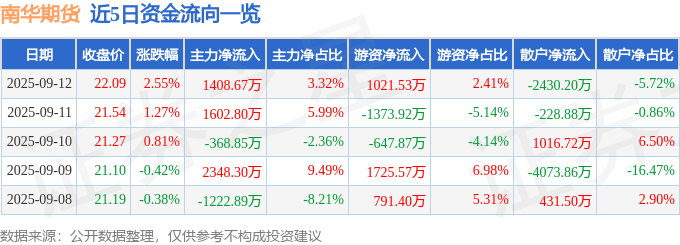
南华期货(603093)9月12日主力资金净买入1408.67万元
Sou Hu Cai Jing· 2025-09-12 07:21
Core Viewpoint - The stock of Nanhua Futures (603093) has shown a recent increase in price, with a closing price of 22.07 yuan on September 12, 2025, reflecting a 2.46% rise, amidst varying capital flows from different investor categories [1][2]. Financial Performance - For the first half of 2025, Nanhua Futures reported a main revenue of 1.101 billion yuan, a year-on-year decrease of 58.27%, while the net profit attributable to shareholders was 231 million yuan, a slight increase of 0.46% [3]. - The second quarter of 2025 saw a main revenue of 567 million yuan, down 65.54% year-on-year, with a net profit of 146 million yuan, up 0.66% year-on-year [3]. - The company’s debt ratio stands at 90.84%, with investment income reported at 130 million yuan [3]. Market Position and Ratios - Nanhua Futures has a total market value of 13.476 billion yuan, ranking 12th in the diversified financial industry, which has an average market value of 24.137 billion yuan [3]. - The company’s price-to-earnings ratio (P/E) is 29.14, while the industry average is -43.05, placing it 11th in the industry [3]. - The return on equity (ROE) for Nanhua Futures is 5.51%, significantly higher than the industry average of 1.66%, ranking 3rd in the industry [3]. Capital Flow Analysis - On September 12, 2025, the net inflow of main capital was 14.0867 million yuan, accounting for 3.32% of the total transaction amount, while retail investors saw a net outflow of 24.302 million yuan, representing 5.72% of the total [1][2]. - Over the past five days, the stock has experienced fluctuations in capital flow, with varying net inflows and outflows from main and retail investors [2]. Analyst Ratings - In the last 90 days, four institutions have provided ratings for Nanhua Futures, with one buy rating and three hold ratings, and the average target price set at 25.16 yuan [4].

铜产业风险管理日报-20250912
Nan Hua Qi Huo· 2025-09-12 02:38
Report Information - Report Title: Copper Industry Risk Management Daily Report [1] - Date: September 12, 2025 [2] - Research Team: Nanhua Non - ferrous Metals Research Team [2] - Analyst: Xiao Yufei [3] Investment Rating - The provided content does not mention the report industry investment rating. Core View - Copper prices rose in the overnight session on Wednesday due to the lower - than - expected US PPI data. Investors expect inflation data to further decline, which removes obstacles to the Fed's interest rate cuts and increases the probability of rate cuts, thus pushing up copper prices. The US inflation data on Thursday night met expectations, validating the PPI data. In the short term, with a tight supply side, copper prices face significant resistance at 79,000 yuan per ton, and the 20 - day moving average may provide support, with prices expected to stabilize above 80,000 yuan per ton [4] Content Summary by Category Copper Price and Volatility - The latest copper price is 80,130 yuan per ton, with a monthly price range forecast of 73,000 - 80,000 yuan per ton. The current volatility is 7.44%, and the historical percentile of the current volatility is 3.5% [3] Copper Risk Management Suggestions Inventory Management - For high - level finished product inventory and concerns about price drops, with a long spot position, the strategy is to sell 75% of the Shanghai Copper main futures contract at around 82,000 yuan per ton and sell 25% of the call option CU2511C82000 when volatility is relatively stable [3] Raw Material Management - For low - level raw material inventory and concerns about price increases, with a short spot position, the strategy is to buy 75% of the Shanghai Copper main futures contract at around 7,8000 yuan per ton [3] Factors Affecting Copper Prices Bullish Factors - The US and other countries reached an agreement on tariff policies; increased rate - cut expectations led to a decline in the US dollar index, boosting the valuation of non - ferrous metals; and the lower support level has been raised [5] Bearish Factors - Tariff policies are unstable; global demand has decreased due to tariff policies; and the US copper tariff policy adjustment has led to an extremely high COMEX inventory [6] Copper Futures Market Data | Futures Contract | Unit | Latest Price | Daily Change | Daily Change Rate | | --- | --- | --- | --- | --- | | Shanghai Copper Main | Yuan/ton | 80,130 | 0 | 0% | | Shanghai Copper Continuous 1 | Yuan/ton | 80,130 | 340 | 0.43% | | Shanghai Copper Continuous 3 | Yuan/ton | 80,100 | 0 | 0% | | LME Copper 3M | US dollars/ton | 10,057 | 45 | 0.45% | | Shanghai - London Ratio | Ratio | 8.11 | - 0.02 | - 0.25% | [7] Copper Spot Market Data | Spot Market | Unit | Latest Price | Daily Change | Daily Change Rate | | --- | --- | --- | --- | --- | | Shanghai Non - ferrous 1 Copper | Yuan/ton | 80,175 | 430 | 0.54% | | Shanghai Wumaotrade | Yuan/ton | 80,140 | 415 | 0.52% | | Guangdong Nanchu | Yuan/ton | 80,120 | 380 | 0.48% | | Yangtze Non - ferrous | Yuan/ton | 80,270 | 390 | 0.49% | | Shanghai Non - ferrous Premium | Yuan/ton | 85 | 25 | 41.67% | | Shanghai Wumaotrade Premium | Yuan/ton | 40 | 15 | 60% | | Guangdong Nanchu Premium | Yuan/ton | 60 | 15 | 33.33% | | Yangtze Non - ferrous Premium | Yuan/ton | 100 | 5 | 5.26% | [13] Copper Scrap - Refined Spread | Spread Type | Unit | Latest Price | Daily Change | Daily Change Rate | | --- | --- | --- | --- | --- | | Current refined - scrap spread (tax - included) | Yuan/ton | 1,628.51 | - 60 | - 3.55% | | Reasonable refined - scrap spread (tax - included) | Yuan/ton | 1,498.2 | - 0.6 | - 0.04% | | Price advantage (tax - included) | Yuan/ton | 130.31 | - 59.4 | - 31.31% | | Current refined - scrap spread (tax - excluded) | Yuan/ton | 6,320 | - 60 | - 0.94% | | Reasonable refined - scrap spread (tax - excluded) | Yuan/ton | 6,239.51 | - 4.16 | - 0.07% | | Price advantage (tax - excluded) | Yuan/ton | 80.49 | - 55.84 | - 40.96% | [17] Copper Warehouse Receipt and Inventory Data Shanghai Futures Exchange (SHFE) | Warehouse Receipt Type | Unit | Latest Price | Daily Change | Daily Change Rate | | --- | --- | --- | --- | --- | | Total SHFE copper warehouse receipts | Tons | 20,028 | 902 | 4.72% | | Total international copper warehouse receipts | Tons | 5,419 | 1,001 | 22.66% | | SHFE copper warehouse receipts in Shanghai | Tons | 1,530 | 0 | 0% | | Total bonded SHFE copper warehouse receipts | Tons | 0 | 0 | - 100% | | Total tax - paid SHFE copper warehouse receipts | Tons | 20,028 | 902 | 4.72% | [21] London Metal Exchange (LME) | Inventory Type | Unit | Latest Price | Daily Change | Daily Change Rate | | --- | --- | --- | --- | --- | | Total LME copper inventory | Tons | 154,175 | - 875 | - 0.56% | | LME copper inventory in Europe | Tons | 22,675 | 0 | 0% | | LME copper inventory in Asia | Tons | 16,500 | - 115,875 | - 87.54% | | LME copper inventory in North America | Tons | 0 | 0 | - 100% | | Total LME copper registered warehouse receipts | Tons | 133,325 | 0 | 0% | | Total LME copper cancelled warehouse receipts | Tons | 20,850 | - 875 | - 4.03% | [23] COMEX | Inventory Type | Unit | Latest Price | Weekly Change | Weekly Change Rate | | --- | --- | --- | --- | --- | | Total COMEX copper inventory | Tons | 309,834 | 7,090 | 2.34% | | Total COMEX copper registered warehouse receipts | Tons | 147,589 | - 3,239 | 1.09% | | Total COMEX copper cancelled warehouse receipts | Tons | 162,245 | - 458 | - 0.28% | [24] Copper Import Profit and Processing Data | Indicator | Unit | Latest Price | Daily Change | Daily Change Rate | | --- | --- | --- | --- | --- | | Copper import profit and loss | Yuan/ton | - 104.48 | - 109.58 | - 2148.63% | | Copper concentrate TC | US dollars/ton | - 40.5 | 0 | 0% | [25]
南华金属日报:CPI符合预期,贵金属高位震荡-20250912
Nan Hua Qi Huo· 2025-09-12 02:38
Report Summary 1. Report Industry Investment Rating No relevant content provided. 2. Core View of the Report - The medium - to long - term trend of precious metals may be bullish, while in the short - term, gold and silver are consolidating at high levels. For London gold, the support level is around $3600, with strong support in the $3500 area, and the resistance level has moved up to $3700. For London silver, the short - term support is around $40.5, with strong support in the $39.5 - 40 area, and the upper target has moved up to the $44 - 45 area. The operation strategy is to buy on dips, and existing long positions can be reduced on rallies [5]. 3. Summary by Relevant Catalogs 3.1 Market Review - On Thursday, the precious metals market fluctuated at high levels, with silver outperforming gold. The US inflation data met expectations, and the weekly initial jobless claims exceeded expectations, indicating cooling pressure in the job market. The contrast in monetary policies between Europe and the US pushed the US dollar index lower, which was beneficial for dollar - denominated precious metals. The high spot lease rate of silver reflected a tight supply in the silver spot market. Since the end of August, the strength of precious metals has been mainly driven by the increasing expectation of Fed easing and the significant decline in long - term US Treasury yields. As of the end, COMEX gold 2512 contract closed at $3673.4 per ounce, down 0.23%; COMEX silver 2512 contract closed at $42.065 per ounce, up 1.12%. SHFE gold 2510 main contract closed at 830.78 yuan per gram, down 0.31%; SHFE silver 2510 contract closed at 9798 yuan per kilogram, up 0.28%. The US CPI inflation in August basically met expectations, with the core CPI up 3.1% year - on - year and 0.3% month - on - month, and CPI up 2.9% year - on - year and 0.4% month - on - month. The number of initial jobless claims in the US last week increased to 263,000, a nearly four - year high. The ECB kept interest rates unchanged for the second consecutive meeting, and President Lagarde's hawkish remarks weakened the expectation of ECB rate cuts [2]. 3.2 Interest Rate Cut Expectations and Fund Holdings - The expectation of interest rate cuts within the year has slightly rebounded. Traders have priced in three rate cuts within the year, but the expectation of a 50 - basis - point cut in September has cooled. According to CME's "FedWatch" data, the probability of the Fed keeping interest rates unchanged in September is 0%, the probability of a 25 - basis - point cut is 93.9%, and the probability of a 50 - basis - point cut is 6.1%. For October, the probability of a cumulative 25 - basis - point cut is 7.6%, a 50 - basis - point cut is 86.8%, and a 75 - basis - point cut is 5.6%. For December, the probability of a cumulative 25 - basis - point cut is 0.5%, a 50 - basis - point cut is 13.1%, a 75 - basis - point cut is 81.2%, and a 100 - basis - point cut is 5.2%. In terms of long - term funds, the SPDR Gold ETF's holdings decreased slightly by 2.01 tons to 977.95 tons; the iShares Silver ETF's holdings remained at 15,069.6 tons. In terms of inventory, SHFE silver inventory decreased by 12 tons to 1240.2 tons, and SGX silver inventory decreased by 35.3 tons to 1248.3 tons as of the week ending September 5 [3]. 3.3 This Week's Focus - Attention should be paid to the preliminary value of the US University of Michigan Consumer Confidence Index tonight. This week marks the quiet period for Fed officials ahead of the September 18 Fed interest rate decision [4]. 3.4 Price and Inventory Data - **Precious Metals Futures and Spot Prices**: SHFE gold main contract was at 830.78 yuan per gram, down 0.32%; SGX gold TD was at 826.09 yuan per gram, down 0.44%; CME gold main contract was at $3673.4 per ounce, down 0.19%. SHFE silver main contract was at 9798 yuan per kilogram, up 0.02%; SGX silver TD was at 9772 yuan per kilogram, down 0.12%; CME silver main contract was at $42.065 per ounce, up 1%. The SHFE - TD gold spread was 4.69 yuan per gram, up 26.76%; the SHFE - TD silver spread was 26 yuan per kilogram, down 1300%. The CME gold - silver ratio was 87.3268, down 1.17% [6]. - **Inventory and Position Data**: SHFE gold inventory was 50,151 kilograms, up 9.14%; CME gold inventory was 1210.3089 tons, unchanged. SHFE gold position was 114,423 lots, down 4.19%; SPDR gold position was 977.95 tons, down 0.21%. SHFE silver inventory was 1240.187 tons, down 0.96%; CME silver inventory was 16,314.2027 tons, up 0.26%; SGX silver inventory was 1248.255 tons, down 2.75%. SHFE silver position was 203,343 lots, down 4.32%; SLV silver position was 15,069.602597 tons, down 0.45% [15][17]. 3.5 Other Market Data - **Stock, Bond, and Commodity Market Overview**: The US dollar index was at 97.5392, down 0.29%; the US dollar against the Chinese yuan was at 7.1152, down 0.04%. The Dow Jones Industrial Average was at 46,108 points, up 1.36%. WTI crude oil spot was at $62.37 per barrel, down 2.04%. LmeS copper 03 was at $10,057 per ton, up 0.45%. The 10 - year US Treasury yield was at 4.01%, down 0.74%; the 10 - year US real interest rate was at 1.67%, down 1.18%; the 10 - 2 - year US Treasury yield spread was at 0.49%, down 2% [22].