LZLJ(000568)

Search documents
张坤等知名基金经理罕见发声!
天天基金网· 2026-01-22 05:20
Group 1 - The core viewpoint of the article highlights the strategic adjustments made by prominent fund managers at E Fund in their investment portfolios for Q4 2025, focusing on sectors like AI, healthcare, consumer goods, and technology [2][4][6][10] Group 2 - Zhang Kun adjusted the structure of investments in the healthcare, consumer, and technology sectors while maintaining a stable position in top holdings, which include Tencent Holdings, Kweichow Moutai, and Alibaba-W [4][5] - Zhang Kun expressed confidence in the improvement of living standards and social security in China over the next decade, suggesting a narrowing gap with developed countries [4] - The AI wave is seen as a significant driver for innovation, with strong domestic demand expected to attract global resources and talent [4][5] Group 3 - Chen Hao focused heavily on AI-related sectors, increasing allocations in power equipment, new energy, non-bank financials, and chemicals, which yielded positive returns [7][8] - Chen Hao anticipates a transition of the AI industry from an acceleration phase in 2025 to a stable growth phase in 2026, emphasizing the importance of structural opportunities and the integration of AI with local applications [7][8] Group 4 - Xiao Nan reduced allocations in high-end and sub-high-end liquor sectors while increasing investments in the livestock industry, anticipating inflation-driven cost increases over the next two years [10] - The top holdings in Xiao Nan's consumer sector fund remained unchanged, including Kweichow Moutai and Midea Group [10]







组合中企业“护城河还在,城在不在”?张坤在2025年四季报中给出了明确回答
Xin Lang Cai Jing· 2026-01-22 03:40
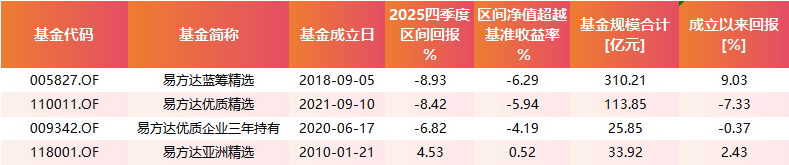
Core Viewpoint - The report highlights the investment strategies of top fund managers, particularly focusing on Zhang Kun from E Fund, who has made adjustments in his portfolio amidst market fluctuations, maintaining a long-term optimistic outlook on China's economic transformation and the growth of domestic demand [1][10]. Fund Performance - As of the end of Q4 2025, Zhang Kun managed funds totaling 48.383 billion yuan, with three A-share focused products underperforming against benchmarks, while the E Fund Asia Select, which invests in overseas Chinese stocks, achieved a positive return of 4.53% [1][2][10]. - The performance of the funds is as follows: - E Fund Blue Chip Select: -8.93% return, 31.021 billion yuan in size - E Fund Quality Select: -8.42% return, 11.385 billion yuan in size - E Fund Quality Enterprise Three-Year Holding: -6.82% return, 2.585 billion yuan in size - E Fund Asia Select: 4.53% return, 3.392 billion yuan in size [2][12]. Portfolio Adjustments - In Q4 2025, Zhang Kun reduced holdings in key stocks such as Kweichow Moutai, Wuliangye, Shanxi Fenjiu, and Luzhou Laojiao, while maintaining overall stock positions but adjusting sector allocations towards pharmaceuticals, consumer goods, and technology [3][13]. - The top holdings in the portfolio include Tencent Holdings (6.93%), Kweichow Moutai (6.87%), and Wuliangye (6.70%), with notable reductions in their respective weightings [3][13]. Economic Outlook - Zhang Kun expressed a long-term optimistic view on macroeconomic conditions, predicting significant improvements in living standards and social security in China over the next decade, narrowing the gap with developed countries [4][14]. - He emphasized the unique advantages of the Chinese market in the context of the global AI wave, suggesting that a strong domestic demand market is a crucial driver for technological innovation [4][14]. Investment Philosophy - The report indicates that despite current market pessimism regarding core assets, Zhang Kun believes that the intrinsic value of quality companies remains intact, presenting attractive investment opportunities for long-term investors [5][15]. - The central economic work conference highlighted the importance of boosting consumption and expanding domestic demand as key tasks for 2026, reinforcing the focus on consumer-driven growth [6][16]. GDP Growth Projections - According to the "14th Five-Year Plan," China aims to achieve a per capita GDP of $23,400 by 2035, requiring a compound annual growth rate of 5.27% from the current level of $13,300 [7][17]. - The report notes that the decline in housing prices over the past five years has negatively impacted consumer wealth and spending, but this trend may be reversing, potentially improving consumer sentiment and demand [8][18].





张坤2025四季报发声:强大内需不仅是“消费引擎”,更是“科技创新的燃料”
Xin Lang Cai Jing· 2026-01-22 03:34
Core Viewpoint - The report highlights the investment strategies of top fund managers, particularly focusing on Zhang Kun from E Fund, who has made adjustments in his portfolio amidst market fluctuations, maintaining a long-term optimistic outlook on China's economic transformation and the growth of the domestic market [1][10]. Fund Performance - As of the end of Q4 2025, Zhang Kun managed a total fund size of 48.383 billion yuan, which reflects adjustments from the previous quarter [1]. - Three of the funds primarily investing in A-shares reported negative quarterly returns, failing to outperform their benchmarks, while the E Fund Asia Select, which focuses on overseas Chinese stocks, achieved a positive return of 4.53%, significantly exceeding its benchmark [2][10]. Portfolio Adjustments - In Q4 2025, there was a reduction in holdings of key stocks such as Kweichow Moutai, Wuliangye, Shanxi Fenjiu, and Luzhou Laojiao, while maintaining a stable stock position overall [3][13]. - The adjustments focused on reallocating investments in sectors such as pharmaceuticals, consumer goods, and technology [3][13]. Economic Outlook - Zhang Kun expressed a long-term optimistic view on the macroeconomic environment, predicting significant improvements in living standards and social security in China over the next decade, narrowing the gap with developed countries [4][14]. - He emphasized the unique advantages of the Chinese market in the context of the global AI wave, noting that a strong domestic demand market is a crucial driver for technological innovation [4][14]. Investment Philosophy - The report addresses concerns regarding the long-term value of core assets, with Zhang Kun asserting that the underlying value remains intact and that current market pessimism has created attractive valuations for quality companies [5][15]. - He believes that the current low valuation of quality assets presents a rare opportunity for long-term investors [5][15]. Policy Context - The Central Economic Work Conference in December emphasized the importance of boosting consumption and expanding domestic demand as a key task for 2026, highlighting the government's commitment to enhancing consumer spending [6][16]. - The report notes that recent indicators show domestic consumption has been weak, particularly for companies focused on domestic demand compared to those reliant on exports [6][16]. GDP Growth Projections - According to the "14th Five-Year Plan," China aims to achieve a per capita GDP level comparable to that of middle-income developed countries by 2035, requiring a compound annual growth rate of 5.27% [7][17]. - The report suggests that the decline in housing prices over the past five years has negatively impacted consumer wealth and spending, but this trend may be reversing due to potential policy support and lower interest rates [7][17].
机构看好零食乳业弹性,白酒估值修复可期,消费ETF嘉实(512600)布局消费复苏行情
Xin Lang Cai Jing· 2026-01-22 03:32
Group 1 - The core viewpoint of the articles highlights the performance of the consumer sector in China, particularly the growth of brand value for Kweichow Moutai, which increased by 2.2% to reach $59.63 billion, ranking first in the global liquor industry [1] - The China Securities Index shows that the major consumer index has risen by 0.20%, with significant gains from stocks such as Hainan Rubber (+2.15%), Yanjing Beer (+1.64%), and Dongpeng Beverage (+1.53%) [1] - The market is currently favoring sectors like snacks and dairy, which are experiencing clear growth and higher elasticity, driven by policy support and improving monthly data, while the liquor sector is in a "bottoming out" phase [1] Group 2 - The major consumer index includes leading A-share consumer stocks across various categories, with liquor being the largest sector, accounting for over 38% of the index [2] - The top ten weighted stocks in the major consumer index, which include Yili, Kweichow Moutai, and Wuliangye, collectively account for 68.63% of the index [1] - Investors can also access the consumer recovery trend through the Consumption ETF linked fund (009180) [3]



易方达基金张坤Q4持仓出炉:前十大重仓包括腾讯控股、贵州茅台等
Zhong Guo Zheng Quan Bao· 2026-01-22 02:35
Group 1 - The core viewpoint of the news is that E Fund's Blue Chip Select Fund, managed by Zhang Kun, has maintained a stable stock position while adjusting its sector allocations in pharmaceuticals, consumer goods, and technology as of Q4 2025 [1] - The top ten holdings of the fund as of the end of Q4 2025 include Tencent Holdings, Kweichow Moutai, Wuliangye, Alibaba-W, Shanxi Fenjiu, Luzhou Laojiao, Yum China, CNOOC, JD Health, and Focus Media, showing no changes from Q3 2025 [1] - Zhang Kun expresses confidence that both the actual living standards and social security levels in China will significantly improve over the next decade, narrowing the gap with developed countries [1] Group 2 - The current AI wave highlights the importance of a strong domestic demand market in promoting technological innovation, as it attracts global resources, talent, and capital [2] - Subscription revenues, such as the approximately $200 annual fee for C-end users of leading AI models like GPT and Gemini, are crucial for companies' financing and ongoing investment confidence amid debates about an "AI bubble" [2] - A domestic company with leading foundational model capabilities could benefit from a stronger consumer environment, enhancing subscription income and model investment interactions, which may help it catch up with global leaders [2]
酒价内参1月22日价格发布 习酒君品下跌13元
Xin Lang Cai Jing· 2026-01-22 01:23
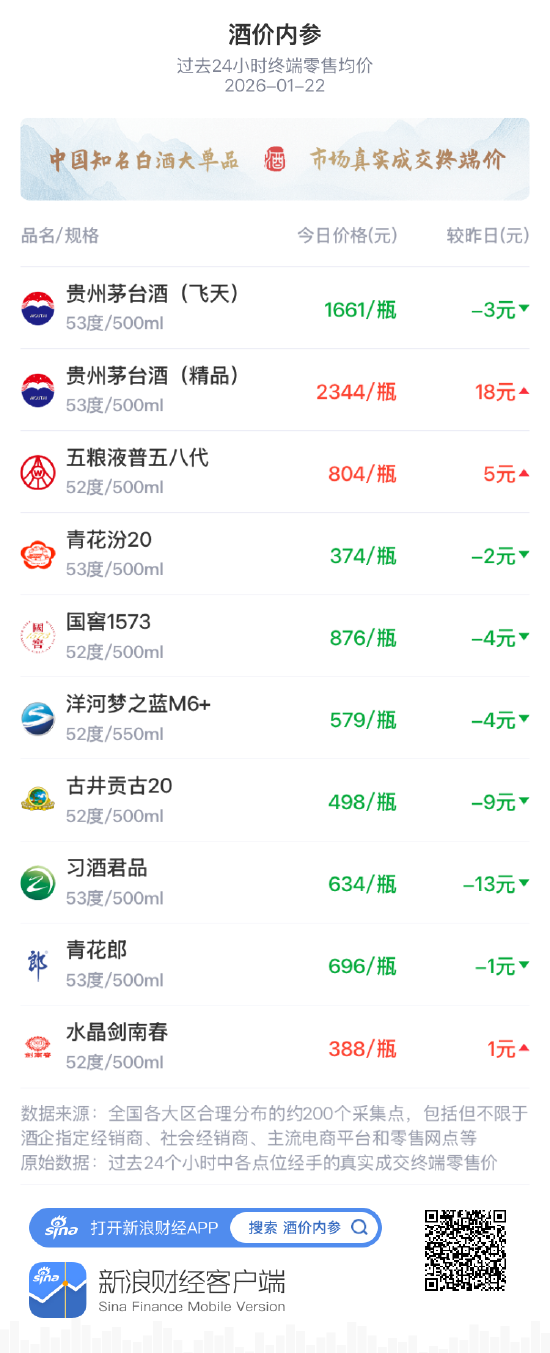
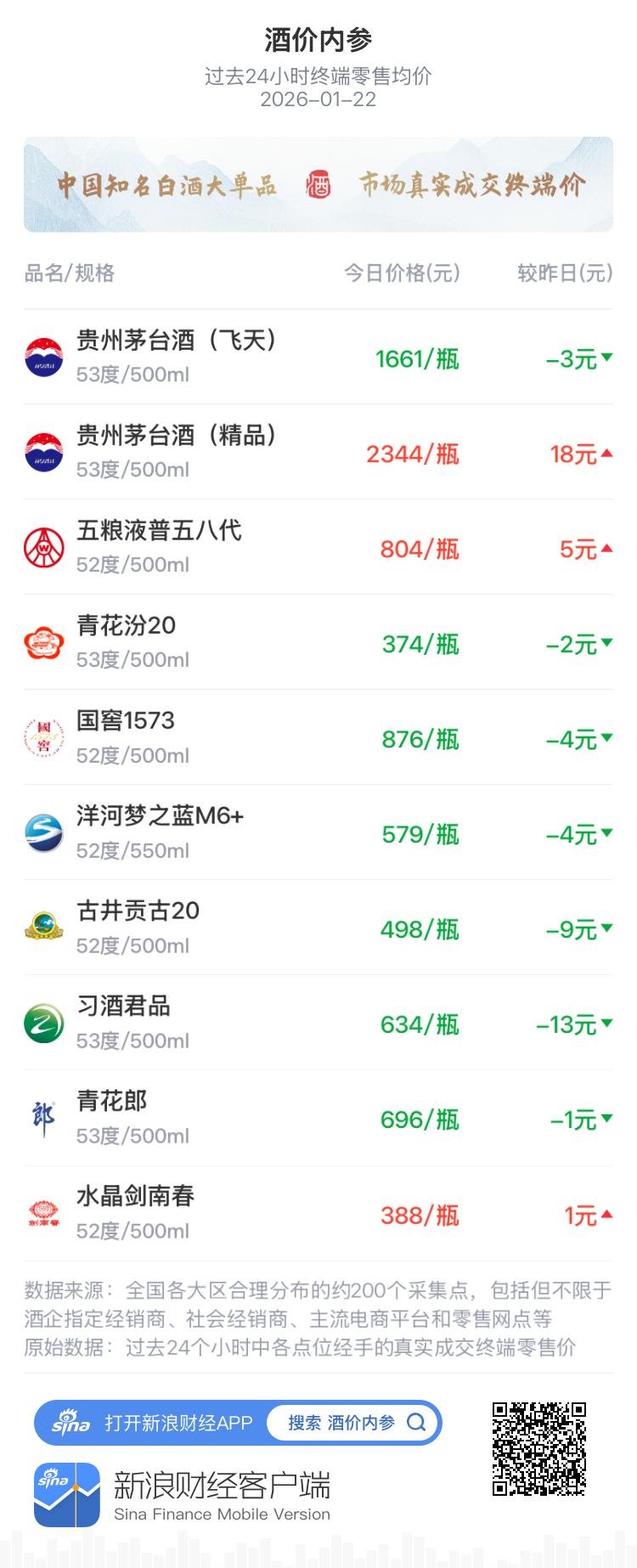
Core Insights - The Chinese liquor market is experiencing a general decline in retail prices, with the average price of the top ten products dropping to 8,854 yuan, a decrease of 12 yuan from the previous day, marking the fifth consecutive decline to a two-month low [1][7][8] - The market shows a mixed trend with seven products declining and three increasing in price, indicating a short-term adjustment phase in the industry [1][8] Price Trends - The leading product, Xijiu Junpin, saw the largest drop of 13 yuan per bottle, while Gujing Gonggu followed with a decrease of 9 yuan per bottle [1][8] - Other notable declines include Guojiao 1573 and Yanghe Dream Blue M6+, both down by 4 yuan per bottle, and Feitian Moutai, which decreased by 3 yuan per bottle [1][8] - In contrast, the premium Moutai product increased significantly by 18 yuan per bottle, attributed to tightened supply and replenishment demand [1][8] Data Collection Methodology - The "Liquor Price Reference" collects data from approximately 200 points across various regions, including designated distributors, social distributors, e-commerce platforms, and retail outlets, ensuring a comprehensive and objective representation of market prices [2][9] - The pricing data is weighted based on actual transaction volumes to provide accurate retail price calculations for products like Feitian Moutai and premium Moutai [2][9] Brand Value Insights - Moutai ranks first in the global spirits industry with a brand value of 59.63 billion USD, reflecting a 2.2% year-on-year increase, underscoring its role as a benchmark for Chinese liquor brands [3][9] - The Brand Finance report indicates that while the number of Chinese brands in the top 500 decreased by one, the total brand value increased by 9.7%, with an average brand strength index of 76.4, surpassing the global average [3][9]


酒价内参1月22日价格发布 市场延续下跌五创两月价格新低
Xin Lang Cai Jing· 2026-01-22 00:59
Core Viewpoint - The Chinese liquor market is experiencing a general decline in retail prices for the top ten products, marking the fifth consecutive drop in two months, with high-end liquor prices continuing to decrease, indicating a short-term adjustment in the industry [1]. Price Trends - The overall retail price for a package of the top ten liquor products is 8,854 yuan, down by 12 yuan from the previous day [1]. - Among the top ten products, seven saw price declines while three experienced price increases, highlighting a clear market downturn [1]. Specific Product Performance - The leading price drop was observed in Xijiu Junpin, which decreased by 13 yuan per bottle; followed by Gujing Gonggu with a drop of 9 yuan; and both Guojiao 1573 and Yanghe Dream Blue M6+ with declines of 4 yuan each [1][3][4]. - The only products that saw price increases were the premium Moutai, which rose by 18 yuan per bottle due to tightened channel supply and replenishment demand, and Wuliangye Pu 58th generation, which increased by 5 yuan [1][3]. Market Dynamics - The market is characterized by a significant divergence in the performance of leading liquor brands, with only a few showing signs of recovery from the price declines [1]. - The continuous supply of lower-priced Moutai is further weakening the support for terminal prices [1].
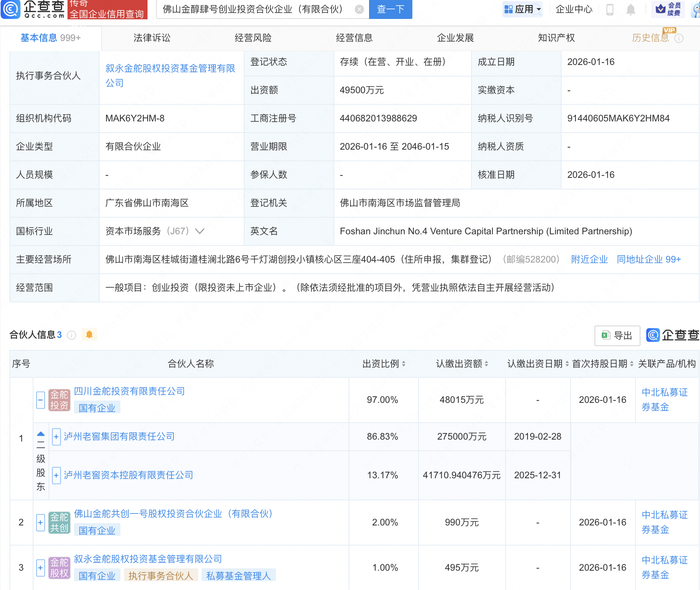
泸州老窖等新设创投合伙企业,出资额4.95亿
Qi Cha Cha· 2026-01-22 00:18
Group 1 - Foshan Jinchun No.4 Venture Capital Partnership (Limited Partnership) has been established with a total investment of 495 million yuan, focusing on venture capital investments in unlisted companies [1][2] - The partnership is co-funded by Sichuan Jinjue Investment Co., Ltd., a subsidiary of Luzhou Laojiao Group [1][2] - The registered office of the partnership is located in Nanhai District, Foshan City, Guangdong Province, with a business duration from January 16, 2026, to January 15, 2046 [2] Group 2 - Sichuan Jinjue Investment Co., Ltd. holds a 97% stake in the partnership, contributing 480.15 million yuan [2] - Luzhou Laojiao Group Limited Liability Company has a significant investment history, with a total contribution of 275 million yuan since February 28, 2019 [2] - The partnership's operational scope includes general projects in venture capital, specifically limited to investments in unlisted enterprises [2]
食品饮料行业今日跌1.53%,主力资金净流出24.16亿元
Zheng Quan Shi Bao Wang· 2026-01-21 09:20
Market Overview - The Shanghai Composite Index rose by 0.08% on January 21, with 18 out of the 28 sectors experiencing gains. The top-performing sectors were non-ferrous metals and electronics, with increases of 2.79% and 2.62% respectively [1] - The banking and coal sectors saw the largest declines, with drops of 1.58% and 1.57% respectively [1] Capital Flow Analysis - The net inflow of capital in the two markets was 11.983 billion yuan, with 14 sectors receiving net inflows. The electronics sector led with a net inflow of 16.369 billion yuan, while the non-ferrous metals sector followed with a net inflow of 7.289 billion yuan [1] - Conversely, 17 sectors experienced net outflows, with the power equipment sector seeing the largest outflow of 6.688 billion yuan, followed by the defense and military sector with an outflow of 2.906 billion yuan [1] Food and Beverage Sector Performance - The food and beverage sector declined by 1.53%, with a net outflow of 2.416 billion yuan. Out of 124 stocks in this sector, 23 rose while 97 fell, including one stock that hit the daily limit down [2] - The top three stocks with the highest net inflows in the food and beverage sector were "Hao Xiang Ni" with 61.106 million yuan, "*ST Chun Tian" with 12.8997 million yuan, and "Wei Zhi Xiang" with 12.7381 million yuan [2] - Major stocks with significant net outflows included Kweichow Moutai with 9.52 billion yuan, Wuliangye with 3.66 billion yuan, and Shanxi Fenjiu with 1.33 billion yuan [2][4] Food and Beverage Sector Capital Inflow and Outflow - The capital inflow leaderboard in the food and beverage sector included "Hao Xiang Ni" (+8.11%), "*ST Chun Tian" (+4.85%), and "Wei Zhi Xiang" (+1.43%) [2] - The capital outflow leaderboard featured Kweichow Moutai (-1.64%), Wuliangye (-1.77%), and Shanxi Fenjiu (-2.34%) [4]


白酒板块1月21日跌1.83%,*ST岩石领跌,主力资金净流出26.42亿元
Zheng Xing Xing Ye Ri Bao· 2026-01-21 08:53
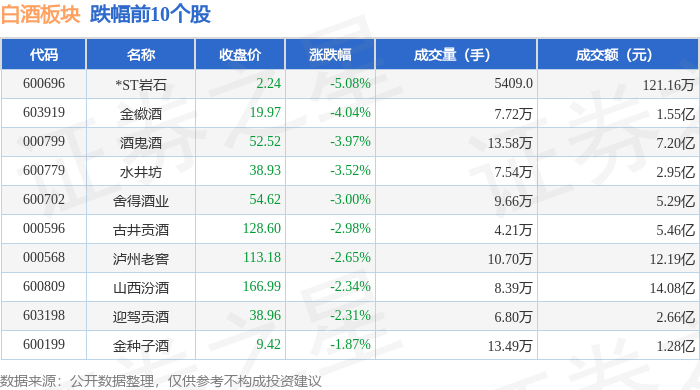
Core Viewpoint - The liquor sector experienced a decline of 1.83% on January 21, with *ST Rock leading the drop, while the overall market indices showed slight increases [1] Group 1: Market Performance - The Shanghai Composite Index closed at 4116.94, up 0.08% [1] - The Shenzhen Component Index closed at 14255.12, up 0.7% [1] - The liquor sector saw a net outflow of 2.642 billion yuan from main funds, while retail investors contributed a net inflow of 858 million yuan [1] Group 2: Individual Stock Performance - *ST Rock closed at 2.24 yuan, down 5.08% with a trading volume of 5409 lots [1] - Other notable declines included Quan Wei Jiu down 4.04%, Zhi Si Li down 3.97%, and Shui Jing Fang down 3.52% [1] - The highest closing price was for Shanxi Fen Jiu at 166.99 yuan, down 2.34% [1] Group 3: Fund Flow Analysis - Main funds showed a significant outflow from several stocks, including Lao Bai Gan Jiu with a net outflow of 18.7589 million yuan [2] - Retail investors had a net inflow in stocks like Jin Shi Zi Jiu, which saw a net inflow of 12.814 million yuan [2] - The overall trend indicates a mixed sentiment among different types of investors within the liquor sector [2]