CHANGAN AUTOMOBILE-B(000625)

Search documents
央国企新能源掀起融资上市潮
Jing Ji Guan Cha Wang· 2025-12-05 14:41
Core Viewpoint - Central state-owned enterprises (SOEs) in the new energy vehicle (NEV) sector are initiating a collective counter-offensive to improve their market position and operational efficiency, following a series of IPO applications and capital operations aimed at enhancing their competitiveness against private companies like BYD and Tesla [1][2][10]. Group 1: Market Performance and Challenges - From January to November, BYD achieved cumulative sales of 4.182 million vehicles, while Tesla's sales in China were lower but still significant due to its global influence and profitability [3]. - In contrast, major SOEs like SAIC Motor and Changan Automobile reported significantly lower sales figures, with SAIC selling 1.499 million NEVs and Changan 995,000 NEVs during the same period [3]. - The performance of high-end brands under these SOEs, such as Lantu and Avita, remains modest, with annual sales ranging from tens of thousands to a few hundred thousand units, indicating a struggle to capture market attention and innovate effectively [3]. Group 2: Financial Struggles and Strategic Shifts - Private companies have established sustainable profit paths through vertical integration and technology development, with BYD reporting a net profit of 23.33 billion yuan and Tesla 2.91 billion USD (approximately 20.91 billion yuan) in the first three quarters of the year [4]. - In contrast, many SOE NEV businesses are still in the investment phase, facing significant losses, such as Avita's cumulative loss exceeding 11 billion yuan and Lantu's loss of about 3.1 billion yuan from 2022 to 2024 [4]. - The State-owned Assets Supervision and Administration Commission (SASAC) is pushing for performance assessments focused on efficiency and returns, prompting SOEs to seek market-driven reforms and independent operations [4][5]. Group 3: Capitalization and Market Mechanisms - The recent wave of IPOs and financing is viewed as a critical move for SOEs to establish independent operational mechanisms and secure necessary funding for R&D and market expansion [5][6]. - Analysts suggest that independent listings will compel these companies to improve governance structures and attract talent, addressing historical inefficiencies in innovation [7]. - The goal is to balance the manufacturing strengths of traditional SOEs with the agility and resources gained from capital markets, creating a new competitive edge [7]. Group 4: Future Industry Dynamics - The influx of capital will intensify competition in technology differentiation and production scale, with brands needing to effectively convert funding into production and sales to maintain cash flow [8]. - The industry is expected to undergo significant consolidation, with predictions that the number of NEV manufacturers in China could shrink to fewer than 15, making successful IPOs a critical factor for survival [9][10]. - Global market expansion will become increasingly important, as domestic competition intensifies, and SOEs leverage their parent companies' global strategies to compete internationally [10].



12月5日深证国企股东回报(970064)指数涨1.95%,成份股电投能源(002128)领涨
Sou Hu Cai Jing· 2025-12-05 11:27
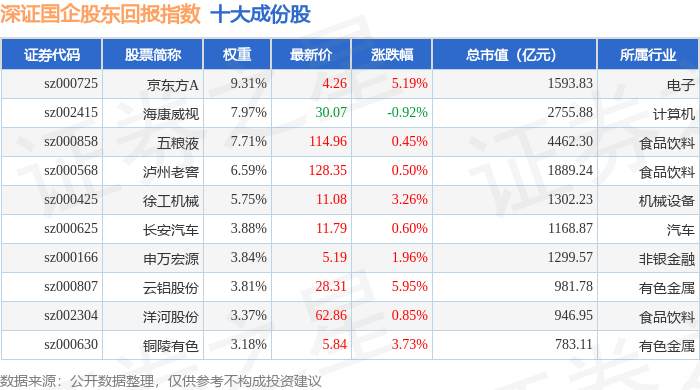
Core Viewpoint - The Shenzhen State-Owned Enterprises Shareholder Return Index (970064) closed at 1668.3 points on December 5, with a 1.95% increase and a trading volume of 32.01 billion yuan, indicating positive market sentiment towards state-owned enterprises [1]. Group 1: Index Performance - The index saw 43 constituent stocks rise, with Electric Power Investment leading at a 6.96% increase, while 6 stocks declined, with China Merchants Shekou leading the decline at 1.91% [1]. - The top ten constituent stocks of the index include BOE Technology Group (9.31% weight, 4.26 yuan, 5.19% increase) and Huatai Securities (3.84% weight, 5.19 yuan, 1.96% increase) [1]. Group 2: Capital Flow - The net inflow of main funds into the index's constituent stocks totaled 1.242 billion yuan, while retail investors experienced a net outflow of 365 million yuan [3]. - Major stocks like BOE Technology Group had a net inflow of 901 million yuan, while other stocks like Tongling Nonferrous Metals saw a net inflow of 205 million yuan [3]. Group 3: Index Adjustments - Recent adjustments to the index included the addition of 10 new stocks and the removal of 10 stocks, reflecting changes in market dynamics [4]. - New additions include Zhongmi Holdings (total market value 7.349 billion yuan) and Gujing Gongjiu (total market value 87.906 billion yuan), while removals include Xinyu Media and Yanghe Brewery [4].






长安启源A06订单超3万辆 但因提车周期长被车主吐槽!多地经销商:店内无现车
Mei Ri Jing Ji Xin Wen· 2025-12-05 11:21
Core Insights - Changan Qiyuan A06 has received over 30,000 orders within a month of its launch, but long delivery times have led to customer complaints [2][5][6] - The production capacity constraints at the Changan Ford second factory are the primary reason for the extended delivery times [3][5] - Changan Qiyuan is pursuing a "big product" strategy, aiming for annual sales of 200,000 units for key models, with Qiyuan A06 seen as a potential flagship [7][8] Production and Delivery Issues - The delivery cycle for Qiyuan A06 is currently at least one month due to limited factory capacity, with most vehicles being delivered to customers who placed orders in early November [3][5] - The Changan Ford second factory, which has been modified to produce Qiyuan A06, has a designed capacity of 350,000 units but is currently ramping up to produce 70,000 units annually [3][5] - As of November 30, Qiyuan A06 has accumulated orders exceeding 30,000, indicating a supply-demand imbalance [5] Customer Reactions - Some customers have opted to cancel their orders due to the lengthy wait times, particularly with the impending end of purchase subsidy policies [6] - Changan Qiyuan is exploring solutions to address the delays, including production material guarantees and tax policy support [6] Sales Strategy - Changan Qiyuan's strategy includes the development of "big products" that can achieve sales of over 20,000 units annually, with Qiyuan A06 and other models like Q05 identified as potential candidates [7][8] - The current sales performance shows that while Qiyuan has exceeded 30,000 units in sales for several months, reliance on models like Lumin is insufficient for long-term success [8]
长安汽车:阿维塔已经完成超700家渠道触点布局,覆盖超200个城市
Mei Ri Jing Ji Xin Wen· 2025-12-05 11:09
每经AI快讯,有投资者在投资者互动平台提问:阿维塔现在门店数是多少,与2023年和2024年相比如 何? (记者 张明双) 长安汽车(000625.SZ)12月5日在投资者互动平台表示,渠道方面,阿维塔已经完成超700家渠道触点 布局,覆盖超200个城市,为更多用户提供更便利的服务。 ...
销量、营收、核心市场份额占比不断提升,海外市场成新增长极
Zhong Guo Qi Che Bao Wang· 2025-12-05 09:57
Core Viewpoint - The Chinese automotive industry is transitioning from incremental competition to stock competition, with overseas markets becoming a new growth driver as domestic competition intensifies [4][8]. Export Growth - In October, China's automotive exports reached 666,000 units, a month-on-month increase of 2.1% and a year-on-year increase of 22.9%. From January to October, exports totaled 5.616 million units, up 15.7% year-on-year [4]. - The export growth rate is outpacing domestic production and sales growth, indicating a shift in focus for Chinese automakers towards international markets [4]. Company Performance - Chery's overseas sales for January to October reached 1.06 million units, accounting for 46% of total sales, with a year-on-year growth of 13% [5]. - BYD's overseas sales for the same period were 780,000 units, a significant increase of 130%, raising its export share to 21% [5]. - Great Wall Motors reported overseas sales of 454,100 units, making up nearly 37% of total sales, with a 44.61% increase compared to 2023 [5]. - Geely's overseas sales reached nearly 300,000 units, with a remarkable 214% increase in exports of new energy vehicles [6]. Market Expansion - GAC's overseas terminal sales grew by 36.5%, covering 85 countries and regions, with over 570 sales outlets [7]. - Chinese automotive brands are increasingly penetrating mature markets like the EU, with a record 7.4% market share in the European passenger car market as of September 2025, doubling from 3.3% year-on-year [14]. Revenue Contribution - Chery's revenue for the first three quarters of 2025 was 214.83 billion yuan, a 17.9% increase year-on-year, with exports contributing significantly to this growth [10]. - BYD's overseas revenue share increased from 28% in 2024 to 36.5% in the third quarter of 2025, with a net profit margin of 4.2% [11]. - Great Wall Motors' overseas revenue surged to 80.3 billion yuan, accounting for 39.69% of total revenue [12]. Strategic Insights - Chinese automakers are focusing on localizing products to meet diverse market needs, which is essential for integrating into local markets [9][20]. - The shift from product export to ecological output is becoming a key strategy for Chinese car manufacturers, enhancing their competitiveness in international markets [13][19]. - The global market share of Chinese automobiles is expected to exceed 38% by 2025, with significant growth in emerging markets like Southeast Asia and Africa [14][16]. Future Projections - By 2030, it is anticipated that Chinese automotive brands will achieve over 12% market share in overseas markets, with sales reaching nearly 10 million units [18]. - The global expansion of Chinese car manufacturers is accelerating, with strategies focusing on building a global vehicle that meets diverse market demands [19].




9家主流车企年度销量目标完成率超八成 零跑、小鹏、小米提前达成KPI
Xin Lang Cai Jing· 2025-12-05 08:40
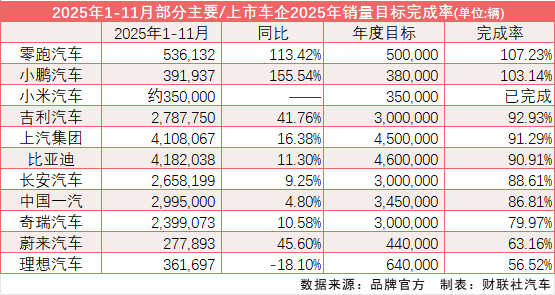
Core Viewpoint - The Chinese automotive market is experiencing a year-end "sprint" driven by the approaching policy window, pressure to meet annual sales targets, and a surge in consumer demand [1] Group 1: Sales Performance - As of November, major domestic car manufacturers have varying completion rates for their 2025 sales targets, with Leap Motor, Xpeng, and Xiaomi having already met their goals, while NIO and Li Auto are below 70% completion [1] - Leap Motor achieved 536,132 vehicle deliveries from January to November, a year-on-year increase of 113.42%, exceeding its annual target of 500,000 vehicles by 7.23% [2] - Xpeng delivered 391,937 vehicles in the same period, marking a 155.54% year-on-year growth and successfully meeting its annual target of 380,000 vehicles [3] - Xiaomi's total sales reached approximately 350,000 vehicles, also achieving its annual target [3] - Geely, SAIC Group, and BYD have completion rates of 92.93%, 91.29%, and 90.91% respectively, with Geely's sales reaching 2.787 million vehicles, a 41.76% increase year-on-year [2][4] - NIO and Li Auto reported significantly lower completion rates, with NIO at 63.16% and Li Auto at 56.52% [2][6] Group 2: Market Trends and Strategies - Leap Motor aims to reach a sales target of 1 million vehicles in 2026, supported by the launch of new models like the A10 and Lafa5 [3] - Xpeng's overseas market performance has been a highlight, with 39,773 vehicles delivered internationally, a 95% increase year-on-year [3] - Geely's growth is driven by its strong performance in the new energy sector, with 153.4 million new energy vehicles sold, a 97% increase [4] - SAIC Group's sales have shown resilience, with a total of 4.108 million vehicles sold, a 16.4% increase year-on-year [5] - BYD's sales reached 4.182 million vehicles, but it has faced a decline in monthly performance since September, attributed to increased competition and market saturation [5] Group 3: Challenges and Outlook - NIO's performance has been inconsistent, with a total of 277,893 vehicles delivered, and it faces a challenging target of 43,000 deliveries in December to meet its quarterly guidance [6] - Li Auto has experienced a decline in deliveries for six consecutive months, with a focus on resolving supply issues for its i6 model [6] - The overall passenger car market in China saw a wholesale increase of 11% year-on-year, but consumer sentiment is cautious due to tightening policies on trade-in and scrappage subsidies [6]


长安汽车:新能源汽车快速增长
数说新能源· 2025-12-05 03:28
Core Viewpoint - The company has shown strong sales growth in both domestic and overseas markets, particularly in the new energy vehicle segment, which is becoming a key growth driver for the company [2][3][4]. Group 1: Sales Performance - In November, the company's overall wholesale vehicle sales reached 284,000 units, a year-on-year increase of 2.5% [2]. - Cumulative sales from January to November reached 2.658 million units, representing a year-on-year growth of 9.3% [2]. - The new energy vehicle segment achieved record sales of 126,000 units in November, up 23.3% year-on-year, with cumulative sales nearing 1 million units, reflecting a 54.7% increase [2]. Group 2: Overseas Market - In November, overseas market sales totaled 56,000 units, marking a significant year-on-year growth of 46.7% [3][5]. - Cumulative overseas sales from January to November reached 584,000 units, with a year-on-year increase of 15.7% [3]. Group 3: Key Models and Brands - The Changan Inertia series sold 77,000 units in November, with cumulative sales exceeding 870,000 units from January to November [3]. - The CS75 and Yidong series maintained strong sales performance, with a year-on-year growth of 31% and cumulative sales exceeding 360,000 units, reflecting an increase of over 40% [3]. - Deep Blue Automotive achieved global sales of 33,000 units in November, with cumulative deliveries surpassing 300,000 units, a year-on-year increase of over 57% [4]. Group 4: Future Plans and Innovations - The company plans to set targets above industry growth rates for next year, with a global partner conference scheduled to announce overall planning, including new product launches and future robotics initiatives [6][8]. - The company is set to introduce new products across several brands, including a collaboration with Huawei for Avita, which is expected to significantly reduce losses and achieve profitability in the following year [8]. - The company is also investing in robotics, with plans to unveil a car-mounted robot concept at the Beijing Auto Show, aiming for mass production after safety testing [17]. Group 5: Financial Outlook - The break-even point for the Avita brand is estimated to be between 25,000 and 30,000 units per month, with expectations of achieving profitability in the first quarter of next year [9]. - The company anticipates a growth rate of 1% to 1.5% for the automotive industry next year, with optimistic projections for both domestic and export markets [10].

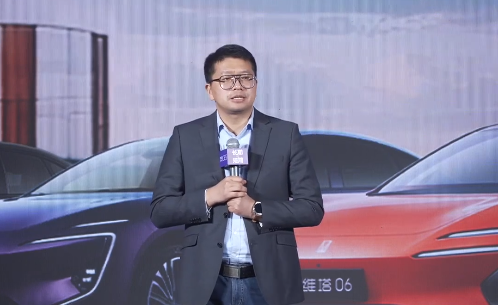
阿维塔雍军:供应链和主机厂要一起做全球化
Xin Lang Cai Jing· 2025-12-05 03:12
Core Viewpoint - The 2025 New Automotive Cooperation Ecosystem Exchange Conference emphasizes the need for collaboration between supply chain partners and manufacturers to achieve globalization in the automotive industry [1][4]. Group 1: Globalization Strategy - Companies like Avita and Changan are pursuing globalization, currently achieving satisfactory sales through KD (knock-down) or direct trade methods [1][4]. - As globalization reaches a certain scale, companies will inevitably face tariff barriers between countries, necessitating a strategic approach to market entry [1][4]. - The proposed model involves "serving one country in one country," indicating a deeper commitment to local markets [1][4]. Group 2: Supply Chain Integration - The entry into new markets should not only involve manufacturers but also the entire supply chain, highlighting the importance of collaboration [1][4]. - Support from all suppliers is crucial throughout the processes of product experience, innovation, and globalization [1][4].
比亚迪赚走6成利润,6家新势力亏掉107亿,14大车企前三季度业绩锐评
3 6 Ke· 2025-12-05 02:56
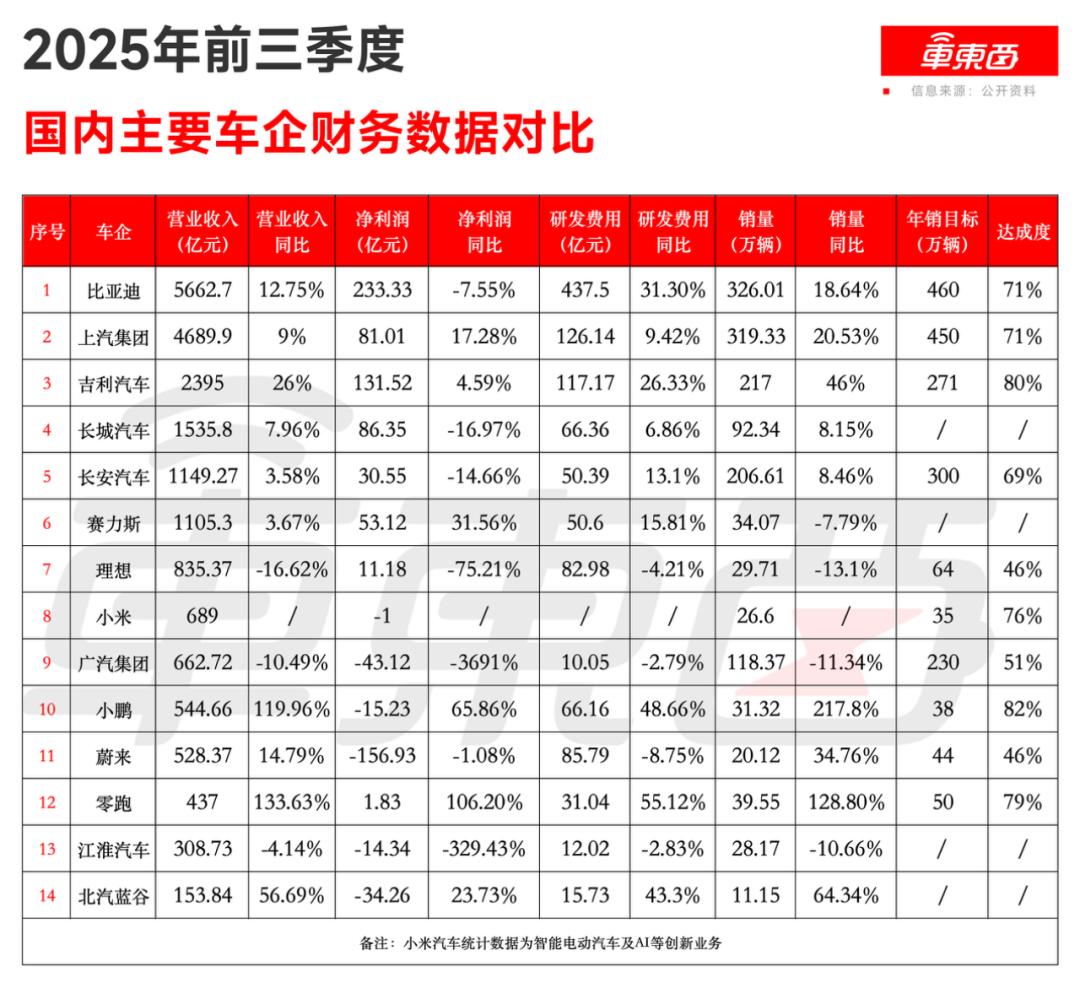
Core Insights - The financial reports of 14 major domestic car manufacturers for the first three quarters of 2025 show a total revenue of 2.07 trillion yuan and a net profit of 364 billion yuan, resulting in a net profit margin of only 1.76% [2][6][22]. Group 1: Financial Performance - Among the traditional car manufacturers, eight companies reported a combined net profit exceeding 471 billion yuan, with BYD leading with a net profit of 233 billion yuan, accounting for 64% of the total net profit of the 14 companies [4][8]. - Geely's revenue reached 239.5 billion yuan, a 26% increase year-on-year, with a net profit of 131.52 billion yuan, benefiting from its accelerated transition to new energy vehicles [8][22]. - The new energy vehicle sector is experiencing significant losses, with six new entrants collectively losing 107 billion yuan, while only Seres, Li Auto, and Leap Motor reported profits [4][6][22]. Group 2: Revenue and Profit Comparison - BYD's revenue was 566.27 billion yuan, a 12.75% increase, while its net profit decreased by 7.55% [5][7]. - SAIC Group reported a revenue of 468.99 billion yuan and a net profit of 81.01 billion yuan, both showing growth [11][22]. - NIO's revenue was 528.37 billion yuan, with a significant net loss of 156.93 billion yuan, highlighting the challenges faced by the company [22][24]. Group 3: R&D Investment - BYD led in R&D investment with 437.5 billion yuan, a 31.3% increase, indicating a commitment to technological expansion despite a slight decline in net profit [25][29]. - Geely's R&D expenditure was 117 billion yuan, up 26%, reflecting its focus on innovation [29][32]. - NIO, despite its losses, invested 85.79 billion yuan in R&D, maintaining a strong commitment to technology development [32][36]. Group 4: Sales Performance - The total sales volume for the 14 companies reached 15 million units, with BYD, SAIC, Geely, and others achieving significant growth [37][41]. - BYD sold 3.26 million vehicles, a year-on-year increase of 18.64%, while SAIC's sales reached 3.19 million units, growing by 20.53% [38][45]. - New entrants like Leap Motor and Xpeng saw substantial sales increases, with Leap Motor's sales up 128.8% and Xpeng's up 217.8% [49][50]. Group 5: Market Dynamics - The competitive landscape in the automotive industry is intensifying, with companies facing pressures from supply chain costs, rapid technological changes, and the need for substantial R&D investments [52]. - The performance of these 14 companies reflects a growing divide in profitability, with only a few achieving a balance between revenue growth and profit margins [22][52].
长安汽车丨11月:具身智能发力 汽车+机器人双向赋能【国联民生汽车 崔琰团队】
汽车琰究· 2025-12-05 02:04
Core Viewpoint - The company is experiencing growth in wholesale sales, particularly in its self-owned and new energy vehicle segments, while also accelerating its transformation towards electric and intelligent vehicles [1][2][5]. Sales Performance - In November, the company's wholesale sales reached 284,000 units, a year-on-year increase of 2.5% and a month-on-month increase of 2.1% [1] - Cumulative wholesale sales from January to November totaled 2.658 million units, up 9.3% year-on-year [1] - Self-owned brand sales in November were 244,000 units, reflecting a year-on-year increase of 5.8% and a month-on-month increase of 2.8% [2] - New energy vehicle sales in November were 126,000 units, a year-on-year increase of 23.3% and a month-on-month increase of 5.9% [2] Brand Performance - Deep Blue brand sales in November were 33,000 units, down 8.2% year-on-year and down 10.1% month-on-month [2] - Avita brand sales reached 14,057 units in November, up 21.4% year-on-year and 4.1% month-on-month [2] - Cumulative sales for Avita from January to November were 118,000 units, a significant year-on-year increase of 99.8% [1] Future Outlook - The company aims for a sales target of 3 million units by 2025, with new energy vehicle sales targeted at 1 million units [2] - Upcoming models such as the Deep Blue L06 and other new products are expected to support this growth while transitioning to electric vehicles [2][3] Strategic Initiatives - The company has approved an investment of 225 million yuan to establish a robotics company, marking its entry into the robotics sector [4] - The "1+N+X" strategy framework will guide the robotics business, focusing on humanoid robots and various applications across different scales [4] Financial Projections - Revenue projections for 2025-2027 are estimated at 189.6 billion, 209.5 billion, and 233.5 billion yuan respectively, with net profits expected to be 6.29 billion, 8.33 billion, and 10.51 billion yuan [5][7] - Earnings per share (EPS) are projected to be 0.63, 0.84, and 1.06 yuan for the same period, with corresponding price-to-earnings (PE) ratios of 18, 14, and 11 times [5][7]