
政府债

Search documents
银行行业2026年1月金融数据点评:政府债发力明显,股市活跃推动存款搬家
Zhong Guo Yin He Zheng Quan· 2026-02-15 06:24
Investment Rating - The report maintains a "Recommended" rating for the banking sector, highlighting its high dividend and low valuation attributes that continue to attract long-term capital [5]. Core Insights - The banking sector is experiencing a significant contribution from government bonds to social financing growth, with a notable increase in government bond issuance in January 2026 [5]. - The report indicates that while social financing has increased year-on-year, the growth rate has decreased compared to the previous month, primarily due to weaker RMB loans and fluctuating demand from the real economy [5]. - The capital market's activity is driving a "deposit migration" process, as increased market engagement leads to higher liquidity in the banking sector [5]. Summary by Sections Banking Industry - In January 2026, new social financing reached 7.22 trillion yuan, an increase of 165.4 billion yuan year-on-year, with government bonds being the main contributor [5]. - RMB loans increased by 4.9 trillion yuan, which is a decrease of 319.4 billion yuan year-on-year, influenced by demand fluctuations and debt restructuring [5]. - The report notes that short-term loans in the real sector have increased, while medium and long-term loans remain weak, particularly in the real estate sector, which saw a 28.5% decline in sales for major developers [5]. Market Activity - The report highlights that M1 and M2 growth rates are at 4.9% and 9% respectively, indicating an increase in liquidity [5]. - Financial institutions' RMB deposits increased by 9.9% year-on-year, with a monthly increase of 8.09 trillion yuan, driven by both household and corporate deposits [5]. - The report emphasizes the role of an active capital market in attracting deposits, with a 58% increase in average daily trading volume in January [5].






流动性与同业存单跟踪:如何理解R007加权利率
ZHESHANG SECURITIES· 2026-01-18 08:06
Report Industry Investment Rating The provided content does not mention the report industry investment rating. Core Viewpoints - The current weighted average rate of R007 is around 1.50%. Its pricing includes DR007, representing the central bank's desired pricing, and the "bank - non - bank" liquidity friction (the spread between R007 and DR007). It's not advisable to hold overly optimistic expectations [1]. - The R007 weighted average rate around 1.50% is reasonably priced. DR007 is unlikely to deviate significantly below the central bank's 7 - day reverse repurchase rate, and 1.40% effectively forms the lower limit of DR007. The spread between R007 and DR007 is at a low level. Considering the increase in the large - scale current deposit rate of non - legal person products, R007 should not be lower than 1.50%. This also means that the current yield levels of inter - bank certificates of deposit and short - term credit bonds are reasonable [2][3]. Summary by Related Catalogs 1 R007 weighted average rate 1.50% high? - R007 is a key indicator for measuring the cost of funds for non - bank institutions and products in the inter - bank market. Its pricing consists of DR007 and the "bank - non - bank" liquidity friction. DR007 reflects the central bank's expected management and fluctuates around the central bank's 7 - day reverse repurchase rate. R007 is generally higher than DR007, and the friction varies with market liquidity [11]. - In the past week, the R007 weighted average rate around 1.50% is reasonably priced. DR007 is unlikely to deviate significantly below the central bank's 7 - day reverse repurchase rate, with 1.40% as the lower limit. The spread between R007 and DR007 is low. From the perspective of opportunity cost, R007 should not be lower than 1.50%. The current yield levels of inter - bank certificates of deposit and short - term credit bonds are also reasonable [12][13]. 2 Narrow - sense liquidity 2.1 Central bank operations - Short - term liquidity: The central bank conducts short - term liquidity operations to smooth out peaks and troughs. In the week from January 12 to January 16, 2026, the net short - term liquidity injection was 8128 billion yuan [14]. - Medium - and long - term liquidity: The central bank actively injects medium - and long - term liquidity [15]. 2.2 Institutions' funding inflow and outflow situation - Fund supply (lenders): The net lending of large - scale banks remains at a seasonal high [18]. - Fund demand (borrowers): The absolute financing balance is high, but the relative leverage ratio is low [27]. 2.3 Repurchase market trading situation - Fund volume and price: The trading volume increases while the price remains stable [36]. - Fund sentiment index: It tightens first and then eases [39]. 2.4 Interest rate swaps Interest rate swaps decline slightly [41]. 3 Government bonds 3.1 Next week's net payment of government bonds The net payment of government bonds will increase slightly next week. In the past week, the total net payment was - 485 billion yuan, while in the coming week, it is expected to be 2065 billion yuan [49]. 4 Inter - bank certificates of deposit 4.1 Absolute yield The provided content does not elaborate on the absolute yield of inter - bank certificates of deposit. 4.2 Issuance and stock situation - As of January 16, 2026, the total issuance of inter - bank certificates of deposit was 5536 billion yuan, with different proportions for different maturities and banks. - The total stock balance of inter - bank certificates of deposit was 191068.1 billion yuan, with different proportions for different types of banks and maturities [55][56]. 4.3 Relative valuation The spread between the 1 - year AAA - rated inter - bank certificate of deposit and R007 is at the 28% quantile since 2020; the spread between the 1 - year AAA - rated inter - bank certificate of deposit and DR007 is 18bp, at the 23% quantile; the spread between the 10 - year treasury bond and the 1 - year AAA - rated inter - bank certificate of deposit is 22bp, at the 57% quantile [58].
1月大税期,三种情景
HUAXI Securities· 2026-01-17 15:05
Group 1: Liquidity Overview - From January 12 to 16, the liquidity showed unexpected fluctuations, with R001 rising from 1.35% to 1.49% and R007 exceeding 1.60% due to a lack of buyout reverse repos[1] - As of January 16, the bank's lending scale returned to over 5 trillion yuan, providing some support to the liquidity[3] - The expected liquidity gap for the upcoming tax period is approximately 2 trillion yuan, compounded by 1.1 trillion yuan of public market expirations and 0.25 trillion yuan of government debt payments, totaling over 3.3 trillion yuan[2] Group 2: Market Trends and Projections - The liquidity rates are expected to remain loose, similar to January 2024, due to structural interest rate cuts and a relatively late Spring Festival this year[2] - Historical trends show three liquidity patterns in January: tight (2021, 2025), slight convergence (2023), and relatively loose (2022, 2024)[2] - The central bank is likely to increase liquidity injections during the tax period to maintain market stability, with a reference to a net liquidity injection of about 1.5 trillion yuan in January 2024[3] Group 3: Public Market and Government Debt - From January 19 to 23, a total of 11.015 trillion yuan will expire in the public market, including 9.515 trillion yuan in reverse repos[4] - The estimated net payment for government bonds from January 19 to 23 is 2.465 trillion yuan, significantly higher than the previous week's -0.485 trillion yuan[8] - The government bond issuance is accelerating, with a planned issuance of 7.066 trillion yuan for the week, compared to 2.818 trillion yuan the previous week[41] Group 4: Interbank Certificates of Deposit - The pressure from maturing interbank certificates of deposit is decreasing, with 6,799 billion yuan maturing from January 19 to 23, down from 8,339 billion yuan the previous week[50] - The weighted issuance rate for interbank certificates of deposit increased to 1.65%, with significant contributions from state-owned and joint-stock banks[48]
12月金融数据点评:2026年初降息落地,后续降准亦可期
Bank of China Securities· 2026-01-15 12:31
Economic Overview - In December 2025, new social financing (社融) reached 2.21 trillion yuan, which was 645.7 billion yuan less than the same month last year and 280.8 billion yuan less than November 2025, exceeding the consensus expectation of 1.82 trillion yuan[2] - The year-on-year growth of social financing stock was 8.3%, slightly above the expected 8.2%, but down 0.23 percentage points from November 2025[2] Loan and Deposit Trends - New RMB loans in December amounted to 975.7 billion yuan, an increase of 135.5 billion yuan year-on-year and 566.1 billion yuan more than November 2025[2] - December saw a strong increase in deposits, totaling 1.68 trillion yuan, which was 3.08 trillion yuan more than the same month last year, driven mainly by a rise in household deposits of 2.58 trillion yuan[2] Monetary Supply and Policy - M2 growth in December was 8.5%, up 0.5 percentage points from November, while M1 growth was 3.8%, down 1.1 percentage points[2] - The People's Bank of China (PBOC) announced a 0.25 percentage point reduction in the re-lending and rediscount rates on January 15, 2026, indicating potential for further monetary easing[2] Corporate and Household Loan Dynamics - New corporate loans in December were robust at 1.07 trillion yuan, with short-term loans and bills accounting for 617.7 billion yuan and medium to long-term loans for 340 billion yuan[2] - Household loans continued to show weakness, with a decrease of 916 billion yuan in December, marking a trend of declining household loan demand over the past three months[2] Risk Factors - Potential risks include a resurgence of global inflation, a faster-than-expected economic slowdown in Europe and the U.S., and increasing complexity in international relations[2]
【广发宏观吴棋滢】延续必要强度,优化发力路径:2026年财政政策展望
Xin Lang Cai Jing· 2025-12-25 01:33
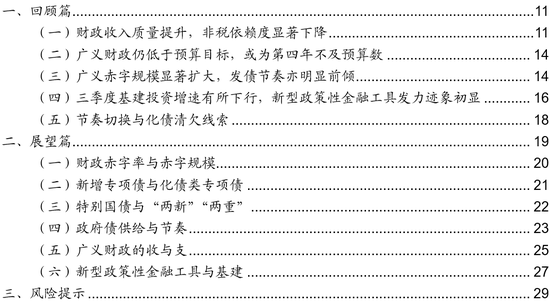
Group 1 - The core viewpoint of the report is that the fiscal policy for 2025 will be "more proactive," leading to significant increases in both narrow and broad fiscal deficits, with narrow deficit expected to rise by 39% and broad deficit by 27% [1][13][14] - The issuance of government bonds will be accelerated, with net supply expected to increase by 128% year-on-year in the first half of 2025, while broad fiscal expenditure is projected to show a "U"-shaped trend in 2024 and a "front high and back low" trend in 2025 [1][14] - The structure of fiscal revenue is improving, with a target growth rate for non-tax revenue set at -14.2%, indicating a reduced reliance on non-tax income [2][15][16] Group 2 - The expansion of debt resolution measures and diversification of debt resolution methods are highlighted, including the issuance of special bonds and policies targeting corporate arrears and PPP projects [2][16][17] - The expected slowdown in infrastructure investment growth in the second half of 2025 is attributed to several factors, including the completion of prior funding projects and the diversion of funds to debt resolution [3][18][19] - For 2026, the central economic work conference emphasizes the continuation of a more proactive fiscal policy, with expectations for a slight increase in fiscal strength compared to 2025 [4][20][21] Group 3 - The anticipated fiscal revenue growth for 2026 is projected to rebound to 3%-5%, driven by price increases and tax policy adjustments [5][26][27] - The introduction of new policy financial tools is expected to significantly impact fixed asset investment, with an estimated investment scale of 1.5-2 trillion yuan in 2026 [6][28][29] - The report indicates a structural shift in consumption patterns, with a focus on new types of consumption and service consumption, as traditional durable goods consumption is expected to slow down [8][32][33] Group 4 - The report discusses the expansion of debt resolution to include non-hidden debts, with measures to clear local government arrears to enterprises [9][34][35] - The importance of improving the local tax system is highlighted, with potential reforms in consumption tax expected to accelerate [10][36][37] - The overall impact on the asset side suggests that continued fiscal strength and proactive measures will support nominal growth and micro-activity in 2026 [11][37]

【广发宏观吴棋滢】延续必要强度,优化发力路径:2026年财政政策展望
郭磊宏观茶座· 2025-12-25 01:26
Group 1 - The core viewpoint of the article is that the fiscal policy for 2025 is set to be "more proactive," leading to significant increases in both narrow and broad fiscal deficits, with narrow deficit scale increasing by 39% and broad deficit scale by 27% [1][12][13] - The government debt net supply is expected to reach a recent high, with a notable increase in the issuance pace of bonds, particularly in the first half of 2025, where net supply is projected to increase by 128% year-on-year [1][14] - Fiscal expenditure trends are expected to show a "U" shape in 2024 and a "front high and back low" pattern in 2025, aligning with economic and equity asset trends [1][13] Group 2 - One highlight in the fiscal sector for 2025 is the improvement in the structure of fiscal revenue, with a target growth rate for non-tax revenue set at -14.2%, indicating a commitment to reduce reliance on non-tax income [1][16] - Tax revenue is expected to perform well in the second half of the year, driven by active industries and tax policy adjustments, contrasting with the decline in non-tax revenue [1][17] Group 3 - Another highlight in the fiscal sector for 2025 is the expansion of debt resolution methods and the diversification of debt resolution tools, including the issuance of special new bonds and the use of local fiscal funds to pay for existing PPP project costs [2][19] - The debt resolution measures are expected to benefit small and micro enterprises by improving cash flow [2][19] Group 4 - A constraint on the economy in 2025 is the anticipated slowdown in infrastructure investment growth in the second half of the year, attributed to various factors including the front-loading of fiscal funds and the diversion of debt funds to debt resolution [2][22][23] - The decline in infrastructure investment growth is expected to be predictable, with narrow infrastructure investment growth dropping from 10.4% in the first five months to 0.1% by November [2][22] Group 5 - Looking ahead to 2026, the central economic work conference has indicated that a "more proactive fiscal policy" will continue, with expectations for a slight increase in fiscal intensity compared to 2025 [3][25] - The narrow target deficit rate is expected to remain at a relatively high level of 4.0%, with a small chance of increasing to 4.2%, reflecting a cautious approach to fiscal policy [3][25][26] Group 6 - The broad deficit is expected to see structural adjustments, with new special bonds projected to increase from 4.6 trillion yuan to around 5 trillion yuan, focusing on optimizing the use of local government special bonds [3][28] - The total government debt net supply is anticipated to be approximately 14.9 trillion yuan in 2026, an increase of about 5.4 billion yuan compared to 2025, indicating a continued expansion of fiscal policy [3][30] Group 7 - Fiscal revenue growth is projected to rebound to around 3%-5% in 2026, driven by price increases and the effects of tax policy adjustments [3][33] - The expected growth in fiscal expenditure is anticipated to slow to 3.9%, down from 5.9% in 2025, reflecting limited debt expansion [3][34] Group 8 - The main driver for fixed asset investment will be the 500 billion yuan new policy financial tools, which are expected to leverage credit significantly and support investment growth in 2026 [3][36] - The focus on effective investment will also include adjustments to special bonds and support for private sector participation in key projects [3][39] Group 9 - In the consumption sector, there is an expected structural shift towards new types of consumption and service consumption, with a focus on releasing the potential of service consumption [3][41] - The anticipated growth in durable goods consumption is expected to slow, while service consumption areas such as tourism and elderly care are projected to see increased demand [3][41] Group 10 - The debt resolution area is expected to expand to include non-hidden debts, with measures to clear debts owed by local governments to enterprises [3][43] - The central economic work conference emphasized the need for multiple measures to mitigate risks associated with local government financing platforms [3][43] Group 11 - The improvement of the local tax system is highlighted as a key focus for 2026, with potential reforms in consumption tax expected to accelerate [3][45] - The reforms aim to create incentives for local tax revenue generation and shift the competitive focus from production to consumption [3][45]

政府债周报(12/14):下周新增债披露发行352亿-20251216
Changjiang Securities· 2025-12-16 05:47
Report Investment Rating - No investment rating information provided in the report Core Viewpoints - From December 15 - 21, local government bonds are scheduled to be issued worth 400.4 billion yuan, including 352.2 billion yuan of new bonds (59.6 billion yuan of new general bonds and 292.6 billion yuan of new special bonds) and 48.2 billion yuan of refinancing bonds (39.2 billion yuan of refinancing general bonds and 9.0 billion yuan of refinancing special bonds) [1][5] - From December 8 - 14, local government bonds worth 1069.6 billion yuan were issued, including 710.5 billion yuan of new bonds (210.0 billion yuan of new general bonds and 500.5 billion yuan of new special bonds) and 359.0 billion yuan of refinancing bonds (187.4 billion yuan of refinancing general bonds and 171.6 billion yuan of refinancing special bonds) [1][5] - As of December 14, the fifth - round second - batch special refinancing bonds totaled 20,000.00 billion yuan, the sixth - round totaled 2881.00 billion yuan, and no new disclosure was made this week. The top three provinces or municipalities with separately - planned status in the fifth - round second - batch disclosure were Jiangsu (2511.00 billion yuan), Hunan (1288.00 billion yuan), and Henan (1227.00 billion yuan) [5] - As of December 14, the special new special bonds in 2025 totaled 13656.08 billion yuan, and since 2023, a total of 25534.72 billion yuan has been disclosed. The top three in terms of disclosure scale are Jiangsu (2440.35 billion yuan), Hubei (1377.69 billion yuan), and Henan (1325.34 billion yuan). The top three provinces or municipalities with separately - planned status in 2025 disclosure are Jiangsu (1289.00 billion yuan), Guangdong (1239.28 billion yuan), and Henan (759.60 billion yuan) [6] Summary by Directory Local Bond Actual Issuance and Forecast Issuance - Actual Issuance and Pre - issuance Disclosure: From December 8 - 14, the net supply of local government bonds was 623 billion yuan; from December 15 - 21, the forecast net supply of local government bonds is 281 billion yuan [12] - Comparison of Planned and Actual Issuance: Data shows the comparison between planned and actual issuance of local government bonds in November and December, as well as the comparison of monthly issuance and net financing in recent months [15][18][21] Local Bond Net Supply - New Bond Issuance Progress: As of December 14, the issuance progress of new general bonds was 95.06%, and that of new special bonds was 99.32%. The calculation denominator of the issuance progress includes the 200 billion yuan of used carry - over quota, so there is a certain difference in the caliber compared with the previous progress (before November) [25] - Refinancing Bond Net Supply: As of December 14, the cumulative scale of refinancing bonds minus local government bond maturities for the year is shown in the figure, and the statistical caliber includes both issued and disclosed but not yet issued bonds [27][28] Special Bond Issuance Details - Special Refinancing Bond Issuance Statistics: As of December 14, the special refinancing bond statistics are presented in the figure, including different rounds of issuance in various regions, and the statistical caliber includes both issued and disclosed but not yet issued bonds [31][32] - Special New Special Bond Issuance Statistics: As of December 14, the special new special bond statistics are presented in the figure, showing the issuance in 2023, 2024, and 2025 in various regions, and the statistical caliber includes both issued and disclosed but not yet issued bonds [34][35] Local Bond Investment and Trading - Primary - Secondary Spread: The primary and secondary spreads of local government bonds are presented in the figure, showing the spreads of different maturities on December 7 and December 14, 2025, and the changes [38] - Regional Secondary Spread: The regional secondary spreads of local government bonds from September 5, 2025, to December 12, 2025, in different regions are presented in the figure [39] New Special Bond Investment Directions - Project Investment Direction Monthly Statistics: The latest month's statistics only consider the investment directions of issued new bonds, and do not consider the pre - issuance disclosure of new bond investment directions [41]
流动性与同业存单跟踪:从央行党委学习会议通稿看2026年货币政策细微变化
ZHESHANG SECURITIES· 2025-12-14 11:09
Report Industry Investment Rating - Not provided in the report Core View - The market generally focuses on the changes in the description of monetary policy in the Central Economic Work Conference. The meeting minutes of the People's Bank of China Party Committee's study and implementation of the Central Economic Work Conference spirit are equally important, reflecting the central bank's specific thinking on monetary policy in 2026 [1]. Summary by Directory 1. From the Meeting Minutes of the Central Bank Party Committee's Study to See Subtle Changes in Monetary Policy in 2026 - The Central Economic Work Conference is an important institutional arrangement for the Party to govern the country. After the conference, various systems and ministries will convey, study, and deploy specific work for 2026. The People's Bank of China Party Committee will also study and clarify implementation measures [1][12]. - Comparing the 2025 and 2024 meeting minutes, four main changes were found: adding "grasp the intensity, rhythm, and timing of policy implementation", which may indicate a more moderate loose - monetary - policy; changing the description of social comprehensive financing costs from "stable and gradually decreasing" in 2024 to "operating at a low level" in 2025; making the description of the RMB exchange rate more concise, showing confidence in the recent appreciation trend of the RMB; and continuing to emphasize "coordination with fiscal policy" [2][12][13]. 2. Narrow - Sense Liquidity 2.1 Central Bank Operations - Short - term liquidity: In the past week (12/8 - 12/12), the central bank's net reverse - repurchase injection was 4.7 billion yuan. As of December 12, the central bank's reverse - repurchase balance was 668.5 billion yuan, at a relatively low level [15]. - Medium - term liquidity: In December, the due amount of the central bank's outright reverse - repurchase was 140 billion yuan (including 100 billion yuan for the 3 - month and 40 billion yuan for the 6 - month). On December 5, the central bank renewed the 3 - month outright reverse - repurchase of 100 billion yuan. On December 15, it will renew the 6 - month outright reverse - repurchase of 60 billion yuan, with a net injection of 20 billion yuan [16]. 2.2 Institutional Fund Inflow and Outflow: Large Banks' Net Outflow Reaches a New High - Fund supply: On December 12, large banks' net fund outflow was 4.2 trillion yuan (flow concept), up about 100.2 billion yuan from December 5. The net outflow balance was 4.8 trillion yuan, up about 130.2 billion yuan. The net outflow balance of money funds was 1.1 trillion yuan, down about 117.7 billion yuan from December 5. The net outflow of joint - stock banks was 28.96 billion yuan, up about 285.5 billion yuan from December 5 [18]. - Fund demand: On December 12, the balance of repurchase - to - be - bought bonds in the inter - bank market was about 12.4 trillion yuan, up 646.7 billion yuan from December 5. The leverage ratio of the whole market was 107%, up 0.40 pct from December 5, and the leverage ratio of non - legal person products was 112%, up 1.17 pct from December 5 [29]. 2.3 Repurchase Market Transaction Situation: Low Liquidity Friction - Fund volume and price: In the past week, the inter - bank pledged repurchase market had a large volume and stable prices. The median daily trading volume was about 8.1 trillion yuan, up 203.9 billion yuan from December 1 - 5. The median of R001 was 1.35%, down 1bp from last week. The median spread of R001 - DR001 was 7.0bp, up 0.6bp from last week, and the median spread of GC001 - R001 was 7.2bp, up 0.8bp from last week [32]. - Fund sentiment index: The overall fund situation was loose, and the financing difficulty was low. The sentiment index was mostly below 50 [36]. 2.4 Interest Rate Swaps: Basically Flat - The 1 - year FR007 IRS interest rate was basically the same as last week. This week, the median of the 1 - year FR007 IRS was 1.54%, at the 11% quantile since 2020 [38]. 3. Government Bonds: The Net Payment Pressure of Government Bonds Will Decrease in the Next Week 3.1 Next Week's Net Payment of Government Bonds - In the past week, the net payment of government bonds was 14.8 billion yuan, with a relatively small pressure. Among them, the net repayment of treasury bonds was 69.7 billion yuan, and the net payment of local bonds was 84.5 billion yuan. In the next week, the government bonds are expected to have a net repayment of 83.9 billion yuan, including a net repayment of 119.3 billion yuan for treasury bonds and a net payment of 35.3 billion yuan for local bonds. The net repayment is highly concentrated on Monday [39]. 3.2 Current Issuance Progress of Government Bonds - As of December 12, the net financing progress of treasury bonds was 96.7%, up 0.5% in the past week, with about 221 billion yuan of remaining net financing space in 2025. Local bonds have basically completed issuance [43]. 4. Inter - Bank Certificates of Deposit: Yields Fluctuated Slightly Higher 4.1 Absolute Yields - On December 12, the SHIBOR overnight, 7 - day, 1M, 3M, 6M, 9M, and 1Y quotes were 1.28%, 1.45%, 1.53%, 1.59%, 1.62%, 1.64%, and 1.65% respectively. The yields of 1M, 3M, 6M, 9M, and 1Y inter - bank certificates of deposit of AAA - rated commercial banks were 1.62%, 1.62%, 1.64%, 1.65%, and 1.66% respectively. Except for the 1M term, which increased by 4bp compared with December 5, the quotes of other terms remained unchanged [46]. 4.2 Issuance and Stock Situation - In the past week (December 8 - 12), the total issuance of inter - bank certificates of deposit was 941.78 billion yuan. In terms of issuance terms, the proportions of 1M, 3M, 6M, 9M, and 1Y were 9%, 27%, 43%, 6%, and 15% respectively. Among them, the proportion of 3M increased by 15 pcts, while those of 1M, 6M, 9M, and 1Y decreased by 4 pcts, 1 pct, 2 pcts, and 7 pcts respectively [51]. 4.3 Relative Valuation - On December 12, the spread between the 1 - year AAA - rated inter - bank certificate of deposit yield and R007 was 15bp, at the 34% quantile since 2020. The spread between the 10 - year treasury bond yield and the 1 - year AAA - rated inter - bank certificate of deposit was 18bp, at the 40% quantile since 2020 [54].

非标融资和政府债托底社融,实体信贷收缩,对消费与投资拖累大!
Sou Hu Cai Jing· 2025-12-13 20:11
Group 1 - In November 2025, new social financing increased by 6.9% year-on-year, primarily supported by non-standard financing and government bonds, while core credit demand from the real economy remained weak [2][4][8] - Non-standard financing became the main contributor, with trust loans and other non-standard assets increasing significantly, indicating a reliance on flexible funding channels to support infrastructure and local projects [4][6] - Government bonds played a leading role, with net issuance of 1.2 trillion yuan in November, but the growth rate declined due to a high base effect, highlighting the increasing share of government-related financing in total social financing [6][7] Group 2 - Resident loans continued to contract, reflecting weak real estate cycles and insufficient consumer spending, with a significant year-on-year decrease in new resident loans [9][11] - The real estate market showed signs of weakness, with high household savings rates and declining property prices, leading to a lack of purchasing intent among residents [12][13] - Consumer confidence dropped, exacerbated by external pressures such as high global inflation and domestic supply excess, indicating a need for policy shifts to stimulate consumption [13][14] Group 3 - Corporate funding needs increased year-on-year, but the debt structure revealed a lack of confidence in future investments, with a notable preference for short-term financing over long-term expansion [14][17] - New short-term loans surged, while medium- to long-term loans saw a decline, reflecting a cautious approach among businesses amid low demand and economic uncertainty [17][19] - Fixed asset investment showed a rare decline, indicating insufficient capital formation and the need for improved business environments and tax incentives to stimulate long-term demand [19][20] Group 4 - Fiscal policy is expected to shift focus from replacing local hidden debts to promoting fixed asset investment in 2026, aiming to support economic growth [20][22] - The central economic work conference emphasized maintaining active fiscal policies, with potential measures to boost investment in real estate and infrastructure [22][23] - However, challenges remain regarding investment efficiency amid existing overcapacity, and the potential for government debt to exceed credit could further dampen household and corporate demand [22][23]
华泰证券:9月社融总量增长平稳,结构更趋平衡
Xin Lang Cai Jing· 2025-10-15 23:41
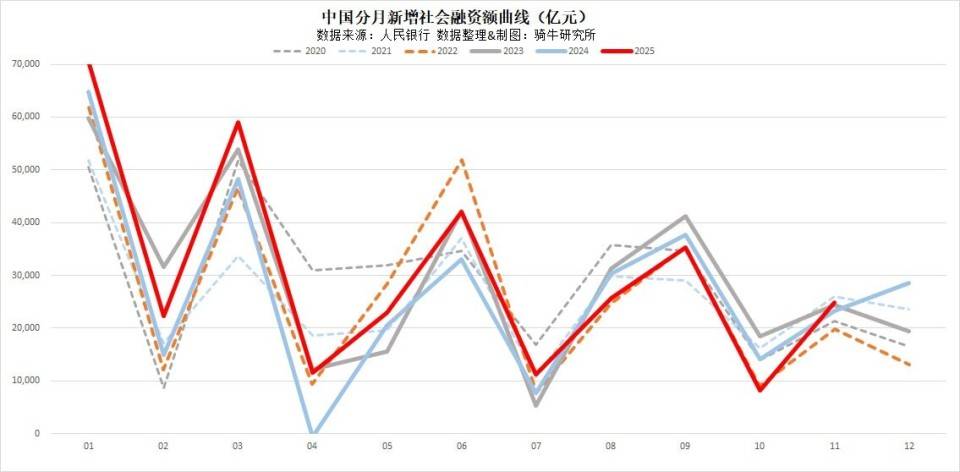
Core Viewpoint - The report from Huatai Securities indicates a slight slowdown in the year-on-year growth rate of social financing in September, primarily due to a lower net issuance of government bonds compared to a high base last year, while signs of stabilization in financing demand from households and enterprises are emerging [1] Group 1: Social Financing Trends - The year-on-year growth rate of social financing has slightly slowed down in September, attributed to a decrease in net issuance of government bonds [1] - Financing demand from households and enterprises is showing signs of stabilization at low levels [1] Group 2: Monetary Supply Indicators - The M2 year-on-year growth rate remains stable under high base conditions, while M1 growth has accelerated, indicating further improvement in liquidity [1] Group 3: Future Outlook - The introduction of new policy financial instruments is expected to stimulate loan demand, which will help support the growth rate of social financing in the fourth quarter [1] - The net issuance of government bonds in September was significantly lower year-on-year due to a shift in fiscal financing timing, with an expected net issuance of around 2.4 trillion yuan in the fourth quarter, which may represent a year-on-year decrease of 1.7 trillion yuan [1] - The acceleration of new policy financial instruments is anticipated to boost corporate loan demand, providing some support for the growth rate of social financing in the fourth quarter [1]
