
库存

Search documents
玻璃日报:短期震荡-20260130
Guan Tong Qi Huo· 2026-01-30 11:37
Group 1: Report Industry Investment Rating - The short - term investment rating for the glass industry is "short - term shock" [1] Group 2: Core View of the Report - The supply - demand contradiction in the glass market has not been substantially improved. The short - term price may fluctuate, but there is a possibility of weakening in the later stage. Attention should be paid to macro - policy changes and production line cold - repair situations [4] Group 3: Summary by Relevant Catalogs Market行情回顾 - In the futures market, the glass main contract opened high and went low, showing a short - term shock signal. The trading volume increased by 361,000 lots and the open interest increased by 43,145 lots compared with the previous day. The closing price was 1056 yuan/ton, down 21 yuan/ton or 1.95% from the previous settlement price [1] - In the spot market, the situation varied by region. North China was stable, East China had average trading, Central China had some price increases in Hubei, and South China's market center shifted down [1] - The basis in North China was - 36 yuan/ton with a spot price of 1020 yuan/ton [1] Fundamental Data - **Supply**: As of January 29, the weekly total output of float glass was 1.057 million tons, flat month - on - month and - 3.375% year - on - year. The industry average operating rate was 71.86%, up 0.24% month - on - month, and the capacity utilization rate was 75.7%, flat month - on - month. One production line was restarted but had not yet produced glass [2] - **Inventory**: The total inventory of national float glass sample enterprises was 52.564 million heavy boxes, down 652,000 heavy boxes or 1.22% month - on - month and up 21.24% year - on - year. The inventory days were 22.8 days, 0.3 days less than the previous period [2] - **Import and Export**: In December 2025, domestic float glass exports were 87,000 tons, an increase of 2200 tons or 2.59% from the previous month. The net exports were 72,400 tons, a 4.51% increase month - on - month. The cumulative export volume from January to December was 1.0292 million tons, a 93.63% increase year - on - year [2] - **Profit**: The weekly average profit of natural - gas float glass was - 155.12 yuan/ton, up 3.57 yuan/ton week - on - week. The weekly average profit of coal - gas float glass was - 68.5 yuan/ton, down 3.39 yuan/ton week - on - week. The weekly average profit of petroleum - coke float glass was 1.07 yuan/ton, up 2.85 yuan/ton week - on - week [3] Main Logic Summary - The long - term losses of glass production lines have accelerated the capacity clearance of some enterprises, and there are still plans to cold - repair some production lines before the Spring Festival, so the supply side is expected to shrink further. However, real - estate demand has not improved, and downstream demand is expected to weaken further after February. The short - term price may fluctuate [4]
日度策略参考-20260130
Guo Mao Qi Huo· 2026-01-30 04:23
1. Report Industry Investment Ratings - **Bullish**: Copper, Aluminum, Palm Oil, Soybean Oil, Canola Oil [1] - **Bearish**: None - **Neutral**: Stock Index, Treasury Bonds, Alumina, Zinc, Non - ferrous Metals, Stainless Steel, Tin, Precious Metals, Platinum - Palladium, Industrial Silicon, Polysilicon, Lithium Carbonate, Rebar, Iron Ore, Other Metals, Soda Ash, Coking Coal, Coke, Cotton, Sugar, Corn, Soybean Meal, Pulp, Crude Oil, Bitumen, Shanghai Rubber, BR Rubber, PTA, Polyester Staple Fiber, Styrene, Methanol, PE, PP, PVC, SS, LPG, Container Shipping on European Routes [1] 2. Core Views of the Report - Before the holiday, the domestic macro - level may be relatively calm, and market performance will be highly related to regulatory trends. The stock index is expected to have limited short - term shock adjustment space and mainly show a shock - strong trend [1]. - Asset shortage and weak economy are beneficial to bond futures, but the central bank has recently warned of interest - rate risks, and attention should be paid to the Bank of Japan's interest - rate decision [1]. - Although the industrial drive is limited, the market risk preference has increased, and the prices of copper and aluminum are rising. The supply of domestic alumina is strong while demand is weak, and the price is expected to fluctuate [1]. - The cost center of zinc fundamentals is stabilizing, and there is room for a supplementary increase in zinc prices. The supply of Indonesian nickel ore is tightening, and short - term nickel prices are running at a high level [1]. - The supply of stainless - steel raw materials is unstable, and the futures are oscillating at a high level. The supply of tin ore in Myanmar has limited incremental supply in the first quarter, and there is upward potential for tin prices [1]. - Due to the tense geopolitical situation in Iran, the prices of precious metals have risen strongly, but short - term fluctuations are severe. The prices of platinum and palladium fluctuate greatly, and it is recommended to allocate platinum at low prices [1]. - The production of industrial silicon in the northwest is increasing while that in the southwest is decreasing. The production of polysilicon and organic silicon in December has decreased [1]. - The new - energy vehicle market is in the off - season, but the energy - storage demand is strong. The price of lithium carbonate has risen significantly [1]. - The expected increase in rebar and iron - ore prices is not strong, and it is recommended to take a wait - and - see approach. The supply and demand of other metals are in a situation of weak reality and strong expectation [1]. - The supply of soda ash is more relaxed in the medium term, and the price is under pressure. The market is pessimistic about the coking - coal 05 contract, and the previous low - buying strategy may need to be changed [1]. - The purchase rhythm of major consumer countries has started, and the price of palm oil is expected to be shock - strong. The fundamentals of domestic soybean oil are strong, and the price is bullish [1]. - The import of Canadian rapeseed is restricted, and the supply contradiction is not significantly alleviated. The cotton market is currently supported but lacks driving force [1]. - The global sugar market is in surplus, and the domestic new - crop supply is increasing. The upward momentum of corn prices before the holiday is insufficient [1]. - The Brazilian soybean supply is sufficient, and it is recommended to be cautious when chasing up the soybean - meal price. The paper - pulp price has fallen, and it is recommended to wait and see [1]. - The price of logs is expected to have limited further decline space and will fluctuate within a certain range. The pig - production capacity needs to be further released [1]. - Due to OPEC+ suspending production increase, tense Middle - East geopolitics, and the US cold wave, the price of crude oil is affected [1]. - Bitumen follows the trend of crude oil, and its profit is relatively high. Shanghai rubber is driven by cost and market sentiment to rise [1]. - The fundamentals of BR rubber are mixed, with short - term wide - range fluctuations and medium - long - term upward expectations. The PTA and polyester staple - fiber markets are affected by the strong PX market [1]. - The price of styrene has rebounded, and the inventory pressure has decreased. The methanol market is affected by the Iranian situation and downstream feedback [1]. - The supply of PE and PP is under pressure, and the PVC market has both positive and negative factors. The SS market fundamentals are weak [1]. - The LPG market is affected by multiple factors, and the price is expected to weaken. The freight rate of container shipping on European routes has peaked and fallen before the holiday [1] 3. Summary by Variety Stock Index - Before the holiday, the domestic macro - level may be relatively calm, and market performance will be highly related to regulatory trends. The short - term shock adjustment space is limited, and it will mainly show a shock - strong trend [1] Treasury Bonds - Asset shortage and weak economy are beneficial to bond futures, but the central bank has recently warned of interest - rate risks. Attention should be paid to the Bank of Japan's interest - rate decision [1] Copper - Although the industrial drive is limited, the market risk preference has increased, and copper prices have risen further [1] Aluminum - Recently, the industrial drive is limited, but the decline of the US dollar index supports the price. Coupled with the tense situation in the Middle East, which causes concerns about the supply side, aluminum prices are running strongly [1] Alumina - The supply of domestic alumina is strong while demand is weak, and the industrial situation is weak. The price is under pressure, but it is currently near the cost line and is expected to fluctuate [1] Zinc - The cost center of zinc fundamentals is stabilizing. Recently, the North American cold wave has increased energy prices, which is unfavorable for the resumption of overseas smelters. There is room for a supplementary increase in zinc prices [1] Non - ferrous Metals - The market risk preference has recovered, which boosts non - ferrous metals. The supply of Indonesian nickel ore is tightening, and short - term nickel prices are running at a high level, still affected by the resonance of the non - ferrous metals sector. In the medium - long term, the high global nickel inventory may still have a suppressing effect [1] Stainless Steel - The supply of raw - material nickel - iron prices has been rising continuously, the spot trading of stainless steel is weak, the speed of social - inventory reduction has slowed down, and the steel mills' production schedule in January has increased. The supply - side disturbances are repeated, and the stainless - steel futures are oscillating at a high level [1] Tin - In the short term, the market sentiment is changeable. Although the approval of explosives in Myanmar is a negative news, the incremental supply of tin ore in Myanmar in the first quarter is still limited. Under the situation of fragile supply and rigid demand, there is upward potential for tin prices [1] Precious Metals - Due to the tense geopolitical situation in Iran, the demand for hedging and the wave of de - dollarization have accelerated, and the prices of precious metals have risen strongly again. However, as the market sentiment has fermented to the extreme, the prices of gold and silver have plunged at a high level, with severe short - term fluctuations. It is recommended to participate with a light position [1] Platinum - Palladium - The macro - drive has weakened, and the liquidity is relatively insufficient, resulting in large price fluctuations of platinum and palladium. In the medium - long term, the supply - demand prospects of platinum and palladium are different. There is still a supply - demand gap for platinum, while palladium tends to have a loose supply. It is recommended to allocate platinum at low prices or focus on the [long platinum, short palladium] arbitrage strategy [1] Industrial Silicon - The production in the northwest is increasing while that in the southwest is decreasing. The production schedules of polysilicon and organic silicon in December have decreased [1] Polysilicon - The new - energy vehicle market is in the off - season, the energy - storage demand is strong, there is a rush for battery exports, and the price has risen significantly [1] Lithium Carbonate - The expected increase is strong, but the spot market is weak, and the sentiment has not been smoothly transmitted to the spot market. The upward momentum is insufficient [1] Rebar - The expected increase is strong, but the spot market is light, and the sentiment transmission to the spot is not smooth. The upward momentum is insufficient. It is recommended to close the long - single position and participate in the cash - and - carry arbitrage [1] Iron Ore - There is sector rotation, but the upward pressure on iron - ore prices is obvious. It is not recommended to chase up at this position [1] Other Metals - There is a situation of weak reality and strong expectation. The current supply and demand continue to be weak, but energy - consumption dual control and anti - involution may have an impact on the supply [1] Soda Ash - It mainly follows the trend of glass. The medium - term supply and demand are more relaxed, and the price is under pressure [1] Coking Coal - The market is pessimistic about the coking - coal 05 contract. After the first - round price increase of coke was shelved on Monday, funds began to anticipate the downstream's active de - stocking after the holiday. The short - position increased, and the price of coking - coal 05 broke through the previous important multi - empty boundary and support levels. The previous low - buying strategy may need to be changed [1] Coke - The logic is the same as that of coking coal [1] Palm Oil - The purchase rhythm of major consumer countries has started, and the production area is expected to reduce production and inventory. Coupled with the possible fermentation of the biodiesel theme, it is expected to be shock - strong [1] Soybean Oil - The fundamentals of domestic soybean oil are strong, and coupled with the rebound of US soybeans and positive news about US biodiesel, it is bullish [1] Canola Oil - Due to the influence of the US, the relationship between China and Canada is still uncertain, the continuous import of Canadian rapeseed is blocked, and the short - term supply contradiction is not significantly alleviated. Positive news about US biodiesel is beneficial to the oil market [1] Cotton - The domestic new - crop harvest is expected to be good, and the purchase price of seed cotton supports the cost of lint. The downstream operation rate is low, but the yarn - mill inventory is not high, and there is a rigid demand for replenishment. Considering the growth of spinning capacity, the demand for cotton in the new - crop market year is relatively resilient. Currently, the cotton market is in a situation of "supported but lack of driving force" [1] Sugar - Globally, there is a sugar surplus, and the domestic new - crop supply has increased. The short - term fundamentals lack continuous driving force. Attention should be paid to the change in the capital side [1] Corn - Before the holiday, the stocking is almost over, the regional price difference is at a low level, and the domestic grain - reserve inventory is sufficient. The funds have taken profit, and the upward momentum of the futures price is insufficient. It is expected to fluctuate and回调 before the holiday [1] Soybean Meal - In February, there is an expectation of rainfall return in the Argentine production area, and the total supply of Brazilian soybeans is sufficient. The expected logistics congestion has postponed the selling pressure of Brazilian premiums. Unilaterally, there are no conditions for a significant trend - like increase. Currently, the domestic soybean - purchasing and crushing profit is at a high level, and from the perspective of crushing profit, the valuation of the soybean - meal futures is relatively high. It is recommended to be cautious when chasing up [1] Pulp - Today, the pulp price has fallen due to the decline of the commodity macro - market, but it has not broken through the oscillation range. The short - term commodity sentiment fluctuates greatly, and it is recommended to wait and see [1] Logs - The spot price of logs has shown a certain sign of bottom - rebounding recently, and the futures price is expected to have limited further decline space. However, the January overseas offer has still slightly decreased, and the spot and futures markets of logs lack upward - driving factors. It is expected to fluctuate in the range of 760 - 790 yuan/m³ [1] Pigs - Recently, the spot price has gradually stabilized. Supported by demand and with the slaughter weight not fully cleared, the production capacity still needs to be further released [1] Crude Oil - OPEC+ has suspended production increase until the end of 2026, the geopolitical situation in the Middle East has heated up, and the cold wave in the US has increased energy demand [1] Bitumen - In the short term, the supply - demand contradiction is not prominent, and it follows the trend of crude oil. The probability of the 14th - Five - Year Plan rush - work demand being falsified is high, and the supply of Ma Rui crude oil is sufficient. The profit of bitumen is relatively high [1] Shanghai Rubber - The raw - material cost has strong support, the sharp rise of synthetic rubber has driven the sector to strengthen, and the overall atmosphere of the commodity market is bullish [1] BR Rubber - The cost - end butadiene still has strong bottom support, and the overseas cracking - device capacity has been cleared, which is beneficial to the long - term domestic butadiene export expectation. Recently, the profit of private cis - butadiene rubber plants has been severely lost, and the expectation of maintenance and production reduction has increased, and the short - term downstream negative feedback has been gradually realized. Fundamentally, butadiene is in the process of inventory reduction, and the high inventory of cis - butadiene rubber is still a potential negative factor. Attention should be paid to the pre - Spring - Festival inventory reduction of cis - butadiene rubber and the performance of butadiene inventory. The short - term futures price is expected to have a wide - range oscillation and a callback, and there is an upward expectation for BR in the medium - long term [1] PTA - The PX market has strongly led the rise of chemical products, and a large amount of funds have flowed into the chemical sector. Driven by the "cycle reversal" narrative, the market has significantly increased the allocation of chemical products. Polyester has led the rise of the entire chemical sector. The domestic PTA production has continued to increase, there is no new PTA production capacity in China, the domestic PTA has maintained a high - operation rate, the domestic demand has declined, and the production reduction of polyester factories has had a limited negative feedback on PTA [1] Polyester Staple Fiber - The PX market has strongly led the rise of chemical products, and a large amount of funds have flowed into the chemical sector. Driven by the "cycle reversal" narrative, the market has significantly increased the allocation of chemical products. Polyester has led the rise of the entire chemical sector. The domestic PTA production has continued to increase, there is no new PTA production capacity in China, the domestic PTA has maintained a high - operation rate, the domestic demand has declined, and the price of polyester staple fiber continues to closely follow the cost fluctuations [1] Styrene - There is news that the styrene plant in the Middle East has shut down. As the supply - demand fundamentals of styrene have improved marginally, the styrene futures price has rebounded rapidly. The Asian styrene market has stabilized, supported by the increase in domestic export opportunities and the rise of domestic prices. The styrene - benzene price difference has widened, and the economy has been slightly repaired. The styrene inventory has decreased, and the overall inventory pressure has been reduced [1] Methanol - Methanol is generally affected by the situation in Iran, and it is expected that the future import will decrease, but the downstream negative feedback is obvious, with both long and short factors intertwined. The downstream MTO leading plant has shut down, and some enterprises have reduced production, but Fude will restart on January 25th. The situation in Iran has eased, but the risk cannot be completely ruled out. Affected by the cold air, the freight in the inland area has increased, and the northwest enterprises have a large pressure to reduce inventory and sell at a reduced price [1] PE - The overseas ethylene glycol price has rebounded after a long - term slump. The reduction of ethylene glycol exports in the Middle East has boosted market confidence. A 1.8 - million - ton ethylene glycol plant in Jiangsu plans to switch the production of a 900,000 - ton EG production line in mid - February due to profit reasons. Driven by this news, the speculative demand in the market has significantly increased [1] PP - There are few maintenance operations, the operation load is relatively high, and the supply pressure is relatively large. The downstream improvement is less than expected. The price has returned to a reasonable range. The geopolitical conflict has intensified, and there is a risk of crude - oil price increase [1] PVC - In 2026, the global new production capacity is relatively small, and the future expectation is relatively optimistic. The fundamentals are poor. The export tax rebate has been cancelled, and there may be a phenomenon of rushing for exports later. The differential electricity price in the northwest region is expected to be implemented, which will force the elimination of PVC production capacity [1] SS - The macro - sentiment has temporarily subsided, and the futures price is expected to react to the fundamentals again. The fundamentals are weak, and the absolute price is at a low level. The factory is facing continuous inventory accumulation, and the spot price may still be reduced [1] LPG - The March CP is expected to decline compared with February, and the futures sentiment will switch between fundamentals and sentiment. The geopolitical conflict in the Middle East has cooled down, and the short - term risk premium has declined. The driving logic of the overseas cold wave is gradually weakening, the futures price is expected to weaken, and the basis is expected to gradually widen. The domestic PDH operation rate has declined, the profit is expected to be seasonally repaired, the global civil - combustion rigid demand is stable, the demand for MTBE
铜市周周谈
Guo Tou Qi Huo· 2026-01-29 11:25
1. Report Industry Investment Rating - No relevant content provided. 2. Core View of the Report - This week, the apparent demand for rebar continued to decline, production remained stable in the short - term, and inventory continued to accumulate. The demand and production of hot - rolled coils both increased slightly, inventory continued to decline, and the pressure was gradually relieved. Attention should be paid to the marginal changes in off - season demand [1]. 3. Summary by Relevant Catalog 3.1 Production - The total weekly production of steel products was 823.17 tons, with a week - on - week increase of 3.58 tons. Among them, rebar production was 199.83 tons (up 0.28 tons week - on - week), wire rod production was 76.41 tons (up 1.28 tons week - on - week), hot - rolled coil production was 309.21 tons (up 3.80 tons week - on - week), cold - rolled coil production was 92.25 tons, medium - plate production was 149.30 tons (down 1.77 tons week - on - week) [1]. 3.2 Inventory - The total factory inventory was 387.78 tons, with a week - on - week decrease of 0.84 tons. The total social inventory was 890.73 tons, with a week - on - week increase of 22.27 tons. The combined factory and social inventory was 1278.51 tons, with a week - on - week increase of 21.43 tons [1]. 3.3 Consumption - The weekly consumption of steel products (excluding imports and exports) was 801.74 tons, with a week - on - week decrease of 7.78 tons [1].
纯碱日报:短期震荡偏强-20260129
Guan Tong Qi Huo· 2026-01-29 11:05
1. Report Industry Investment Rating - The short - term investment rating for the soda ash industry is "oscillating and slightly bullish" [1] 2. Core Viewpoint of the Report - Currently, the capacity utilization rate of soda ash remains high, and with the gradual release of new production capacity, the overall output is increasing. Recently, a glass production line has resumed production, leading to a slight recovery in the rigid demand for soda ash. In the short - term, the futures market is affected by anti - involution sentiment and energy price increases, showing a strong trend. However, the continuously increasing high inventory pressure will still limit the price rebound space. Therefore, the short - term futures price is expected to oscillate and be slightly bullish. It is necessary to continue to monitor changes in downstream demand, macro - policies, and market sentiment [4] 3. Summary by Relevant Catalogs Market行情回顾 - **Futures market**: The main soda ash futures contract opened higher and strengthened during the day. The 120 - minute Bollinger Bands showed an opening horn, indicating a short - term oscillating and slightly bullish signal. The intraday pressure was near the previous secondary high, and the support was near the 20 - day moving average of the daily line. The trading volume increased by 331,000 lots compared to the previous day, and the open interest increased by 7,400 lots. The intraday high was 1225, the low was 1193, and the closing price was 1224, up 31 yuan/ton or 2.6% compared to the previous settlement price [1] - **Spot market**: It was weakly stable. The enterprise equipment was operating stably, with supply remaining at a high level. Some enterprises had maintenance plans in early February. Downstream purchasing sentiment was poor, and transactions were mainly based on low - price restocking [1] - **Basis**: The spot price of heavy soda ash in North China was 1250, and the basis was 26 yuan/ton [1] Fundamental Data - **Supply**: As of January 29, the domestic soda ash output was 783,100 tons, a month - on - month increase of 11,400 tons or 1.47%. Among them, the light soda ash output was 362,000 tons, a month - on - month increase of 3,200 tons; the heavy soda ash output was 421,100 tons, a month - on - month increase of 8,200 tons. The comprehensive capacity utilization rate was 84.19%, down 2.23% month - on - month from 86.42% last week. Among them, the ammonia - soda process capacity utilization rate was 88.99%, a month - on - month increase of 1.30%; the co - production process capacity utilization rate was 74.65%, a month - on - month decrease of 3.34%. The overall capacity utilization rate of 16 enterprises with an annual production capacity of one million tons or more was 88.32%, a month - on - month decrease of 1.56% [2] - **Inventory**: The total inventory of domestic soda ash manufacturers was 1,544,200 tons, an increase of 3,200 tons or 0.21% compared to Monday. Among them, the light soda ash inventory was 82,810 tons, a month - on - month decrease of 10,200 tons, and the heavy soda ash inventory was 716,100 tons, a month - on - month increase of 13,400 tons. It increased by 23,000 tons or 1.52% compared to last Thursday. The inventory at the same time last year was 1,845,100 tons, a year - on - year decrease of 30,090 tons or 16.31% [2] - **Demand**: The shipment volume of soda ash enterprises was 760,100 tons, a month - on - month decrease of 7.94%. The overall shipment rate of soda ash was 97.06%, a month - on - month decrease of 9.92%. The downstream demand for soda ash was average, the purchasing enthusiasm was poor, and the consumption was mainly based on inventory and low - price rigid demand purchasing [2][3] - **Profit**: According to Longzhong Information statistics, the theoretical profit (double - ton) of the co - production method was - 26.5 yuan/ton, a month - on - month increase of 13.5 yuan/ton. The theoretical profit of the ammonia - soda process was - 88.35 yuan/ton, a month - on - month increase of 7.95 yuan/ton. During the week, the price of raw material rock salt was stable, the price of thermal coal oscillated downward, and the cost decreased slightly [3] Main Logic Summary - The high capacity utilization rate and the release of new production capacity lead to an increase in overall output. The resumption of a glass production line has slightly increased the rigid demand for soda ash. The short - term futures market is affected by anti - involution sentiment and energy price increases, but the high inventory pressure limits the price rebound space. The short - term futures price is expected to oscillate and be slightly bullish [4]
甲醇聚烯烃早报-20260129
Yong An Qi Huo· 2026-01-29 01:43
Group 1: Report Industry Investment Rating - No relevant information provided Group 2: Report Core Views - For methanol, with the continued fermentation of the Iran conflict, MTO shows resistance. Some plants have parking or production - reduction plans. Methanol has difficulty moving up or down, and the MTO profit caps the upside. It is currently appropriate to be bearish or sell call options [2] - For plastics, the futures market fluctuates, the spot market is stable, and the basis is weak. The supply of standard products is growing rapidly, and the supply - demand balance sheet of LL in 05 still faces relatively large pressure [2] - For PP, the futures market is stable, the basis is weak. The import and export profits are negative, and the export volume declines slightly. The overall inventory is neutral, and the balance sheet for 05 and later is expected to be slightly on the high side [4] - For PVC, the basis is - 330, up 10 compared to the previous period. The overall inventory level is still moderately high, and the comprehensive profit is low. In the long - term, the PVC outlook remains poor [6] Group 3: Summary by Product Methanol - **Price Data**: From January 22 to January 28, the price of动力煤期货 remained at 801. The price of江苏现货 increased from 2238 to 2305, a change of 38. The MTO profit on the disk decreased by 20 [2] - **Market Situation**: The Iran conflict continues to ferment, MTO shows resistance, and some plants have parking or production - reduction plans. The MTO profit caps the upside, and it is currently appropriate to be bearish or sell call options [2] Plastics - **Price Data**: From January 22 to January 28, the price of华东LL increased from 6825 to 6975, a change of 25. The主力期货 price increased by 68, and the基差 decreased by 40. The两油库存 decreased by 800 [2] - **Market Situation**: The futures market fluctuates, the spot market is stable, and the basis is weak. The supply of standard products is growing rapidly, and the supply - demand balance sheet of LL in 05 still faces relatively large pressure [2] PP - **Price Data**: From January 22 to January 28, the price of华东PP increased from 6415 to 6630, a change of 105. The主力期货 price increased by 69, and the基差 remained unchanged [4] - **Market Situation**: The futures market is stable, the basis is weak. The import and export profits are negative, and the export volume declines slightly. The overall inventory is neutral, and the balance sheet for 05 and later is expected to be slightly on the high side [4] PVC - **Price Data**: From January 22 to January 28, the price of山东烧碱 decreased from 645 to 622, a change of - 8. The price of电石法 - 西北 increased from 4260 to 4330, a change of 30. The基差 remained unchanged [5][6] - **Market Situation**: The basis is - 330, up 10 compared to the previous period. The overall inventory level is still moderately high, and the comprehensive profit is low. In the long - term, the PVC outlook remains poor [6]
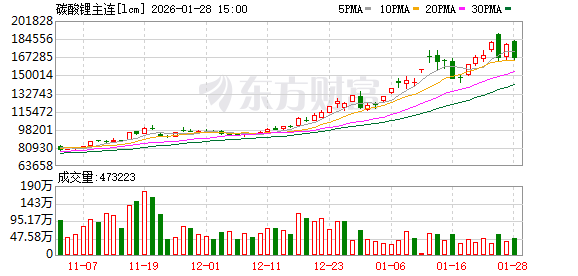
碳酸锂期价冲高回落 “强现实”已兑现?
Qi Huo Ri Bao· 2026-01-29 00:28
Core Viewpoint - The recent fluctuation in lithium carbonate futures prices reflects a market returning to fundamental trading after digesting previous bullish news, with a notable price drop of 3.9% to 166,280 yuan/ton on January 28 [2] Supply and Demand Dynamics - Lithium carbonate supply remains high but with limited incremental growth, maintaining a weekly production of approximately 22,000 tons [2] - Demand shows a "not weak in the off-season" characteristic, with energy storage batteries operating at full capacity and a "rush to export" phenomenon in power batteries due to export tax rebate policies [2] - Current weekly inventory reduction of lithium carbonate is around 800 tons, indicating a shift back to destocking after a slight accumulation [2][3] Market Sentiment and Price Trends - Analysts note that the rapid price increase has led to a cooling market sentiment, with price fluctuations becoming more pronounced due to increased divergence between bullish and bearish market participants [2][3] - The overall inventory level in the industry is low, particularly among lithium salt manufacturers and downstream industries, while futures traders hold higher inventory levels [3] - The market is expected to experience high volatility, with prices likely to oscillate at high levels until new driving factors emerge [3][4] Risk Management and Regulatory Measures - The exchange's risk management measures, including adjustments to margin ratios and trading limits, are crucial for maintaining market order and mitigating irrational short-term price fluctuations [4] - Regulatory bodies emphasize the importance of compliance and risk management in trading activities to ensure market stability [3][4] Future Outlook - Analysts suggest that while there is strong demand support for lithium carbonate prices, the current high price levels warrant caution regarding potential price corrections [4][5] - The market is transitioning into a phase of "weak expectations" versus "strong expectations," with the future balance of supply and demand remaining uncertain [5]

现实压?仍存,盘?弱势运
Zhong Xin Qi Huo· 2026-01-28 01:25
1. Report Industry Investment Rating - The mid - term outlook for the black building materials industry is "oscillation" [8] 2. Core View of the Report - The current black building materials market is under real - world pressure, with the futures market running weakly. The slow resumption of steel mills, high iron ore shipments and inventories, and the weakening support of coal - coke restocking all contribute to the weak market. In the off - season, the steel inventory accumulation pressure is increasing, the cost support is loosening, and the supply - demand surplus of glass and soda ash continues to suppress prices. Although there is downward pressure on the short - term futures market, there is a possibility of a low - level rebound in furnace material prices before the Spring Festival, and attention should be paid to downstream restocking efforts and macro - policy disturbances [1][2][3] 3. Summary by Relevant Catalogs 3.1 Iron Element - **Supply**: Iron ore arrivals have decreased, temporarily alleviating supply pressure, but inventory pressure is still increasing. There are still disturbance expectations on the supply side due to weather. Scrap steel supply has rebounded, and daily consumption is expected to decline [2] - **Demand**: Before the festival, restocking supports ore prices, but the actual supply - demand situation on both sides remains to be verified. Scrap steel consumption is expected to decline, and the overall fundamentals will marginally weaken, with spot prices expected to follow finished products [2] 3.2 Carbon Element - **Coke**: The cost support is strong, and there are still expectations of steel mill复产 and winter restocking demand. The contradiction in the supply - demand structure is limited, and spot price increases are still expected to be implemented. The futures market is expected to follow coking coal [2] - **Coking Coal**: The demand side is still in the process of winter restocking, and the supply side is expected to see a decline in coal mine production near the holiday. The fundamentals will continue to improve marginally, with strong spot support. However, after the futures market has priced in the winter restocking, the positive driving force of the fundamentals is limited, and it is expected to oscillate [2] 3.3 Alloys - **Manganese Silicon**: Cost support has loosened, the market supply - demand is in a loose state, and the upstream inventory reduction pressure is large. The futures price is under pressure, but the room for further decline is limited, and it is expected to run at a low level around the cost valuation [3] - **Silicon Iron**: The market has a situation of weak supply and demand, with limited fundamental contradictions. The poor market trading activity suppresses the upward space of the futures price, and it is expected to oscillate around the cost valuation in the short term [3] 3.4 Glass and Soda Ash - **Glass**: There are still disturbance expectations on the supply side, but the mid - and downstream inventories are moderately high. Currently, the supply - demand is still in surplus. If there is no more cold repair by the end of the year, high inventory will suppress prices, and it is expected to oscillate weakly; otherwise, prices will rise [3] - **Soda Ash**: The overall supply - demand is still in surplus. It is expected to oscillate in the short term, and in the long term, the supply surplus pattern will further intensify, and the price center will continue to decline, promoting capacity reduction [3] 3.5 Specific Commodity Analysis - **Steel**: The cost support has shifted downwards, and the futures market is running weakly. The spot market trading is generally weak, the steel mill profitability rate is improving, the iron water output has stopped falling and stabilized, and the demand is seasonally weak. There is pressure on inventory accumulation, and the short - term futures market still has downward pressure, but the downward space is limited [10] - **Iron Ore**: The spot price is stable with a slight upward trend, and port trading has decreased month - on - month. Overseas mine shipments have increased, arrivals have weakened, and the supply side is affected by weather. The demand side has stable rigid demand, and steel mills are restocking with weak enthusiasm. Port and steel mill inventories are increasing, and it is expected to oscillate in the short term [10][11] - **Scrap Steel**: This week's arrivals have decreased, and the spot price has risen slightly. Supply has declined slightly, demand is expected to decrease, and the overall fundamentals will marginally weaken, with spot prices expected to follow finished products [12] - **Coke**: The futures market oscillates, and the cost support is strong. The steel mills are resistant to price increases, and the environmental protection disturbances are frequent. The demand side has a slight increase in iron water output, and the inventory is increasing. Spot price increases are still expected to be implemented, and the futures market is expected to follow coking coal [12][14] - **Coking Coal**: The futures market is stable, and the supply is stable with high imports. The demand side is in the process of winter restocking, and the inventory is gradually reaching the target. After the futures market has priced in the restocking, the positive driving force is limited, and it is expected to oscillate [15] - **Glass**: The spot price has risen month - on - month, and the futures market oscillates. The supply side has limited losses, and there is unlikely to be a large - scale cold repair in the short term. The demand side is weak, and the mid - and downstream inventories are moderately high. If there is no more cold repair, prices will be weakly oscillating; otherwise, prices will rise [16] - **Soda Ash**: The supply has increased month - on - month, and the spot contradictions are limited. The supply side has a slight increase in daily output, the demand side has a weakening trend, and the supply - demand is in surplus. It is expected to oscillate in the short term and decline in the long term [16] - **Manganese Silicon**: The inventory pressure is large, and the futures price is weakly sorted. The cost support has loosened, the supply - demand is loose, and the upstream inventory reduction pressure is large. The futures price is expected to run at a low level around the cost valuation [18] - **Silicon Iron**: The trading atmosphere is poor, and the futures market is weakly oscillating. The cost support has loosened, the supply - demand is weak, and the trading activity suppresses the upward space. It is expected to oscillate around the cost valuation in the short term [19]
中信建投期货:1月27日能化早报
Xin Lang Cai Jing· 2026-01-27 01:22
Group 1 - Domestic natural rubber price is 15,950 CNY/ton, down 50 CNY/ton from the previous day; Thai 20 mixed rubber price is 15,150 CNY/ton, also down 50 CNY/ton [4][31] - Thai rubber water price reported at 57.7 THB/kg, up 0.1 THB/kg from the previous day; cup rubber price remains stable at 53.0 THB/kg [5][32] - As of January 25, 2026, Qingdao's total inventory of natural rubber is 584,500 tons, a decrease of 0.04 million tons, or 0.07% [5][32] Group 2 - The global rubber market is expected to transition from dynamic pricing based on supply-demand balance to static pricing based on inventory levels as the Northern Hemisphere enters the low production season [5][32] - Despite a projected moderate growth in global tire and rubber product demand by 2026, growth will take time and may be limited by ongoing global trade barriers [5][32] - The rebound in rubber prices is not expected to exceed the levels seen in late July 2025 before the Lunar New Year in 2026 [5][32] Group 3 - PX industry load in China decreased by 0.4 percentage points to 89.0%, while Asia's load increased by 0.4 percentage points to 81.0%, indicating a stable supply [6][33] - The PX supply-demand balance is expected to shift to a loose state in the first quarter due to numerous maintenance plans in downstream PTA facilities [6][33] - The price of PX is expected to fluctuate in the short term, with a support range of 7,200-7,300 CNY [6][33] Group 4 - PTA industry load decreased by 0.3 percentage points to 76.6%, indicating a low level compared to historical data, with expected supply tightening due to maintenance plans [8][35] - The overall demand for PTA is weak, with a decline in new orders and a decrease in factory operating rates in the Jiangsu-Zhejiang region [8][35] - PTA price is expected to fluctuate in the short term, with a support range of 5,200-5,300 CNY [8][35] Group 5 - The EG industry load decreased by 0.8 percentage points to 73.7%, with domestic supply remaining ample despite potential import reductions from North America and the Middle East [10][37] - The price of EG is expected to fluctuate strongly in the short term, with a support range of 3,900-3,950 CNY [10][37] Group 6 - The PR industry load decreased by 2.0 percentage points to 66.4%, with ongoing maintenance expected to support processing fees [12][42] - The demand for PR is weak due to the traditional off-season for beverage consumption, limiting production recovery [12][42] - PR price is expected to fluctuate in the short term, with a support range of 6,100-6,200 CNY [12][42] Group 7 - The glass industry shows weak supply and demand, with inventory increasing by 10,000 tons to 266,100 tons, a year-on-year increase of 22.7% [18][45] - The glass production rate remains stable, but downstream purchasing activity is generally weak [18][45] - Glass prices are expected to fluctuate in the short term, with a reference range of 1,060-1,100 CNY [18][46]


贵金属早报-20260126
Yong An Qi Huo· 2026-01-26 03:17
Report Summary Price Performance - London Gold price is 4946.25 with a change of 114.20 [1] - London Silver price is 99.00 with a change of 5.62 [1] - London Platinum price is 2507.00 with a change of 5.00 [1] - London Palladium price is 1850.00 with a change of -19.00 [1] - WTI Crude price is 61.07 with a change of 1.71 [1] - LME Copper price is 12925.50 with a change of 81.00 [1] - US Dollar Index is 97.51 with a change of -0.77 [1] - Euro to US Dollar is 1.18 with a change of 0.01 [1] - British Pound to US Dollar is 1.36 with a change of 0.01 [1] - US Dollar to Japanese Yen is 155.72 with a change of -2.70 [1] - US 10 - year TIPS is 1.92 with a change of -0.03 [1] Trading Data - COMEX Silver inventory is 12952.26 with a change of -54.02 [1] - SHFE Silver inventory is 581.09 with a change of -7.96 [1] - Gold ETF持仓 is 1086.53 with a change of 6.87 [1] - Silver ETF持仓 is 16089.98 with a change of -14.10 [1] - Shanghai Gold Exchange Silver inventory is not provided, and the change of its Gold deferred - fee payment direction is -1.00, and Silver deferred - fee payment direction change is 0.00 [1]
燃料油早报-20260126
Yong An Qi Huo· 2026-01-26 02:34
Report Industry Investment Rating - No relevant information provided. Core Viewpoints of the Report - This week, the near - month of Singapore 380cst has strengthened significantly, with both cracking and calendar spreads strengthening. Short - term arbitrage logistics have tightened to a 6 - month low, and Singapore residue inventory has dropped significantly to a 13 - week low. The 0.5 low - sulfur cracking strengthened on Friday compared to the previous week, at a historically low level year - on - year, and the calendar spread is at a low level for the same period in history. In terms of inventory, EIA residue has slightly reduced inventory, ARA residue has increased inventory, and Fujairah has slightly increased inventory. Under the new situation in Venezuela, heavy - oil logistics are tilted towards the United States, Canadian heavy oil is seeking new buyers, the price of Merey crude oil has risen, and trading is light. Recently, the Iranian situation and arbitrage logistics have affected 380, the high - sulfur spot has tightened, the cracking has rebounded, and in the short term, high - sulfur has the strongest driving force among oil products, while the low - sulfur external market remains weak [3][4]. Summary by Relevant Catalogs Rotterdam Fuel Oil Swap Data - From January 19 to January 23, 2026, the price of Rotterdam 3.5% HSF O swap M1 increased from 336.61 to 345.50, with a change of 0.57; the price of Rotterdam 0.5% VLS FO swap M1 increased from 385.89 to 388.38, with a change of 2.30; the Rotterdam HSFO - Brent M1 changed from - 10.43 to - 9.41, with a change of - 0.15; the Rotterdam 10ppm Gasoil swap M1 decreased from 630.80 to 646.25, with a change of - 2.20; the Rotterdam VLSFO - Gasoil M1 changed from - 244.91 to - 257.87, with a change of 4.50; the LGO - Brent M1 remained unchanged at 25.00; the Rotterdam VLSFO - HSFO M1 increased from 49.28 to 42.88, with a change of 1.73 [1]. Singapore Fuel Oil Swap Data - From January 19 to January 23, 2026, the price of Singapore 380cst M1 and 180cst M1 data for January 23 are missing. The Singapore VLSFO M1 data for January 23 is missing. The Singapore Gasoil M1 data for January 23 is missing. The Singapore 380cst - Brent M1 changed from - 6.30 to - 4.78, with a change of 0.77 [1]. Singapore Fuel Oil Spot Data - From January 19 to January 23, 2026, the FOB 380cst data for January 23 is missing, and the FOB VLSFO data for January 23 is missing. The 380 - basis data for January 23 is missing. The high - sulfur internal - external spread decreased from 12.6 to 11.8, with a change of - 0.7; the low - sulfur internal - external spread increased from 15.6 to 18.0, with a change of 2.0 [2]. Domestic FU Data - From January 19 to January 23, 2026, FU 01 increased from 2478 to 2517, with a change of 2; FU 05 increased from 2526 to 2623, with a change of 41; FU 09 increased from 2500 to 2562, with a change of 17; FU 01 - 05 changed from - 48 to - 106, with a change of - 39; FU 05 - 09 changed from 26 to 61, with a change of 24; FU 09 - 01 changed from 22 to 45, with a change of 15 [2]. Domestic LU Data - From January 19 to January 23, 2026, LU 01 decreased from 3136 to 3183, with a change of - 3; LU 05 decreased from 3052 to 3106, with a change of - 20; LU 09 decreased from 3073 to 3121, with a change of - 16; LU 01 - 05 changed from 84 to 77, with a change of 17; LU 05 - 09 changed from - 21 to - 15, with a change of - 4; LU 09 - 01 changed from - 63 to - 62, with a change of - 13 [3].