
反内卷

Search documents
黑色金属日报-20251216
Guo Tou Qi Huo· 2025-12-16 11:15
| SDIC FUTURES | 操作评级 | 2025年12月16日 | | --- | --- | --- | | 螺纹 | 女女女 | 曹颖 首席分析师 | | 热着 | な女女 | F3003925 Z0012043 | | 铁矿 | ☆☆☆ | 何建辉 高级分析师 | | 焦炭 | ☆☆☆ | F0242190 Z0000586 | | 焦煤 | 女女女 | | | 锰硅 | ★☆☆ | 韩惊 高级分析师 | | 硅铁 | ★☆☆ | F03086835 Z0016553 | | | | 李啸尘 高级分析师 | | | | F3054140 Z0016022 | | | | 010-58747784 | | | | gtaxinstitute@essence.com.cn | 【钢材】 | | | 今日盘面继续震荡反弹。淡季螺纹表需环比下滑,产量同步下降,库存延续去化态势。热卷供需双降,库存缓慢下降,压力仍 有待缓解。 轶水产量继续回落,供应压力逐步缓解,下游承接能力不足,钢厂利润依然欠佳,后期高炉继续减产可能性较大, 关注唐山等地环保限产持续性。从11月统计数据看,地产投资降幅继续扩大,基建、制造 ...
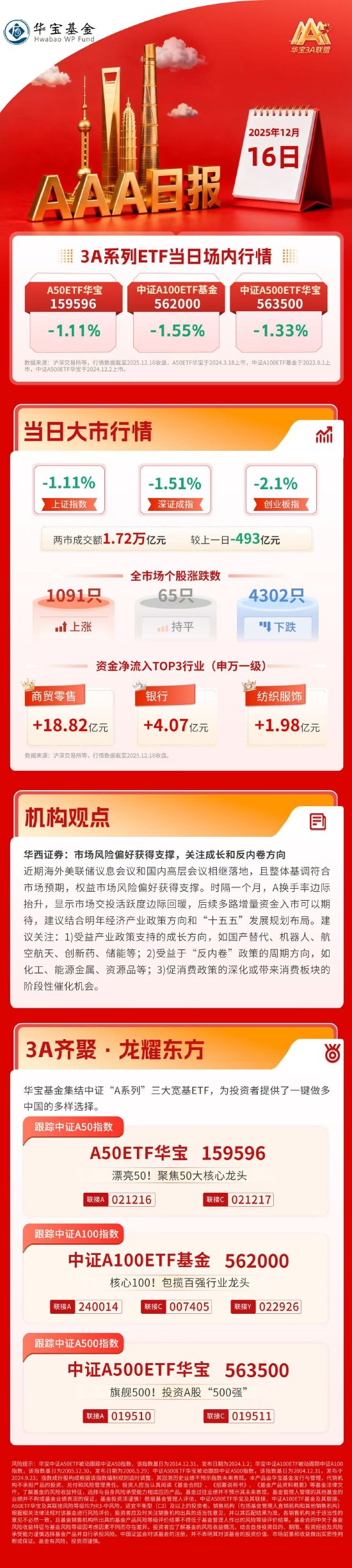
市场再度大幅调整,创指跌超2%,主力资金抢筹零售板块 | 华宝3A日报(2025.12.16)
Xin Lang Cai Jing· 2025-12-16 11:11
Group 1 - The market risk appetite has been supported by recent meetings of the Federal Reserve and domestic high-level conferences, aligning with market expectations [3][9] - The turnover rate has marginally increased, indicating a slight recovery in market trading activity, with expectations for multiple new capital inflows [3][9] - Suggested investment focus includes growth sectors benefiting from industrial policy support, such as domestic substitution, robotics, aerospace, innovative pharmaceuticals, and energy storage [3][9] Group 2 - The "A Series" ETFs from Huabao Fund provide investors with diverse options to invest in China, tracking major indices like the A50, A100, and A500 [4] - The A50 ETF focuses on 50 leading companies, while the A100 ETF encompasses the top 100 industry leaders, and the A500 ETF covers a broader range of 500 companies [4] - The total market turnover reached 1.72 trillion yuan, with a decrease of 493 billion yuan compared to the previous day, reflecting overall market dynamics [8]

大小摩等机构展望A股2026,中国将从结构性牛市转向全面牛市!
Xin Lang Cai Jing· 2025-12-16 10:32
Core Viewpoint - Domestic and foreign investment institutions predict that the A-share market will transition from a structural bull market to a more comprehensive bull market in 2026, with expectations of a gradual recovery in earnings [1][20]. Group 1: Market Outlook - According to China Securities, A-shares are expected to move from the "Bull Market II Phase" to the "Bull Market III Phase," driven by profit improvements, with a projected earnings growth rate of 5%-10% for non-financial A-shares in 2026 [2][25]. - The overall net profit growth for A-shares is anticipated to reach 16.5% in 2026, supported by a recovery in gross margins and a more balanced market across various sectors [4][27]. - Morgan Stanley forecasts a 6% earnings growth for the MSCI China Index in 2026, accelerating to 10% in 2027, with a target price for the index set at 90 points [38]. Group 2: Investment Themes - Key investment themes identified include technology, "anti-involution," and sectors benefiting from domestic demand recovery, with a focus on AI, new energy, and military technology [11][13][20]. - Goldman Sachs emphasizes a shift from valuation-driven to earnings-driven growth, highlighting the importance of AI and "anti-involution" policies as major growth drivers [34]. - UBS suggests focusing on self-sufficiency, "anti-involution," and overseas expansion, with an expected earnings growth rate for A-shares rising from 6% to 8% in 2026 [36][37]. Group 3: Asset Allocation - Recommended asset allocation includes sectors such as non-ferrous metals, machinery, power equipment, electronics, media, and social services [3][26]. - Investment strategies should focus on high-growth sectors like AI, new energy, and innovative pharmaceuticals, as well as traditional cyclical sectors benefiting from price recovery and demand stimulation [4][27]. - Specific stocks with strong growth in the "anti-involution" theme have shown significant revenue and profit increases, indicating potential investment opportunities [24][45].

2025年11月经济数据点评:需求待企稳
BOHAI SECURITIES· 2025-12-16 09:50
Economic Data Overview - In November 2025, the industrial added value for large-scale enterprises grew by 4.8% year-on-year, slightly below the expected 5.0% and previous value of 4.9%[2] - The total retail sales of consumer goods increased by 1.3% year-on-year, significantly lower than the expected 2.9%[2] - The cumulative year-on-year growth rate of fixed asset investment was -2.6%, worse than the expected -2.3% and previous -1.7%[2] Industrial Production Insights - The year-on-year growth rate of industrial added value showed a slight slowdown compared to the previous value, with the monthly growth rate aligning with historical averages[3] - High-tech manufacturing sectors outperformed overall industrial growth, indicating a shift in production dynamics[3] - The annual industrial production growth rate is projected to stabilize around 5.8%, with potential constraints from "anti-involution" and a slight weakening in exports affecting December's production[3] Consumer Spending Trends - The year-on-year growth rate of retail sales in November was impacted by early online shopping promotions and diminishing subsidy effects, leading to a broader decline across most categories[4] - Notably, furniture, building materials, and home appliances were significantly affected, with automotive consumption dragging down overall growth by nearly 2 percentage points[4] - The annual retail sales growth is expected to be around 3.7%, with a focus on stimulating service consumption in the short term[4] Investment Outlook - Fixed asset investment saw an expanded decline, particularly in manufacturing, where negative growth persisted for five consecutive months[5] - Infrastructure investment showed signs of stabilization, with improvements in transportation and energy sectors, while water conservancy and public facilities continued to lag[5] - Real estate investment experienced a significant drop of -30.3% year-on-year, with ongoing declines in new construction and completion areas[5] Risk Factors - Geopolitical uncertainties may elevate market risk preferences, potentially disrupting economic stability[6] - Unexpected changes in economic conditions or policies could arise due to increasing volatility in overseas markets and domestic economic transitions[6]
11月份经济数据解读:经济维持稳态,结构性改善明显
Caixin Securities· 2025-12-16 09:17
Report Industry Investment Rating No specific industry investment rating is provided in the report. Core Viewpoints of the Report - The economy maintained a stable state in November 2025, with obvious structural improvements, but the endogenous momentum needs to be consolidated, and the recovery trend remains to be observed. The report maintains the judgment that the economic growth rate in 2026 will still be positive, with a possible pattern of being lower in the first half and higher in the second half [4]. - In the equity market, market sentiment may continue to improve, and the market may show a volatile upward trend. In the bond market, volatility may increase, and it is not recommended to buy at the bottom in the short term. In the commodity market, the differentiation intensifies, and attention should be paid to gold, copper, and aluminum priced internationally [4]. Summary by Relevant Catalogs 1. Overview of the November 2025 Economy - The economy maintained a stable state with obvious structural improvements, including the continuous recovery of CPI, prominent economic kinetic energy switching, strengthened export competitiveness, high - level production, steady growth of industrial enterprise profits, and highlights in service consumption [5]. - The endogenous momentum needs to be consolidated, and the recovery trend remains to be observed. The "subsidy withdrawal" effect has a significant impact, economic data still needs trend improvement, the endogenous growth momentum needs to be strengthened, and real estate still has a certain drag on the economy [6]. 2. Interpretation of November 2025 Economic Sub - item Data - Manufacturing PMI increased slightly, and service PMI declined. The new order index was the main contributor to the increase in PMI. The PMI of high - tech manufacturing was above the boom - bust line. The service business activity index was below the boom - bust line for the first time since September 2024. The construction industry PMI improved [7][8]. - Fixed - asset investment continued to decline under the drag of real estate. Real estate development investment dragged down the growth rate of fixed - asset investment by 3.4 percentage points. In the future, the drag of real estate on fixed - asset investment is expected to shrink, and infrastructure investment may stabilize, while manufacturing investment should focus on emerging directions [9]. - Service consumption had highlights, while commodity consumption was highly differentiated. The total retail sales of consumer goods increased slightly. Service consumption, such as catering, maintained growth, while commodity consumption, such as automobiles and home appliances, declined due to the "subsidy withdrawal" effect [10]. - Exports showed strong resilience, with prominent structural highlights and a steady expansion of the surplus. In November, the export growth rate rebounded. The exports to Africa performed outstandingly, and the product structure was optimized. Exports are expected to be a major bright spot in the economy in 2026 [11][12]. - Real estate sales continued to bottom out. The sales area and sales volume of new commercial housing decreased year - on - year, and the market was still in the process of destocking. The prices of commercial residential buildings in large and medium - sized cities declined both month - on - month and year - on - year [13]. - The production end remained stable. In November, the added value of large - scale industrial enterprises increased year - on - year and month - on - month. The added value of the equipment manufacturing and high - tech manufacturing industries grew faster than the overall level [14]. - At the price end, CPI continued to rise, and PPI was stable and waiting to rise. In November, CPI increased year - on - year, and PPI increased month - on - month. Consumption - end prices showed a recovery trend, and production - end prices were characterized by differentiation [14]. - In November, the overall social financing was stable, and credit increased less year - on - year. Government bond financing supported the growth of social financing, while the demand of the resident sector was weak, and the demand of the enterprise sector improved marginally [18]. - The profits of industrial enterprises increased steadily. From January to October 2025, the cumulative profit growth rate of large - scale industrial enterprises increased for three consecutive months. In the future, policies are expected to promote the growth of industrial enterprise profits [19][20]. 3. Future Economic Outlook - Overseas, the main narrative is the soft landing of the economy, but there are still uncertainties in the structure. The US economy is expected to maintain a positive trend, but there are risks such as the differentiation between the real and virtual economies, the widening wealth gap, and the differentiation between AI and non - AI investments [21]. - At the domestic policy level, in 2026, the macro - policy will be more proactive. Fiscal policy will be more positive and pay attention to robustness and sustainability, and monetary policy will be moderately loose, with possible reserve requirement ratio and interest rate cuts [21]. - In terms of the economy, the economic growth rate in 2026 is expected to be lower in the first half and higher in the second half. The endogenous recovery momentum of domestic demand needs to be consolidated, and exports are expected to perform well [22]. 4. Investment Suggestions - Equity market: In the short term, the market may show a volatile upward trend. Investors should focus on sectors with positive event catalysts, sectors benefiting from the recovery of the equity market, sectors benefiting from the Fed's interest rate cuts, and the supplementary rise of the large - consumption sector [24]. - Bond market: The volatility of ultra - long bonds may increase, and it is not recommended to buy at the bottom in the short term. Attention should be paid to the expected term of fiscal bond issuance and the adjustment of the risk assessment indicators of large banks [25]. - Commodity market: The differentiation intensifies. For precious metals, the long - bull foundation of gold remains. For crude oil, the price trend may continue to be weak. For internationally priced non - ferrous metals, the price is in a medium - term upward channel. For commodities priced by the domestic fundamentals, the prices of relevant "anti - involution" varieties will enter a wide - range volatile trend [26].
交银国际:锂电行业“反内卷”趋势延续 建议关注宁德时代
Zhi Tong Cai Jing· 2025-12-16 09:12
Core Insights - The report from CMB International highlights a robust growth in China's power battery industry in November, driven by strong demand and favorable policies, indicating a clear trend of "anti-involution" in the industry [1][2] Group 1: Industry Performance - In November, the installed capacity of power batteries in mainland China reached 93.5 GWh, reflecting a year-on-year increase of 39.2% and a month-on-month increase of 11.2% [2] - The export of batteries remained strong, with a total export of 32.2 GWh in November, marking a year-on-year increase of 46.5% and a month-on-month increase of 14.1% [2] - Lithium iron phosphate batteries accounted for 80.5% of the total installed capacity, with a significant year-on-year increase of 40.7% [2] Group 2: Price Trends - The trend of "anti-involution" continues in the lithium battery industry, with prices across the supply chain generally rising due to government initiatives aimed at curbing irrational price competition [3] - The price of lithium hexafluorophosphate has reached 180,000 CNY per ton, while battery-grade lithium carbonate has surpassed 95,500 CNY per ton [3] - Companies like Suzhou Dejia Energy Technology have announced price increases of 15% for their battery products starting December 16, due to rising raw material costs [3] Group 3: Production Plans - December production plans indicate a continued increase in battery production, with domestic companies planning to produce 148.8 GWh, a month-on-month increase of 2.3% [4] - The production of separator materials is expected to rise by 2.6%, while the production of electrolyte is projected to increase by 1.4%, reflecting strong downstream demand [4] - The lithium battery sector has experienced a correction, with the Wande Lithium Battery Index down approximately 12% from its peak, presenting a potential investment opportunity [4] Group 4: Investment Recommendations - The report suggests focusing on leading companies with cost and technological advantages, particularly CATL (宁德时代), as the industry fundamentals remain strong and production continues to rise [1][4]




建材行业2026年度投资策略:向内看“反内卷”显效,向外拓“新市场”机遇
CMS· 2025-12-16 09:04
Group 1 - The report highlights that the building materials industry has shown a strong performance since 2025, particularly in fiberglass, cement, and refractory materials, benefiting from significant price increases and improved supply-demand dynamics [1][12][14] - The consensus on "anti-involution" among companies has led to supply reductions or maintenance, while structural demand growth is observed in specific segments such as specialty electronic fabrics in fiberglass and overseas market expansion in cement [1][12] - The report anticipates that the building materials industry will continue to present structural opportunities in 2026, with specific focus on segments like float glass, tiles, pipes, and sanitary ware, which are still in the process of bottoming out [1][12] Group 2 - The report indicates that the cement industry is expected to see a profit recovery in 2025, with the profit turning point occurring before revenue, driven by capacity management and a decrease in coal prices [5][6][12] - The overseas market for cement is highlighted as a key growth area, with significant projects expected to contribute to earnings in 2026, such as Huaxin Cement's project in Malawi and West Cement's project in Uganda [5][6][12] - The fiberglass sector is projected to experience significant profit recovery, with multiple rounds of price increases and expanding demand from downstream applications, particularly in wind energy and electric vehicles [5][6][12] Group 3 - The report notes that the float glass sector continues to face challenges, with high inventory levels and weak demand leading to price pressures, while the industry is expected to undergo a reshuffling due to cost differentiation [6][12][25] - The report emphasizes the importance of focusing on leading companies in the building materials sector that possess strong brand competitiveness, scale advantages, and well-established distribution channels to capture dual benefits of market share growth and profit improvement [6][12][25] - Investment recommendations include focusing on leading companies in various segments such as waterproof materials, coatings, pipes, and tiles, as well as cement companies with strong cash flow and dividend commitments [6][12][25]




建材行业2025年三季报综述:传统建材仍在寻底,电子布正异军突起
Hua Yuan Zheng Quan· 2025-12-16 08:20
Investment Rating - The investment rating for the building materials industry is "Positive" (maintained) [4] Core Viewpoints - The building materials sector is under pressure, but overall profitability is stabilizing. In the first three quarters of 2025, the sector's revenue decreased by 4.39% year-on-year, while gross margin increased by 1.61 percentage points. The net profit attributable to shareholders increased by 20.56% year-on-year, with a notable performance in the fiberglass segment due to rising demand for electronic fabrics [5][9][12] Summary by Relevant Sections Overall Industry Performance - The building materials sector experienced a revenue decline of 4.39% year-on-year in the first three quarters of 2025, with a gross margin increase of 1.61 percentage points and a net profit margin increase of 1.08 percentage points. The net profit attributable to shareholders rose by 20.56% year-on-year [5][9][10] Cement Sector - The cement market faced significant demand decline, with a total production of 1.259 billion tons in the first three quarters of 2025, down 5.2% year-on-year. The revenue for the cement sector decreased by 7.63% year-on-year, while the net profit attributable to shareholders increased by 158.74% year-on-year [25][26] Glass Sector - The float glass segment saw a production decline of 5.2% year-on-year, with revenue down by 9.94%. In contrast, the photovoltaic glass segment experienced a recovery in the second half of the year, with prices increasing significantly in September [9][25] Fiberglass Sector - The fiberglass sector showed a revenue increase of 23.54% year-on-year, driven by demand from AI server upgrades and high-frequency communication technology, leading to price increases in specialized fiberglass products [9][12] Consumer Building Materials - The consumer building materials sector's revenue decreased by 6.46% year-on-year, but some companies like SanKeShu and TuBaoBao managed to achieve growth through strategic adjustments and product optimization [12][19]
兴证策略张启尧:十大外资如何看2026年A股?
Xin Lang Cai Jing· 2025-12-16 07:57
Economic Outlook - The GDP growth forecast for 2026 has been adjusted to 4.4%, with a quarterly increase expected in Q1 to 6.5% and a slight decrease in H2 to 3.6% [1] - The fiscal deficit is projected to expand by 1 percentage point in 2026, with a total budget deficit of 4% and special government bonds amounting to approximately 4.8 trillion yuan [9] - Inflation is expected to remain low, with CPI projected to rise slightly to 0.4% and PPI potentially turning positive by the end of 2026 [11] Stock Market Projections - The target levels for major indices by the end of 2026 are set at 100 points for MSCI China, 5200 points for CSI 300, and 16000 points for MSCI Hong Kong, indicating potential increases of 20%, 13%, and 20% respectively [2] - The expected EPS growth for MSCI China is around 15% for 2026, with a significant contribution from the consumer discretionary sector [4][6] Key Investment Themes - The four main investment themes identified are anti-involution, AI, overseas expansion, and structural recovery in domestic demand [1][6] - The easing of price wars among major companies is anticipated to improve profit margins, particularly in the consumer discretionary sector [4] - The demand for AI infrastructure is expected to drive performance for Chinese tech hardware suppliers, with significant capital expenditure growth projected for major cloud service providers [5] Industry Insights - The "anti-involution" policy is expected to enhance profit margins and return on equity (ROE) across various sectors, particularly in industries facing excessive competition [5] - The structural recovery in sectors such as healthcare, information technology, and communication services is showing signs of broadening, with over one-third of sub-sectors currently in a revenue expansion phase [3] - The automotive, consumer electronics, and AI-related hardware sectors are projected to see significant improvements in overseas revenue contributions [7] Policy Environment - The policy landscape is expected to support consumption and investment, with a focus on structural rebalancing between services and manufacturing [1][9] - Monetary policy is anticipated to remain moderately accommodative, with expectations of interest rate cuts and reserve requirement ratio reductions [9][15] - The government is likely to implement targeted measures to stimulate consumption, particularly in service and green sectors [9][10]
东兴证券:制造业出口向“品牌出海”升级 建议关注人形机器人等细分机会
Zhi Tong Cai Jing· 2025-12-16 07:36
Group 1: Mechanical Sector Performance - The mechanical sector is expected to see significant growth in 2025, with a projected increase in revenue and profit compared to 2024 [1] - The Shenwan Mechanical Equipment Index is forecasted to rise by 36.11% in 2025, outperforming the Shanghai Composite Index by 19.74 percentage points and the Shenzhen Component Index by 8.78 percentage points [1] - For the first three quarters of 2025, the mechanical industry reported operating revenue of 15,135.34 billion yuan, a year-on-year increase of 7.35%, and a net profit attributable to shareholders of 1,080.76 billion yuan, up 16.80% year-on-year [1] Group 2: Export Resilience in Equipment Manufacturing - The equipment manufacturing industry has maintained export resilience through diversified market strategies, technological innovation, and policy support [2] - From January to October 2025, the export delivery value for general equipment, specialized equipment, and transportation equipment reached 6,173.20 billion yuan, 5,319.30 billion yuan, and 4,124 billion yuan respectively, with year-on-year growth rates of 5.5%, 9.3%, and 24.20% [2] - Engineering machinery and motorcycles are highlighted as strong sectors for China's manufacturing industry, expected to enhance brand effects and transition from "manufacturing going abroad" to "branding going abroad" [2] Group 3: Systemic Ecological Transformation - The emergence of new manufacturing scenarios signifies a profound shift from single technology upgrades to systemic ecological restructuring, driven by technological revolutions, policy initiatives, and market demands [3] - These new scenarios are enhancing production efficiency, product quality, and innovation capabilities, thereby promoting industrial transformation and high-quality economic development [3] - Key areas for investment include humanoid robots, smart logistics, non-power nuclear technology applications, low-altitude economy, deep-sea technology, ice and snow economy, and high-end measurement and testing [3] Group 4: High-Quality Development in Key Industries - The 2025 Central Financial Committee meeting emphasized "anti-involution" as a crucial task for building a unified national market, focusing on addressing low-price disorderly competition and phasing out outdated capacity [4] - The anti-involution policy aims to reshape industry ecology through market-oriented measures, restoring pricing power and promoting sustainable long-term growth [4] - The lithium battery, photovoltaic, and semiconductor equipment industries are expected to transition from extensive growth to high-quality development, enhancing overall competitiveness and sustainability [4]
