新消费

Search documents
A股“520”,三大赛道掀涨停潮
新华网财经· 2025-05-20 05:15
Core Viewpoint - The article highlights the significant rise in new consumption sectors, particularly in the beauty care, pet economy, and "grain economy" sectors, driven by the "self-economy" trend in the current consumer landscape [2][4][10]. New Consumption Sectors - The beauty care sector experienced the most substantial gains, with stocks like Kela Co. and Fuirjia seeing increases of 20.03% and 12.17% respectively [5][6]. - The pet economy also showed strong performance, with Tianyuan Pet reaching a limit-up increase [8]. - The "grain economy" sector saw stocks like Mankalon and Chuangyuan Co. rise significantly [8]. Market Performance - As of the morning close, the Shanghai Composite Index rose by 0.38%, the Shenzhen Component Index by 0.79%, and the ChiNext Index by 1.04% [2]. - High-profile stocks experienced a downturn, with companies like Lijun Co. and Ningbo Yuanyang facing significant declines [2]. Future Market Predictions - Institutions predict that by 2025, the "beauty economy" market in China will exceed 3.5 trillion yuan, with light medical beauty, green cosmetics, and smart beauty devices identified as key growth areas [8]. - The rise of personalized and intelligent beauty solutions is expected to further enhance the market [8]. Pharmaceutical Sector - The pharmaceutical sector saw a strong performance, particularly in innovative drugs and recombinant proteins, with companies like Sanofi and Rongchang Bio achieving notable stock increases [11][12]. - Sanofi's collaboration with Pfizer for the exclusive development and commercialization of a product has led to a significant market response, with a non-refundable upfront payment of $1.25 billion and potential total payments reaching $4.8 billion [13][16]. Investment Trends - The article notes a shift in investment logic from "total expansion" to "demand differentiation," with new consumption companies benefiting from high communication characteristics and the younger generation's demand for personalized products [10]. - Three key directions for the broader consumer sector include essential consumption showing defensive value, rapid rise of new consumption formats, and the release of incremental space in lower-tier markets [10].



4月社零同比增5.1%,看好新消费机遇
HTSC· 2025-05-20 02:50
Investment Rating - The report maintains an "Overweight" rating for the consumer sector, specifically highlighting the potential in new consumption opportunities and structural growth within the domestic market [6]. Core Insights - In April, the total retail sales of consumer goods reached 3.7 trillion yuan, with a year-on-year growth of 5.1%, indicating resilience in domestic demand despite external pressures [1]. - The report emphasizes the positive impact of government policies aimed at boosting consumption, particularly in sectors such as home appliances, sports, and entertainment [1][4]. - The online retail penetration continues to grow, with a 5.8% year-on-year increase in physical goods sold online, reflecting a shift towards digital consumption [2]. Summary by Sections Retail Performance - In April, the restaurant and retail sectors saw year-on-year growth of 5.2% and 5.1%, respectively, indicating a stable recovery trend [2]. - The online retail sales of physical goods increased by 6.1% year-on-year from January to April, with an online penetration rate rising to 24.3% [2]. Consumer Trends - Various consumer categories showed positive growth, particularly in home appliances (up 38.8%), furniture (up 26.9%), and sports equipment (up 23.3%), driven by policies encouraging consumption upgrades [3]. - Jewelry sales surged by 25.3% year-on-year, attributed to investment-driven demand for gold and silver [3]. Economic Indicators - The Consumer Price Index (CPI) in April decreased by 0.1% year-on-year, with food prices showing a slight decline of 0.2% [4]. - Service prices increased by 0.3% year-on-year, with notable growth in domestic services such as housekeeping and education [4]. Investment Recommendations - The report suggests four main investment themes for 2025: 1. New consumption opportunities driven by domestic brands [5]. 2. High-growth emotional consumption sectors [5]. 3. The burgeoning silver economy [5]. 4. AI-driven consumer innovations [5]. - Specific stock recommendations include brands like 毛戈平 (Mao Geping), 安踏体育 (Anta Sports), and 海澜之家 (HLA) among others, all rated as "Buy" [9][41].



国泰海通:白酒板块配置价值凸显 大众品首选新消费、高成长
Zhi Tong Cai Jing· 2025-05-19 22:52
Group 1 - The core viewpoint is that the white liquor sector is showing significant allocation value, with its commodity attributes being rapidly reshaped, enhancing its fast-moving consumer goods (FMCG) characteristics, which will increasingly highlight the competitive advantages of companies that can adapt to FMCG operational logic [1][2] - The new consumption trend is fundamentally a structural dividend driven by channel and category resonance, with retail efficiency improving and younger demographics gradually generating income, leading to a clear new channel and new category-driven consumption [2] - The white liquor industry is currently in a bottoming cycle, with pricing pressure greater than volume pressure, and most companies' short-term performance increasingly reliant on market share gains in core markets [2][3] Group 2 - The white liquor sector shows significant allocation value from a stock price perspective, with potential for dividends as leading companies have dividend yields close to or greater than 3% [3] - Dynamic valuations have returned to historically low levels, with potential catalysts such as stabilization in housing prices and domestic demand policies [3] - The selection of stocks should prioritize companies with market share logic, as the industry is expected to continue evolving [3]

国泰海通|食饮:首选新消费、高成长
国泰海通证券研究· 2025-05-19 14:20
Core Viewpoint - The article emphasizes the structural growth driven by new consumption trends, highlighting the resonance of channel and category innovation in boosting the performance of consumer goods [2][3]. Group 1: New Consumption Trends - New consumption represents a structural dividend, with channel and category innovations driving growth. The retail efficiency is improving, and the younger demographic is increasingly contributing to consumption [2]. - The consumer landscape is evolving with a clear shift towards new channels and product categories, driven by regional differentiation in consumer groups and rising demands for diverse products [2]. Group 2: Consumer Goods and Alcohol Industry - The consumer goods sector is favored for new consumption and high growth potential, while the liquor industry is seen as seeking a bottom but showing significant configuration value [3]. - The liquor industry is currently in a phase of inventory cycle adjustment, with most companies relying on market share gains in core markets and the performance of mid-tier and lower-tier products [3]. - The article notes that the attributes of liquor products are being reshaped, enhancing their fast-moving consumer goods characteristics, which will benefit companies that adapt to FMCG operational logic [3]. Group 3: Investment Recommendations - The liquor sector shows configuration value due to potential dividends, with leading companies having dividend yields close to or exceeding 3% [3]. - Dynamic valuations in the liquor sector have reverted to historically low levels, with potential catalysts such as stabilization in housing prices and domestic demand policies [3]. - Stock selection should prioritize companies with strong market share logic [3].

中美又有新的交锋?!
格兰投研· 2025-05-19 14:16
Economic Overview - Industrial production shows resilience with a year-on-year growth of 6.1% in April and 6.4% from January to April, driven by strong export performance [1] - Total goods import and export in April reached 38,391 billion yuan, a year-on-year increase of 5.6%, with exports at 22,645 billion yuan, growing by 9.3% [1] Consumer Spending - Social retail sales totaled 37,174 billion yuan in April, up 5.1% year-on-year, primarily supported by subsidies [3] - Categories like clothing and tobacco saw declines, while home appliances and furniture benefited from trade-in policies, although the effectiveness of such policies is diminishing [3][4] - Tourism emerged as a bright spot, with 1.467 billion people traveling during the May Day holiday, a year-on-year increase of 8.0%, indicating a recovery in consumer spending [6][8] Investment Trends - Investment in real estate and infrastructure has unexpectedly declined, with real estate development investment down 10.3% year-on-year [9][11] - Excluding real estate, fixed asset investment growth increased from 4% to 8% [11] - The decline in investment is attributed to increased uncertainty due to tariff impacts, necessitating further stimulus policies to boost domestic demand [11][12] Market Dynamics - The stock market has shown limited movement, with significant fluctuations but no clear trend in index performance [13] - New consumption trends, particularly among younger demographics, are emerging, characterized by unique consumption models such as blind box purchases and pet-related products [14][15] - The outlook for the market remains cautious, with ongoing negotiations between China and the U.S. regarding tariffs being a critical factor for future economic sentiment [16][17]

消费基金阶段收益拆解及基金经理精选:刚需韧性+新消费破局,消费基金的Alpha掘金路径
SINOLINK SECURITIES· 2025-05-19 09:06
Report Summary 1. Report Industry Investment Rating No relevant content provided. 2. Core Viewpoints of the Report - The consumer market has shown significant structural differentiation and opportunities. New consumption sectors such as trendy toys, pet economy, and AI+ have emerged, while traditional sectors like liquor have faced challenges due to economic pressure [21]. - Different stages of the consumer market are characterized by distinct investment styles. For example, in the core - asset - dominated stage, low - turnover and growth - style consumer funds outperformed; in the market - oscillation stage, value - style funds with flexible and diversified holdings had an edge [36][57]. - The performance of consumer funds is closely related to macro - economic conditions, policy support, and market sentiment. In weak market environments, dividend - value style funds with strong stock - picking abilities tend to perform better [70]. 3. Summary by Relevant Catalogs 3.1 Consumption Market Historical Review - **Core Asset Dominated (20190101 - 20210210)**: The market trended upward. The relaxation of domestic policies, inflow of foreign capital, and economic recovery promoted investment opportunities in the consumer sector, especially in the liquor industry. The CSI Liquor Index rose over 350% [13]. - **Repeated Oscillation (20210218 - 20230116)**: Factors such as the pandemic, macro - economic pressure, and geopolitical issues led to market oscillations. There were structural rotation opportunities in high - end consumption, pig farming, and other sectors [13]. - **Oscillation Decline (20230117 - 20240202)**: The market first rose and then declined. The weak economic recovery and low consumer confidence led to a decline in the consumer industry, especially in the real - estate post - cycle and food and beverage industries. The CSI Liquor Index fell nearly 38% [21]. - **New Consumption Dominated (20240205 - 20250415)**: The consumer market showed structural differentiation. New consumption sectors such as trendy toys, pet economy, and AI+ performed well, while the liquor industry still faced pressure. The CSI Liquor Index fell 3.8%, and the Xinhua SHS Emerging Consumption Index rose 53% [21]. 3.2 Consumption Fund Holdings - **Stock - holding Proportion**: The proportion of liquor holdings in consumer funds reached a peak in 2023 (about 41%) and then declined to about 30% in 2024. The proportion of new - consumption holdings increased from about 10% in 2019 to 25.7% at the end of 2024 [29]. - **Stock - holding Contribution**: Liquor has been the main source of continuous contribution to consumer funds since 2019. New - consumption stocks have made significant contributions since 2024, with companies like Pop Mart leading the way [29]. - **HK Stock Holdings**: Consumer funds' holdings of HK stocks are mainly concentrated in the new - consumption field. The proportion of HK - stock holdings increased in 2020 and 2024, mainly due to the layout of new consumption [33]. 3.3 Fund Return Sources and Portraits - **Stage One (20190101 - 20210210)**: High - growth consumer funds with low turnover and high retention of heavy - position stocks outperformed. The expansion of liquor channels and the upgrade of price ranges drove the growth of the consumer market [36]. - **Stage Two (20210218 - 20230116)**: Funds with a balanced and slightly value - oriented style and flexible and diversified holdings performed better. The moderate increase in CPI and the decline in PPI benefited the consumer industry, and value - type consumer stocks showed high defensive properties [57]. - **Stage Three (20230117 - 20240202)**: Funds with a deep - value style and strong alpha capabilities outperformed. In a weak market environment, low - volatility, high - dividend stocks became a safe haven for funds [70]. - **Stage Four (20240205 - 20250411)**: The elasticity and stock - picking ability of consumer funds in the new - consumption field became the key to returns. Traditional companies' second - growth curves and the growth of new consumption drove the performance of consumer funds [84]. 3.4 Consumption ETF Funds - **A股 - related ETFs**: There are ETF funds corresponding to 5 A - share consumer comprehensive indices, with the largest number (3) and total scale (27 billion yuan) corresponding to the CSI Consumption 50 Index [95]. - **港股 - related ETFs**: There are ETF funds corresponding to 5 HK - stock consumer comprehensive indices, with the largest number (4) corresponding to the CSI Hong Kong Stock Connect Consumption Index and the largest total scale (33.5 billion yuan) corresponding to the Hang Seng Consumption Index [95].
中原期货晨会纪要-20250519
Zhong Yuan Qi Huo· 2025-05-19 07:18
1. Market Index Performance 1.1 Global Stock Indices - The Dow Jones Industrial Index rose 331.99 points (0.784%) to 42,654.74 [2]. - The Nasdaq Index increased by 98.78 points (0.517%) to 19,211.10 [2]. - The S&P 500 climbed 41.45 points (0.701%) to 5,958.38 [2]. - The Hang Seng Index fell 108.11 points (-0.461%) to 23,345.05 [2]. 1.2 Other Macro - indicators - SHIBOR overnight rose 0.25 to 1.65, a 17.806% increase [2]. - The US Dollar Index dropped 0.244 points (-0.241%) to 100.74 [2]. - The US Dollar to RMB (CFETS) remained unchanged at 7.20 [2]. 1.3 Commodity Futures (International) - COMEX Gold decreased by $38.60 (-1.190%) to $3,205.30 [2]. - COMEX Silver fell $0.36 (-1.098%) to $32.43 [2]. - LME Copper declined $137 (-1.431%) to $9,440.00 [2]. 1.3 Commodity Futures (Domestic) - Gold futures dropped 2.80 (-0.372%) to 749.00 [2]. - Silver futures fell 8.0 (-0.099%) to 8093.00 [2]. - Copper futures decreased 470.0 (-0.601%) to 77670.00 [2]. 1.4 Energy and Chemical Futures (Domestic) - Crude oil futures rose 6.30 (1.381%) to 462.50 [4]. - Fuel oil futures increased 19.0 (0.636%) to 3008.00 [4]. - Natural rubber futures dropped 55.0 (-0.369%) to 14850.00 [4]. 1.5 Agricultural Futures (Domestic) - Yellow soybean No.1 futures rose 17.0 (0.408%) to 4185.00 [4]. - White sugar futures fell 14.0 (-0.239%) to 5841.00 [4]. - Cotton No.1 futures dropped 10.0 (-0.075%) to 13380.00 [4]. 2. Macro - economic News 2.1 Domestic News - Central bank officials support Beijing's financial development, including promoting RMB internationalization and strengthening the Beijing Stock Exchange [7]. - China's domestic refined oil prices are expected to drop by about 230 yuan/ton on May 19 [7]. - China - US freight volume has recovered after mutual tariff cuts, and US business cooperation is increasing [7]. - China aims to grow its data industry to 7.5 trillion yuan by 2030 and build a data infrastructure system by 2029 [8]. - China will impose anti - dumping duties on imported copolymerized polyoxymethylene from the US, EU, Taiwan region, and Japan starting May 19 [8]. - China's cold - chain logistics showed growth in Q1 2025, with a 4.0% increase in total value and a 3.9% increase in revenue [8]. 2.2 International News - US President Trump urges the Fed to cut interest rates and criticizes Fed Chair Powell [9]. - US Treasury Secretary responds to Moody's downgrade of US credit rating and plans to attend a G7 meeting [9]. 3. Morning Views on Main Varieties 3.1 Agricultural Products - Sugar: Suggest trading in the 5800 - 5900 yuan/ton range, with a key support at 5830 yuan/ton [12]. - Corn: Maintain a short - selling strategy, watch for a break below 2300 yuan/ton [12]. - Eggs: Consider short - selling, with a focus on the price range and potential support [12]. - Hogs: Hold short positions, and use pre - holiday rebounds for shorting [12]. 3.2 Energy and Chemicals - Caustic soda: Expect stable prices in East China with local fluctuations [14]. - Urea: The market may continue high - level oscillations, with opportunities for positive spreads [14]. 3.3 Industrial Metals - Copper and aluminum: Prices rebounded but faced resistance at previous gaps [14]. - Alumina: Prices are expected to be strong, with a focus on the 3100 - 3200 yuan/ton resistance [14]. 3.4 Others - Steel products: Steel prices may fluctuate at low levels, with specific price ranges for different products [16]. - Ferroalloys: Prices are expected to oscillate at low levels [16]. - Coking coal and coke: Continue weak oscillations in the short term [16]. - Lithium carbonate: Hold short positions, watch for potential technical rebounds [16]. 3.5 Options and Finance - Stock indices: The market is likely to be volatile, with specific trading strategies for futures and options [17][18]. 4. Research Analysts 4.1 Agricultural Products - Li Na (F3060165, Z0016368) and Liu Sikui (F3033884, Z0011291) [22]. 4.2 Industrial Products - Liu Peiyang (F0290318, Z0011155), Peng Bohan (F3076814, Z0016415), and Lin Na (F03099603, Z0020978) [22]. 4.3 Options and Finance - Ding Wen (F3066473, Z0014838) and Li Weihong (F0231193, Z0017182) [22].
兴业证券:把握新消费细分板块及传统龙头竞争优势
智通财经网· 2025-05-19 03:21
Group 1: Core Insights - The external trade environment is highly uncertain, and traditional domestic consumption is relatively weak, making it difficult to show an overall upward trend [1] - The investment logic suggests a bottom-up approach to select leading companies with differentiated competitive advantages and strong earnings certainty [1] Group 2: New Consumption Sectors - The overall consumption is under pressure, but some sub-sectors show high growth potential; companies are adapting to channel changes and industry opportunities [2] - In the personal care sector, domestic brands are leveraging e-commerce and product upgrades to gain market share, with recommendations for companies like Baiya Co. and Haoyue Care [2] - The AI glasses sector is expected to see accelerated product launches by 2025, with Mingyue Lens recommended for its unique advantages [2] - The emotional consumption sector is gaining traction, with recommendations for companies like Chenguang Co. that are investing in IP resources [2] Group 3: Traditional Consumption Sectors - The home and paper industries face pressure from the overall consumption environment; investment points include the ability of quality stocks to leverage policy support and operational advantages [4] - In the home sector, the expansion of subsidy categories and amounts in 2025 presents opportunities for leading companies like Oppein and Sophia [4] - The paper industry is closely tied to economic cycles, with recommendations for Sun Paper due to its cost control capabilities and upcoming production [4] Group 4: Export Sector - Due to high uncertainty regarding tariffs, companies with established overseas production capabilities are at an advantage; some export sectors are highly dependent on U.S. and Vietnamese production [5] - Companies with lower exposure to U.S. exports are considered safer, while certain sub-sectors still show high growth potential due to rigid demand and changing consumption habits [5] - Recommended companies in the export sector include Jiayi Co., Gongchuang Turf, and Deou Technology [5]



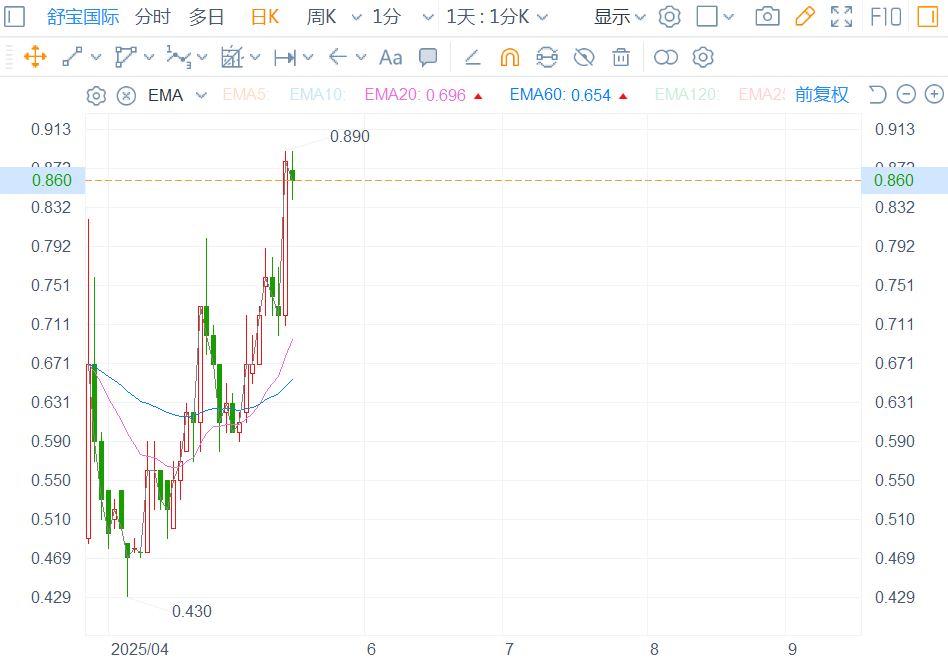
新消费“蔚然成风”,舒宝国际(02569)能否乘势而起?
智通财经网· 2025-05-19 02:28
Group 1 - The core viewpoint of the articles highlights the strong market performance of Shubao International, with its stock price increasing significantly since its listing, reflecting growing investor confidence in consumer companies [1][2] - Shubao International, as part of the Jinjiang enterprise group, benefits from the "going global + maternal and infant" concept, aligning with the current preference for high-growth emerging consumer stocks in the Hong Kong market [2][3] - The company has experienced a notable shift in its business structure, with revenue growth slowing down, particularly in its ODM (Original Design Manufacturer) segment, which saw only a 1.1% increase in 2024 [3][4] Group 2 - In 2024, Shubao International reported a revenue of approximately 753 million yuan, a year-on-year increase of 15.01%, but this growth rate is significantly lower than the previous years [3][4] - The company's revenue from its ODM business accounted for 60.1% of total revenue, while the brand product business saw a substantial increase of 44.6%, driven mainly by a doubling of sales in female hygiene products [3][4] - The decline in revenue from the Russian market, which dropped by 31.9% year-on-year in early 2024, has contributed to the overall slowdown in revenue growth [6][8] Group 3 - The shift in focus from the "infant" market to the "female" market is a response to the saturation of the infant care market, which has been negatively impacted by declining birth rates in China and Russia [8][9] - The global female hygiene products market is projected to reach approximately $89.29 billion by 2033, with a compound annual growth rate of about 7.8% from 2024 to 2033, indicating a significant growth opportunity for Shubao International [9][10] - Despite the potential in the female hygiene market, Shubao International faces challenges due to low barriers to entry and intense competition from both domestic and international brands [10]
港股科技ETF(513020)跌近1.5%,网罗港股互联网+医药+硬科技龙头,外资爆买港股互联网龙头
Mei Ri Jing Ji Xin Wen· 2025-05-19 02:18
Group 1 - The core viewpoint of the article highlights a decline in Hong Kong's technology sector, with significant drops in popular concepts such as automobiles, industrial machinery, computers, and robotics, while the Hong Kong Technology ETF (513020) fell nearly 1.5% [1] - Foreign capital has significantly increased its holdings in Hong Kong's internet leaders, with Bridgewater Associates reporting a purchase of over 5.4 million shares of Alibaba, marking a 21-fold increase, making it the fourth largest holding [1] - Bridgewater's total assets under management reached $21.6 billion, reflecting a quarter-over-quarter increase of 1.47% [1] Group 2 - Shenwan Hongyuan maintains a positive outlook on Hong Kong stocks compared to A-shares, suggesting that Hong Kong is at the forefront of China's asset revaluation, particularly in the AI industry chain, new consumption, and innovative pharmaceuticals [1] - The Hong Kong Technology ETF (513020) tracks the CSI Hong Kong Stock Connect Technology Index, which includes core technology sectors such as the internet, new energy vehicles, and biomedicine, representing the overall investment value of Chinese technology assets [1] - The Hong Kong Stock Connect Technology Index is more balanced in its technology sector allocation compared to the Hang Seng Technology Index, allowing for better investment opportunities in growth sectors [1]