
供需平衡

Search documents
纯碱、玻璃日报-20251202
Jian Xin Qi Huo· 2025-12-02 01:33
Group 1: Report Overview - Report Name: "Soda Ash, Glass Daily Report" [1] - Date: December 2, 2025 [2] - Research Team: Energy and Chemical Research Team [4] Group 2: Industry Investment Rating - No investment rating information provided Group 3: Core Views - Soda Ash: The current weak supply - demand imbalance in the soda ash market has marginally eased but not fundamentally changed. In the short term, it will likely maintain a bottom - grinding and oscillating trend. In the medium - to - long - term, if there is a phased price rebound, a strategy of selling on rebounds can be adopted [9]. - Glass: The glass market is currently weaker than expected, with prices in a low - level oscillation pattern. In the short term, it will likely continue this trend. Attention should be paid to the implementation of production line cold repairs and changes in real estate demand [11]. Group 4: Market Review and Operation Suggestions Soda Ash - On December 1, the main soda ash futures contract SA601 oscillated weakly, closing at 1176 yuan/ton, down 5 yuan/ton or 0.50%, with a daily reduction of 24,299 lots [8]. - Supply is decreasing, with this week's production falling below 700,000 tons and the capacity utilization rate down 2.60% week - on - week. Demand is weak, with total shipments down 3.65% week - on - week. Inventory decreased 1.75% week - on - week [9]. Glass - The glass market is weaker than expected, with prices in a low - level oscillation. Spot prices do not support the market, and the supply reduction from the concentrated production line shutdown in the Shahe area did not meet expectations [10][11]. - Supply is stable, and inventory pressure is high. Demand is weak, especially in the real estate market. However, due to low profits, about 5,000 tons of production lines are expected to undergo cold repairs by the end of the year [11]. Group 5: Data Overview - The report provides data on soda ash and glass futures trading on December 1, including opening price, high price, low price, closing price, change, change rate, open interest, and open interest change [7]. - It also includes figures related to soda ash and glass, such as price trends, weekly production, enterprise inventory, market price, and flat glass production [13][18][20]
供需偏弱但产业呈现“平衡”状态,双硅价格震荡走势为主
Hua Jin Qi Huo· 2025-12-01 10:39
Report Industry Investment Rating - Not provided in the report Core Viewpoints of the Report - Industrial silicon: 12 - month price is expected to show a pattern of shock consolidation. The recommended strategy is to wait and see or conduct interval band operations. The main risk points include device start - up adjustments and polysilicon price transmission [3] - Polysilicon: It is expected to remain in a high - level consolidation in the short term. The price fluctuates in the high - level range of 50,000 - 57,000 yuan/ton, with high volatility. Related enterprises can intervene in hedging. The risk points are the progress of policy procurement and enterprise device changes [4] Summary by Relevant Catalogs 1. Market Review - **Industrial silicon and polysilicon futures market review**: In November 2025, the futures prices of industrial silicon and polysilicon maintained a range - bound trend. The industrial silicon futures SI2601 contract ran in the range of 8,800 - 9,500 yuan/ton, closing at 9,130 yuan/ton at the end of the month, up 0.33% month - on - month. The polysilicon futures PS2601 contract closed at 56,425 yuan/ton at the end of the month, up 0.03% month - on - month [7][11][12] - **Basis performance**: For industrial silicon, the basis at the end of November was 385 yuan/ton, narrowing compared with the beginning of the month, and the basis change was mainly dominated by the futures price. For polysilicon, the basis at the end of November was - 3,090 yuan/ton, and the basis change was also mainly dominated by the futures price [15][16] 2. Industrial Silicon Market Situation Analysis - **Spot**: The prices of main production areas of industrial silicon changed little. The prices in the northwest followed the futures market, and there was a certain price fluctuation in the middle of the month, but it quickly fell back. The downstream demand for 553 was weak, while the market activity of 421 was high. There was no arbitrage opportunity between the spot and the futures [19][21] - **Supply**: As of November 25, the number of domestic industrial silicon furnaces in operation decreased to 265, with an overall opening rate of 33.29%. The output in November was about 400,000 tons, a month - on - month decrease of about 12%, and it was expected to further decrease in December [22][26] - **Cost and profit**: In November, the cost of industrial silicon in Xinjiang changed little, while the cost in Sichuan and Yunnan increased. The average full - cost of national industrial silicon was about 9,200 yuan/ton, and some manufacturers had cost inversion [30] - **Inventory**: The total sample inventory of industrial silicon showed a slight fluctuation, and it was still at a relatively high level. The social inventory decreased, the production enterprise inventory increased, and the downstream enterprise inventory changed little [33] 3. Polysilicon Market Situation Analysis - **Spot market price performance**: In November, the polysilicon price was basically stable. The N - type polysilicon price index decreased slightly month - on - month. The downstream silicon wafer and battery cell prices fell, but the polysilicon enterprises had a strong willingness to support the price [36][37] - **Supply**: The domestic polysilicon output in November was about 115,000 tons, a year - on - year decrease of about 14%. It was expected to remain stable or slightly change in December [43][44] - **Cost and profit**: Since the implementation of the "anti - involution" in July 2025, the polysilicon product profit turned from loss to profit. In November, the cost increased and the profit declined, but the overall industry was still profitable [46] - **Demand**: - **Silicon wafer**: In November, the silicon wafer price decreased, the profit was generally in a loss state, and the output decreased. The production schedule in December was expected to further decline [48][50] - **Battery cell**: In November, the battery cell price and profit weakened, the output decline was limited, and the production schedule in December was expected to be further lowered [53] - **Component**: The component market price was weakly stable and differentiated. The production in November decreased slightly, and the production schedule in December was expected to further decline [58][61] - **Inventory**: The polysilicon production enterprise inventory continued to accumulate, reaching 281,000 tons. The downstream demand was weak, and the procurement was mainly based on rigid demand [62] 4. Silicon Industry Demand: Silicone & Aluminum Alloy - **Silicone market performance and demand forecast for silicon**: In November, the DMC price of the silicone market changed greatly. After the industry meeting, the price was raised. In December, affected by the production reduction policy and market expectations, the demand for industrial silicon was expected to drop to 100,000 - 110,000 tons [65][71] - **Aluminum alloy market performance and demand forecast for silicon**: In November, the aluminum alloy industry demand was stable, and the silicon consumption was at a rigid demand level. In December, the demand in the new energy field was stable, and some enterprises might increase production slightly. It was expected that the silicon consumption would increase by 3% - 5% compared with November [74][75] 5. Industrial Silicon Summary and Future Market Forecast - **Supply - demand structure summary**: In December, the domestic industrial silicon supply and demand were expected to decrease. The cost in the Sichuan and Yunnan regions was expected to increase, the profit was expected to decline, and the inventory was expected to remain stable with minor fluctuations [76] - **Futures market trend analysis**: The industrial silicon market was in a relatively "tight balance" state. The price in December was expected to fluctuate mainly, and the main risk points were the enterprise device changes and polysilicon price transmission. The active contract would gradually shift from SI2601 to 2605 in the middle and later period, and attention should be paid to the roll - over risk [77] 6. Polysilicon Summary and Future Market Forecast - **Supply - demand structure summary**: In December, the polysilicon supply was expected to be flat or slightly fluctuate compared with November, the demand was expected to decline, and the inventory would remain at a high level [78][81] - **Futures market trend analysis**: The polysilicon market was in a relative "balance state". It was expected to show a high - level shock trend, and the inflection point still needed to wait. The polysilicon futures price had high volatility, and relevant enterprises could intervene in hedging operations [82]
瑞达期货苯乙烯产业日报-20251201
Rui Da Qi Huo· 2025-12-01 10:23
Group 1: Report Industry Investment Rating - No relevant content found Group 2: Core Viewpoints of the Report - EB2601 fell and then rebounded, closing at 6,549 yuan/ton. Last week, the impact of the shutdown of Sinochem Quanzhou's 450,000 - ton plant expanded, and Tianjin Bohua's 450,000 - ton plant had a short - term shutdown. Styrene production and capacity utilization decreased month - on - month. Downstream operating rates varied, and the consumption of downstream EPS, PS, and ABS decreased slightly. Factory and port inventory changes were inconsistent, and the de - stocking pace slowed down. Non - integrated process losses decreased, and integrated process profitability deepened. Recently, Dongming's 200,000 - ton new plant was put into operation, and Lianyungang Petrochemical's 600,000 - ton plant will restart this week. Domestic styrene supply is expected to recover. In December, the impact of styrene maintenance will weaken marginally, and the capacity utilization rate is expected to rise. In the short term, the downstream demand load will be slightly adjusted, with little overall change. The tight balance between supply and demand of styrene may gradually turn into a loose balance, and price support will weaken. In terms of cost, the actual supply of international oil prices continues to be stronger than demand. There are still uncertainties in the geopolitical situations of Russia - Ukraine and the US - Venezuela. The market expects the probability of the Fed cutting interest rates in December to increase, and there is a long - short game in international oil prices. In the short term, EB2601 is expected to show a volatile trend, and the daily K - line should pay attention to the support around 6,460 and the resistance around 6,620 [2][3] Group 3: Summary by Related Catalogs Futures Market - The futures closing price of the active contract for styrene was 6,549 yuan/ton, a decrease of 17 yuan; the futures trading volume was 270,098, a decrease of 20,251; the long - position volume of the top 20 holders was 316,499 hands, a decrease of 21,219 hands; the 1 - month contract closing price was 6,549 yuan/ton, a decrease of 17 yuan; the futures open interest was 308,914 hands, a decrease of 6,808 hands; the net long - position volume of the top 20 holders was - 46,463 hands, an increase of 4,741 hands; the short - position volume of the top 20 holders was 362,962 hands, a decrease of 25,960 hands; the total number of warehouse receipts was 0 hands, a decrease of 100 hands [2] Spot Market - The spot price of styrene was 6,656 yuan/ton, unchanged; the FOB Korea intermediate price was 811 US dollars/ton, an increase of 5 US dollars; the CFR China intermediate price was 821 US dollars/ton, an increase of 5 US dollars; the mainstream price in the Northeast region was 6,375 yuan/ton, unchanged; the mainstream price in the South China region was 6,790 yuan/ton, an increase of 40 yuan; the mainstream price in the North China region was 6,540 yuan/ton, unchanged; the mainstream price in the East China region was 6,605 yuan/ton, an increase of 30 yuan; the CFR Northeast Asia intermediate price of ethylene was 741 US dollars/ton, an increase of 10 US dollars; the CFR Southeast Asia intermediate price of ethylene was 721 US dollars/ton, unchanged; the CIF Northwest Europe intermediate price of ethylene was 641.5 US dollars/ton, a decrease of 1 US dollar; the FD US Gulf price of ethylene was 457 US dollars/ton, a decrease of 6 US dollars [2] Upstream Situation - The spot price of pure benzene in Taiwan's CIF was 658 US dollars/ton, a decrease of 3.33 US dollars; the spot price of pure benzene in the US Gulf's FOB was 273 cents/gallon, unchanged; the spot price of pure benzene in Rotterdam's FOB was 714 US dollars/ton, a decrease of 6 US dollars; the market price of pure benzene in the South China market was 5,300 yuan/ton, unchanged; the market price of pure benzene in the East China market was 5,355 yuan/ton, an increase of 35 yuan; the market price of pure benzene in the North China market was 5,270 yuan/ton, an increase of 20 yuan [2] Industry Situation - The total styrene operating rate was 67.29%, a decrease of 1.66 percentage points; the national styrene inventory was 190,430 tons, an increase of 2,334 tons; the total inventory in the East China main port was 164,200 tons, an increase of 15,900 tons; the trade inventory in the East China main port was 94,200 tons, an increase of 6,900 tons [2] Downstream Situation - The operating rate of EPS was 54.75%, a decrease of 1.52 percentage points; the operating rate of ABS was 71.2%, a decrease of 1.2 percentage points; the operating rate of PS was 57.6%, an increase of 1.7 percentage points; the operating rate of UPR was 37%, unchanged; the operating rate of styrene - butadiene rubber was 75.99%, an increase of 1.23 percentage points [2] Industry News - From November 21st to 27th, the total output of Chinese styrene plants was 334,700 tons, a decrease of 2.39% from the previous period; the plant capacity utilization rate was 67.29%, a decrease of 1.66 percentage points month - on - month. From November 21st to 28th, the consumption of downstream EPS, PS, and ABS of styrene was 268,800 tons, a decrease of 0.3% month - on - month. As of November 27th, the styrene plant inventory was 190,400 tons, an increase of 1.24% from the previous week. As of December 1st, the styrene inventory in the East China port was 160,600 tons, a decrease of 2.19% from the previous week; the inventory in the South China port was 9,500 tons, a decrease of 39.1% from the previous week. As of November 26th, the non - integrated profit of styrene was - 159 yuan/ton, and the integrated profit was 208.76 yuan/ton [2]
新增产能放缓,关注下游MTO投产节奏
Hua Tai Qi Huo· 2025-11-30 09:09
1. Report Industry Investment Rating - Unilateral neutral, pay attention to the opportunity of going long the spread between MA2605 and MA2609 when the spread is low [1] 2. Core Viewpoints of the Report - The supply - demand situation in 2026 is expected to improve compared to 2025. The slowdown of non - integrated methanol production and the commissioning of downstream MTO devices are the main drivers. Traditional downstream industries also have a certain commissioning growth rate, which may gradually digest the high port inventory. Overseas, the pressure of new production capacity is not significant, and the duration of the winter maintenance at the end of 2025 will determine the absolute level of port inventory in 2026 [1][8] - The annual supply - demand is estimated to be balanced, with a significant improvement compared to 2025. The key drivers are the commissioning of traditional downstream industries and MTO devices, which boost demand. If there are supply - side problems in overseas operations, the inventory clearance rate of methanol will accelerate. There is an expectation of inventory reduction, but the current high inventory is a major issue [7][21] 3. Summary According to the Directory 3.1 Market News and Important Data - Overseas supply: In 2026, the nominal new foreign production capacity is 1.65 million tons, and the actual production capacity put into operation weighted by commissioning time is about 0.62 million tons/year, with an actual capacity growth rate of about 0.8%. The total import increment in 2026 is expected to be 1.37 million tons, with an import growth rate of about 9.6% [5] - Domestic non - integrated production: In 2026, the nominal new non - integrated production capacity is 1.2 million tons, and the actual production capacity put into operation weighted by commissioning time is about 0.98 million tons/year, with an actual capacity growth rate of 1.1% [5] - Demand increment: The new external - purchase methanol MTO devices will increase the methanol demand by 2.2 million tons/year after weighted by commissioning time, with a demand growth rate of 13.8%. In 2026, the new production capacity of traditional downstream industries will increase the nominal methanol demand by 3.33 million tons/year, and the actual demand increment is 2.5 million tons/year, driving the methanol demand growth by 7.9% [6] 3.2 Market Analysis - The supply - demand situation in 2026 is expected to improve compared to 2025. The slowdown of non - integrated methanol production and the commissioning of downstream MTO devices are the main factors. Traditional downstream industries also have a certain commissioning growth rate, which may gradually digest the high port inventory. Overseas, the pressure of new production capacity is not significant, and the duration of the winter maintenance at the end of 2025 will determine the absolute level of port inventory in 2026 [8] 3.3 Methanol Annual Balance Sheet Estimation - 2026 MTO and traditional downstream commissioning boost demand, and the high - level inventory is expected to be cleared. The annual supply - demand is estimated to be balanced, with a significant improvement compared to 2025. The key drivers are the commissioning of traditional downstream industries and MTO devices, which boost demand. If there are supply - side problems in overseas operations, the inventory clearance rate of methanol will accelerate [15][21] 3.4 Methanol Port Supply - Demand Analysis - New external devices: In 2026, the pressure of new overseas methanol production capacity is not significant. The nominal new production capacity is 1.65 million tons/year, and the actual capacity growth rate weighted by commissioning time is about 0.8% [22][23] - Overseas existing devices: In 2025, the Iranian methanol supply showed a pattern of low in the first half and high in the second half. The winter maintenance at the end of 2025 was late, and the actual maintenance duration needs attention. Non - Iranian supply also had different performance in different regions [25][26][31] - Internal - external price ratio: In the context of high port inventory, the import was in an inverted state, and the overseas premium performance was average [43] - Port inventory: In 2025, the port inventory reached a historical high. The winter maintenance of Iran was later than expected, and the inventory pressure in December 2025 continued. The inventory in different regions such as Jiangsu, Zhejiang, and South China all reached historical highs [49] - MTO new situation: In 2026, the new commissioning plan of external - purchase MTO is the highest since 2020, mainly including Shandong Lianhong Phase II and Guangxi Huayi. The integrated MTO mainly focuses on the commissioning plan of CCM Yulin Phase II in Q3 of 2026 [64] - MTO existing devices: In 2025, the operation of external - purchase MTO was acceptable. The maintenance was not concentrated, and the loss gradually recovered after the cease - fire between Iran and Israel [70][72] - Regional price difference: Pay attention to the sustainability of the window for port methanol to flow back to the inland [79] 3.5 Inland Supply - Demand Analysis - Inland methanol new situation: In 2026, the domestic commissioning pressure is not significant. The planned commissioning is 5.13 million tons/year, but non - integrated methanol devices are only 1.1 million tons/year [83] - Inland existing device load: Coal - based maintenance is mainly seasonal, and the winter maintenance of gas - based devices is still slow [90] - Non - integrated coal - based: The profit of coal - based methanol was good in the first three quarters of 2025, and the operation was acceptable [91] - Natural gas - based: The winter maintenance of southwest gas - based devices was late in 2025 [97] - Coke oven gas - based: Pay attention to the maintenance of coking enterprises. The operation of coke oven gas - based methanol has a certain long - term correlation with the coking operation rate [99][103] - Inland inventory: In 2025, the inventory of northwest enterprises decreased compared to 2024, and the inventory of east - China enterprises increased after October [105] - Traditional downstream performance: In 2025, acetic acid entered a loss and production - reduction stage after concentrated commissioning, while MTBE performed well driven by exports [109] - Traditional downstream new situation: In 2026, the new commissioning scale of traditional downstream industries is still considerable. The nominal new methanol demand is 3.33 million tons/year, and the actual new demand is 2.5 million tons/year [122][125]
下游投产节奏放缓,供应宽松格局持续
Hua Tai Qi Huo· 2025-11-30 09:05
1. Report Industry Investment Rating - The investment rating for the propylene industry in 2026 is "Neutral" for single - side trading [2][11] 2. Core Viewpoints of the Report - In 2026, the fundamental pressure on propylene's market is difficult to change, with prices expected to oscillate weakly, refinery profits shrinking, and PDH profits gradually contracting. Although the demand increment from downstream propylene projects in 2026 is greater than the propylene production capacity increase, most downstream projects are scheduled for the fourth quarter. Therefore, the supply - demand situation will remain loose in the first half of the year, and attention should be paid to the PL03 - 05 inter - period reverse arbitrage opportunity. With the peak of downstream production capacity coming in the second half of the year, propylene inventory may gradually be reduced [2][11] 3. Summaries According to Relevant Catalogs 3.1 Market News and Important Data - **New Capacity**: 2026 is still a propylene production capacity expansion period in China, but the growth rate is expected to slow down compared to 2025. The expected new propylene production capacity in 2026 is 7.36 million tons, with a nominal capacity growth rate of 9.3% (the actual capacity growth rate weighted by the commissioning time is about 4.4%), significantly lower than that in 2025 [6][25] - **Supply Pattern**: In 2025, China's propylene industry was in a rapid capacity expansion period, with new production capacity reaching 9.485 million tons, intensifying the market supply pressure. The supply in the Shandong market remained loose [6][35] - **Import - Export Pattern**: In 2025, China's propylene imports generally decreased, and the import dependence gradually declined. The cumulative import volume from January to October was 1.8349 million tons, a year - on - year increase of 14.96%, and the cumulative export volume was 26,900 tons, a year - on - year decrease of 61.67%. The import dependence is expected to further decline [7][53] - **Demand Increment**: The propylene demand converted from downstream new projects in 2026 is 8.24 million tons, with a nominal growth rate of 9.57%. However, due to the concentration of downstream projects in the fourth quarter, the weighted actual demand growth rate may be only 3.86%, lower than the actual growth rate of new propylene production capacity. The inventory pressure will persist in Q1 - Q2, and the inventory may gradually be reduced in the second half of the year [7][116] 3.2 Market Analysis - In 2025, propylene supply was at a high level, with high upstream inventory and continuous price pressure. The core factor was the lack of obvious highlights in terminal demand. In the short term, there was no obvious sign of demand improvement. In the first half of 2026, the focus was on digesting the existing high inventory, but the supply remained loose. Attention should be paid to the positive feedback from PDH device maintenance [8] 3.3 Propylene 2025 Market Review - The domestic propylene spot price showed a downward trend in 2025, affected by supply - demand and cost factors. The price trend can be divided into four stages: a decline from the beginning of the year to early June, a short - term increase from late June to early August, a sharp decline from October to early November, and a weak rebound at the end of the year [17] - The propylene futures price showed a fluctuating downward trend, affected by the loose supply - demand situation and weak international oil prices. The game between warehouse receipt registration and delivery was an important factor affecting the futures price [18] 3.4 2026 China Propylene Commissioning Situation - From 2021 - 2025, the compound growth rate of propylene production capacity was 11.97%, with 9.485 million tons of new capacity in 2025, a growth rate of 13.6%. In 2026, the new capacity is expected to be 7.36 million tons, with a nominal growth rate of 9.3% (actual growth rate about 4.4%), lower than that in 2025 [25] 3.5 Propylene Supply Pattern and Production Profit Analysis - In 2025, the propylene supply was loose due to capacity expansion. The low - point of propylene operation mainly occurred in mid - to - late May, affected by PDH device maintenance. The profit of major refineries and PDH devices was compressed, which dragged down the operation rate, while the coal - based operation was less affected by profit [35][49] 3.6 Propylene Import - Export Pattern Analysis - In 2025, China's propylene imports decreased, and the import dependence declined. The import window remained closed, and the domestic price advantage was obvious. The import dependence is expected to further decrease [53] 3.7 Propylene Upstream Raw Material Propane Pattern Analysis - The price of propane had a significant impact on the profit of domestic PDH devices. In 2025, the propane price fluctuated greatly, affected by factors such as Sino - US tariffs, market demand, and supply. The price decline in the second half of the year compressed the profit of PDH devices and led to a decline in the operation rate [70] 3.8 Propylene Downstream Pattern Analysis - **Downstream Profit and Demand**: In 2025, the profit of propylene downstream products shrank, and the demand support was weak. Downstream factories mainly purchased propylene on a rigid - demand basis, putting downward pressure on the propylene price [86] - **2026 Downstream Commissioning Situation**: In 2026, the commissioning pace of propylene downstream projects slowed down. The converted propylene demand from downstream new projects was 8.24 million tons, with a nominal growth rate of 9.57%. However, the weighted actual demand growth rate may be only 3.86%, lower than the actual growth rate of new propylene production capacity. The inventory pressure will persist in the first half of the year and may be reduced in the second half [109][116] 3.9 Propylene and Downstream Inventory Situation and Outlook - In 2025, the propylene inventory remained high, and the high - production growth rate may continue in 2026. The inventory pressure of propylene and its downstream products such as PP and acrylonitrile will persist in the first half of 2026, but the PP inventory may be reduced in the first half of 2026 due to the slowdown of new capacity commissioning [117]
工业硅&多晶硅周报 2025/11/29:工业硅跟随波动,多晶硅受仓单注销及平台公司预期双重影响-20251129
Wu Kuang Qi Huo· 2025-11-29 11:56
Report Industry Investment Rating - Not provided in the given content Core Viewpoints - The industrial silicon market shows limited marginal changes in the current situation, with a weak supply - demand pattern and non - prominent contradictions. The disk price is easily affected by the capital sentiment of other new energy varieties, mostly showing following or compensatory fluctuations [16]. - The polysilicon market has obvious contradictions between reality and expectations, as well as among industrial upstream and downstream. The supply - demand and inventory situation remains weak, and the price is affected by factors such as warehouse receipt cancellation and the expected landing of platform companies [18]. Summaries by Directory 01. Weekly Assessment and Strategy Recommendation - **Demand**: The weekly output of polysilicon decreased to 2.73 tons, the DMC output increased to 4.99 tons, the cumulative output of aluminum alloy from January to October was 1576.00 tons, and the cumulative net export of industrial silicon from January to October was 59.80 tons [14]. - **Inventory**: As of November 28, 2025, the industrial silicon inventory was 48.14 tons, with a decrease of 17.87 tons compared to the previous period, mainly due to the concentrated cancellation of warehouse receipts [14]. - **Price**: The spot price of 553 (non - oxygen - passing) industrial silicon was 9350 yuan/ton, and the 421 was 9800 yuan/ton. The futures main contract (SI2601) closed at 9130 yuan/ton [15]. - **Cost**: The average cost in Xinjiang was 8504.17 yuan/ton, Yunnan was 9766.67 yuan/ton, Sichuan was 9720 yuan/ton, and Inner Mongolia was 9000 yuan/ton [15]. - **Supply**: The weekly output of industrial silicon was 8.90 tons, a decrease of 0.02 tons compared to the previous period [15]. 02. Spot and Futures Market - **Industrial Silicon**: As of November 28, 2025, the spot price of 553 (non - oxygen - passing) industrial silicon in East China remained unchanged at 9350 yuan/ton week - on - week, and the 421 was 9800 yuan/ton. The futures main contract (SI2601) closed at 9130 yuan/ton, up 70 yuan/ton [23]. - **Polysilicon**: As of November 28, 2025, the average price of SMM - statistical polysilicon N - type re -投料 was 52.3 yuan/kg, and the N - type dense material was 51 yuan/kg, both remaining unchanged week - on - week. The futures main contract (PS2601) closed at 56425 yuan/ton, up 3065 yuan/ton [26]. 03. Industrial Silicon - **Total Output**: As of November 28, 2025, the weekly output of industrial silicon was 8.90 tons, a decrease of 0.02 tons compared to the previous period. In October 2025, the output was 40.48 tons, and the cumulative output from January to October decreased by 63.79 tons year - on - year [31]. - **Output in Main Producing Areas**: Not specifically summarized in text, but data is presented in relevant charts [33][35]. - **Production Cost**: As of November 28, 2025, the power price and silicon coal price in the main producing areas remained stable week - on - week. The average cost in Xinjiang was 8504.17 yuan/ton, Yunnan was 9766.67 yuan/ton, Sichuan was 9720 yuan/ton, and Inner Mongolia was 9000 yuan/ton [44][47]. - **Visible Inventory**: As of November 28, 2025, the industrial silicon inventory was 48.14 tons, a decrease of 17.87 tons compared to the previous period. Factory inventory increased by 0.02 tons, market inventory remained unchanged, and registered warehouse receipt inventory decreased by 17.89 tons [50]. 04. Polysilicon - **Output**: As of November 28, 2025, the weekly output of polysilicon was 2.73 tons, showing a continuous decline. The output in November was 11.46 tons, and the cumulative output from January to November was 118.97 tons, a year - on - year decrease of 28.07% [55]. - **Capacity Utilization and Scheduled Production**: The capacity utilization rate in October was 50.09%, up 0.66 percentage points month - on - month. The expected output in December is 11.35 tons, showing a continuous decline [58]. - **Inventory**: As of November 28, 2025, the factory inventory of polysilicon was 28.21 tons (Baichuan Yingfu口径), and the inventory was 28.1 tons (SMM口径) [61]. - **Cost and Profit**: As of November 28, 2025, the production cost of polysilicon was 41640.63 yuan/ton, and the gross profit was 8464.63 yuan/ton [64]. - **Silicon Wafer**: The weekly output was 12.02GW, showing a decline. The output in November was 54.37GW, and the cumulative output from January to November was 603.19GW, a year - on - year decrease of 0.35%. The inventory was 19.5GW, showing a slight increase, and the predicted output in December is 45.7GW, showing a significant decline [67][70]. - **Battery Cell**: The output in October was 59.27GW, a decrease of 1.7GW month - on - month. The capacity utilization rate in October was 57.79%, a decrease of 1.77 percentage points month - on - month. The cumulative output from January to October was 567.11GW, a year - on - year increase of 3.73%. The inventory was 12.05GW, showing an increase, and the expected output in November is 58.68GW, showing a slight decrease [76][79]. - **Module**: The output in October was 48.1GW, a decrease of 1.8GW month - on - month. The capacity utilization rate in October was 46.85%, a decrease of 1.85 percentage points month - on - month. The cumulative output from January to October was 477.6GW, a year - on - year increase of 0.57%. The finished product inventory was 30.2GW, remaining stable, and the expected output in December is 39.99GW, showing a significant decline [84][87]. 05. Organic Silicon - **Output**: As of November 28, 2025, the DMC output was 4.99 tons, an increase of 0.07 tons compared to the previous period. The output in October was 20.09 tons, and the cumulative output from January to October was 206.27 tons, a year - on - year increase of 14.39% [94]. - **Price and Profit**: As of November 28, 2025, the average price of organic silicon was 13100 yuan/ton, remaining unchanged week - on - week, and the DMC gross profit was 1128.13 yuan/ton [97]. - **Inventory**: As of November 28, 2025, the DMC inventory was 4.47 tons, an increase of 0.09 tons compared to the previous period [100]. 06. Silicon - Aluminum Alloy and Exports - **Aluminum Alloy**: As of November 28, 2025, the price of primary aluminum alloy A356 was 21910 yuan/ton, an increase of 130 yuan/ton compared to the previous period, and the price of recycled aluminum alloy ADC12 was 21330 yuan/ton, remaining unchanged. The cumulative output from January to October was 1576.00 tons, a year - on - year increase of 254.20 tons or 19.23%. The capacity utilization rate of primary aluminum alloy was 60.2%, and that of recycled aluminum alloy was 61.5% [105][108]. - **Exports**: The cumulative net export of industrial silicon from January to October was 59.80 tons, a year - on - year increase of 0.97 tons or 1.66% [111]
宏观金融类:文字早评2025/11/28星期五-20251128
Wu Kuang Qi Huo· 2025-11-28 01:42
Report Industry Investment Rating No relevant content provided. Core Viewpoints - After recent continuous declines, the index is expected to stabilize in the short - term. Policy support for the capital market remains unchanged, and technology growth is still the market's main theme. The medium - to long - term approach for the index is to go long on dips [4]. - In the fourth quarter, the supply - demand pattern of the bond market may improve. The market is currently in a situation of weak domestic demand recovery and improved inflation expectations, maintaining an overall oscillatory trend. Attention should be paid to the linkage between stocks and bonds and the impact of liquidity [6]. - The expectation of the Fed's loose monetary policy has significantly rebounded, and the overseas interest - rate cut cycle will continue. It is recommended to go long on precious metals on dips [9]. - Most metal prices are expected to oscillate. Some metals have strong price support due to supply - demand relationships, while others may face downward pressure due to factors such as over - supply or weak demand [12][14][16]. - The demand for steel has officially entered the off - season, and the inventory pressure of hot - rolled coils remains. Steel prices are likely to continue weak oscillations in the short term, but there may be a marginal inflection point in demand later [33]. - The prices of most energy - chemical products are expected to oscillate. Some products may have short - term upward or downward trends due to factors such as supply - demand changes and cost fluctuations [54][55]. - The prices of most agricultural products are expected to oscillate. Some products may face downward pressure due to over - supply, while others may have short - term upward potential due to factors such as production reduction expectations [73][82]. Summary by Directory Macro - financial Stock Index - **Market Information**: There are over 150 humanoid robot enterprises in China, and the NDRC encourages the development of new energy storage and hydrogen energy technologies. OPEC+ may reach an agreement on a mechanism to evaluate member countries' maximum production capacity. JPMorgan Chase has upgraded the rating of A - shares to "overweight" [2]. - **Strategy Viewpoint**: After recent declines, the index is expected to stabilize in the short - term. The long - term approach is to go long on dips, with technology growth as the main theme [4]. Treasury Bonds - **Market Information**: On Thursday, the main contracts of TL, T, TF, and TS had positive changes. From January to October, the total profit of industrial enterprises above the designated size increased by 1.9% year - on - year. The NDRC has arranged special treasury bonds for "two major" construction projects. The central bank conducted a net injection of 564 billion yuan through reverse repurchase operations on Thursday [5]. - **Strategy Viewpoint**: In October, the economic data on both the supply and demand sides were weak. The growth rate of social financing may remain weak at the end of the year. The central bank is maintaining an attitude of protecting funds. The bond market is expected to oscillate in the fourth quarter [6]. Precious Metals - **Market Information**: Shanghai gold and silver futures rose, and COMEX gold and silver prices also had certain trends. The market is mainly concerned about the Fed's subsequent personnel changes and monetary policy expectations. The probability of a 25 - basis - point interest - rate cut by the Fed in December is 86.9% [7][8]. - **Strategy Viewpoint**: The expectation of the Fed's loose monetary policy has rebounded. It is recommended to go long on precious metals on dips [9]. Non - ferrous Metals Copper - **Market Information**: Geopolitical concerns have resurfaced, and the RMB has slightly depreciated. LME copper prices have declined, and domestic copper inventories have decreased. The import loss of domestic copper has widened [11]. - **Strategy Viewpoint**: The probability of an interest - rate cut by the Fed in December is high, but there are still uncertainties in the geopolitical situation. The supply of copper raw materials is tight, and the price support is strong. The reference range for the Shanghai copper main contract is 86,200 - 87,800 yuan/ton [12]. Aluminum - **Market Information**: Aluminum prices have corrected. Domestic aluminum ingot inventories have decreased, and LME aluminum inventories have also decreased [13]. - **Strategy Viewpoint**: The global visible inventory of aluminum ingots is relatively low, and the price support is strong. Although the downstream is entering the off - season, the inventory accumulation pressure is not large. The price may strengthen after adjustment. The reference range for the Shanghai aluminum main contract is 21,400 - 21,700 yuan/ton [14]. Zinc - **Market Information**: The Shanghai zinc index rose slightly. Domestic and LME zinc inventories have certain trends, and the import loss of zinc ingots is relatively large [15][16]. - **Strategy Viewpoint**: Zinc ore imports declined significantly in October, and the supply of zinc ore is tight during the winter stockpiling period of smelters. However, it is expected to loosen marginally after stockpiling. The zinc industry is still in an over - supply cycle, and zinc prices are expected to be weak in the short term [16]. Lead - **Market Information**: The Shanghai lead index declined. Domestic and LME lead inventories have certain trends, and the import profit of lead ingots is relatively small [17]. - **Strategy Viewpoint**: The supply of lead ingots is increasing, and the export of lead - acid batteries is declining. Lead prices are expected to decline at a slower pace in the short term [17]. Nickel - **Market Information**: Nickel prices oscillated narrowly. The prices of nickel ore and nickel pig iron have certain trends, and the supply of refined nickel raw materials is expected to increase [18]. - **Strategy Viewpoint**: The fundamentals of nickel are under pressure, and prices are expected to be under pressure in the short term. It is not recommended to chase short or bottom - fish. The reference range for Shanghai nickel prices is 113,000 - 118,000 yuan/ton [18]. Tin - **Market Information**: The Shanghai tin main contract rose. The production of tin smelters in Yunnan and Jiangxi is at a high level, and the demand in emerging fields provides support for tin prices. The inventory has increased slightly [20]. - **Strategy Viewpoint**: The short - term supply and demand of tin are in a tight balance. It is expected that tin prices will oscillate. It is recommended to wait and see. The reference range for the domestic main contract is 280,000 - 310,000 yuan/ton [21]. Carbonate Lithium - **Market Information**: The spot index of carbonate lithium declined. The price of the LC2605 contract also declined [22]. - **Strategy Viewpoint**: Domestic production has declined, and inventory has decreased. There are differences in the market's expectations for next year's demand. It is recommended to wait and see or use options. The reference range for the Guangzhou Futures Exchange's carbonate lithium 2605 contract is 91,200 - 99,600 yuan/ton [23]. Alumina - **Market Information**: The alumina index rose slightly. The price of overseas ore has declined, and the inventory of futures has decreased [24]. - **Strategy Viewpoint**: The supply of overseas ore is expected to increase, and the alumina smelting industry has an over - supply situation. It is recommended to wait and see in the short term. The reference range for the domestic main contract AO2601 is 2,600 - 2,900 yuan/ton [26]. Stainless Steel - **Market Information**: The stainless - steel main contract declined. The prices of spot and raw materials remained stable, and the inventory decreased [27]. - **Strategy Viewpoint**: The spot market price is stable, and the sales of 300 - series stainless steel are relatively good. However, the consumption in related fields is weak, and the inventory removal speed is slow. Stainless - steel prices are expected to oscillate [28]. Cast Aluminum Alloy - **Market Information**: The price of cast aluminum alloy fluctuated. The inventory of domestic aluminum alloy ingots decreased, and the inventory in factories increased [29]. - **Strategy Viewpoint**: The cost of cast aluminum alloy provides strong support, and the price is expected to follow the trend of aluminum prices in the short term [30]. Black Building Materials Steel - **Market Information**: The prices of rebar and hot - rolled coil futures declined. The prices of spot rebar and hot - rolled coil also decreased [32]. - **Strategy Viewpoint**: The supply and demand of rebar have both declined, and the inventory has been continuously removed. The production of hot - rolled coils has increased, and the inventory removal is slow. The export of steel to South Korea may be affected. Steel prices are expected to continue weak oscillations in the short term [33]. Iron Ore - **Market Information**: The iron - ore main contract rose slightly. The price of spot iron ore and the basis have certain trends [34]. - **Strategy Viewpoint**: The overseas shipment of iron ore has decreased, and the demand from steel mills has weakened. The inventory of iron ore is relatively high, and the price is expected to oscillate. If the molten iron output continues to decline, the ore price may decline in the short term [35]. Glass and Soda Ash - **Market Information**: The glass main contract rose slightly, and the inventory decreased. The soda - ash main contract rose slightly, and the inventory decreased [36][38]. - **Strategy Viewpoint**: The cold - repair expectation of glass production lines in December is increasing, and the supply is expected to shrink. The demand for glass is weak, and the price is expected to oscillate at the bottom. The supply of soda ash is in an over - supply situation, and the price is expected to remain weak [37][38]. Manganese Silicon and Ferrosilicon - **Market Information**: The prices of manganese - silicon and ferrosilicon futures declined. The prices of spot manganese - silicon and ferrosilicon also decreased [39]. - **Strategy Viewpoint**: The risk appetite of the market has weakened, and the prices of ferrous alloys have declined. However, the expectation of an interest - rate cut by the Fed in December has rebounded. It is recommended to pay attention to the inflection point of market sentiment. For the black sector, it may be more cost - effective to look for opportunities to rebound [40][42]. Industrial Silicon and Polysilicon - **Market Information**: The price of industrial - silicon futures rose slightly, and the inventory decreased. The price of polysilicon futures declined, and the inventory increased [43][45]. - **Strategy Viewpoint**: The production of industrial silicon is declining, and the demand is relatively stable. The price is expected to oscillate. The production of polysilicon is declining, and the supply - demand pattern may improve marginally. The price is expected to oscillate in a wide range [44][46]. Energy and Chemicals Rubber - **Market Information**: Rubber prices rebounded. The flood in Thailand's rubber - producing areas is a positive factor, but the subsequent rainfall has decreased. The inventory of exchange - traded RU is low [48]. - **Strategy Viewpoint**: It is recommended to take a neutral approach and conduct short - term trading. It is recommended to partially build a hedging position by buying RU2601 and selling RU2609 [52]. Crude Oil - **Market Information**: The prices of crude - oil and refined - oil futures rose. The US EIA data shows that the inventory of crude oil and some refined oils has increased [53]. - **Strategy Viewpoint**: Although the geopolitical premium has disappeared, the supply of OPEC has not increased significantly. It is recommended to take a wait - and - see approach in the short term and adopt a low - buy and high - sell strategy [54]. Methanol - **Market Information**: The price of methanol futures rose, and the basis decreased. The price of spot methanol also increased [55]. - **Strategy Viewpoint**: The potential positive factors of Iran's plant shutdown have been realized, and the market has stopped falling and stabilized. The supply is expected to remain high, and the market is expected to oscillate after the positive factors are realized [55]. Urea - **Market Information**: The price of urea futures rose, and the basis decreased. The price of spot urea also increased [56]. - **Strategy Viewpoint**: The price of urea is expected to gradually emerge from the bottom range. The supply is relatively high, and the demand has improved. It is recommended to go long on dips at low prices [56]. Pure Benzene and Styrene - **Market Information**: The price of pure - benzene futures remained unchanged, and the basis increased. The price of styrene futures declined, and the basis decreased [57]. - **Strategy Viewpoint**: The supply of styrene is under pressure, and the BZN spread has room for upward repair. The price of styrene may stop falling temporarily [58]. PVC - **Market Information**: The price of PVC futures rose, and the basis decreased. The cost of PVC remained stable, and the inventory increased [59]. - **Strategy Viewpoint**: The supply of PVC is in an over - supply situation, and the demand is weak. It is recommended to go short on rallies in the medium term [60]. Ethylene Glycol - **Market Information**: The price of ethylene - glycol futures declined, and the basis decreased. The inventory of ethylene glycol remained unchanged [61]. - **Strategy Viewpoint**: The supply of ethylene glycol is expected to decline in December, and the inventory accumulation may slow down. It is recommended to go short on rallies in the medium term [62]. PTA - **Market Information**: The price of PTA futures declined, and the basis decreased. The inventory of PTA decreased [63]. - **Strategy Viewpoint**: The supply of PTA is expected to increase, and the demand is expected to remain high in the short term. The processing fee of PTA has limited upward space, and there is a risk of PXN valuation correction [64]. Para - Xylene - **Market Information**: The price of PX futures declined, and the basis increased. The inventory of PX increased [65]. - **Strategy Viewpoint**: The load of PX remains high, and the inventory is difficult to continuously remove. The valuation of PX is at a neutral level, and there is a risk of valuation correction [66]. Polyethylene (PE) - **Market Information**: The price of PE futures declined, and the basis increased. The inventory of PE decreased [67]. - **Strategy Viewpoint**: The price of crude oil may have bottomed out. The valuation of PE has limited downward space, but the high number of warehouse receipts suppresses the price. It is recommended to short the LL - 1 - 5 spread on rallies [68]. Polypropylene (PP) - **Market Information**: The price of PP futures rose, and the basis decreased. The inventory of PP decreased [69]. - **Strategy Viewpoint**: The supply of PP is under pressure, and the demand is seasonally oscillating. The inventory pressure is high. The price may be supported after the supply - over - supply situation changes in the first quarter of next year [70]. Agricultural Products Hogs - **Market Information**: The domestic hog price mainly declined. The market demand is increasing slowly, and the supply of hogs is abundant [72]. - **Strategy Viewpoint**: The theoretical supply of hogs is still large, and the demand is weak. It is recommended to short near - term contracts or conduct reverse - spread trading [73]. Eggs - **Market Information**: The national egg price was stable with some increases. The supply is stable, and the downstream digestion speed is average [74]. - **Strategy Viewpoint**: The egg - price futures have rebounded in advance, but the spot price has not followed up as expected. The short - term trend is expected to oscillate. It is recommended to conduct reverse - spread trading in the near - term and far - term contracts, and short on rallies in the medium term [75]. Soybean and Rapeseed Meal - **Market Information**: The CBOT soybean market was closed due to a holiday. The domestic soybean - meal price was stable, and the inventory increased [76]. - **Strategy Viewpoint**: The global supply of soybeans has decreased, and the domestic soybean inventory is at a high level. The price of soybean meal is expected to oscillate [77]. Oils - **Market Information**: The export of Malaysian palm oil has decreased, and the production has increased. The domestic oil price rebounded [78]. - **Strategy Viewpoint**: The over - supply of palm oil may reverse in the fourth quarter and the first quarter of next year. It is recommended to try to go long on dips [79][80]. Sugar - **Market Information**: The Zhengzhou sugar futures price oscillated strongly. The global sugar supply is expected to be in surplus, and the domestic sugar price is at a relatively low level [81]. - **Strategy Viewpoint**: The global sugar supply - demand relationship has changed from shortage to surplus. It is recommended to short on rallies and close positions when the price falls [82]. Cotton - **Market Information**: The Zhengzhou cotton futures price oscillated narrowly. The downstream spinning - mill operating rate decreased, and the global cotton production increased [83]. - **Strategy Viewpoint**: The demand for cotton is not too bad after the peak season, and the market has digested the negative impact of high yields. The cotton price is expected to oscillate in the short term [84].
纯碱、玻璃日报-20251127
Jian Xin Qi Huo· 2025-11-27 01:21
Report Information - Report Name: Soda Ash and Glass Daily Report [1] - Date: November 27, 2025 [2] - Research Team: Energy and Chemical Research Team [4] Industry Investment Rating - Not provided Core Viewpoints - Soda ash continues its weak pattern of supply - demand imbalance. In the short - term, it will experience bottom - grinding oscillations, and in the medium - to - long - term, it may be treated with a strategy of shorting on rebounds [8] - The current glass price has limited room to decline further. The mid - term market direction is still dominated by fundamentals. Without new market expectations, the downward trend of the market is difficult to reverse [9] Summary by Section 1. Soda Ash and Glass Market Review and Operation Suggestions Soda Ash - On November 26, the main soda ash futures contract SA601 oscillated at a low level. The closing price was 1,175 yuan/ton, remaining unchanged from the previous day, with a daily reduction of 27,403 lots in positions [7] - Soda ash maintains a weak supply - demand imbalance. Although weekly production and operating rates have declined, the absolute output remains high. Downstream float glass has a weak supply - demand situation, and the terminal real estate and photovoltaic demand show no significant improvement. Cost supports prices, but high inventory restricts price increases [8] Glass - On the fundamental side, the spot performance is lower than market expectations. The impact of the concentrated production suspension in Shahe is less than expected. Supply is stable, inventory remains high after the holiday, and demand from the real estate market is weak. However, as industry profits decline, cold - repairs are accelerating. If 5,000 tons of production lines are cold - repaired by the end of the year, inventory can be reduced, and a new supply - demand balance can be achieved. The glass price is currently undervalued, with limited room for further decline [9] 2. Data Overview - The report presents various data charts, including the price trends of soda ash and glass active contracts, soda ash weekly production, soda ash enterprise inventory, central China heavy soda market price, and flat glass production [13][17][18]
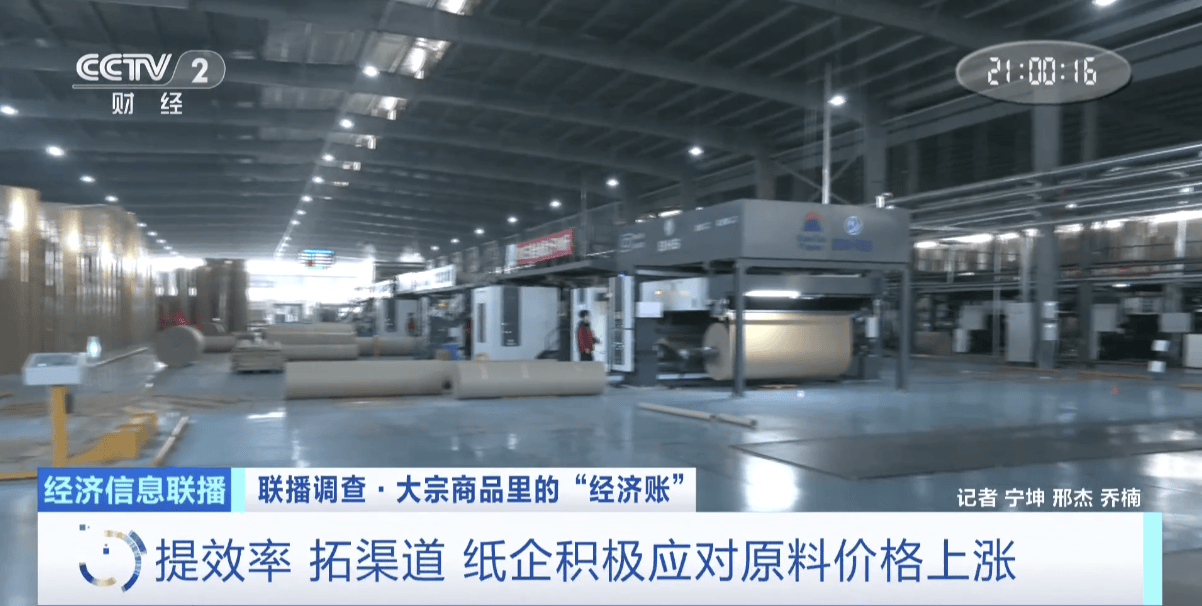
提效率 拓渠道 纸企积极应对原料价格上涨
Sou Hu Cai Jing· 2025-11-26 15:28
Core Viewpoint - The paper price increase has prompted various sectors of the industry chain to raise product prices and actively seek long-term supply-demand balance solutions to cope with rising raw material costs [1] Group 1: Industry Response to Price Increases - A packaging paper company in Langfang, Hebei, has two newly launched production lines operating at full capacity, which have improved efficiency and helped mitigate some cost pressures from last year’s equipment upgrades [3] - Packaging paper manufacturers are reducing costs through efficiency improvements, while upstream paper companies are expanding raw material sourcing channels to stabilize the supply and prices of waste paper [5] Group 2: Supply Chain Dynamics - Currently, imported pulp constitutes a low proportion of production materials in China, leading to tight domestic waste paper supply, which is expected to persist for some time [7] - Analysts indicate that paper manufacturers are maintaining low raw material inventories, which supports strong demand for waste paper [9] Group 3: Future Market Trends - Although paper prices are expected to continue rising in the short term, the domestic corrugated box and paperboard industry is entering a concentrated period of new capacity investment, which may lead to a future decline in paper prices as supply-demand relationships adjust [11] - According to statistics, from January to September this year, over 3.5 million tons of new capacity for corrugated box and paperboard have been added, and increased operating rates among small and medium-sized paper lines are likely to further boost overall market supply, potentially stabilizing paper prices [13]

供应宽松,锌镍走势为何分化
2025-11-26 14:15
Summary of Conference Call Notes Industry Overview - The conference call discusses the nickel and zinc markets, highlighting the supply-demand dynamics and price trends for both metals. Nickel Market Insights - Nickel prices have been declining due to oversupply across the industry chain, particularly in the nickel-iron and stainless steel segments, with prices reaching a three-year low [2] - The demand for stainless steel is weak, exacerbated by the release of high-cost nickel-iron capacity, leading to increased inventory pressures in the nickel market [2] - Indonesia's mining quota was set lower than the previous year, but actual supply has increased, particularly with a 36.4% year-on-year rise in nickel ore imports from the Philippines [4] - The expectation is that nickel prices may stabilize between 100,000 to 110,000 yuan in 2026, with a recommendation to adopt a bearish strategy and look for short-selling opportunities [5] Zinc Market Insights - Global zinc production has increased by 59,000 tons (7.7% year-on-year), primarily from overseas mines, while domestic zinc supply remains ample due to increased imports [6] - China's refined zinc processing fees have rebounded, leading to a high operating rate of over 90% in smelting plants, which has significantly boosted domestic refined zinc supply [6] - The domestic market is expected to face significant inventory pressure, while the international market may experience price support due to supply tightness from overseas smelters [8] - The demand for zinc in 2025 is projected to be stable, with traditional industries like construction and real estate dragging down demand, while the automotive sector provides some incremental growth [9] Price Trends and Recommendations - Short-term price support for zinc may come from seasonal production cuts in northern mines and the opening of export windows for refined zinc [10] - However, the long-term outlook suggests a continued downward trend in zinc prices due to an oversupply situation, with recommendations to sell wide-strike options to capitalize on this trend [10][11] - Investors are advised to monitor overseas processing fee recoveries and smelter restarts, as well as LME inventory levels, which could impact market dynamics [11] Additional Considerations - The conference highlights the importance of keeping an eye on policy changes in resource countries like Indonesia and the Philippines, as these can significantly affect market conditions [3] - The potential for a supply-demand imbalance in the nickel market is emphasized, with a focus on the need for strategic positioning in light of high inventory levels and weak demand [5][10]