通缩压力

Search documents
商品股票极限劈叉,进入自下而上选品种的下半场
对冲研投· 2025-08-28 12:37
Group 1 - The article discusses the importance of narratives in shaping market expectations and collective consciousness, suggesting that contemporary wisdom evolves from questioning to creating narratives [1] - It highlights the need for a bottom-up approach to observe commodity situations, noting that the black series (like rebar and coking coal) is constrained by weak real estate investment and high inventory levels [2] - The article points out a shift in market sentiment due to the Federal Reserve's indications of further interest rate easing, which has improved risk appetite and optimism regarding global economic recovery [3] Group 2 - It identifies potential risks, including rising unemployment and inflation overseas, but suggests that the probability of China entering deflation is low, indicating a solid safety margin for commodity bulls [4] - The article emphasizes the importance of supply-demand dynamics, particularly in lithium carbonate, coking coal, and polysilicon, as these sectors may see tightening supply and recovering demand [4] - It notes a change in coal production attitudes, with a reported decrease in coal output and imports, indicating a strong underlying market [6] Group 3 - The article suggests a shift away from traditional commodity tracking methods, indicating that the Chinese economy's reliance on real estate is decreasing, which may open new consumption windows, particularly in energy-related sectors [9] - It highlights the significance of electricity consumption as a key indicator of manufacturing strength, with July's electricity usage surpassing 1 trillion kilowatt-hours, reflecting an 8.6% year-on-year increase [9] - The oil market is projected to face significant oversupply in the coming quarters, with expectations of a surplus of 1.5 million barrels per day in Q4 and over 2 million barrels per day in the first half of 2026 [11] Group 4 - The article discusses the potential for global liquidity improvement driven by anticipated interest rate cuts by the Federal Reserve, which could benefit commodities like copper and gold [12] - It notes that traditional and new energy metals are supported on the supply side, which may help stabilize commodity prices [12] - The article concludes that commodity volatility may signal changes in market dynamics, emphasizing the need for careful monitoring of these indicators [13]


经济放缓,市场强劲
Minmetals Securities· 2025-08-22 02:12
Economic Overview - The U.S. economy is showing signs of pressure, with July non-farm payrolls increasing by only 73,000, significantly below expectations, and previous months' data revised downwards[6] - The unemployment rate in the U.S. rose by 0.1 percentage points to 4.2% in July, indicating a cooling labor market[6] - In contrast, the Eurozone continues its recovery, with the manufacturing PMI index at 49.8 in July, showing a seven-month upward trend despite being below the growth threshold[13] Domestic Economic Conditions - In July, China's retail sales growth slowed to 3.7% year-on-year, down 1.1 percentage points from June, reflecting weak consumer demand[15] - Fixed asset investment in China fell by 5.2% year-on-year in July, marking the largest monthly decline since March 2020[19] - China's exports grew by 7.2% year-on-year in July, with a notable decline of 21.67% in exports to the U.S., while exports to ASEAN and the EU increased by 16.59% and 9.24%, respectively[21] Inflation and Policy Outlook - China's CPI remained flat year-on-year in July, while PPI decreased by 3.6%, indicating significant deflationary pressure[25] - The necessity for a new round of large-scale stimulus policies in the second half of the year is emphasized due to ongoing economic pressures[27] - The Chinese government is expected to maintain a focus on "stabilizing growth and adjusting structure" in its policy approach for the latter half of the year[30] Market Trends - The stock market has seen a broad rally, particularly in China, driven by improved liquidity and risk appetite, while long-term government bonds have significantly declined[32] - The technology sector is anticipated to remain a key focus for market investment in the near term, with potential policy announcements in September or October likely to boost market sentiment[34] Risks - Key risks include potential reversals in U.S.-China trade negotiations and rapid declines in consumer spending and exports[35]
华尔街资深人士Zervos:美联储已严重滞后 应立即大幅降息
智通财经网· 2025-08-14 22:30
Group 1 - David Zervos, Chief Market Strategist at Jefferies, stated that the Federal Reserve is "seriously behind" in approving interest rate cuts and called for immediate and significant monetary easing [1] - Zervos emphasized that despite the July Producer Price Index (PPI) showing higher-than-expected inflation pressures, this should not hinder the Fed from cutting rates [1] - He believes that aggressive rate cuts could prevent a slowdown in the labor market and potentially create an additional 1 million jobs [1] Group 2 - Zervos reiterated his stance for a 50 basis point cut in the federal funds rate during the last three Fed meetings and maintains that current monetary policy is too tight [1] - The list of potential successors to Fed Chair Jerome Powell has expanded from three to nearly ten candidates, with Zervos being one of them [1] - Zervos and BlackRock's bond strategist Rick Rieder are among the few candidates with a market background [1] Group 3 - Zervos highlighted the advantage of having more market-savvy individuals in monetary policy decision-making [2] - Another candidate, Marc Sumerlin, also supports a 50 basis point cut and criticized the Fed for being "too conservative" in combating inflation [2] - President Trump has been pressuring the Fed to cut rates, suggesting a reduction of up to 300 basis points, but Zervos expressed uncertainty about supporting such a drastic cut [2] Group 4 - Zervos indicated he could accept a 200 basis point cut if emphasizing deflationary pressures from AI, technology, and supply-side factors [2] - He is not concerned about Trump's criticisms of the Fed, stating that understanding the political process is essential for the role [2]
反内卷政策下的行业新变:锂价或冲 8 万 / 吨,水泥盈利迎拐点?投资机会在哪里?
Zhi Tong Cai Jing· 2025-08-12 13:16
Group 1: Macro Overview - The "anti-involution" policy is beginning to influence various industries in China, affecting supply and demand dynamics despite ongoing deflationary pressures [1][2] - July economic data shows that CPI remained flat year-on-year at 0%, while PPI maintained a deflation level of -3.6%, indicating weak domestic demand [2] - The policy has led to slight price recoveries in specific commodities like coal and cement, but the sustainability of these effects is uncertain without stronger demand-side measures [2] Group 2: Lithium Industry - The lithium sector is experiencing a supply contraction coinciding with a seasonal demand increase, with predictions that lithium prices may exceed 80,000 yuan per ton [3][4] - A significant supply reduction is expected due to the suspension of operations at a major lithium mine, which could decrease global lithium supply by 4-6% annually [3] - Demand for lithium is projected to rise significantly, particularly in the battery sector, with expectations of a monthly increase of 5,000 tons of lithium carbonate equivalent (LCE) from August to November [3] Group 3: Cement Industry - The cement industry is seeing a dual impact from supply-side production cuts and demand support from new infrastructure projects [5][6] - Major cement producers are voluntarily reducing production, with some regions coordinating extended shutdowns to improve supply-demand balance [5] - New infrastructure projects, such as the 1.2 trillion yuan Yajiang Hydropower Station, are expected to bolster cement demand and alleviate downward pressure on the industry [5] Group 4: Investment Outlook - Companies like Ganfeng Lithium and Tianqi Lithium have been upgraded to "buy" ratings due to improved production capabilities and favorable market conditions [4] - The profitability outlook for cement companies, such as Anhui Conch Cement, has been raised, reflecting market expectations of policy effectiveness and improved cash flow [6][7] - The overall sentiment indicates that structural opportunities may arise in sectors with clear supply-demand mismatches and strong policy support [7]


美财长对华态度急转,非心血来潮,多国紧盯中方后续回应
Sou Hu Cai Jing· 2025-08-04 06:59
Core Viewpoint - The sudden shift in the U.S. Treasury Secretary's stance towards China reflects a strategic retreat by the Trump administration after facing multiple failures in its aggressive policies [1][3][19]. Group 1: Energy Policy - Trump's initial strategy involved leveraging energy sanctions against countries purchasing Russian oil to create global supply tensions, aiming to address domestic economic issues [5][7]. - The OPEC+ decision to increase oil production undermined Trump's plan, preventing the desired volatility in oil prices that could have pressured the Federal Reserve to lower interest rates [7][9]. Group 2: Trade and Alliances - Trump's approach to isolate China involved threatening tariffs on key allies, hoping to create a perception of U.S. dominance in international negotiations [10][12]. - While some agreements were reached with the EU and Japan, these were met with significant domestic opposition, indicating a lack of genuine commitment to U.S. demands [12][14]. Group 3: Domestic Economic Challenges - Recent labor data revealed a significant downturn in employment, comparable to post-pandemic levels, which directly challenged Trump's narrative of a strong economy [17]. - In response to negative economic reports, Trump dismissed the head of the statistics bureau, highlighting his anxiety and inability to address the underlying issues [17][19]. Group 4: Political Implications - The combination of failed external strategies and poor domestic economic performance led to a drop in Trump's approval ratings to a new low of 37%, raising concerns within the Republican Party about upcoming elections [19][21]. - The shift in U.S. policy towards China is seen as a last resort after exhausting other options, indicating a retreat from aggressive posturing to a focus on domestic crisis management [21].

上半年“消费回暖”,即时零售开战引火商超?
3 6 Ke· 2025-07-26 08:03
Group 1: Overall Consumption Trends - The overall consumption market shows a gradual recovery, with a year-on-year growth rate of 4.6% in Q1 and 5.4% in Q2, leading to a total retail sales of 24.5 trillion yuan in the first half of the year, contributing 52% to economic growth [1][5] - However, in June, the year-on-year growth rate of retail sales dropped to 4.8%, lower than the GDP growth rate of 5.3%, indicating a more complex reality in the consumption market [1][5] - The decline in June reflects a shift in consumer behavior, with spending moving from high-ticket dining to more affordable options like snacks and fast food [3][5] Group 2: Consumer Behavior and Spending Patterns - In June, restaurant income growth slowed significantly to 0.9% compared to 5.9% in May, with high-end dining establishments experiencing a 0.4% decline in revenue [3][5] - Retail sales of discretionary items such as beverages, tobacco, and cosmetics also saw a year-on-year decline, indicating consumers are more cautious with non-essential spending [3][5] - Households are increasing savings, with new household deposits rising by 10.77 trillion yuan while loans only grew by 1.17 trillion yuan, reflecting a conservative financial strategy [5] Group 3: Impact of E-commerce and Instant Retail - Online retail sales grew by 8.5% year-on-year in the first half of the year, significantly outpacing overall retail sales growth, with online sales accounting for 24.9% of total retail sales [5] - Instant retail is rapidly gaining traction, with major internet platforms enhancing local merchant partnerships and logistics to offer delivery within 30 minutes, posing a significant threat to traditional supermarkets [6][8] - Traditional supermarkets are losing customer appeal as consumer habits shift towards convenience and immediate fulfillment, leading to a decline in foot traffic [6][8] Group 4: Challenges Facing Traditional Supermarkets - Traditional supermarkets are struggling, with limited growth in sales despite efforts to optimize store experiences and product offerings [9][12] - Financial reports indicate significant losses for major supermarket chains, such as Zhongbai Group and Yonghui Supermarket, highlighting the difficulties in reversing declining trends [8][12] - The fundamental issue lies in the mismatch of business models, as instant retail increasingly meets consumer needs more effectively than traditional supermarkets [11][12] Group 5: Price Trends and Economic Pressures - The Consumer Price Index (CPI) showed a year-on-year decline of 0.1% in the first half of 2025, marking the first negative growth for this period in recent years [13][15] - There is a structural divergence in price trends, with commodity prices declining while service prices are rising, creating challenges for traditional retailers [15][17] - Retailers face pressure from falling prices in core categories like fresh produce and daily necessities, which compresses profit margins and intensifies competition [17][19] Group 6: Strategic Recommendations for Retailers - Retailers need to move beyond simple price competition and focus on enhancing supply chain efficiency, developing private labels, and enriching service experiences to create differentiated competitive advantages [20] - The current market environment necessitates a structural approach to building cost and value barriers to better navigate cyclical changes [20]
连平:当下亟需出台更有力度的针对性举措
和讯· 2025-07-18 09:47
Group 1 - The overall economic performance in China is stable with improvements in exports and consumption growth, while facing challenges from the real estate market and external uncertainties [1][2] - The real estate market remains a significant negative factor for economic performance, with sales declining over 10% year-on-year in major cities and liquidity pressures on developers [3][4][5] - Real estate investment is expected to fluctuate around -10%, contributing to a decline in nominal GDP growth by 0.75 percentage points [5][6] Group 2 - Private investment growth is weak, with a continuous decline in fixed asset investment since 2023, primarily due to the downturn in the real estate market [6][7] - Structural issues, including market access restrictions and increased regulatory scrutiny, are contributing to the low enthusiasm for private investment [6][7] - Consumer spending may face challenges due to potential resource shortages in policy support and a conservative consumption attitude among residents [7][8] Group 3 - Export performance is under pressure from U.S. tariffs and trade barriers, particularly affecting labor-intensive industries [8][9] - Domestic demand remains weak, leading to structural deflationary pressures, with CPI and PPI showing declines [10][11] - Local government finances are strained due to declining land sales and high debt repayment pressures, limiting infrastructure investment capabilities [11][12] Group 4 - Monetary policy needs to improve coordination with fiscal policy to effectively support economic growth [12][13] - There is a need for targeted measures to support the real estate sector and enhance liquidity for developers [14][15] - Increased support for private enterprises and consumer spending is essential to stimulate economic activity [16][17] Group 5 - Recommendations include expanding fiscal support for trade enterprises and enhancing capital market stability through various financial tools [20][21][22] - The government should implement measures to alleviate the financial burden on local governments and improve their investment capabilities [23][24] - A proactive monetary policy approach is necessary to address deflationary pressures and stabilize the economy [24][25]

股指期货周报-20250711
Rui Da Qi Huo· 2025-07-11 09:33
1. Report Industry Investment Rating No relevant content provided. 2. Core View of the Report - A-share major indices rose collectively this week, with the ChiNext Index up over 2%. The four stock index futures also rose collectively, and small and medium-cap stocks outperformed large-cap blue-chip stocks. Market trading activity increased slightly compared to last week. Although the US restarted the tariff war, the market's reaction has become dull. With the release of semi-annual performance forecasts, the market is optimistic about the first-half earnings of listed companies. The previous series of growth-stabilizing policies are starting to take effect, and the market has strong expectations for positive economic data in the second quarter. The fundamental recovery supports the stock market, and with the approaching of the Politburo meeting in July, market bulls may pre-layout, driving the stock market higher. The strategy is to lightly buy on dips [6][97]. 3. Summary by Relevant Catalogs 3.1 Market Review - Futures: IF2509 rose 1.46% for the week, IH2509 rose 1.27%, IC2509 rose 2.69%, and IM2509 rose 3.40%. - Spot: The CSI 300 rose 0.82%, the SSE 50 rose 0.60%, the CSI 500 rose 1.96%, and the CSI 1000 rose 2.36% [10]. 3.2 News Overview - Trump announced a new round of tariff rates, which may have a negative impact on the market, but the market's reaction has become dull. - China's June CPI rose 0.1% year-on-year, turning from a decline to an increase, which is positive for the market. - As of July 10, 129 out of 147 A-share listed companies that have announced their semi-annual performance forecasts are expected to be profitable, which is positive for the market [6][13][97]. 3.3 Weekly Market Data - **Domestic Major Indices**: The Shanghai Composite Index rose 1.09%, the Shenzhen Component Index rose 1.78%, the STAR 50 rose 0.98%, the SME 100 rose 0.73%, and the ChiNext Index rose 2.36% [16]. - **External Major Indices (as of Thursday)**: The S&P 500 rose 1.11%, the UK FTSE 100 rose 1.73%, the Hang Seng Index rose 0.93%, and the Nikkei 225 fell 0.61% [17]. - **Industry Sector Performance**: Industry sectors generally rose, with real estate, steel, and non-bank finance sectors strengthening significantly, while coal and banking sectors weakened slightly [21]. - **Industry Sector Main Fund Flow**: Industry main funds were generally net outflows, with significant net outflows in electronics, computer, and national defense and military industries [25]. - **SHIBOR Short-Term Interest Rates**: SHIBOR short-term interest rates showed differentiation, and the capital price was low [29]. - **Other Data**: This week, major shareholders net sold 6.61 billion yuan in the secondary market, the restricted-share lifting market value was 43.09 billion yuan, and northbound funds traded a total of 688.585 billion yuan [30]. 3.4 Market Outlook and Strategy - The market is expected to be supported by the fundamental recovery, and with the approaching of the Politburo meeting in July, market bulls may pre-layout, driving the stock market higher. The strategy is to lightly buy on dips [97].
瑞达期货股指期货全景日报-20250710
Rui Da Qi Huo· 2025-07-10 09:26
Report Summary 1. Report Industry Investment Rating No information provided. 2. Core Viewpoints - Although the US has restarted the tariff war, the market has become somewhat desensitized after previous fluctuations in trade relations. With the release of listed companies' semi - annual performance forecasts, the market is optimistic about their H1 earnings. A series of pro - growth policies are taking effect, and the market has strong expectations for positive Q2 economic data. The fundamental recovery supports the stock market, and with the approaching July Politburo meeting, market bulls may pre - position, driving the stock market up. It is recommended to buy on dips with a light position [2]. 3. Summary by Relevant Catalogs Futures Disk - **Contract Prices**: IF main contract (2509) at 3972.0, up 15.0; IH main contract (2509) at 2740.4, up 13.4; IC main contract (2509) at 5854.2, up 24.2; IM main contract (2509) at 6231.6, up 11.8. IF sub - main contract (2507) at 3997.2, up 15.4; IH sub - main contract (2507) at 2745.4, up 14.0; IC sub - main contract (2507) at 5958.8, up 21.6; IM sub - main contract (2507) at 6375.2, up 10.2 [2]. - **Contract Spreads**: IF - IH current - month contract spread at 1251.8, up 4.6; IC - IF current - month contract spread at 1961.6, up 8.6; IM - IC current - month contract spread at 416.4, down 12.4; IC - IH current - month contract spread at 3213.4, up 13.2; IM - IF current - month contract spread at 2378.0, down 3.8; IM - IH current - month contract spread at 3629.8, up 0.8 [2]. - **Quarter - to - Month Spreads**: IF current - quarter to current - month at - 25.2, down 1.0; IF next - quarter to current - month at - 55.6, up 1.4; IH current - quarter to current - month at - 5.0, up 0.8; IH next - quarter to current - month at - 4, up 0.6; IC current - quarter to current - month at - 104.6, up 2.0; IC next - quarter to current - month at - 227.6, up 2.4; IM current - quarter to current - month at - 143.6, up 1.2; IM next - quarter to current - month at - 328.8, up 2.4 [2]. Futures Positions - IF top 20 net positions at - 29,557.00, down 216.0; IH top 20 net positions at - 14,304.00, up 275.0; IC top 20 net positions at - 10,512.00, down 601.0; IM top 20 net positions at - 36,476.00, up 278.0 [2]. Spot Prices - CSI 300 at 4010.02, up 18.6; SSE 50 at 2756.93, up 17.0; CSI 500 at 5983.05, up 29.6; CSI 1000 at 6406.57, up 16.1. IF main contract basis at - 38.0, up 0.6; IH main contract basis at - 16.5, down 0.6; IC main contract basis at - 128.9, up 1.2; IM main contract basis at - 175.0, up 1.5 [2]. Market Sentiment - A - share trading volume at 15,150.68 billion yuan, down 123.53 billion yuan; margin trading balance at 18,687.97 billion yuan, up 38.65 billion yuan; north - bound trading volume at 1818.91 billion yuan, up 142.25 billion yuan; reverse repurchase (maturity, operation) at - 572.0 billion yuan, up 900.0 billion yuan; main funds at - 449.96 billion yuan (yesterday) and - 192.38 billion yuan (today) [2]. - Rising stock ratio at 54.37%, up 20.10%; Shibor at 1.316%, up 0.003%; IO at - the - money call option closing price (2507) at 29.00, up 5.00; IO at - the - money call option implied volatility at 11.69%, down 0.23%; IO at - the - money put option closing price (2507) at 29.60, down 12.40; IO at - the - money put option implied volatility at 11.69%, down 0.23%; CSI 300 index 20 - day volatility at 9.25%, up 0.05%; trading volume PCR at 51.64%, down 1.13%; open interest PCR at 73.00%, up 1.18% [2]. Wind Market Strength - Weakness Analysis - All A - shares at 6.00, up 2.00; technical aspect at 5.40, up 2.00; capital aspect at 6.50, up 1.90 [2]. Industry News - Trump announced on social media that tariffs would start on August 1, 2025, and he plans to impose tariffs on specific industries like pharmaceuticals, semiconductors, and metals, with a 50% tariff on copper and up to 200% on pharmaceuticals. He also mentioned a 10% tariff on each BRICS member country [2]. - US Commerce Secretary Howard Lutnick said the US delegation will meet with Chinese officials next month to discuss trade issues, with members including the Treasury Secretary and the US Trade Representative [2]. - China's June CPI rose 0.1% year - on - year (previous value down 0.1%), down 0.1% month - on - month (previous value down 0.2%); PPI fell 3.6% year - on - year (previous value down 3.3%), down 0.4% month - on - month (previous value down 0.4%) [2]. Key Events to Watch - St. Louis Fed President Sam Lem to speak on July 10 at 21:00; Fed Governor Waller to speak on July 11 at 1:15; China's June financial data release time is pending [3]
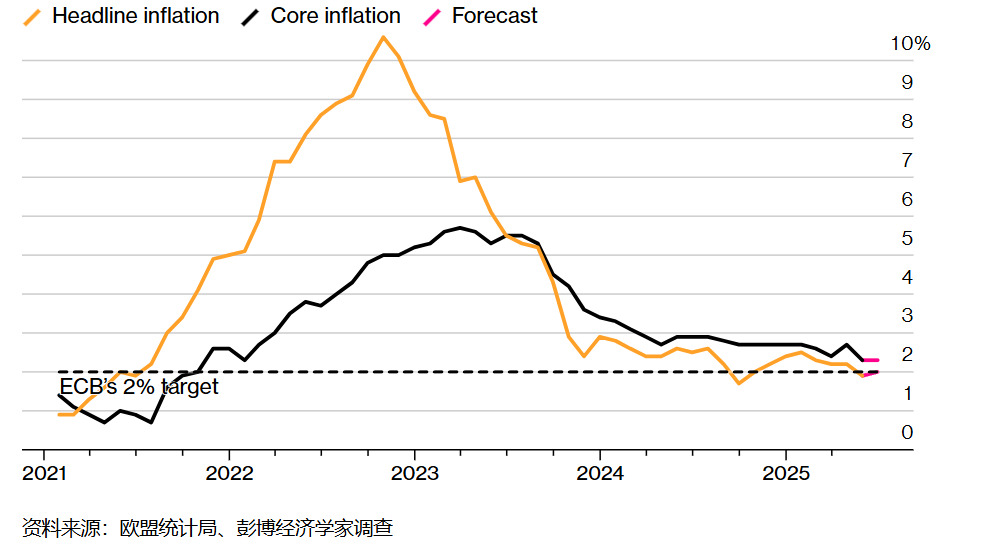
欧央行官员警告:欧美关税僵局可能加剧通缩压力 9月或迎最后一次降息
Zhi Tong Cai Jing· 2025-07-01 06:31
Group 1 - The current inflation situation in the Eurozone faces multiple downward pressures, with a warning that the recent rapid rise of the euro against the dollar and energy market volatility due to Middle Eastern geopolitical conflicts may cause inflation rates to deviate from the 2% target [1] - The probability of inflation remaining below the target level has exceeded the upside risks, according to the Lithuanian central bank governor [1] - Despite forecasts indicating that inflation will stabilize at 2% by 2027, current price trends remain uncertain, influenced by geopolitical risks and aggressive trade protectionism policies from the Trump administration [1] Group 2 - The likelihood of maintaining interest rates unchanged in the July meeting is the most probable policy option, aligning with market expectations [3] - Since the start of the current easing cycle in June 2024, the European Central Bank has consecutively lowered the benchmark interest rate eight times, with expectations for further rate cuts in September [3] - The average tariff rate on European goods exported to the U.S. is currently 10%, and the impact of existing trade barriers on the real economy has not yet fully manifested [3]