
供需平衡

Search documents
中辉期货日刊-20250811
Zhong Hui Qi Huo· 2025-08-11 02:36
1. Report Industry Investment Ratings - **Cautiously Bearish**: Crude oil, L, PP, PVC, LPG, glass, soda ash, caustic soda, ethylene glycol, urea, propylene [1][2] - **Bearish**: PX, PTA, methanol, asphalt [1][2] 2. Core Views of the Report - **Crude Oil**: Supply pressure is rising, and the oil price center continues to move down. The oil price is at the end of the peak season. With the gradual expansion of production by OPEC+, the pressure of oversupply in crude oil is increasing, and the oil price has a large downward pressure, but the decline space is gradually narrowing. Focus on the break - even point of new US shale oil drilling around $60 [1][5]. - **LPG**: The valuation is low, the position has risen to a recent high, and the rebound momentum has increased. Although the cost - end oil price is weak, the basis is at a high level, and the downstream chemical demand is fair [1]. - **L**: The spot price has risen continuously, and the basis has strengthened. The supply pressure has increased marginally, but the agricultural film peak season is coming, and the far - month contract has anti - decline characteristics [1]. - **PP**: The warehouse receipts have decreased slightly from a high level, and the commercial total inventory has continued to accumulate. The upstream maintains high maintenance, and the domestic demand is at the switching point between the off - season and peak season. The downstream start - up rate has increased for two consecutive weeks [1]. - **PVC**: The fundamentals are difficult to improve, the futures and spot prices have declined simultaneously, and the basis has strengthened. The upstream start - up rate has increased, and the supply and demand pattern is expected to continue to accumulate inventory [1]. - **PX**: The supply - side changes are not significant, and the demand - side PTA processing fee is low, and the device maintenance intensity has increased. The tight balance expectation of supply and demand has been relaxed, and the PX inventory has decreased but is still at a high level [1][34]. - **PTA**: The recent device maintenance intensity has increased, and the start - up load has decreased significantly. The supply - side pressure is expected to increase in the future. The demand - side is generally weak, and the start - up of downstream polyester and terminal weaving is in the seasonal off - season [1][38]. - **Ethylene Glycol**: The domestic ethylene glycol devices have slightly increased their loads, but the arrivals and imports are still low compared with the same period. The downstream polyester and terminal weaving are in the seasonal off - season, and the terminal orders are generally low. The supply and demand are in a tight balance in August, and the inventory is generally low, which supports the disk price [1][42]. - **Glass**: The industry profit has slightly recovered, the production capacity has slightly increased, the shipment speed of manufacturers has slowed down, the market wait - and - see sentiment is strong, and the enterprise inventory has stopped decreasing and started to increase [2]. - **Soda Ash**: The industry pattern has not improved significantly. The overall supply side continues to be at a high level, the demand side mostly continues with rigid demand, and the upstream inventory has accumulated again and the absolute quantity is high [2]. - **Caustic Soda**: The supply and inventory in Shandong are relatively abundant. The terminal alumina industry's supply and demand have turned loose, and the demand for caustic soda is low. The non - aluminum terminal has rigid demand, and the consumption of caustic soda is limited. The overall situation is oversupply [2]. - **Methanol**: The domestic maintenance devices have resumed production, the overseas methanol device load has increased, and the supply - side pressure has increased. The demand has weakened, the coastal MTO external procurement device start - up load has continued to decline significantly, and the traditional downstream start - up has decreased [2][59]. - **Urea**: The urea device start - up load is expected to increase, and the supply - side pressure will increase. The domestic industrial and agricultural demand is generally weak, but the export is relatively good. The cost side has certain support [2][63]. - **Asphalt**: The cost - end oil price is under pressure, and the asphalt raw material supply is relatively sufficient. The supply - side pressure is gradually increasing. The short - term is in the consumption peak season, but the demand in the north has decreased due to precipitation, and the medium - to - long - term price is under pressure [2][68]. - **Propylene**: The Shandong spot price has continuously increased, and the basis has strengthened. The PDH cost support has weakened, the PDH and MTO start - up have increased marginally, but the downstream demand has not kept up, and the factory inventory has continued to accumulate for five weeks, remaining at a high level compared with the same period [2][73]. 3. Summaries According to Relevant Catalogs Crude Oil - **Market Review**: On August 8, WTI remained flat, Brent rose 0.24%, and SC fell 1.57%. The latest prices of WTI, Brent, and SC were $63.88/barrel, $66.59/barrel, and 496.4 yuan/barrel respectively [3][4]. - **Basic Logic**: The support of the peak season for oil prices is gradually decreasing, and the pressure of OPEC+ production increase on oil prices is gradually increasing. The oil price still has room for compression, but as the price drops, the support below is gradually strengthening. In the medium - to - long - term, it may still be pressed to around $60 [5]. - **Strategy Recommendation**: After the short - position profit - taking, you can temporarily wait and see. Pay attention to the range of SC [490 - 505] [7]. LPG - **Market Review**: On August 8, the PG main contract closed at 3803 yuan/ton, a decrease of 0.89% compared with the previous day. The spot prices in Shandong, East China, and South China were 4500 (-20) yuan/ton, 4403 (-3) yuan/ton, and 4380 (+0) yuan/ton respectively [8][9]. - **Basic Logic**: The cost - end oil price is weak, but the self - fundamentals are okay. The basis is at a high level, and the position has risen rapidly recently, increasing the support below [10]. - **Strategy Recommendation**: Lightly open a long position on a trial basis. Pay attention to the range of PG [3750 - 3850] [11]. L - **Market Review**: The L2509 contract closed at 7290 yuan/ton. The North China main basis was - 60 yuan/ton, and the L9 - 1 spread was - 54 yuan/ton [13][15]. - **Basic Logic**: The spot price has continuously increased, and the basis has strengthened. The supply pressure has increased marginally, but the agricultural film peak season is coming, and the far - month contract has anti - decline characteristics [16]. - **Strategy Recommendation**: Gradually take profit on short positions at low prices. As the delivery month approaches, industrial customers can choose the opportunity to sell for hedging [16]. PP - **Market Review**: The PP2509 closed at 7062 yuan/ton, and the PP9 - 1 spread was - 29 yuan/ton [19][20]. - **Basic Logic**: The warehouse receipts have decreased slightly from a high level, and the commercial total inventory has continued to accumulate. The upstream maintains high maintenance, and the domestic demand is at the switching point between the off - season and peak season. The downstream start - up rate has increased for two consecutive weeks [22]. - **Strategy Recommendation**: Gradually take profit on short positions at low prices [23]. PVC - **Market Review**: The V2601 closed at 5046 yuan/ton, and the warehouse receipts increased by 251 lots [26][27]. - **Basic Logic**: The fundamentals are difficult to improve, the futures and spot prices have declined simultaneously, and the basis has strengthened. The upstream start - up rate has increased, and the supply and demand pattern is expected to continue to accumulate inventory [29]. - **Strategy Recommendation**: Wait for a rebound and then go short. Pay attention to the range of V [4900 - 5100] [29]. PX - **Market Review**: On August 8, the spot price of PX in East China was 7015 yuan/ton, the PX09 contract closed at 6726 (-30) yuan/ton, the PX9 - 1 spread was 50 (+4) yuan/ton, and the East China basis was 149 (-2.4) yuan/ton [32][33]. - **Basic Logic**: The supply - side changes are not significant, and the demand - side PTA processing fee is low, and the device maintenance intensity has increased. The tight balance expectation of supply and demand has been relaxed, and the PX inventory has decreased but is still at a high level [34]. - **Strategy Recommendation**: Hold short positions, pay attention to high - short opportunities, and sell call options. Pay attention to the range of PX [6690 - 6800] [35]. PTA - **Market Review**: On August 8, the PTA price in East China was 4670 (-15) yuan/ton, the TA09 closed at 4684 (-4) yuan/ton, the TA9 - 1 spread was - 20 (+18) yuan/ton, and the East China basis was - 14 (-11) yuan/ton [36][37]. - **Basic Logic**: The PTA processing fee is generally low, and the supply - side devices have significantly reduced their loads. The demand - side is generally weak, and the start - up of downstream polyester and terminal weaving is in the seasonal off - season [38]. - **Strategy Recommendation**: Hold short positions, pay attention to high - short opportunities, and sell call options. Pay attention to the range of TA [4650 - 4720] [39]. Ethylene Glycol - **Market Review**: On August 8, the spot price of ethylene glycol in East China was 4456 (-19) yuan/ton, the EG09 closed at 4384 (-12) yuan/ton, the EG9 - 1 spread was - 38 (-4) yuan/ton, and the East China basis was 72 (-7) yuan/ton [40][41]. - **Basic Logic**: The domestic ethylene glycol devices have slightly increased their loads, but the arrivals and imports are still low compared with the same period. The downstream polyester and terminal weaving are in the seasonal off - season, and the terminal orders are generally low. The supply and demand are in a tight balance in August, and the inventory is generally low, which supports the disk price [42]. - **Strategy Recommendation**: Take profit on long positions, pay attention to high - short opportunities, and sell call options. Pay attention to the range of EG [4360 - 4420] [43]. Glass - **Market Review**: The spot market quotation continued to decline, the disk slightly declined, the Hubei basis widened, and the warehouse receipts increased [45][46]. - **Basic Logic**: The "anti - involution" policy expectation is repeated, the market risk preference has declined, and the commodity market sentiment is cautious. The start - up rate has increased, the shipment speed of manufacturers has slowed down, the market wait - and - see sentiment is strong, and the enterprise inventory has stopped decreasing and started to increase [47]. - **Strategy Recommendation**: Pay attention to the range of FG2509 [1050, 1080] [48]. Soda Ash - **Market Review**: The heavy - soda spot quotation declined, the disk slightly declined, the basis negative value widened, the warehouse receipts increased, and the forecast increased [50][51]. - **Basic Logic**: The hype of macro - policies has cooled down. The overall production has slightly decreased. The supply has slightly increased this week, the terminal has rigid demand for picking up goods, and the alkali plant inventory has ended three weeks of destocking. The supply - demand surplus pattern has not improved significantly, and the fundamentals are bearish under the background of high supply and high inventory [52]. - **Strategy Recommendation**: Wait patiently for the callback to be in place. Temporarily wait and see or be cautiously bearish [52]. Caustic Soda - **Market Review**: The liquid - caustic spot quotation declined, the disk declined, the center of gravity moved down, the main basis narrowed, and the warehouse receipts remained unchanged [55][56]. - **Basic Logic**: The supply and inventory in Shandong are relatively abundant. The terminal alumina industry's supply and demand have turned loose, and the demand for caustic soda is low. The non - aluminum terminal has rigid demand, and the consumption of caustic soda is limited. The overall situation is oversupply, and the liquid - caustic price is expected to maintain a weak fluctuation [57]. - **Strategy Recommendation**: Not provided in the report. Methanol - **Market Review**: On August 8, the spot price of methanol in East China was 2393 (-3) yuan/ton, the methanol main 09 contract closed at
黄金:2025年多指标变动,下半年或继续上攻
Sou Hu Cai Jing· 2025-08-10 23:45
Core Viewpoint - Since 2025, gold and silver indices have shown significant increases, influenced by various factors including inflation rates, interest rates, and supply-demand dynamics [1] Inflation - The Consumer Price Index (CPI) peaked at 9.1% in June 2022 and has since shown a moderate decline, with core CPI and core Personal Consumption Expenditures (PCE) also trending downwards. However, CPI rebounded in February 2024, with June 2025 CPI rising 2.7%, exceeding expectations, and core CPI at 2.9%, in line with forecasts. PCE figures for June 2025 also surpassed market expectations, indicating a two-month inflation increase [1] Interest Rates - U.S. mid-term treasury yields have fluctuated, declining until January 2023, then rebounding since February 2024, approaching last year's highs before retreating again. The yields are currently experiencing wide fluctuations near 24-year lows [1] Supply and Demand - The gold market is experiencing a tight balance between supply and demand, with a slight increase in domestic supply and a notable rise in investment demand. Central banks continue to purchase over 1,000 tons of gold, maintaining a tight balance in the domestic market. Investment demand is expected to surge in the first half of 2025 [1] Employment Data - In July 2025, the U.S. added 73,000 jobs, marking a nine-month low, with average hourly earnings growth steady at 0.3% and an unemployment rate of 4.2%. Non-farm employment data significantly underperformed expectations [1] Market Outlook - Recent trends show gold futures rising after a strong opening, with Chicago gold surpassing previous highs. The focus is on whether Shanghai gold can break through its upper range. The market has been consolidating for several months, with potential support at the lower range. In the second half of 2025, central bank purchases, ETF investments, and a weak dollar are expected to support gold's wide fluctuations. A Fed rate cut is anticipated in September, with potential for further gold price increases in Q4 [1] Investment Strategy - The recommendation is to hold long positions in gold and observe market conditions for potential increases in positions, while maintaining a cautious stance on options [1]
能源化工周报合集-20250810
Guo Tai Jun An Qi Huo· 2025-08-10 12:51
Report Industry Investment Rating No relevant content provided. Core Viewpoints of the Report Naphtha and Ethylene - The contradiction of naphtha in the second half of the year lies in the dual increase of supply and demand. The supply side is affected by OPEC's production increase and new refining capacity, while the demand side is driven by new cracking devices. Near - term ethylene cracking profit is greatly influenced by crude oil. Ethylene is expected to shift from a short - term tight supply - demand situation to an oversupply in the fourth quarter [9]. Fuel Oil and Low - Sulfur Fuel Oil - The price weakness of fuel oil and low - sulfur fuel oil is difficult to change in the short term. The supply of the fuel oil market is generally loose, and the low - sulfur fuel oil supply in the Asia - Pacific market is expected to increase. Domestic low - sulfur fuel oil prices are also under pressure, but the new export quota may support the price [160]. Summary by Relevant Catalogs Naphtha Part - **Supply**: With OPEC's production increase, the Middle East export center has risen. Russian exports are expected to remain stable, and the arbitrage cargo in Asia will decrease after September [9]. - **Demand**: Weekly Northeast Asian naphtha imports have decreased, but ethylene cracking profit has rebounded, and propane cracking economy has weakened, which is beneficial to the increase of naphtha demand [9]. - **Price and Valuation**: Asian gasoline - naphtha spread is 64 dollars/ton (+6 dollars/ton), European gasoline - naphtha spread is 143 dollars/ton (+7 dollars/ton), and Asian aromatics reforming profit is 27 dollars/ton (+11 dollars/ton) [9]. - **Balance Sheet**: The supply side may see a slight reduction in arbitrage cargo, and the demand side is expected to increase. The market is expected to continue de - stocking in the long term [91]. Ethylene Part - **Global Capacity and Logistics**: In 2025, the growth of global ethylene cracking capacity is mainly concentrated in China. Asia is the main pricing area, with clear import and export routes [107][109]. - **Price and Profit**: This week, the domestic ethylene price rebounded, and the profit of downstream derivatives was compressed. Overseas ethylene derivatives' profit was in a low - level shock [110][116]. - **Balance Sheet**: The supply and demand of domestic ethylene increased this week. The supply - demand relationship in September will tighten, but it will gradually ease after October [135]. Olefin - Aromatic Association - **Aromatic Relative Valuation**: This week, with the significant decline of crude oil, the relative valuation of downstream aromatics to upstream has rebounded. Overseas aromatic valuation has increased, and the spread with Asia has slightly widened [144][148]. Fuel Oil and Low - Sulfur Fuel Oil - **Supply**: The global fuel oil supply is generally loose. Middle East exports are expected to increase in August, and the supply of low - sulfur fuel oil in the Asia - Pacific market is expected to rise [160]. - **Demand**: The port bunkering demand for low - sulfur fuel oil in China is weak, and the demand in the Singapore market is also sluggish [160]. - **Inventory**: The Singapore market has entered a high - inventory state, and the spot digestion is difficult [160]. - **Price and Spread**: The price of fuel oil continues to decline, and the LU's previous strength has further weakened. The FU and LU's near - term contango structure will continue [160].
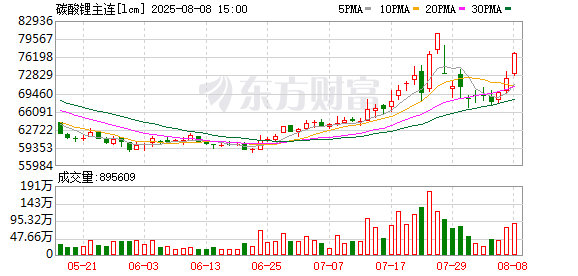
江西矿区减停产传闻引爆碳酸锂期货,一周飙涨超10%至76960元/吨
Sou Hu Cai Jing· 2025-08-10 05:15
Core Viewpoint - After a brief adjustment, lithium carbonate futures have experienced a significant price increase, with the main contract closing at 76,960 yuan/ton on August 8, marking a weekly rise of over 10% [1] Supply Changes and Price Drivers - The market's focus has shifted to the progress of mining license renewals in Jiangxi, with expectations of production cuts driving the potential for supply contraction, which is a key factor for price increases [3] - Despite the uncertainty surrounding potential production halts, this has led to heightened sensitivity in market trading rhythms [3] - Current weekly production of lithium carbonate remains high, and rising prices have encouraged some companies to increase operational willingness, with expectations of increased output from African and South American sources [3] - Social inventory growth is limited, indicating that downstream sectors still have some capacity for absorption, although rapid price increases have led to a cautious stance among processing and end-user companies [3] Demand Changes and Market Sentiment - Demand-side changes have not led to a comprehensive boost, but there are still expectations for a seasonal peak, with a slight decline in new energy vehicle sales in the first half of the year [4] - There are signs of increased production plans for cathode materials and battery cells, which bolster confidence among some market participants to maintain long positions and enhance raw material replenishment intentions [4] - The impact of market sentiment has been particularly pronounced, with ongoing speculation about production halts leading to significant short-term price fluctuations [4] - Despite prices being at high levels, market volatility may continue until actual procurement activities commence, necessitating a stable response from investment and industrial procurement to mitigate risks from over-expectation [4]


碳酸锂强势拉升 分析人士:理性看待各类消息
Qi Huo Ri Bao· 2025-08-09 00:04
Core Viewpoint - Lithium carbonate futures have rebounded after a brief correction, with a weekly increase of 11.02% as of August 8, closing at 76,960 yuan/ton [2][3]. Price Movement - The main contract for lithium carbonate (LC2511) closed at 76,960 yuan/ton, reflecting a weekly increase of 11.02% [2]. - Weekly production of lithium carbonate increased by over 13% to 19,600 tons as of August 7, while weekly inventory only rose by 692 tons, indicating stable downstream demand [4]. Supply and Demand Dynamics - Concerns about potential production halts at a major mine in Jiangxi are influencing market sentiment, with expectations leaning towards a production cut [4][5]. - The market is currently in a relatively balanced supply-demand phase, with some marginal improvements in fundamentals as demand expectations improve [4]. - Despite the price recovery, supply remains high, and the elasticity of supply is still significant, suggesting limited room for further price increases even if production halts occur [5][6]. Future Outlook - Analysts suggest that if the current operating rates for mica-derived lithium remain stable, there will be no substantial impact on supply-demand dynamics, although supply shortage concerns may persist [6]. - The potential for overseas supply to increase could exert downward pressure on lithium carbonate prices if related policies do not create sustained constraints [6]. - Investors are advised to approach market fluctuations with caution, as excessive speculation on supply disruptions may pose risks [6].
永安期货有色早报-20250808
Yong An Qi Huo· 2025-08-08 01:24
Group 1: Report's Overall Investment Rating - No investment rating for the industry is provided in the report. Group 2: Core Views of the Report - For copper, the US tariff details on copper mainly affect the market in several ways, including the reversal of the CL arbitrage spread logic, potential outflow of US export supply, and a more relaxed import situation in China. The report is not pessimistic about copper prices in Q3 and Q4, seeing dips as opportunities [1]. - For aluminum, supply has increased slightly, and August is expected to be a seasonal off - peak for demand. Inventory is expected to continue to accumulate slightly in August. Attention should be paid to demand and low - inventory trading strategies [1]. - For zinc, prices have fluctuated downward. Supply is increasing, while domestic demand is seasonally weak and overseas demand is average. Short - term strategies include waiting and watching, holding long positions in the domestic - foreign positive spread, and looking for opportunities in the positive spread between months [2]. - For nickel, supply remains high, demand is weak, and inventory is stable. Attention can be paid to the opportunity of narrowing the nickel - stainless steel price ratio [3]. - For stainless steel, supply has decreased due to some steel mill cut - backs, demand is mainly for rigid needs with some restocking, and the overall fundamentals are weak. Attention should be paid to future policy trends [3]. - For lead, prices have declined this week. Supply is tight, demand is weak, and there is expected to be inventory accumulation in July. However, lead prices are expected to rise next week as battery factories replenish stocks [5]. - For tin, prices have fluctuated widely. Supply may decline slightly in July - August, and demand is expected to slow down. The market is in a situation of weak supply and demand, and short - term short - selling at high prices is recommended [7]. - For industrial silicon, the recent supply reduction by leading enterprises has improved the supply - demand balance. The复产 rhythm of Southwest China and Hesheng is crucial. In the long - term, the market will mainly oscillate at the bottom of the cycle [10]. - For lithium carbonate, the market is affected by resource - end compliance issues. In the short - term, there is upward potential if risks are realized, while in the long - term, prices will oscillate at a low level if risks are resolved [12]. Group 3: Summary by Metal Copper - Market trading this week focused on the results of the 232 investigation. The US decision not to impose tariffs on refined copper but only on copper products exported to the US has had a significant impact on the market. The CL spread may shift towards export profit, US supply may flow out, and China's import situation may become more relaxed. The market demand support remains, and dips in copper prices are seen as opportunities [1]. Aluminum - Supply has increased slightly, with imports providing an increment from January to May. August is a seasonal off - peak for demand, with weak aluminum product exports and a decline in the photovoltaic sector. Inventory is expected to accumulate slightly in August. Attention should be paid to demand and low - inventory trading strategies [1]. Zinc - Prices have fluctuated downward this week. The domestic processing fee (TC) has increased in August, and smelting output has increased. Domestic demand is seasonally weak, and overseas demand is average. Domestic social inventory is rising, and overseas LME inventory has been decreasing since May. Short - term strategies include waiting and watching, holding long positions in the domestic - foreign positive spread, and looking for opportunities in the positive spread between months [2]. Nickel - Supply of pure nickel remains at a high level, demand is weak overall, and inventory at home and abroad is stable. Attention can be paid to the opportunity of narrowing the nickel - stainless steel price ratio [3]. Stainless Steel - Supply has decreased due to some steel mill cut - backs since late May. Demand is mainly for rigid needs, with some restocking due to the macro - environment. Costs are stable, and inventory in Xifu has decreased slightly. The overall fundamentals are weak, and attention should be paid to future policy trends [3]. Lead - Prices have declined this week. Supply is tight due to low scrap battery supply and high - cost recycling. Demand is weak, with high battery inventory and low consumer purchasing power. There is expected to be inventory accumulation in July, but prices are expected to rise next week as battery factories replenish stocks [5]. Tin - Prices have fluctuated widely this week. Supply may decline slightly in July - August due to low processing fees and upcoming maintenance in domestic smelters. Overseas, there are signs of production resumption in Wa State, and the import volume from the DRC has exceeded expectations. Demand is expected to slow down, and there is a risk of a short squeeze in the LME market. Short - term short - selling at high prices is recommended [7]. Industrial Silicon - The recent supply reduction by leading enterprises has improved the supply - demand balance. The market inventory has decreased significantly, and the high basis has led to the cancellation of warehouse receipts. The复产 rhythm of Southwest China and Hesheng is crucial. In the long - term, the market will mainly oscillate at the bottom of the cycle due to over - capacity [10]. Lithium Carbonate - The market has been affected by the implementation of the Mineral Resources Law and resource - end compliance issues. In the short - term, there is upward potential if risks are realized. In the long - term, prices will oscillate at a low level if risks are resolved, and a significant weakening of demand is needed to open up further downward space [12].
广发期货《黑色》日报-20250807
Guang Fa Qi Huo· 2025-08-07 02:49
Group 1: Report Industry Investment Rating - No information provided in the content Group 2: Report's Core Viewpoints Steel - In the short - term, steel inventory pressure is not significant. With demand shifting from the off - peak to the peak season, steel prices are expected to be supported. It is recommended to hold existing long positions, and be cautious about chasing long due to limited release of terminal demand. The main risk lies in the interference of coking coal supply expectations [1] Iron Ore - The shipment volume is expected to decline, while the iron level will remain high in August. Steel exports are strong, short - term iron water toughness persists. Considering the upcoming policies and potential production restrictions, iron ore prices will mainly follow steel prices. It is recommended to go long on dips and conduct an arbitrage strategy of going long on coking coal and short on iron ore [4] Coking Coal and Coke - Coke has potential for further price increases, and coking coal prices are generally stable with an upward bias. Supply is tight, and demand has some support. It is recommended to go long on dips for both coking coal 2601 and coke 2601, and switch to a positive spread strategy for both coke 9 - 1 and coking coal 9 - 1 [6] Group 3: Summary by Relevant Catalogs Steel Price and Spread - For rebar, spot prices in East China, North China, and South China mostly increased, while futures prices of different contracts also showed minor increases. For hot - rolled coils, spot prices remained stable, and futures prices decreased slightly [1] Cost and Profit - Steel billet prices increased, and costs of different steelmaking processes in different regions showed varying degrees of increase. Profits of rebar and hot - rolled coils in different regions also increased [1] Production - Daily average pig iron output decreased by 0.6% to 240.7 tons, and the output of five major steel products increased by 0.1% to 867.4 tons. Rebar production decreased by 0.4%, while hot - rolled coil production increased by 1.7% [1] Inventory - The inventory of five major steel products increased by 1.2% to 1351.9 tons, rebar inventory increased by 1.4% to 546.3 tons, and hot - rolled coil inventory increased by 0.8% to 348.0 tons [1] Transaction and Demand - Building material trading volume decreased by 3.5%, the apparent demand for five major steel products decreased by 1.9%, rebar's apparent demand decreased by 6.1%, and hot - rolled coil's apparent demand increased by 1.5% [1] Iron Ore Price and Spread - Warehouse receipt costs of various iron ore types mostly decreased, and spot prices also showed a downward trend. The 5 - 9 spread increased by 9.1%, while the 9 - 1 spread decreased by 17.1% [4] Supply - The arrival volume at 45 ports increased by 11.9% to 2507.8 tons, and the national monthly import volume increased by 8.0% to 10594.8 tons. The global shipment volume decreased by 4.3% to 3061.8 tons [4] Demand - The daily average pig iron output of 247 steel mills decreased by 0.6% to 240.7 tons, national monthly pig iron output decreased by 3.0%, and national monthly crude steel output decreased by 3.9% [4] Inventory - The inventory at 45 ports increased by 0.6% to 13740.97 tons, the imported ore inventory of 247 steel mills increased by 1.4% to 9012.1 tons, and the inventory available days of 64 steel mills remained unchanged [4] Coking Coal and Coke Price and Spread - Coking coal and coke futures prices showed a strong upward trend. The fifth round of coke price increase was officially implemented, with an increase of 50/55 yuan/ton. Coking coal auction prices were stable with an upward bias [6] Supply - Coke production increased slightly, while the production of Fenwei sample coal mines decreased. Coal mine开工 decreased month - on - month [6] Demand - The demand for coke and coking coal was mainly supported by the high - level but slightly declining blast furnace pig iron production [6] Inventory - Coke inventory in coking plants and steel mills decreased, while port inventory increased slightly. Coking coal inventory in coking plants and steel mills increased, and port inventory decreased [6]
《能源化工》日报-20250807
Guang Fa Qi Huo· 2025-08-07 02:29
Industry Investment Ratings - Not provided in the given content Core Views - **Crude Oil**: Current oil price decline is driven by OPEC+ production increase, and supply-demand logic will dominate oil price trends in the short term. Suggest trading in a band, with support levels for WTI at [63, 64], Brent at [66, 67], and SC at [495, 505]. Consider capturing volatility contraction opportunities in the options market [2]. - **Pure Benzene**: In the short term, pure benzene is expected to fluctuate weakly. The BZ2603 contract should follow the trends of oil prices and styrene [5]. - **Styrene**: In the short term, styrene is expected to fluctuate weakly. Consider closing short positions in EB09 and look for opportunities to short at high prices [5]. - **Methanol**: MA09 is expected to accumulate inventory, while MA01 has seasonal demand and potential supply reduction from Iranian plants. Consider buying MA01 at low prices [30]. - **Caustic Soda**: The caustic soda market is in a weak state. It is expected that the number of warehouse receipts in the main production areas will increase in August. Consider holding short positions at high prices [40]. - **PVC**: The PVC market is under pressure, with increasing inventory and weak demand. Future prices are likely to continue to decline [40]. - **Polyolefins**: In August, there is pressure on inventory accumulation. However, there is potential for restocking in the seasonal peak season. Consider closing short positions at 7200 - 7300 and continue to hold LP01 [44]. - **Urea**: In the short term, the urea market is dominated by bullish sentiment. There is a game between positive factors such as the Indian tender and negative factors such as the off - peak agricultural demand [52]. - **Polyester Industry Chain**: PX, PTA, ethylene glycol, short - fiber, and bottle - chip markets are all affected by supply - demand relationships and oil prices. They are expected to fluctuate in certain ranges, and corresponding trading strategies are provided [56]. Summaries by Catalog Crude Oil - **Prices and Spreads**: On August 7, Brent was at $66.92, WTI at $64.41, and SC at 502.10 yuan/barrel. Some spreads such as Brent - WTI and EFS decreased, while others like WTI M1 - M3 and SC M1 - M3 increased [2]. - **EIA Data**: As of August 1, US crude oil production was 1328.4万桶/日, refinery utilization rate was 96.9%, and commercial crude oil inventory decreased by 302.9万桶 [60]. Pure Benzene and Styrene - **Prices and Spreads**: On August 6, the price of pure benzene and related products changed. For example, the pure benzene - naphtha spread increased by 4.9%. Styrene prices also had minor fluctuations [5]. - **Inventory and开工率**: Pure benzene and styrene inventories in Jiangsu ports decreased, and the开工 rates of related industries had different changes [5]. Methanol - **Prices and Spreads**: On August 6, MA2601 closed at 2503, MA2509 at 2396. The MA91 spread decreased by 7.00% [28]. - **Inventory and开工率**: Methanol enterprise inventory decreased by 9.50%, while port inventory increased by 14.48% [29]. Caustic Soda and PVC - **Prices and Spreads**: On August 6, the price of 32% liquid caustic soda in Shandong remained unchanged, and the price of PVC in East China increased slightly [35]. - **Supply and Demand**: The caustic soda industry's开工率 increased, while the PVC total开工率 decreased. The demand for caustic soda and PVC downstream industries was weak [38][39][40]. Polyolefins - **Prices and Spreads**: On August 6, L2601 closed at 7382, PP2601 at 7120. Some spreads such as L2509 - 2601 and PP2509 - 2601 changed [44]. - **Inventory and开工率**: PE and PP enterprise inventories increased, and the开工 rates of related devices decreased [44]. Urea - **Prices and Spreads**: On August 6, the price of urea in various regions increased slightly. The futures prices of different contracts decreased [52]. - **Supply and Demand**: Domestic urea daily production increased slightly, and factory inventory decreased by 3.24% [52]. Polyester Industry Chain - **Prices and Spreads**: On August 6, the prices of upstream raw materials such as crude oil and naphtha decreased, and the prices of downstream polyester products had different changes [56]. - **开工率**: The开工 rates of PX, PTA, and other industries had different degrees of change [56].
碳酸锂期货月报-20250807
Da Yue Qi Huo· 2025-08-07 02:15
Report Summary 1. Investment Rating The document does not mention the industry investment rating. 2. Core Viewpoints - The supply - demand pattern of lithium carbonate in July 2025 remained supply - strong and demand - weak, but the supply - demand gap decreased. It is expected to continue improving in the second half of the year, but the improvement will be limited. - In the second half of the year, the growth rate of upstream supply may stabilize, there is still some growth space for downstream demand, and the cost side, especially the ore end, will have little room for further decline. After the recent sharp rise, the futures price is expected to fall back but will still be higher than the previous high and mainly adjust with wide - range fluctuations [4][64]. 3. Summary by Directory First Part: Market Review and Logic Sorting - **Futures Trend Review**: The lithium carbonate main contract in July 2025 first showed a long - position trend and then a short - position trend. It opened at 62,140 yuan/ton on July 1st and closed at 68,280 yuan/ton on July 31st, with a monthly increase of 10.98%. The supply remained high, inventory was high, and the subsequent production increase of downstream cathode material factories was less than expected. The import of lithium carbonate from Chile decreased, and short - term demand drove the market up. The futures market is expected to show narrow - range fluctuations. The basis showed a clear trend, with the futures price rising faster than the spot price after July 18th, and then the spot price leading the futures price again after July 25th. If the demand cannot be sustained, the basis is expected to narrow [5]. Second Part: Fundamental Analysis - **Supply Side** - **Production**: In July, the domestic production of spodumene and lepidolite was still in a cost - profit inversion state, with the total lepidolite output at 21,100 tons (a month - on - month decrease of 3.21%) and spodumene output at 6,500 tons (a month - on - month increase of 0.78%). The import of spodumene from Australia in July was 255,506 tons, a month - on - month decrease of 31.20%. The prices of spodumene and lepidolite continued to rise steadily. The lithium ore was in a state of slight supply shortage in July, and the inventory decreased slightly. The supply - demand gap in the second half of the year is expected to continue to narrow. The domestic lithium carbonate production in July was 81,530 tons, a month - on - month increase of 4.41%. The production was mainly battery - grade. The output from the waste lithium - battery recycling end decreased significantly due to cost - profit inversion. The supply - demand pattern of lithium carbonate turned from slight oversupply to slight undersupply in July, and it is expected to be in a tight - balance state in the second half of the year. The production capacity of lithium hydroxide continued to increase, but its downstream demand was weak. The supply - strong and demand - weak pattern of lithium hydroxide was obvious, and its price is expected to face downward pressure in the short term [9][15][17]. - **Cost and Profit**: The overall cost of the ore end continued to decline. Enterprises using externally - purchased spodumene as raw materials had high costs. By the end of July, the cost of spodumene had dropped to around 68,000 yuan/ton, and the processing cost rebounded slightly, with corresponding enterprises having a small profit. The processing cost of lepidolite also rebounded, and enterprises were still in a loss state. The cost of salt - lake lithium extraction was much lower than that of the ore end and remained profitable. The cost of the waste - battery recycling end remained stable, and the loss situation did not change. Except for the salt - lake end, other production methods were still in a cost - profit inversion state [28]. - **Inventory**: The registered warehouse receipts on the exchange decreased after May, with the current inventory at around 14,000 tons. Due to the large fluctuations in the spot and futures prices in July, the downstream's willingness to take delivery was low, and the inventory - accumulation pressure of upstream and downstream lithium carbonate enterprises increased. The inventory reduction in July mainly occurred in the upstream, while the downstream inventory increased slightly due to rigid demand. The overall inventory is expected to remain stable in the near future. The inventory of lithium hydroxide decreased in July, but the de - stocking rate is expected to be low, and its price increase space may be limited [39]. - **Demand Side** - **Power/Storage Batteries**: The production of power batteries remained high, and the price was stable. The loading demand in July remained high, but the increase was limited, providing stable support for upstream demand. The inventory of ternary power batteries was basically stable, while that of lithium iron phosphate increased slightly. The de - stocking speed of ternary batteries decreased, while that of lithium iron phosphate increased. On the storage side, the winning - bid price and order volume decreased in June, and the inventory - to - sales ratio was low, with inventory pressure slightly higher than the same period in previous years, which is expected to suppress the futures price in the short term [44]. - **Ternary Precursors/Materials**: In July, the prices and costs of ternary precursors and ternary materials rebounded, and the overall loss situation improved slightly but still remained in a loss state. The supply - surplus situation intensified as the production increased slightly. The 5 - series, 6 - series, and 8 - series materials still dominated. The supply - demand situation of ternary precursors improved little, and the inventory reduction was limited [45]. - **Iron Phosphate/Lithium Iron Phosphate**: Since June 2024, the production capacity of lithium iron phosphate has continued to increase, but the operating rate has been low due to weak downstream demand. The production has been high, and the prices of iron phosphate and lithium iron phosphate have continued to weaken. The loss in July improved with the rebound of the lithium carbonate price, and the inventory decreased after reaching a high level. However, the subsequent production scheduling may still face pressure, and the price may be suppressed [54]. - **New Energy Vehicle Production and Sales**: In June 2025, the production of new energy vehicles was 1,268,000 units, a month - on - month decrease of 0.15%; the sales were 1,329,000 units, a month - on - month increase of 1.68%; the export volume was 205,000 units, a month - on - month decrease of 3.30%. The dealer inventory coefficient was 1.42, a month - on - month increase of 0.04, and the inventory warning coefficient in July was 51.8, a month - on - month increase of 1.3. The inventory pressure has emerged. The demand in July is expected to strengthen, and the inventory may be reduced. Overall, the new energy vehicle production decreased in June, demand remained stable, dealer inventory increased, and the support for upstream lithium carbonate is limited [58]. - **Supply - Demand Pattern Analysis** - **Supply**: The cost - profit inversion of the ore end has improved, while the continuous cost - profit inversion of the recycling end limits the output increase, which is expected to support the futures price in the short term [62]. - **Demand**: The power - battery production scheduling in July remained stable, but the increase was limited due to lower - than - expected downstream demand. The demand for new energy vehicles recovered weakly, and the dealer inventory pressure increased steadily, providing limited support for the futures price. The growth of energy - storage equipment was remarkable, but the low inventory - to - sales ratio may limit the downstream demand [63]. - **Summary**: The supply - demand pattern of lithium carbonate in July was still supply - strong and demand - weak, but the supply - demand gap decreased. It is expected to continue to improve in the second half of the year, but the improvement will be limited. The upstream supply growth may stabilize, the downstream demand has some growth space, and the cost, especially the ore end, will have little room for further decline. The futures price is expected to fall back after the recent sharp rise but will still be higher than the previous high and mainly adjust with wide - range fluctuations [64].
光大期货能化商品日报-20250806
Guang Da Qi Huo· 2025-08-06 03:36
Research Views Crude Oil - On Tuesday, the price center of oil continued to decline. The September contract of WTI closed down $1.13 to $65.16 per barrel, a decrease of 1.7%. The October contract of Brent closed down $1.12 to $67.64 per barrel, a decrease of 1.63%. The SC2509 closed at 502.5 yuan per barrel, down 6.6 yuan per barrel, a decrease of 1.3% [1]. - API data showed that last week, US crude oil and gasoline inventories decreased, while distillate inventories increased. As of the week ending August 1, crude oil inventories decreased by 4.2 million barrels, gasoline inventories decreased by 860,000 barrels, and distillate inventories increased by 1.6 million barrels [1]. - Cargo tracking data showed that Russia's seaborne crude oil exports in July dropped to a five - month low. The crude oil shipped from Russian ports in July reached 3.46 million barrels per day, slightly lower than 3.47 million barrels per day in June and the lowest level since March [1]. - Russia's exports to India in July increased by 5% month - on - month to 1.72 million barrels per day. India started to purchase oil from the US and Canada. It is reported that Indian Oil Corporation bought crude oil from the US, Canada, and the Middle East through tender, scheduled to arrive in September [1]. - The market's concern about oversupply is significant, and the price center of oil continues to decline. The view is "volatile and weak" [1]. Fuel Oil - On Tuesday, the main fuel oil contract FU2509 on the Shanghai Futures Exchange closed down 0.94% at 2,842 yuan per ton; the main low - sulfur fuel oil contract LU2510 closed down 0.78% at 3,560 yuan per ton [1]. - In August, the supply of high - and low - sulfur fuel oil remains sufficient, and demand may show signs of weakening. The fundamental support from the supply - demand side has declined. The view is "volatile and weak" [1][3]. Asphalt - On Tuesday, the main asphalt contract BU2509 on the Shanghai Futures Exchange closed down 1.58% at 3,544 yuan per ton [3]. - In August, some refineries in Shandong have maintenance plans, and asphalt supply is expected to decrease. Refinery inventories are generally controllable, and North China's main refineries may continue low - production in the short term to deliver previous contracts, with limited supply growth. In the southern market, rainfall has decreased, demand is expected to improve, and terminal construction after the rainy season has positive support. The demand for modified asphalt in Shandong's highway projects has been released intensively, driving an increase in terminal capacity utilization [3]. - In the short term, the asphalt market is supported by low supply and inventory, and spot prices are relatively firm. The risk lies in the fluctuation of crude oil prices at the cost end. Short - term long positions can be considered after the oil price stabilizes. The view is "volatile" [3]. Polyester - TA509 closed at 4,682 yuan per ton yesterday, down 0.34%; the spot offer was at a discount of 13 yuan per ton to the 09 contract. EG2509 closed at 4,399 yuan per ton yesterday, up 0.23%, with the basis increasing by 3 yuan per ton to 83 yuan per ton, and the spot price was 4,463 yuan per ton. The main PX futures contract 509 closed at 6,734 yuan per ton, down 0.3%. The spot negotiation price was $839 per ton, equivalent to 6,901 yuan per ton in RMB, and the basis widened by 58 yuan per ton to 179 yuan per ton [3]. - The sales of polyester yarn in Jiangsu and Zhejiang were generally light, with an average sales estimate of about 30%. A 1.2 - million - ton PTA plant in East China is preparing to restart, and its 1.5 - million - ton PTA plant is expected to shut down for maintenance soon. A 750,000 - ton/year ethylene glycol plant in Malaysia shut down due to an accident recently, with an initial estimated shutdown time of about one week [3]. - OPEC+ continues to over - produce, the cost - end oil price is further pressured, downstream demand has resilience support, and the terminal operating load is at a low level in the off - season. TA prices are under pressure. The view is "volatile and weak" [3][5]. Rubber - On Tuesday, as of the day - session close, the main Shanghai rubber contract RU2509 rose 180 yuan per ton to 14,545 yuan per ton, the main NR contract rose 140 yuan per ton to 12,300 yuan per ton, and the main butadiene rubber BR contract rose 120 yuan per ton to 11,515 yuan per ton [5]. - The weather in rubber - producing areas is currently good, and raw material prices have loosened. Downstream demand is stable domestically and weak externally, and exports will decline, while domestic demand has stable growth. Fundamentally, rubber supply increases while demand is stable. With the peak season gradually materializing, there is pressure on the upside of rubber prices. The view is "volatile" [5]. Methanol - On Tuesday, the spot price in Taicang was 2,373 yuan per ton, the price in Inner Mongolia's northern line was 2,085 yuan per ton, the CFR China price was $269 - 273 per ton, and the CFR Southeast Asia price was $331 - 336 per ton. In the downstream, the formaldehyde price in Shandong was 1,045 yuan per ton, the acetic acid price in Jiangsu was 2,280 - 2,350 yuan per ton, and the MTBE price in Shandong was 5,050 yuan per ton [5]. - Overall, there is still an expectation of inventory accumulation in August, but the expected increase in imports in August is not large, and demand changes little. Although inventory increases month - on - month, it will not increase significantly year - on - year, and the total inventory level is relatively low year - on - year. It is expected that methanol prices will maintain a volatile trend [5]. Polyolefins - On Tuesday, the mainstream price of East China拉丝 was 6,970 - 7,200 yuan per ton. The profit of oil - based PP production was - 306.75 yuan per ton, the profit of coal - based PP production was 476.87 yuan per ton, the profit of methanol - based PP production was - 751.33 yuan per ton, the profit of propane - dehydrogenation - based PP production was - 229.24 yuan per ton, and the profit of externally - purchased propylene - based PP production was 70.67 yuan per ton. For PE, the price of HDPE film was 7,956 yuan per ton, the price of LDPE film was 9,514 yuan per ton, and the price of LLDPE film was 7,403 yuan per ton. In terms of profit, the profit of oil - based polyethylene production was - 362 yuan per ton, and the profit of coal - based polyethylene production was 970 yuan per ton [6]. - In August, both supply and demand will start to recover, inventory will gradually transfer from society to downstream, and there are not many fundamental contradictions. Without a significant increase in the cost end, the overall upside space is limited. The view is "volatile" [6]. Polyvinyl Chloride (PVC) - On Tuesday, the price in the East China PVC market fluctuated slightly. The price of calcium - carbide - based type 5 material was 4,840 - 4,910 yuan per ton, and the mainstream reference price of ethylene - based material was about 5,000 - 5,300 yuan per ton. In the North China PVC market, prices rose and fell. The mainstream reference price of calcium - carbide - based type 5 material was about 4,760 - 4,950 yuan per ton, and the mainstream reference price of ethylene - based material was 5,060 - 5,210 yuan per ton. In the South China PVC market, prices increased. The mainstream reference price of calcium - carbide - based type 5 material was about 4,900 - 4,970 yuan per ton, and the mainstream offer price of ethylene - based material was 5,020 - 5,100 yuan per ton [6]. - In August, the fundamental pressure on PVC has eased, and inventory is slowly decreasing. It is expected that the market will gradually return to fundamental trading after the supply - side reform trading. The main contract will switch to V2501, which is in the off - season of consumption. It is expected that prices will be volatile and weak, and the basis and monthly spread will gradually strengthen [6]. Daily Data Monitoring - The report provides the basis data of various energy - chemical products on August 6, 2025, including spot prices, futures prices, basis, basis rates, price changes, basis changes, and the percentile of the latest basis rate in historical data for products such as crude oil, liquefied petroleum gas, asphalt, high - sulfur fuel oil, etc [7]. Market News - API data showed that last week, US crude oil and gasoline inventories decreased, while distillate inventories increased. As of the week ending August 1, crude oil inventories decreased by 4.2 million barrels, gasoline inventories decreased by 860,000 barrels, and distillate inventories increased by 1.6 million barrels. Analysts previously expected a decrease of about 600,000 barrels in crude oil inventories, a decrease of about 400,000 barrels in gasoline inventories, and an increase of about 800,000 barrels in distillate inventories [11]. - Cargo tracking data showed that Russia's seaborne crude oil exports in July dropped to a five - month low. The crude oil shipped from Russian ports in July reached 3.46 million barrels per day, slightly lower than 3.47 million barrels per day in June and the lowest level since March. Russia's exports to India in July increased by 5% month - on - month to 1.72 million barrels per day [11]. - Fed's Daly said that the time for interest - rate cuts is approaching, and two interest - rate cuts this year are still an appropriate adjustment. It is also possible that there will not be two interest - rate cuts this year, but it is more likely that more cuts will be needed [11]. - US President Trump said that he will meet with Russia tomorrow. He will "wait and see" regarding tariffs on Russia and "quite possibly" impose a 100% tariff on Russian oil [11]. Chart Analysis Main Contract Prices - The report presents the closing price charts of main contracts of various energy - chemical products from 2021 to 2025, including crude oil, fuel oil, low - sulfur fuel oil, asphalt, LPG, PTA, ethylene glycol, etc [13][15][17]. Main Contract Basis - The report shows the basis charts of main contracts of various energy - chemical products from 2021 to 2025, including crude oil, fuel oil, low - sulfur fuel oil, asphalt, ethylene glycol, etc [27][29][33]. Inter - Contract Spreads - The report provides the spread charts of different contracts of various energy - chemical products, such as fuel oil (01 - 05, 09 - 01), asphalt (main and sub - main contracts), PTA (01 - 05, 05 - 09), etc [41][43][46]. Inter - Commodity Spreads - The report shows the spread and ratio charts between different energy - chemical products, such as crude oil's internal - external spread, B - W spread, fuel oil's high - low - sulfur spread, fuel oil/asphalt ratio, etc [59][62][65]. Production Profits - The report presents the production profit charts of various energy - chemical products, such as ethylene - based ethylene glycol cash flow, PP production profit, LLDPE production profit, etc [69][70][72]. Team Member Introduction - The research team includes members such as Zhong Meiyan (Assistant Director and Energy - Chemical Director), Du Bingqin (Crude Oil, Natural Gas, Fuel Oil, Asphalt, and Shipping Analyst), Di Yilin (Natural Rubber/Polyester Analyst), and Peng Haibo (Methanol/PE/PP/PVC Analyst), with their respective educational backgrounds, honors, and work experiences introduced [74][75][76].