
反内卷政策

Search documents
金隅冀东(000401) - 金隅冀东投资者关系管理信息20251101
2025-11-01 00:10
Group 1: Market Outlook - The demand for cement is expected to decline in 2026, but infrastructure investments may provide some support due to the initiation of major projects and policies from the 20th Central Committee [2] - Supply-side optimization and stricter production scheduling are anticipated to improve the supply-demand relationship and pricing in the long term [2] Group 2: Production Capacity Management - The implementation of production restrictions is expected to optimize supply, leading to a substantial reduction in total supply and improved capacity utilization [2] - The company is actively advancing capacity replacement through internal adjustments and external acquisitions, with six production line replacement plans already announced [4] Group 3: Financial Performance and Shareholder Returns - The company has completed a cash dividend distribution of approximately CNY 266 million for the 2024 fiscal year as part of its three-year shareholder return plan [3] - Future dividend levels will be determined based on development strategy, cash flow, and investment needs [3] Group 4: Asset Management and Innovation - The company is focusing on transforming production lines to produce new materials, such as metallurgical lime, to minimize asset losses from capacity adjustments [5] - Strategic integration plans in core regions will enhance competitive advantages by selecting high-quality assets and extending the supply chain [6]

专题报告:四季度增量刺激政策出台概率较低
Xinda Securities· 2025-10-31 14:11
Group 1: Manufacturing Sector Insights - The manufacturing PMI decreased by 0.8 percentage points in October, exceeding market expectations, primarily due to a significant decline in the production sector[5] - The production PMI fell by 2.2 percentage points in October, dropping below the threshold line and contributing over 0.5 percentage points to the overall decline in manufacturing sentiment[5] - The decline in production is the largest for October since 2017, indicating that the current drop may exceed normal fluctuations[5] Group 2: Non-Manufacturing Sector Performance - The non-manufacturing PMI rose to 50.1% in October, driven by a recovery in the service sector, which was boosted by holiday consumption[12] - Although the construction sector remains in a contraction zone, it shows signs of stabilization, with the business activity index for civil engineering increasing by over 5 percentage points in October[12] - The core factor limiting the recovery of the construction sector is the weakness in real estate-related industries, although infrastructure investment activities are showing a rebound trend[12] Group 3: Policy Outlook - The likelihood of new incremental stimulus policies being introduced in Q4 is low, supported by manageable growth pressures and recent positive developments in US-China trade negotiations[16] - The actual GDP growth rate for the first three quarters of 2025 was 5.2%, indicating that achieving the annual target of 5% is feasible with a required Q4 growth rate of approximately 4.6%[16] - Recent US-China negotiations have resulted in a temporary suspension of certain tariffs, which is expected to marginally benefit exports[17] Group 4: Risk Factors - Consumer confidence recovery is slow, and the implementation of policies is not meeting expectations, posing risks to economic stability[22]
申万宏源:10月制造业PMI加速收缩,服务业加速扩张,基本面关注度抬升
Hua Er Jie Jian Wen· 2025-10-31 11:22
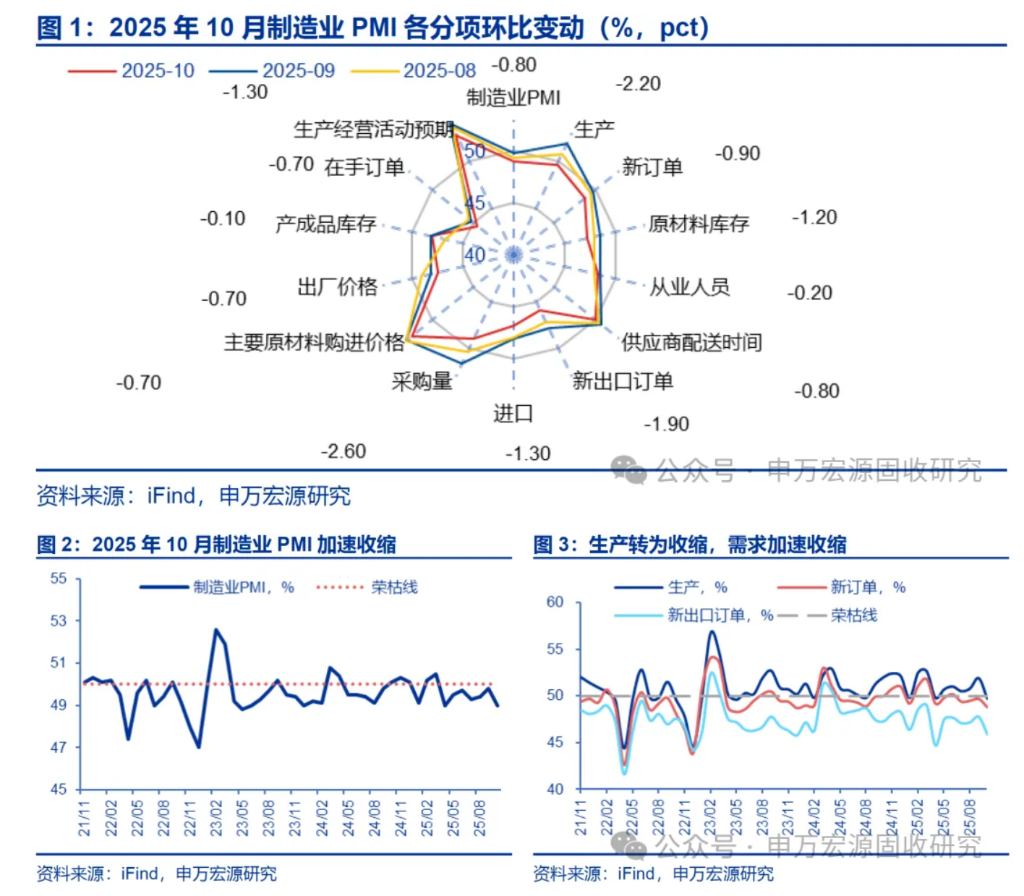
Core Viewpoint - The latest report from Shenwan Hongyuan indicates a decline in both production and demand, with the manufacturing PMI for October showing accelerated contraction, while the service sector experiences expansion due to the holiday effect [1]. Manufacturing Sector - The manufacturing PMI for October 2025 is reported at 49.0%, a decrease of 0.8 percentage points from the previous month [1]. - The production index fell by 2.2 percentage points to 49.7%, which is below the seasonal level compared to previous years [1][3]. - The new orders index decreased by 0.9 percentage points to 48.8%, indicating a faster contraction in demand, also below the seasonal level [1][3]. Price Trends - The major raw materials purchasing price index is at 52.5%, while the factory price index is at 47.5%, both showing a decline of 0.7 percentage points [1]. - The consumer goods factory price index has decreased, while the high-tech manufacturing factory price index has increased, reflecting a divergence in price trends [1]. Service Sector - The service sector PMI increased by 0.1 percentage points to 50.2%, driven by the holiday effect, with business activity indices for travel-related industries exceeding 60.0% [1]. Real Estate Sector - The construction business activity index fell to 49.1%, down 0.2 percentage points, impacted by slower construction progress during the holidays [1]. - Fixed asset investment growth continues to decline, and while there has been a temporary boost in real estate sales following policy adjustments, the sustainability of this trend is uncertain [1]. Economic Outlook - The overall economic situation remains under pressure, with the bond market's previous stress being alleviated, leading to increased focus on fundamentals [1]. - Recent developments in US-China trade talks and the Fourth Plenary Session's focus on top-level design are expected to have limited short-term impact on the bond market [1].


瑞银:升中国石油股份目标价至10.3港元 第三季度业绩胜预期
Zhi Tong Cai Jing· 2025-10-31 07:56
瑞银发布研报称,中国石油股份(00857)2025年前九个月净利润同比下降5%,至1,263亿元人民币;第三 季度录得423亿元人民币,同比下降4%,但按季上升14%,优于该行的预测。瑞银上调中石油目标价, 从9.3港元升至10.3港元。鉴于2025年第三季度业绩优于预期,小幅上调中石油2025年预测盈利2%,评 级"买入"。 展望2025年第四季度,瑞银预期,布伦特原油价格平均为63美元/桶;因国内天然气需求进入旺季,预期 天然气价格及销量均可上升。瑞银又认为,炼油及化工基本面可能面临一些压力;并建议关注年底时的 资产减值情况。 长期而言,瑞银预期中石油2026至2028年油价分别为每桶64美元、70美元及75美元,逐步趋稳并反弹; 国内天然气价格可能较海外价格更稳定,因国内天然气需求仍处增长状态;中石油下游炼油及化工细分 市场可受益于反内卷政策。 ...

新世纪期货交易提示(2025-10-31)-20251031
Xin Shi Ji Qi Huo· 2025-10-31 03:39
Report Industry Investment Ratings - Iron ore: Rebound [2] - Coking coal and coke: Rebound [2] - Rolled steel: Oscillation [2] - Glass: Oscillation [2] - Soda ash: Oscillation [2] - CSI 500: Rebound [4] - CSI 1000: Rebound [4] - 2-year Treasury bond: Oscillation [4] - 5-year Treasury bond: Oscillation [4] - 10-year Treasury bond: Upward [4] - Gold: High-level oscillation [4] - Silver: High-level oscillation [4] - Logs: Weak oscillation [6] - Pulp: Bottom consolidation [6] - Offset paper: Weak oscillation [6] - Soybean oil: Range operation [6] - Palm oil: Range operation [6] - Rapeseed oil: Range operation [6] - Soybean meal: Rebound [6] - Rapeseed meal: Rebound [6] - Soybean No. 2: Rebound [8] - Soybean No. 1: Rebound [8] - Live pigs: Oscillation with a slight upward trend [8] - Rubber: Oscillation [10] - PX: On the sidelines [10] - PTA: Oscillation [10] - MEG: On the sidelines [10] - PR: On the sidelines [10] - PF: On the sidelines [10] Report's Core Views - The macro利好 has landed, and black prices are returning to fundamentals. The iron ore market has an oversupply situation, and the coal and coke market is affected by policies and supply concerns. The steel market's price stop depends on production cuts and anti-"involution" policies. The glass market has inventory pressure and weak demand. The financial market has different trends for various indexes, and the precious metal market is affected by multiple factors such as central bank purchases and geopolitical risks. The light industry and agricultural product markets have their own supply and demand characteristics, and the soft commodity and polyester markets also face different situations [2][4][6][8][10] Summary by Related Catalogs Black Industry - Iron ore: The main line is "loose supply, low demand, and port inventory accumulation." The supply has room for impulse, and the demand is weak due to the low level of real estate new construction. Follow-up attention should be paid to four main lines that may trigger price revaluation [2] - Coking coal and coke: Driven by multiple news, the price has risen. The market is concerned about demand-side policies, and the core contradiction lies in the low profit level of steel mills [2] - Rolled steel: The price is affected by the demand for steel, and the stop of the decline depends on production cuts and policy implementation [2] - Glass: There are contradictions in the market, with weak demand and increasing inventory pressure. The solution depends on reducing the daily melting volume and the support of policies [2] Financial Market - Stock index futures/options: Different indexes have different trends, and the market is short-term consolidated with increasing bullish sentiment [4] - Treasury bonds: The yield of 10-year Treasury bonds has declined, and the market has a slight upward trend. It is recommended to hold long positions lightly [4] - Gold: The pricing mechanism is changing, and it is affected by multiple factors such as central bank purchases, geopolitical risks, and interest rate policies. It is expected to oscillate at a high level in the short term [4] Light Industry - Logs: The supply is increasing seasonally, while the demand is weakening. The price is expected to oscillate weakly [6] - Pulp: The cost support is weakening, and the demand is poor. The price is expected to consolidate at the bottom [6] - Offset paper: There is supply pressure, and the demand has not improved. The price is expected to oscillate weakly [6] Oil and Fat - Oils: The supply is abundant, and the demand is weak. The overall is expected to continue range operation [6] - Meal: Supported by trade optimism and the rise of US soybean futures, it is expected to rebound in the short term [6] Agricultural Products - Live pigs: The trading average weight may increase slightly, and the settlement price may rise. The market is expected to oscillate with a slight upward trend [8] Soft Commodities and Polyester - Rubber: The supply is affected by weather, and the demand is improving. The inventory is decreasing. The price is expected to oscillate widely [10] - PX: The trade dispute risk is weakening, and the price follows the oil price [10] - PTA: The cost support is weakened, and the supply and demand are marginally improved. The price follows the cost [10] - MEG: The supply is at a high level, and the demand is worrying. The price is suppressed by the inventory pressure [10] - PR: The market may oscillate weakly [10] - PF: The market may be sorted narrowly [10]
新能源及有色金属日报:统计库存小幅去化,工业硅供需格局有望好转-20251031
Hua Tai Qi Huo· 2025-10-31 02:48
1. Report Industry Investment Rating No relevant content provided. 2. Core Viewpoints of the Report - For industrial silicon, the supply - demand pattern may improve as the spot price center moves up slightly, with increased northwest开工 in the near term and southwest production cuts starting at the end of October. The industrial silicon valuation is low, and if there are relevant policies, the futures price may rise. For short - term, it's recommended to operate within a range, and for the dry - season contracts, it's advisable to go long at low prices [1][3]. - For polysilicon, the supply - demand fundamentals are average with large inventory pressure. Although the production has started to decrease recently and is expected to decline in November, the downstream production schedule may also weaken. The futures price is affected by anti - involution policies and weak reality, with large fluctuations. In the medium - to - long - term, it's suitable to lay out long positions at low prices. In the short - term, it's recommended to operate within a range [4][7]. 3. Summary by Related Catalogs Industrial Silicon Market Analysis - **Futures Market**: On October 30, 2025, the industrial silicon futures price showed a strong and volatile trend. The main contract 2601 opened at 9145 yuan/ton and closed at 9155 yuan/ton, up 85 yuan/ton (0.94%) from the previous settlement. The open interest of the main contract 2511 was 227,764 lots at the close, and the total number of warehouse receipts was 47,410 lots, an increase of 72 lots from the previous day [1]. - **Spot Market**: The industrial silicon spot price remained stable. According to SMM data, the price of East China oxygen - passed 553 silicon was 9400 - 9500 yuan/ton; 421 silicon was 9600 - 9800 yuan/ton; Xinjiang oxygen - passed 553 silicon was 8700 - 8800 yuan/ton; 99 silicon was 8700 - 8800 yuan/ton. Silicon prices in Kunming, Huangpu Port, Northwest, Tianjin, Xinjiang, Sichuan, and Shanghai regions increased slightly, and the price of 97 silicon also rose slightly [1]. - **Inventory**: As of October 30, the total social inventory of industrial silicon in major regions was 558,000 tons, a decrease of 1,000 tons from the previous week. Among them, the social ordinary warehouse inventory was 124,000 tons, an increase of 1,000 tons from the previous week, and the social delivery warehouse inventory (including non - registered warehouse receipts and spot inventory) was 434,000 tons, a decrease of 2,000 tons from the previous week [1]. - **Consumption**: According to SMM statistics, the quoted price of silicone DMC was 10,800 - 11,200 yuan/ton. Under the background of gradually released supply - side pressure and insufficient demand - side support, the game between upstream and downstream markets will intensify, and the domestic silicone DMC price will still be under pressure and decline slightly [2]. Strategy - **Unilateral**: Short - term range operation, and for dry - season contracts, go long at low prices. - **Others**: No strategies for inter - period, cross - variety, spot - futures, or options operations are provided [3]. Polysilicon Market Analysis - **Futures Market**: On October 30, 2025, the main contract 2601 of polysilicon futures fluctuated. It opened at 54,900 yuan/ton and closed at 54,950 yuan/ton, a decrease of 0.15% from the previous trading day. The open interest of the main contract reached 126,052 lots (118,430 lots the previous day), and the trading volume was 223,914 lots [4]. - **Spot Market**: The polysilicon spot price weakened slightly. According to SMM statistics, the price of N - type material was 49.60 - 55.00 yuan/kg, and the price of N - type granular silicon was 50.00 - 51.00 yuan/kg [4]. - **Inventory and Production**: The polysilicon manufacturer inventory and silicon wafer inventory increased. The latest polysilicon inventory was 261,000 tons, a month - on - month increase of 1.16%; the silicon wafer inventory was 18.93GW, a month - on - month increase of 2.49%. The weekly polysilicon output was 28,200 tons, a month - on - month decrease of 4.41%; the silicon wafer output was 14.24GW, a month - on - month decrease of 3.32%. The polysilicon output in October is expected to be about 133,500 tons, an increase from September, and it is expected to decline in November due to significant production cuts in the southwest region [4][5]. - **Silicon Wafer**: The price of domestic N - type 18Xmm silicon wafers was 1.34 yuan/piece (down 0.01 yuan/piece); the price of N - type 210mm silicon wafers was 1.69 yuan/piece; the price of N - type 210R silicon wafers was 1.36 yuan/piece [5]. - **Battery Cell**: The price of high - efficiency PERC182 battery cells was 0.27 yuan/W; PERC210 battery cells were about 0.28 yuan/W; TopconM10 battery cells were about 0.31 yuan/W; Topcon G12 battery cells were 0.32 yuan/W; Topcon210RN battery cells were 0.29 yuan/W; HJT210 half - cell batteries were 0.37 yuan/W [5]. - **Component**: The mainstream transaction price of PERC182mm components was 0.67 - 0.74 yuan/W; PERC210mm components were 0.69 - 0.73 yuan/W; N - type 182mm components were 0.66 - 0.68 yuan/W; N - type 210mm components were 0.67 - 0.69 yuan/W [6]. Strategy - **Unilateral**: Short - term range operation. The 11th main contract will fluctuate between 49,000 - 53,000 yuan/ton, and the 12th contract is expected to fluctuate between 50,000 - 57,000 yuan/ton. - **Others**: No strategies for inter - period, cross - variety, spot - futures, or options operations are provided [7].
有色金属的投资机遇:流动性、供需、政策与资产的四重奏
Sou Hu Cai Jing· 2025-10-31 02:41
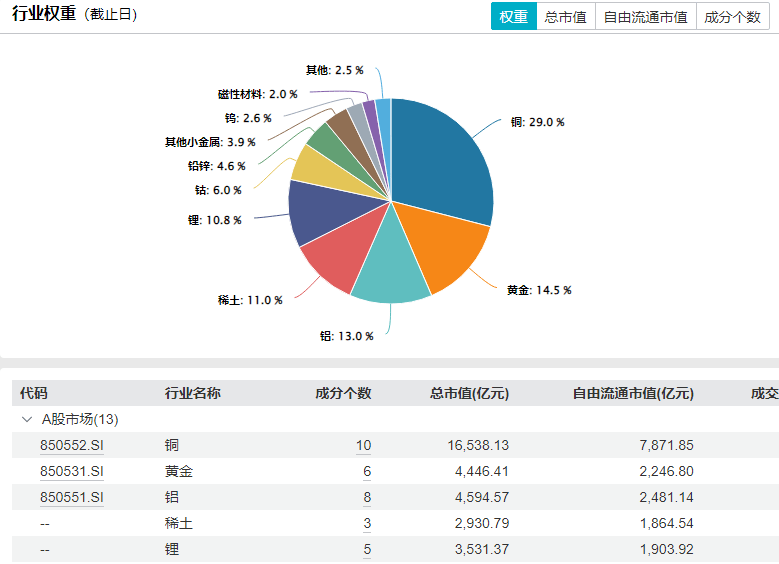
Group 1: Monetary Policy Impact - The Federal Reserve has initiated a rate-cutting cycle, creating a favorable financial environment for the non-ferrous metals sector [2][4] - Historical data shows that previous Fed rate-cutting cycles led to significant increases in non-ferrous metal prices, with copper prices rising from $1,400/ton to $8,700/ton after the 2001 crisis and from $3,000/ton to $10,000/ton post-2008 [3][4] Group 2: Supply and Demand Dynamics - There is a notable supply-demand imbalance in the non-ferrous metals market, particularly for copper, which has led to rising prices [5][6] - Major copper mines, including Kamoa-Kakula, El Teniente, and Grasberg, have faced production halts, exacerbating supply tightness [5][6] - Global refined copper consumption from January to August 2025 reached 18.83 million tons, a 5.90% increase year-on-year, with China's consumption growing by 11.05% [6][7] Group 3: Policy Developments - The Chinese government's "anti-involution" policy aims to address low-price competition and may lead to a new round of supply-side reforms in the non-ferrous metals industry [8][9] - The policy is expected to constrain supply, potentially raising the price floor for metals, particularly in the copper smelting sector [9] Group 4: Investment Opportunities - Non-ferrous metal ETFs, such as 512400, provide efficient investment tools for investors looking to capitalize on the sector's growth [10][12] - The index tracked by the ETF includes leading companies across various segments, offering a balanced exposure to industrial metals, precious metals, and strategic metals [10][12]
研究所晨会观点精萃-20251031
Dong Hai Qi Huo· 2025-10-31 01:22
Report Industry Investment Rating No relevant content provided. Core View of the Report - Overseas, influenced by the hawkish stance of Fed Chair Powell, the US dollar index strengthened, and global risk appetite cooled. Domestically, economic growth accelerated, and the meeting between Chinese and US leaders and a series of agreements reached boosted domestic market optimism. Policy stimulus expectations increased after the Fourth Plenary Session of the CPC, which helped lift domestic risk appetite. The recent market trading logic focused on domestic incremental stimulus policies and Sino - US trade negotiations, with short - term upward macro - drivers strengthening. Attention should be paid to the progress of Sino - US trade negotiations and the implementation of domestic incremental policies [3][4]. Summary by Related Catalogs Macro Finance - **Overall Situation**: Overseas, Fed Chair Powell's hawkish attitude led to a stronger US dollar index and cooled global risk appetite. Domestically, economic growth accelerated, the Sino - US meeting boosted optimism, and policy stimulus expectations increased. The market focused on domestic policies and Sino - US trade talks, with short - term upward macro - drivers strengthening [3]. - **Asset Recommendations**: Stock indices were short - term oscillating and slightly stronger, with short - term cautious long positions recommended. Treasury bonds were short - term oscillating, and cautious observation was advised. In the commodity sector, black metals were short - term oscillating and rebounding, with short - term cautious long positions; non - ferrous metals were short - term oscillating and rebounding, with short - term cautious long positions; energy and chemicals were short - term oscillating, with cautious long positions; precious metals were short - term in a high - level correction, and cautious observation was recommended [3]. Stock Indices - **Market Performance**: Domestic stocks fell sharply due to the drag of semiconductor components, military, and gaming sectors. However, economic growth acceleration, the Sino - US meeting, and policy stimulus expectations strengthened short - term upward macro - drivers. Short - term market sentiment subsided, leading to a short - term correction. Short - term cautious long positions were recommended [4]. Precious Metals - **Market Performance**: The precious metals market rose on Thursday night. The main contract of Shanghai gold closed at 920.40 yuan/gram, up 1.11%; the main contract of Shanghai silver closed at 11448 yuan/kg, up 1.47%. Spot gold rebounded and closed up 2.39% at 4024.49 US dollars/ounce. - **Outlook**: Short - term oscillation, with the medium - to - long - term upward pattern unchanged. Short - term observation was recommended, and medium - to - long - term buying on dips was advised [4]. Black Metals - **Steel**: On Thursday, the domestic steel futures and spot markets continued a small - scale rebound. The trading volume was low. Sino - US trade conflicts eased, with some tariffs cancelled and restrictions postponed. Steel inventories continued to decline, and the apparent consumption of five major steel products increased by 23.69 tons month - on - month. Supply might decline as steel mill profits were compressed and environmental restrictions were imposed in Hebei. The market was mainly driven by macro - logic, and prices were expected to be oscillating and slightly stronger [5][6]. - **Iron Ore**: On Thursday, the spot price of iron ore fell slightly, while the futures price continued to be strong. The recent rebound was due to strong macro - expectations and a significant decline in arrivals. With compressed steel mill profits, hot metal production was below 240 tons and might decline further. Steel mills mainly made rigid - demand replenishments. The price was expected to be in a short - term range - bound oscillation [6]. - **Silicon Manganese/Silicon Iron**: On Thursday, the spot prices of silicon iron and silicon manganese were flat. The futures price of silicon manganese rebounded slightly, and that of silicon iron fell slightly. The demand for ferroalloys was acceptable as the production of five major steel products increased slightly. The supply of silicon manganese decreased slightly. The prices of silicon iron and silicon manganese were expected to continue range - bound oscillations [7]. - **Soda Ash**: On Thursday, the main contract of soda ash oscillated within a range. Supply increased in the short term as some plants resumed production, and there were capacity expansion plans in the fourth quarter. Demand increased slightly. The industry lacked clear policy - following motivation, and supply pressure remained. A bearish view was recommended in the medium - to - long - term [8]. - **Glass**: On Thursday, the main contract of glass oscillated within a range. Supply remained stable, and demand in the peak season was weak. The inventory of float glass was relatively high. The anti - involution policy provided some support, and the price was expected to be oscillating and slightly stronger in the short term, with attention paid to the demand during the year - end peak construction season [8]. Non - Ferrous Metals and New Energy - **Copper**: The Fed cut interest rates by 25BP, but Powell's remarks on a December rate cut were hawkish. US copper inventories were at a historical high, restricting import demand. The shutdown of an Indonesian copper mine tightened the global supply, but the possible restart of a Panamanian copper mine was a risk. Domestic refined copper de - stocking was less than expected. LME's restriction on large near - month positions limited the upside of copper prices, and short - term high - level oscillations were expected [9]. - **Aluminum**: On Thursday, aluminum prices fell slightly. The Fed's hawkish stance and the fading of market optimism after the Sino - US meeting led to a decline in risk assets. The falling LME aluminum inventory supported the LME 3 - month aluminum price, which was expected to drive up the Shanghai aluminum price, but the increase in Shanghai aluminum would be smaller due to poor domestic fundamentals [9]. - **Tin**: After the maintenance of a large Yunnan smelter ended, the smelting start - up rate increased by 21.3% to 71.61%. The supply of tin ore was tight as Indonesia cracked down on illegal mining and adjusted the mining approval cycle. High prices suppressed demand, but some downstream enterprises made small - scale rigid - demand replenishments, and inventory decreased. Tin prices were expected to remain in high - level oscillations [10]. - **Lithium Carbonate**: On Thursday, the main contract of lithium carbonate rose 1.19%. Supply and demand both increased, with weekly production hitting new highs and strong demand in the peak season. Social inventory decreased slightly, and the number of warehouse receipts decreased rapidly. Short - term oscillation and a slightly stronger trend were expected, but attention should be paid to the upside hedging pressure [11]. - **Industrial Silicon**: On Thursday, the main contract of industrial silicon rose 0.94%. Demand was relatively stable, and social inventory increased slightly at a high level. With cost support from大厂 cash - flow costs and rising coal prices, the market was expected to be oscillating and slightly stronger [11]. - **Polysilicon**: On Thursday, the main contract of polysilicon fell 0.15%. The supply was high, and demand was low. Attention should be paid to the strengthening of policy expectations such as state purchases and the support of spot prices [12]. Energy and Chemicals - **Crude Oil**: Oil prices changed little for two consecutive days. The market was waiting to see the impact of US sanctions on Russian producers and the progress of Sino - US trade negotiations. The Fed's stance reduced the expectation of a December rate cut, putting pressure on oil prices. Attention should be paid to OPEC's new production policy on Sunday, and oil prices faced long - term pressure [13]. - **Asphalt**: The cost support for asphalt weakened as oil price rebounds stalled, and the futures price fell slightly. Although inventory decreased recently, the de - stocking speed would slow down as the demand off - season approached. The supply pressure decreased temporarily, but attention should be paid to the rebound space of oil prices driven by Russian oil sanctions, and the asphalt market lacked strong upward drivers [13]. - **PX**: Crude oil prices were stable, and the tight supply of PX provided cost support. PX prices oscillated. Although PX prices decreased with the high - start of PTA, there was still some demand support. The PXN spread and the PX outer - market price rebounded slightly. PX was likely to follow crude oil fluctuations, with a relatively high bearish risk [14]. - **PTA**: The meeting of leading manufacturers did not reach a substantial anti - involution agreement. The spot basis was - 70, with a possible slight decline in the future. Some winter clothing orders were booming, and downstream inventory decreased. The PTA inventory accumulation speed slowed down, but the processing fee was low. The implementation of anti - involution policies and cost logic were the main drivers, and the price was expected to be short - term oscillating with high bearish pressure in the future [14]. - **Ethylene Glycol**: Port inventory decreased slightly to 52.3 tons. The price followed the stalled oil price rebound and fell slightly. Downstream inventory decreased, and feedstock purchases increased. The price tested the lower support. Further upward movement required continuous de - stocking, and the cost - boosting factor might weaken, with short - term oscillations expected [15][16]. - **Short - Fiber**: Short - fiber prices oscillated with the polyester sector in the short term but faced high pressure in the future. Terminal orders declined seasonally, and short - fiber production decreased in some areas, with inventory accumulating slightly. Further de - stocking depended on whether terminal orders could continue to rise counter - seasonally, and the upside space was limited. Medium - term short positions were recommended [16]. - **Methanol**: The domestic methanol market declined, and port spot prices oscillated at a low level. Supply pressure was expected to increase as some plants would restart and imported goods continued to arrive. Demand was weak, and inventory was high. The price was expected to oscillate in the short term [17]. - **PP**: The market quotations mostly oscillated. The supply was sufficient, and demand improved due to "Double Eleven" stocking. Inventory decreased slightly, and the price might have a short - term recovery [17]. - **LLDPE**: The price of LLDPE fluctuated slightly. Supply was expected to increase, and industrial inventory decreased. Demand was expected to improve as the downstream PE industry's start - up rate might increase slightly, and the greenhouse film production was in the peak season. The price was expected to recover in the short term, but the supply - surplus situation remained, and the rebound was weak [18]. - **Urea**: The urea market was generally weak, but some low - end quotations had good transactions. Supply was abundant, and demand from agriculture and industry was stable, with some reserve demand likely to be released. Enterprise inventory increased slightly, and port inventory decreased significantly. The price was expected to oscillate at a low level [18]. Agricultural Products - **US Soybeans**: The CBOT January soybean contract rose 1.14% to 1107.75. US soybean exports had decreased by 45% year - on - year so far this crop year. The Sino - US trade consensus might open the agricultural product trade window, and US soybeans were expected to strengthen. However, the lack of USDA reports and stable South American weather provided little fundamental guidance [19][20]. - **Soybean and Rapeseed Meal**: Domestic soybean arrivals and inventories were high, and oil mills maintained high - level production, resulting in sufficient soybean meal supply. The improvement of Sino - US agricultural trade relations reduced the risk of soybean shortages, and inventory accumulation might limit the upside of soybean meal prices [20]. - **Palm Oil**: The BMD crude palm oil futures rebounded, supported by technical buying, the rise of Dalian soybean oil, and the weakening of the ringgit. Southeast Asian palm oil inventories were low, and the production season had entered a decline cycle. The details and progress of Indonesia's B50 biodiesel policy were uncertain. After continuous declines, palm oil was in a technically oversold state, and short - selling should be cautious [20]. - **Soybean and Rapeseed Oil**: Soybean oil supply was sufficient, and inventory was high. In the consumption peak season, it had a cost - performance advantage, and the spot basis was strong. The price difference between soybean oil and palm oil continued to narrow. Rapeseed oil inventory decreased, but the possible supply from Australia and Russia and the Sino - Canadian trade dialogue put pressure on rapeseed oil prices [21]. - **Corn**: The price of corn in the northern ports continued to decline slightly, and the price in the production areas changed little. The Sino - US trade negotiations affected the market, and traders' intention to build inventory was weak. The market price was close to the planting cost, and high - quality corn was scarce. As the temperature dropped, farmers' reluctance to sell might slow down the price decline [21]. - **Hogs**: The national average price of live hogs was 12.63 yuan/kg, down 0.04 yuan/kg. After the continuous rise in hog prices, slaughterhouses' procurement was normal, but the planned volume was limited. The strong price difference between fat and standard hogs increased the enthusiasm for second - fattening and farmers' reluctance to sell. Hog prices had stabilized in the short term, but the supply - demand mismatch pressure in November was high, and there was little room for a significant rebound [21].
大越期货玻璃早报-20251031
Da Yue Qi Huo· 2025-10-31 01:16
Report Summary 1. Report Industry Investment Rating No information provided. 2. Core View of the Report The glass industry has a weak fundamental outlook. In the short term, it is expected to operate with a weak and fluctuating trend. The supply has declined to a relatively low level, and there are more disturbances on the supply side recently, but the terminal demand recovery is weak [3][7]. 3. Summary by Relevant Catalogs Glass Futures Market - The closing price of the main contract was 1091 yuan/ton, a decrease of 3.19% from the previous value. The spot price of Shahe Safety large - size glass was 1048 yuan/ton, an increase of 0.38% from the previous value. The main basis was - 43 yuan/ton, a decrease of 48.19% from the previous value [8]. Glass Spot Market - The market price of 5mm white glass large - size boards in Hebei Shahe, the spot benchmark, was 1048 yuan/ton, an increase of 4 yuan/ton from the previous day [13]. Fundamental Analysis - Cost Side No detailed content provided. Fundamental Analysis - Production - The number of operating national float glass production lines was 226, with an operating rate of 76.35%. The number of operating production lines was at a historical low for the same period. The daily melting volume of national float glass was 161,300 tons, and the production capacity was at the lowest level in the same period in history and was stabilizing and recovering [24][26]. Fundamental Analysis - Demand - In August 2025, the apparent consumption of float glass was 4.8602 million tons. The real - estate terminal demand was still weak, and the number of orders from glass deep - processing enterprises was at a historical low for the same period. The capital collection in the deep - processing industry was not optimistic, and traders and processors were cautious, mainly digesting the original glass inventory [30][6]. Fundamental Analysis - Inventory - The inventory of national float glass enterprises was 65.79 million weight boxes, a decrease of 1.24% from the previous week. The inventory was running above the 5 - year average [45]. Fundamental Analysis - Supply - Demand Balance Sheet - The supply - demand balance sheet from 2017 to 2024E shows changes in production, consumption, and other indicators. For example, in 2024E, the production was 55.1 million tons, the consumption was 53.1 million tons, and the production growth rate was 3.94%, while the consumption growth rate was - 1.15% [46]. Influencing Factors - **Positive Factors**: Under the influence of the "anti - involution" policy, there is an expectation of production capacity clearance in the float glass industry. There are more disturbances on the supply side due to the "coal - to - gas" conversion of some production lines in the Shahe area [5]. - **Negative Factors**: The real - estate terminal demand is weak, and the number of orders from glass deep - processing enterprises is at a historical low for the same period. The capital collection in the deep - processing industry is not optimistic, and traders and processors are cautious [6]. Main Logic The glass supply has declined to a relatively low level for the same period. Recently, there have been more disturbances on the supply side, but the terminal demand recovery is weak. It is expected that the glass will mainly operate in a fluctuating manner [7].
【机构策略】A股市场韧性有望增强 流动性有望继续好转
Zheng Quan Shi Bao Wang· 2025-10-31 01:02
Group 1 - The market confidence has been positively impacted since mid-October, with policy support boosting the technology sector's performance and trading activity recovering [1] - The capital market is expected to deepen reforms, focusing on serving the real economy and promoting technological innovation, which will enhance market resilience and improve liquidity [1] - Despite a recent adjustment in the A-share market, the "slow bull" trend continues, with sufficient trading volume and positive developments from the China-US talks [1][1] Group 2 - On October 30, the A-share market experienced a decline, with the technology sector underperforming while lithium battery and shipping sectors rose [1] - The market environment is expected to remain favorable, with short-term disturbances subsiding and the A-share index likely to continue its upward trend [1] - Supportive factors for the fourth quarter include "anti-involution" policies, increased household savings entering the market, potential Federal Reserve rate cuts, and technical reversals [1]