
中美贸易谈判

Search documents
中美又要在伦敦谈了!怎么谈?!
格兰投研· 2025-06-07 15:04
Core Viewpoint - The upcoming trade talks between the U.S. and China in London are significant, with potential implications for technology sanctions and tariffs, as well as the broader economic landscape [1][2][6]. Group 1: Trade Talks - The meeting will take place in London, a neutral location, symbolizing equality and historical significance as the first country to reach a trade agreement with Trump [2]. - The U.S. delegation includes key figures: Treasury Secretary Mnuchin, Commerce Secretary Ross, and Trade Representative Lighthizer, indicating a serious approach to negotiations [3][4]. - The involvement of Commerce Secretary Ross suggests that technology sanctions will be a topic of discussion, which could indicate a shift in U.S. policy [3][6]. Group 2: Economic Implications - There is speculation that the U.S. may make concessions during the talks, such as easing technology sanctions or extending tariff suspension periods, which could positively impact the market [6]. - The outcome of these negotiations is expected to influence market movements, particularly in the A-share market [6]. Group 3: Federal Reserve and Interest Rates - Trump has been pressuring Federal Reserve Chairman Powell to lower interest rates significantly, citing the need to reduce government borrowing costs [7][11]. - The U.S. national debt has surpassed $36 trillion, with a debt-to-GDP ratio exceeding 120%, raising concerns about fiscal sustainability [11][12]. - The urgency for rate cuts is driven by the impending maturity of a substantial amount of U.S. debt, which could lead to increased interest expenses if rates remain high [12].


谈判结束,美3路人马离京,特朗普或将被迫继续向中国认怂?
Sou Hu Cai Jing· 2025-05-27 10:56
Core Viewpoint - China's selling of US Treasury bonds is putting significant pressure on the US government, forcing President Trump to reconsider his stance towards China amid the ongoing trade negotiations [1][10][17] Group 1: Financial Impact - The US Treasury is facing a daily interest expense of $3 billion, while China's holdings of $765.4 billion in US debt are depreciating by 1% daily [2][5] - The short positions on 10-year US Treasuries have surged to levels not seen since 2008, with $3.8 trillion in capital fleeing from dollar assets [2][10] - If China continues to reduce its US debt holdings by 5%, the Pentagon may need to cut its budget for two aircraft carrier battle groups next year [7][10] Group 2: Currency Dynamics - The recent 13% appreciation of the euro against the dollar threatens the foundation of the petrodollar system [4][10] - China's share of global oil trade settled in yuan has increased to 2.3%, a 15-fold increase from three years ago [5][10] - The Chinese government is allowing companies to use iron ore and copper concentrate as collateral for loans in yuan, facilitating bypassing the dollar in commodity transactions [9][10] Group 3: Strategic Moves - The negotiations in Geneva include a clause where China demands recognition of the yuan's special drawing rights, which would effectively grant the yuan an "international passport" [7][10] - China's reduction of US debt holdings is part of a broader strategy to internationalize the yuan and challenge the dollar's dominance [14][15] - The ongoing trade war has transformed into a financial battle, with the key to victory being the internationalization of local currencies [14][15]
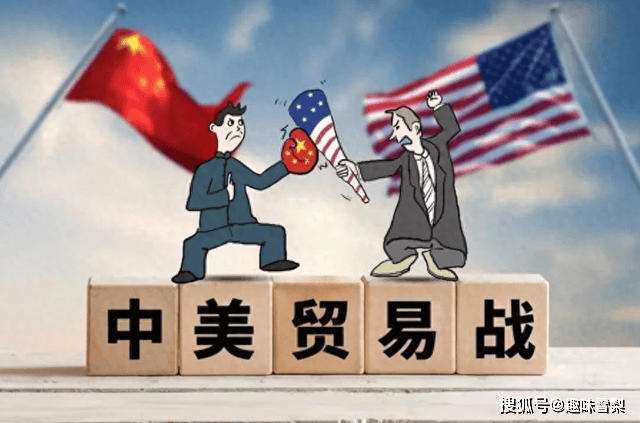
中方手里不止一张王炸,不怕特朗普翻脸不认人,再打美国还是输
Sou Hu Cai Jing· 2025-05-26 04:36
Group 1: Trade Negotiations - Recent US-China trade negotiations have made some progress, with both sides agreeing to revert tariffs to pre-Trump's "reciprocal tariff" policy levels [1] - However, there are indications that Trump may change his stance and propose new tariffs, which aligns with his historically unpredictable behavior [1][3] - China has been preparing for potential changes in negotiations, given the long-standing nature of US-China trade tensions that began during Trump's first term [1][3] Group 2: Rare Earth Resources - Rare earth resources have become a significant topic in international trade, particularly in the context of US-China relations [5] - These resources are scarce and non-renewable, widely used in advanced technology, and have been dubbed "the mother of new materials" and "industrial vitamins" [6] - Rare earth elements are essential in various applications, including enhancing the strength and lifespan of steel, which is crucial in military applications [8] Group 3: China's Dominance in Rare Earths - China holds the world's largest rare earth reserves, accounting for approximately 25% of global reserves, and produces about 80% of the world's rare earth products [11][12] - The global rare earth market is largely dominated by China, with around 70% of its exports going overseas, indicating a high level of dependency from other countries [12] - China's southern regions contain over 70% of the world's heavy rare earth resources, providing it with a strategic advantage [12] Group 4: US Dependency and Response - The US relies heavily on China for rare earth compounds and metals, with over 70% sourced from China in recent years [14] - The US has not yet mastered the technology for separating heavy rare earths, which is critical for its defense industry [14][16] - In response to this dependency, the Trump administration initiated a domestic rare earth supply chain restructuring plan, but this requires significant investment and time [17][19] Group 5: Strategic Implications - Rare earth resources have become a key bargaining chip for China in trade negotiations, with China showing no willingness to make concessions [21] - China's strong position in rare earth resources gives it confidence in dealing with the unpredictable nature of US trade policies [21]
五矿期货文字早评-20250520
Wu Kuang Qi Huo· 2025-05-20 02:52
Report Industry Investment Ratings No relevant content provided. Core Views of the Report - The domestic stock market shows a mixed trend, with some indices rising and some falling. The impact of Trump's tariff policy on market risk preference has weakened, and it is recommended to buy certain stock index futures on dips. The bond market faces short - term adjustment pressure due to tariff negotiations, but the subsequent capital supply is expected to be loose. The precious metals market is under pressure due to the expected release of geopolitical risks and the cautious attitude of the Fed. The prices of various non - ferrous metals, black building materials, energy chemicals, and agricultural products are affected by factors such as supply and demand, policies, and international situations, showing different trends and investment opportunities [2][4][6][7]. Summary by Related Catalogs Stock Index - **Market Performance**: The previous trading day saw the Shanghai Composite Index unchanged, the ChiNext Index down 0.33%, and the North - bound 50 up 2.37%. The total trading volume of the two markets was 108.64 billion yuan, a decrease of 3.1 billion yuan from the previous day. The financing amount decreased by 1.883 billion yuan, and the overnight Shibor rate increased by 11.70bp to 1.6540%. [2] - **Macro News**: In April, China's social consumer goods retail sales growth slowed to 5.1% year - on - year, and the national real estate development investment decreased by 10.3% year - on - year. The added value of industrial enterprises above designated size increased by 6.1% year - on - year. The 30 - year US Treasury yield exceeded 5%, and Moody's downgraded the US credit rating [2]. - **Trading Strategy**: It is recommended to buy IF stock index long positions on dips, and there is no recommended arbitrage strategy [4]. Treasury Bonds - **Market Performance**: On Monday, the TL, T, TF, and TS main contracts all rose, with increases of 0.37%, 0.13%, 0.04%, and 0.02% respectively [5]. - **News**: In April, economic data showed certain disturbances due to tariffs, with structural differentiation. The central bank conducted 135 billion yuan of 7 - day reverse repurchase operations, achieving a net investment of 9.2 billion yuan [5][6]. - **Strategy**: The bond market faces short - term adjustment pressure, but considering the decline in capital interest rates after reserve requirement ratio cuts and interest rate cuts, it is recommended to wait for opportunities to buy on dips [6]. Precious Metals - **Market Performance**: Shanghai gold rose 0.97% to 758.02 yuan/gram, and Shanghai silver rose 0.25% to 8111.00 yuan/kilogram. COMEX gold and silver fell slightly [7]. - **Market Outlook**: The cease - fire negotiation between Russia and Ukraine shows new signs of progress, and the Fed maintains a cautious monetary policy stance. International gold prices are expected to continue to correct in the short term [7]. - **Strategy**: It is recommended to wait and see for gold, and pay attention to the 700 yuan/gram support level. Silver is expected to maintain a range - bound pattern [8]. Non - Ferrous Metals - **Copper**: The price of copper oscillated and rebounded. The LME inventory decreased, and the domestic social inventory of electrolytic copper increased slightly. The short - term rebound space of copper prices may be limited [10]. - **Aluminum**: The price of aluminum fell under pressure. The domestic aluminum ingot and aluminum rod inventory decline slowed down. It is recommended to pay attention to the inter - month positive spread opportunities of aluminum [11]. - **Zinc**: The price of zinc fell slightly. The zinc concentrate port inventory continued to rise, and the zinc price still has a certain downward risk in the medium term [12]. - **Lead**: The price of lead fell slightly. The regenerative lead enterprise's operating rate continued to decline, and the short - term lead price showed a strong oscillation [13]. - **Nickel**: The price of nickel oscillated. The cost of nickel is expected to loosen, and the inventory may return to the accumulation trend. It is recommended to pay attention to the change of LME nickel 0 - 3 month premium [14]. - **Tin**: The price of tin rose slightly. The supply of tin is expected to loosen in the medium term. If the downstream demand remains weak, the center of tin prices may move down [15]. - **Lithium Carbonate**: The price of lithium carbonate fell. The fundamentals lack favorable drivers, and the short - term disk may run weakly [16]. - **Alumina**: The price of alumina rose. The mine and supply side are disturbed. It is recommended to wait and see in the short term [17]. - **Stainless Steel**: The price of stainless steel fell slightly. The cost support is enhanced, but the terminal procurement is still cautious. The short - term may maintain a narrow - range oscillation [18]. Black Building Materials - **Steel**: The price of steel showed a weak oscillation. The apparent demand for rebar increased slightly, and the hot - rolled coil may show a strong oscillation in the short term. The long - term demand is still under pressure [20][21]. - **Iron Ore**: The price of iron ore fell slightly. The supply increased, and the demand for molten iron is expected to decline. The short - term price of iron ore will oscillate [22][23]. - **Glass and Soda Ash**: The price of glass is expected to be weak in the medium term. The supply of soda ash is expected to decrease, but the inventory pressure is still large, and the disk is expected to be weak [24][25]. - **Manganese Silicon and Ferrosilicon**: The prices of manganese silicon and ferrosilicon fell slightly. The demand for manganese silicon and ferrosilicon is expected to weaken, and it is recommended to wait and see [26][27]. - **Industrial Silicon**: The price of industrial silicon fell slightly. The industry has over - capacity, and the price may continue to fall. It is recommended to wait and see [30][31]. Energy Chemicals - **Rubber**: The price of rubber oscillated and rebounded. There is an expectation of rubber storage and production reduction, but the demand is in the off - season. The market has different views on the rise and fall of prices [33]. - **Crude Oil**: The prices of WTI and Brent crude oil rose, and the INE crude oil price fell. It is recommended to short - sell on rallies in the medium term [36][37]. - **Methanol**: The price of methanol fell. The production profit is high, but the downstream performance is weak. It is recommended to short - sell on rallies [38]. - **Urea**: The price of urea fell. The supply and demand are both strong, but the price increase is limited. It is recommended to wait and see [39]. - **PVC**: The price of PVC rose slightly. The supply is expected to increase, and the demand is weak. The short - term price is expected to be weak [40]. - **Ethylene Glycol**: The price of ethylene glycol rose. The industry is in the de - stocking stage, but attention should be paid to risks [41][42]. - **PTA**: The price of PTA rose slightly. The supply is in the maintenance season, and the demand is expected to be strong. The processing fee has support, but attention should be paid to risks [43]. - **Para - Xylene**: The price of para - xylene rose. It is in the maintenance season, and the inventory is expected to decrease. Attention should be paid to risks [44]. - **Polyethylene PE**: The price of polyethylene is expected to maintain an oscillation. The supply pressure increases in the second quarter, and the demand is in the off - season [45][46]. - **Polypropylene PP**: The price of polypropylene is expected to maintain a weak oscillation. The supply has no new capacity in May, and the demand is in the off - season [47]. Agricultural Products - **Hogs**: The price of hogs is mainly stable, with a weakening trend. It is recommended to short - sell on rallies in the medium term [49]. - **Eggs**: The price of eggs is weak. The supply is sufficient, and the demand is general. It is recommended to short - sell on rallies for near - month contracts [50]. - **Soybean and Rapeseed Meal**: The price of domestic soybean meal fell. The short - term supply of soybeans is large, and the price is expected to oscillate weakly [51][52]. - **Oils and Fats**: The price of oils and fats is expected to oscillate weakly. The production of palm oil is recovering, and the US biodiesel policy may be lower than expected [53][56]. - **Sugar**: The price of sugar oscillated. The international market supply tension may ease, and the domestic sugar price may weaken [57][58]. - **Cotton**: The price of cotton is expected to oscillate strongly in the short term. The downstream operating rate increased slightly, and the inventory is being depleted [59].
广发早知道:汇总版-20250520
Guang Fa Qi Huo· 2025-05-20 02:20
广发早知道-汇总版 广发期货研究所 有色金属: 铜、锌、镍、不锈钢、锡、碳酸锂 黑色金属: 钢材、铁矿石、焦煤、焦炭、铁合金 农产品: 油脂、粕类、玉米、生猪、白糖、棉花、鸡蛋、花生、红枣、苹果 电 话:020-88830760 E-Mail:zhaoliang@gf.com.cn 目录: 金融衍生品: 金融期货: 股指期货、国债期货 贵金属: 黄金、白银 集运指数 商品期货: 能源化工: 原油、PTA、乙二醇、苯乙烯、短纤、尿素、瓶片、烧碱、PVC、LLDPE、 PP 特殊商品: 橡胶、玻璃纯碱、工业硅、多晶硅 2025 年 5 月 20 日星期二 投资咨询业务资格: 证监许可【2011】1292 号 组长联系信息: 张晓珍(投资咨询资格:Z0003135) 电话:020- 88818009 邮箱:zhangxiaozhen@gf.com.cn 刘珂(投资咨询资格:Z0016336) 电话:020-88818026 邮箱:qhliuke@gf.com.cn 叶倩宁(投资咨询资格:Z0016628) 电话:020- 88818017 邮箱:yeqianning@gf.com.cn 周敏波(投资咨询资格:Z00 ...
资金面小幅收敛,债市情绪偏弱
Dong Zheng Qi Huo· 2025-05-18 08:16
1. Report Industry Investment Rating - The rating for treasury bonds is "Oscillating" [4] 2. Core Viewpoints of the Report - This week (May 12 - May 18), treasury bond futures fluctuated weakly due to factors such as the unexpected progress of China - US trade negotiations and marginal convergence of the capital market. Looking ahead to next week, the capital market is expected to see a slight increase in interest rates during the tax period, and the market sentiment will remain weak. Although the curve is expected to steepen in the long - term, the process will be tortuous, and there is a possibility of flattening in the short - term [13][15] 3. Summary According to the Directory 3.1 One - Week Review and Views 3.1.1 This Week's Trend Review - Treasury bond futures fluctuated weakly. On Monday, due to the unexpected statement of China - US trade negotiations, futures opened lower, then strengthened slightly and finally weakened significantly. On Tuesday, they turned from weak to strong. On Wednesday, they declined slightly. On Thursday, long - term futures performed strongly. On Friday, the curve flattened bearishly in the morning and the decline narrowed in the afternoon. As of May 16, the settlement prices of 2 - year, 5 - year, 10 - year, and 30 - year treasury bond futures main continuous contracts were 102.368, 105.695, 108.460, and 118.880 yuan respectively, with changes of +0.012, +0.005, - 0.015, and - 0.520 yuan compared to last weekend [13] 3.1.2 Next Week's Views - The capital market will be the focus. During the tax period, the capital market is expected to be slightly tighter, and the market sentiment will be weak. Although the curve is expected to steepen in the long - term, the process is tortuous, and there may be a slight flattening in the short - term. The capital interest rate is expected to rise slightly during the tax period, and the market's concern about the capital market persists [15] 3.2 Weekly Observation of Interest - Bearing Bonds 3.2.1 Primary Market - This week, 77 interest - bearing bonds were issued, with a total issuance of 939.5 billion yuan and a net financing of 707.974 billion yuan. The net financing of local government bonds increased slightly, while that of inter - bank certificates of deposit decreased [23] 3.2.2 Secondary Market - Treasury bond yields increased. As of May 16, the yields of 2 - year, 5 - year, 10 - year, and 30 - year treasury bonds were 1.48%, 1.55%, 1.68%, and 1.88% respectively, up 4.73, 6.80, 4.60, and 4.25 bp from last weekend. The 10Y - 1Y spread widened, while the 10Y - 5Y and 30Y - 10Y spreads narrowed [27] 3.3 Treasury Bond Futures 3.3.1 Price, Trading Volume, and Open Interest - Treasury bond futures fluctuated weakly. The trading volumes of 2 - year, 5 - year, 10 - year, and 30 - year treasury bond futures increased, while the open interests decreased [35][38] 3.3.2 Basis and IRR - The opportunity for the cash - and - carry strategy decreased significantly. The basis of each variety is expected to gradually return to a normal level [42] 3.3.3 Inter - Delivery and Inter - Variety Spreads - The inter - delivery spreads of each variety generally widened in the opposite direction and are expected to gradually converge to 0 in the oscillation. However, the time for deploying this strategy is limited [47] 3.4 Weekly Observation of the Capital Market - This week, the central bank's open - market operations had a net withdrawal of 475.1 billion yuan. As of May 16, capital interest rates such as R007, DR007, SHIBOR overnight, and SHIBOR 1 - week all increased. The average daily trading volume of inter - bank repurchase increased [51][53] 3.5 Weekly Overseas Observation - The US dollar index strengthened slightly, and the 10Y US Treasury yield rose slightly. As of May 9, the US dollar index increased by 0.56% to 100.9828, and the 10Y US Treasury yield rose 6 bp to 4.43%. The spread between China and the US 10Y Treasury bonds was inverted by 275 bp [60] 3.6 Weekly Observation of High - Frequency Inflation Data - This week, industrial product prices rose across the board, while agricultural product prices showed mixed trends [64] 3.7 Investment Recommendations - Next week, with weak market sentiment, short - term defense is recommended. Aggressive investors can consider buying long - term varieties on dips. In the long - term, the curve is expected to steepen, but the process is tortuous. The opportunity for the cash - and - carry strategy has decreased significantly, and attention can be paid to the strategy of the basis returning to 0. The strategy of widening the inter - delivery spread can be tried, with a quick - in - quick - out approach [2][65]
投资策略周报八问公募新规对行业影响几何
KAIYUAN SECURITIES· 2025-05-18 06:40
Group 1: Market Influences - The two major factors impacting the market this week are the US-China trade negotiations and the new public fund regulations[1] - The US has imposed a 30% tariff on China, while China retains a 10% tariff on the US, with the US holding a 24% additional space for future negotiations[10] - The trade negotiations have exceeded expectations in terms of timing rather than tariff levels, indicating a strong US demand for results[11] Group 2: Public Fund Regulations - The new public fund regulations emphasize "stock priority," shifting focus from new fund launches to enhancing existing fund performance[2] - A floating fee mechanism will pressure active equity funds to return to "real alpha" orientation, reducing ineffective supply[14] - The proportion of active equity funds underperforming their benchmarks by over 10% reached 64% from 2022 to 2024, highlighting the need for regulatory intervention[15] Group 3: Investment Strategies - The industry is advised to focus on sectors with potential marginal funding increases, such as banking, public utilities, and construction, which currently show significant underweight positions[36] - The recommended investment strategy includes a focus on domestic consumption, technology growth, cost improvement sectors, and structural opportunities from international trade relations[40] - The long-term investment behavior of institutions is expected to shift towards stable holdings and reduced turnover rates, enhancing the attractiveness of A-shares for long-term capital[39]
方正证券:黄金在短期调整后有望继续维持长期上行趋势
智通财经网· 2025-05-18 06:31
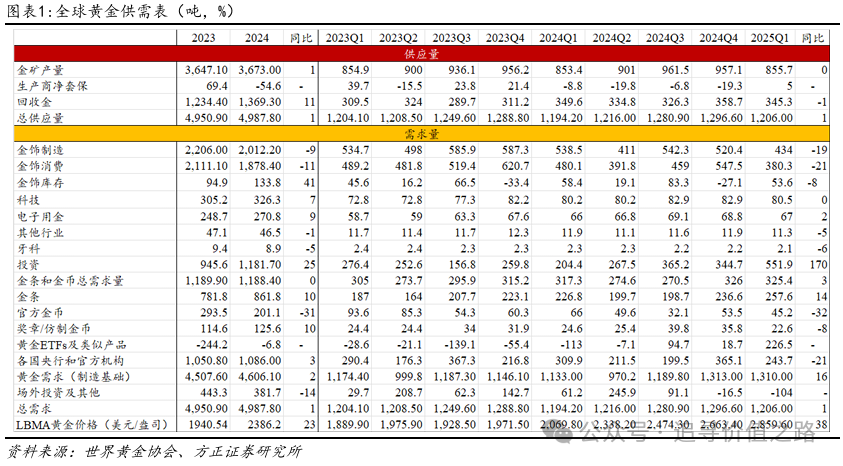
Core Insights - The recent surge in gold prices is primarily driven by increased purchases from global central banks and heightened investment demand, reflecting new characteristics in gold demand structure [1][2][3] - Short-term fluctuations may occur due to profit-taking by investors and a temporary slowdown in central bank purchases, but a long-term upward trend in gold prices is expected due to declining dollar credibility and ongoing central bank gold accumulation [1][3] Supply and Demand Analysis - Gold prices are determined by supply and demand balance, with supply being relatively stable due to gold's scarcity. Demand is categorized into jewelry manufacturing, industrial use, central bank purchases, and investment [4][6] - Central bank gold purchases have significantly increased in recent years, accounting for 21.77% of total demand by the end of 2024, making it a crucial factor influencing gold prices [6][9] Historical Trends - Gold's historical price movements can be divided into three phases: the Bretton Woods system (1944-1971), a period of volatility post-1971, and the current phase characterized by increased central bank purchases since 2022 [2][31] - The current phase of gold price increases is marked by central bank purchases and investor demand driven by inflation expectations and geopolitical tensions [2][65] Future Outlook - Short-term corrections in gold prices may occur, but a long-term upward trend is anticipated due to factors such as declining dollar trust, the onset of a Federal Reserve rate-cutting cycle, and sustained central bank gold purchases [3][65] - The interplay of gold's financial, commodity, and monetary attributes will continue to influence its demand and pricing dynamics in the context of global economic uncertainties [18][26][70]

投资策略周报:八问公募新规对行业影响几何-20250518
KAIYUAN SECURITIES· 2025-05-18 05:12
Group 1: Core Insights - The report emphasizes the significance of the new public fund regulations, which aim to strengthen equity investment orientation and long-term performance evaluation, leading to a shift in the industry from a "new issuance-driven" model to a focus on "existing stock cultivation" [1][2][3] - The new regulations are expected to create a medium to long-term institutional dividend for the equity market, facilitating the inflow of long-term capital [1][2] Group 2: Public Fund Regulations - The reform highlights a "stock priority" approach, encouraging fund companies to focus on the sustained performance of existing products rather than just new issuances [2][14] - The introduction of a floating fee mechanism is designed to push products back to a "real alpha" orientation, enhancing benchmark constraints and reducing ineffective supply from high-scale, low-performance funds [2][15] - Smaller fund companies are advised to adopt a "boutique strategy" and focus on niche markets to build competitive advantages through efficient research and incentive mechanisms [2][16] - The report anticipates a surge in index products, particularly ETFs, driven by expedited registration and policy support for Smart Beta and enhanced strategies [2][17] - The classification evaluation mechanism will transform the business model of distribution agencies, shifting the focus from "selling quickly" to "holding long" [2][18] - Active equity funds will face pressure from regulatory constraints on performance deviation and style drift, leading to a faster exit of inefficient equity products [2][19] - The new regulations are likely to impact the industry allocation structure, with sectors such as banking and public utilities expected to see passive reallocation due to strengthened benchmark constraints [2][36] Group 3: Investment Recommendations - The report suggests a "4+1" investment strategy focusing on domestic consumption, technology growth, cost improvement, structural opportunities from international trade, and stable long-term holdings [3][40] - Specific sectors identified for potential investment include consumer goods, technology, military, and stable dividend stocks, with a particular emphasis on the automotive and healthcare sectors [3][40]
日度策略参考-20250516
Guo Mao Qi Huo· 2025-05-16 06:40
| 19 E K # 5 | 日度策略参 | | | | | | | | --- | --- | --- | --- | --- | --- | --- | --- | | 趋势研判 | 行业板块 | 逻辑观点精粹及策略参考 | 品種 | 股指 | 震荡 | 持有的多头头寸考虑减仓,警惕进一步调整风险。 | 110 | | 资产荒和弱经济利好债期,但短期央行提示利率风险,压制上涨 | 容间。 | 宏观金融 | | | | | | | 短期金价或进入盘整;但中长期上涨逻辑尚未改变。明终 | 農汤 | 黄金 | 整体跟随黄金,但关税超预期结果将利好白银商品属性,因此短 | 農法 | 三 千尺 | | | | 期银价韧性或强于黄金。 | 近期市场情绪好转,铜价走高,但下游需求转弱,铜价存在回调 | 股 | | | | | | | 风险。 | 电解铝自身产业面无明显矛盾,在中美贸易谈判结果超预期情况 | 看头 | | | | | | | 下,铝价延续反弹走势。 | 铝土矿及氧化铝供应扰动有所提升,氧化铝供需格局有所好转 | 氧化铝 | | | | | | | 短期价格或进一步反弹。 | 步入淡季终端需求明显走弱,叠加 ...