
有色

Search documents
策略周专题(2025年7月第1期):哪些行业中报业绩可能更占优势?
EBSCN· 2025-07-13 06:43
Group 1 - The A-share market has shown signs of recovery, with major indices mostly rising, particularly the ChiNext Index which increased by 2.4% [13][14][16] - The real estate, steel, and non-bank financial sectors performed relatively well this week, with respective increases of 6.1%, 4.4%, and 4.0% [16][19][34] - The manufacturing sector is predicted to have the highest mid-year report performance growth, with an estimated year-on-year growth rate of approximately 10.0% [33][34] Group 2 - Industries expected to show high mid-year report performance growth include light industry, non-ferrous metals, and non-bank financial sectors, with predicted net profit growth rates of 34.2%, 33.0%, and 19.1% respectively [33][34] - The construction materials, electronics, and telecommunications sectors are anticipated to have significant performance improvement, with expected growth rate improvements of 11.4%, 7.9%, and 6.1% respectively [34][39] - The current mid-year earnings forecast disclosure rate is only 4.1%, indicating limited reference value for investors [39][42] Group 3 - The overall pre-announcement rate for A-share companies is 72%, with many industries showing high pre-announcement rates, particularly in real estate and non-bank financial sectors [39][40] - The environmental protection, transportation, and media sectors are expected to show significant improvement in mid-year earnings forecasts, with respective improvement rates of 139.5pct, 111.0pct, and 96.7pct [41][44] - The market is expected to experience a bullish trend in the second half of the year, with a focus on sectors that are likely to outperform in mid-year reports [57][58]
河南实施五大行动助力制造业加"数"跑
Zhong Guo Chan Ye Jing Ji Xin Xi Wang· 2025-07-11 01:28
Core Viewpoint - The Henan Province is accelerating digital transformation to promote high-quality development in its manufacturing sector, leveraging its comprehensive industrial system and aiming to enhance its modern industrial framework's support capacity for quality growth [1][2]. Group 1: Digital Transformation Actions - The first action focuses on comprehensive digital transformation, providing tailored solutions for companies that have not yet implemented digital upgrades and promoting the establishment of smart workshops and factories for those that have [1]. - The initiative aims to harness opportunities from generative artificial intelligence, driving the construction of industrial large models and establishing centers for AI industry empowerment and hardware-software adaptation [1]. Group 2: Traditional Industry Upgrading - The second action targets quality enhancement in traditional industries such as steel, non-ferrous metals, chemicals, building materials, and food, aiming to improve the competitive advantage across the entire industry chain [2]. - Support will be provided for traditional manufacturing sectors to delve into niche markets, incubate new technologies, explore new avenues, and cultivate new industries [2]. Group 3: Advanced Manufacturing Clusters - The third action is focused on cultivating advanced manufacturing clusters, specifically enhancing the scale and technological level of national clusters in superhard materials and modern agricultural machinery [2]. - There is a strong emphasis on supporting the creation of national advanced manufacturing clusters in new power equipment, modern food, and smart terminals [2]. Group 4: Development Zone Enhancement - The fourth action aims to elevate the capabilities of development zones by attracting upstream and downstream enterprises and supporting service institutions to build clear leading industries and complete industrial chains [2]. - Efforts will be made to improve management service efficiency in development zones, deepen reforms, and optimize operational models to enhance public services and market-oriented operations [2]. Group 5: Quality Enterprise Cultivation - The fifth action focuses on nurturing quality enterprises, strengthening leading companies, and enhancing their resource allocation capabilities [2]. - Support will be provided for cross-regional mergers and acquisitions, accelerating vertical integration across the entire chain, and aiming to create a batch of national chain-leading and pioneering enterprises [2].
中国6月通胀数据分化,政策效果待观察
Hua Tai Qi Huo· 2025-07-10 05:35
Report Industry Investment Rating - No information provided Core Viewpoints - The passing of the "Big Beautiful" tax and spending bill in the US marks a shift from the "tight fiscal expectation + neutral monetary" phase in the first half of the year to a policy phase of "easy to loosen, hard to tighten." In China, the Central Financial and Economic Commission's meeting has reignited market inflation trading [3]. - The inflation trading this round is not smooth. Overseas, the core is the inflation expectation dominated by currency, while in China, it is the supply - side. Further details of production reduction policies are needed to determine the main line of inflation trading [3]. - Attention should be paid to corresponding commodity sectors. Domestically, the black and new - energy metal sectors are most sensitive to the supply - side. Overseas, the energy and non - ferrous sectors benefit significantly from inflation expectations [4]. - For commodities and stock index futures, it is recommended to allocate long positions in industrial products on dips [5]. Summary by Related Catalogs Market Analysis - In July, a Politburo meeting in China is awaited. In May, domestic investment data weakened, especially in the real estate sector, which may drag down fiscal revenue and the entire real - estate chain. Exports were also under pressure, while consumption showed resilience. China's June manufacturing PMI rebounded, and the CPI turned positive year - on - year, with the core CPI rising 0.7% year - on - year, driven by industrial consumer goods. The PPI decreased 3.6% year - on - year in June, with the decline widening by 0.3 percentage points [2]. - Since July, policies to address low - price and disorderly competition in industries such as photovoltaics, lithium batteries, automobiles, and steel are expected to heat up, and some commodity prices have recovered. The low base of PPI in the second half of 2024 may boost the year - on - year PPI reading in the second half of this year [2]. - The US will impose tariffs ranging from 25% to 40% on imports from 14 countries including Japan and South Korea starting from August 1. The US and Japan will continue tariff negotiations, and the EU aims to reach a trade agreement with the US by August 1. The US Commerce Secretary plans to talk with China in early August [2]. Macro - inflation Trading - The "Big Beautiful" tax and spending bill in the US may increase the US government's debt by $3.4 trillion in the next decade, leading to a shift in US policies. In China, the Central Financial and Economic Commission's meeting has re - heated market inflation trading [3]. - Overseas, the US one - year inflation expectation in June dropped from 3.2% to 3.0%, a five - month low. However, the Fed's path to restarting easing is not smooth, and although the "Big Beautiful" bill has passed, Treasury bond issuance will still absorb market liquidity [3]. - In China, the core of inflation trading is on the supply - side. The 2025 Central Financial and Economic Commission meeting is different from the 2015 one, and more details of production reduction policies are needed to determine the main line of inflation trading [3]. Commodity Sectors - Domestically, the black and new - energy metal sectors are most sensitive to the supply - side. Overseas, the energy and non - ferrous sectors benefit significantly from inflation expectations [4]. - The black sector is still dragged down by downstream demand expectations. The supply shortage in the non - ferrous sector remains unresolved. In the energy sector, the short - term geopolitical premium has ended, and the medium - term supply is expected to be relatively loose. OPEC+ will increase production by 548,000 barrels per day in August, higher than expected [4]. - The EIA expects the Brent crude oil price to be $69 per barrel in 2025 (previously $66). The price of agricultural products has limited fluctuation in the short term due to the absence of weather disturbances [4]. Strategy - For commodities and stock index futures, it is recommended to allocate long positions in industrial products on dips [5]. Important News - The Chinese government supports enterprises in stabilizing employment positions, including expanding the scope of special loans for stabilizing and expanding employment, increasing the proportion of unemployment insurance refunds for enterprises, and allowing enterprises in difficulty to apply for deferred payment of social insurance premiums [7]. - In June, China's CPI turned positive year - on - year after four consecutive months of decline, mainly due to the recovery of industrial consumer goods prices. The year - on - year decline of PPI widened in June, but prices in some industries are showing signs of stabilization and recovery [7]. - Trump has determined that tariffs will be implemented on August 1, 2025. The US and Japan will continue tariff negotiations, and the EU aims to reach a trade agreement with the US by August 1. The US plans to talk with China in early August [2][7]. - COMEX copper futures maintained a 9.6% increase, and Trump intends to impose a 50% tariff on copper. The investigation of the pharmaceutical and semiconductor sectors will be completed by the end of the month [7]. - The US one - year inflation expectation in June dropped from 3.2% to 3.0%, a five - month low, and the three - year inflation expectation remained stable at 3% [7]. - US API crude oil inventories increased by more than 700,000 barrels last week. The EIA expects the Brent crude oil price to be $69 per barrel in 2025 and $58 per barrel in 2026 [7]. - Trump has approved the shipment of more defensive weapons to Ukraine and is considering further sanctions against Russia. He is also considering supporting a new bill for severe sanctions against Russia [7][8].
税收数据显示青海重点领域设备更新提速
Zhong Guo Chan Ye Jing Ji Xin Xi Wang· 2025-07-09 22:34
Group 1: Equipment and Industry Performance - The implementation of large-scale equipment renewal policies has accelerated equipment updates in key sectors, leading to stable production growth [1] - In the period from May last year to May this year, the invoice amounts for machinery equipment purchases in the non-ferrous and steel industries increased by 2.8 times and 92.1% respectively [1] - The sales revenue from key sectors achieved a year-on-year growth of 4.3%, surpassing the provincial average growth rate by 9.2 percentage points [1] Group 2: Consumer Goods and Market Trends - The consumption of home appliances has increased significantly, with retail sales of refrigerators and daily household appliances rising by 1.1 times and 36.6% respectively [2] - The retail sales of smart home products, particularly furniture and sanitary ware, saw substantial growth, with increases of 55.4% and 27.1% respectively [2] - The "old-for-new" policy for automobiles has led to a year-on-year increase of 11.8% in new car retail sales across the province [2] - Overall, the retail sales revenue in the province grew by 4.8% year-on-year, exceeding the provincial average growth rate by 9.7 percentage points, highlighting the role of consumption in driving economic circulation and high-quality development [2]
晚报 | 7月10日主题前瞻
Xuan Gu Bao· 2025-07-09 14:29
Group 1: Autonomous Driving - BYD announced it has achieved L4-level smart parking capabilities and will cover all safety and loss liabilities for users of its Tian Shen Yan vehicles in smart parking scenarios [1] - CITIC Securities predicts that by 2025, the penetration rate of mid-to-high-end autonomous driving in China is expected to double, creating a market increment of 35 billion [1] - Guohai Securities notes that the commercialization of smart driving is accelerating, with increasing penetration rates expected to benefit the domain controller hardware and software supply chain [1] Group 2: Short Dramas - The short drama market in China has reached an annual scale of 300 to 350 billion, with expectations to surpass 500 billion next year [2] - The user base for micro-short dramas is projected to exceed 600 million by 2024, with the market size expected to reach 505 billion, surpassing annual box office revenue for the first time [2] - CITIC Jinshi Securities highlights a significant shift in the short drama industry towards advertising-based business models and an influx of traditional film companies [2] Group 3: 3D Printing - Researchers at the University of Texas at Austin have developed a new 3D printing technology that seamlessly integrates soft and hard material properties, opening new possibilities for prosthetics and flexible medical devices [3] - The 3D printing market in China is expected to exceed 63 billion by 2024, growing 30 times over the past decade, with projections to surpass 100 billion by 2029 [3] - The technology is seen as a transformative force in manufacturing, with applications expanding across various industries including healthcare and education [3] Group 4: Measurement and Testing - The State Administration for Market Regulation and the Ministry of Industry and Information Technology have issued a plan to support the development of new industrial productivity through measurement [4] - The demand for high-precision measurement in emerging industries such as new energy and aerospace is increasing significantly [4] - The Chinese measurement market is projected to exceed 150 billion yuan by 2025, with a compound annual growth rate of over 10% [4]



中信期货晨报:国内商品期货涨跌互现,集运欧线大幅上涨-20250709
Zhong Xin Qi Huo· 2025-07-09 05:36
Group 1: Report Investment Rating - No information provided on the industry investment rating in the report Group 2: Core Views - For domestic assets, there are mainly structural opportunities, with the policy-driven logic strengthening. The probability of incremental domestic policies being implemented in the fourth quarter is higher. Overseas, attention should be paid to tariff frictions, geopolitical risks, etc. In the long run, the weak US dollar pattern continues. Strategic allocation to resources such as gold should be maintained [5] - The overseas stagflation trade has cooled down, and the long - short allocation thinking has diverged. In the domestic market, there may be moderate reserve requirement ratio and interest rate cuts, and the fiscal end will implement established policies in the short term. In the overseas market, the inflation expectation structure has flattened, the economic growth expectation has improved, and the stagflation trade has cooled down [7] Group 3: Summary by Directory 1. Macro Highlights - **Overseas Macro**: The June non - farm payrolls performance exceeded expectations, delaying the market's bet on the Fed's interest rate cut, and the US dollar index rebounded slightly. The implementation of the "Big and Beautiful" bill will increase the US deficit pressure. There are hidden concerns in the US employment market, and the bill will increase the US deficit by $3.3 trillion in the next 10 years [5] - **Domestic Macro**: The economic fundamentals have increased with resilience. The "anti - involution" policy has promoted the short - term rebound of commodities such as rebar, glass, and polysilicon. Domestic - demand - oriented commodities and those that have been falling since the beginning of the year have been greatly affected by the "anti - involution" policy [5] - **Asset Views**: Domestic assets mainly have structural opportunities, and the policy - driven logic is strengthened. Overseas, attention should be paid to tariff frictions and geopolitical risks. A long - term weak US dollar pattern continues, and non - US dollar assets should be focused on. Strategic allocation to gold and other resources should be maintained [5] 2. View Highlights - **Macro**: Domestic market may see moderate RRR and interest rate cuts, and fiscal policies will be implemented. Overseas, stagflation trade cools down. Stock index futures, index options, and treasury bond futures are expected to oscillate. Key points to watch include micro - cap stock stampedes, dollar liquidity deterioration, option liquidity, and unexpected changes in tariffs, supply, and monetary easing [7] - **Precious Metals**: With the recovery of risk appetite, precious metals are in short - term adjustment. Gold and silver are expected to oscillate, and key points to watch are Trump's tariff policy and the Fed's monetary policy [7] - **Shipping**: The sentiment has declined, and attention should be paid to the sustainability of the increase in the loading rate in June. The container shipping to Europe route is expected to oscillate, and key points to watch are tariff policies and shipping company pricing strategies [7] - **Black Building Materials**: Affected by domestic and foreign policies, the price fluctuations of the sector have increased. Products such as steel, iron ore, coke, coking coal, etc. are expected to oscillate, and key points to watch include special bond issuance progress, steel exports, iron ore production and shipment, etc. [7] - **Non - ferrous Metals and New Materials**: Amid the coexistence of low - inventory reality and weak demand expectations, non - ferrous metals continue to oscillate. Copper, aluminum, etc. are expected to oscillate, while zinc and nickel may oscillate downward [7] - **Energy and Chemicals**: Due to OPEC+ over - production, energy and chemicals are expected to oscillate weakly. Crude oil, LPG, asphalt, etc. may fall or oscillate downward, while some products like ethylene glycol and short - fiber are expected to oscillate upward [9] - **Agriculture**: Rubber stabilizes after a decline. Products such as grains, oils, and livestock are expected to oscillate, and key points to watch include weather, production and demand data, and market transactions [9]
ETF资金周报(6/30-7/4)|宽基板块资金延续流出,证券ETF龙头(159993)强势吸金、规模突破20亿
Sou Hu Cai Jing· 2025-07-08 10:53
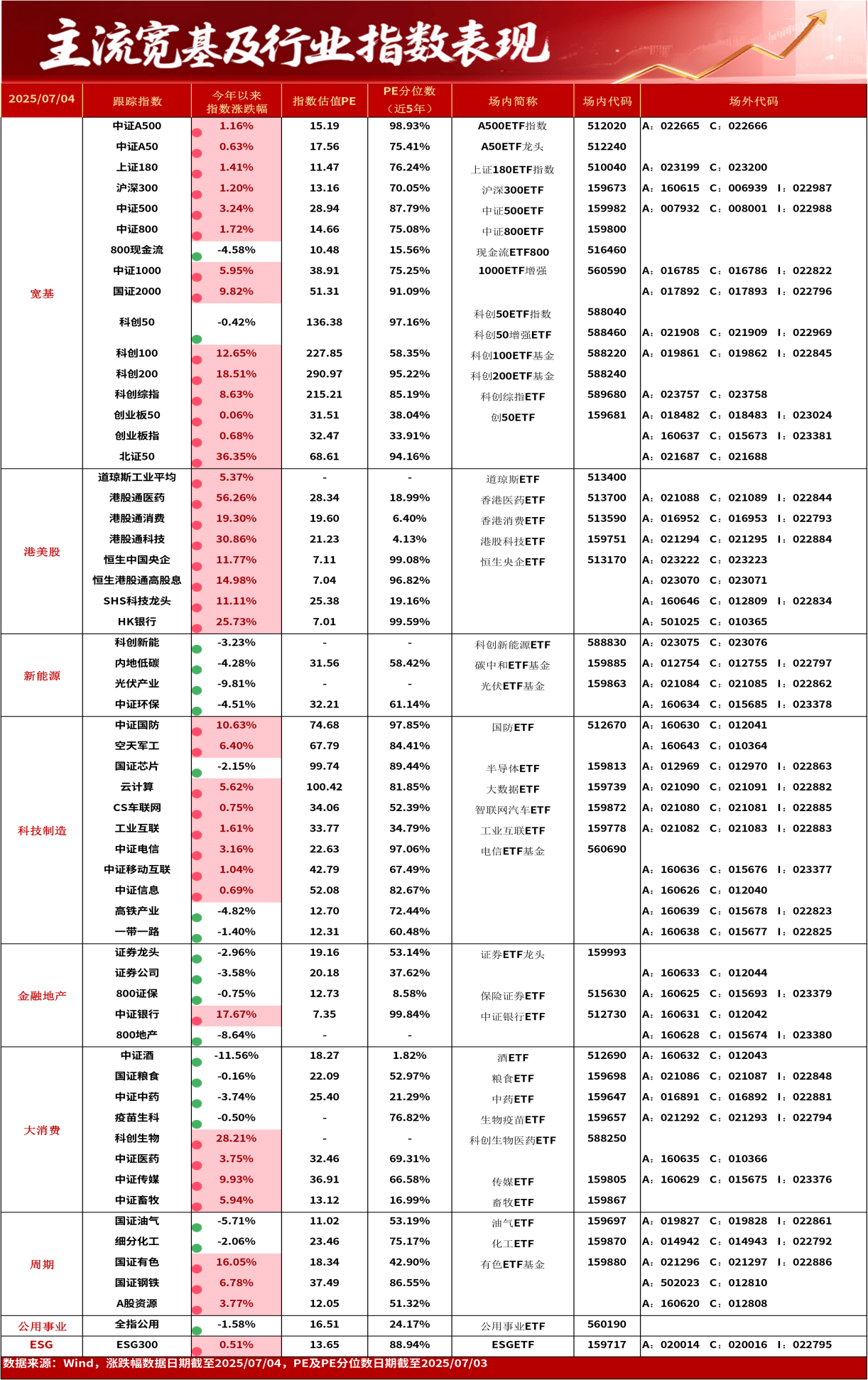
Market Overview - The total scale of equity ETFs in the market reached 37,631.20 billion yuan, with an increase of 208.04 billion yuan in total scale over the past week, and a net outflow of 132.28 billion yuan [1]. Fund Inflow and Outflow Direction - In terms of major categories, industry and thematic ETFs saw a net inflow of 116.39 billion yuan, while broad-based and strategic ETFs experienced a net outflow of 338.22 billion yuan [2]. - Within the broad-based and strategic ETFs, the top three sectors for net inflow were: Sci-Tech Innovation 50, Strategy-Dividend, and Shenzhen 100. The top three sectors for net outflow were: CSI 300, CSI A500, and CSI 1000 [3]. - For industry and thematic ETFs, the top five sectors for net inflow were: Securities, Semiconductor Chips, Military Industry, Photovoltaics, and Innovative Drugs. The top five sectors for net outflow were: Entertainment Media, State-Owned Enterprises, Telecommunications, Biotechnology, and Steel [3]. Financial Sector Insights - The financial sector continued to attract capital inflow, with the leading securities ETF (159993) accumulating 3.22 billion yuan over the week, surpassing a total scale of 20 billion yuan. There are expectations for mergers and acquisitions in the securities sector, driven by the backdrop of a "Financial Power" strategy [3]. - The approval of virtual asset trading service licenses for Chinese securities firms' Hong Kong subsidiaries opens a new chapter for financial innovation, potentially enhancing trading sentiment within the securities sector [3].
博时市场点评7月8日:两市放量上涨,创业板涨2.39%
Xin Lang Ji Jin· 2025-07-08 08:14
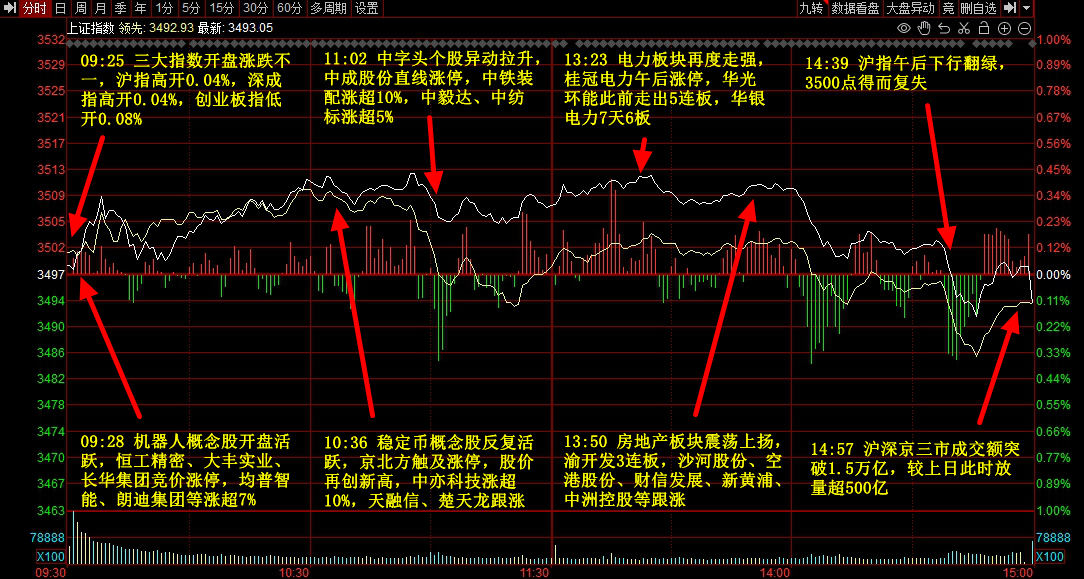
Market Overview - The three major indices in the A-share market rose, with the ChiNext index increasing by nearly 2.4% and total trading volume reaching 1.47 trillion yuan, indicating a gradual increase in risk appetite and liquidity in the domestic market [1] - The market is expected to experience a structural trend, with indices fluctuating while the central tendency moves upward, as corporate earnings still face pressure despite signs of economic recovery [1] Economic Indicators - As of the end of June, China's gold reserves reached 73.9 million ounces, an increase of 70,000 ounces from the end of May, marking the eighth consecutive month of gold accumulation [2] - China's foreign exchange reserves stood at $33,174 billion, up by $32.2 billion from the end of May, remaining stable above $3.2 trillion for 19 consecutive months [2] Policy Developments - The National Development and Reform Commission and other departments issued a notice to promote the scientific planning and construction of high-power charging facilities, aiming for over 100,000 such facilities nationwide by the end of 2027 [2][3] - The policy aims to address the challenges in charging infrastructure for new energy vehicles, with expectations for accelerated construction from 2025 to 2027, benefiting the upstream and downstream of the industry chain [3] Trade Relations - The U.S. government announced a delay in tariff negotiations, with President Trump set to sign an executive order imposing a 25% tariff on all products imported from Japan and South Korea starting August 1, 2025 [3] - This trade policy reflects the Trump administration's strategy of using pressure to facilitate negotiations, which may increase global market volatility in the short term [3] Market Performance - On July 8, the A-share market saw the Shanghai Composite Index close at 3,497.48 points, up 0.70%, while the Shenzhen Component Index rose by 1.47% to 10,588.39 points [4] - Among the sectors, utilities and banking experienced declines, while telecommunications, power equipment, and electronics led the gains [4] Capital Flow - The market's trading volume was 1,474.798 billion yuan, showing an increase from the previous trading day, with the margin financing balance also rising to 1,859.38 billion yuan [5]


收评:沪指涨0.7%逼近3500点,资源股集体拉升,消费电子概念等强势
Zheng Quan Shi Bao Wang· 2025-07-08 07:50
Market Performance - Major stock indices in Shanghai and Shenzhen rose across the board, with the Shanghai Composite Index approaching 3500 points and the ChiNext Index surging over 2% [1] - As of the market close, the Shanghai Composite Index increased by 0.7% to 3497.48 points, the Shenzhen Component Index rose by 1.47% to 10588.39 points, and the ChiNext Index climbed by 2.39% to 2181.08 points [1] - The total trading volume in the Shanghai and Shenzhen markets reached 14,747 billion yuan [1] Sector Performance - Sectors such as semiconductors, non-ferrous metals, steel, building materials, chemicals, brokerages, and automobiles saw significant gains [1] - Strong performance was noted in the photovoltaic industry chain, PCB concepts, and consumer electronics concepts, while insurance, banking, and electric power sectors experienced slight declines [1] Investment Outlook - Short-term industry highlights are emerging, with strong drivers in certain sectors, suggesting that the stock market will continue to perform positively amid strong trading sentiment [2] - The overall risk premium in the stock market remains at a historically high level, with the ERP index of the National Securities A Index recorded at 3.5%, indicating a relatively high cost-performance ratio for the A-share market [2] - Macroeconomic policies are expected to continue to support economic growth in the second half of the year, with "anti-involution" policies deepening and industry highlights emerging, positively influencing A-share performance [2] - Current liquidity in the stock market is relatively abundant, and potential rebalancing trades from overseas funds are beneficial for Chinese assets, providing support for the A-share market [2]
银河证券每日晨报-20250708
Yin He Zheng Quan· 2025-07-08 03:20
Key Insights - As of June 2025, China's foreign exchange reserves stood at 33,174 billion USD, indicating a stable economic environment [1] - The convertible bond market showed a 3.3% increase in June, following a 4.7% rise in the stock market, driven by policy stimuli and geopolitical factors [2][3] - The life sciences upstream sector is experiencing a turning point, with a projected revenue growth of 10.75% year-on-year in 2024, driven by stable investment and domestic substitution trends [7][8] - The North Exchange is expected to maintain high trading activity and market attention, with a focus on new industries such as artificial intelligence and commercial aerospace for the second half of 2025 [12][17] Convertible Bond Market - The convertible bond market's valuation is not overly high, with structural opportunities still available, particularly in sectors showing improved economic conditions such as non-ferrous metals, machinery, agriculture, and computing [4][3] - The market is transitioning from a policy-driven focus to a fundamental pricing approach, with expectations of a 5% economic growth target being met [3][4] - Recommended convertible bonds for July include Guotou Convertible Bond, Ran 23 Convertible Bond, and others, indicating a strategic focus on sectors benefiting from policy support [4] Life Sciences Upstream Sector - The life sciences upstream sector is characterized by high specialization and significant barriers to entry, with major companies expanding and exploring international markets [7][8] - The sector is poised for growth due to the booming demand for innovative drugs, with the Chinese antibody drug market expected to reach 510.8 billion RMB by 2030 [8] - Mergers and acquisitions are becoming more prevalent, with domestic companies looking to replicate the growth paths of global giants, enhancing industry concentration and growth potential [9][10] North Exchange - The North Exchange's trading activity has slightly decreased, with an average daily turnover of approximately 279.83 billion RMB, but it remains higher than other markets [13] - The North Exchange's overall price-to-earnings ratio is around 50.4 times, indicating a slight decline but still higher than other boards, with the electronics sector showing the highest ratios [14] - The North Exchange is optimizing its evaluation system to support the high-quality development of small and medium-sized enterprises, focusing on innovation and market ecology improvement [15][17]