公用事业

Search documents
5月经济数据点评:稳内需主要政策加力提效
Bank of China Securities· 2025-06-16 09:42
Economic Performance - In May, industrial added value increased by 5.8% year-on-year, slightly above the consensus forecast of 5.7%[4] - Retail sales of consumer goods grew by 6.4% year-on-year in May, exceeding expectations and up 1.3 percentage points from April[10] - Fixed asset investment showed a cumulative year-on-year growth of 3.7% from January to May, down 0.3 percentage points from the previous period[18] Sector Analysis - Manufacturing investment from January to May rose by 8.5% year-on-year, while real estate investment fell by 10.7%[21] - The cumulative year-on-year decline in real estate new construction area was 22.8%, with completed area down by 17.3%[22] - High-tech industries saw a cumulative year-on-year growth of 9.5% in industrial added value from January to May[6] Policy Implications - The importance of stabilizing domestic demand is emphasized, especially with external uncertainties remaining high[30] - Active fiscal policies are being accelerated, with government bond financing continuing to grow significantly[30] - The government is focusing on measures to stabilize the real estate market and boost consumer spending[30] Risks - Potential risks include a resurgence of global inflation and a faster-than-expected economic slowdown in Europe and the U.S.[30]
经济数据点评:消费强地产弱分化加剧,货币财政或将先后加码
Huafu Securities· 2025-06-16 07:32
Consumption and Retail - In May, the total retail sales of consumer goods increased by 6.4% year-on-year, reaching a new high since 2024, driven primarily by subsidies in home appliances and communications[3] - Home appliance and communication equipment sales grew by 53.0% and 33.0% year-on-year, respectively, with increases of 14.2 and 13.1 percentage points compared to the previous month[3] - Retail sales of essential goods and catering services increased by 9.6%, 5.3%, and 5.9% year-on-year, indicating stable growth in essential and service consumption[3] Investment Trends - Fixed asset investment growth fell to a year-to-date low of 2.7% year-on-year, marking a decline of 0.8 percentage points for the second consecutive month[4] - Real estate development investment decreased by 12.0% year-on-year, with the decline deepening by 0.7 percentage points compared to the previous month, reflecting weak demand and high inventory levels[4] - Infrastructure investment (excluding electricity) dropped to a six-month low of 4.9% year-on-year, down by 0.9 percentage points[4] Real Estate Market - In May, residential sales area saw a year-on-year decline of 4.6%, deepening by 2.2 percentage points, the lowest since October 2024[5] - New housing starts and completions fell by 18.2% and 22.1% year-on-year, respectively, indicating a continued downturn in the real estate sector[5] - The price index for new and second-hand residential properties decreased by 0.2% and 0.5% month-on-month, with first-tier cities experiencing the largest declines[5] Industrial Performance - Industrial added value slightly decreased by 0.3 percentage points to 5.8% year-on-year, with manufacturing down by 0.4 percentage points to 6.2%[5] - Export-oriented industries such as automobiles and electronics maintained growth rates above 10%, with increases of 11.6%, 10.2%, and 11.0% year-on-year[5] Economic Outlook - The report indicates a "two strong, two weak" economic structure, with robust consumer demand and export performance contrasted by weak real estate and traditional infrastructure investment[5] - Anticipated measures include a potential interest rate cut of 10 basis points and an additional 200 billion yuan in consumption subsidies to counteract export decline risks in the second half of the year[5]
5月经济数据点评:经济叙事的三重分化
Soochow Securities· 2025-06-16 06:31
Economic Performance - In May, industrial added value increased by 5.8% year-on-year, while the service production index rose by 6.2%[3] - Retail sales grew by 6.4% year-on-year, up 1.3 percentage points from the previous month[3] - Fixed asset investment accumulated a year-on-year growth of 3.7%, down 0.3 percentage points from last month[3] Sector Analysis - Infrastructure and manufacturing investment grew by 10.4% and 8.5% respectively in the first five months of the year[3] - New energy vehicle production surged by 40.8%, while industrial robots increased by 32%[3] - Real estate sales and investment saw declines of -2.9% and -10.7% respectively in the first five months[3] Price Trends - The Producer Price Index (PPI) fell from -2.7% to -3.3% year-on-year, indicating price pressures affecting investment[3] - Consumer Price Index (CPI) showed signs of stabilization, nearing the mid-level of 2022-2024[3] Future Outlook - The economy is expected to meet the annual growth target of around 5%, but structural changes will depend on the evolution of the current economic narratives[3] - Key issues to monitor include the potential overconsumption of durable goods, export growth rates, and the government's policy responses[3]
农银汇理基金经理魏刚:TMT 全面反弹机会来临?
Shang Hai Zheng Quan Bao· 2025-06-15 18:08
Group 1 - The TMT industry has shown signs of recovery since late May, with a potential for a comprehensive rebound in the sector and its sub-sectors [1] - The performance of the dividend theme has weakened in June, with the probability of the CSI Dividend Index outperforming the CSI 300 dropping to 31%, significantly lower than in May [1] - Key dividend sectors such as banking, transportation, utilities, and coal have low probabilities of outperforming, with the transportation sector below 20% in June [1] Group 2 - Historical analysis indicates that the CSI Dividend Index has outperformed the CSI 300 in June due to favorable industry fundamentals and market downturns in previous years [2] - Current market conditions lack new industry logic or significant market fluctuations, suggesting that dividend assets may face headwinds in June [2] - New consumption and innovative pharmaceuticals are currently experiencing high market enthusiasm, but there is a risk of overcrowding, leading to a potential need for portfolio adjustments [2] Group 3 - The market sentiment for the TMT sector is currently at a low level, positioned at the 15th percentile over the past year, indicating potential for a catalytic phase [3] - Events such as the Apple Worldwide Developers Conference and Huawei Conference may serve as catalysts for the TMT sector, with the R2 model being a potential trigger point [3] - The performance of sub-sectors related to AI computing in Q2 is expected to support future trends, enhancing the attractiveness of the TMT industry amidst challenges in the dividend and new consumption sectors [3]
中东局势动荡对资产价格有何影响?
2025-06-15 16:03
Summary of Conference Call Records Industry or Company Involved - The records primarily discuss the impact of the Middle East situation on asset prices and the current state of China's export market. Key Points and Arguments Export Market Analysis - In May, China's exports grew by 4.8%, a decrease of 3.3 percentage points from April, but still showing resilience. Adjusted for fewer working days, the growth could reach 15.8% [2][3] - The trade talks between China and the US led to a temporary reduction of tariffs on Chinese goods to 10%, resulting in the release of some backlog orders [2] - Exports to the US saw a significant decline of 34.5%, while exports to the EU and Africa increased by 14.8% and 33.3%, respectively [2] - High-tech products and equipment manufacturing, such as automobiles and general machinery, showed strong export growth, while labor-intensive products faced negative growth [2][3] - The overall export outlook remains under pressure for the year, but a diversified market strategy may mitigate the negative impacts of US tariffs [3] Impact of Middle East Turmoil - The turmoil in the Middle East has a limited direct impact on the domestic market, but it may cause short-term fluctuations and long-term structural changes [1][4] - Historical data indicates that conflicts in the Middle East have had a relatively minor effect on A-shares and Hong Kong stocks, with markets typically showing narrow fluctuations during such events [6] - In the short term, the impact on various industries is not significant, but prolonged conflicts could benefit sectors like resources and transportation [7][8] Credit and Economic Conditions - In May, new RMB loans amounted to 620 billion, an increase of 340 billion from April but a decrease of 3.3 billion from the previous year [9] - The decline in credit growth is attributed to local government debt replacement and weakened effective demand [9][10] - The current economic transformation suggests that excessively high credit growth is not desirable, as it may undermine the sustainability of bank support for the real economy [12] Market Trends and Future Outlook - The market is expected to remain in a consolidation phase, with limited upward or downward trends in the near term [8] - Small-cap stocks have shown strong performance, but there may be a shift towards large-cap stocks in the coming weeks [13] - The overall market is anticipated to maintain a volatile yet stable trajectory, with a focus on whether trading volumes can support upward movements [13] Other Important but Possibly Overlooked Content - The geopolitical situation in the Middle East, particularly the conflict between Israel and Iran, is likely to be a focal point for discussions but may not dominate market trends [8] - The potential for new policy financial tools to stimulate credit growth suggests that concerns about future credit expansion may be overstated [11]
环保公用事业行业周报(2025、06、15):开展氢能试点,支撑氢能“制储输用”全链条发展-20250615
CMS· 2025-06-15 13:32
Investment Rating - The report maintains a "Recommended" investment rating for the environmental and public utility sector [2] Core Insights - The environmental sector index increased by 0.26%, while the public utility sector index decreased by 1.19%, indicating a divergence in performance [7] - The report highlights the ongoing pilot projects in hydrogen energy, aiming to support the entire chain of hydrogen "production, storage, transportation, and utilization" [11] - The report emphasizes the need for market-oriented measures in electricity management, particularly in cross-provincial emergency dispatching [11] Summary by Sections Key Event Interpretations - The National Energy Administration has initiated hydrogen energy pilot projects to promote clean energy consumption in various sectors [11] - The National Development and Reform Commission has proposed a management method for cross-provincial electricity emergency dispatching to ensure power supply safety [11] Market Performance Review - The environmental sector has shown a cumulative increase of 6.01% since the beginning of 2025, outperforming the Shanghai and Shenzhen 300 indices [7] - The report notes that the coal price remains low, with Qinhuangdao's 5500 kcal thermal coal price at 620 CNY/ton, a significant drop from previous highs [23][24] Industry Data Tracking - As of June 13, 2025, the water level of the Three Gorges Reservoir is 150.66 meters, showing a year-on-year increase of 1.6% [25] - The report tracks the price of polysilicon, which has decreased to 35 CNY/kg, reflecting ongoing price adjustments in the market [40] Key Industry Events - The report discusses the implementation of various policies aimed at promoting hydrogen energy and carbon emission reduction across different provinces [54][55]
类权益周报:洼地掘金-20250615
HUAXI Securities· 2025-06-15 11:26
Market Overview - The market returned to a volatile range from June 9-13, with the Wind All A closing at 5142.43, down 0.27% from June 6, while the China Convertible Bond Index fell 0.02%[8] - Since the beginning of 2025, the Wind All A has increased by 2.40%, and the China Convertible Bond Index has risen by 4.65%[8] External Factors - The second round of China-US trade talks and escalating Middle East tensions were key trading cues, leading to increased market volatility[2] - The US CPI data indicated limited impact from tariffs on prices, supporting expectations for a rate cut by the Federal Reserve, while geopolitical conflicts pushed oil prices higher[2][36] Strategy Insights - Following the second round of trade talks, market adjustment pressures stem from external uncertainties, particularly from the Middle East and potential changes in US tariff policies[3] - Historical data shows that after significant geopolitical conflicts, the Wind All A typically experiences a recovery around 14 trading days later, with technology and dividend sectors showing notable excess returns[3][39] Market Dynamics - The congestion level of the China 2000 index has decreased significantly, currently at the 79.3 percentile since September 2023, indicating improved structural issues in the small-cap market[16] - Investors are favoring industries with lower congestion levels while avoiding those with higher congestion, maintaining a "rotation thinking" approach in trading strategies[19][20] Convertible Bond Valuation - Convertible bond valuations have generally declined, particularly for crowded debt-type products, with the valuation center for 80 yuan parity dropping to 46.85%[23] - The valuation for 100 yuan parity has decreased to 26.37%, reflecting a broader trend of valuation adjustments in the convertible bond market[23][29]
A股的3400点突围战开始了丨智氪
36氪· 2025-06-15 09:41
Core Viewpoint - The article discusses the challenges faced by the Shanghai Composite Index in breaking through the 3400-point barrier, highlighting the current high valuation levels and the lack of supportive policies or improved earnings expectations as key obstacles [4][10]. Valuation Analysis - The static PE ratio of the Wind All A (excluding financials) is currently at 31.51 times, which is at the 49th percentile since 2000, the 54th percentile over the past decade, and the 100th percentile over the last three years, indicating that the market is nearing its high tolerance for valuations [6][10]. - Compared to global equity markets, the valuation of Wind All A (excluding financials) is relatively high, with the Nasdaq at 44 times, S&P 500 (excluding financials) at approximately 30 times, and the Hang Seng Tech Index at 21 times, suggesting that A-shares lack a solid foundation to maintain levels above 3400 points [9][10]. Market Conditions - The article emphasizes that without new incremental policy support or significant improvements in earnings expectations, the market is unlikely to sustain levels above 3400 points. Current trade environment pressures limit the feasibility of large-scale policy stimulus [10]. - The Producer Price Index (PPI) has shown a continuous decline, with a year-on-year drop of 3.3% in May, indicating that A-share earnings are unlikely to improve in the near term [10]. Future Market Outlook - The market is expected to experience volatility, with a higher probability of downward movement. The focus will likely shift towards sectors with more predictable earnings, suggesting a strategy of seeking certainty and avoiding underperforming stocks [10][11]. - In the absence of significant changes in policies or PPI, a notable rise in the Shanghai Composite Index above 3400 points would be seen as a signal to reduce positions rather than increase them [11]. Structural Opportunities - The article outlines different market styles based on historical data since 2015, indicating that stable styles (e.g., utilities, consumer staples) are favored during external risks or tightening policies, while cyclical styles (e.g., materials, industrials) thrive in improving economic conditions [13][14]. - Growth styles (e.g., technology, emerging industries) depend on upward industry trends, policy support, and liquidity, while consumer styles are closely tied to economic recovery and consumer confidence [15][16]. - Currently, the market environment is characterized by weak earnings and low capital inflows, which is unfavorable for cyclical, growth, and consumer styles, but relatively beneficial for stable and financial styles [19]. Investment Recommendations - The article suggests a balanced allocation strategy, focusing on sectors with potential marginal improvements such as petrochemicals, brokerages, non-ferrous metals, military, and electric power, as well as industries aligned with policy and industry trends like AI applications, gaming, communication, and semiconductors [19].

可转债周度跟踪:顺势而为,哑铃优先-20250615
ZHESHANG SECURITIES· 2025-06-15 09:22
Group 1: Report Industry Investment Rating - Not provided in the given content Group 2: Core Viewpoints of the Report - This week, the market first declined and then rose, showing a sideways and narrow - fluctuating trend with an unclear main line. In the equity market, sectors such as non - ferrous metals, petrochemicals, and agriculture, forestry, animal husbandry, and fisheries led the gains, and the large - cap style was dominant. Positive feedback in the equity market may be gradually forming. From May 29th to June 12th, the bond market had a relatively high - amplitude upward trend since April 7th, with the 30 - year Treasury bond futures recording a maximum increase of 2 points. The short - term upward momentum of the bond market may be limited, and it is more likely to show a volatile trend [1][7]. - Positive feedback in the equity market may be gradually forming. Since April 7th, institutions such as Central Huijin have been bullish on the equity market and entered the market to buy, which has played a crucial role in supporting the equity market. As the resilience of the equity market gradually strengthens, the decline is limited and often accompanied by rebounds, which further enhances investors' confidence. Since May, the Shanghai Composite Index has faced relatively large profit - taking pressure when approaching the annual high, but the market adjustment has been generally controllable, indicating the gradual enhancement of investors' confidence. In terms of allocation, it is recommended to focus on the dividend style, which continues to be highly allocated, and gradually layout sub - sectors in the technology growth sector with potential for recovery [2][8]. - The convertible bond market resonates with the equity market, and structural opportunities dominate the trading rhythm. Currently, the convertible bond market maintains a pattern of high - valuation shock repair. The index is short - term limited by the height of the underlying stocks and the supply rhythm, while the medium - term structural allocation logic continues. The allocation strategy suggests focusing on three main lines: controlling positions, preferentially allocating large - cap blue - chip stocks with high ratings and good liquidity; paying attention to small and medium - cap low - parity, high - elasticity varieties; and closely monitoring the clause game rhythm and credit rating changes to adjust positions [2][9]. Group 3: Summary by Relevant Catalogs 1 Market Observation - From June 9th to June 13th, the broad - based indexes and convertible bond indexes first declined and then rose. The convertible bond financial index, AAA index, convertible bond low - price index, and large - cap index led the gains. In terms of valuation, the valuations of balanced and equity - like convertible bonds were compressed. The short - term upward momentum of the bond market may be limited, and it is more likely to show a volatile trend [7]. - Positive feedback in the equity market may be gradually forming. The market is currently in a stage of structural switching with high volatility and rotation, and the main line is in a dynamic balance among AI technology, new consumption, and dividend value. In terms of market value, large - cap dividends and mid - cap growth are favored by funds. In terms of style, the growth main line is gathering strength, and the dividend logic is stable. In terms of allocation, it is recommended to focus on the dividend style and technology growth sectors [8]. - The convertible bond market resonates with the equity market, and structural opportunities dominate the trading rhythm. The overall strategy should focus on structural optimization, risk control, and theme rotation, and the dumbbell strategy is still preferred. It is recommended to use a neutral position to deal with fluctuations, improve strategy flexibility through careful bond selection, and continuously pay attention to changes in the supply rhythm and capital structure [9]. 2 Convertible Bond Market Tracking 2.1 Convertible Bond Market Conditions - The report provides the performance data of various convertible bond indexes in different time periods, including the recent week, two weeks, since March, one month, two months, half - year, and one - year. For example, the Wind Convertible Bond Energy Index had a 0.41% increase in the recent week, 1.28% in the recent two weeks, etc. [10]. 2.2 Convertible Bond Individual Bonds - Not provided in the given content 2.3 Convertible Bond Valuations - Not provided in the given content 2.4 Convertible Bond Prices - Not provided in the given content
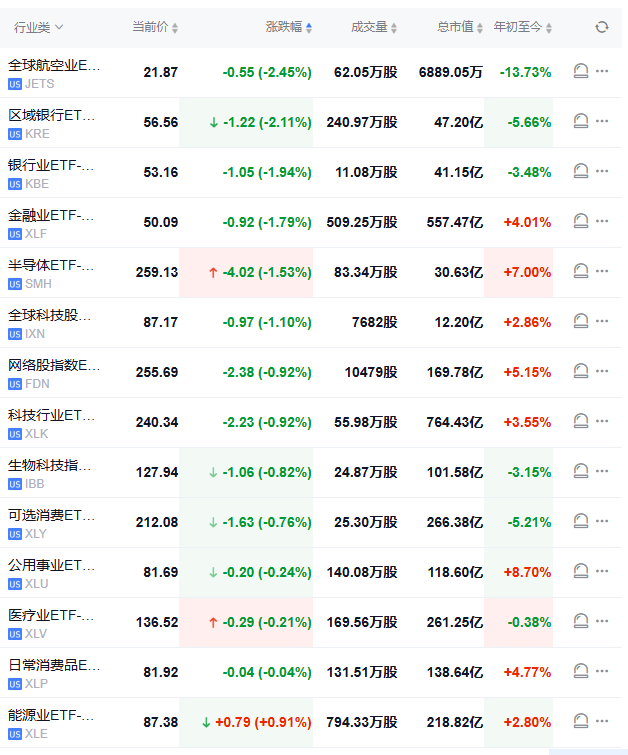
美股盘初,主要行业ETF多数下跌,全球航空业ETF、区域银行业ETF跌超2%,银行业ETF跌近2%。
news flash· 2025-06-13 13:57
Core Viewpoint - Major industry ETFs in the US are mostly down, with global airline and regional banking ETFs dropping over 2%, and banking ETFs nearly down 2% [1] Group 1: Industry Performance - Global airline industry ETF is priced at $21.87, down by $0.55 (-2.45%), with a trading volume of 620,500 shares and a year-to-date decline of 13.73% [2] - Regional banking ETF is priced at $56.56, down by $1.22 (-2.11%), with a trading volume of 2,409,700 shares and a year-to-date decline of 5.66% [2] - Banking ETF is priced at $53.16, down by $1.05 (-1.94%), with a trading volume of 110,800 shares and a year-to-date decline of 3.48% [2] - Financial sector ETF is priced at $50.09, down by $0.92 (-1.79%), with a trading volume of 5,092,500 shares and a year-to-date increase of 4.01% [2] Group 2: Other Sector Performance - Semiconductor ETF is priced at $259.13, down by $4.02 (-1.53%), with a trading volume of 833,400 shares and a year-to-date increase of 7.00% [2] - Global technology stock ETF is priced at $87.17, down by $0.97 (-1.10%), with a trading volume of 7,682 shares and a year-to-date increase of 2.86% [2] - Biotechnology index ETF is priced at $127.94, down by $1.06 (-0.82%), with a trading volume of 248,700 shares and a year-to-date decline of 3.15% [2] - Consumer discretionary ETF is priced at $212.08, down by $1.63 (-0.76%), with a trading volume of 253,000 shares and a year-to-date decline of 5.21% [2] - Energy sector ETF is priced at $87.38, up by $0.79 (+0.91%), with a trading volume of 7,943,300 shares and a year-to-date increase of 2.80% [2]