建材

Search documents
建筑建材双周报(2025年第13期):把握“基建回暖”与“反内卷”两条主线-20250730
Guoxin Securities· 2025-07-30 14:56
Investment Rating - The report maintains an "Outperform" rating for the construction and building materials sector, indicating expected performance above the market index by over 10% [5][79]. Core Views - The construction and building materials sector is expected to benefit from two main themes: "infrastructure recovery" and "anti-involution," leading to significant excess returns in recent times. The Ministry of Industry and Information Technology announced a new round of growth stabilization plans for key industries, including construction materials, which is anticipated to boost infrastructure investment and order recovery in the construction sector [1][3]. - The building materials sector is experiencing a structural improvement in supply and demand, driven by the "anti-involution" trend and expectations of stable growth, which are expected to resonate positively across various sub-sectors [1][3]. Summary by Sections Cement - National cement prices fell by 0.9% last week, with declines of 10-30 yuan/ton in regions like Jilin and Hunan. High temperatures and rainfall have weakened construction demand, leading to a drop in the average shipment rate to 43%. The sector faces significant inventory pressure and ongoing price declines [2][23]. Glass - The domestic float glass market showed signs of recovery, with prices increasing due to speculative demand and replenishment from downstream buyers. Inventory levels have decreased, alleviating some pressure in certain regions. The photovoltaic glass market also saw improved trading conditions, with a slight reduction in inventory [2][41]. Fiberglass - The price of non-alkali roving remained stable, while electronic yarn prices showed slight increases. The overall market demand remains weak, with transactions primarily based on need [2][47]. Investment Recommendations - The report suggests focusing on leading companies in the cement and glass sectors, such as Conch Cement, Huaxin Cement, and Qibin Group, as well as companies benefiting from structural demand in fiberglass, like China National Materials and China Jushi. The construction sector is expected to recover in the second half of the year, with recommendations for companies like China Railway Construction and China Communications Construction [3][12].
薛鹤翔:以史为鉴看“反内卷”对债市的影响——反内卷系列报告之六
Xin Lang Cai Jing· 2025-07-30 14:40
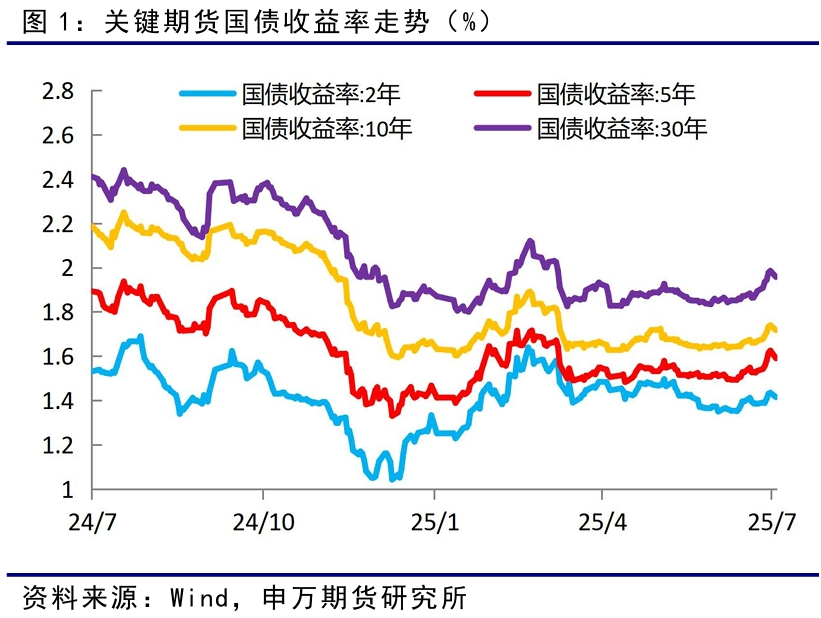
炒股就看金麒麟分析师研报,权威,专业,及时,全面,助您挖掘潜力主题机会! 7月份以来,各国债期货合约价格持续下跌,T2509合约下跌超过0.7%,10年期国债收益率从1.64%最高回升至1.73%上方,回升幅度超过9bp,创今年4月 份以来的新高,主要在反内卷政策驱动下,权益和商品同步走强,提升市场风险偏好,压制债市情绪,同时部分经济金融数据回升改善经济增长预期,美 联储降息时间推迟制约国内货币政策空间。 2015年11月中央财经领导小组会议首次提出供给侧结构性改革,并在当年中央经济工作会议确立"三去一降一补"五大任务,同时实施相互配合的五大政策 支柱。受供给侧结构性改革影响,煤焦钢矿等受影响较大相关期货品种,均于2015年11月见底回升,随后一年(2015年11月10日-2016年11月10日)涨幅 巨大,带动PPI同比降幅于2016年1月份加速收窄,至2016年9月份时转正,在2017年2月份创下本轮PPI同比的高点7.8%。CPI涨幅较为温和,从1.3%回升 至2.5%附近,总体保持在3%以内。但2015年11月至2016年底的债市行情并未明显受到供给侧结构性改革的影响,且在PPI降幅持续收窄甚至转正之 ...

债市基本面高频数据跟踪报告:水泥价格接近前低:2025年7月第4周
SINOLINK SECURITIES· 2025-07-30 14:22
1. Report Industry Investment Rating No relevant information provided. 2. Core Viewpoints of the Report The report analyzes the economic growth, inflation, and related market trends in July 2025, including production, demand, CPI, and PPI indicators, and points out the price changes and influencing factors of various products and industries [4]. 3. Summary According to the Table of Contents 3.1 Economic Growth: Cement Prices Approach Previous Lows 3.1.1 Production: Power Plant Daily Consumption Fluctuates at a High Level - Power plant daily consumption fluctuates at a high level. On July 29, the average daily consumption of 6 major power - generation groups was 882,100 tons, a 0.01% decrease from July 22. On July 22, the daily consumption of power plants in eight southern provinces was 2.18 million tons, a 4.0% decrease from July 15 [4][11]. - The blast furnace operating rate remains at a high level. On July 25, the national blast furnace operating rate was 83.5%, unchanged from July 18; the capacity utilization rate was 90.8%, a 0.1 - percentage - point decrease from July 18. On July 25, the blast furnace operating rate of steel mills in Tangshan was 92.0%, unchanged from July 18 [4][14]. - The tire operating rate shows weak and stable operation. On July 24, the operating rate of all - steel truck tires was 65.0%, a 0.1 - percentage - point decrease from July 17; the operating rate of semi - steel car tires was 75.9%, a 0.1 - percentage - point decrease from July 17. The operating rate of looms in the Jiangsu and Zhejiang regions declined moderately [4][16]. 3.1.2 Demand: Cement Prices Approach Previous Lows - The new - home sales in 30 cities turned negative month - on - month. From July 1 - 29, the average daily sales area of commercial housing in 30 large and medium - sized cities was 201,000 square meters, a 31.4% decrease compared to the same period in June, an 18.8% decrease compared to the same period in July last year, and a 34.7% decrease compared to the same period in July 2023 [4][22]. - The retail sales of the auto market are stable and relatively strong. In July, retail sales increased by 9% year - on - year, and wholesale sales increased by 17% year - on - year [4][23]. - Steel prices maintain resilience. On July 29, the prices of rebar, wire rod, hot - rolled coil, and cold - rolled coil increased by 2.1%, 0.8%, 0.9%, and 0.9% respectively compared to July 22 [4][30]. - Cement prices approach previous lows. On July 29, the national cement price index decreased by 1.6% compared to July 22, with prices in the East China and Yangtze River regions decreasing by 2.3% and 2.7% respectively [4][31]. - Glass prices corrected. On July 29, the active futures contract price of glass was 1,182 yuan/ton, a 1.7% decrease from July 22 [4][37]. - The container shipping freight index has declined for seven consecutive weeks. On July 25, the CCFI index decreased by 3.2% compared to July 18, and the SCFI index decreased by 3.3% [4][40]. 3.2 Inflation: Pig Prices Weaken 3.2.1 CPI: Pig Prices Weaken - Pig prices weaken. On July 29, the average wholesale price of pork was 20.5 yuan/kg, a 1.2% decrease from July 22 [4][46]. - The agricultural product price index fluctuates weakly. On July 29, the agricultural product wholesale price index decreased by 0.04% compared to July 22. By variety, eggs (+5.1%) > fruits (+1.7%) > mutton (+0.9%) > vegetables (+0.7%) > chicken (+0.4%) > beef (-0.02%) > pork (-1.2%) [4][50]. 3.2.2 PPI: Oil Prices Rise - Oil prices rise. On July 29, the spot prices of Brent and WTI crude oil were 71.6 and 69.2 dollars/barrel respectively, increasing by 2.2% and 6.0% compared to July 22 [4][53]. - Copper and aluminum prices decline. On July 29, the prices of LME 3 - month copper and aluminum decreased by 0.9% and 1.2% respectively compared to July 22 [4][58]. - The month - on - month increase of the domestic commodity index widens. On July 29, the Nanhua Industrial Products Index decreased by 0.8% compared to July 22, and the CRB index decreased by 0.3% [4][58]. - Most industrial product prices rise. Since July, most industrial product prices have increased, with wire rod, cement, and steam coal prices decreasing month - on - month, while other industrial product prices increasing month - on - month, with coking coal and coke having the largest increases. The year - on - year decline of most industrial product prices has narrowed [62].
7月政治局会议解读:立足当下,着眼长远
Yin He Zheng Quan· 2025-07-30 13:04
Economic Performance - The Politburo meeting affirmed the good performance of the economy in the first half of the year, with GDP growth reaching 5.3% year-on-year, exceeding market expectations[2] - The meeting emphasized the need to consolidate the economic recovery and address prominent issues in economic operations, such as insufficient effective demand and low price levels[2] Policy Direction - The meeting highlighted the importance of "bottom-line thinking" to safeguard domestic economic and social stability, prioritizing employment as a key policy goal[2] - It was stated that macro policies should continue to exert force and be implemented in a timely manner, with a focus on more proactive fiscal policies in the second half of the year[3] Monetary Policy - The monetary policy remains moderately loose, with expectations for 1-2 interest rate cuts in the second half of the year, totaling a reduction of 20-30 basis points[3] - The meeting indicated that structural monetary policy tools would be utilized to support technology innovation, boost consumption, and stabilize foreign trade, with a new focus on small and micro enterprises[3] Market Competition and Consumption - The meeting called for the promotion of a unified national market and the optimization of market competition order to eliminate disorderly competition[3] - Service consumption is emphasized as a new growth point, with per capita service consumption expenditure increasing by 4.9% year-on-year, accounting for 45% of total per capita consumption expenditure[3] Long-term Planning - The decision to hold the Fourth Plenary Session in October to formulate the "14th Five-Year Plan" proposal reflects a long-term strategic vision[2] - The "14th Five-Year Plan" is seen as crucial for achieving the long-term goal of socialist modernization, with a focus on new quality productivity and emerging pillar industries[4]
周期ETF单周吸金77亿元 机构:“反内卷”反转行情待验证
2 1 Shi Ji Jing Ji Bao Dao· 2025-07-30 11:09
Group 1 - The "anti-involution" policy is driving significant inflows into cyclical theme ETFs, with notable net inflows of over 18 billion yuan for Penghua Chemical ETF, 14 billion yuan for Guotai Steel ETF, and 13 billion yuan for GF Infrastructure 50 ETF from July 21 to July 29 [1][4] - The performance of cyclical theme ETFs has been outstanding, with rare earth ETFs and rare metals ETFs returning 42% and 36% year-to-date, respectively, leading the industry theme ETFs [1][3] - The recent market performance indicates a structural market shift, with traditional industries like coal and steel, as well as emerging sectors like photovoltaics and electric vehicles, benefiting from the "anti-involution" policy [1][7] Group 2 - Major industry indices such as steel, building materials, and non-ferrous metals have seen significant increases, with the steel index rising by 20.39% and the building materials index by 14.46% over the past month [2] - Several ETFs, including rare earth ETFs and steel ETFs, have shown impressive returns, with some rare earth ETFs exceeding 25% returns in the last month [3][4] - The "anti-involution" policy aims to optimize market competition and is expected to create a long-term mechanism for enterprise transformation, moving away from simple administrative interventions [5][6] Group 3 - The sustainability of the "anti-involution" market trend is still under observation, with analysts suggesting that if demand-side policies are insufficient, the current trend may only represent a temporary rebound [7] - The market performance will vary across sectors, with traditional industries like steel and coal having clearer capacity constraints, while emerging sectors like photovoltaics will need to demonstrate technological advancements [8] - Investment opportunities are identified in cyclical stocks at the bottom of their cycles, particularly in steel and cement, as well as in leading companies in chemical, non-ferrous, and machinery sectors that can benefit from improved industry dynamics [9][10]
金十期货整理 | “反内卷”预期推动大宗商品价格反弹,最近进展如何?(7月30日)
news flash· 2025-07-30 06:40
Group 1 - The Ministry of Industry and Information Technology (MIIT) proposed to strengthen the regulation of "involution" competition in the automotive industry to maintain a fair and orderly market environment [1] - The revised Anti-Unfair Competition Law will take effect on October 15, 2025, aiming to address issues of unfair competition [1] - The Central Economic Committee emphasized the need to govern low-price and disorderly competition in enterprises [1] Group 2 - The MIIT plans to introduce a growth stabilization plan for ten key industries, including steel, non-ferrous metals, petrochemicals, and building materials, focusing on structural adjustments and eliminating outdated production capacity [2] - A meeting was held to further regulate the competitive order in the new energy vehicle industry [2] - The National Energy Administration announced a verification of coal mine production due to disruptions caused by some companies exceeding announced production capacities [2] Group 3 - The Guangdong Paper Industry Association issued an initiative to resist low-price disorderly competition and maintain market fairness [3] - A national meeting emphasized the need to strengthen governance in key industries like photovoltaics and to enhance the national standard system in the industrial and information sectors [3] - The Political Bureau of the Central Committee highlighted the importance of promoting a unified national market and optimizing market competition order [3]
上交所:中国建材股份有限公司债券7月31日上市,代码243386
Sou Hu Cai Jing· 2025-07-30 06:16
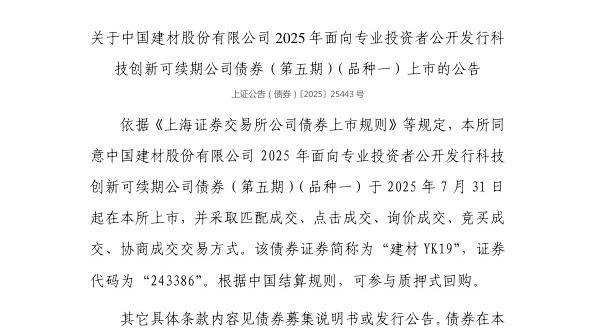
7月30日,上交所发布关于中国建材股份有限公司2025年面向专业投资者公开发行科技创新可续期公司 债券(第五期)(品种一)上市的公告。 依据《上海证券交易所公司债券上市规则》等规定,上交所同意中国建材股份有限公司2025年面向专业 投资者公开发行科技创新可续期公司债券(第五期)(品种一)于2025年7月31日起在上交所上市,并 采取匹配成交、点击成交、询价成交、竞买成交、协商成交交易方式。该债券证券简称为"建材 YK19",证券代码为"243386"。根据中国结算规则,可参与质押式回购。 来源:金融界 ...
6 月工业企业利润数据点评:中下游利润边际改善
Haitong Securities International· 2025-07-30 01:12
Profit Trends - In June, the decline in industrial enterprise profits narrowed, with a year-on-year decrease of -4.3%, an improvement of 4.8 percentage points from May's decline[3] - Cumulative profit growth for industrial enterprises from January to June was -1.8%, lower than the -1.1% recorded from January to May[3] Profit Margins and Industry Performance - The profit margin for June was 6.0%, showing a slight recovery from May, while the cumulative profit margin was 5.2%[6] - The automotive industry experienced the most significant profit recovery, benefiting from lower raw material prices and policy support[7] Demand and Inventory Dynamics - Industrial product inventory growth was 3.1% from January to June, indicating a passive destocking phase for enterprises[13] - Revenue growth for industrial enterprises in June was 1.6%, reflecting a slight recovery compared to the previous month[13] Future Outlook - Upcoming policies, including the "old-for-new" subsidy program, are expected to stimulate consumption and investment, potentially improving enterprise profits[17] - The "anti-involution" actions in various industries may help restore profit margins by reducing price competition[17] Risks - Uncertainties in trade relations and the effectiveness of policy measures such as "anti-involution" and "old-for-new" initiatives pose risks to profit recovery[18]
兴业期货日度策略-20250729
Xing Ye Qi Huo· 2025-07-29 12:51
1. Report Industry Investment Ratings - Index: Bullish [1] - Treasury Bonds: Sideways [1] - Gold: Sideways, with a bullish pattern for silver [4] - Non - ferrous Metals (Copper): Sideways [4] - Non - ferrous Metals (Aluminum and Alumina): Sideways for alumina, cautious and bearish short - term, long - term bullish for aluminum [4] - Non - ferrous Metals (Nickel): Sideways [4] - Lithium Carbonate: Sideways [6] - Silicon Energy: Sideways [6] - Steel and Ore (Threaded Steel): Bullish pattern [6] - Steel and Ore (Hot - Rolled Coil): Bullish pattern [6] - Steel and Ore (Iron Ore): Sideways pattern [7] - Coking Coal and Coke (Coking Coal): Sideways [7] - Coking Coal and Coke (Coke): Sideways [7] - Soda Ash/Glass (Soda Ash): Sideways pattern [7] - Soda Ash/Glass (Float Glass): Sideways pattern [7] - Crude Oil: Sideways [9] - Methanol: Bullish [9] - Polyolefins: Sideways [9] - Cotton: Sideways and bullish [9] - Rubber: Cautiously bullish [9] 2. Core Views of the Report - The overall upward trend of the stock index is clear, and there are opportunities to go long on dips; the bond market is affected by sentiment and the stock - commodity market, with reduced upward pressure but high uncertainty [1] - Gold is in a high - level sideways pattern, and silver has strong support. It is recommended to hold short - put option positions and go long on silver [4] - The copper market is affected by the US copper tariff policy, with high uncertainty and a sideways pattern [4] - Alumina is affected by sentiment in the short - term, with a medium - term surplus pattern; aluminum has clear supply constraints and a relatively stable long - term bullish strategy [4] - Nickel lacks directional drivers and is in a sideways pattern, and the short - call option position can be held [4] - The long - term logic of "anti - involution" in the steel and ore market remains valid, but short - term factors are differentiated. Each variety has different supply - demand situations and corresponding strategies [6][7] - The soda ash market has a supply surplus, and the glass market has a relatively better fundamental situation. It is recommended to hold the long - glass and short - soda ash strategy [7] - The crude oil market is affected by geopolitical factors, with a risk premium increase and a sideways pattern [9] - Methanol has price support, and it is recommended to sell put options [9] - Polyolefins have a low basis, and the futures may continue to fluctuate [9] - Cotton prices may fluctuate in a moderately bullish range before September - October [9] - Rubber is in a situation of both supply and demand increasing, with a sideways price trend [9] 3. Summaries According to Related Catalogs 3.1 Stock Index - On Monday, the A - share market had a narrow - range consolidation, with the ChiNext remaining strong and the trading volume slightly decreasing. The stock index futures were in a high - level consolidation, and the discount of IC and IM widened again [1] - The "anti - involution" sentiment in the market cooled down, and the market returned to a state of rapid sector rotation. The macro - level is affected by Sino - US economic and trade talks, and the fundamental long - term logic of corporate profit repair remains unchanged. The upward trend of the stock index is clear, and attention should be paid to the opportunity to go long on dips [1] 3.2 Treasury Bonds - The bond market rebounded across the board, and the upward pressure on the bond market decreased. The central bank made large - scale net injections, and the liquidity was abundant. The bond market is affected by sentiment and the stock - commodity market in the short - term, with high uncertainty [1] 3.3 Gold and Silver - Gold is in a high - level sideways pattern, lacking short - term drivers. If it pulls back to the lower edge of the operating range since June, short - term long positions can be considered. The gold - silver ratio continues to converge, and silver has strong price support. It is recommended to hold short - put option positions and go long on silver [4] 3.4 Non - ferrous Metals Copper - The Shanghai copper market is mainly affected by the US copper tariff policy. The medium - long - term supply of the mining end is tight, and the short - term import demand depends on policies. The market has high uncertainty and is in a sideways pattern [4] Aluminum and Alumina - Alumina is affected by sentiment in the short - term, with a medium - term surplus pattern. The short - term demand for aluminum is cautious, but the supply constraints are clear, and the long - term bullish strategy is relatively stable [4] Nickel - The supply of nickel has a tight situation in Indonesia's mines and abundant production capacity of nickel iron and intermediate products. The demand is in the off - season. The market "anti - involution" sentiment cooled down, and the nickel price lacks directional drivers, remaining in a sideways pattern. The short - call option position can be held [4] 3.5 Lithium Carbonate - The exchange adjusted the handling fee and daily opening limit, and the long - position sentiment in the lithium carbonate futures market weakened. The supply pattern has limited improvement, and there is still inventory accumulation pressure. Attention should be paid to the mining license approval results of key mines in Jiangxi in early August [6] 3.6 Silicon Energy - The silicon energy market has limited new orders for polysilicon, and downstream procurement is cautious. The industrial silicon market is mainly driven by polysilicon in the early stage, and the fundamental situation has not improved substantially, with the bullish sentiment fading [6] 3.7 Steel and Ore Threaded Steel - The spot price of threaded steel continued to decline, and the basis strengthened significantly. The regulatory tightening cooled the market, and the short - term supply contraction probability is low. The price has strong support, and it is recommended to hold the short - put option position [6] Hot - Rolled Coil - The spot price of hot - rolled coil continued to decline, and the basis also strengthened significantly. The short - term supply contraction probability is low. The price has support, and it is recommended to wait and see [6] Iron Ore - The short - term supply of iron ore is relatively stable, and the long - term price is under pressure. The 9 - 1 positive spread strategy can be patiently held, and the arbitrage opportunity of going long on coking coal and short on iron ore in the 01 contract can be grasped after the sentiment stabilizes [7] 3.8 Coking Coal and Coke Coking Coal - The exchange upgraded risk - control measures, and the coking coal futures price fell sharply. The supply tightening expectation exists, and the fundamentals support the price, but short - term unilateral participation requires caution [7] Coke - The coke spot market is bullish, but the futures price is affected by the decline of coking coal and shows a sideways decline [7] 3.9 Soda Ash and Glass Soda Ash - The soda ash market has a supply surplus, and the demand is affected by "anti - involution". The inventory decreased recently, and attention should be paid to the warehouse receipt pressure. It is recommended to wait and see for new orders and hold the long - glass and short - soda ash strategy [7] Float Glass - The glass market has a relatively better fundamental situation, with continuous inventory reduction. It is recommended to go long on dips or sell put options and hold the long - glass and short - soda ash strategy [7] 3.10 Crude Oil - Geopolitical factors have become the short - term focus of the market, and the risk premium has increased. The OPEC+ may increase production in September. The demand - side support has weakened, and the market is in a sideways pattern [9] 3.11 Methanol - The port inventory of methanol is expected to increase, and the start - up rate of northwest coal - chemical plants is expected to rise. The futures price is higher than the spot price, and it is recommended to sell put options [9] 3.12 Polyolefins - The basis of polyolefins is low, and the futures may pull back. In August, both supply and demand are expected to increase, and the futures will continue to fluctuate [9] 3.13 Cotton - The short - term supply of cotton is tight, and the demand is relatively stable. There is a possibility of additional quotas. Before September - October, the cotton price may fluctuate in a moderately bullish range [9] 3.14 Rubber - The port inventory of rubber is increasing again, and the supply and demand are both increasing. The price is in a sideways pattern, and attention should be paid to the production increase rate in Southeast Asian producing areas [9]
大宗商品:反转之后的博弈
对冲研投· 2025-07-29 12:04
Core Viewpoint - The recent market volatility is driven by intense corrections in speculation, raising questions about whether the current supply-side policy-driven rally has ended or is merely a "backward catch" opportunity [3][8]. Policy Analysis - The government has emphasized the need to combat deflation through supply-side policies, such as halting the addition of excess capacity and promoting domestic consumption. The scope of supply rationalization measures has expanded to include metals, petrochemicals, and industries like lithium and coal, which have reported supply disruptions [3][9]. - Historical responses to deflation have varied, with the current situation being unique due to the predominance of advanced capacity and the fragmented industrial landscape, alongside high government debt limiting fiscal space [3][9][10]. Commodity-Specific Insights - Lithium prices have rebounded but remain below marginal cash costs of $11,500/ton, with approximately 45% of global capacity unable to cover cash costs at a price of $9,000/ton. This suggests limited downside potential for prices [4][13]. - Recent compliance checks in the lithium sector may lead to short-term supply disruptions, with around 20,000 tons of lithium capacity facing compliance risks, potentially resulting in significant inventory depletion and price rebounds [14]. - In the coal sector, production inspections are focused on preventing overproduction, with expectations of moderate impacts. However, recent price declines may limit further downside [5][15]. Agricultural Sector Developments - The hog farming industry is actively responding to regulatory controls by reducing breeding sow inventories and adjusting market weights, which may support near-term price stability and long-term valuation increases [6][16]. Market Trends and Expectations - The bond market reflects expectations of prolonged deflation, with government policies aimed at supply-side constraints potentially boosting industrial prices and improving upstream profits. This may reduce the urgency for monetary easing [6][17]. - The recent surge in government infrastructure investment, such as the $1.2 trillion Tibet dam project, has also contributed to supply concerns and influenced market dynamics [6][17].