Qi Huo Ri Bao

Search documents
“收储”无实质性进展 多晶硅价格涨不动了?
Qi Huo Ri Bao· 2025-11-10 00:15
Core Viewpoint - The photovoltaic market is experiencing a weak supply and demand situation, leading to a decline in polysilicon futures prices despite ongoing discussions about "stockpiling" policies [2][3][4]. Group 1: Market Dynamics - As of November 7, polysilicon futures for the main contract closed at 53,215 yuan/ton, reflecting a weekly decline of 5.51% [2]. - The repeated announcements regarding "stockpiling" have diminished their impact on the market, with analysts noting that the lack of substantial progress has led to a reversion to fundamental trading [2][4]. - The current market structure is characterized by weak fundamentals driving prices down, while expectations of "stockpiling" are exerting upward pressure [4]. Group 2: Supply and Demand Analysis - The polysilicon market is facing a dual weakness in supply and demand, with supply expected to decrease by 12.4% due to maintenance by two major producers [3]. - Demand is also weak, with November's production of silicon wafers and battery cells projected to decline, resulting in a year-on-year decrease in photovoltaic installations of 53.75% [3]. - Current polysilicon inventory stands at a high of 301,000 tons, indicating an ongoing oversupply situation [3]. Group 3: Future Outlook - Analysts suggest that if the "stockpiling" initiative does not progress, polysilicon prices will remain under downward pressure due to high inventory and weak demand [4]. - The future price trajectory of polysilicon will depend on the resolution of funding issues related to the "stockpiling" initiative and the ability of silicon material companies to control prices [4]. - Until there is substantial progress on "stockpiling," polysilicon prices are expected to fluctuate within a high range [4].


“收储”无实质性进展,多晶硅价格涨不动了?
Qi Huo Ri Bao· 2025-11-09 23:48
Core Viewpoint - The photovoltaic market is experiencing a weak supply and demand situation, leading to a decline in polysilicon futures prices despite ongoing discussions about "stockpiling" policies [1][2][3] Group 1: Market Dynamics - As of November 7, polysilicon futures for the main contract closed at 53,215 yuan/ton, reflecting a weekly decline of 5.51% [1] - The repeated announcements regarding "stockpiling" have diminished their impact on the market, with analysts noting that the lack of substantial progress has led to a reversion to fundamental trading [1][2] - The current market is characterized by weak fundamentals, with polysilicon prices unable to sustain high premiums due to insufficient support from the spot market [1][2] Group 2: Supply and Demand Analysis - The polysilicon market is facing a dual weakness in supply and demand, with supply expected to decrease by 12.4% due to maintenance by two major producers [2] - Demand is also weak, with a reported 53.75% year-on-year decline in photovoltaic installations, contributing to inventory pressures [2] - Current polysilicon inventory stands at a high of 301,000 tons, indicating an ongoing oversupply situation [2] Group 3: Future Outlook - Analysts are divided on the future of polysilicon prices, with some suggesting that if "stockpiling" funding issues are resolved, prices could stabilize or increase [3] - Conversely, if no substantial progress is made on "stockpiling," prices are likely to remain under pressure due to high inventory and weak demand [3] - The key factors influencing future price movements will be component prices and overall demand in the market [3]
降息,突变!白宫发出警告!美政府“停摆”有望结束?
Qi Huo Ri Bao· 2025-11-09 23:45
Group 1: Federal Reserve and Interest Rates - The core prediction from Bank of America is that the Federal Reserve will not lower interest rates again during Powell's term, which ends in May 2026 [1][2] - The Federal Funds Rate is expected to remain in the range of 3.75% to 4.0% until the second half of 2026, when a new chair may initiate rate cuts [2] - Powell's cautious remarks after the October rate cut indicate that the threshold for a December rate cut has been raised, requiring data to justify such a move [1][2] Group 2: Economic Impact of Government Shutdown - The ongoing government shutdown has lasted for 40 days, with estimates suggesting it has reduced the U.S. GDP by 1.5% [2] - If the shutdown continues, it could negatively impact consumer spending during the upcoming holiday season, potentially leading to a contraction in Q4 economic growth [2] - Treasury Secretary has indicated that prolonged shutdown could halve the economic growth forecast for Q4 [2] Group 3: Market Reactions and Predictions - The market is currently in a "data vacuum" due to the delay in key economic data releases, such as the October CPI [1] - Alternative data suggests a cooling labor market without severe deterioration, providing the Fed with justification to pause rate cuts [1] - The probability of a 25 basis point rate cut in December is estimated at 66.5%, while the likelihood of maintaining current rates is 33.5% [3] Group 4: Silicon Market Dynamics - The photovoltaic market is experiencing weak supply and demand dynamics, with multi-crystalline silicon prices under pressure [7][8] - Current inventory levels for multi-crystalline silicon are high at 301,000 tons, indicating an oversupply situation [8] - Analysts suggest that without substantial progress on "stockpiling" initiatives, prices will remain under pressure due to weak demand and high inventory levels [9]
“今日提价”!多家企业发函,双焦期价要涨?
Qi Huo Ri Bao· 2025-11-09 23:40
Core Viewpoint - Multiple coking enterprises have announced price increases, marking the fourth round of price hikes due to rising coking coal prices and increasing losses among coking companies [1][4]. Group 1: Price Increases - Coking enterprises have implemented three previous price increases, with the latest increase set to take effect on November 10, 2025, raising wet quenching coke prices by 50 yuan per ton and dry quenching coke prices by 55 yuan per ton [3]. - Analysts predict that there could be 4 to 5 rounds of price increases in the fourth quarter, driven by the need to restore profits amid rising coking coal prices [4]. Group 2: Supply and Demand Dynamics - The current supply of coking coal and coke is tight, with downstream procurement being active, leading to a short-term supply-demand imbalance [4]. - As of October, both coking coal and coke inventories have decreased, with total social inventory of coke down by 2% year-on-year and coking coal down by 5% year-on-year [4]. Group 3: Production Challenges - Certain coal mines in Shanxi have reduced production due to safety issues, and there is a significant decrease in output from open-pit coal mines in Inner Mongolia [5]. - The operating rate of domestic coking coal mines continues to decline, and strict safety and environmental inspections are expected to limit recovery in coal production [5]. Group 4: Market Outlook - The futures market for coking coal and coke is experiencing high volatility, with differing opinions on future trends among industry experts [6]. - The market is currently characterized by a balance between supply and demand, but potential negative feedback from steel demand could impact future pricing [7].

【大宗周刊】依托河南临港产业规划,打造大宗商品交易平台
Qi Huo Ri Bao· 2025-11-09 23:22
Core Insights - The construction of a bulk commodity trading platform is essential for enhancing the service capabilities of ports and activating the development of the port industry [4][6][12] - The central government has issued a directive to support the establishment of bulk commodity trading centers, which is expected to elevate the industrial scale and service level in regions like Henan [1][2] Group 1: Importance of Bulk Commodity Trading Platforms - The trading platform can facilitate large-scale distribution of bulk commodities at ports, directly boosting related industries such as loading, storage, and logistics [4][6] - By integrating trading, information, storage, and logistics services, the platform can significantly improve resource allocation efficiency and help enterprises reduce costs and increase efficiency [4][6] - The platform aims to create a comprehensive market structure that enhances the stability and resilience of the bulk commodity supply chain through digital collaboration [3][4] Group 2: Development Plans and Strategies - The "1+6+N" development system proposed in the development plan includes one leading industry (port logistics) and six categories of manufacturing industries [2][3] - Specific deployments for the bulk commodity market include establishing trading bases for various commodities and creating a professional trading market [3][4] - The plan emphasizes the need for a multi-layered bulk commodity market system to optimize market structure and strengthen risk hedging mechanisms [3][4] Group 3: Regional Collaboration and Infrastructure - The development of a digital trading platform is seen as a core engine for transitioning from isolated breakthroughs to comprehensive regional collaboration [6][12] - The integration of logistics networks and the establishment of a cross-regional resource allocation mechanism are crucial for enhancing market depth and efficiency [6][12] - The opening of new inland ports and the establishment of specialized logistics solutions are expected to significantly reduce transportation costs and improve logistics efficiency [12][13] Group 4: Future Outlook - The focus on building a comprehensive bulk commodity trading platform is a key task for Henan in the near future, aiming to transition from single-category to multi-category trading [12] - The integration of smart ports and digital trading platforms is anticipated to drive the transformation of the port industry towards higher value-added services [13][14] - The strategic development of an inland port economy is expected to position Henan as a core hub in the national unified market, enhancing its role in both domestic and international trade [12][13]

俄乌突发,大规模空袭!谈判进展有限,美政府继续“停摆”!分析人士:油价大概率震荡下行
Qi Huo Ri Bao· 2025-11-08 23:41
Group 1: Oil Market Dynamics - The international oil market experienced fluctuations this week, initially rising before declining due to various factors including geopolitical tensions and economic data [7][8] - WTI crude oil futures for December increased by 0.69% to $59.84 per barrel, while Brent crude oil futures for January rose by 0.50% to $63.70 per barrel, despite a weekly decline of 1.87% and 1.65% respectively [7] - The market is currently facing concerns over oversupply, exacerbated by a significant increase in EIA inventory and a prolonged U.S. government shutdown impacting demand [8][10] Group 2: Geopolitical Events Impacting Oil Supply - Russia launched a large-scale missile and drone attack on Ukraine, targeting energy and transportation infrastructure, which has implications for oil supply stability in the region [1] - This attack marks the ninth major assault on Ukraine's energy infrastructure since October, leading to emergency power outages and damage to facilities responsible for gas and heating supply [1] - Analysts suggest that geopolitical conflicts, particularly involving Russia, could significantly influence oil prices if they lead to supply disruptions [10] Group 3: Inventory and Demand Trends - U.S. commercial crude oil inventories rose unexpectedly to 421.2 million barrels, reflecting a 1.25% increase, indicating weak demand [8] - Seasonal reductions in refinery processing rates are contributing to lower oil consumption, with the current processing rate at 15.256 million barrels per day, remaining in a low range for the year [8] - In Singapore, fuel oil inventories surged by 1.754 million barrels, a 7.6% increase, driven by a significant rise in import volumes, suggesting a growing supply glut [9]
知名棉企15亿元风险对冲计划的背后:价格显著波动下的必然选择
Qi Huo Ri Bao· 2025-11-08 23:40
Core Viewpoint - The announcement of a hedging plan by Xinjiang Saimu Modern Agriculture Co., Ltd. (referred to as XinSai) highlights the cotton spinning industry's struggle for survival amid price volatility, with a total hedging plan amounting to up to 1.5 billion yuan [1][3]. Summary by Sections Hedging Strategy - XinSai plans to seek shareholder approval for its subsidiary to engage in futures and options hedging, with a maximum margin requirement of 800 million yuan for futures and 700 million yuan for options [1][3]. - The move is seen as a typical response from the cotton spinning and agricultural processing industry to manage price volatility risks [3]. Industry Context - The company faces significant challenges in raw material procurement, cost management, and product sales due to fluctuations in the commodity market [3]. - XinSai's projected net loss of 244 million yuan for 2024 underscores the pressure the company is under [3]. Peer Actions - Other companies in the industry, such as Guannong Co., are also taking steps to stabilize operations through hedging, with plans to utilize up to 485.6 million yuan for hedging activities in 2025 [4]. - Guannong's successful past hedging practices demonstrate the value of such strategies in managing price risks [4]. Market Dynamics - The complexity and uncertainty in the macroeconomic and industry environment are driving companies to invest heavily in risk management [6][7]. - Factors such as changes in cotton planting subsidy policies and the competitive landscape in the textile sector are contributing to increased sensitivity to raw material cost fluctuations [7][8]. Evolving Risk Management Tools - The announcement from XinSai indicates a shift towards using both options and futures as part of a comprehensive risk management strategy, with a focus on non-linear risk management tools [10]. - The use of options allows companies to lock in minimum sales prices or control maximum procurement costs, providing flexibility in risk management [10]. - The trend towards more sophisticated and professional risk management practices reflects the modernization of agricultural enterprises in China [10].

海关总署发布两则公告,事关进口美国原木和大豆
Qi Huo Ri Bao· 2025-11-07 17:51
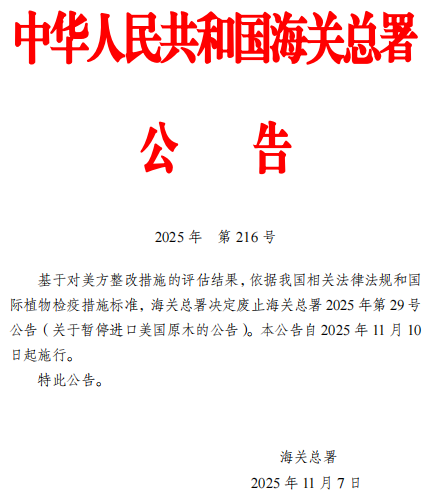
Group 1 - The General Administration of Customs of China announced the repeal of the suspension on the import of U.S. logs, effective from November 10, 2025, based on an assessment of U.S. corrective measures [1] - The General Administration of Customs also announced the repeal of the suspension on the soybean import qualifications of CHS Inc. and two other companies, effective from November 10, 2025, following the evaluation of U.S. corrective measures [3]
聚焦“破壁·立标·赋能”,虹桥论坛共商绿色贸易自由化全球行动
Qi Huo Ri Bao· 2025-11-07 07:51
Core Viewpoint - The global green transition is irreversible, and there is a need to oppose unilateralism and "green protectionism" while promoting a collaborative and fair global governance framework to facilitate the free flow of green trade [1][2]. Group 1: Challenges in Global Green Trade - The urgency of addressing climate change and the significant market potential of green industries are driving strong trade demand, but fragmented green standards and unilateral measures like carbon tariffs are creating new trade barriers [1][2]. - Trade protectionism is identified as the biggest obstacle to green development, with the fragmentation of global green trade rules raising concerns about increased trade costs and uncertainties [3][4]. Group 2: International Cooperation and Standards - There is a consensus that countries lack sufficient agreement and clarity on rules regarding green transition and international cooperation, necessitating the sharing of China's green development experience and technology globally [2][4]. - The establishment of a collaborative governance mechanism involving governments, enterprises, and international organizations is essential to address the challenges posed by fragmented rules [5]. Group 3: Corporate Initiatives and Innovations - Multinational companies emphasize that technological innovation and collaboration across the entire industry chain are fundamental to breaking down barriers and achieving green development [5][6]. - Companies like BMW and Cargill are actively working on creating transparent green rules and standards, with Cargill focusing on sustainable agricultural practices and BMW advocating for comprehensive carbon footprint assessments [5][6]. - Chinese private enterprises are also taking significant steps in promoting green practices abroad, such as replacing fuel vehicles with electric ones in Africa and supporting local supply chains [6].
资金面转松 稳定债市预期
Qi Huo Ri Bao· 2025-11-07 07:47
图为十债主力合约日线 11月4日,美国国会参议院再次未能通过联邦政府临时拨款法案。美国国会预算办公室称,此次"停摆"可能使美国第四季度经济增速降低多达2个百分点。若 僵局延续至感恩节当周,约140亿美元的经济损失将彻底无法挽回。不过美国10月ADP就业人数增加4.2万人,大幅超过预期,ISM服务业PMI上升2.4点至 52.4,也创8个月新高。10月底美联储如期降息25个基点后,美联储主席鲍威尔表示,12月是否进一步降息"远非已成定局",加上偏强的就业和服务数据, 12月美联储降息概率下降,美债收益率回升。 预计央行将保持支持性的货币政策,后续国债买卖等操作将进一步加大,市场资金面处于合理充裕水平。 11月份以来,国债期货价格维持震荡,10年期国债收益率维持在1.8%附近。 央行发布的各项工具流动性投放情况显示,10月份公开市场国债买卖净投放200亿元,表明今年1月份以来暂停的国债买卖操作已恢复。同时,央行于11月5 日开展7000亿元3个月期买断式逆回购操作,有利于向市场投放长期流动性,稳定市场预期。 从市场资金利率看,最新DR007和Shibor1周利率分别为1.4378%和1.421%,较10月末分别回 ...