
Qi Huo Ri Bao

Search documents
2026年“两新”政策部署发布
Qi Huo Ri Bao· 2025-12-31 02:19
据新华社电 国家发展改革委、财政部印发的《关于2026年实施大规模设备更新和消费品以旧换新政策 的通知》30日对外发布,明确2026年"两新"政策的支持范围、补贴标准和工作要求。2026年"两新"政策 主要做了3个方面优化。 一是优化支持范围。设备更新方面,总体延续2025年支持范围,在民生领域增加老旧小区加装电梯、养 老机构设备更新,在安全领域增加消防救援、检验检测设备更新,在消费基础设施领域增加商业综合 体、购物中心、百货店、大型超市等线下消费商业设施的设备更新。消费品以旧换新方面,进一步集中 资源,着力提升覆盖人群广、带动效应强的重点消费品"得补率"。继续实施汽车报废更新和汽车置换更 新补贴;继续实施家电以旧换新补贴,支持范围聚焦冰箱、洗衣机、电视、空调、电脑、热水器等6类 产品;同时,将数码产品购新补贴拓展为数码和智能产品购新补贴,支持范围包括手机、平板、智能手 表(手环)、智能眼镜和智能家居产品(含适老化家居产品)。 通知要求,国家发展改革委发挥"两新"部际联席会议制度牵头部门作用,会同财政部安排超长期特别国 债资金实施"两新"政策,加强统筹协调和跟踪调度。 二是优化补贴标准。设备更新方面,将住宅老 ...
分析人士:贵金属基本面仍偏强
Qi Huo Ri Bao· 2025-12-31 01:40
Core Viewpoint - The recent decline in precious metal prices is attributed to a technical correction following a strong prior rally, compounded by multiple macroeconomic and geopolitical negative factors, particularly during the low liquidity period of the Christmas holidays in Europe and the U.S. [1] Group 1: Price Movements - As of December 30, domestic precious metal futures prices collectively fell, with the main gold contract down 3.11% and the main silver contract down 3.96%, while platinum and palladium futures hit their daily limit down [1] - The sharp decline in precious metal prices is seen as a correction of previous over-expectations regarding U.S. fiscal and monetary policies [2] - Platinum prices surged over 30% in the previous week, leading to significant profit-taking and increased volatility in the short term [2] Group 2: Market Influences - The expectation of a new Federal Reserve chair aligning with President Trump's fiscal policies is influencing market sentiment, with potential for accelerated interest rate cuts [4] - Global central banks are reducing U.S. Treasury holdings while increasing gold reserves, which directly supports higher precious metal prices [4] - The industrial demand for silver remains strong due to its support from the photovoltaic industry, while platinum and palladium face declining demand from the automotive sector [4] Group 3: Future Outlook - Despite the recent price corrections, the long-term outlook for precious metals remains positive, driven by expectations of continued Federal Reserve rate cuts [4] - The upcoming announcement of the new Federal Reserve chair and the pace of interest rate cuts will be critical factors to monitor [4] - The introduction of new regulations in India regarding silver collateral may impact international silver supply dynamics in the first quarter of the following year [5]
镍 底部特征显现
Qi Huo Ri Bao· 2025-12-31 01:25
Core Viewpoint - The nickel market is currently facing a supply expansion cycle, with production growth significantly outpacing demand, leading to concerns about supply contraction and rising costs, particularly influenced by policy changes in Indonesia [1][3][4]. Group 1: Market Dynamics - Nickel prices have recently declined, reaching a new low since 2021 in late October, while other metals like copper and aluminum have seen price increases, indicating a divergence in the market [1]. - The overall nickel market is experiencing a significant increase in production, with domestic output expected to reach approximately 360,000 tons from January to November 2025, representing a year-on-year growth of 19.34% [2]. - Global visible nickel inventories have surpassed 310,000 tons, with an increase of over 100,000 tons throughout the year, indicating high inventory levels [2]. Group 2: Cost and Pricing Pressure - Nickel prices have fallen below the cost of purchasing raw materials and some integrated processes, leading to a lack of strong cost support at current price levels [2]. - The lowest production costs in the industry continue to decline, anchoring market prices to these lower levels amid an oversupply situation [2]. Group 3: Policy Variables - Indonesia, the largest global supplier of nickel, has indicated potential significant changes in mining quotas and taxation that could impact future supply [3]. - The Indonesian Nickel Miners Association (APNI) has reported a proposed reduction in the mining output target for 2026 to approximately 250 million tons, down from 379 million tons in 2025 [3]. - Proposed adjustments to pricing and tax rules in Indonesia could increase mining costs, as cobalt and other by-products may be treated as independent commodities subject to royalties [3]. - The market is highly sensitive to any potential supply contraction from Indonesia, which could lead to a rapid price rebound based on rising cost expectations [3]. Group 4: Future Outlook - The potential for further declines in nickel prices appears limited, with a preliminary establishment of a phase bottom, heavily reliant on the final outcomes of Indonesia's mining quota approvals and tax policy implementations [4].
物产中大期货:铁矿石价格韧性十足
Qi Huo Ri Bao· 2025-12-31 00:36
Core Viewpoint - Despite the global mining capacity entering an expansion cycle and China's port iron ore inventory reaching historical highs, iron ore futures prices remain resilient at high levels, indicating a divergence between long-term expectations and short-term realities [1] Inventory Levels - Although the total port iron ore inventory is at a historical high, the inventory structure is severely differentiated, leading to a "loose total, tight structure" scenario [2] - The differentiation in varieties exacerbates structural contradictions, with Brazilian ore inventory being high while Australian ore inventory is generally low, particularly for certain grades like PB powder, which is at a low level [2] - Steel mills are currently shifting towards purchasing lower-grade Australian ore due to profit fluctuations, which has led to a structural supply shortage and sustained increases in spot prices [2] - The low inventory levels at steel mills reinforce the demand for replenishment, providing solid short-term buying support for iron ore prices [2] Mining Profits - Iron ore, as a crucial industrial raw material, follows the logic of "demand determines direction, supply determines elasticity" [3] - China's iron ore demand remains strong, with cumulative pig iron production increasing by approximately 24.5 million tons year-on-year, leading to an estimated increase in iron ore demand of about 39.2 million tons [3] - The global iron ore supply is characterized by an oligopolistic structure, with four major mining companies controlling nearly half of the production and over 70% of the trade volume [3] - This asymmetric structure allows mining companies to maintain high profits even during industry downturns, contributing to the long-term price resilience of iron ore [3] Steel Mill Replenishment - The specific participant structure in the futures market further solidifies the strong price trend of iron ore, with foreign institutions holding significant long positions that influence market sentiment and price movements [4] - The persistent backwardation in iron ore futures creates an inherent attractiveness for long positions, providing stable support for prices [4] - Historical trends indicate that significant price declines in iron ore are typically driven by demand contractions rather than supply increases, which are often fully priced in by the market [4] Overall Market Dynamics - Supply growth is a long-term slow variable with limited short-term impact on iron ore prices; the main contradictions currently lie in demand and inventory structure [5] - In the short term, due to the current structural contradictions in inventory and the seasonal replenishment phase for steel mills, there is still potential for slight price increases [5] - However, as supply continues to increase and replenishment ends, along with the current low profitability of steel mills, iron ore may face downward pressure if production recovery in Q1 next year does not meet expectations [5] Future Focus - Two key variables to monitor are the changes in domestic steel mill production rhythms and the actual production and shipping progress of the West Mangdu project, which could be critical drivers in breaking the current price stalemate [6]

单月每吨上涨近千元!强预期下 棉花行情能走多远?
Qi Huo Ri Bao· 2025-12-31 00:22
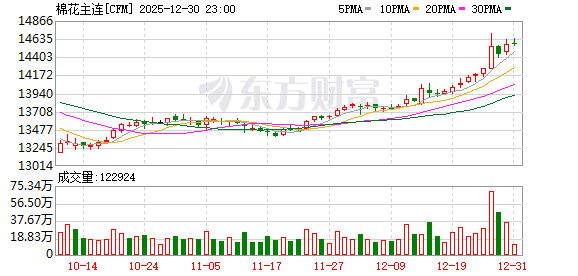
Core Viewpoint - The cotton futures market is experiencing a strong rally, with the main contract in Zhengzhou breaking through key resistance levels, showing a nearly 1,000 yuan per ton increase since December, significantly outperforming U.S. cotton and becoming a focal point in the commodity market [2] Group 1: Market Dynamics - The recent price increase in Zheng cotton is driven by strong expectations of reduced cotton production in the new year, which has been gradually confirmed by recent developments [2] - The Xinjiang Cotton Association indicated that the cotton planting area in Xinjiang may face structural reductions in 2026, which is expected to influence the domestic cotton supply landscape long-term [2] - The current supply-demand balance in the cotton market is tight, with a notable decrease in import ratios and low carryover stocks, maintaining a robust long-term fundamental outlook [3] Group 2: Demand Factors - The resilience of demand in the cotton market is a significant driver of the current price trend, supported by retail sales data and operational rates of midstream textile enterprises [3] - In November, retail sales of clothing, shoes, hats, and textiles reached 154.2 billion yuan, reflecting a year-on-year increase of 3.5%, indicating stable demand in the cotton textile industry [3] Group 3: Price Pressures and Market Sentiment - The market is characterized by a coexistence of strong expectations and weak realities, with rising cotton prices exceeding processing costs for ginning factories, leading to some hedging pressure [4] - The seasonal off-peak period is affecting downstream cotton yarn prices, which are struggling to keep pace with rising cotton prices, potentially impacting profit margins for yarn manufacturers [4] - The price disparity between Zheng cotton and U.S. cotton is widening, with U.S. cotton prices remaining stagnant due to a lack of sufficient drivers, although there are concerns about indirect impacts from imported cotton yarn on domestic consumption [4] Group 4: Future Outlook - The cotton import volume remains at historical lows, with a 67.5% year-on-year decrease expected for the 2024/2025 season, which is unlikely to alter the domestic supply structure significantly [5] - Short-term cotton futures are expected to maintain a strong oscillating trend, driven by a combination of strong expectations and realities, reducing the likelihood of a shift to bearish sentiment [5] - The cotton subsidy policy is increasingly favoring high-quality cotton, with expectations for adjustments in the target price subsidy policy in 2026, which could further support cotton prices [5] - Overall, short-term market optimism is likely to persist, with medium to long-term projections indicating potential upward price movement supported by supply reduction expectations and resilient demand [5]

2026年纯碱基本面或延续供强需弱格局 价格中枢或小幅下移
Qi Huo Ri Bao· 2025-12-31 00:20
Core Viewpoint - The soda ash industry is expected to continue its bearish trend in 2025 and 2026, characterized by high supply, high inventory, and low valuations, with prices likely to decline further due to weak demand and high inventory pressure [1][2]. Supply Pressure - The soda ash industry experienced high profitability from 2021 to 2023, with profits reaching 2000 yuan/ton, leading to increased operating rates and new capacity investments. However, this has resulted in a rapid transition to a bearish market [2]. - In 2025, domestic soda ash production capacity is expected to increase by 5.9 million tons, a growth rate of approximately 15%, significantly higher than in 2024. From 2023 to 2025, nearly 14 million tons of new capacity will be added, representing a cumulative increase of about 40% [2]. - For 2026, new capacity investments are expected to decrease significantly, with only a few projects coming online, which will have limited impact on supply during the year [2][3]. Demand Trends - Domestic soda ash demand is projected to decline for the first time in five years in 2025, with a decrease of approximately 90,000 tons to 35.36 million tons, a decline of about 0.3% [4]. - In 2026, total soda ash demand is expected to remain stable, with light soda demand slightly increasing and heavy soda demand slightly decreasing. The increase in light soda demand is primarily driven by the growth in lithium carbonate production [5]. - Heavy soda demand is anticipated to decrease significantly in 2026, with a projected reduction of about 400,000 tons due to pressures in the real estate and photovoltaic industries [6]. Export Dynamics - In 2025, domestic soda ash exports surged while imports dropped significantly, with exports increasing by 88.8% to 1.961 million tons and imports falling by 97.7% to 22,000 tons [7]. - The average export price for soda ash was approximately 1,331 yuan/ton, while the import price was around 1,819 yuan/ton, leading to a near-zero import volume due to price differentials [7]. - The soda ash export volume is expected to reach historical highs in 2026, with projections of 2.19 million tons, driven by increased demand from Southeast Asia and Africa [8].
我国关税调整方案明日起实施 商品影响几何?
Qi Huo Ri Bao· 2025-12-31 00:18
Group 1: Import Tariff Adjustments - The State Council Tariff Commission announced adjustments to import tariffs for steel, coal, non-ferrous metals, cotton, and urea effective January 1, 2026 [1] - The total import quota for cotton in 2026 is set at 894,000 tons, with a low tariff rate of 1% for quota imports [3][4] - The sliding tax mechanism for cotton imports will help stabilize domestic market prices by adjusting costs based on import prices [4] Group 2: Impact on Cotton Industry - The adjustment in cotton planting area in major production regions like Xinjiang is expected to draw significant market attention [4] - The new quota application process allows companies to apply for quotas throughout the year, enhancing flexibility [4] - The focus on stabilizing cotton prices and protecting domestic farmers' interests is emphasized through the sliding tax mechanism [4] Group 3: Steel and Coal Industry - The tariff adjustments for steel and coal products remain largely unchanged from 2025, with zero import tax on recycled steel materials [5][6] - China's crude steel production reached 892 million tons in the first eleven months of the year, accounting for 54% of global output [6] - Steel exports hit a record high of nearly 11 million tons, while imports decreased significantly [6][7] Group 4: Urea and Fertilizer Industry - The import tax rate for urea and other fertilizers remains at 1%, supporting food security and stabilizing agricultural production costs [9][10] - The domestic urea production capacity exceeds 70 million tons, indicating self-sufficiency and minimal reliance on imports [11] - The low tax rate is expected to enhance supply flexibility and stabilize market prices, ensuring agricultural production stability [12] Group 5: Non-Ferrous Metals - The import tariffs for copper and aluminum products remain unchanged, reflecting a strategy to ensure stable raw material supply for domestic industries [14] - The focus is on maintaining supply chain security and supporting high-quality domestic industrial development [14] - The cancellation of temporary tax rates on certain products indicates a shift towards more stable tariff policies [15]
镍价底部特征显现 关注印尼镍矿配额审批最终结果
Qi Huo Ri Bao· 2025-12-31 00:06
Core Viewpoint - The nickel market is currently facing a supply expansion cycle, with production growth significantly outpacing demand, leading to concerns about supply contraction and rising costs. Nickel prices have reached a new low since 2021, but the potential for further declines is limited, indicating a possible formation of a temporary bottom [1][4]. Group 1: Market Conditions - The recent divergence in the non-ferrous metals market shows copper and aluminum prices reaching new highs, while nickel continues to weaken, primarily due to its cyclical challenges and policy disruptions from key producing regions [1]. - Nickel production in China is projected to reach approximately 360,000 tons from January to November 2025, reflecting a substantial year-on-year increase of 19.34%. This is coupled with relatively slow growth in downstream demand, resulting in a significant accumulation of global nickel inventory, which has exceeded 310,000 tons by early December, marking an increase of over 100,000 tons for the year [2]. Group 2: Cost Dynamics - Nickel prices have fallen below the cost line for purchasing raw materials and certain integrated processes. However, the industry's minimum production costs continue to decline, leading the market to anchor around these lower costs, which diminishes strong cost support at current price levels [2]. Group 3: Policy Variables - Indonesia, the world's largest nickel supplier, has signaled potential changes that could significantly impact future supply. The Indonesian Nickel Miners Association (APNI) has indicated that the mining quota for 2026 may be drastically reduced to approximately 250 million tons, down from 379 million tons in 2025 [3]. - Additionally, the Indonesian government plans to revise the pricing and tax rules for nickel, which will increase mining costs by treating cobalt and other associated minerals as independent commodities subject to royalties. This could lead to a supply gap if the mining quotas are implemented as planned, thereby raising costs across the industry [3]. - The market is highly sensitive to any potential supply contraction, especially after significant price adjustments and valuation compressions, leading to a rapid price rebound based on expectations of rising costs [3]. Group 4: Future Outlook - The future trajectory of nickel prices will heavily depend on the final outcomes of Indonesia's mining quota approvals and the specific implementation of related tax policies [4].
126个交易日,用1035元实现近170倍的收益,老铁们算算赚了多少
Qi Huo Ri Bao· 2025-12-30 23:44
Core Insights - The article highlights the remarkable achievement of Yuan Yongjian, who turned an initial investment of 1,035 yuan into nearly 170 times that amount within 126 trading days during a futures trading competition [1] Group 1: Psychological Transformation - A significant turning point in Yuan's trading career occurred after a painful lesson in early 2022 when he faced a margin call on soybean meal futures, leading to a realization of the market's uncertainties [2] - This experience prompted Yuan to explore options trading, recognizing the limited loss potential for buyers as a necessary certainty in his trading strategy [3] - Yuan's acceptance of being a "market weakling" is framed as a powerful psychological shift, allowing him to focus on manageable risks rather than attempting to predict market movements [4] Group 2: Trading Discipline and Strategy - The core of Yuan's trading system is based on the principle of "low price is king," which is informed by extensive data analysis rather than intuition [5] - He emphasizes the importance of patience, stating that he only engages in high-probability opportunities and spends most of his time waiting for the right moment [5] - Yuan integrates trading into his life, prioritizing family and personal well-being over trading, which helps him maintain emotional control [5] Group 3: Psychological Resilience - The final day of the competition showcased Yuan's psychological strength, as he maintained his routine and composure despite being in second place before the last trading day [6] - He made calculated decisions based on probabilities and was prepared to accept losses, demonstrating a readiness to adapt quickly to unexpected market movements [6][7] - True psychological resilience is characterized not by the absence of mistakes but by the ability to recover swiftly from them [7] Group 4: Life and Trading Philosophy - Yuan articulates a profound connection between trading success and quality of life, advising those struggling in trading to focus on their personal lives to regain strength [8] - He suggests that small capital experimentation is essential before achieving stable profits, emphasizing that losses should not disrupt normal life [8] - Yuan's journey from a margin call to championship serves as a testament to the importance of self-reflection and continuous improvement in trading [8]
我国关税调整方案明日起实施,影响几何?
Qi Huo Ri Bao· 2025-12-30 23:44
Group 1: Import Tariff Adjustments - The State Council Tariff Commission announced adjustments to import tariffs for steel, coal, non-ferrous metals, cotton, and urea effective January 1, 2026 [1] - The total import quota for cotton in 2026 is set at 894,000 tons, with a general tariff rate of 125% within the quota and a sliding scale tax for imports outside the quota [2][3] - The sliding tax mechanism for cotton aims to stabilize domestic market prices by adjusting import costs based on price fluctuations [3] Group 2: Impact on Cotton Industry - The new cotton import quota system allows for year-round applications, facilitating easier access for companies with previous import records [3] - Adjustments in cotton planting areas in major production regions like Xinjiang are expected to impact market dynamics significantly [3] - The low tariff rate of 1% for urea and other fertilizers is intended to ensure food security and stabilize agricultural production costs [6][7] Group 3: Steel and Coal Market Insights - The tariff adjustments for steel and coal remain largely unchanged from 2025, with zero tariffs on recycled steel materials to encourage imports [4][5] - China's crude steel production reached 892 million tons in the first 11 months of the year, accounting for 54% of global output, with steel exports hitting a record high of nearly 11 million tons [4] - The overall supply-demand balance in the steel market is stable, although there are pressures on raw material supply due to rising iron ore inventories [5] Group 4: Urea and Fertilizer Market Dynamics - The continuation of the 1% low tax rate for urea is seen as a measure to enhance market confidence and prevent price volatility in agricultural inputs [7][9] - Despite the low tax rate, the direct impact on the urea industry is minimal due to sufficient domestic production capacity, with annual output exceeding 70 million tons [8] - The low tax rate policy is expected to improve the supply-demand balance in the urea market, enhancing the industry's resilience to risks [9] Group 5: Non-Ferrous Metals Tariff Stability - The import tariffs for copper and aluminum products remain unchanged, reflecting a strategy focused on stabilizing domestic supply and costs [10] - The unchanged tariffs aim to support domestic smelting and processing enterprises while ensuring supply chain security [10] - The policy shift includes the removal of temporary tariffs on certain products like sulfuric acid, reverting to the most-favored-nation rate [10][11]