华尔街见闻

Search documents
大转变,“囤积商品”的时代来临了!
华尔街见闻· 2026-01-11 12:21
Core Viewpoint - The commodity market is undergoing a profound paradigm shift due to escalating geopolitical tensions and the restructuring of global supply chains, moving from a "just-in-time" model to a "just-in-case" inventory accumulation strategy [1][2]. Group 1: Supply Chain Transformation - Major economies are transitioning from a reliance on minimal commercial inventories to large-scale strategic reserves to mitigate risks from potential wars, shipping disruptions, or geopolitical blockades [2]. - This shift is driven by an extreme desire for security, reshaping the supply-demand dynamics of various commodities, particularly energy and strategic metals [3][4]. Group 2: Price Volatility and Investment Opportunities - Prices of critical military metals like tungsten and cobalt have experienced significant volatility, with projected price increases of 229% and 120% respectively by 2025 [5][15]. - The new trading narrative for investors includes a focus on gold as a hedge against credit risk and a bullish outlook on metals driven by national security demands, especially as defense budgets rise significantly [6][15]. Group 3: Geopolitical Implications - The low-trust global environment has shifted priorities from efficiency to survival, with countries now prioritizing physical ownership of commodities [9]. - The U.S. is reinforcing its energy security, with strategic actions reflecting a long-term focus on resource control to ensure absolute security [12][13]. Group 4: Gold and De-dollarization - The global de-dollarization process is fundamentally changing the pricing logic of gold, with central banks accelerating their shift from dollar reserves to gold [16]. - If the top 50 central banks increase their gold reserves by just 1%, it could potentially raise gold prices by approximately $1,000 [17]. Group 5: Market Implications - The macro narrative shift presents direct investment implications, with recommendations for investors to focus on capital market opportunities related to defense stocks and commodity ETFs [18]. - Mining stocks, particularly gold mining companies, are also positioned to benefit, as evidenced by record profits across tracked gold miners [20].


中国“AI四巨头”罕见同台,阿里、腾讯、Kimi与智谱“论剑”:大模型的下一步与中国反超的可能性
华尔街见闻· 2026-01-11 12:21
Core Insights - The article discusses the AGI-Next summit held at Tsinghua University, highlighting the optimism and challenges faced by China's AI industry in the context of global competition, particularly with the U.S. [1][3] Group 1: Current State of AI in China - The atmosphere at the summit suggests a belief in the rise of Chinese models and the potential for AGI, but there is caution regarding self-congratulation, with a consensus that while short-term parity is possible, long-term leadership is uncertain [3] - The sentiment among experts indicates that the probability of China surpassing the U.S. in leading new paradigms is estimated to be below 20% due to significant differences in foundational research investment [3][12] Group 2: Key Challenges and Opportunities - Yao Shunyu emphasizes that the core challenge for China is not just to catch up in existing paradigms but to lead in new paradigms, which requires long-term investment and tolerance for uncertainty [4][6][7] - The article identifies three critical constraints that need to be addressed: computational power bottlenecks, the ability to convert technology into cash flow in the B2B market, and the cultural willingness to invest in uncertain but potentially transformative directions [8][9][10] Group 3: Perspectives from Experts - Lin Junyang presents a cautious view, asserting that while there are opportunities, the structural differences in research investment and application between China and the U.S. limit the likelihood of surpassing the U.S. [12][14][15] - Tang Jie acknowledges the existing gap but is optimistic about a paradigm shift around 2026, driven by improvements in academic research capabilities and the need for "intelligent efficiency" due to diminishing returns on scaling [17][18][19] - Yang Qiang expresses a more structural optimism, suggesting that China may excel in consumer-facing applications (toC) while needing to develop its own solutions for business applications (toB) [20][21][23]

太空光伏与“轨道数据中心”:为什么下一代能源与算力的战场,会在800km的高空?
华尔街见闻· 2026-01-11 12:21
Core Viewpoint - Space photovoltaic technology is evolving from merely being "solar panels on satellites" to becoming a crucial pathway for the next generation of computing forms, specifically space computing and orbital data centers [1][4]. Group 1: Market Dynamics - The approval of SpaceX to deploy an additional 7,500 second-generation Starlink satellites, bringing the total to 15,000, is reshaping the supply-demand landscape of the space industry [2]. - The cost of deploying a data center in space is significantly lower than on the ground, with a projected total cost of approximately $8.2 million for a 40MW data center in space compared to about $167 million on the ground over ten years [3][16]. - The demand for solar wings is becoming rigid and preemptive due to the increasing number of satellites, which are expected to grow from 237 launches in 2016 to over 4,300 by 2025, reflecting a compound annual growth rate of about 34% [5][7]. Group 2: Technological Advancements - The energy and cooling requirements for satellites are being redefined, with solar wings becoming essential for long-term power supply, accounting for 20%-30% of the total manufacturing cost of satellites [5][8]. - The area of solar wings for Starlink satellites has increased dramatically, from 22.68 square meters in version 1.5 to 256.94 square meters in version 3, indicating a significant upgrade in power consumption [9]. - The market for solar wings is projected to grow significantly, with estimates suggesting a market space of approximately 200 billion yuan if annual launches reach 10,000 satellites [10][11]. Group 3: Cost Structure and Competitive Landscape - The core business logic for space computing is to convert the largest long-term cost items (energy and cooling) from ongoing expenses to one-time investments, leveraging the favorable conditions in space [17][18]. - The cost of energy systems in satellites can account for up to 22% of the overall economic viability, emphasizing the importance of developing lighter, cheaper, and scalable solar wings [14][15]. - The competition in the space computing sector will increasingly focus on the energy system's power-to-weight ratio, which will become a key competitive advantage [21]. Group 4: Future Outlook and Strategic Considerations - The optimal orbit for deploying satellites, particularly the Sun-Synchronous Orbit (SSO), is limited, which will drive competition towards larger platform motherships or multi-satellite clusters [20]. - The transition from gallium arsenide to silicon-based technologies, particularly HJT (Heterojunction Technology), is anticipated due to its advantages in energy, weight, and cost efficiency [22][29]. - The growth of space photovoltaic technology is not just an industry story but a resonance of a comprehensive system involving energy, transport, orbit, and computing [33].

一周重磅日程:美国通胀、中国外贸数据,财报季正式开启,美高院关税裁决将出
华尔街见闻· 2026-01-11 12:21
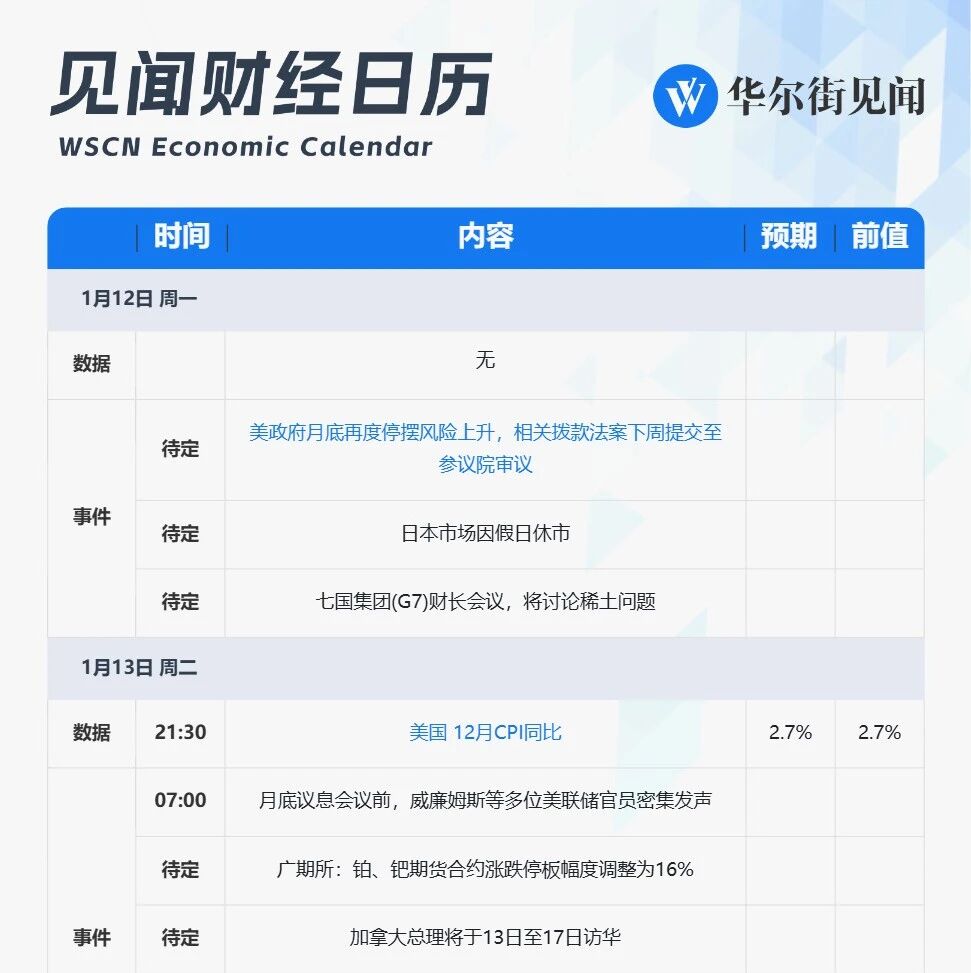
Core Viewpoint - The article highlights the upcoming significant economic events and data releases that could impact market dynamics, including U.S. inflation data, corporate earnings reports, and geopolitical developments, particularly concerning the U.S. government funding and G7 discussions on rare earth issues [3][16][20]. Economic Data - The U.S. is expected to release the December CPI data on January 13, with predictions of a significant rebound, influenced by government shutdown-related statistical distortions. Morgan Stanley forecasts a core CPI increase of 0.36% [5][6]. - China's December import and export data will be released on January 14, with expectations of a 3.0% year-on-year increase in exports and a 2.9% decline in imports [4]. Corporate Earnings - Major U.S. banks, including JPMorgan Chase, will kick off the earnings season, with a focus on the health of the financial system amid high interest rates. The earnings reports from these banks will be critical for assessing market sentiment [11]. - Taiwan Semiconductor Manufacturing Company (TSMC) is set to release its Q4 2025 earnings on January 15, with anticipated revenue of approximately NT$1.011 trillion and earnings per share of NT$2.72. The report will be crucial for understanding the demand for advanced chip manufacturing, particularly in AI [10]. Geopolitical and Industry Developments - The risk of a U.S. government shutdown is rising, with funding bills being expedited through Congress. The outcome of these discussions will significantly influence market sentiment [16]. - The G7 finance ministers will meet to discuss rare earth issues, which could have implications for global supply chains and technology sectors [20]. - The 2026 Nuclear Fusion Technology and Industry Conference will take place on January 16-17, indicating a growing focus on nuclear fusion as a future energy source, with significant investments expected in the coming years [21].

2026:中国商业航天的“诺曼底时刻”
华尔街见闻· 2026-01-10 10:48
Core Viewpoint - The successful launch of the "Qianfan Constellation" marks a significant milestone in China's commercial space industry, transitioning from plans to actual deployment of satellites, akin to a pivotal moment in history [2][3]. Group 1: Reasons for the Current Momentum - The alignment of policies, technology, resources, and competition has created a unique window of opportunity for China's commercial space sector from 2024 to 2026 [5]. - The urgency is driven by the impending 2027 deadline for satellite deployment and frequency activation, necessitating immediate action to secure orbital resources [15][17]. - The strategic focus has shifted from technology validation to "frequency preservation and orbital occupation," emphasizing the need to establish a presence in the increasingly competitive low Earth orbit [18][20]. Group 2: Technological Advancements - The transition from traditional satellite manufacturing to an industrialized approach has significantly reduced costs, with production capabilities reaching 1.5 satellites per day and costs dropping from hundreds of millions to tens of millions [31]. - The evolution of rocket technology, including advancements in liquid propulsion and reusable designs, is expected to lower launch costs to $3,000-$4,000 per kilogram by 2025-2026 [40]. - The emergence of private rocket companies is enhancing competition and innovation within the sector, moving away from reliance on traditional state-run entities [33][35]. Group 3: Changing Role of the State - The Chinese government is shifting from a regulatory role to becoming the largest client in the commercial space sector, facilitating a more supportive environment for private enterprises [41][50]. - New procurement models are being established, where the government purchases services rather than just funding projects, mirroring successful strategies used by SpaceX in the U.S. [47][49]. - Local governments are increasingly investing in commercial space initiatives, recognizing the sector as a vital component of economic development [48]. Group 4: Competitive Pressure from SpaceX - The rapid expansion of SpaceX's Starlink constellation, with over 6,000 satellites launched, creates a pressing need for China to accelerate its own satellite deployment to avoid being outpaced [54][62]. - The military applications of Starlink, demonstrated during conflicts, highlight the strategic importance of establishing a competitive low Earth orbit presence [57][60]. - The potential for SpaceX's Starship to revolutionize launch capabilities adds urgency for China to develop its own satellite infrastructure before facing overwhelming competition [64][66].

我国新增20万颗卫星申请,权威解读来了
华尔街见闻· 2026-01-10 10:48
Core Viewpoint - The article discusses China's strategic application for over 200,000 satellite frequency resources to enhance its satellite internet capabilities and compete with global leaders like SpaceX [2][5]. Group 1: Satellite Resource Application - China has applied for over 200,000 satellite frequency resources from the International Telecommunication Union (ITU), with more than 190,000 satellites coming from the newly established Radio Innovation Institute [2][3]. - The largest satellite constellations in this application are CTC-1 and CTC-2, each consisting of 96,714 satellites [3][4]. - Other significant constellations include CHINAMOBILE-L1 with 2,520 satellites, SAILSPACE-1 with 1,296 satellites, and TIANQI-3G with 1,132 satellites [3]. Group 2: Establishment of Radio Innovation Institute - The Radio Innovation Institute was registered on December 30, 2025, in Xiong'an New Area, Hebei, and is the first new-type research institution in China's radio management technology field [5]. - This institute aims to serve the satellite internet industry, research electromagnetic space technology, and explore the value potential of frequency resources [5]. - The institute is a collaboration among seven entities, including the National Radio Monitoring Center and China Satellite Network Group [5]. Group 3: Strategic Importance and Future Prospects - The application for such a large number of satellites indicates China's commitment to a systematic layout in low Earth orbit and its capability to compete with Western countries [5]. - The ITU's "first come, first served" rule emphasizes the importance of timely applications for frequency and orbital positions to avoid losing access to these resources [7]. - Even if the ITU approves the application, deployment is not guaranteed, and the successful applicant must complete 10% of the deployment within seven years to retain rights [9]. - The potential for deploying 200,000 satellites over a decade is feasible given the large market for low Earth orbit satellites in China [9]. Group 4: Industry Impact - The application by the Radio Innovation Institute is seen as a positive signal for the satellite launch industry, potentially affecting how frequency resources are allocated [10]. - The presence of a national entity applying for such a large number of satellites may change the dynamics of frequency applications, especially for smaller satellite companies [10].

美联储月末降息没戏?“新美联储通讯社”称12月非农就业给按兵不动铺路,交易员预计1月几无可能
华尔街见闻· 2026-01-10 10:48
Core Viewpoint - The December non-farm payroll report has eliminated market expectations for a Federal Reserve rate cut at the end of this month, despite only 50,000 new jobs added in December and significant downward revisions to the previous two months' data. The unexpected drop in the unemployment rate to 4.4% provides ample justification for the Fed's decision to maintain its current monetary policy stance [1][4][13]. Employment Data Summary - The December non-farm payroll report revealed an increase of only 50,000 jobs, falling short of Wall Street's expectation of 65,000. Additionally, the previous two months' job numbers were revised down by a total of 76,000, with October's figures adjusted from a loss of 105,000 to a loss of 173,000, and November's from an increase of 64,000 to 56,000 [8]. - The average monthly job growth in the private sector over the last three months has dropped to 29,000, marking the second-lowest level for the year. The total non-farm employment increase for 2025 was only 584,000, the weakest annual performance since the pandemic caused a loss of 9.2 million jobs in 2020 [8]. - In terms of industry performance, healthcare added 21,000 jobs, while sectors such as retail trade, construction, and manufacturing saw job losses. Out of 11 major industries, five experienced declines in employment [11]. Unemployment Rate Insights - The unemployment rate unexpectedly fell from 4.6% in November to 4.4% in December, alleviating some of the most severe concerns regarding labor market deterioration. This decline is partly attributed to a drop in the labor force participation rate to 62.4%, indicating that some unemployed individuals have exited the labor market and are no longer counted as actively seeking work [4][18]. - The decrease in the unemployment rate is a key highlight of the non-farm payroll report and serves as a core basis for the Fed's decision to hold rates steady [18]. Wage Growth Analysis - Despite the weak job growth, wage growth remains resilient, with average hourly earnings increasing by 0.3% month-over-month in December, and the annual wage growth reaching 3.8%, which is approximately 1 percentage point above the inflation rate [12]. Market Reactions and Future Expectations - Following the employment report, bond traders quickly adjusted their positions, almost entirely retracting bets on a January rate cut. U.S. Treasury prices fell across the board, with yields rising by up to 3 basis points. The probability of a January rate cut dropped to zero, with traders now expecting the first rate cut in June, following the end of Fed Chair Powell's term, with an anticipated total cut of about 50 basis points for the year [5][20]. - Analysts suggest that the Fed is likely to maintain a cautious approach, with the focus shifting to inflation data and subsequent labor market performance to determine the pace and magnitude of potential rate cuts throughout the year [22].

美国最高法院暂未公布对特朗普关税的判决,市场紧盯下周三
华尔街见闻· 2026-01-10 10:48
Core Viewpoint - The U.S. Supreme Court has not yet made a ruling on the legality of tariffs imposed by the Trump administration, leaving the future of this key economic policy uncertain [1][3]. Group 1: Supreme Court Ruling - The Supreme Court will not announce a decision on the Trump tariffs on January 9, with the next announcement scheduled for January 14 [1]. - The ruling will address two main issues: whether the government can impose tariffs under the International Emergency Economic Powers Act (IEEPA) and if refunds are necessary for importers who have already paid tariffs [3]. Group 2: Market Reactions and Implications - The lack of a ruling led to a decline in stocks related to tariffs, highlighting the market's sensitivity to the outcome [3]. - Analysts predict a mixed ruling, which may limit the government's ability to use tariffs as a tool for national security or negotiation, potentially impacting fiscal conditions [8][11]. Group 3: Alternative Strategies - Even if the court rules against the Trump administration, there are alternative methods to implement tariffs without relying on the IEEPA [6][10]. - The administration has backup plans in place to maintain tariff levels, indicating a proactive approach to potential legal setbacks [10]. Group 4: Financial Impact - Tariffs are projected to generate approximately $195 billion in revenue for the fiscal year 2025 and $62 billion for 2026, emphasizing their significance to the U.S. Treasury [9]. - The actual impact of tariffs has been less severe than expected, with limited inflation effects and a significant reduction in the trade deficit, which fell to its lowest level since the 2009 financial crisis [14].

从“房贷QE”到“信用卡限价”:当特朗普开始亲自定价利率
华尔街见闻· 2026-01-10 10:48
Core Viewpoint - The article discusses the Trump administration's intervention in interest rates, particularly focusing on mortgage and credit card rates, as a response to the Federal Reserve's reluctance to lower rates quickly. This intervention is seen as a political strategy to address voter concerns about financial burdens rather than a purely economic decision [1][2][5]. Group 1: Mortgage Market Intervention - The Trump administration has directed Fannie Mae and Freddie Mac to purchase mortgage-backed securities (MBS) to mitigate the impact of the Federal Reserve's balance sheet reduction, aiming to narrow the spread between mortgage rates and Treasury yields [7][8]. - This intervention is characterized as a "quasi-QE" experiment, leveraging historical precedents of quantitative easing [6][8]. - The 30-year mortgage rate is crucial as it directly influences home purchasing ability, while the average credit card APR significantly affects household cash flow [9][10]. Group 2: Credit Card Rate Cap Proposal - The proposal to impose a 10% cap on credit card interest rates raises concerns as it disrupts the risk-based pricing mechanism, which is essential for lenders [11][12]. - Current average credit card APRs range from 20% to 25%, and enforcing a cap without financial support could lead banks to withdraw from the market, limiting credit access for higher-risk borrowers [12][13][14]. - This shift from market intervention to price control is alarming as it sets a precedent for future financial policies [15]. Group 3: Broader Implications of Administrative Power - The article highlights a fundamental shift in how interest rates are determined, moving from a market-driven approach to one influenced by political decisions, which could have long-term consequences for the financial system [18][19]. - The traditional separation of powers in U.S. economic policy is being challenged, with the administration seeking to redefine the boundaries of monetary policy and its implementation [17][18]. - The real risk lies not in the immediate effects of rate changes but in the potential for political judgments to dictate financial pricing, which could destabilize the market [19].
黄金成全球最大储备资产,30年来首次超越美债!
华尔街见闻· 2026-01-09 09:43
随着金价飙升和各国央行激进的购买潮,黄金已正式超越美国国债,三十年来首次成为全球最大的储备资产。 这是全球金融体系的一个标志性时刻,凸显了在财政可持续性担忧和地缘政治风险加剧的背景下,全球资本正加速向避险资产转移。 据世界黄金协会(WGC)最新数据,若假设年底央行持有的黄金储备规模不变,以年底价格计算,美国海外全球官方黄金储备价值已达3.93万亿美元。这一数字正式超 越了海外官方持有的长期和短期美债规模,后者截至10月份的价值接近3.88万亿美元。 尽管金价处于高位,各国央行并未停止积累黄金储备。世界黄金协会的数据显示,美国海外全球官方黄金储备总量已超过9亿金衡盎司。这种持续买入行为表明,决策者 对黄金作为核心储备资产的战略重视程度正在上升。 对于分析师而言 ,这一现象代表了全球储备持有的结构性转变。相比于传统的法定货币资产,黄金被视为没有交易对手风险的更安全替代品。 Kalish在研报中坦言: 分析人士指出,这标志着全球储备持有结构发生了根本性变化。NDR首席宏观策略师Joe Kalish指出,随着人们对法定货币的信任度降低, 非美国家持有的黄金储备价值 正迅速追赶并最终超越其美债储备价值。 这一趋势意味着 ...