国泰海通证券研究

Search documents
国泰海通|海外科技:CES:NVDA、INTEL算力升级,物理AI成推进焦点——2026 CES大会要点点评
国泰海通证券研究· 2026-01-07 15:07
Core Insights - Nvidia showcases comprehensive AI infrastructure deployment and iteration, emphasizing the application prospects of physical AI [1][3] - AMD and Intel have made significant progress in previously weaker areas, such as rack capabilities and the 18A process node [1][4] Group 1: Nvidia Developments - Nvidia's new AI platform Rubin has entered full-scale production, featuring six new chips: Vera CPU, Rubin GPU, NVLink 6 switch, ConnectX-9 super network card, BlueField-4 DPU, and Spectrum-6 Ethernet switch [3] - Rubin GPU achieves 3.5 times the training speed and 5 times the inference speed compared to the Blackwell architecture, with a peak computing power of 50 Petaflops [3] - The token cost during inference is reduced by up to 10 times compared to the Blackwell platform, and the number of GPUs required for training mixture of experts (MoE) models is reduced to one-fourth [3] - Nvidia introduces a memory storage platform driven by BlueField-4 to address KV Cache issues, enhancing token processing speed by up to 5 times in specific scenarios [3] - Microsoft and Coreweave are set to be the first customers to deploy Rubin in the second half of 2026, with Microsoft's next-generation Fairwater AI super factory scaling to hundreds of thousands of Vera Rubin chips [3] - Nvidia's Alpamayo series VLA open-source AI models and tools are aimed at autonomous vehicle development, with the DRIVE system entering mass production for the Mercedes-Benz CLA, expected to hit the US roads in 2026 [3] Group 2: AMD and Intel Innovations - AMD launches the Helios rack based on the MI 455X, featuring a fully liquid-cooled design with four Instinct MI455X GPUs and one EPYC Venice Zen6 CPU [4] - The MI500 series chips are in development, expected to enhance AI performance by 1000 times by 2027 [4] - Intel introduces its first computing platform based on the 18A process node, the Intel Core Ultra 3 series (codenamed Panther Lake), achieving a total AI computing power of 180 TOPS, with the GPU contributing 120 TOPS [4] - The Core Ultra 3 platform supports running a 70 billion parameter large language model locally with 32k context, with consumer laptops featuring this processor set to pre-sell on January 6, 2026 [4]



国泰海通|银行:12月理财月报:公募销售新规发布,利好理财流动性管理
国泰海通证券研究· 2026-01-07 15:07
马婷婷深度研究 分享一篇文章。 【国泰海通银行马婷婷团队】12月理财月报:公募销售新规发布,利好理财流动性管理 原创 阅读全文 ...

国泰海通|策略:新兴产业空间广阔,看多中国产业龙头
国泰海通证券研究· 2026-01-07 15:07
Core Viewpoint - The Chinese emerging technology industry is in its early lifecycle stage, with high valuations, while companies with significant innovation advantages are expected to see market value growth. The manufacturing and consumption industries are more mature, and companies with solid global competitiveness are likely to see valuation increases [1]. Emerging Technology - The Chinese emerging technology sector, including semiconductors, innovative pharmaceuticals, and communication equipment, is still in its growth phase, with revenue and profitability lagging behind international leaders. However, the capital market has assigned high valuations, reflecting optimistic expectations for technological independence and industry catch-up. Companies with technological barriers and significant domestic substitution potential are expected to benefit more [2]. - Internet platform companies are projected to benefit from the rapid iteration of large models and AI applications, leading to valuation recovery and growth resonance [2]. Advanced Manufacturing - The domestic advanced manufacturing industry has developed relatively maturely, establishing solid global competitiveness due to a complete industrial system and significant efficiency cost advantages. In the new energy sector, lithium battery companies lead globally in scale and profitability, with head companies generally having lower valuations than overseas leaders, indicating a strong cost-performance advantage [2]. - Wind power profitability is weaker than that of overseas counterparts, but valuations are also low. High-end equipment and new materials industries have profitability comparable to overseas leaders, with valuations at reasonable levels, but there is substantial room for global expansion [2]. Consumer Sector - In the consumer sector, leading Chinese companies in product consumption, such as high-end liquor and beverages, have demonstrated strong profitability, but their growth heavily relies on the domestic market, resulting in lower global competitiveness compared to international leaders. The service consumption sector is still in its early development stage, with lower scale and profitability compared to overseas leaders [3]. - The consumer sector overall has a high cost-performance ratio, with potential growth opportunities in service consumption driven by structural transformation and in unique product consumption brands with global potential [3]. Investment Recommendations - Recommendations include leading companies in electric new energy, transportation equipment, communication equipment, electronics, and service consumption industries. Companies with significant innovation advantages and strong overseas expansion momentum are expected to accelerate their catch-up with international leaders or maintain their leading positions. The following sectors are highlighted for investment: 1. Advanced manufacturing leaders benefiting from strong profitability and global competitive advantages [3] 2. Emerging technology leaders benefiting from rapid improvements in Chinese innovation capabilities [3] 3. Service consumption and mass goods industries poised for growth due to structural transformation [3].

国泰海通|金工:大类资产及择时观点月报(2026.01)——股票市场发出正向信号
国泰海通证券研究· 2026-01-06 14:27
Core Insights - The report indicates that as of the end of December 2025, the signals for stocks, bonds, and gold markets in January 2026 are positive, negative, and positive respectively [1][3]. Group 1: Macro Environment - The macro environment forecast for Q1 2026 is predicted to be a slowdown, with credit spreads narrowing and term spreads expanding based on the latest data from December 2025 [2]. Group 2: Industry Trends - From January 2015 to December 2025, the cumulative return of the industry composite trend factor combination is 124.81%, with an excess return of 48.89%. The factor signal for December 2025 was positive, and the Wind All A index had a monthly return of 3.30%. The industry composite trend factor remains at 0.46, maintaining a positive signal [3].

国泰海通 · 晨报260107|策略、食饮、固收
国泰海通证券研究· 2026-01-06 14:27
Group 1: AI Industry Investment Insights - The article analyzes historical technology bull markets to provide insights into the current AI industry investment phase, emphasizing the importance of historical patterns for future investment decisions [3][4] - It identifies two key phases in technology bull markets: valuation expansion and profit-driven periods, highlighting the characteristics of stock price performance during these phases [3][5] Group 2: Valuation Expansion Phase - During the valuation expansion phase, new technologies emerge without profit support, leading to increased valuations driven by industry and policy catalysts [4] - Historical data shows that high industry crowding indicators are common, but the likelihood of price corrections increases within 20 trading days after reaching extreme values, while longer-term trends tend to see new highs [4] - Risk premium is a better measure for valuation boundaries; when the industry risk premium falls below one standard deviation of the rolling two-year average, the market tends to enter a consolidation phase [4] Group 3: Profit-Driven Phase - In the profit-driven phase, exceeding earnings expectations becomes the core driver of market performance, with historical examples including iPhone sales and mobile game penetration rates [5] - Valuation constraints under terminal thinking are crucial, as leading companies' peak stock prices often correspond to future three-year valuation levels around 30-40 times PE [5] - The risk of intensified competition and overcapacity during profit upturns can negatively impact profitability, signaling the end of investment trends [5] Group 4: Investment Recommendations - For overseas computing power, the profit-driven phase is expected to continue, with reasonable long-term valuations around 20-30 times PE, indicating no bubble [6] - Domestic computing power is in the valuation expansion phase, with low risk premiums suggesting that the next market movement may depend on performance realization or systemic declines in risk-free rates [6] - AI applications are also in the valuation expansion phase, with high valuation potential but challenges in predicting the timing and areas of successful applications [6]

国泰海通|有色:地缘局势增加供给不确定性
国泰海通证券研究· 2026-01-06 14:27
报告导读: 地缘局势增加供给不确定性 。 拉美地区是全球矿产资源核心供给地之一,地 缘局势紧张可能引发相关区域政策波动,进而导致供应不确定性增加 。 贵金属:贵金属因交易因素宽幅震荡,趋势未改。 上周( 1 月 2 日当周) COMEX 黄金价格突破 4500 美金 / 盎司后明显回撤,伦敦现货白银价格突破 83 美元 / 盎司后回撤,铂、钯价格宽幅震荡。展望 2026 年,我们认为央行购金、黄金 ETF 持仓份额上升和美联储降息预期,将继续成为支撑黄金价格的 重要因素,关注 地缘局势带来的 地缘政治风险上行。白银来看,白银库存的短缺持续存在,非交割月走势或趋缓。 铜:宏观叠加供给扰动,铜价或偏强震荡。 市场情绪波动,周内铜价呈现宽幅震荡。近期美国就业数据等即将披露,特朗普或于 1 月公布下一任美联储主席 人选,市场对美国流动性宽松预期有望提升。供应端,智利 Mantoverde 铜矿工会表示将采取罢工行动,预计维持约 30% 的正常产能;受厄瓜多尔政局影 响,米拉多铜矿二期工程或延期。此外,需关注拉美铜矿供给端扰动。 铝:铝价再创新高,宏观利好与基本面弱势博弈。 宏观政策积极,周内铝价再创新 高。 供给侧, ...

国泰海通|电子:互联网大厂加速AI布局,国产算力需求增长可期
国泰海通证券研究· 2026-01-06 14:27
Core Viewpoint - Tencent is accelerating its AI application layout and online tool mini-program growth plan, which is expected to benefit domestic computing power [2][3]. Group 1: Tencent's AI Application Growth Plan - Tencent officially launched the AI application and online tool mini-program growth plan on January 5, 2026, allowing developers to use Tencent's flagship models for free during a one-year incentive period [2]. - Developers will receive comprehensive backend support for mini-programs, free AI computing power, and access to a total of 100 million tokens for the latest text generation model and 10,000 credits for the image generation model [2]. - The platform will provide traffic incentives and an ad integration solution that allows for intelligent ad placements without development requirements, which is expected to accelerate the development of AI mini-programs and applications [2]. Group 2: Industry Trends and Competitors - Major internet companies are accelerating their AI layouts and commercial monetization, with ByteDance and Alibaba also launching significant AI projects [3]. - ByteDance plans to release the Doubao phone by December 1, 2025, integrating AI features into the operating system, while Alibaba is launching the Qianwen project to develop an app that competes with ChatGPT [3]. - The growth of AI applications and edge-side AI is anticipated to drive demand for domestic computing power [3]. Group 3: Catalysts for Growth - The introduction of new AI business models and the release of popular AI applications are seen as key catalysts for growth in the sector [4].


国泰海通|医药:MFN谈判接近尾声,14家药企达成协议
国泰海通证券研究· 2026-01-06 14:27
报告导读: 美国共 14 家药企与政府达成最惠国价格协议,降价渠道收入占比较低,且药 企获三年关税豁免,整体影响有限。 12 月 19 日,美国政府公布与九家大型跨国药企达成协议。 此次药企包括安进、勃林格殷格翰、百时美施贵宝、基因泰克、吉利德、葛兰素史克、默沙东、 诺华和赛诺菲。这些协议涵盖 Medicaid 降价、新药国际对齐定价以及 TrumpRx 直销渠道等多项内容。在本轮签署之前,辉瑞、礼来、阿斯利康、 EMD Serono 和诺和诺德已先一步与政府达成协议。在特朗普点名的 17 家药企中,仅剩强生、艾伯维和再生元尚未宣布达成一致。 本次协议措施包括降低部分渠道价格、创新药最惠国价格及增加投资。 1 )降低慢病类用药费用。 适应症包括 2 型糖尿病、类风湿性关节炎等。 2 )增加 本土投资。 9 家制药企业承诺在近期内合计投资至少 1500 亿美元用于美国本土生产。 3 )创新药最惠国价格。 协议要求 9 家企业所有上市创新药均须执 行最惠国价格。 降价局限于 Medicaid 和直销渠道,收入占比有限。 此次达成 MFN 协议的 9 家药企均选择了最开始的辉瑞模式,在 Medicaid 下以直销( ...

国泰海通 · 深度|策略:从历次科技牛规律,定位当下AI产业链投资阶段
国泰海通证券研究· 2026-01-06 14:27
Core Viewpoint - The current overseas computing power valuation is reasonable with potential for upward revision, while domestic computing power has significant long-term growth potential and performance expectations are being met [1] Historical Analysis of Technology Bull Markets - The article reviews past technology bull markets (2009-2010 consumer electronics, 2013-2015 gaming, and 2019-2021 lithium battery) to analyze the price performance characteristics during valuation expansion and profit-driven phases, providing a historical reference for the current AI industry chain [2][8] Valuation Expansion Phase Characteristics - During this phase, new technologies emerge without profit support, and industry and policy catalysts create imagination space, driving up valuations. Historical data shows that: - High levels of industry crowding are common, but short-term trading crowding does not affect the overall trend [3][15] - Risk premium effectively measures valuation boundaries, with significant reactions to positive news diminishing when the risk premium falls below a certain threshold [18] - High valuation ranges are sensitive to liquidity changes, with tightening liquidity potentially triggering adjustments [3][18] Profit-Driven Phase Characteristics - In this phase, exceeding profit expectations drives market performance, with historical examples showing: - The need to be cautious of competitive pressures and valuation constraints under endgame thinking [4][21] - Overcapitalization during profit upturns can lead to increased competition and excess capacity, negatively impacting profitability [22][25] Investment Recommendations - Overseas Computing Power: Currently in the profit-driven phase, with ROIC expected to continue rising until Q3 2025, and leading companies' valuations (PE-FY3) are reasonable at 20-30 times, indicating no bubble [5][26] - Domestic Computing Power: Significant long-term growth potential exists, with performance expectations being met and a systemic decline in risk-free rates acting as a catalyst for the next market phase [5][28] - AI Applications: Valuation is attractive, particularly in the internet and media sectors, although the timing and areas for breakout applications are uncertain [5][29]

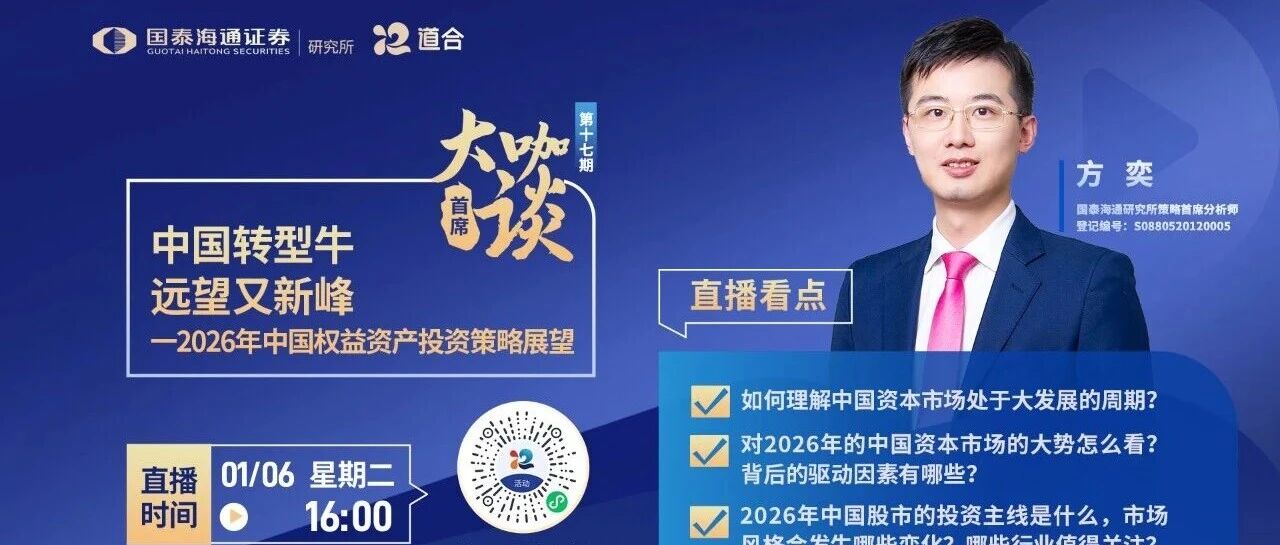
国泰海通 · 首席大咖谈|策略方奕:中国转型牛,远望又新峰——2026年中国权益资产投资策略展望
国泰海通证券研究· 2026-01-06 03:00
2 道合 国泰海通证券 | 研究所 中国 在线学业生 元型又新隆 2026年中国权益资产投资策略展望 型 国泰海通研究所策略首席分析师 登记编号: S0880520120005 直播看点 如何理解中国资本市场处于大发展的周期? 对2026年的中国资本市场的大势怎么看? 更多国泰海通研究和服务 亦可联系对口销售获取 重要提醒 本订阅号所载内容仅面向国泰海通证券研究服务签约客户。因本资料暂时无法设置访问限制,根据《证 券期货投资者适当性管理办法》的要求,若您并非国泰海通证券研究服务签约客户,为保证服务质量、 控制投资风险,还请取消关注,请勿订阅、接收或使用本订阅号中的任何信息。我们对由此给您造成的 不便表示诚挚歉意,非常感谢您的理解与配合!如有任何疑问,敬请按照文末联系方式与我们联系。 法律声明 ...