国泰海通证券研究

Search documents
国泰海通|宏观:核心通胀韧性仍在——2025年12月物价数据点评
国泰海通证券研究· 2026-01-09 13:28
Core Viewpoint - December inflation maintains a steady upward trend, driven by low food price base, rising gold prices, and soaring global industrial metals, while domestic demand-related prices remain relatively stable [1][2] CPI Analysis - The contribution from food prices has decreased, while services have shown an increased contribution [2] - Food prices, including pork, contributed +0.21% to CPI, with other food items contributing +0.47% [8] - Core CPI remains at the seasonal upper limit, with a month-on-month increase of +0.2% and year-on-year stability [8] PPI Analysis - PPI shows a year-on-year decrease of -1.9%, but a month-on-month recovery to +0.2% [1][8] - Industrial prices are becoming more balanced across upstream, midstream, and downstream sectors, with notable contributions from non-ferrous metals and stable performance in the black metal chain [8] - Non-ferrous metals continue to thrive under the global AI narrative, serving as a core driver for December PPI [8]


国泰海通|电子:存储产业链的“通胀”投资机会
国泰海通证券研究· 2026-01-09 13:28
Core Viewpoint - The introduction of NVIDIA's inference context memory storage platform is expected to intensify the supply tightness in the storage market, with NAND and DRAM contract prices projected to increase significantly in Q1 2026 [1][3]. Group 1: NVIDIA's Impact on Storage - NVIDIA's new AI platform, Rubin, integrates six chips and is designed to enhance storage capacity, achieving a fivefold increase in long-context inference performance, total cost of ownership (TCO), and energy efficiency [2]. - The AI-native storage platform, NVIDIA's inference context memory storage, serves as a key-value (KV) cache layer, further driving the demand for storage solutions [2]. Group 2: Market Predictions - According to TrendForce, the global server market is expected to peak in 2026, leading to increased demand for Enterprise SSDs, which will become the largest application for NAND Flash [3]. - The limited production capacity of suppliers is expected to deepen the supply tightness, resulting in a projected increase of 55%-60% for general DRAM contract prices and 33%-38% for NAND prices in Q1 2026 [3]. Group 3: Longsys Technology's IPO and Growth - Longsys Technology's IPO is anticipated to further expand its capital expenditures, as it is the largest and most advanced DRAM R&D and manufacturing enterprise in China [4]. - The company has successfully transitioned from first-generation to fourth-generation process technology and has a comprehensive product range from DDR4 to DDR5 [4]. - Longsys Technology's fixed asset investments from 2022 to the first half of 2025 are projected to increase significantly, with a planned fundraising of 29.5 billion yuan through its IPO [4].

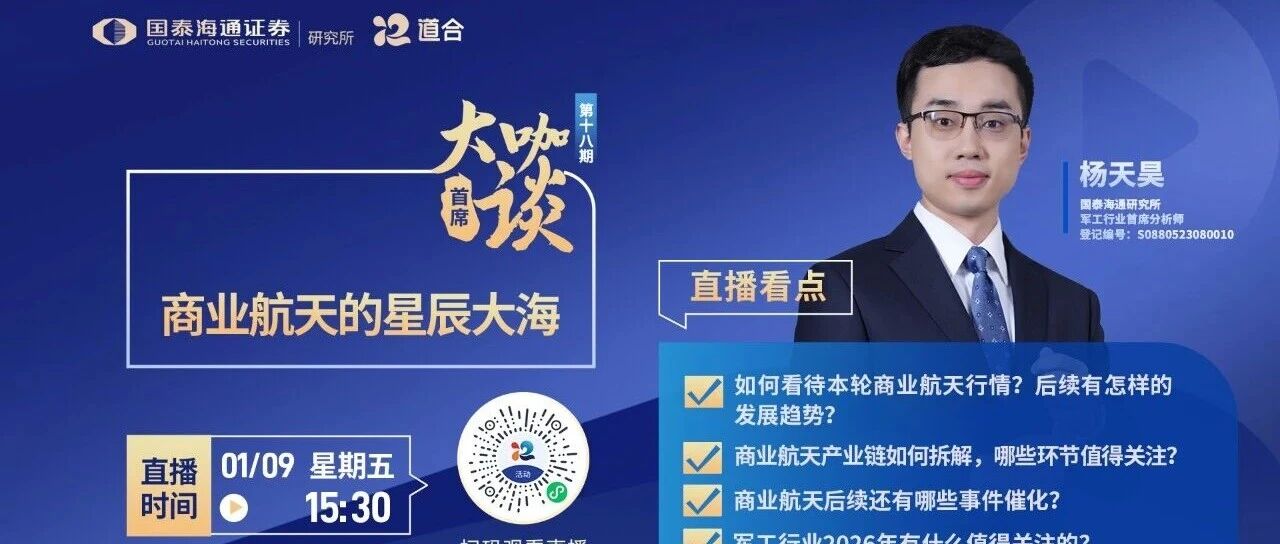
国泰海通 · 首席大咖谈|军工杨天昊:商业航天的星辰大海
国泰海通证券研究· 2026-01-09 04:28
如何看待本轮商业航天行情?后续有怎样的 发展趋势? 2 道合 国泰海通证券 GUOTAIHAITONG SEURITIES | 研究所 商业航天的星辰才 国泰海通研究所 军工行业首席分析师 登记编号: S0880523080010 直播看点 更多国泰海通研究和服务 亦可联系对口销售获取 重要提醒 本订阅号所载内容仅面向国泰海通证券研究服务签约客户。因本资料暂时无法设置访问限制,根据《证 券期货投资者适当性管理办法》的要求,若您并非国泰海通证券研究服务签约客户,为保证服务质量、 控制投资风险,还请取消关注,请勿订阅、接收或使用本订阅号中的任何信息。我们对由此给您造成的 不便表示诚挚歉意,非常感谢您的理解与配合!如有任何疑问,敬请按照文末联系方式与我们联系。 法律声明 十六,11, http://www.libelun nnouk TT + / + / + / + / + / + A ...
国泰海通|批零社服:消费政策利好,文旅行业迎来消费回暖
国泰海通证券研究· 2026-01-08 14:11
Core Viewpoint - The release of the "Employee Cultural and Sports Consumption Policy" is expected to stimulate demand recovery in the cultural and tourism industry, presenting investment opportunities for related sectors [1]. Group 1: Policy Overview - The policy aims to expand employee cultural and sports consumption, unlocking potential spending power among employees [2]. - By 2030, a comprehensive employee cultural and sports activity system is expected to be established, featuring a range of impactful projects and improved service quality [2]. - The policy encourages up to four seasonal outings per year and increased funding for employee cultural activities [2]. Group 2: Investment Opportunities - Leading tourism companies are anticipated to benefit from policy support, with short-term gains expected from increased employee cultural consumption [1]. - The demand for cultural and tourism consumption is projected to be further released through measures like annual tickets and consumption vouchers [1]. - Key areas of focus include: 1. Continuously exceeding tourism data expectations and maintaining a positive outlook on travel chains 2. Companies with significantly improved competitive landscapes 3. Dividend stocks 4. AI integration 5. Undervalued stocks [1]. Group 3: Product and Service Development - The policy encourages collaboration between trade unions and cultural, tourism, film, and sports sectors to offer exclusive products and services for employees [3]. - Development of annual tourism tickets and distribution of cultural consumption vouchers are supported to enhance employee engagement in cultural activities [3].

国泰海通|计算机:八部门印发人工智能赋能制造专项行动实施意见,制造业AI大有可为
国泰海通证券研究· 2026-01-08 14:11
Core Viewpoint - The article emphasizes the importance of the "Artificial Intelligence + Manufacturing" initiative, which aims to enhance technological supply and industrial application, while accelerating the "intelligent industrialization" and "industrial intelligence" processes to support the development of a strong manufacturing nation and digital China [1][3]. Group 1: Policy Implementation - On January 7, eight government departments jointly issued the "Implementation Opinions on the 'Artificial Intelligence + Manufacturing' Special Action," focusing on both technological supply and application empowerment [1]. - The initiative aims to promote the deep integration of AI technology and manufacturing applications, enhancing the innovation capabilities of both sectors [1]. Group 2: Goals and Targets - By 2027, the initiative targets achieving a secure and reliable supply of key AI technologies, maintaining a leading position in industrial scale and empowerment levels globally [2]. - The plan includes the deep application of 3-5 general large models in manufacturing, the creation of 100 high-quality industrial data sets, and the promotion of 500 typical application scenarios [2]. Group 3: Industry Support and Development - The document encourages local governments to provide support such as "computing power vouchers" and "model vouchers" to reduce application development costs for enterprises [3]. - It emphasizes the establishment of a collaborative mechanism among departments and industries to guide enterprises in differentiated development and prevent excessive competition [3].
国泰海通|电子:钛合金持续渗透,国内企业积极布局
国泰海通证券研究· 2026-01-08 14:11
Core Viewpoint - Titanium alloys are expected to continue penetrating various applications, driven by advancements in powder metallurgy and 3D printing technologies, which will further expand their usage [1][2][3]. Group 1: Titanium Alloy Applications - The first foldable screen product from Apple is anticipated to be released in 2026, which is expected to significantly increase the demand for titanium alloys due to their high strength, corrosion resistance, and favorable surface texture [3]. - Key applications of titanium alloys in foldable screens include: 1. Middle frame: Titanium alloy frames exhibit superior bending resistance compared to aluminum alloys while achieving lightweight, thus better protecting the screen and internal components [3]. 2. Screen backing: It supports the screen to ensure display quality and touch experience, guiding the screen to bend at specific angles during folding and unfolding, reducing creases. Using pure titanium backing can significantly lower the device's weight, balancing weight, performance, and processing costs [3]. 3. Other applications: Due to better toughness and corrosion resistance, titanium alloys are expected to be used in components like foldable screen axis covers [3]. - The development of 3D printed titanium alloys offers high design freedom, enabling the production of complex hollow or integrated structures that CNC cannot achieve, with gradual applications in aerospace, medical fields, and high-end consumer electronics [3]. Group 2: Domestic Enterprises and Market Demand - Domestic companies are deeply engaged in titanium alloy production and are expected to benefit from a surge in downstream demand [4]. - Powder metallurgy can also be utilized to prepare advanced fusion materials, with domestic enterprises actively overcoming critical bottlenecks. As global demand for sustainable energy grows, the commercialization of nuclear fusion continues to advance [4]. - The materials used in nuclear fusion reactors must withstand extreme conditions, including high-energy neutron irradiation, high temperatures, high heat flux, and strong magnetic fields, necessitating high-performance materials [4]. - Companies like Tiangong International are making significant progress in developing fusion materials through powder metallurgy, including advanced reduced activation ferritic-martensitic (RAFM) steel and high-boron steel for nuclear power, with core applications in shielding layers and vacuum chamber interlayers, which are expected to benefit from the upcoming demand for nuclear fusion [4].

国泰海通|金工:根据量化模型信号,1月建议超配小盘风格,均衡配置价值成长风格
国泰海通证券研究· 2026-01-08 14:11
Group 1 - The report suggests an overweight allocation to small-cap stocks for January, while recommending an equal-weight allocation to value and growth styles based on quantitative model signals [1] - As of the end of December, the quantitative model signal for small-cap stocks was 0.17, indicating a preference for small-cap over large-cap stocks [1] - The long-term view indicates that the current market capitalization factor valuation spread is 0.89, which is still below the historical peak range of 1.7 to 2.6, suggesting continued optimism for small-cap stocks [1] Group 2 - The quantitative model signal for value and growth styles is 0, recommending an equal-weight allocation for January [1] - As of the end of December, the model's return for value and growth styles was 22.72%, with an excess return of 1.93% compared to the equal-weight benchmark of 20.4% [1] - The report provides detailed strategy construction in a separate document focused on monthly and weekly value and growth style rotation strategies [1] Group 3 - Among eight major style factors, momentum and value factors showed high positive returns, while dividend factors exhibited high negative returns [2] - For the year, volatility and growth factors had high positive returns, while liquidity and large-cap factors showed negative returns [2] - The report updates the factor covariance matrix, which is essential for predicting stock portfolio risk, using a multi-factor model [2]

国泰海通|交运:2025年运价再创新高,2026年期待超级牛市
国泰海通证券研究· 2026-01-08 14:11
Core Viewpoint - The oil shipping industry has experienced a continuous uptrend for four years, with expectations for a super bull market driven by supply-demand dynamics and geopolitical factors [1][4]. Group 1: Oil Shipping Long Logic - The first phase of the oil shipping boom is driven by geopolitical conflicts, notably the Russia-Ukraine conflict, which has restructured global oil trade, increasing average shipping distances and demand by over 10% [1]. - The second phase is anticipated to be fueled by global oil production increases starting from April 2025, as OPEC+ shifts from a production cut cycle to an increase cycle, which is expected to boost oil shipping demand [1]. - The aging fleet of oil tankers, combined with stricter environmental regulations and sanctions on shadow fleets, will likely maintain a rigid supply in the compliant market, supporting continued demand growth [1]. Group 2: Market Outlook for 2025 - In the second half of 2025, oil shipping rates are expected to surge, potentially reaching a ten-year high in tanker profitability, with estimates for VLCC TCE (Time Charter Equivalent) at $51,000, up from $36,000 in 2023-24 [2]. - The oil shipping market will face pressure tests in late 2024 due to geopolitical oil prices and Iranian production increases, but a significant recovery is expected in early 2025 as oil prices stabilize [2]. - The combined effects of OPEC+ and South American production increases, along with India's shift to compliant oil imports, will drive high tanker utilization rates and elevated shipping rates [2]. Group 3: Focus on the Grey Market - The tightening of sanctions by the U.S. on Iran and shadow fleets has led to a decline in operational efficiency for these fleets, benefiting the compliant oil market [3]. - The recent U.S. measures against Venezuela are expected to impact its oil exports, potentially driving compliant oil production and benefiting the compliant market [3]. - Future geopolitical developments, such as the potential lifting of sanctions on Venezuela and Russia, could significantly expand the compliant oil shipping market and reduce the grey market's operational space [3]. Group 4: Seasonal Risks and Investment Recommendations - The oil shipping industry has seen a four-year upward trend, with expectations for tanker profitability to reach a ten-year high in 2025 [4]. - The capital market shows significant divergence regarding future trends in oil shipping, indicating potential for substantial gains [4]. - The recent seasonal price adjustments in the oil shipping market are in line with expectations, suggesting a strategic opportunity for investment during the off-season [4].

国泰海通|地产:如何理解“房地产高质量发展”——房地产行业“十五五”系列研究
国泰海通证券研究· 2026-01-08 14:11
报告导读: 十四五和十五五期间,党中央对地产行业发展要求,房地产行业总量所处阶段 存在明显差异。房地产行业高质量发展要求的提出,从防风险、提品质、促转型等多维度 为行业提供纲领性指引。我们认为未来五年行业将步入提质增效发展新阶段,看好行业迈 入格局和盈利稳定,蓝筹基本面持续优化阶段。 当前 AH 房地产板块总市值与行业在经济中所处地位不匹配 ,推荐 : 1 )开发类; 2 )商住类; 3 )物业类; 4 )文旅类 。 行业环境变化,十五五提出新目标。 十四五前端行业政策以降杠杆、缩总量,防止泡沫扩大甚至压降泡沫为主,以上政策导向下,行业总量大幅回落。伴随 产能和市场杠杆水平逐步回归合理水平,十四五后端中央政策开始逐步推动行业平稳触底。从要求上,明确表达"着力稳定房地产市场"、"止跌回稳"等清晰 表态。我们认为,高质量发展要求的提出,代表十五五和十四五期间中央对房地产发展要求存在变化。基于全球成熟国家历史经验,中国自身人口和国情,我 们认为十五五期间行业需求有望企稳回升,维持在 7-8 亿平区间。 高质量发展意义深刻要求前瞻,六大任务指示明确蓄势待发。 面对行业供需关系与经济环境深刻变化,人民、经济和行业对房地 ...

国泰海通 · 晨报260108|元旦文旅景气增长,科技周期延续涨价
国泰海通证券研究· 2026-01-07 15:07
Core Viewpoint - The article highlights the growth in tourism and cultural activities during the New Year period, alongside the continuation of price increases in the technology sector, indicating a mixed performance in the macroeconomic landscape [3]. Group 1: Tourism and Cultural Activities - The New Year holiday saw a significant increase in travel demand, with an average daily cross-regional flow of 198 million people, up 19.5% year-on-year, and an average daily entry-exit figure of 2.205 million, up 28.6% year-on-year [4]. - Domestic tourism showed improvement, with average daily tourist numbers and revenue increasing by 5.2% and 6.3% respectively compared to the previous year, driven by enhanced service supply and flexible holiday arrangements [4]. - Shanghai Disneyland's congestion index rose by 128.8% year-on-year during the last week of 2025, indicating a surge in visitor numbers [4]. Group 2: Downstream Consumption - The price of live pigs increased by 3.9% as of December 28, driven by improved demand for New Year preparations [5]. - Real estate sales remain under pressure, with transaction volumes in 30 major cities down 26.0% year-on-year, and significant declines observed across first, second, and third-tier cities [5]. - Retail sales of passenger vehicles decreased by 12% year-on-year during the last week of December 2025, reflecting ongoing challenges in the durable goods sector [5]. Group 3: Technology and Manufacturing - The electronic industry continues to thrive, with prices for DRAM memory chips increasing by 2.6% to 7.1% across different types as of January 2 [6]. - Chemical raw material prices showed mixed performance, with PX prices rising by 6.4% while PTA prices slightly declined [6]. - Industrial metal prices have continued to rise due to supply disruptions and expectations of interest rate cuts, with coal prices stabilizing at a 0.9% increase [6].