国泰海通证券研究

Search documents
倒计时1天|2025上海先导产业大会暨第14届医药CEO论坛+第5届人工智能大会
国泰海通证券研究· 2025-09-03 08:39
Core Viewpoint - The article discusses the upcoming 2025 Shanghai Leading Industries Conference, which includes the 14th Pharmaceutical CEO Forum and the 5th Artificial Intelligence Conference, highlighting the significance of innovation and global expansion in the pharmaceutical industry [2][6]. Event Details - The conference will take place on September 4-5, 2025, at the Mandarin Oriental Hotel in Pudong, Shanghai [4][6]. - Key participants include CEOs and senior executives from various pharmaceutical companies, engaging in roundtable discussions and keynote speeches [7][8]. Agenda Highlights - The morning session on September 4 features a roundtable discussion on "From Local Innovation to Global Leadership: The Era of Chinese Pharmaceutical Companies Going Abroad," moderated by Yu Wenxin, Deputy Director of the Guotai Haitong Research Institute [8]. - Another discussion titled "The Birth of Big Drugs is the Future of Pharmaceuticals: Finding the Next Billion-Dollar Bomb" will also take place, focusing on identifying significant pharmaceutical breakthroughs [9]. - The afternoon sessions will cover various topics, including future disease areas and technology fields worth exploring for pharmaceutical assets going abroad [10]. Keynote Speakers and Topics - Notable speakers include Chen Zhongyi, Vice President of Guotai Haitong Securities, and various industry leaders from companies like Bai Li Tian Heng and Heng Rui Pharmaceutical [8][9]. - The conference will also feature discussions on the future of drug development platforms and innovations in brain-machine interfaces [10][11]. Additional Sessions - The TMT sub-forum will address topics such as the impact of AI on the gaming industry and innovations in AI applications [11][12]. - The medical sub-forum will explore advancements in ADC technology and the integration of medical devices with innovative manufacturing [13].


国泰海通|“大国博弈与欧洲投资”欧洲国别论坛·第一期
国泰海通证券研究· 2025-09-03 08:39
Core Viewpoint - The article discusses the upcoming 2025 Europe Country Forum organized by Guotai Junan Securities, focusing on the investment opportunities and challenges for Chinese enterprises in Europe, as well as the evolving geopolitical landscape and its implications for economic relations between China and Europe [2]. Group 1: Event Overview - The forum will take place on September 12, 2025, in Shanghai, coinciding with the 50th anniversary of China-Europe diplomatic relations [2]. - The event aims to address how China and Europe can collaborate during a time of significant global changes and complex international relations [2]. Group 2: Key Topics and Speakers - The forum will feature various sessions, including discussions on the impact of U.S. tariff policies and fiscal and monetary policies by Yang Shuiqing from the Chinese Academy of Social Sciences [4]. - A session on "Trump 2.0 Policies and the European Economy" will be led by Sun Yanhong, focusing on the economic relationship between China and Europe under these policies [4]. - Ding Chun from Fudan University will discuss the geopolitical relations in a multipolar world and the fiscal outlook for Germany [4]. - Hu Zong, CEO of Guotai Junan Securities (UK), will highlight the significance of the European market and cross-border financial services [4]. - A roundtable discussion will explore investment opportunities in the U.S. and European markets, featuring various experts from the finance sector [4].


倒计时1天|物理智能产业与资本峰会:L3高阶智驾专题暨VLA模型产业白皮书及产业图谱发布
国泰海通证券研究· 2025-09-03 08:39
Core Insights - The article discusses the rapid development of large models and their integration into intelligent driving, highlighting the growing consensus in the industry that L3 level intelligent driving is becoming commercially viable due to supportive policies [1][2] - The introduction of the Visual-Language-Action (VLA) model is expected to create a comprehensive cognitive framework similar to human drivers, influencing the landscape of intelligent driving and embodied intelligence, while presenting significant market and capital opportunities [1][2] Group 1: Key Presentations - The event featured speeches from industry leaders, including Chen Zhongyi from Guotai Junan Securities and Wu Heng from SAIC Group, emphasizing the importance of L3 intelligent driving and embodied intelligence [3] - Zhu Feng, Chief Analyst at Guotai Junan, presented on the VLA model as a key to achieving L3 intelligent driving [3] - Yuan Yuji from Momenta discussed the company's data-driven approach and dual-product strategy for scalable autonomous driving solutions, including mass production of assisted driving and RoboTaxi services [4] Group 2: Technological Innovations - He Yihan from Che Lian Tian Xia highlighted the evolution of intelligent cockpit large models, focusing on redefining vehicle experiences through AI and optimizing multiple large language models for practical applications [4] - Liu Bin from Juefei Technology emphasized the importance of data loops in driving high-quality development in intelligent driving, providing customized data engines and services [5] - Zhou Enze from Al-Link showcased innovations in automotive intelligent cockpit technology, significantly reducing development costs for car manufacturers while enhancing user experience [5] Group 3: Industry Trends - Wang Panqu from Zero One Automotive discussed the transition to intelligent heavy trucks under the VLA framework, aiming to become a leading global transportation robotics company through vertical integration and innovative design [6] - The event concluded with a roundtable discussion involving industry, investment, and banking sectors, focusing on the future of intelligent driving and investment opportunities [6]

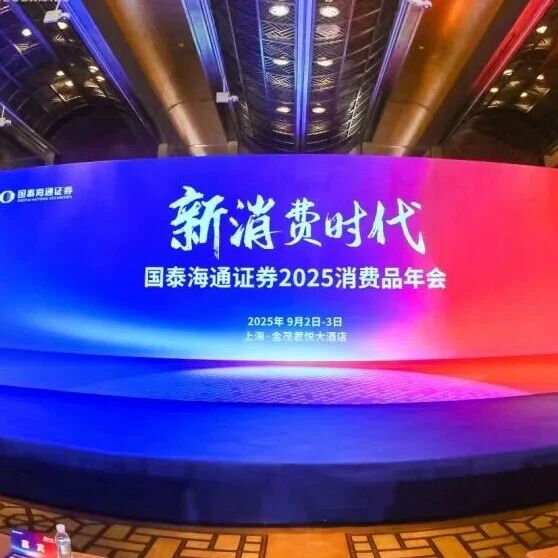
精彩花絮|“新消费时代”国泰海通证券2025消费品年会
国泰海通证券研究· 2025-09-03 08:39
1 国泰海通证券 | 研究所 消费时代 C DEMMER 1 国特周通证 铜归母净利润同 大多数种子 约先玉1 ¤在产量 1 国热热通证券 新清楚时代 【发时代 2000年 1982年 上海钻石 1 国泰海通辽养 V 恢复销售 交易所成立 黄金首饰 200 1993年 鼓比尔斯 fer 开启钻石推广 新消费时代 新道 Getty aH 1 国泰海通证券 1 国语海语馆 文化符号、收藏歌、分享歌 维深信息Wellsen 公司,公司致力为 客观、全面、有前 【播拆卡和页 1 国际用品区 公司自成立以来- 恒动性、参与! 国际局局近存 中国X型风量发 l 演员时代 2025年 9月2日-3日 上海 · 会符君悦大酒店 国泰海通证券 新消费时代 国泰海通证券 SUOTAI HAITONG SECURITIES 国泰海通证券2025消费品年会 泰田 IP i 7月 2 202 E 国泰海通证券 GUOTAIHATONG SECURITIES 新消费时代 国泰海通证券2025消费品年会 国泰海通证 翻滿氣味 T N 国泰海通证券 新消费时代 国泰海通证券2025消费品年会 117 : 5消 2025年 9 国泰周旭址 泰 ...
国泰海通|汽车经销商系列调研电话会
国泰海通证券研究· 2025-09-03 08:39
国泰海通证券 GUOTALHAITONG SECURITIES l 研究所 系列调研电话会 9月3、5、 ite 刘 潘若瑛 六年研究史 8 S 呜 132 リロ ® 9 1 回旅客回 重要提醒 本订阅号所载内容仅面向国泰海通证券研究服务签约客户。因本资料暂时无法设置访问限制,根据《证 券期货投资者适当性管理办法》的要求,若您并非国泰海通证券研究服务签约客户,为保证服务质量、 控制投资风险,还请取消关注,请勿订阅、接收或使用本订阅号中的任何信息。我们对由此给您造成的 不便表示诚挚歉意,非常感谢您的理解与配合!如有任何疑问,敬请按照文末联系方式与我们联系。 法律声明 本公众订阅号(微信号 GTHT RESEARCH )为国泰海通证券股份有限公司(以下简称"国泰海通证券") 研 更多国泰海通研究和服务 亦可联系对口销售获取 ...

国泰海通|策略:海纳百川:海外资本与国内ETF加速流入中国
国泰海通证券研究· 2025-09-02 11:58
Core Viewpoint - The A-share market is experiencing increased trading activity, with significant inflows from ETFs and other capital sources, indicating a positive shift in market sentiment and participation from retail investors [3][4][6]. Group 1: Market Trading Activity - The trading heat in the A-share market has risen, with the average daily trading volume reaching 3 trillion yuan, and the turnover rate for the Shanghai Composite Index and CSI 300 both rising to the 98th percentile [3]. - The number of stocks hitting the daily limit has decreased to 69, with the maximum consecutive limit-up days averaging 5.5, and the sealing rate slightly declining to 67.4% [3]. - The proportion of stocks that gained in value has dropped to 32.06%, with the median weekly return for all A-shares falling to -2.07% [3]. Group 2: Capital Flows - Public funds saw new issuance scale increase to 20.528 billion yuan, with equity funds increasing their positions [4]. - Foreign capital inflow reached 245 million USD as of August 27, with northbound trading accounting for 13.3% of total trading [4]. - The net inflow of ETFs expanded to 8.39 billion yuan, with passive trading significantly increasing to 6.1% of total trading volume [4]. Group 3: Industry Allocation - The technology and financial cyclical sectors are attracting significant capital, with net inflows in electronics (+30.15 billion yuan) and communications (+8.41 billion yuan) leading the way [5]. - Foreign capital has notably flowed into banking and electronics sectors, with no significant outflows reported [5]. - The top three industries on the trading leaderboard are computer, electronics, and machinery equipment [5]. Group 4: Hong Kong and Global Capital Flows - Southbound capital inflow increased to 22.17 billion yuan, marking a 75th percentile level since 2022, while foreign capital inflow into the Hong Kong market reached 34.1 million USD as of August 27 [6]. - Developed markets saw a net outflow of 3.85 billion USD, while emerging markets experienced a net inflow of 0.4 billion USD [6]. - Active foreign capital continues to flow into A-shares, with the inflow scale marginally expanding [6].

国泰海通 · 晨报0903|固收、基本面量化、食品饮料
国泰海通证券研究· 2025-09-02 11:58
Group 1: Fixed Income Strategies - The strategy for credit bonds and sci-tech bonds ETFs focuses on four main considerations: cash retention versus bond allocation, seeking flexibility versus static returns, duration versus credit risk for yield, and the duration structure of holdings being either barbell or bullet [4] - Historical review indicates that cash retention is typically a short-term phenomenon during periods of weak market conditions, and the likelihood of holding cash is low [4] - In the current low interest rate and low spread environment, actively seeking static returns through credit bond ETFs is not cost-effective, and these ETFs tend to extend duration to seek flexibility when interest rates stabilize or decline [4][5] Group 2: Credit Bond ETF Preferences - Given the current market environment, the preference for sci-tech bond ETFs may align with that of credit bond ETFs during correction periods, focusing on high flexibility and high ratings while favoring a barbell strategy with increased allocation to long-duration bonds [5] - The credit dimension shows that during volatile periods, credit bond ETFs have increased their allocation to high-rated bonds, and this trend is expected to continue for sci-tech bond ETFs, maintaining a dominant position in AAA-rated and above securities [5] Group 3: Selection Strategies for Sci-Tech Bonds - The selection strategy for sci-tech bonds during expansion expectations is based on the excess spread between component bonds and non-component bonds, with a narrowing spread observed as of August 29 [6] - There is an anticipated increase in demand for perpetual (non-subordinated) sci-tech bonds due to expansion expectations, with three of the first ten sci-tech bond ETFs including such bonds [6] - The issuance space for new sci-tech bonds has increased, with an average weekly issuance of 427 billion since July, indicating a growing opportunity for new issuances [6] Group 4: Market Trends in Consumer Goods - The food and beverage sector is expected to show performance advantages in growth, with a stable revenue scale and a deceleration in profit growth, particularly in the beverage and snack segments [15] - The overall performance of the food and beverage sector in Q2 2025 showed a slight increase in revenue and a decrease in net profit, with specific segments like soft drinks and snacks experiencing significant growth [16][17] - The high-end and sub-high-end liquor segments are facing pressure on demand, leading to a notable divergence in performance among brands, with top brands maintaining stability while others struggle [16]

国泰海通|海外策略:港股可选消费板块盈利预期下修
国泰海通证券研究· 2025-09-02 11:58
Core Viewpoint - Global markets experienced mixed performance last week, with increased trading activity and heightened market observation. There are indications from multiple Federal Reserve officials suggesting a potential interest rate cut in September, with market expectations of approximately two rate cuts within the year. Additionally, economic forecasts for both the US and China have been marginally revised upwards, while earnings expectations for US tech stocks in 2026 continue to be upgraded, and those for Hong Kong stocks have been slightly downgraded [1]. Market Performance - Global markets showed mixed results last week, with MSCI Global down by 0.4%, MSCI Developed down by 0.4%, and MSCI Emerging down by 0.6%. In the bond market, French 10Y government bond yields saw a significant increase. In commodities, silver prices led the gains. Currency-wise, the US dollar strengthened, the British pound depreciated, the Japanese yen remained stable, and the Chinese yuan appreciated. Sector-wise, the materials sector in Hong Kong led the gains, while the energy sector in the US showed relative strength [2]. Trading Sentiment - Overall trading sentiment in global stock markets improved last week, with increased trading volumes in indices such as the Hang Seng Index, S&P 500, European Stoxx 50, and Nikkei 225, while the Korean Kospi 200 saw a decline in trading volume. Investor sentiment in Hong Kong and the US decreased but remained at historically high levels. Volatility increased in Hong Kong, US, and European markets, while it decreased in Japan. Valuations for both developed and emerging markets saw a decline compared to the previous week [2]. Earnings Expectations - Earnings expectations for Hong Kong's consumer discretionary sector were downgraded last week. Comparatively, US earnings expectations for 2025 showed the best performance, followed by European and Hong Kong markets, with Japan lagging. Specifically, Hong Kong's Hang Seng Index 2025 EPS forecast was revised down from 2190 to 2140. The S&P 500's 2025 EPS forecast was adjusted from 268 to 269, while the Eurozone STOXX 50's 2025 EPS forecast was slightly increased from 335 to 336 [3]. Economic Expectations - Economic forecasts for both the US and China were revised upwards last week. The Citigroup US Economic Surprise Index increased, benefiting from expectations of Federal Reserve rate cuts and strong earnings reports from tech leaders like Nvidia. Conversely, the European Economic Surprise Index declined, likely due to a drop in the Eurozone Economic Sentiment Index in August. China's Economic Surprise Index rose, attributed to policy expectations, increased retail participation, and structural highlights in earnings reports [3]. Capital Flows - Global macro liquidity showed a slight easing last week. Recent comments from several Federal Reserve officials indicated a potential rate cut in September. As of August 29, futures market implied rates suggested expectations of approximately 2.2 rate cuts by the Federal Reserve this year, an increase from the previous week. Last week, US dollar liquidity tightened marginally. In terms of micro liquidity, July saw capital inflows primarily into India, Europe, Hong Kong, and South Korea, with flexible foreign capital and net inflows into Hong Kong stocks last week [4].

国泰海通|金工:风格及行业观点月报(2025.09)
国泰海通证券研究· 2025-09-02 11:58
Group 1 - The core viewpoint of the article indicates that the market is favoring small-cap and growth styles, with the style rotation model for Q3 2025 confirming this trend [1][2] - In August, the small-cap stocks outperformed large-cap stocks with a monthly excess return of 1.34%, while growth stocks outperformed value stocks with a monthly excess return of 12.76% [1][3] - The industry rotation model showed that in August, two industry combinations achieved absolute returns exceeding 12%, with excess returns above 4% [1][3] Group 2 - The dual-driven rotation strategy for Q3 2025 indicated a signal for small-cap stocks based on the latest data as of June 30, 2025, with a composite score of -3 [2] - The dual-driven rotation strategy for Q3 2025 also indicated a signal for growth stocks, with a composite score of -5 [3] - In August, the composite factor strategy achieved an excess return of 4.38%, while the single-factor multi-strategy achieved an excess return of 4.59% [3]

国泰海通|食饮:成长为主,供需出清迎拐点——食品饮料板块2025年中报总结
国泰海通证券研究· 2025-09-02 11:58
Core Viewpoint - The food and beverage sector shows stable revenue and profit growth in the first half of 2025, with a slight decline in profit in the second quarter, indicating a mixed performance across different segments [1][2]. Group 1: Overall Performance - In H1 2025, the food and beverage sector's revenue and net profit both increased by 1% year-on-year, while Q2 showed a revenue increase of 0.2% but a net profit decline of 2% [1][2]. - The liquor segment is experiencing a slowdown, while consumer goods are showing structural growth, particularly in soft drinks, yellow wine, condiments, and dairy products [2]. Group 2: Liquor Segment - The liquor market is under pressure, with high-end, sub-high-end, and regional liquor revenues growing by 3%, -5%, and -27% respectively in Q2 2025, and net profits declining by 1%, -19%, and -42% [3]. - The competitive environment is leading to a faster destocking process, with high-end brands like Moutai maintaining stable performance while second-tier brands are experiencing a more pronounced destocking rhythm [3]. Group 3: Consumer Goods Performance - Beer revenue grew by 2% and net profit by 13% in Q2 2025, driven by structural upgrades and cost improvements [4]. - Yellow wine saw a revenue increase of 9% and a net profit increase of 64% in Q2 2025 [4]. - Soft drinks experienced a revenue increase of 17% and a net profit increase of 19%, indicating sustained high demand [4]. - Snacks showed a mixed performance with revenue up by 11% but net profit down by 54%, highlighting internal differentiation [4]. - Dairy products reported a revenue increase of 4% and a net profit increase of 47%, reflecting improved profitability [4]. - Condiments saw a revenue increase of 6% and a net profit increase of 9%, driven by falling costs [4]. - The restaurant supply chain faced a revenue increase of 3% but a profit decline of 14%, indicating weak consumer recovery and intensified competition [4]. - Processed meat products experienced a revenue decline of 14% and a net profit decline of 41%, with ongoing pressure on profitability [4].