LEAPMOTOR(09863)

Search documents
大洗牌!造车新势力巨变来袭
Xin Lang Cai Jing· 2025-12-02 11:44
Core Insights - The competition among new energy vehicle manufacturers is intensifying, with significant shifts in market leadership as companies strive to establish themselves ahead of the 2025 deadline [1][3][38] - The "big reshuffle" in the automotive market is a recurring theme as new players enter the field, leading to increased industry concentration and the potential elimination or upgrading of smaller firms [4][39] Sales Performance - Hongmeng Zhixing achieved a record monthly delivery of 81,900 vehicles in November, marking a 89.61% year-on-year increase [5][40] - Leap Motor delivered 70,327 vehicles in November, maintaining a growth streak for nine consecutive months [5][40] - Xiaomi's sales exceeded 40,000 units, solidifying its position in the second tier of new energy vehicle manufacturers [5][40] - Xpeng Motors delivered 36,728 vehicles, showing a 19% year-on-year increase but a 12.6% decline from the previous month [5][40] - NIO delivered 36,275 vehicles, with a 76.3% year-on-year increase but a 10% month-on-month decline [5][40] - Li Auto's deliveries were 33,181 units, reflecting a 31.9% year-on-year decrease but a 4.45% month-on-month increase [5][40] - Deep Blue and Lantu also reported sales of 33,060 and 20,005 vehicles respectively, with varying year-on-year performance [5][40] Market Dynamics - The new energy vehicle sector is experiencing a significant transformation, with companies like Leap Motor and Xiaomi achieving their annual sales targets ahead of schedule [8][43] - The competitive landscape is shifting, with traditional leaders like NIO, Xpeng, and Li Auto facing challenges as they collectively fall below 40,000 units in November [6][41][42] - The market is increasingly defined by technological advancements, with safety becoming a critical concern for manufacturers as they navigate the evolving landscape [70] Financial Performance - Leap Motor has exceeded its annual delivery target of 500,000 vehicles, while NIO, Xpeng, and Leap are all currently operating at a loss [26][61] - Li Auto has emerged as the first new energy vehicle manufacturer to achieve annual profitability, with a reported net profit of 11.81 billion yuan [25][26] - The cumulative losses for NIO have surpassed 100 billion yuan, highlighting the financial struggles faced by many in the sector [58][61] Industry Trends - The new energy vehicle market is characterized by a rapid influx of players, with significant investments exceeding 100 billion yuan over the past decade [11][46] - The competitive dynamics have led to a re-evaluation of market positions, with companies like Xiaomi quickly gaining traction despite being relatively new entrants [10][67] - The industry is moving towards a phase where technological capabilities will determine survival, with safety and reliability becoming paramount [70]





海通国际:内地11月新能源车“翘尾”行情遇冷 车企年终冲刺更考验销量与盈利之间平衡
智通财经网· 2025-12-02 09:25
Core Insights - The automotive industry in mainland China is experiencing a significant divergence in sales performance as major car manufacturers report their November sales figures, with the impact of the "two new" policies fading and sales growth slowing down or even declining [1][2][3] Group 1: Sales Performance - Geely Automobile reported November sales of 310,000 units, a year-on-year increase of 24% and a month-on-month increase of 1%, with a cumulative total of 2.79 million units for the first eleven months, representing a 42% year-on-year increase [1] - Leap Motor achieved over 70,000 units in November, maintaining a year-on-year growth of 75%, with a cumulative delivery of 536,000 units for the first eleven months, up 113% year-on-year [2] - Xiaomi Automobile delivered over 40,000 units in November, maintaining this level for three consecutive months, and is expected to exceed its annual target of 350,000 units by the third week of December [3] Group 2: New Energy Vehicles - Geely's new energy vehicle sales reached 188,000 units in November, a year-on-year increase of 53%, with a penetration rate exceeding 60% [1] - Leap Motor's B and C series vehicles are seeing increased deliveries, with the A10 model recently unveiled at the Guangzhou International Auto Show [2] - The "Five Realms" product matrix of Chery Automobile has been completed, indicating strong future performance potential [2] Group 3: Competitive Landscape - Ideal Auto's November deliveries were 33,000 units, a year-on-year decrease of 32%, with cumulative deliveries for the first eleven months at 362,000 units, down 18% year-on-year [3] - NIO's November sales were 36,000 units, a year-on-year increase of 76%, but cumulative deliveries for the first eleven months were only 278,000 units, indicating challenges in meeting year-end targets [3] - The overall industry is facing a challenging environment with regulatory pressures and the withdrawal of subsidies, limiting the potential for significant changes in market structure in December [3]

海通国际:“翘尾”行情遇冷 新能源车全年格局基本落定
Zhi Tong Cai Jing· 2025-12-02 06:09
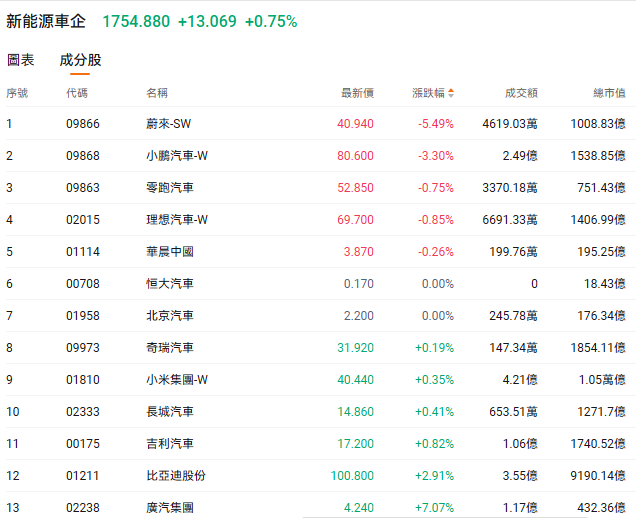
Core Viewpoint - The automotive market is experiencing a significant shift in sales dynamics as major car manufacturers report their November sales figures, with a notable decline in the "tail-end" effect compared to previous years. The exit of subsidy policies is leading to a slowdown in sales growth, making it challenging for companies to balance sales and profitability during the year-end push [1][2]. Group 1: Sales Performance - BYD (002594) achieved sales of 480,000 units in November, a month-on-month increase of 9%, with domestic sales at 348,000 units. Cumulative sales from January to November reached 4.182 million units, reflecting an 11% year-on-year increase. Notably, overseas exports exceeded 130,000 units, marking a nearly 300% year-on-year increase [2]. - Geely Automobile (00175) reported November sales of 310,000 units, a year-on-year increase of 24% and a month-on-month increase of 1%. Cumulative sales for the first eleven months reached 2.79 million units, a 42% year-on-year increase, positioning the company to meet its annual target of 3 million units [2]. - New energy vehicle sales for Geely in November reached 188,000 units, a year-on-year increase of 53%, with a penetration rate exceeding 60% [2]. Group 2: Emerging Players - Leap Motor (09863) sold over 70,000 units in November, a year-on-year increase of 75%, maintaining a steady performance. Cumulative deliveries for the first eleven months reached 536,000 units, a 113% year-on-year increase, surpassing its annual target of 500,000 units [3]. - Hongmeng Zhixing delivered 82,000 units in November, a year-on-year increase of 90%, with strong demand for its models [3]. - Xiaomi Automobile delivered over 40,000 units in November, maintaining this level for three consecutive months, and is expected to exceed its annual target of 350,000 units [3]. Group 3: Competitive Landscape - Li Auto (02015) delivered 33,000 units in November, a year-on-year decrease of 32%, with cumulative deliveries of 362,000 units, an 18% year-on-year decline [4]. - Xpeng Motors (09868) delivered 37,000 units in November, a year-on-year increase of 19%, with cumulative deliveries of 392,000 units, reflecting a 156% year-on-year increase [4]. - NIO (09866) reported November sales of 36,000 units, a year-on-year increase of 76%, with cumulative deliveries of 278,000 units from January to November [4].

电动车11月成绩单:鸿蒙智行突破8万辆创新高,小米再破4万辆,“蔚小理”集体环比下滑
Hua Er Jie Jian Wen· 2025-12-02 03:38
Core Insights - The Chinese electric vehicle market is experiencing significant growth, with BYD leading in November sales at 480,200 units, followed by Hongmeng Zhixing with over 80,000 units, and Zeekr and Leap Motor with over 60,000 and 70,000 units respectively [1][2][6] Group 1: Sales Performance - BYD's November production reached 474,175 units, with a cumulative production of 4,117,760 units for the year, reflecting a year-on-year increase of 7.29% [6][8] - Hongmeng Zhixing achieved a record monthly delivery of 81,864 units, maintaining its position as the industry leader [6][11] - Zeekr's sales reached 63,902 units in November, marking a 7.1% year-on-year increase [11] - Leap Motor delivered 70,327 units, showing a growth of over 75% year-on-year [13] - NIO's multi-brand strategy resulted in 36,275 units delivered, a 76.3% increase year-on-year [19] - Ideal Auto delivered 33,181 units, with total historical deliveries reaching 1,495,969 units [24][28] Group 2: Market Dynamics - The market is showing a clear differentiation, with over half of the companies achieving monthly deliveries exceeding 10,000 units, while leading companies are widening their sales advantages [2] - The "Wei Xiao Li" trio (NIO, Xpeng, and Li Auto) experienced varying degrees of decline in delivery numbers compared to the previous month [2] - Xiaomi's automotive division reported over 40,000 units delivered in November, continuing its strong growth momentum [16][18] Group 3: New Models and Strategies - Several companies are launching new models or updating delivery policies, with the launch of the Zhiji LS9 and the upcoming Lantu Chasing Light L on December 10 [5][36][37] - Ideal Auto is implementing a dual-supplier model for battery supply to enhance production capacity for its i6 model, expecting to stabilize monthly production at 20,000 units early next year [28]
11月新能源车销量跟踪:“翘尾”行情遇冷,全年格局基本落定
Haitong Securities International· 2025-12-02 01:40
Investment Rating - The report does not explicitly provide an investment rating for the automotive industry or specific companies within it [26]. Core Insights - The year-end sales data for major automakers indicates a significant divergence in performance, with the typical "year-end tailwind" being weaker than in previous years. The phase-out of the "two-new" subsidy policies is contributing to a trend of slowing or declining sales growth [8][9]. - BYD's November sales were 480,000 units, down 5% year-on-year but up 9% month-on-month, primarily due to weaker domestic demand. Domestic sales were 348,000 units, down 27% year-on-year. Cumulative sales from January to November reached 4.18 million units, an 11% increase year-on-year [9][10]. - Geely's November sales reached 310,000 units, a 24% year-on-year increase, with cumulative sales of 2.79 million units, up 42% year-on-year, putting its annual target of 3 million units within reach. NEV sales for Geely in November were 188,000 units, a 53% year-on-year increase [9][10]. - Leapmotor exceeded 70,000 units in November, marking a 75% year-on-year increase, with cumulative deliveries reaching 536,000 units, surpassing its annual target ahead of schedule [10][11]. - Xiaomi Auto delivered over 40,000 units in November, maintaining this level for three consecutive months, and raised its full-year delivery outlook to over 400,000 units [12]. - Li Auto's November deliveries were 33,000 units, down 32% year-on-year, with cumulative deliveries of 362,000 units, an 18% decrease year-on-year [13]. - NIO's November sales were 36,000 units, a 76% year-on-year increase, but cumulative deliveries totaled 278,000 units, indicating challenges in achieving profitability in Q4 [14][15]. Summary by Sections Sales Performance - BYD's November sales were 480,000 units, with domestic sales at 348,000 units, reflecting a significant year-on-year decline [9][10]. - Geely's sales performance showed strong growth, particularly in NEVs, with a notable increase in overseas exports [9][10]. - Leapmotor and Xiaomi Auto demonstrated robust sales growth, exceeding their targets [10][12]. Market Dynamics - The automotive market is experiencing a reshuffling of sales rankings, with leading new energy vehicle (NEV) players facing slowing growth [10][11]. - The competitive landscape is intensifying, with companies needing to balance volume and profitability as subsidies phase out [15].
造车新势力Q3财报
2 1 Shi Ji Jing Ji Bao Dao· 2025-12-01 23:13
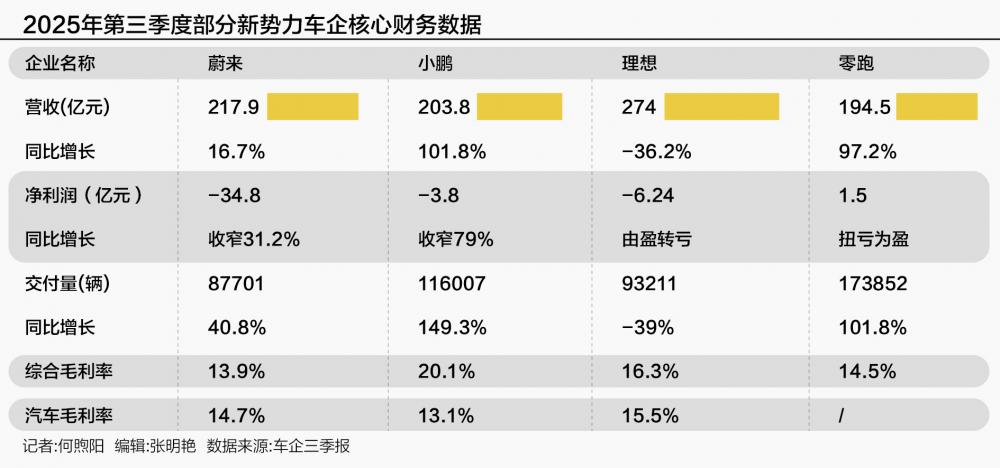
Core Insights - The competitive landscape of new energy vehicle manufacturers in China is undergoing significant changes as Q3 2025 financial reports are released, with Xpeng Motors showing remarkable growth while NIO and Li Auto face challenges [1][2][3] Company Performance - **Xpeng Motors**: Achieved a revenue of 203.8 billion yuan, with a year-on-year growth of 101.8%. Despite a net loss of 3.8 billion yuan, this represents a 79% reduction in losses compared to the previous year. The company delivered 116,007 vehicles, marking a 149.3% increase year-on-year [4][6][8] - **NIO**: Reported a revenue of 217.9 billion yuan, with a year-on-year growth of 16.7%. The net loss was 34.8 billion yuan, a 31.2% reduction from the previous year. NIO delivered 87,701 vehicles, a 40.8% increase year-on-year [4][12][14] - **Li Auto**: Generated a revenue of 274 billion yuan, but experienced a 36.2% year-on-year decline. The company reported a net loss of 6.24 billion yuan, ending an 11-quarter streak of profitability. Vehicle deliveries fell by 39% to over 93,000 units [4][9][11] - **Leap Motor**: Achieved a revenue of 194.5 billion yuan, with a year-on-year growth of 97.2%. The company reported a net profit of 1.5 billion yuan, marking its second consecutive profitable quarter. Leap Motor delivered nearly 174,000 vehicles, a 101.8% increase year-on-year [4][15][16] Strategic Adjustments - The new energy vehicle market is shifting from growth to competition based on product, technology, and brand strength, as companies adapt their strategies to survive in a more competitive environment [3][16] - **Xpeng Motors**: Focused on improving operational efficiency and profitability, launching new models like the X9 Super Range Extender, which aims to address consumer pain points regarding range and charging speed [7][8] - **Li Auto**: Shifted focus towards AI integration in vehicles, moving away from traditional family-oriented branding to emphasize technological advancements [10][11] - **NIO**: Reduced operational costs and refocused on core automotive sales, moving away from previous explorations in other business areas [12][13] - **Leap Motor**: Adjusted its strategy to enter the range extender market and target the high-end SUV segment, while also attempting to elevate its brand image [15][16]

乌美就领土问题讨论达6.5小时;加密货币大跌!超26万人爆仓;宁德时代基层员工每月涨薪150元;万科境内债展期方案曝光丨每经早参
Mei Ri Jing Ji Xin Wen· 2025-12-01 22:09
Group 1 - French President Macron will visit China from December 3 to 5 at the invitation of President Xi Jinping [4] - The U.S. stock market saw a collective decline, with the Dow Jones down 0.89%, Nasdaq down 0.38%, and S&P 500 down 0.53% [4] - The cryptocurrency market experienced significant losses, with Bitcoin dropping nearly 30% since early October [4] Group 2 - International gold prices rose, with spot gold up 0.38% at $4239.15 per ounce [5] - International oil prices increased, with WTI crude oil up 1.57% at $59.47 per barrel [6] Group 3 - The number of planned flights from China to Japan has seen over 40% cancellations, totaling more than 1900 flights [8] - The Hong Kong government reported 151 fatalities from a recent fire incident, with over 30 individuals still missing [8] Group 4 - The China Logistics and Purchasing Federation released a guideline on the application of AI in procurement and supply chain management [9] - The guideline focuses on building an efficient, collaborative, and secure modern procurement supply chain system [9] Group 5 - NIO reported a vehicle collision incident, clarifying that the vehicle was not in autonomous driving mode during the accident [17] - NIO's safety and battery performance are under scrutiny, impacting confidence in the electric vehicle industry [18] Group 6 - Nvidia announced a $2 billion investment in Synopsys, aiming to integrate AI computing technology into industrial design and engineering [21] - This partnership is expected to significantly expand Nvidia's market reach in the industrial sector [21] Group 7 - Vanke proposed a one-year extension for the repayment of a 2 billion yuan medium-term note due to challenging business conditions [22] - The extension reflects ongoing risks in the real estate sector, prompting investor attention to the company's financial health [22] Group 8 - The president of PICC Property and Casualty was taken away for investigation, raising concerns about leadership stability in the insurance industry [23] - Under his leadership, the company saw significant growth in premium income, indicating potential impacts on market stability [23]



车企11月“翘尾”行情降温,比亚迪月度销量仍未超50万辆
Zhong Guo Ji Jin Bao· 2025-12-01 15:20
Core Insights - The automotive industry in China is experiencing a mixed performance in November, with some leading companies showing a slowdown in sales growth or declines, while others achieve record sales [2][3][21] - BYD's November sales reached 480,186 units, a year-on-year decrease of 5.25%, with domestic sales down 26.81% [2][5][11] - New energy vehicle companies like Leap Motor and others have successfully met their annual delivery targets ahead of schedule [15][17] Group 1: Sales Performance - BYD's November sales were 480,186 units, failing to surpass the 500,000 mark [5][11] - SAIC and Geely saw significant year-on-year growth in November, with sales increasing by 19.75% and 53.36%, respectively [11][12] - Leap Motor's sales reached 70,327 units, marking a 75.08% increase year-on-year [4][15] Group 2: Market Trends - The expected year-end sales surge, known as the "tailwind effect," is cooling down, with many companies reporting lower growth rates compared to the previous year [21][22] - NIO's delivery guidance for Q4 remains unchanged, expecting deliveries between 120,000 and 125,000 units [21][22] - The suspension of vehicle trade-in subsidies in several regions is impacting short-term sales expectations [21][22] Group 3: Competitive Landscape - Geely's new energy vehicle penetration rate reached a record high of 60.50% in November, driven by the success of its Galaxy brand [12][14] - New energy vehicle companies like Lantu and Avita are also seeing significant sales growth, with Lantu's sales up 84.28% year-on-year [19][20] - Xiaomi and Xpeng have also set ambitious new sales targets for 2025, reflecting confidence in their market positions [17][15]


11月压力大!车企销量看环比就露馅
Jing Ji Guan Cha Bao· 2025-12-01 15:03
Group 1 - The Chinese automotive market remains strong in November, but the impact of subsidy reductions is spreading beyond price-sensitive consumers, leading to a general delay in purchasing decisions [2] - NIO's CEO Li Bin noted a significant drop in new orders across the industry in November, with consumers adopting a wait-and-see approach [2] - BYD's sales in November reached 480,000 units, a year-on-year decline of 5.25%, indicating a shift from rapid growth to a need for structural adjustment [2] Group 2 - Geely's sales in November were 310,000 units, a year-on-year increase of 24%, supported by multiple product lines [3] - SAIC's overall sales reached 316,000 units, with a growth rate of 9.5%, indicating a stable performance across its brands [3] - Great Wall and Chery maintained steady sales, with Great Wall selling 133,200 units (up 4.57%) and Chery selling 255,800 units (down 2%) [3] Group 3 - The new energy vehicle segment is gaining traction among state-owned enterprises, with Dongfeng's Lantu surpassing 20,000 units in November [4][5] - Traditional brands like FAW showed stable performance, with total sales of 306,000 units in November, including a significant increase in new energy vehicle sales [5] Group 4 - Huawei's automotive strategy is evolving, with its smart vehicle delivery reaching 81,864 units in November, reflecting its growing influence in the industry [6] - The competition is shifting from vehicle-to-vehicle to ecosystem-to-ecosystem, highlighting the importance of integrated capabilities [6] Group 5 - New entrants like Leap Motor delivered 70,327 units in November, marking a year-on-year growth of over 75%, positioning themselves as significant competitors [6] - Xiaomi maintained stable delivery levels above 40,000 units, while XPeng and NIO also reported strong growth in November [7] Group 6 - The automotive market is entering a phase that tests companies' capabilities, with consumers becoming more discerning and extending their decision-making processes [8] - The focus of competition is shifting from subsidies to long-term brand value, supply chain stability, and technological advancement [9]

造车新势力11月齐遇“寒流”:“蔚小理”集体环比下滑
Feng Huang Wang· 2025-12-01 15:00
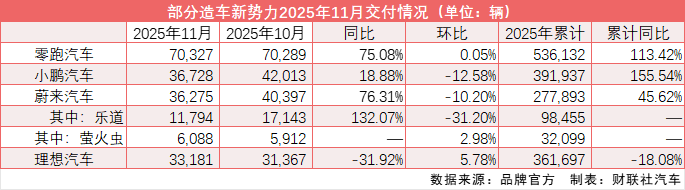
Core Viewpoint - The new energy vehicle market is experiencing varied delivery performances among different manufacturers in November, with some companies showing growth while others face declines. The overall market sentiment is cautious due to tightening policies and consumer hesitation. Group 1: Delivery Performance - Leap Motor led the delivery numbers with 70,327 units in November, marking a 75.08% year-on-year increase and a slight 0.05% month-on-month growth, achieving its annual sales target of 500,000 units 45 days ahead of schedule [2][3] - Xiaopeng Motors delivered 36,728 units, reflecting an 18.88% year-on-year increase but a 12.58% month-on-month decline, marking its first monthly drop in six months [3][4] - NIO delivered 36,275 units, a 76.31% year-on-year increase, with its sub-brands showing significant growth, particularly the LeDao brand with a 132.07% increase [2][3] - Li Auto's deliveries were at 33,181 units, showing a 31.92% year-on-year decline, continuing a six-month trend of year-on-year decreases [4][5] Group 2: Future Projections and Strategies - Leap Motor aims to reach a sales target of 1 million units by 2026, supported by the launch of new models like the A10 and Lafa5, which cater to different market segments [3][4] - Xiaopeng Motors is expanding its overseas market presence, with a 95% year-on-year increase in overseas deliveries, and is optimistic about new models contributing to future growth [3][4] - NIO has set a quarterly delivery guidance of 120,000 to 125,000 units, needing to deliver over 43,000 units in December to meet this target [4] - Li Auto is focusing on enhancing its long-term competitiveness through organizational, product, and technological improvements, with a cautious delivery guidance of 100,000 to 110,000 units for the fourth quarter [5]