Shanxi Xinghuacun Fen Wine Factory (600809)

Search documents
食品饮料周报(25年第40周):酒类渠道包袱加速去化,大众品品类表现分化-20251105
Guoxin Securities· 2025-11-05 11:16
Investment Rating - The report maintains an "Outperform the Market" rating for the food and beverage sector [4][5][11]. Core Views - The food and beverage sector is currently characterized by "low base, low holdings, and low expectations," indicating potential for stock price increases with any changes in supply and demand dynamics [3][11]. - The report highlights a divergence in performance across categories, with beverages outperforming food and alcoholic beverages [2][11]. - The report suggests that the liquor segment is entering a left-side layout phase, with quality companies expected to gain greater growth opportunities [2][11]. Summary by Relevant Sections Liquor - The liquor sector is experiencing an expanded decline in performance, with Q3 revenue down 18.4% year-on-year and net profit down 22.2% [2][11]. - Recommended companies include Luzhou Laojiao, Shanxi Fenjiu, and Guizhou Moutai, which are expected to benefit from national expansion and pricing power [2][11]. - The report notes that the current inventory clearance pace is similar to the 2013-2014 period, suggesting a potential recovery in the future [11]. Beer - The beer industry is in a healthy inventory position, awaiting demand recovery, with recommendations for Yanjing Beer and China Resources Beer [12][11]. - The report anticipates that the relaxation of consumption regulations will positively impact beer sales [12]. Dairy Products - The dairy sector is seeing a steady recovery in demand, with a recommendation for Yili as a leading company with valuation safety margins [14][11]. - The report indicates that the supply side is gradually clearing, which may lead to improved supply-demand dynamics by 2025 [14]. Snacks - The report emphasizes the importance of strong alpha stocks in the snack sector, particularly focusing on the growth potential of konjac snacks [12][11]. - Leading companies in this category, such as Weidong and Yanjin Pouch, are highlighted for their competitive advantages and strong growth prospects [12]. Food Supply Chain - The food supply chain sector is showing signs of stabilization, with recommendations for leading companies like Yihai International and Haitian Flavoring [13][11]. - The report notes that the overall profitability of the industry is expected to gradually stabilize as companies optimize their expense management [13]. Beverages - The beverage sector continues to show strong performance, with recommendations for Nongfu Spring and Dongpeng Beverage, which are expected to benefit from accelerated operations and national expansion [14][11]. - The report highlights the ongoing growth in the no-sugar tea and energy drink segments, indicating a favorable outlook for leading companies [14].



基金经理减仓白酒?不,其实是加仓
Sou Hu Cai Jing· 2025-11-05 10:51
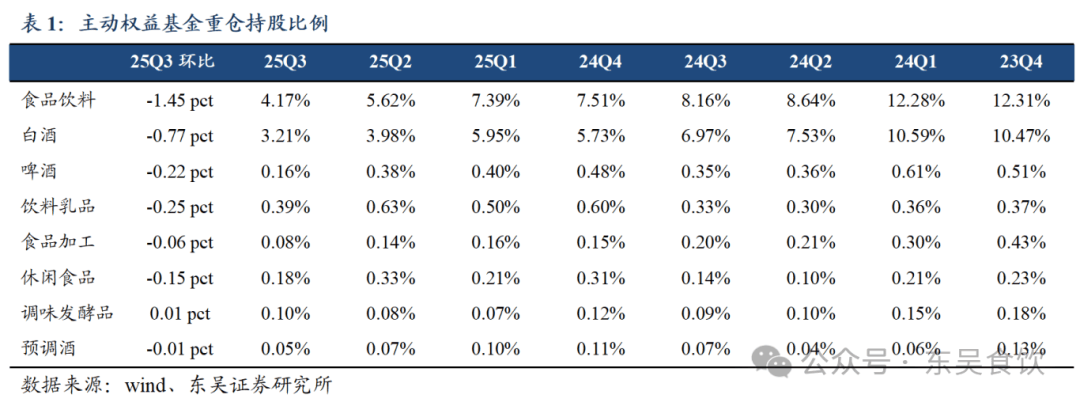
Core Viewpoint - The active funds have continued to reduce their holdings in the liquor sector during the third quarter, influenced by the underperformance of liquor stocks compared to broader indices, leading to a passive decline in their proportion within public fund holdings [2][4]. Group 1: Fund Holdings and Changes - In the third quarter, the number of liquor stocks held by active funds slightly increased from 325 million shares to 328 million shares, indicating no large-scale sell-off [4][6]. - The total number of liquor stocks held by active funds decreased significantly from 501 million shares to 325 million shares in the second quarter, a reduction of 35% [4]. - The total market value of liquor stocks held by active funds in the third quarter was approximately 6.90 billion yuan, with a slight increase in holdings compared to the previous quarter [7]. Group 2: Performance of Liquor Stocks - The China Securities Liquor Index rose by 7.75% in the third quarter, underperforming the CSI 300 Index by 10 percentage points and the "Equity Mixed Fund Index" by 18 percentage points [2]. - The proportion of liquor stocks in the public fund holdings decreased due to their underperformance relative to other sectors [2]. Group 3: Fund Managers' Strategies - Fund manager He Shuai significantly increased his positions in Kweichow Moutai and Luzhou Laojiao, which became part of the top ten holdings in his fund, accounting for a total of 11.4% [9]. - Fund manager Li Xiaoxing also increased his holdings in Luzhou Laojiao and Wuliangye, citing the attractive dividend yield and potential for recovery in consumer stocks [11]. - Fund manager Nie Shilin increased his holdings in Kweichow Moutai by 77% and in Shanxi Fenjiu by 96%, indicating a strong bullish stance on high-end liquor [13]. Group 4: Market Sentiment and Future Outlook - Some fund managers expressed a cautious outlook, suggesting that the domestic consumption and real estate sectors remain under pressure, with a focus on observing policy changes affecting consumer demand [14]. - Fund managers like Zhang Feng have shifted their focus to higher dividend yield sectors, indicating a strategic pivot towards food and beverage stocks, including liquor, due to their potential for recovery [19]. Group 5: Redemption and Fund Flows - The consumer-focused active funds experienced significant redemptions, with total shares dropping from 74.5 billion to 65.5 billion, reflecting a net redemption of 12% [25]. - In contrast, the total shares of ordinary stock and mixed funds saw only a 5% net redemption, highlighting the challenges faced by consumer-focused funds [26].



预计逆势涨超10%!消费风向变了,光瓶酒成了“香饽饽”?
Nan Fang Du Shi Bao· 2025-11-05 10:29
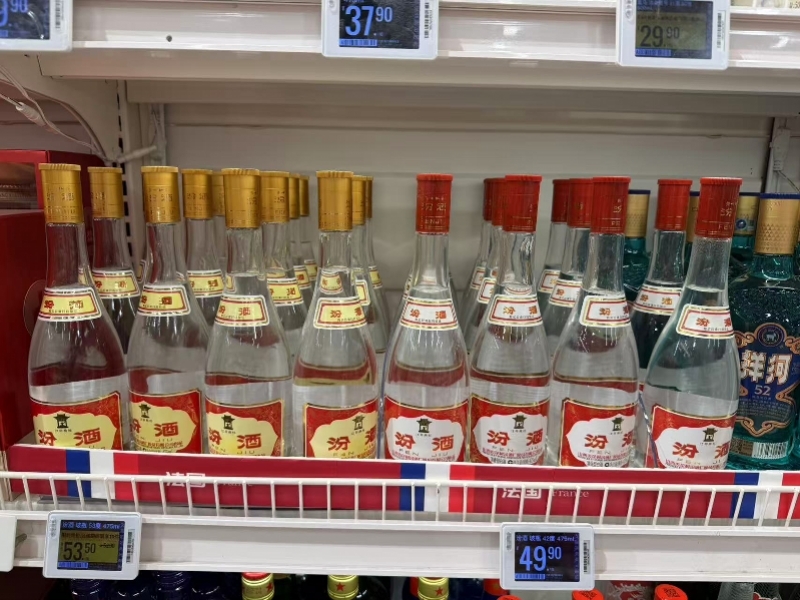
Core Viewpoint - The overall performance of the liquor industry, particularly the baijiu sector, is declining, with only a few companies like Guizhou Moutai and Shanxi Fenjiu showing slight growth, while the majority face significant revenue drops [1][2]. Industry Overview - In the third quarter of 2025, 20 listed baijiu companies reported their earnings, with only Guizhou Moutai and Shanxi Fenjiu achieving minor increases, while 18 others experienced varying degrees of decline [1]. - The baijiu industry is undergoing a deep adjustment period due to changing consumer environments and high channel inventories [1]. Market Trends - Despite the overall downturn, the light bottle liquor segment is experiencing robust growth, with products like Shanxi Fenjiu's Guo Fen showing over 10% sales growth in the first three quarters [1][5]. - The market size of light bottle liquor has expanded from 35.2 billion yuan in 2013 to over 150 billion yuan in 2024, with projections indicating it will surpass 200 billion yuan in 2025 [1][5]. Company Performance - Shanxi Fenjiu reported a revenue of 32.924 billion yuan in the first three quarters of 2025, marking a 5% year-on-year increase, with a net profit of 11.405 billion yuan, a slight increase of 0.48% [2]. - The growth in Shanxi Fenjiu's performance is attributed to its light bottle products, particularly Guo Fen, which has shown significant sales increases [2][5]. Competitive Landscape - The rapid growth of the light bottle liquor market has prompted many liquor companies to increase their investments in this segment, with notable entries from Yanghe and other brands [6][8]. - Analysts indicate a shift in consumer preferences from luxury packaging to quality and cost-effectiveness, driving the growth of light bottle liquor [8]. Market Challenges - Despite the overall growth in the light bottle liquor market, there is increasing differentiation among brands, with traditional brands like Niulanshan facing severe challenges [10][12]. - Niulanshan's revenue dropped by 19.79% to 5.869 billion yuan in the first three quarters, with a net profit decline of 79.85% [10][12]. - The competitive landscape is intensifying, with many companies facing challenges due to changing consumer habits and market dynamics [13][16].
2025中国白酒酒业市场中期研究报告
Sou Hu Cai Jing· 2025-11-05 05:52
Core Insights - The Chinese liquor industry is undergoing a significant transformation, facing challenges such as declining production and prices, while also experiencing new opportunities driven by consumer trends and digitalization [1][6][14] Group 1: Market Performance (2024-2025) - In 2024, the number of large-scale liquor enterprises decreased to 989, with total production at 4.145 million kiloliters, a year-on-year decline of 1.8%. However, sales revenue reached 796.38 billion yuan, up 5.3%, and total profit increased by 7.8% to 250.87 billion yuan, indicating a shift from extensive to intensive development [2][16] - The top six brands (CR6) accounted for 86% of the industry's total profit in 2024, up from 55% in 2014, highlighting a growing concentration in the market [2][20] - In the first quarter of 2025, the industry faced further pressure with production down 7.2% year-on-year to 1.032 million kiloliters, marking a potential eighth consecutive year of decline [3][26] Group 2: Consumer Trends and Pricing - The first half of 2025 saw a significant shift in consumer behavior, with only 26.9% of distributors reporting increased sales before the Spring Festival, dropping to 11.5% during the May Day holiday [4] - The price range of 100-300 yuan became the most active market segment, while higher price segments faced significant challenges, with the price of premium brands like Moutai dropping over 36% since 2022 [4][6] - Young consumers are increasingly defining value in the liquor market, prompting companies to innovate product designs and marketing strategies to attract this demographic [5][6] Group 3: Industry Challenges - The industry is experiencing a "volume and price decline" scenario, with over 59.7% of liquor companies reporting reduced operating profits due to rising costs and declining sales [3][34] - The average inventory turnover days reached 900, a 10% increase year-on-year, indicating high inventory pressure and a widespread issue of price inversion affecting 60% of companies [23][34] - The overall market is characterized by a cautious consumer sentiment, with many companies resorting to discounts and bundled sales to maintain market share, further squeezing profit margins [3][34] Group 4: Future Outlook - The report suggests that 2025 presents a strategic opportunity for the liquor industry to achieve high-quality development despite short-term challenges, focusing on product innovation, digital transformation, and cultural marketing [6][14] - The industry is expected to transition from "scale growth" to "value growth," with a focus on enhancing product quality and consumer experience [6][14]

晨会纪要:2025年第188期-20251105
Guohai Securities· 2025-11-05 03:12
Key Insights - The report highlights a rebound in the electrolyte industry, with significant growth potential in fluorinated liquids, particularly for the company Xinzhou Bang, which reported a revenue of 6.616 billion yuan for the first three quarters of 2025, a year-on-year increase of 16.75% [6][10] - The company achieved a net profit of 748 million yuan, up 6.64% year-on-year, with a sales gross margin of 24.51%, reflecting a decline of 2.58 percentage points [6][10] - The report indicates that the company is well-positioned to benefit from the recovery in the electrolyte market, driven by rising prices of lithium hexafluorophosphate and improved operational efficiency [10][11] Group 1: Xinzhou Bang (Battery) - The company reported a revenue of 2.368 billion yuan in Q3 2025, a year-on-year increase of 13.60% and a quarter-on-quarter increase of 5.45% [7] - The net profit for Q3 2025 was 264 million yuan, down 7.51% year-on-year but up 4.03% quarter-on-quarter, indicating a mixed performance [7][8] - The company is focusing on optimizing its product structure and enhancing operational efficiency, with a stable growth trajectory in its organic fluorine chemicals and electronic information chemicals [9][10] Group 2: Weijian Medical (Personal Care Products) - The company achieved a revenue of 7.897 billion yuan in the first three quarters of 2025, a year-on-year increase of 30.10%, with a net profit of 732 million yuan, up 32.36% [13][14] - The medical segment saw a revenue increase of 44.4%, driven by strong growth in surgical consumables and high-end dressings [14] - The consumer segment also performed well, with a revenue of 4.01 billion yuan, up 19.1%, led by significant growth in the sales of sanitary products [15] Group 3: Longqi Technology (Consumer Electronics) - The company reported a revenue of 31.332 billion yuan for the first three quarters of 2025, a year-on-year decrease of 10.28%, but a net profit increase of 17.74% [21] - In Q3 2025, the revenue was 11.424 billion yuan, down 9.62% year-on-year, while the net profit increased by 64.46% [22] - The company is expanding its product portfolio under the "1+2+X" strategy, focusing on smart devices and automotive electronics [23][24] Group 4: Minxin Technology (Semiconductors) - The company reported a revenue of 464 million yuan in the first three quarters of 2025, a year-on-year increase of 37.73%, with a gross margin of 30.28% [25][26] - In Q3 2025, the revenue was 160 million yuan, up 21.9% year-on-year, indicating strong demand for pressure and inertial sensors [25][27] - The company is well-positioned to benefit from the growth of MEMS sensors in the AI era, with a diverse product matrix [26][28] Group 5: Yingly Technology (General Equipment) - The company reported a revenue of 2.121 billion yuan in the first three quarters of 2025, a year-on-year increase of 11.02%, with a net profit of 294 million yuan, up 29.59% [35][36] - The company is expanding its processing and coating capabilities in the blade and casing industry, which is expected to enhance its production capacity [37] - The gross margin for Q3 2025 was 38.03%, reflecting a significant improvement in profitability [38] Group 6: Weichai Power (Automotive Parts) - The company reported a revenue of 170.57 billion yuan for the first three quarters of 2025, a year-on-year increase of 5.3%, with a net profit of 8.88 billion yuan, up 5.7% [44] - In Q3 2025, the revenue was 57.42 billion yuan, up 16.1% year-on-year, driven by strong demand in the heavy truck sector [44] - The company is benefiting from the recovery in the heavy truck market, with significant growth in natural gas and electric vehicle sales [44]




史上最长春节假期+免税新政刺激,旅游ETF逆势上涨1%
Ge Long Hui A P P· 2025-11-05 02:13
Core Viewpoint - Global stock markets experienced a decline, while A-shares in the retail and duty-free sectors saw gains, driven by new government policies aimed at boosting consumption and an extended holiday period for the 2026 Spring Festival [1] Group 1: Market Performance - A-shares in the retail and duty-free sectors showed positive performance, with Hainan Airport rising by 6% and China Duty Free Group increasing by 3.71% [1] - The tourism ETF rose by 1%, while the largest food and beverage ETF increased by 0.18% [1] Group 2: Policy Changes - The Ministry of Finance and four other departments issued a notice to enhance duty-free shop policies, increasing the number of duty-free product categories to 47 and expanding domestic product offerings to encourage overseas consumption to return [1] Group 3: Holiday Impact - The official announcement of a nine-day Spring Festival holiday from February 15 to February 23, 2026, led to a doubling in search volume for train and international flight tickets on travel apps within half an hour [1] - The number of pre-booked tickets for the 2026 Spring Festival is projected to increase by 63% year-on-year [1] Group 4: Notable Products - The tourism ETF (562510) rose by 1.59%, with key stocks including China Duty Free, Junting Hotel, Hainan Airport, and Shanghai Airport [1] - The largest food and beverage ETF (515170) increased by 0.18%, with a total scale of 6.164 billion yuan and a year-to-date increase of 5.1 billion shares, primarily consisting of leading liquor stocks like Kweichow Moutai and Wuliangye [1]




山西汾酒|清香龙头的抗周期韧性
Xin Lang Cai Jing· 2025-11-05 01:33
Core Insights - Shanxi Fenjiu has demonstrated resilience in the face of industry challenges, achieving both revenue and net profit growth amid a broader downturn in the liquor sector [4][5] - The company's revenue reached 32.924 billion yuan, a year-on-year increase of 5.00%, while net profit attributable to shareholders was 11.405 billion yuan, up 0.48% [4] - The implementation of the nationalization strategy has significantly contributed to the company's performance, with sales from outside Shanxi province growing by 12.72% to 21.813 billion yuan, accounting for 66% of total revenue [4] Revenue and Profit Growth - In Q3 2025, the company reported a revenue of 8.960 billion yuan, reflecting a 4.05% year-on-year increase [4] - The third-quarter net profit was 2.899 billion yuan, showing a slight decline but maintaining a strong performance [4] Nationalization Strategy - The nationalization 2.0 strategy has been pivotal, with significant growth in high-potential economic regions such as the Yangtze River Delta and Pearl River Delta [4] - The strategy has not only expanded market reach but also enhanced brand penetration and channel development [4] Product Matrix and Channel Strategy - The core Fenjiu product line generated 32.171 billion yuan in sales, marking a 5.54% increase, serving as a stabilizing force for the company's growth [4] - The company has adopted a clear product strategy focusing on high-end, mid-range, and low-end products, ensuring a comprehensive price range [4] - Initiatives like the "Fen Enjoy Benefits" program have strengthened channel profitability and inventory health, preventing issues like excessive stock and price discrepancies [4] Youth Engagement and Market Position - Shanxi Fenjiu has been proactive in engaging younger consumers through innovative marketing strategies and interactive experiences [4] - The company has shifted its strategic focus from rapid growth to stable growth, emphasizing quality over speed, which is seen as a critical capability during industry adjustments [5] - The brand's historical and cultural significance, combined with the global potential of its aromatic profile, positions it well for future international expansion [5]
山西证券研究早观点-20251105
Shanxi Securities· 2025-11-05 01:17
Market Overview - The domestic market indices showed a decline, with the Shanghai Composite Index closing at 3,960.19, down 0.41% [2] Company Analysis: Kweichow Moutai (600519.SH) - For the first three quarters of 2025, Kweichow Moutai reported total revenue of 130.90 billion, a year-on-year increase of 6.32%, and a net profit attributable to shareholders of 64.63 billion, up 6.25% [6] - In Q3 2025, the total revenue was 39.81 billion, growing 0.35% year-on-year, while the net profit was 19.22 billion, increasing by 0.48% [6] - Moutai's revenue growth was primarily driven by its liquor sales, with Moutai liquor revenue at 34.90 billion, up 7%, while series liquor revenue fell by 34% [6] - The direct sales channel saw a revenue decline of 15%, largely due to a more than 50% drop in "i Moutai" sales [6] - The company maintained stable profitability with a net profit margin of 50.97% and a gross margin of 91.28% in Q3 2025 [6] - Future expectations suggest a gradual improvement in demand, with projected net profits for 2025-2027 at 90.46 billion, 97.32 billion, and 105.20 billion respectively, corresponding to PE ratios of 19.8X, 18.4X, and 17.0X [6] Company Analysis: Luzhou Laojiao (000568.SZ) - For the first three quarters of 2025, Luzhou Laojiao reported revenue of 23.13 billion, a decrease of 4.84%, and a net profit of 10.76 billion, down 7.17% [9] - Q3 2025 revenue and profit were 6.67 billion and 3.10 billion respectively, showing a year-on-year decline of 9.80% and 13.07% [9] - The company’s mid-to-low-end products performed better than high-end products, with expectations of a 10%+ decline in Guojiao sales [9] - The net profit margin for the first three quarters was 46.67%, down 1.09 percentage points year-on-year [9] - Future projections estimate net profits for 2025-2027 at 12.35 billion, 12.49 billion, and 13.80 billion respectively, with corresponding PE ratios of 16, 15.9, and 14.4 [9] Company Analysis: Shanxi Fenjiu (600809.SH) - Shanxi Fenjiu reported a revenue of 8.96 billion for Q3 2025, a year-on-year increase of 4.05%, while net profit was 2.90 billion, down 1.38% [10] - The company’s product lines, including Qinghua 20 and Glass Fen, contributed significantly to revenue growth [10] - The sales net profit margin for the first three quarters was 34.78%, a decrease of 1.45 percentage points year-on-year [10] - Future estimates suggest net profits for 2025-2027 at 12.30 billion, 12.90 billion, and 13.65 billion respectively, with PE ratios of 18.9, 18, and 17 [10]
“茅五汾”变“茅汾五”:白酒行业格局会重构吗?
Sou Hu Cai Jing· 2025-11-04 16:40
Core Insights - The Chinese liquor industry is experiencing a significant downturn, with a collective revenue of 317.78 billion yuan for 20 listed liquor companies in the first three quarters of 2025, representing a year-on-year decline of 5.90% [2][4] - Shanxi Fenjiu has surpassed Wuliangye to become the second-largest player in the industry, with a revenue of 8.96 billion yuan in Q3 2025, compared to Wuliangye's 8.17 billion yuan [2][7] - The industry is undergoing structural changes, with a general slowdown in revenue growth and profitability across most companies [4][5] Industry Performance - The overall revenue growth rate for the liquor industry has dropped to a five-year low, with only eight companies achieving double-digit profit growth, while many others reported single-digit or negative growth [4] - Moutai remains the leader with a revenue of 128.45 billion yuan in Q3, but its growth rate has slowed to 6.36% [4] - Wuliangye reported a revenue of 60.95 billion yuan with a decline of 10.26%, while Fenjiu's revenue growth of 5% is notable [4][5] Challenges Faced - The industry is facing several challenges, including rising raw material costs, increased promotional expenses, and deteriorating cash flow due to higher inventory levels among distributors [5] - The cumulative production of liquor from January to September 2025 was 2.655 million kiloliters, a year-on-year decrease of 9.9%, indicating weak market demand [5] - Wuliangye's performance has been particularly affected by an imbalanced product structure and intensified competition in the mid-range market [8][9] Competitive Landscape - The competition is shifting from scale expansion to quality differentiation, with Fenjiu's rise posing a potential threat to Wuliangye's long-standing position [10][11] - Fenjiu's growth is attributed to the revival of clear aroma liquor, appealing to younger consumers [11][12] - Wuliangye's traditional distribution model is under pressure, leading to increased inventory and financial strain on distributors [8][9] Future Outlook - The liquor industry is expected to undergo a cleansing process, with a potential recovery starting in 2026 as macroeconomic conditions improve [13][14] - The "Matthew Effect" will continue to intensify, favoring leading companies with strong brand power and national distribution [14][15] - Companies that can blend traditional brewing wisdom with modern consumer insights are likely to emerge as winners post-adjustment [15]

当贵州茅台也失去增长
Sou Hu Cai Jing· 2025-11-04 11:48
Core Insights - The Chinese liquor industry is facing a significant downturn, with major brands like Kweichow Moutai and Shanxi Fenjiu losing growth momentum, indicating a broader crisis in the sector [5][6][10] - The inventory crisis has been exacerbated by a shift in consumer demand and market dynamics, leading to a situation where even top brands are struggling to maintain sales [4][7][8] Industry Overview - The liquor industry began a recovery phase in 2016, characterized by a trend towards high-end products, which led to increased sales but also created underlying risks due to unsustainable consumption levels [1][2] - The 2023 Chengdu Sugar and Wine Fair highlighted the industry's inventory crisis, with insiders suggesting that current stock levels could take three years to deplete without production [1][5] Company Performance - Kweichow Moutai reported a slight revenue increase of 0.56% to 39.064 billion yuan in Q3 2025, but its growth has stagnated, reflecting broader industry challenges [5] - Shanxi Fenjiu's Q3 revenue grew by 4.05% to 8.960 billion yuan, but its net profit declined by 1.38% [5] - Gujing Gongjiu experienced a dramatic revenue drop of 51.65% to 2.545 billion yuan in Q3 2025, with net profit falling by 74.56% [5] - Jiangsu-based brand Jinshiyuan saw its revenue decline by 10.66% to 8.881 billion yuan, with net profit down 17.39% [6] - Laobaigan Liquor, which had previously shown growth, reported a 18.53% revenue decline to 3.330 billion yuan, with net profit down 28.04% [7] Market Dynamics - The traditional sales model in the liquor industry has extended the supply chain's impact, leading to uncertainty in how quickly products reach consumers [4] - The market is currently experiencing a convergence of inventory cycles, industry driving forces, and shifts in consumer preferences, creating a complex environment for brands [7][8] Strategic Recommendations - Companies need to abandon outdated operational models and focus on consumer-driven demand rather than relying on inventory pressure [9] - Embracing new market directions, such as the growth of low-cost liquor segments, is essential for survival in the current climate [11][12] - Historical context suggests that while the current downturn is severe, recovery is possible if companies adapt and innovate in response to market needs [12][15]