
Shanxi Xinghuacun Fen Wine Factory (600809)

Search documents
解读白酒“最差三季报”:至暗时刻的破与立(二)| 逆势增长4.54%,20家上市白酒企业合同负债达390亿元!渠道信心从何而来?
Mei Ri Jing Ji Xin Wen· 2025-11-07 02:35
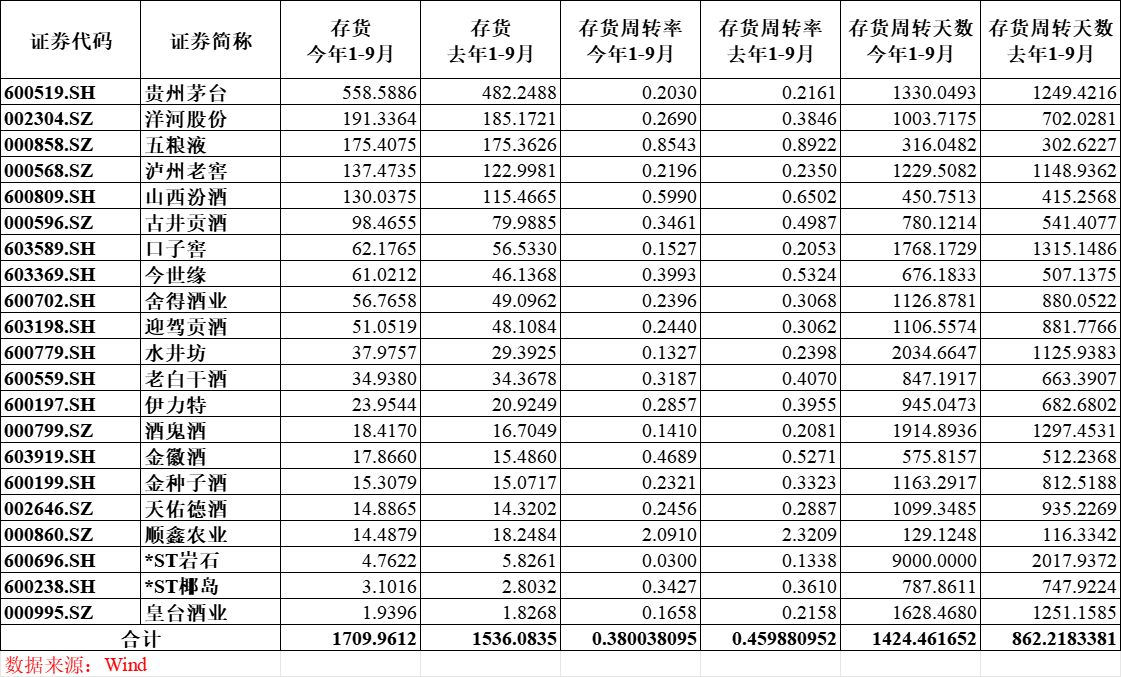
Core Viewpoint - The A-share liquor industry reported its worst performance in a decade for Q3 2025, with 20 listed companies (excluding Shunxin Agriculture) achieving a total revenue of 312.09 billion yuan and a net profit of 122.49 billion yuan, both down approximately 7% year-on-year [1][2] Financial Performance - The total revenue and net profit of the liquor industry have significantly declined, indicating a pronounced pressure on the industry [1] - Only Kweichow Moutai and Shanxi Fenjiu managed to maintain growth in both revenue and net profit amidst the overall decline [1] - The total contract liabilities for 20 liquor companies reached 39 billion yuan, reflecting a year-on-year increase of 4.54%, despite the overall performance downturn [1][6] Inventory and Turnover - The total inventory of 21 listed liquor companies rose to 170.99 billion yuan, a year-on-year increase of 11.32%, with an average inventory turnover period extending to 1424 days, up 65.21% from the previous year [2][4] - The increase in inventory turnover days signals significant pressure on channel inventory [4] Market Response - The market reacted calmly to the poor performance reports, with the China Securities Liquor Index rising by 1.72% on October 31, indicating that investors have already digested the performance pressures [1] - The stability in contract liabilities suggests that confidence in the industry and companies remains intact, despite the challenges [2][7] Channel Dynamics - The increase in contract liabilities is primarily driven by leading liquor companies, with four out of six major firms reporting year-on-year growth [7] - Companies are shifting from a simple sales model to a service-oriented approach, focusing on channel health and profitability for distributors [8][9] Innovative Sales Models - New sales models are emerging, such as the "Wan Shang Alliance" by Zhenjiu Li Du, which emphasizes no stockpiling and allows for returns, thereby reducing inventory risks [10][11] - The introduction of commission-based systems and unified pricing strategies aims to alleviate financial pressure on distributors and ensure transparent profit distribution [12] Conclusion - The growth in contract liabilities and the evolving relationships between manufacturers and distributors highlight the industry's resilience and potential for recovery, as companies prioritize channel health and collaborative strategies [12][13]






白酒两轮周期全扫描:行业家底更厚 头部抗跌能力更强
2 1 Shi Ji Jing Ji Bao Dao· 2025-11-07 01:56
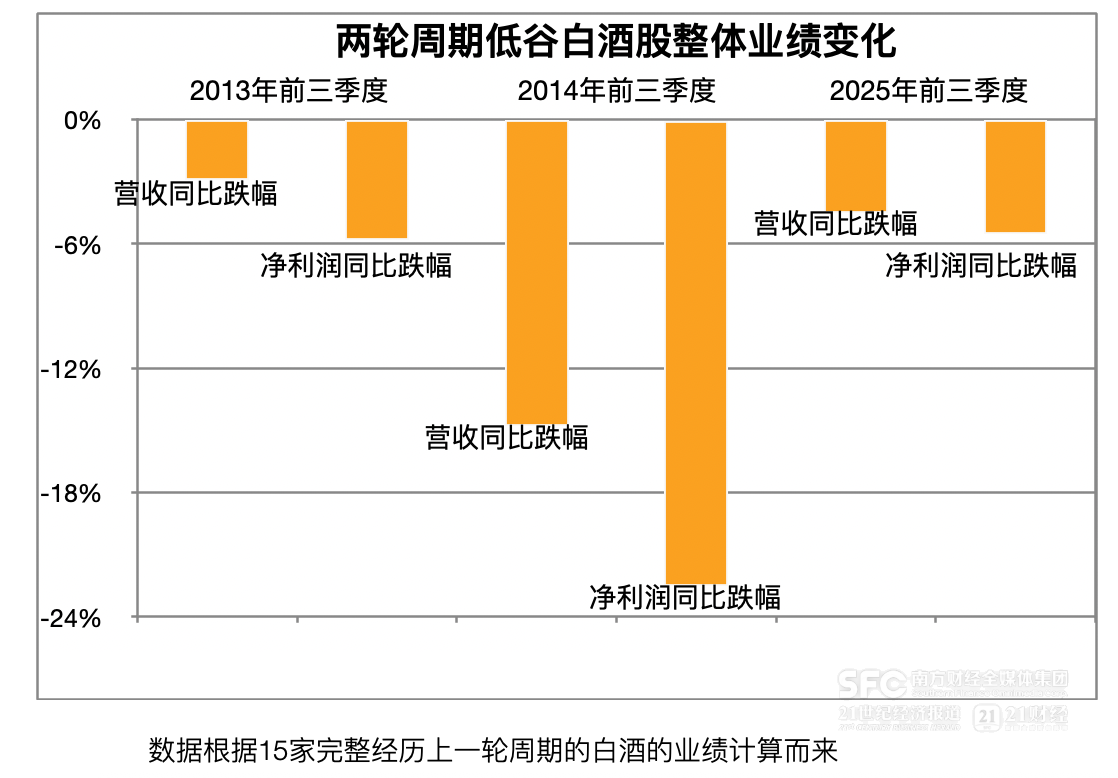
Core Viewpoint - The 2025 Q3 report for the liquor industry indicates a significant downturn, marking the worst quarter in the past decade, with most companies experiencing substantial profit declines, while only a few, like Kweichow Moutai and Shanxi Fenjiu, managed to maintain positive growth [1] Group 1: Performance Comparison - Among the 21 A-share liquor companies, only 15 have fully experienced the previous downturn, including Kweichow Moutai, Shanxi Fenjiu, and Wuliangye [2] - The overall resilience of these 15 companies has improved, with revenue and net profit declines of 4.5% and 5.5% respectively in 2025, compared to larger declines in the previous cycle [3] Group 2: Company-Specific Insights - In 2025, Kweichow Moutai and Shanxi Fenjiu are the only companies showing both revenue and profit growth, contrasting with the previous cycle where only one company managed to do so [6] - Wuliangye's net profit decline is limited to under 14%, while Shanxi Fenjiu has returned to positive growth [7] - Luzhou Laojiao has significantly improved its performance, with revenue and profit declines controlled to single digits in 2025, compared to much larger declines in the previous cycle [7][8] Group 3: Profitability and Financial Health - The total net profit of the 15 companies exceeded 1100 billion in 2025, significantly higher than the previous cycle's total of under 280 billion [10] - The accumulated undistributed profits of these companies reached 4688 billion, five times that of 2013, providing a strong financial cushion [13][15] - Kweichow Moutai's undistributed profits are seven times higher than in 2013, indicating robust financial health [15] Group 4: Cost Management - Many companies have reduced their sales expense ratios compared to the previous cycle, indicating a more restrained approach to spending [29] - Kweichow Moutai maintains a very low sales expense ratio, consistently around 3-4%, reflecting strong brand recognition and market confidence [33] Group 5: Channel Confidence and Cash Flow - The confidence of distributors in head companies has improved, with many reporting increases in contract liabilities, indicating better cash flow management [38] - However, some non-head companies are experiencing negative cash flow, with five companies reporting negative net cash flow from operating activities for two consecutive years [42]
21特写|白酒两轮周期全扫描:行业家底更厚 头部抗跌能力更强
2 1 Shi Ji Jing Ji Bao Dao· 2025-11-07 01:51
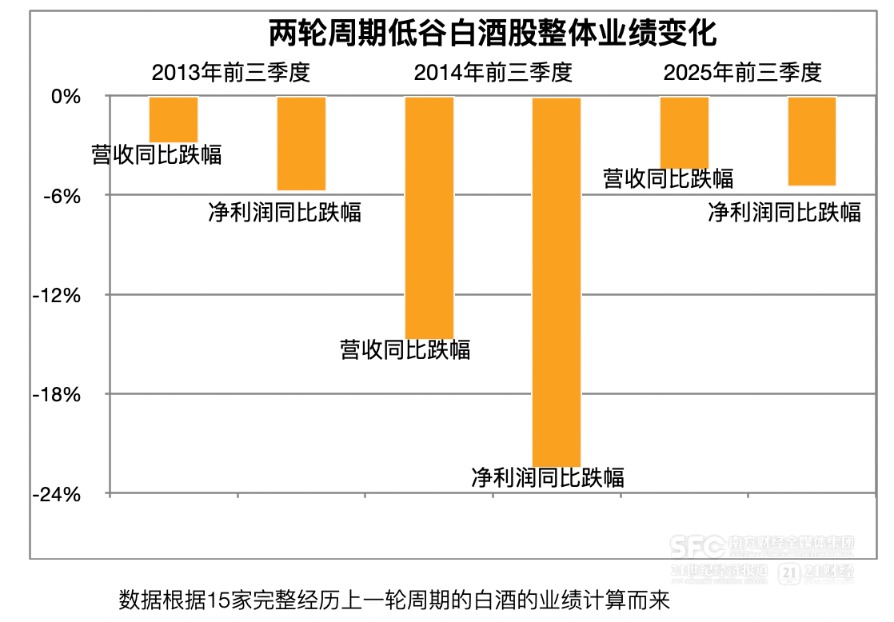
Core Viewpoint - The 2025 Q3 report for the liquor industry is the worst in the past decade, with most companies experiencing significant declines in performance, while only a few, like Kweichow Moutai and Shanxi Fenjiu, managed to maintain positive growth [1] Group 1: Performance Comparison - Among the 21 A-share liquor companies, only 15 have fully experienced the previous adjustment period, including Kweichow Moutai, Shanxi Fenjiu, and Wuliangye [2][3] - The overall decline in revenue and net profit for these 15 companies in 2025 Q3 was 4.5% and 5.5%, respectively, compared to larger declines during the previous cycle [4] - The number of leading liquor companies showing positive growth has increased, with Kweichow Moutai and Shanxi Fenjiu both achieving revenue and profit growth in 2025 Q3 [7] Group 2: Profitability and Financial Resilience - The total net profit for the 15 companies exceeded 110 billion yuan in 2025 Q3, significantly higher than the previous cycle's figures [12] - The accumulated undistributed profits for these companies reached 468.8 billion yuan, five times that of 2013, indicating a stronger financial cushion [13][15] - Kweichow Moutai's undistributed profits are seven times higher than in 2013, showcasing its robust financial health [15] Group 3: Cost Management and Sales Strategy - Liquor companies have learned from past experiences and are controlling sales expenses more effectively, with many reducing their sales expense ratios compared to the previous cycle [26][28] - Kweichow Moutai maintains a low sales expense ratio of around 3-4%, reflecting strong brand recognition and market confidence [31] Group 4: Channel Confidence and Cash Flow - The confidence of distributors has improved, with contract liabilities for the 15 companies increasing by 3.6% in 2025 Q3, contrasting sharply with the previous cycle's declines [33] - However, some non-leading companies are experiencing negative cash flow, with five companies reporting negative net cash flow from operating activities for two consecutive years [39]
白酒2025年三季报总结:加速纾压,底部渐明
Soochow Securities· 2025-11-06 11:05
Investment Rating - The report maintains an "Accumulate" rating for the liquor industry [1] Core Viewpoints - The liquor industry is currently in a phase of pressure relief and clearing, with expectations for performance recovery in the future. The focus should be on companies that show early signs of a turning point and have leading growth elasticity [3] - The overall revenue of the liquor sector has declined, with a 5.5% year-on-year drop in total revenue for the first three quarters of 2025, and an 18.3% decline in Q3 alone. Net profit also saw a significant decrease of 21.9% in Q3 [12][24] - The high-end liquor segment is under pressure, with a need for macroeconomic recovery to achieve a balance in volume and price. Companies with strong brand positioning and national expansion potential are recommended for investment [3][12] Summary by Sections 1. Q3 Performance and Market Conditions - The Q3 performance of the liquor sector shows a slow recovery in consumption scenarios, with overall sales continuing to face pressure. The high-end and next-high-end liquor demand remains under pressure, particularly in business and personal dining scenarios [12][13] - The overall revenue for the liquor sector in Q3 dropped by 18.3% year-on-year, with net profit down by 21.9%, indicating a significant acceleration in the decline compared to previous quarters [12][24] 2. Revenue Trends - The liquor sector's revenue has been on a downward trend, with a 5.5% year-on-year decline in the first three quarters of 2025. The Q3 revenue decline is particularly sharp at 18.3% [12][24] - High-end liquor companies are experiencing a shift in their financial reports, with revenue declines driven by pressure on major brands like Moutai and Wuliangye [30][41] 3. Profitability Analysis - The gross profit margin for the liquor sector has decreased, with Q3 margins at 81.7%, down 0.7 percentage points year-on-year. The decline in profitability is attributed to structural issues and increased costs [2][3] - The report highlights that the majority of liquor companies have seen an increase in sales expenses, while management expenses have also risen slightly due to weaker revenue realization [2][3] 4. Investment Recommendations - The report suggests prioritizing investments in companies that are likely to recover first, such as Luzhou Laojiao and Shanxi Fenjiu, which have strong governance and dividend yields. Other companies to watch include Zhenjiu Lidu and Shede Liquor [3][12] - The focus should be on companies that can maintain channel stability and show early signs of marginal recovery, as the market is expected to support valuations for these firms [12][13]


山西朔州开展“守护知识产权”行动严查商标专利侵权行为
Zhong Guo Zhi Liang Xin Wen Wang· 2025-11-06 05:06
Core Viewpoint - The Shanxi Province Shuozhou Market Supervision Administration has launched a special enforcement action titled "Guarding Intellectual Property Rights," focusing on key areas such as supermarkets and tobacco and alcohol specialty stores to combat trademark and patent infringements [1] Group 1: Enforcement Actions - The enforcement action resulted in the seizure of 82 bottles of white liquor infringing on the "Fenjiu" trademark and the investigation of 19 cases of suspected design patent infringement [1] - A total of over 60 business entities were inspected, leading to the identification and crackdown of several counterfeit and infringing activities [1] Group 2: Collaboration and Strategy - The action adopted a government-enterprise collaboration model, working with professionals from Shanxi Xinghuacun Fenjiu Distillery Co., Ltd. to conduct thorough inspections in the region [1] - The administration emphasized a dual approach of strict regulation and educational measures to deter intellectual property violations while guiding businesses towards compliance [1]
食品饮料2025年三季报总结:白酒主动释放压力,速冻迎来行业拐点,软饮、零食量贩高景气维持
China Post Securities· 2025-11-06 05:06
Industry Investment Rating - The investment rating for the food and beverage industry is "Outperform" [1] Core Insights - The report highlights that the liquor sector is actively releasing pressure on financial statements, with the industry gradually bottoming out. The frozen food sector is witnessing a turning point, while the soft drink and snack sectors maintain high levels of prosperity [3][4][30] Summary by Sections 1. Liquor - The liquor sector's total revenue for the first three quarters of 2025 was CNY 319.23 billion, a year-on-year decrease of 5.76%, with net profit down 6.85% to CNY 122.67 billion. In Q3 alone, revenue fell 18.38% to CNY 78.48 billion, and net profit dropped 22.00% to CNY 28.09 billion [14][28] - High-end liquor brands like Moutai showed stable growth, while others like Wuliangye and Luzhou Laojiao faced significant declines. Moutai's revenue grew by 9.28% year-on-year, while Wuliangye's fell by 10.26% [17][19] - The second-tier liquor brands, such as Fenjiu, showed resilience with a revenue increase of 5.00%, while others like Shui Jing Fang and Shede experienced declines [26][22] 2. Soft Drinks - The soft drink sector saw significant growth, with companies like Dongpeng Beverage reporting a 34.13% increase in revenue year-on-year. The energy drink segment, particularly, showed robust growth [30][31] - The introduction of new flavors and products, such as Dongpeng's summer limited edition, contributed to the sustained high growth rates in this sector [30] 3. Dairy Products - The dairy sector, led by Yili, maintained stable performance despite high base effects, with significant growth in milk powder and cold drink products. New Dairy's low-temperature products continued to show double-digit growth [4][31] 4. Frozen Foods - The frozen food industry is experiencing a turning point, with companies noting that the price war has peaked. The focus is shifting towards rational competition and value [7][30] 5. Snacks - The snack sector is undergoing strategic adjustments, with member stores and instant retail becoming key growth channels. The overall consumption environment remains weak, but the snack sector is adapting with targeted strategies [7][30]


聚焦“吃喝”产业链:食品饮料ETF天弘(159736)近10日“吸金”近1.2亿元,农业ETF天弘(认购代码:512623)重磅发行中
2 1 Shi Ji Jing Ji Bao Dao· 2025-11-06 02:00
Group 1: Market Performance - The three major indices opened higher on November 6, with the Shanghai Composite Index up 0.10%, the Shenzhen Component Index up 0.37%, and the ChiNext Index up 0.60% [1] - The Tianhong Food and Beverage ETF (159736) rose by 0.28%, with a premium trading rate of 0.06% [1] - As of November 5, the Tianhong Food and Beverage ETF had a latest circulating scale of 5.622 billion yuan, ranking first among food and beverage ETFs in the Shenzhen market [1] Group 2: Fund Flows - The Tianhong Food and Beverage ETF experienced net inflows for 9 out of the last 10 days, accumulating nearly 120 million yuan [1] - The ETF tracks the CSI Food and Beverage Index, focusing on leading stocks in high-end and mid-range liquor, as well as segments like beverages, dairy, and condiments [1] Group 3: Agricultural Sector - The Tianhong Agricultural ETF (subscription code: 512623, listing code: 512620) officially launched on November 3, with fundraising set to end on November 7, 2025 [1] - This ETF tracks the CSI Agricultural Index, which selects 50 stocks covering sectors such as breeding and agricultural chemicals, including leading companies like Muyuan and Haida [1] Group 4: Industry Insights - Guizhou Province's Commerce Department is soliciting opinions on transforming "selling liquor" into "selling lifestyle," encouraging innovation in product offerings and service methods in retail and dining sectors [2] - As of October 30, over 90% of the autumn grain harvest has been completed nationwide, with the Northeast region nearing completion and expected to achieve a good harvest [2] Group 5: White Liquor Market Analysis - Guosen Securities reports that the white liquor market is facing pressure on both volume and price due to tightening regulations on public consumption and business banquets [3] - The report indicates that the worst period for white liquor sales pressure has passed, with expectations for demand recovery in the future [3] - Guosen Securities suggests focusing on stable industry leaders and high-quality stocks with long-term growth potential due to ongoing structural upgrades and channel strategy optimization [3]


茅台失速,五粮液腰斩,洋河溃败!白酒业怎么了?
Sou Hu Cai Jing· 2025-11-05 16:30
Core Viewpoint - The Chinese liquor industry is experiencing a significant downturn, marked by a battle for inventory reduction and financial pressure, with major companies reporting substantial declines in revenue and profit [1][2]. Industry Overview - In the first three quarters of 2025, 20 A-share liquor companies reported a total revenue of 320.23 billion yuan, a year-on-year decrease of 5.83%, and a net profit of 122.77 billion yuan, down 6.76% [2]. - Only Kweichow Moutai and Shanxi Fenjiu managed to maintain growth, while the remaining 18 companies experienced declines [3]. Quarterly Performance - The third quarter of 2025 was particularly harsh, with companies like Shui Jing Fang and Guo Jiao reporting revenue drops of 58.91% and 51.65% respectively [4]. - Luzhou Laojiao and Kweichow Moutai also faced significant profit declines, with Moutai's revenue growth slowing to 0.56% in Q3, a stark contrast to previous quarters [6][7]. Historical Context - This marks the first major performance decline in five years for the liquor industry, with the number of companies experiencing revenue drops increasing from 2 in 2021 to 7 in 2024 [5]. - The trend of declining profits is evident, with 90% of liquor companies reporting a year-on-year decrease in net profit for the first three quarters of 2025 [6]. Inventory Crisis - The industry is facing a severe inventory crisis, with total inventory for 20 listed liquor companies reaching 176.69 billion yuan by Q3 2025, an increase of 11% year-on-year [14]. - Companies like Kweichow Moutai hold the largest inventory, nearing 56 billion yuan, while others like Yanghe and Wuliangye also report significant inventory levels [14]. Financial Strain - The financial strain is evident as companies reduce their contract liabilities significantly, with Kweichow Moutai's contract liabilities dropping by 19% to 7.75 billion yuan [17]. - Many smaller liquor companies are facing survival challenges, with some unable to cover their interest-bearing debts [20]. Market Dynamics - The price reduction of Moutai has diminished the price advantage of Wuliangye, leading to a rapid decline in its performance [8]. - Shanxi Fenjiu, despite revenue growth, saw its net profit decline for the first time since 2015, indicating market saturation challenges [9]. Sales Strategies - Companies are increasingly resorting to credit sales to manage inventory, with Kweichow Moutai leading this shift by relaxing its cash payment policies [19]. - The overall market is expected to face prolonged challenges as inventory digestion may take several years due to the current oversupply situation [15].
茶酒融合:“微醺经济”的双向奔赴
Nan Fang Nong Cun Bao· 2025-11-05 15:12
Core Viewpoint - The integration of tea and alcohol is emerging as a significant trend in the beverage industry, driven by the demand for "micro-drunk" experiences among younger consumers, leading to innovative product offerings and cross-industry collaborations [5][6][46]. Group 1: Industry Trends - The Guizhou Provincial Department of Commerce has issued a draft guideline to promote the transition from "selling alcohol" to "selling lifestyle," emphasizing the integration of alcohol and tea products to expand cross-industry consumption markets [2][3]. - The trend of alcohol and tea fusion is not new, with both alcohol and tea companies seeking growth opportunities through innovative product combinations [5][6]. - The younger demographic is increasingly becoming the main consumer group for alcohol, prompting companies to innovate beyond traditional high-alcohol products to attract this audience [8][49]. Group 2: Product Innovations - Major alcohol brands are launching lower-alcohol or non-alcoholic products to cater to younger consumers, with examples including Moutai's introduction of over ten youth-oriented products at a recent trade fair [12][18]. - The collaboration between Luckin Coffee and Moutai to launch the "Sauce Aroma Latte" achieved remarkable sales, with over 5.42 million cups sold on the first day, generating over 100 million yuan in revenue [28][30]. - New tea drinks incorporating alcohol, such as "Drunken Steps" by Tea Baidao and "Lychee Ice Brew" by Grandpa's Tea, have also gained popularity, indicating a growing acceptance of alcohol-infused beverages [32][39]. Group 3: Market Dynamics - The market for low-alcohol beverages is expanding, with data showing that fruit wine accounts for 38% of instant retail channels, growing at 72% annually, while tea and alcohol combinations account for 25%, growing at 65% [54][55]. - Health consciousness among consumers is influencing the beverage market, with a significant percentage of consumers expressing concerns about the health impacts of traditional tea drinks, leading to a demand for healthier options [60][61]. - The fusion of tea and alcohol is seen as a strategic move to address the challenges faced by both industries, allowing them to meet consumer demands for "micro-drunk" experiences while ensuring health considerations are met [63].


多家酒企Q3营利双降,四川龙头也难逃下滑
3 6 Ke· 2025-11-05 12:40
Core Insights - The announcement of salary cuts at Xuanjiu, a prominent regional liquor company, has raised eyebrows in the industry, especially given its recent strong performance in sales and profits [2][3] - The liquor industry is currently undergoing a significant adjustment period, with many companies emphasizing cost reduction and efficiency improvements [5][6] Company Summary - Xuanjiu, based in Anhui Province, reported a sales revenue of 1.8 billion yuan in 2023, a 23% increase year-on-year, and a profit of 314 million yuan, up 16% [2] - The company plans to reduce employee salaries by 10% starting October 1, 2025, which has led to mixed reactions among staff [1][3] - The chairman of Xuanjiu indicated that high-end product sales are expected to grow over 40% in 2024, with tax contributions reaching a historical high of 512 million yuan [2] Industry Summary - The liquor industry is experiencing a downturn, with a reported 18.09% decline in revenue and a 22.10% drop in net profit among 19 listed liquor companies in Q3 2025 [5][6] - Major players like Wuliangye have seen significant revenue declines, with a 52.66% drop in Q3 revenue [6] - The overall market is characterized by an oversupply, leading to reduced consumption in drinking and gifting scenarios, prompting many companies to adopt cost-cutting measures [5][7] - The industry is expected to remain in a bottoming phase, with cautious forecasts for recovery in 2026 [7][8]
