
CHANGAN AUTOMOBILE-B(000625)

Search documents
(经济观察)重庆市两江新区如何借力长江经济带实现高质量发展?
Zhong Guo Xin Wen Wang· 2026-01-26 13:48
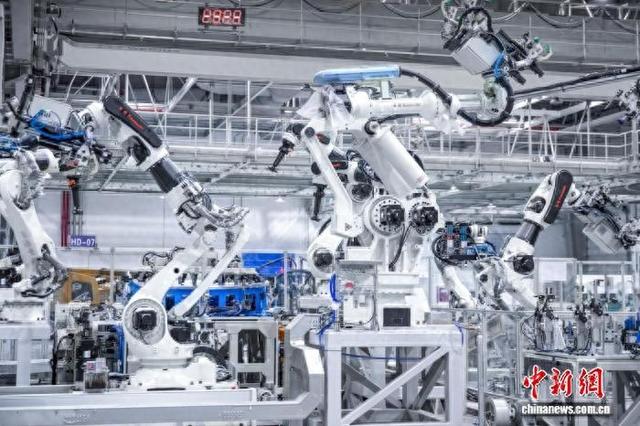
Group 1 - The establishment of the Liangjiang New Area as a national-level administrative district marks a significant step in leveraging the Yangtze River Economic Belt for high-quality development [1] - Liangjiang New Area serves as a core carrier for inland opening-up and high-quality development, positioned at the intersection of the Belt and Road Initiative and the Yangtze River Economic Belt [1] - The area aims to utilize the Yangtze River Economic Belt development strategy to enhance its growth potential [1] Group 2 - The Avita Smart Factory, a leading "dark factory," exemplifies the ecological priority and green development of the Yangtze River Economic Belt, producing a new car every 60 seconds without human intervention [3] - Changan Automobile, a pillar of the Chongqing automotive industry, has expanded its "Made in Chongqing" products to 117 countries and regions by the end of December 2025 [3] - Chongqing Zhongke Yao Lu Chuan Information Technology Co., Ltd. has rapidly grown from a municipal innovative SME to a national-level specialized "little giant" enterprise, achieving over 20 times growth in output value in five years [3][4] Group 3 - Liangjiang New Area is integrating into the city’s innovation corridor, creating a comprehensive innovation landscape with multiple parks and specialized innovation zones [7] - The area has established a collaborative innovation platform with cities like Yibin, Chengdu, Wuhan, and Shanghai, promoting resource sharing and innovation across the Yangtze River region [7][8] - Key technological breakthroughs in smart connected vehicles and advanced materials are enhancing the industrial strength of Liangjiang New Area and contributing to the resilience of the entire industrial chain along the Yangtze River [8] Group 4 - Liangjiang New Area has developed a mechanism for integrated development across government, industry, academia, research, finance, and services, facilitating the transition of scientific achievements from research to market [8][10] - The area has created a full-chain technical service platform covering concept validation, pilot testing, incubation, and inspection, supporting over 900 innovative enterprises [10] - Regular "industry-academia dual-entry" matchmaking events are held to connect technology experts with businesses, resulting in over 1,000 technology collaborations [10] Group 5 - The innovative ecosystem in Liangjiang New Area is attracting significant talent and investment, with nearly 1,000 hard-tech companies and a research and development investment ratio exceeding 40% [8][11] - The establishment of the administrative district is expected to enhance the area's contribution to the high-quality development of the Yangtze River Economic Belt [11]


汽车行业周报:人形机器人+航空航天双轮驱动,旋转变压器迎广阔新兴市场
Huaxin Securities· 2026-01-26 12:24
Investment Rating - The report maintains a "Buy" rating for the automotive industry, particularly focusing on humanoid robots and aerospace sectors [2][10]. Core Insights - The humanoid robot market is expected to significantly drive the demand for rotary transformers, with a projected market size of 6.15 billion yuan by 2030 and 47.1 billion yuan by 2035, reflecting a CAGR of 85.9% from 2026 to 2035 [4][27]. - The aerospace sector is also experiencing growth, with satellite launches increasing rapidly, leading to a forecasted rotary transformer market size of 700 million yuan by 2030 and 1.8 billion yuan by 2035, with a CAGR of 22.7% from 2026 to 2035 [5][30]. Summary by Sections 1. Humanoid Robots and Aerospace Driving Rotary Transformer Market - Rotary transformers are well-suited for humanoid robots due to their strong shock resistance and durability, making them ideal for complex operational environments [4][24]. - The market for rotary transformers in humanoid robots is expected to surpass traditional markets, as they replace encoders in robotic joints [27]. 2. Market Performance of Humanoid Robots - The humanoid robot sector is anticipated to see a substantial increase in market size, driven by the need for high reliability and longevity in robotic joints [4][27]. - The report highlights the importance of rotary transformers in enhancing the performance of humanoid robots, particularly in their joints and dexterous hands [27]. 3. Market Performance of Aerospace Sector - The report notes a significant increase in satellite launches, with SpaceX planning to launch 42,000 satellites by 2033, which will boost the demand for rotary transformers in satellite attitude and orbit control systems [5][30]. - The rotary transformer market in the aerospace sector is projected to grow steadily, with increasing applications in satellite systems [30]. 4. Industry Data Tracking - The global rotary transformer market is expected to grow from approximately 4.445 billion yuan in 2024 to 11.851 billion yuan by 2031, with a CAGR of 15.3% from 2025 to 2031 [33]. - The automotive sector's rotary transformer market is projected to grow from 1.334 billion yuan in 2024 to 3.555 billion yuan by 2031 [33]. 5. Company Announcements - The report emphasizes the rapid growth of domestic companies like Yingshuo Technology, which has captured a significant market share in the rotary transformer sector, particularly in the new energy vehicle market [44][61]. - Yingshuo Technology's revenue has shown a CAGR of 176.6% from 2020 to 2022, with a strong focus on the new energy vehicle sector [44][55].


长安汽车定增被受理 将于深交所上市
Xin Lang Cai Jing· 2026-01-26 11:15
Core Viewpoint - Changan Automobile is issuing A-shares to raise up to 600 million yuan for investments in new energy vehicle development and other projects [1][3]. Group 1: A-Share Issuance - Changan Automobile plans to issue 630,252,100 A-shares, which will not exceed 30% of the current total share capital [1][3]. - The funds raised will be used for new energy vehicle and smart platform development, global R&D center construction, and core capability enhancement projects [1][3]. Group 2: Business Overview - Changan Automobile's main business includes the R&D, manufacturing, and sales of vehicles (passenger and commercial) and engines [1][3]. - The company is actively developing three electric technologies: battery, electric motor, and electronic control, along with smart cockpit and autonomous driving technologies [1][3]. - Changan is exploring new business areas such as automotive life services, new marketing strategies, battery swapping services, and future industries like humanoid robots and flying cars [1][3]. Group 3: Brand Development - Changan has established three major brands: Changan, Deep Blue, and Avita, with differentiated sub-brands under Changan [2][4]. - The company has launched several classic models in the traditional fuel vehicle sector, including the CS series, Yidong series, and UNI series [2][4]. - In the new energy sector, Changan is focusing on models like Changan Qiyuan E07, Deep Blue S07, and Avita 11, aiming to provide high-quality products and services to consumers [2][5].
乘用车板块1月26日跌1.75%,北汽蓝谷领跌,主力资金净流出14.51亿元
Zheng Xing Xing Ye Ri Bao· 2026-01-26 09:37
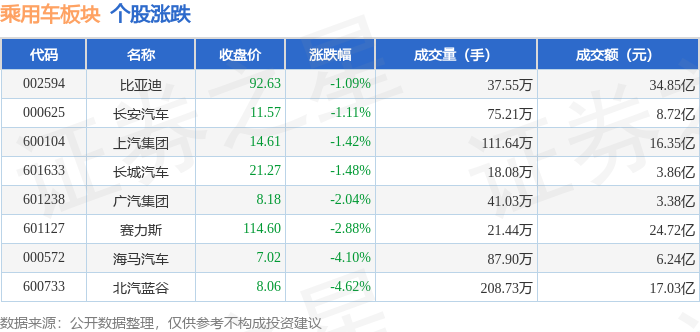
Group 1 - The passenger car sector experienced a decline of 1.75% on January 26, with Beiqi Blue Valley leading the drop [1] - The Shanghai Composite Index closed at 4132.61, down 0.09%, while the Shenzhen Component Index closed at 14316.64, down 0.85% [1] - Major companies in the passenger car sector saw varying declines in their stock prices, with BYD down 1.09% to 92.63, and Beiqi Blue Valley down 4.62% to 8.06 [1] Group 2 - The passenger car sector saw a net outflow of 1.451 billion yuan from main funds, while retail investors contributed a net inflow of 905 million yuan [1] - Specific companies like GAC Group and Great Wall Motors experienced significant net outflows from main funds, with GAC Group at -28.73 million yuan and Great Wall Motors at -46.11 million yuan [2] - BYD had a net outflow of 52.2 million yuan from main funds, while retail investors showed a net inflow of 55.37 million yuan [2]





汽车行业周报:政策托底静待反弹,关注海外电动化
Guoyuan Securities· 2026-01-26 06:24
Investment Rating - The report maintains a "Recommended" investment rating for the automotive industry [6] Core Insights - The automotive market is experiencing significant negative growth, with retail sales of passenger vehicles dropping by 28% year-on-year in the first half of January 2026, and wholesale sales declining by 35% [1][19] - The report emphasizes the need for supportive policies to stimulate market recovery and highlights the potential for growth in the overseas electric vehicle market due to favorable policies in countries like Canada and Germany [3][4] - The report suggests that the domestic market may rebound following the implementation of supportive policies, which could positively impact leading brands [4] Summary by Sections Market Overview - As of January 1-18, 2026, retail sales of passenger vehicles in China reached 679,000 units, a decrease of 28% compared to the same period last year, while wholesale sales totaled 740,000 units, down 35% year-on-year [1][19] - In the same period, retail sales of new energy vehicles were 312,000 units, reflecting a 16% decline year-on-year, and wholesale sales were 348,000 units, down 23% [1][19] Policy Developments - Canada announced plans to import 49,000 electric vehicles from China, significantly reducing tariffs from 100% to 6.1% [3] - Germany introduced a new subsidy program for electric vehicles, offering up to 6,000 euros to families purchasing new electric cars, effective from January 1, 2026 [3][44] - The UK government has launched a substantial subsidy program for electric trucks, with a total budget of 318 million pounds [48] Investment Opportunities - The report highlights the potential for Chinese new energy vehicles to expand into overseas markets, driven by favorable international policies [4] - It suggests that the recovery of the domestic automotive market could benefit leading brands significantly [4]


新职业新风向|智能网联汽车测试员见证“未来已来”
Zhong Guo Qing Nian Bao· 2026-01-26 03:25
Core Insights - The article discusses the introduction of L3 conditional autonomous driving vehicles in China, highlighting the advancements in technology and the regulatory framework that supports their testing and potential commercialization [1][2]. Group 1: L3 Autonomous Driving Technology - The L3 conditional autonomous driving system, known as TJP, allows vehicles to operate autonomously in traffic congestion, with a maximum speed of 50 km/h, and is currently being tested in designated areas of Chongqing and Beijing [1][2]. - The vehicles equipped with L3 systems, such as those from Changan Automobile and BAIC BluePark Magna, have not yet been commercially launched but are part of a critical transition from technology validation to mass production [2]. Group 2: Market Growth and Industry Trends - According to the China Association of Automobile Manufacturers, the production and sales of new energy vehicles in China are projected to reach 16.626 million and 16.49 million units respectively in 2025, marking a year-on-year growth of 29% and 28.2%, with new energy vehicles accounting for 47.9% of total new car sales [2]. - The development of smart connected new energy vehicles is seen as a significant opportunity, with the emergence of new job roles such as smart connected vehicle testers, which are essential for ensuring the safety and functionality of these vehicles [2]. Group 3: Safety and Testing Protocols - The L3 system features enhanced software architecture and safety measures, including redundancy designs to ensure vehicle safety even in the event of component failure [4]. - During the testing phase, Changan Automobile's TJP system has accumulated over 150,000 kilometers of activation without any accidents or violations, demonstrating the system's reliability [5]. Group 4: Future of Autonomous Driving - The article notes that L4 and L5 levels of autonomous driving are on the horizon, with L4 applications focusing on unmanned taxis and logistics vehicles [5]. - The penetration rate of L2 and above autonomous driving in passenger vehicles is expected to reach 55.7% by 2024, indicating a growing demand for skilled personnel in the automotive industry [5].
潮涌“两江”起风帆——重庆两江新区高质量发展新观察
Xin Hua Wang· 2026-01-26 02:20
Core Viewpoint - The establishment of the Chongqing Liangjiang New Area marks a new chapter in development, focusing on integrated development advantages, technological innovation, and high-quality growth for the region [1] Group 1: Innovation and Industry Development - Liangjiang New Area hosts over 2,500 high-tech enterprises and 14,800 technology-based companies, showcasing a highly intelligent and collaborative industrial system [2] - The area has seen the establishment of various innovation platforms, such as Liangjiang Collaborative Innovation Zone and Xiangmiao Data Valley, facilitating the transition of innovative results from laboratories to production lines [2] - The region's innovation ecosystem has led to significant advancements, with companies achieving over 300 invention patents and investing more than 10% of their revenue in R&D annually [4] Group 2: Infrastructure and Logistics - The Guoyuan Port has evolved into a major logistics hub with an annual throughput exceeding 26 million tons, connecting to over 300 ports globally [6] - The integration of various open platforms, such as the China-Europe Railway Express and the Western Land-Sea New Corridor, enhances the region's role as a gateway for international trade [8] - The implementation of innovative regulatory models in the free trade zone has reduced logistics costs significantly, saving approximately 3,000 yuan per container [9] Group 3: Urban Development and Quality of Life - The population of Liangjiang New Area is approximately 3.52 million, with ongoing urban planning aimed at improving public services and living standards [10] - Initiatives such as the expansion of public services and the establishment of a "15-minute high-quality living circle" are enhancing the urban environment and livability [13] - The area is focusing on ecological protection and sustainable development, with efforts to create a harmonious balance between urbanization and nature [13]

汽车行业:26年数据点评系列之一:乘用车25年复盘和26年展望:从“量稳价缓”到“价升量稳”
GF SECURITIES· 2026-01-26 01:49
Investment Rating - The industry investment rating is "Buy" [2] Core Insights - The report indicates a transition from "stable volume and slow price" to "price increase and stable volume" for the automotive industry in 2026 [6][16] - The domestic demand for passenger vehicles is expected to show positive growth in 2026, supported by policies such as scrapping and replacement subsidies [27][28] - The report highlights that the average selling price (ASP) of passenger vehicles is projected to increase, with a notable rise in ASP observed in December 2025 [16][20] Summary by Sections 1. Passenger Vehicle Sales and Market Dynamics - In December 2025, domestic passenger vehicle sales reached 2.278 million units, a year-on-year decrease of 16.4% but a month-on-month increase of 13.6% [16] - The total sales for 2025 were 23.052 million units, reflecting a slight year-on-year increase of 0.6% [16] - The report notes that December's performance was significantly below seasonal norms, attributed to the suspension of scrapping subsidies in some regions [16] 2. ASP Trends and Market Expectations - The ASP for passenger vehicles in 2025 showed a year-on-year decline of 2.1%, with December 2025 ASP increasing by 13.7% compared to the previous year [16][20] - The report anticipates that the continuation of scrapping policies will enhance the sales of mid-to-high-end vehicles, contributing to price increases [27] 3. Inventory and Supply Chain Considerations - As of December 2025, the inventory of passenger vehicles stood at 4.708 million units, with a dynamic inventory-to-sales ratio of 2.48 [40] - The report suggests that short-term inventory risks are manageable, as leading domestic manufacturers may adjust production based on current demand [40] 4. Investment Recommendations - The report recommends focusing on various companies within the passenger vehicle supply chain, including Geely, BYD, and Xpeng Motors for growth potential [6][27] - It also highlights companies like Great Wall Motors and SAIC Group as having potential turning points in their performance [6][27]



周观点 | 特斯拉计划2027年销售机器人 关注机器人板块【国联民生汽车 崔琰团队】
汽车琰究· 2026-01-25 13:40
Market Performance - The automotive sector outperformed the market this week, with a 2.6% increase in A-share automotive stocks from January 19 to January 25, ranking 14th among Shenwan sub-industries, compared to a decline of 0.6% in the CSI 300 index [1] - Sub-sectors such as automotive services, commercial vehicles, automotive parts, motorcycles, and others saw increases of 6.9%, 4.8%, 4.0%, 1.4%, and 0.7% respectively, while passenger vehicles decreased by 1.4% [1] Investment Recommendations - Recommended core stocks include Geely Automobile, Xpeng Motors, BYD, Bertley, Top Group, New Spring Co., and Chunfeng Power [2] - For passenger vehicles, Geely, Xpeng, and BYD are recommended, with Jianghuai Automobile suggested for attention [5] - In the parts sector, recommendations include Bertley and Horizon Robotics for intelligent driving, and Top Group and New Spring Co. for new forces in the industry chain [5] - For motorcycles, recommended companies are Chunfeng Power and Longxin General [6] - In the tire sector, SAILUN and Senqilin are recommended [7] - For commercial vehicles, recommended companies include Weichai Power and China National Heavy Duty Truck for heavy trucks, and Yutong Bus for passenger vehicles [8] Strategic Collaborations - Changan Automobile signed a comprehensive strategic cooperation agreement with Midea Group to deepen the "people-car-home" smart ecosystem collaboration, allowing users to control 20 types of Midea smart appliances via voice and to check vehicle status remotely [4][11] Robotics Sector Insights - Tesla plans to sell humanoid robots to the public by 2027, with deliveries to enterprises expected to start in the second half of 2026. This development is anticipated to catalyze the robotics sector [3][10] - The focus is on the production and technological iteration of Tesla's robots, with domestic manufacturers like Yushutech expected to enter the IPO phase soon, which could serve as a strong catalyst for the sector [3][10] - Key hardware segments such as dexterous hands and lightweight components are expected to see significant changes, and the valuation of leading automotive robotics manufacturers is anticipated to undergo reconstruction [3][10][23] Policy and Market Trends - The new national subsidy policy for 2026 aims to stimulate demand by extending the scope of vehicle replacement subsidies, which is expected to improve the structure of subsidized models [12][18] - The subsidy for scrapping and replacing vehicles will be based on a percentage of the vehicle price, with electric vehicles receiving up to 20,000 yuan and fuel vehicles up to 15,000 yuan [14][16] - The overall discount rate for vehicles in December 2025 increased compared to November, indicating a competitive market environment [53][54] Motorcycle Market Dynamics - The sales of motorcycles above 250cc reached 69,000 units in December 2025, showing a year-on-year increase of 1.8% and a month-on-month increase of 12.9% [30] - The domestic sales of motorcycles above 250cc in December were 28,000 units, up 32.8% year-on-year, while exports showed a decline [31] Heavy Truck Market Recovery - The heavy truck market saw sales of approximately 95,000 units in December 2025, a year-on-year increase of about 13%, supported by the expanded scope of the vehicle replacement subsidy policy [34] - The average subsidy for scrapping and updating eligible trucks is 80,000 yuan, which is expected to stimulate demand significantly [34][36]



整车有望反弹,零部件仍聚焦新产业方向:汽车行业周报(20260119-20260125)-20260125
Huachuang Securities· 2026-01-25 13:12
Investment Rating - The report maintains a "Buy" recommendation for the automotive sector, indicating a potential rebound in vehicle sales in the first quarter driven by retail and export growth [3][4]. Core Insights - The automotive sector is expected to see a rebound in vehicle sales, particularly in the first quarter, with catalysts from retail and export activities. The focus for auto parts remains on new industries such as intelligent driving, robotics, and liquid cooling technologies [3][4]. - Traditional automotive stocks have shown relative stability in prices, while the robotics sector is expanding into second-tier markets [3]. - The report highlights significant growth in new energy vehicle deliveries, with companies like NIO and Li Auto showing notable month-on-month increases [6][7]. Data Tracking - In early January, the discount rate for traditional vehicles remained stable at 9.6%, with an average discount amount of 22,259 yuan, reflecting a year-on-year increase of 2,192 yuan [5]. - December saw a decline in wholesale and retail sales of passenger vehicles, with wholesale sales down 8.7% year-on-year and retail sales down 16.8% [5][6]. - New energy vehicle deliveries in December showed a mixed performance, with BYD delivering 420,398 units (down 18.3% year-on-year) while NIO and Li Auto reported significant increases in deliveries [6][7]. Industry News - The report notes that the German government announced subsidies of up to 6,000 euros for families purchasing new electric vehicles to boost the domestic electric vehicle industry [10]. - The report also mentions that the Chinese government is implementing policies to promote the replacement of old vehicles and appliances, which is expected to enhance the automotive market [10][30]. - Geely's new MPV model, the Galaxy V900, was launched with a price range of 269,800 to 329,800 yuan, featuring advanced AI capabilities [30].

