
BYD(002594)

Search documents
在一片销量创新高的欢呼声中,车企们将迎战更惨烈的2026年
3 6 Ke· 2026-01-04 02:11
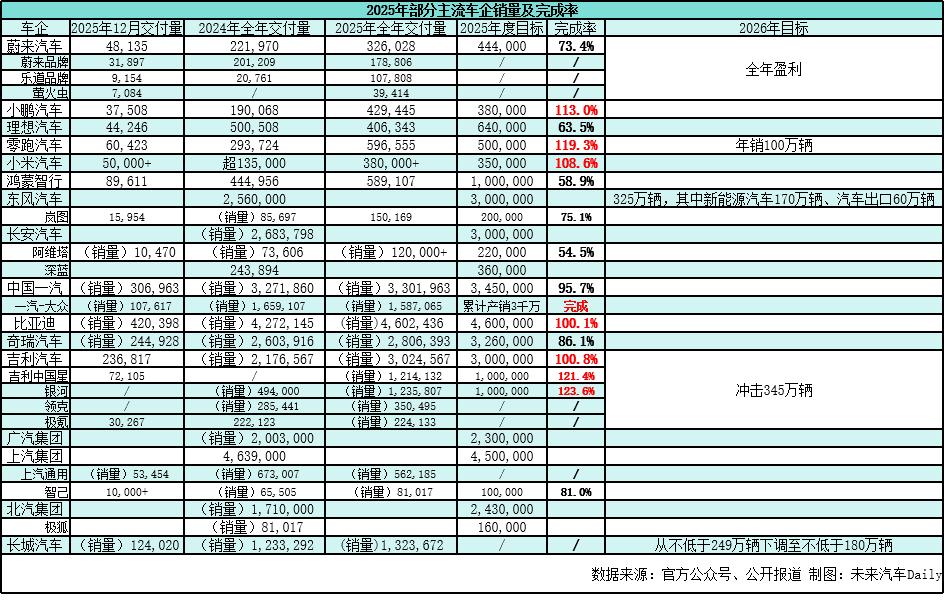
Core Viewpoint - The Chinese automotive market is experiencing a downturn in December, with a significant year-on-year decline in retail sales, prompting companies to seek growth opportunities amidst challenging conditions [1][10]. Market Performance - From December 1 to 28, retail sales of passenger vehicles in China reached 1.928 million units, a 17% decrease compared to the same period last year and a 3% decline from the previous month [1]. - Traditional automakers like BYD reported a sales drop of 12% month-on-month and 18% year-on-year, despite achieving a total of 4.273 million units sold in 2023, marking a 144% increase in exports [6][7]. Company Highlights - NIO achieved a record delivery of 48,000 units in December, with 46% of this volume coming from the new ES8 model [3]. - Xpeng and Xiaomi also saw increases in deliveries, with Xpeng delivering 37,000 units and Xiaomi exceeding 50,000 units [3]. - Li Auto's monthly deliveries rose from 30,000 in November to 40,000 in December, aided by adjustments in production capacity [3][17]. - Homologous Intelligent achieved nearly 90,000 deliveries in December, becoming the top performer among new energy vehicle brands [4][13]. Future Outlook - Industry experts anticipate a rebound in January 2026 due to the timing of the Spring Festival and the implementation of new subsidy policies [8]. - However, the overall automotive industry is expected to remain under pressure throughout 2026 [9]. Competitive Landscape - The competition among automakers is intensifying, with companies like BYD, Li Auto, and others adjusting their sales targets and strategies in response to market conditions [20][23]. - New models and technological advancements are being prioritized, with companies focusing on high-value offerings to navigate the changing market dynamics [30][31].


雷军回应“小字营销”;罗永浩否认与华为有过节;宝马中国回应30多款车型降价;Kimi完成5亿美元新融资,杨植麟:账上有超百亿元现金
Sou Hu Cai Jing· 2026-01-04 01:56
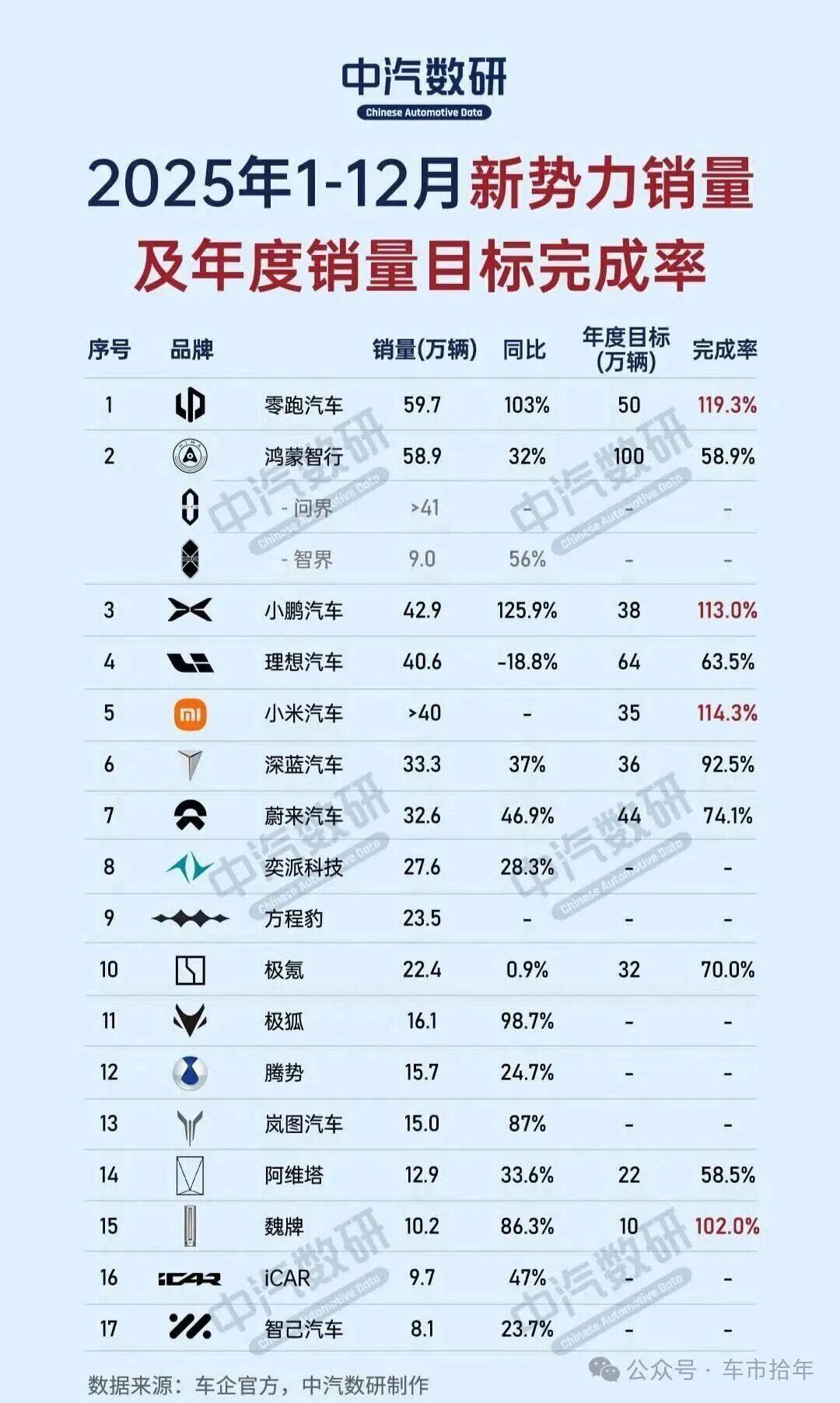
Sales Performance - The sales data for various electric vehicle manufacturers shows significant growth for several companies, with Li Auto experiencing a decline of 18.8% year-on-year, while companies like Leap Motor and Xpeng Motors reported increases of 103% and 125.9% respectively [1] - BYD has surpassed Tesla for the first time, achieving over 4.6 million total new car sales in 2025, a year-on-year increase of approximately 8%, with pure electric vehicle sales exceeding 2.25 million, up 28% [10] Company Developments - Xiaomi's chairman Lei Jun addressed concerns regarding the quality of their vehicles during a live stream, emphasizing the company's commitment to transparency and correcting misconceptions about their marketing practices [4] - Kimi completed a $500 million Series C financing round, with a post-investment valuation of $4.3 billion, indicating strong market interest and a substantial cash reserve of over 10 billion RMB [6] - Baidu announced plans to spin off Kunlun Chip and seek independent listing on the Hong Kong Stock Exchange, which could enhance its market position and operational focus [25] Market Trends - The overall electric vehicle market is witnessing a shift, with BYD taking the lead in global sales, while Tesla's deliveries have declined, indicating a competitive landscape [10] - The trend of price adjustments in the automotive sector is evident, with BMW adjusting prices across a wide range of models, suggesting a strategic response to market conditions [6]


双轮共驱动,锂储再起航
Zhong Guo Neng Yuan Wang· 2026-01-04 01:44
Core Insights - The report from Donghai Securities outlines the investment strategy for the power equipment and new energy sector, projecting significant growth in battery demand driven by high increments in power batteries and rapid growth in energy storage batteries [1][2] Group 1: Battery Demand Projections - By 2026, the demand for power batteries, energy storage batteries, and consumer batteries is expected to reach 1612 GWh, 453 GWh, and 100 GWh respectively, totaling 2166 GWh, with a compound annual growth rate (CAGR) exceeding 25% from 2025 to 2027 [1][2] - In October 2025, the domestic production of power and other batteries reached 170.6 GWh, reflecting a month-on-month growth of 12.9% and a year-on-year growth of 50.5%, indicating strong growth momentum [1][2] Group 2: Industry Growth Trends - Cumulative production for the first ten months of 2025 reached 1292.5 GWh, with a year-on-year increase of 51.3%, maintaining a high growth rate for the entire year [2] - Historical data shows that the cumulative production for 2023 was 778.1 GWh (up 42.5% year-on-year) and for 2024 was 1096.8 GWh (up 41.0% year-on-year), with 2025's production already surpassing 2024's total [2] Group 3: Market Share Dynamics - The duopoly of CATL and BYD remains stable, holding a combined market share of approximately 65.8% in 2025, although both companies experienced slight declines in market share compared to 2022 (CATL down 4.0%, BYD down 1.8%) [3] - Second-tier companies like Zhongchuang Innovation and Guoxuan High-Tech have seen steady increases in market share, with Guoxuan High-Tech reaching 6.7% in Q4 2025, narrowing the gap with the leaders [3] - New and smaller players are entering the market, with companies like Geely Yaoning and Chuxin New Energy achieving market shares of 1.0% and 0.7% respectively in 2025, indicating a more diversified competitive landscape [3] - Some foreign and marginal players are struggling, with LG Energy's market share declining by 0.3% and SK's share becoming negligible, reflecting weakened competitiveness in the domestic market [3]


“数说”2025:10组数据看中国汽车的韧性与潜能
Zhong Guo Qi Che Bao Wang· 2026-01-04 01:40
Core Insights - The year 2025 is pivotal for the automotive industry in China, showcasing resilience and potential despite external challenges such as trade friction and technological bottlenecks [1] Group 1: Market Performance - China's automotive industry achieved three milestones of 30 million vehicles, with FAW-Volkswagen reaching its 30 millionth vehicle on October 30, and Changan Automobile achieving the same on December 10, highlighting the market's vitality [2] - In the first 11 months of the year, China's automotive production and sales exceeded 31 million units, indicating strong market performance [2] Group 2: Vehicle Replacement and Sales - Over 11 months, over 11.2 million vehicles were replaced through trade-in programs, with approximately 60% being new energy vehicles, and the total trade-in market expected to reach 180 billion yuan in 2025 [3] - New energy vehicle sales reached 1.823 million units in November, a year-on-year increase of 20%, with a market share of 53.2%, and the share of new energy passenger vehicles approaching 60% [5] Group 3: Export Growth - In November, China exported 728,000 vehicles, marking a record high and a year-on-year increase of 48.5%, with total exports from January to November reaching 6.343 million units, a growth of 18.7% [4] Group 4: Technological Advancements - The penetration rate of L2-level driving assistance systems reached 64% in the first three quarters, with a significant increase in new car sales featuring these technologies [6][7] - The introduction of megawatt fast charging technology by companies like BYD and Huawei has revolutionized charging capabilities, allowing for rapid charging of electric vehicles [9] Group 5: Infrastructure Development - As of November 2025, China has built 19.32 million charging piles, a 52% year-on-year increase, establishing the largest and most comprehensive charging infrastructure globally [10] Group 6: Market Trends - The heavy-duty truck market has seen eight consecutive months of growth, with November sales reaching 113,000 units, a year-on-year increase of 65.4%, driven by infrastructure investment and strong export performance [12]

比亚迪,超越特斯拉
DT新材料· 2026-01-04 01:36
Group 1 - BYD's new energy vehicle sales reached 2.25 million units in 2025, a year-on-year increase of 28%, while Tesla's deliveries decreased by 8.6% to 1.64 million units [1] - In 2025, BYD's total vehicle sales are projected to be 4.6 million units, with pure electric vehicle sales at 2.25 million and plug-in hybrid vehicle sales at 2.28 million, reflecting an overall growth of approximately 8% [1] - BYD has surpassed Tesla in sales, indicating a potential strengthening of its procurement capabilities and price competitiveness due to scale advantages [1] Group 2 - BYD's automotive sales in 2024 exceeded those of Honda and Nissan, with significant growth in overseas markets, particularly in Europe, Latin America, and Southeast Asia [2] - In Europe, BYD's new vehicle registrations increased by 240% in the first 11 months of 2025, while Tesla's registrations fell by 39%, highlighting a shift in market dynamics [2] - The acceptance of pure electric vehicles in Europe reached approximately 16% of total new car sales in 2025, indicating a growing market for electric vehicles [2]

这个级别价格得下探,全新国产插混SUV,纯电185公里,这是要搅比亚迪和零跑的低价局?
Xin Lang Cai Jing· 2026-01-04 01:29
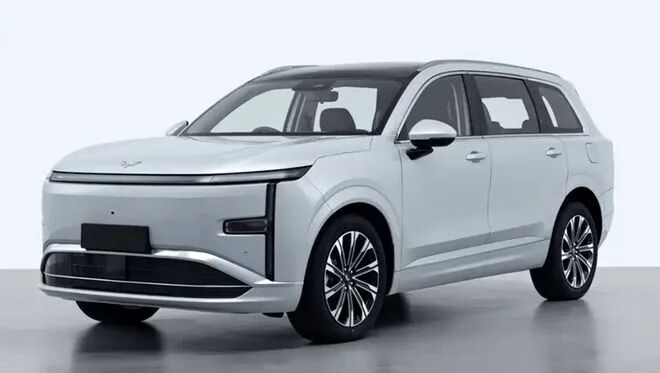
Core Viewpoint - The article discusses the unveiling of the new SAIC-GM Wuling Star L PHEV, highlighting its battery capacity and electric range options, which are 150 km and 185 km for pure electric driving [1][16]. Group 1: Product Specifications - The new SUV will offer two different capacities of lithium iron phosphate batteries, with pure electric ranges of 150 km and 185 km [1][16]. - The vehicle will feature two powertrain options: a 1.5T hybrid engine with a maximum power of 105 kW and a 1.5L naturally aspirated engine with a maximum power of 78 kW [15][30]. - The battery capacities available are 31 kWh and 37.9 kWh, with both powertrain options having a top speed of 190 km/h [15][30]. Group 2: Design and Dimensions - The exterior design incorporates a closed front face, a continuous light strip, and a more mainstream aesthetic compared to previous Wuling models [6][21]. - The vehicle dimensions are 4980 mm in length, 1930 mm in width, 1760 mm in height, and a wheelbase of 2950 mm, with options for 5-seat and 6-seat configurations [12][27]. - The rear design is characterized by a square shape with a continuous taillight group and a roof-mounted spoiler, contributing to a stylish appearance [14][29]. Group 3: Market Competition - The new model is expected to compete with other plug-in hybrid vehicles from brands like Leap Motor and BYD, indicating a more competitive market landscape in the plug-in hybrid segment, especially in the 150,000 RMB price range [16][31].
比亚迪称王!电动车年销量首次超越特斯拉,特斯拉股价大跳水
Xin Lang Cai Jing· 2026-01-04 01:29
Core Viewpoint - BYD has surpassed Tesla in electric vehicle deliveries, claiming the title of "global electric vehicle sales champion" for the first time, marking a significant shift in the competitive landscape of the electric vehicle market [1][11]. Group 1: Tesla's Performance - Tesla's fourth-quarter delivery volume decreased by 15.6% year-on-year, totaling 418,227 vehicles, which was below analysts' expectations of 440,907 vehicles [5][15]. - For the entire year of 2025, Tesla's delivery volume fell by 8.6%, marking the second consecutive year of decline [5][15]. - The decline in Tesla's sales is attributed to the expiration of the U.S. federal electric vehicle tax credit in September 2025, which previously incentivized purchases [5][15]. Group 2: BYD's Growth - BYD reported a 28% year-on-year increase in pure electric vehicle sales for 2025, reaching 2.25 million units [7][17]. - In contrast, Tesla's total annual deliveries were 1.64 million, reflecting an 8.6% decrease [7][17]. - BYD is also experiencing rapid growth in overseas markets, particularly in Latin America and Southeast Asia, with plans to expand production in Brazil and increase exports to Europe [19]. Group 3: Market Dynamics - Tesla is facing increased competition not only from BYD but also from established European automakers, such as Volkswagen, which have surpassed Tesla in electric vehicle sales in Europe [11][22]. - Analysts predict that the U.S. electric vehicle market may struggle in 2026, with a potential turning point expected in 2027 when more manufacturers introduce electric vehicles priced below $30,000 [5][15].

目标完成!比亚迪年销460万辆
Xin Lang Cai Jing· 2026-01-04 01:19
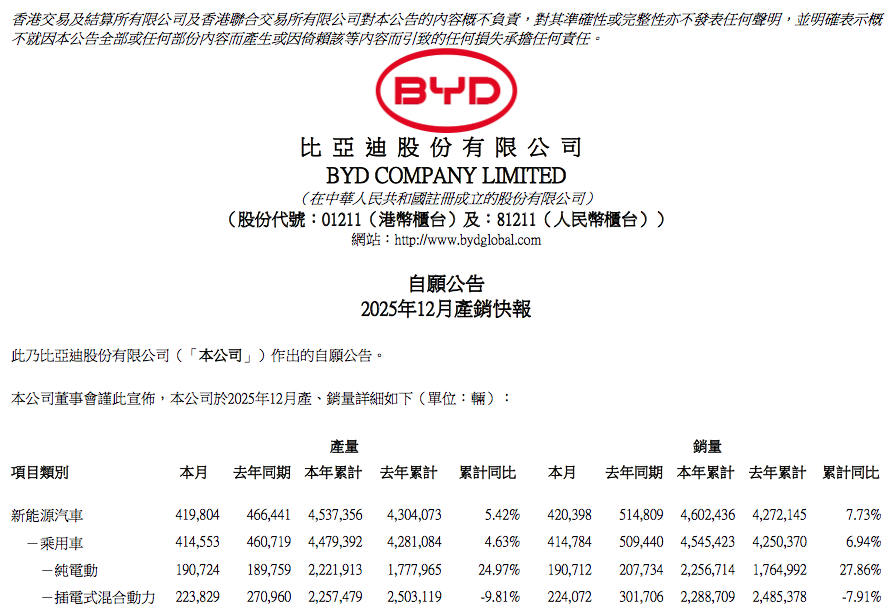
Core Viewpoint - BYD reported its December 2025 and full-year sales data, showing a total of 420,400 electric vehicles sold in December, with a total annual sales of 4,602,436 units, reflecting a year-on-year growth of 7.73% [1][9]. Sales Data Summary - In December 2025, BYD's total sales of new energy vehicles reached 420,400 units, including 414,800 passenger cars, 190,700 pure electric vehicles, and 223,800 plug-in hybrid vehicles [1][2]. - For the entire year of 2025, BYD's cumulative sales of new energy vehicles amounted to 4,602,436 units, with passenger car sales at 4,545,423 units, pure electric vehicle sales at 2,256,714 units (up 27.86%), and plug-in hybrid vehicle sales at 2,288,709 units (down 7.91%) [1][2][12]. Brand Performance - The Dynasty and Ocean networks contributed significantly to sales, with December sales of 344,900 units, including 155,436 units from the Dynasty network and 188,838 units from the Ocean network [3][13]. - The Dynasty network's annual cumulative sales reached 1,885,203 units, while the Ocean network's annual sales totaled 2,220,008 units [4][14]. Export Performance - In December, BYD exported 133,200 new energy vehicles, with total overseas sales for 2025 exceeding 1 million units, marking a 145% year-on-year increase [10][19]. - The company is enhancing its competitiveness in overseas markets through localized production and self-shipping strategies to mitigate high tariffs in regions like Europe and the US [19]. Milestones - BYD announced the production of its 15 millionth new energy vehicle on December 18, 2025, highlighting a significant milestone for the Chinese automotive industry [10][19].
2025年杀青汽车渠道瘦身进行时
Xin Lang Cai Jing· 2026-01-04 01:19
Core Viewpoint - In 2025, the Chinese automotive industry is at a historic turning point, with the penetration rate of new energy vehicles exceeding 50%, marking a shift towards a high-quality development phase characterized by a balance between traditional and electric vehicles [2][16]. Group 1: Industry Transformation - The automotive channel system is undergoing unprecedented restructuring, shifting from scale expansion to integration optimization, model innovation, and deepening market penetration [2][16]. - The era of merely pursuing the number of outlets has ended, with a focus on quality improvement and efficiency optimization becoming the core issues [2][3]. - The automotive channel transformation is clearly presenting three major trends: lightweight, hybrid, and downward expansion, aimed at addressing high costs and low efficiency in the industry [2][3][11]. Group 2: Lightweight Trend - The traditional heavy asset 4S stores are facing high rent and inventory pressures, prompting automakers to explore lightweight outlet models [4][19]. - Lincoln China's "Spark Plan" serves as a benchmark for lightweight transformation, significantly reducing single-store investment from 20-30 million yuan to 4 million yuan, leading to a 40% decrease in dealer operating costs [4][18]. - The optimization of profit structure in lightweight stores allows after-sales profits to fully cover operating costs, enhancing profitability [4][18]. Group 3: Hybrid Trend - The trend of channel hybridization, which began in 2024, continues to deepen in 2025, with brands exploring flexible combinations of direct sales, agency, and authorization models [7][21]. - NIO is cautiously adopting a hybrid approach, allowing local agents to manage market operations while maintaining brand control [7][21]. - BYD's Tengshi and Fangchengbao brands are implementing a dual-track system of direct sales and authorization to enhance channel efficiency [8][22]. Group 4: Downward Expansion Trend - The trend of channel downward expansion is accelerating, with significant sales growth in lower-tier cities, reflecting a clear shift in the automotive consumption market [11][25]. - Leap Motor's strategy of lowering the price of main models to the 150,000 yuan range has led to a 113.42% year-on-year increase in deliveries, with over 60% of sales coming from lower-tier markets [11][25]. - Third-party involvement, such as JD Auto's collaboration with GAC and CATL, is creating new models for the lower-tier market, significantly reducing the purchase threshold [12][26]. Group 5: Efficiency Revolution - The core of channel transformation is an efficiency revolution, focusing on serving more users at lower costs [12][26]. - The automotive channel is undergoing structural reshaping through lightweight, hybrid, and downward expansion trends, but the evolution of channels is far from over [12][26].


研判2025!中国共享出行行业发展背景、产业链、交易规模、竞争格局及未来前景:共享出行交易规模稳步提升,正向智能化、绿色化方向深度演进[图]
Chan Ye Xin Xi Wang· 2026-01-04 01:17
Core Insights - The shared economy model, leveraging internet technology and resource sharing, has rapidly emerged, significantly impacting various sectors including transportation and finance [1] - The shared mobility sector has seen a recovery in transaction volume, reaching 234.5 billion yuan in 2024, a year-on-year increase of 9.07% [1][9] - Future growth is expected as shared mobility integrates with advanced technologies like autonomous driving and electric vehicles, enhancing service intelligence and sustainability [1][9] Shared Mobility Industry Overview - Shared mobility refers to transportation methods where users do not own vehicles but share them, including ride-hailing services and bike-sharing [2] - The industry encompasses various innovative models such as ride-hailing, bike-sharing, and car-sharing services [2] Development Background of Shared Mobility - The shared economy, centered around internet platforms, optimizes resource allocation and enhances efficiency [4] - China's shared economy market size is projected to grow from 19.6 trillion yuan in 2015 to 44.6 trillion yuan in 2024, with a compound annual growth rate of 9.57% [4] Shared Mobility Industry Chain - The industry chain includes hardware suppliers (vehicle manufacturers, battery suppliers) at the upstream, platform operators in the middle, and end-users at the downstream [5] Current State of Shared Mobility - The user base for shared mobility in China has grown from 380 million in 2016 to 710 million in 2024, with a compound annual growth rate of 8.13% [8] - The shared mobility sector is becoming a vital part of urban transportation, driven by urbanization and increasing environmental awareness [8] Competitive Landscape and Key Players - The shared mobility industry features a competitive landscape with major players like Didi Chuxing, Cao Cao Mobility, and others in ride-hailing, while bike-sharing is dominated by companies like Hello Bike and Meituan Bike [9] Future Trends in Shared Mobility - The integration of services and the emergence of Mobility as a Service (MaaS) will enhance user experience and operational efficiency [13] - Technological advancements will improve user experience and operational intelligence, with AI and autonomous driving playing key roles [14] - The green transition in shared mobility will involve collaboration with urban energy systems, enhancing sustainability [15]


