
供应扰动

Search documents
美伊军事冲突增添供应扰动担忧,基本金属震荡回升
Zhong Xin Qi Huo· 2026-03-03 01:41
投资咨询业务资格:证监许可【2012】669号 中信期货研究(有⾊每⽇报告) 2026-03-03 美伊军事冲突增添供应扰动担忧,基本 金属震荡回升 有⾊观点:美伊军事冲突增添供应扰动担忧,基本⾦属震荡回升 交易逻辑:据汇通财经网数据,近期公布的经济数据表现分化,美联储降 息预期继续改善;美以联合打击伊朗,地缘冲突升级,整体来看,宏观面 有扰动但整体稳定。原料端延续偏紧局面;冶炼端仍有扰动预期,美伊军 事冲突引发供应扰动担忧,伊朗和中东供应优势金属铜铅锌铝存在供应中 断风险,整体供应端支撑较强。终端偏弱,现实供需偏宽松,但消费逐步 往传统旺季切换,中期供需收紧预期仍在。整体来看,短期供应端炒作风 险上升,基本金属有望阶段性重回震荡偏强,关注铜铝锡镍短多机会,中 期美联储独立性风险和供应扰动担忧仍在,铜铝锡镍等品种有望维持震荡 偏强走势。 铜观点:地缘冲突加剧,铜价⾼位运⾏ 氧化铝观点:减产预期博弈过剩现实,氧化铝价震荡运⾏ 铝观点:地缘冲突加⼤供应担忧,铝价震荡上⾏ 铝合⾦观点:成本⽀撑延续,价格震荡上⾏ 锌观点:中东地缘冲突,锌价⾼位震荡 铅观点:地缘冲突扰动,铅价震荡运⾏ 镍观点:库存⾼位压制,盘⾯震荡运 ...
美伊冲突如何影响期货市场?
Zhong Xin Qi Huo· 2026-03-02 06:57
Investment consulting business qualification:CSRC License [2012] No. 669 投资咨询业务资格:证监许可【2012】669 号 中信期货国际化研究 | CITIC Futures International Research 2026/3/1 How the U.S.-Iran Conflict Affects the Futures Market 美伊冲突如何影响期货市场? | 陈冬科 | Chen Dongke | 从业资格号 Qualification No.: F03124206 | 投资咨询号 Consulting No.: Z0023470 | | --- | --- | --- | --- | | 朱善颖 Zhu Shanying | | 从业资格号 Qualification No.: F03138401 | 投资咨询号 Consulting No.: Z0021426 | | 李云旭 Li Yunxu | | 从业资格号 Qualification No.: F03141405 | 投资咨询号 Consulting No.: ...
基本金属震荡整理,关注下游消费恢复进展
Zhong Xin Qi Huo· 2026-02-25 00:21
投资咨询业务资格:证监许可【2012】669号 中信期货研究(有⾊每⽇报告) 2026-02-25 基本金属震荡整理,关注下游消费恢复 进展 有⾊观点:基本⾦属震荡整理,关注下游消费恢复进展 交易逻辑:据汇通财经网数据,近期美国公布的经济数据偏弱,美联储降 息预期有所升温,尽管关税政策再度出现反复,但考虑到当下美联储降息 预期也在摇摆,估计短期可能还是会对基本金属构成一定压制。原料端延 续偏紧局面;冶炼端仍有扰动预期,整体供应端支撑较强。终端偏弱,现 实供需偏宽松,但中期供需收紧预期仍在,密切跟踪下游消费恢复进展。 整体来看,短期基本金属偏震荡,中期美联储独立性风险和供应扰动担忧 仍在,铜铝锡镍等品种有望维持震荡偏强走势。 铜观点:特朗普关税被否,铜价⾼位震荡。 氧化铝观点:减产预期博弈过剩现实,氧化铝价震荡运⾏。 铝观点:库存累积明显,铝价震荡运⾏。 铝合⾦观点:成本⽀撑延续,价格震荡运⾏。 锌观点:美国关税政策反复,锌价⾼位震荡。 铅观点:伦铅库存⼤幅累积,铅价震荡运⾏。 镍观点:印尼26年镍矿配额落地,镍价偏强运⾏。 不锈钢观点:镍价震荡⾛⾼,不锈钢盘⾯上⾏。 锡观点:暂⽆明显驱动,锡价震荡运⾏。 ⻛险 ...
恐慌情绪缓和,基本金属企稳
Zhong Xin Qi Huo· 2026-02-04 01:00
Report Summary 1. Industry Investment Rating The report does not explicitly provide an overall industry investment rating. However, for individual metals, the mid - to long - term outlooks are mostly positive, with some expected to be "oscillating strongly" and others "oscillating". 2. Core Viewpoints - The panic sentiment in the base metals market has eased, and the base metals have stopped falling and stabilized [2]. - In the short term, the panic has been significantly released. With the stop - falling of precious metals and active downstream buying, there are opportunities for short - term low - buying and long - positions in copper, aluminum, tin, and nickel. - In the medium term, due to the risk of the Fed's independence and supply - side disturbances, metals like copper, aluminum, and tin are expected to maintain an oscillating and strong trend. - In the long term, with potential domestic stimulus policies and supply - side issues, the supply and demand of copper, aluminum, and tin are expected to tighten, and their prices are optimistic [2]. 3. Summary by Metal Copper - **Viewpoint**: Market sentiment has recovered, and copper prices have stopped falling and stabilized. - **Analysis**: On February 3, the spot of Shanghai 1 electrolytic copper was at a discount of - 150 yuan/ton, a month - on - month increase of 10 yuan/ton. The 25% copper concentrate spot TC was - 50.2 dollars/dry ton, unchanged month - on - month. The China Nonferrous Metals Industry Association proposed to consider including copper concentrates in the strategic reserve [8]. - **Logic**: The previous risk - aversion sentiment in the market has recovered, and the strategic reserve value of copper is prominent. The supply of copper mines is increasingly disturbed, the spot TC of copper concentrates continues to decline, and the supply of refined copper is expected to shrink. Although the terminal demand is weak in the off - season, the long - term supply - demand is expected to be tight [8]. - **Outlook**: Oscillating strongly [8]. Alumina - **Viewpoint**: The expectation of production cuts competes with the reality of oversupply, and the alumina price oscillates. - **Analysis**: On January 29, the national weighted index of alumina spot was 2610.4 yuan/ton (unchanged), and the alumina warehouse receipts were 161,521 tons, a month - on - month increase of 2,402 tons [8]. - **Logic**: The current spot average price has declined significantly compared to the end of last year. High - cost inland production capacity is facing losses, but the supply contraction is insufficient. The prices of raw materials such as bauxite and caustic soda are also weak, weakening the price support. The futures price has pressure above, so it is expected to oscillate widely [8]. - **Outlook**: Oscillating [8]. Aluminum - **Viewpoint**: The capital sentiment has recovered, and aluminum prices have stabilized. - **Analysis**: On February 3, the domestic average spot price of electrolytic aluminum was 23,327 yuan/ton, a month - on - month decrease of 396 yuan/ton; the spot premium was - 220 yuan/ton, unchanged month - on - month. On February 2, the inventory of aluminum ingots in major domestic consumption areas was 829,000 tons, a month - on - month increase of 29,000 tons; the inventory of aluminum rods was 267,000 tons, a month - on - month increase of 14,000 tons [8][9]. - **Logic**: The US January interest - rate meeting was neutral, and the short - term risk appetite decreased. But the macro - outlook is expected to be positive. The domestic production capacity is stable, and overseas production is restricted. The weekly initial - stage operating rate has decreased, and the inventory has accumulated. Overall, the macro - expectation is positive, and the supply - demand is expected to be tight [8][9][10][11]. - **Outlook**: Oscillating strongly in the short term, and the price center is expected to rise in the medium term [11]. Aluminum Alloy - **Viewpoint**: The cost support continues, and the price oscillates. - **Analysis**: On February 3, ADC12 was reported at 23,000 yuan/ton, a month - on - month decrease of 300 yuan/ton; the domestic average spot price of electrolytic aluminum was 23,327 yuan/ton, a month - on - month decrease of 396 yuan/ton [12][14]. - **Logic**: The price of scrap aluminum is high, and the supply is tight. Some manufacturers have started the Spring Festival holiday in advance, and the supply may be restricted by policies. The demand is mainly for rigid - need replenishment. The weekly social inventory has accumulated [12]. - **Outlook**: Oscillating strongly in the short and medium terms [12]. Zinc - **Viewpoint**: The sentiment of the non - ferrous sector has stabilized, and the decline of zinc prices has slowed down. - **Analysis**: On February 3, Shanghai 0 zinc had a discount of - 5 yuan/ton to the main contract, Guangdong 0 zinc had a discount of - 35 yuan/ton, and Tianjin 0 zinc had a discount of - 50 yuan/ton. As of February 3, the total inventory of zinc ingots in seven places was 111,200 tons, a month - on - month increase of 3,800 tons [12][13]. - **Logic**: The Fed's January interest - rate decision was in line with expectations, but the macro - outlook was volatile. The supply of zinc mines is tight in the short term, and the refinery profit has declined. The domestic consumption is in the off - season, and the demand is average. The short - term export of zinc ingots will continue, and the inventory accumulation pressure is not large. In the long term, the supply of zinc ingots will increase, and the demand growth is limited [13]. - **Outlook**: Oscillating [13]. Lead - **Viewpoint**: The decline of non - ferrous metals has slowed down, but the warehouse receipts have increased significantly, and the lead price oscillates downward. - **Analysis**: On February 3, the price of waste electric vehicle batteries was 10,000 yuan/ton, a decrease of 25 yuan/ton; the price of 1 lead ingots was 16,425 - 16,525 yuan/ton, with an average of 16,475 yuan/ton, a month - on - month decrease of 150 yuan/ton. On February 2, the domestic social inventory of lead ingots was 39,000 tons, a month - on - month increase of 60 tons; the latest warehouse receipts of Shanghai lead were 33,439 tons, a month - on - month increase of 4,021 tons [14][15]. - **Logic**: The spot premium has increased slightly, the original - recycled spread has decreased, and the futures warehouse receipts have increased. The price of waste batteries has decreased slightly, and the production of recycled lead has decreased. The orders for electric bicycles have weakened, while those for automobile batteries have improved. The operating rate of lead - acid battery enterprises has declined from the previous high but is still at a relatively high level [15]. - **Outlook**: Oscillating [15]. Nickel - **Viewpoint**: Market sentiment has recovered, and nickel prices are oscillating upward. - **Analysis**: On February 3, the Shanghai nickel warehouse receipts were 48,180 tons, a month - on - month increase of 1,606 tons; the LME nickel inventory was 285,528 tons, unchanged month - on - month. The price of high - nickel iron in the Chinese market was 1,030 - 1,065 yuan/nickel (including tax at the factory), a decrease of 10 - 15 yuan compared to February 2 [16][17]. - **Logic**: The supply of nickel is under pressure, and the demand is in the off - season. However, Indonesia plans to revise the domestic trade pricing method of nickel ore and lower the 2026 nickel ore quota, which has adjusted the market's cost and balance expectations [16]. - **Outlook**: Oscillating strongly, and the policy changes in Indonesia need to be continuously tracked [16]. Stainless Steel - **Viewpoint**: Nickel prices have recovered, and the stainless - steel market is oscillating. - **Analysis**: On February 3, the stainless - steel futures warehouse receipt inventory was 43,758 tons, a month - on - month increase of 239 tons. The spot price of Foshan Hongwang 304 had a premium of 415 yuan/ton to the stainless - steel main contract. The price of high - nickel iron in the Chinese market was 1,030 - 1,065 yuan/nickel (including tax at the factory), a decrease of 10 - 15 yuan compared to February 2 [17]. - **Logic**: The price of nickel iron is relatively firm, and the cost of stainless steel has support. The production in December decreased, and the production schedule in January may increase slightly. The terminal demand is still cautious, and the inventory is accumulating [17][18]. - **Outlook**: Oscillating strongly, and the policy changes in Indonesia need to be continuously tracked [18]. Tin - **Viewpoint**: Market sentiment is weak, and tin prices continue to adjust. - **Analysis**: On February 3, the LME tin warehouse receipt inventory increased by 10 tons to 7,105 tons; the Shanghai tin warehouse receipt inventory decreased by 427 tons to 8,097 tons; the Shanghai tin position decreased by 3,262 lots to 92,297 lots. The average price of Yangtze River Nonferrous 1 tin ingots was 392,550 yuan/ton, a month - on - month decrease of 36,000 yuan/ton [18]. - **Logic**: The supply of tin is the key factor affecting the price. The supply in Wa State may improve, while the supply in Indonesia is restricted, and the situation in the Democratic Republic of the Congo is severe. The supply of ore is tightening, and the production of refined tin is difficult to increase. The demand in the semiconductor, photovoltaic, and new - energy vehicle industries is increasing, and the inventory needs to be rebuilt. However, the short - term price may fluctuate due to the strong US dollar, stable ore supply, and weakened bullish power [18]. - **Outlook**: Oscillating strongly in the medium to long term, but short - term price fluctuations need to be vigilant [19]. 4. Market Index Monitoring - On February 3, 2026, the comprehensive index of CITIC Futures commodities was 2,374.28, a decrease of 1.93%; the commodity 20 index was 2,707.14, a decrease of 2.40%; the industrial products index was 2,290.30, a decrease of 0.97% [145]. - The non - ferrous metals index on February 3, 2026, had a daily decline of 1.15%, a decline of 7.34% in the past 5 days, a decline of 5.65% in the past month, and a decline of 0.29% since the beginning of the year [147].
有色恐慌杀跌,关注下游买盘
Zhong Xin Qi Huo· 2026-02-03 01:21
投资咨询业务资格:证监许可【2012】669号 中信期货研究(有⾊每⽇报告) 2026-02-03 有色恐慌杀跌,关注下游买盘 铜观点:美元指数反弹,铜价⼤幅回落。 氧化铝观点:减产预期博弈过剩现实,氧化铝价震荡运⾏。 铝观点:资⾦情绪反复,铝价⼤幅回调。 铝合⾦观点:盘⾯跟随铝锭,价格有所回落。 锌观点:有⾊板块杀跌,锌价⾼位回落。 铅观点:有⾊板块承压但成本⽀撑较⾼,铅价震荡下⾏。 镍观点:有⾊板块集体回调,镍价⼤幅下挫。 不锈钢观点:镍价⼤幅回调,不锈钢盘⾯⾛弱。 锡观点:市场情绪偏弱,锡价延续调整。 ⻛险提⽰:供应扰动;国内政策刺激超预期;美联储鸽派不及预期; 国内需求复苏不及预期;经济衰退。 有⾊观点:有⾊恐慌杀跌,关注下游买盘 交易逻辑:据财联社消息,1月美联储利率决议符合预期,鲍威尔称接下 来降息路径仍取决于经济数据表现,这给降息预期改善提供了空间,但特 朗普提名的下届美联储主席出乎市场预期,投资者对沃仕印象解读为鹰 派,美元指数快速反抽,贵金属杀跌引发有色整体恐慌,资金短期大幅撤 离,整体上看,宏观面预期出现反复,关注美联储降息预期变化。原料端 延续偏紧局面;冶炼端仍有扰动预期,整体供应端支撑 ...
市场关注点重回弱美元预期和供应扰动,基本金属加速走高
Zhong Xin Qi Huo· 2026-01-30 00:46
Report Industry Investment Rating No relevant information provided. Core Viewpoints of the Report - The market's focus has returned to the weak US dollar expectation and supply disruptions, causing base metals to rise rapidly. In the short - to - medium term, with the return of the weak US dollar expectation and supply disruption concerns, and the breakdown of the US dollar index, base metals are rising rapidly. Long - term, there are still expectations of potential incremental stimulus policies in China, and supply disruptions in copper, aluminum, and tin remain, so their prices are expected to rise [1]. - The prices of copper, aluminum, tin, nickel, and other metals are expected to show different trends. For example, copper prices are expected to be volatile and strong; alumina prices are likely to fluctuate; aluminum prices are expected to remain volatile and strong in the short - term and the price center may rise in the long - term [1][7][9]. Summary by Relevant Catalogs 1.行情观点 Copper - **Viewpoint**: The US dollar index has declined significantly, and copper prices are trending strongly. In December 2025, China's electrolytic copper production was 1.1553 million tons, a month - on - month increase of 14,800 tons and a year - on - year increase of 11.68%. On January 29, 2026, the spot price of Shanghai 1 electrolytic copper was at a discount of - 175 yuan/ton, a month - on - month increase of 75 yuan/ton. The copper social inventory was 335,900 tons, a month - on - month decrease of 5,500 tons. The 25% copper concentrate spot TC was - 50.2 US dollars/dry ton, with no month - on - month change. The US Southern Copper Corporation expects its copper production to decline to 91,140 tons in 2026. - **Main Logic**: Macroscopically, the recent weakening of the US dollar index has boosted the prices of commodities with strong monetary attributes. In terms of supply and demand, copper mine supply disruptions are increasing, and the decline of copper concentrate spot TC continues. The 2026 copper mine long - term processing fee has reached a record low, strengthening the expectation of a contraction in refined copper supply. Although the terminal demand is weak and the inventory is high, the long - term supply - demand situation is expected to be optimistic. - **Outlook**: Volatile and strong [7]. Alumina - **Viewpoint**: The expectation of production cuts is competing with the reality of oversupply, causing alumina prices to fluctuate. On January 29, 2026, the national weighted average price of alumina spot was 2,610.4 yuan/ton (unchanged), and the alumina warehouse receipts were 161,521 tons, a month - on - month increase of 2,402 tons. - **Main Logic**: Recently, the macro - sentiment has amplified the market fluctuations. Fundamentally, the average spot price has dropped significantly compared to the end of last year. Inland high - cost production capacity is facing losses, increasing the expectation of supply contraction. However, the supply contraction is still insufficient, and the domestic market maintains a strong inventory accumulation trend. The prices of raw materials such as bauxite and caustic soda are also weak, weakening the support for alumina prices. - **Outlook**: Volatile [7]. Aluminum - **Viewpoint**: The capital sentiment is optimistic, and aluminum prices continue to trend strongly. On January 29, 2026, the domestic average spot price of electrolytic aluminum was 24,822 yuan/ton, a month - on - month increase of 578 yuan/ton; the spot premium was - 195 yuan/ton, a month - on - month decrease of 20 yuan/ton. The domestic mainstream consumption area aluminum ingot inventory was 800,000 tons, a month - on - month increase of 4,000 tons, and the aluminum bar inventory was 253,000 tons, a month - on - month increase of 12,000 tons. The Shanghai Futures Exchange electrolytic aluminum warehouse receipts were 142,705 tons, a month - on - month decrease of 124 tons. - **Main Logic**: Macroscopically, the statement of the interest - rate cut meeting was neutral, and China's new infrastructure and new energy policies continued to be implemented, with the expectation of continued loose liquidity. On the supply side, the domestic operating capacity and operating rate are at a high level, and there is a risk of power shortage overseas, and the progress of new project commissioning needs further observation. On the demand side, the high aluminum prices have suppressed demand to some extent, and the weekly inventory has accumulated. In general, in the short - term, the positive macro - expectation and the tight supply - demand expectation are expected to keep aluminum prices volatile and strong. - **Outlook**: In the short - term, aluminum prices are expected to remain volatile and strong. In the medium - term, the supply is expected to be tight, and demand will maintain a resilient growth, and the aluminum price center is expected to rise [8][9][10]. Aluminum Alloy - **Viewpoint**: The market follows the price of aluminum ingots and has increased. - **Main Logic**: On the cost side, the tight supply of scrap aluminum is difficult to change in the short - term, providing strong cost support. On the supply side, the weekly operating rate has increased month - on - month, but the tax refund policy and tax burden transfer may still restrict supply in the medium - term. On the demand side, in the short - term, purchases are mainly for刚需 at high prices, and in the medium - term, the automobile trade - in policy will support the improvement of domestic demand. The weekly social inventory has accumulated. - **Outlook**: In the short - term, prices are expected to be volatile and strong. In the medium - term, the cost - support logic will be strengthened, and the supply - demand will remain in a tight balance, with prices expected to be volatile and strong [11]. Zinc - **Viewpoint**: The rise in overseas natural gas prices has led to a volatile upward trend in zinc prices. On January 29, 2026, the premium of Shanghai 0 zinc to the main contract was 55 yuan/ton, Guangdong 0 zinc was 30 yuan/ton, and Tianjin 0 zinc was - 10 yuan/ton. As of January 29, the total inventory of zinc ingots in seven regions was 107,400 tons, a month - on - month decrease of 2,000 tons. - **Main Logic**: Although the recently announced US economic data is positive, the expectation of a weak US dollar still exists. On the supply side, the decline rate of zinc ore processing fees has slowed down, but the short - term supply of zinc ore is still tight, and smelter profits have declined. In the short - term, the previously locked - price zinc ingots will continue to be imported, and the supply pressure is not significant. On the demand side, domestic consumption has entered the off - season, and the demand expectation is average. In the short - term, zinc ingot exports will continue, and the domestic zinc ingot social inventory has room to decline, so zinc prices may continue to be volatile at a high level. In the long - term, zinc ingot supply is expected to increase, while demand growth is limited, and zinc prices may decline. - **Outlook**: In January, zinc ingot production has increased month - on - month, and downstream demand has entered the off - season. However, short - term domestic zinc ingot exports will continue, and the domestic zinc ingot social inventory is difficult to accumulate significantly. Considering the overall strength of the non - ferrous metal sector, zinc prices are expected to be volatile [12][13]. Lead - **Viewpoint**: The social inventory of lead has accumulated, but the sentiment in the non - ferrous metal sector is positive, causing lead prices to rise in a volatile manner. On January 29, 2026, the price of waste electric vehicle batteries was 10,050 yuan/ton (unchanged), and the price difference between primary and secondary lead was 125 yuan/ton (unchanged). The price of 1 lead ingots was 16,750 - 16,850 yuan/ton, with an average price of 16,800 yuan/ton (unchanged), and the spot premium of Henan lead ingots was - 200 yuan/ton, a month - on - month decrease of 10 yuan/ton. The domestic main market lead ingot social inventory was 38,400 tons, a month - on - month increase of 3,500 tons; the latest Shanghai lead warehouse receipts were 29,418 tons (unchanged). - **Main Logic**: On the spot side, the spot premium has slightly decreased, and the price difference between primary and secondary lead and the futures warehouse receipts have remained stable. On the supply side, the price of waste batteries has remained stable, and the profit of secondary lead smelting has remained stable. The previously shut - down secondary lead smelters in Anhui have resumed production, and the weekly lead ingot output has increased slightly. On the demand side, the orders for electric bicycles have weakened slightly, and the orders for automobile batteries have improved. The operating rate of lead - acid battery enterprises has declined from the previous high but is still at a relatively high level compared to the same period in previous years. - **Outlook**: As primary and secondary lead smelters resume production, lead ingot output remains high. The demand for lead ingots has weakened marginally, and the lead ingot import window has opened. However, the cost of waste batteries remains high, so lead prices are expected to be volatile [15]. Nickel - **Viewpoint**: The expected policy is competing with the weak reality, causing the nickel price to rise in the market. On January 29, 2026, the Shanghai nickel warehouse receipts were 46,854 tons, a month - on - month increase of 2,032 tons; the LME nickel inventory was 286,470 tons, a month - on - month increase of 132 tons. The price of high - nickel iron in the Chinese market was 1,045 - 1,075 yuan/nickel (delivered to the factory, including tax), with no month - on - month change. - **Main Logic**: On the supply side, the domestic electrolytic nickel output increased again month - on - month in December 2025, and the overall output of MIHP, ferronickel, and nickel matte in Indonesia remained at a high level in December, so the overall supply pressure of nickel still exists. On the demand side, it has entered the traditional consumption off - season. Although the stainless - steel production schedule has increased month - on - month due to profit repair, the electroplating and alloy sectors are expected to decline, and the overall fundamentals remain in surplus. In terms of policy, Indonesia plans to revise the domestic trade pricing method of nickel ore and lower the nickel ore quota for 2026, which has significantly adjusted the market's expectations for next year's nickel cost and balance. - **Outlook**: The current fundamentals of nickel have not improved significantly. It is expected that the supply - demand will remain loose in January, and the high LME inventory will suppress prices. However, due to the potential policy changes in Indonesia, nickel prices are expected to be volatile and strong [16]. Stainless Steel - **Viewpoint**: The firm price of nickel iron has led to an upward trend in the stainless - steel market. On January 29, 2026, the stainless - steel futures warehouse receipt inventory was 43,519 tons, a month - on - month increase of 3,925 tons. The spot price of Foshan Hongwang 304 stainless steel was at a discount of - 185 yuan/ton to the main stainless - steel contract. The price of high - nickel iron in the Chinese market was 1,045 - 1,075 yuan/nickel (delivered to the factory, including tax), with no month - on - month change. - **Main Logic**: The price of nickel iron has recovered month - on - month, and the chromium price has remained stable, providing some support to the stainless - steel cost. The stainless - steel output decreased month - on - month in December 2025, and the production schedule in January may increase slightly due to profit repair, but the terminal demand remains cautious. Currently, the social inventory has not shown obvious accumulation, but there may be some inventory pressure during the off - season, and the warehouse receipts remain at a low level. - **Outlook**: The production schedule in January may increase slightly due to profit repair, but the downstream demand is expected to be weak in the traditional off - season, which will suppress prices. However, considering the long - term suppression of industrial chain profits and the support from the mine end, stainless - steel prices are expected to be volatile and strong [17][19]. Tin - **Viewpoint**: The supply shortage continues, and tin prices are trending strongly. On January 29, 2026, the LME tin warehouse receipt inventory decreased by 25 tons month - on - month to 7,060 tons; the Shanghai tin warehouse receipt inventory decreased by 163 tons month - on - month to 8,494 tons; the Shanghai tin open interest decreased by 3,821 lots month - on - month to 106,892 lots. The average spot price of Yangtze River Non - Ferrous 1 tin ingots was 438,700 yuan/ton, a month - on - month increase of 2,000 yuan/ton. - **Main Logic**: The tin supply problem is the key factor affecting prices. The explosive approval issue in Wa State is expected to be resolved soon, which may ease the local supply shortage. Indonesia's tin production quota this year may be set at 60,000 tons, but short - term supply will still be restricted due to the RKAB approval. The landslide in the Walikale area of North Kivu Province in the Democratic Republic of the Congo has increased supply concerns. In the future, the mine supply will continue to tighten, and the refined tin output will be difficult to increase. The recent increase in tin concentrate processing fees reflects the increasing financial pressure on some smelters. On the demand side, the US and Europe are in an interest - rate cut cycle, and the expansion of the fiscal side is expected to have a positive effect on the global economy. The semiconductor industry maintains high growth, and the consumption in the photovoltaic and new - energy vehicle sectors continues to rise. Considering the need to rebuild the industrial chain inventory, the demand for tin ingots will continue to grow. - **Outlook**: With high supply risks, tin prices are expected to be volatile and strong [20]. 2.行情监测 Copper No specific monitoring content provided. Alumina No specific monitoring content provided. Aluminum No specific monitoring content provided. Aluminum Alloy No specific monitoring content provided. Zinc No specific monitoring content provided. Lead No specific monitoring content provided. Nickel No specific monitoring content provided. Stainless Steel No specific monitoring content provided. Tin No specific monitoring content provided. 3.中信期货商品指数 (January 29, 2026) - **Comprehensive Index**: The commodity 20 index was 2,995.74, an increase of 2.61%; the industrial products index was 2,422.72, an increase of 1.88%; the PPI commodity index was 1,509.62, an increase of 2.38%. - **Plate Index**: The non - ferrous metal index on January 29, 2026 was 2,977.78, with a daily increase of 3.02%, a 5 - day increase of 5.29%, a 1 - month increase of 11.30%, and a year - to - date increase of 10.86% [146][147].
美元指数破位下行,基本金属再获提振
Zhong Xin Qi Huo· 2026-01-27 00:59
Group 1: Report's Overall Investment Rating and Core View - The overall view of the non-ferrous metals industry is that the breakdown of the US dollar index provides a boost to base metals. In the short and medium term, high inventories put pressure on prices, but the logic of a weak US dollar and supply disruption concerns remains. In the long term, there are expectations of potential incremental stimulus policies in China, and supply disruptions in copper, aluminum, and tin are expected to lead to tighter supply - demand conditions. The report suggests paying attention to opportunities for low - absorption and long - position in copper, aluminum, tin, and nickel. [1] Group 2: Analysis of Each Metal Copper - **View**: Inventory continues to accumulate, and copper prices fluctuate at a high level, with a medium - term outlook of being volatile and bullish. [2][6] - **Logic**: In 2026, the Fed may continue to be loose, providing support to copper prices. The supply of copper ore is tightening, and the processing fees for long - term contracts in 2026 are at a record low, strengthening the expectation of supply contraction in refined copper. Although terminal demand is weak during the off - season and inventory is accumulating, the future supply - demand is expected to be tighter. [6] Alumina - **View**: The fundamentals are weak, and alumina prices are under pressure and fluctuate, with a medium - term outlook of oscillation. [2][7] - **Logic**: High - cost production capacity has some fluctuations, but the supply contraction is insufficient. China is still in a strong inventory - building trend. The prices of raw materials such as bauxite and caustic soda are weak, and the cost support is limited. However, as the valuation enters a low - level range, price fluctuations may increase. [7] Aluminum - **View**: Inventory continues to accumulate, and aluminum prices fluctuate at a high level, with a short - term outlook of being volatile and bullish, and a medium - term outlook of the price center rising. [2][9] - **Logic**: The macro - environment is positive, with expectations of US interest rate cuts and the implementation of China's "Two New" policies. The domestic production capacity and operating rate are high, but there are supply constraints overseas. High aluminum prices suppress demand in the short term, but overall, the short - term supply - demand is expected to be tight. [10] Aluminum Alloy - **View**: Cost support continues, and the market fluctuates at a high level, with a short - and medium - term outlook of being volatile and bullish. [2][11] - **Logic**: The supply of scrap aluminum is tight, providing strong cost support. The weekly operating rate has increased, but there may be supply constraints from policies. Demand is mainly for rigid needs in the short term, and the "old - for - new" policy for cars is expected to support demand in the medium term. [11] Zinc - **View**: The sentiment in the non - ferrous metal sector has improved, and zinc prices have stabilized and rebounded, with an overall outlook of oscillation. [2][12] - **Logic**: Although US economic data has pushed up the US dollar, the expectation of a weak US dollar remains. Zinc ore supply is tight in the short term, and refinery profits are declining. Domestic consumption is in the off - season, but zinc exports are expected to continue, and the social inventory of zinc ingots has room to decline. In the long term, zinc supply is expected to increase while demand growth is limited. [13] Lead - **View**: Social inventory is accumulating, but the sentiment in the non - ferrous metal sector is good, and lead prices fluctuate, with an outlook of oscillation. [2][17] - **Logic**: The spot premium has decreased, and the production of lead ingots has increased slightly. The demand for electric bicycles is weak, but the demand for automotive batteries is improving. The operating rate of lead - acid battery enterprises is still at a relatively high level compared to previous years. [17] Nickel - **View**: Policy expectations compete with the weak reality, and nickel prices fluctuate, with an outlook of being volatile and bullish. [2][18] - **Logic**: The supply of nickel is under pressure, and demand is in the traditional off - season, with an overall oversupply in the fundamentals. Indonesia's potential policy changes regarding nickel ore pricing and quotas have adjusted market expectations, and continuous follow - up is needed. [19] Stainless Steel - **View**: Nickel - iron prices are firm, and the stainless - steel market fluctuates, with an outlook of being volatile and bullish. [2][20] - **Logic**: The cost of stainless steel is supported by the recovery of nickel - iron prices. The production in December decreased, and the production schedule in January may increase slightly. Terminal demand is cautious, and there is pressure on inventory accumulation in the off - season. [21] Tin - **View**: Supply - demand tension continues, and tin prices are bullish, with an outlook of being volatile and bullish. [2][21] - **Logic**: Supply issues are the key factors. Although the supply situation in Wa State may improve, short - term supply in Indonesia is restricted, and the landslide in Congo (Kinshasa) has increased supply concerns. On the demand side, the global economy is expected to improve, and the demand for tin in semiconductor, photovoltaic, and new - energy vehicle industries is increasing. [22] Group 3: Market Index Monitoring - **Comprehensive Index**: The commodity index is 2503.03, up 1.13%; the commodity 20 index is 2879.55, up 1.44%; the industrial product index is 2369.84, up 0.40%. [148] - **Non - ferrous Metal Index**: On January 26, 2026, the non - ferrous metal index is 2830.27, with a daily increase of 0.07%, a 5 - day increase of 1.31%, a 1 - month increase of 7.62%, and a year - to - date increase of 5.37%. [150]
刚刚,金价冲上5000美元/盎司关口!芳烃系领涨化工板块
Qi Huo Ri Bao· 2026-01-26 00:32
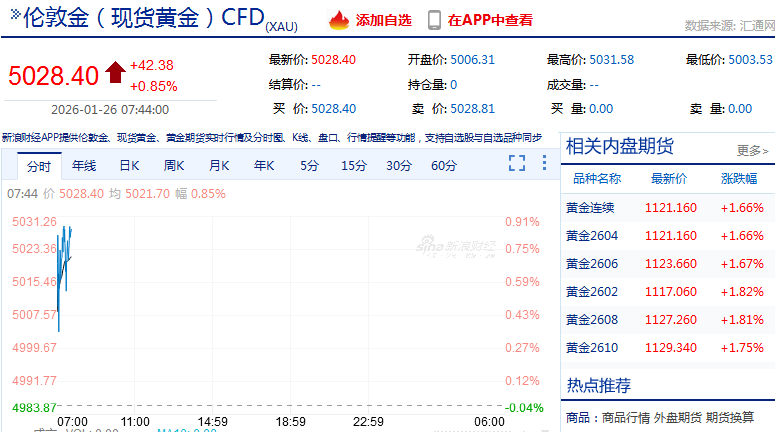
Group 1: Gold Market - Spot gold prices have historically surpassed $5000 per ounce for the first time, just over 100 days after breaking the $4000 mark [2][3] Group 2: Geopolitical Tensions - The Israeli Defense Forces have entered a state of high alert due to escalating regional tensions and are preparing for potential U.S. military actions against Iran [4][5] - Iranian armed forces have declared a state of full readiness, monitoring all hostile movements and prepared to retaliate against any form of aggression [6][7] - Turkey's Foreign Minister has warned external forces against attempting regime change in Iran, emphasizing that the current situation will not lead to such an outcome [8][9] Group 3: Chemical Industry - The chemical futures market has shown a collective strengthening, with significant price increases in aromatics such as pure benzene and styrene, driven by multiple factors including capital rotation and supply disruptions [14][15] - Pure benzene futures rose from 5573 yuan/ton to 6056 yuan/ton, an increase of 8.67%, while styrene futures increased from 7124 yuan/ton to 7708 yuan/ton, up 8.19% [15][16] - The recent price surge in styrene is attributed to supply-side disruptions and increased market sentiment, with expectations of further price support from downstream demand as the Chinese New Year approaches [17][19]
刚刚,金价冲上5000美元/盎司关口!“黑马”,美联储主席最大热门人选出现!芳烃系领涨化工板块
Qi Huo Ri Bao· 2026-01-26 00:17
Group 1: Gold Market - Spot gold prices have historically surpassed $5000 per ounce for the first time, just over 100 days after breaking the $4000 mark, driven by central bank purchases, geopolitical tensions, and economic uncertainty [3] Group 2: Middle East Tensions - The Israeli Defense Forces have entered a state of high alert, closely monitoring regional tensions and preparing for potential U.S. military actions against Iran that could have repercussions for Israel [5] - Iranian armed forces have declared a state of full readiness, emphasizing their capability to respond to any military aggression, particularly in the strategic Strait of Hormuz [6] - Turkey's Foreign Minister has warned external powers against attempting regime change in Iran, asserting that the current situation will not lead to such outcomes [7] Group 3: Chemical Industry - The chemical futures market has shown a collective strengthening, with significant price increases in aromatics such as pure benzene and styrene, which have become the core drivers of the sector's growth [9] - Pure benzene futures rose from 5573 yuan/ton to 6056 yuan/ton, an increase of 8.67%, while styrene futures increased from 7124 yuan/ton to 7708 yuan/ton, up 8.19% [9] - The recent price surge in ethylene glycol futures is attributed to market interest in undervalued chemical assets, despite ongoing supply pressures from new production capacities expected in 2026 [10][13] - The price increases in pure benzene and styrene are driven by market sentiment and supply disruptions, with styrene prices reaching a six-month high due to unexpected plant outages [11] - Upcoming restarts of styrene production facilities are expected to increase supply, potentially exerting downward pressure on prices [12]

国贸期货日度策略参考-20260123
Guo Mao Qi Huo· 2026-01-23 05:56
Report Summary 1) Report Industry Investment Ratings - **Bullish**: Palm oil, soybean oil, natural rubber, BR rubber [1] - **Bearish**: Industrial silicon [1] - **Sideways**: Stock index, treasury bond, copper, alumina, zinc, nickel, stainless steel, tin, silver, gold, platinum, palladium, rebar, hot - rolled coil, iron ore, ferrosilicon, manganese silicon, soda ash, coking coal, coke, rapeseed oil, cotton, sugar, corn, soybean meal, pulp, log, live pig, fuel oil, ethylene glycol, styrene, methanol, asphalt, PTA, short - fiber, PVC, LPG, container shipping on the European route [1] 2) Core Viewpoints - **Macro - financial**: Policy cools market speculative sentiment, stock index oscillates, long - term bulls can look for opportunities; asset shortage and weak economy benefit treasury bond futures, but short - term interest rate risks are prompted [1] - **Non - ferrous metals**: With policy changes, most non - ferrous metals prices are in a state of high - level or range oscillation, and supply - side factors need attention [1] - **Precious metals and new energy**: Market uncertainty supports precious metals prices, but the suspension of key mineral tariffs may suppress platinum and palladium prices [1] - **Black metals**: The situation of weak reality and strong expectation coexists, and the supply may be affected by energy consumption control and anti - involution [1] - **Agricultural products**: The market conditions vary, some are affected by supply and demand, some by policies and weather, and some are in a state of "supported but lack of drive" [1] - **Energy and chemicals**: Affected by multiple factors such as geopolitical conflicts, supply and demand changes, and device maintenance, prices show different trends [1] 3) Summary by Categories Macro - financial - **Stock index**: Policy regulates the market, short - term oscillation adjustment space is limited, long - term bulls can look for opportunities [1] - **Treasury bond**: Asset shortage and weak economy are beneficial, but short - term interest rate risks are prompted, and attention should be paid to the Japanese central bank's interest rate decision [1] Non - ferrous metals - **Copper**: With the suspension of key mineral taxes in the US, short - term concerns ease, and the price oscillates at a high level [1] - **Alumina**: Supply exceeds demand in China, the industry is weak, but the price is near the cost line, so it is expected to oscillate [1] - **Zinc**: The cost center is stable, the fundamentals have few contradictions, and the price fluctuates in a range [1] - **Nickel**: Supply is tight, but inventory accumulation restricts price increase, short - term high - level oscillation [1] - **Stainless steel**: Supply - side disturbances in Indonesia, raw material prices rise, futures run at a high level, beware of squeeze - out risks [1] - **Tin**: The upward trend is suppressed, and attention should be paid to low - buying opportunities in the oscillation range [1] Precious metals and new energy - **Silver, Gold**: Market uncertainty supports prices [1] - **Platinum, Palladium**: Short - term wide - range oscillation, long - term can allocate platinum at low prices or use the "long platinum, short palladium" arbitrage strategy [1] - **Industrial silicon**: Northwest production increases, Southwest production decreases, and polysilicon and organic silicon production decreases in December [1] - **Lithium carbonate**: In the off - season of new energy vehicles, but storage demand is strong, and there is a battery export rush [1] Black metals - **Rebar, Hot - rolled coil, Iron ore**: High production and inventory suppress price increases, and the transmission of futures prices to spot is not smooth [1] - **Ferrosilicon, Manganese silicon**: Weak reality and strong expectation coexist, and supply may be affected by energy consumption control and anti - involution [1] - **Soda ash**: Follows glass, with looser medium - term supply and demand and price pressure [1] - **Coking coal, Coke**: The market is pessimistic about the coking coal 05 contract, and the price may be priced according to Mongolian coal long - term agreement cost [1] Agricultural products - **Palm oil, Soybean oil**: Main consumer countries start purchasing, production areas may reduce production and inventory, and biodiesel themes may ferment [1] - **Rapeseed oil**: Affected by tariff and customs clearance expectations, it is expected to be difficult to fall smoothly, and it is recommended to wait and see [1] - **Cotton**: New crop harvest is expected to be good, but there is a rigid demand for replenishment, and future policies and weather need attention [1] - **Sugar**: Global surplus and domestic new supply increase, short - term fundamentals lack continuous drive [1] - **Corn**: Northeast sales progress is fast, port inventory is low, and there is a pre - holiday replenishment demand [1] - **Soybean meal**: Brazil's harvest progresses, Argentina's weather may cause short - term speculation, and M05 is expected to oscillate weakly [1] - **Pulp, Log**: Affected by macro and external factors, prices are in a state of oscillation [1] - **Live pig**: Supply capacity needs to be further released [1] Energy and chemicals - **Crude oil, Fuel oil**: OPEC+ suspends production increase, affected by the uncertainty of the Russia - Ukraine peace agreement and US sanctions on Venezuela [1] - **Natural rubber**: Short - term supply - demand contradiction is not prominent, follows crude oil, and asphalt profit is high [1] - **BR rubber**: Cost support is strong, market price - support atmosphere is strong, and attention should be paid to downstream acceptance [1] - **PTA, Short - fiber**: PX price rises, PTA maintains high - level operation, and short - fiber follows cost fluctuations [1] - **Ethylene glycol**: Supply - side news stimulates price rebound, and downstream demand exceeds expectations [1] - **Styrene**: Supply - demand fundamentals improve, inventory decreases, and price rebounds [1] - **Methanol**: Affected by the Iranian situation, there is a reduction in expected imports, and downstream feedback is negative [1] - **Asphalt**: Geopolitical conflicts may cause price increases, supply increases, and downstream demand weakens [1] - **PVC**: Global production is low in 2026, but the domestic fundamentals are poor, and there may be a rush to export [1] - **LPG**: February CP is expected to rise, cost support is strong, and inventory is decreasing [1] Others - **Container shipping on the European route**: It is expected to peak in mid - January, airlines' resumption of flights is cautious, and pre - holiday replenishment demand still exists [1]