日历效应

Search documents
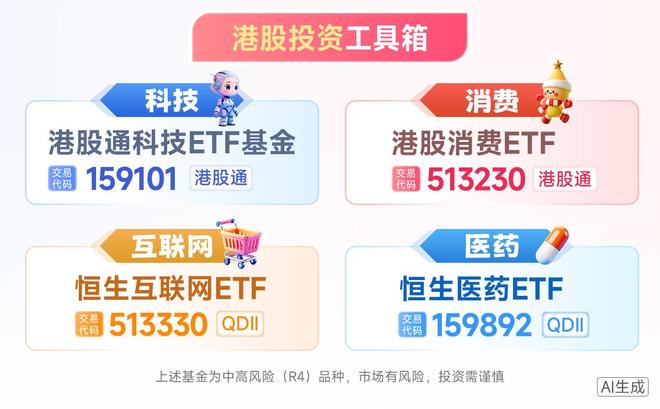
机构称港股“持股过节”胜率较高,聚焦港股通科技ETF基金(159101)布局机会
Mei Ri Jing Ji Xin Wen· 2025-09-29 03:12
Group 1 - The Hong Kong Stock Connect Technology ETF (159101) has seen a net inflow of 464 million yuan over the past 10 trading days, indicating strong investor interest [1] - Major holdings in the ETF, such as SenseTime, Kuaishou, UBTECH, Kingdee International, and Alibaba, have shown significant price increases [1] - Historical patterns suggest a "pre-holiday defense - mid-holiday rally - post-holiday switch" effect in the Hong Kong market, with a focus on domestic consumption data and fourth-quarter policy strength [1][2] Group 2 - The ETF closely tracks the CSI Hong Kong Stock Connect Technology Index, selecting 30 large-cap, high R&D investment technology leaders, with the top ten stocks accounting for over 75% of the weight [2] - Recommended sectors include technology growth (hardware, internet, and pharmaceuticals), consumer goods benefiting from improved cash flow and turnover, and Hong Kong financial stocks [2]

A股分析师前瞻:持股还是持币过节,10月又有哪些日历效应?
Xuan Gu Bao· 2025-09-28 14:59
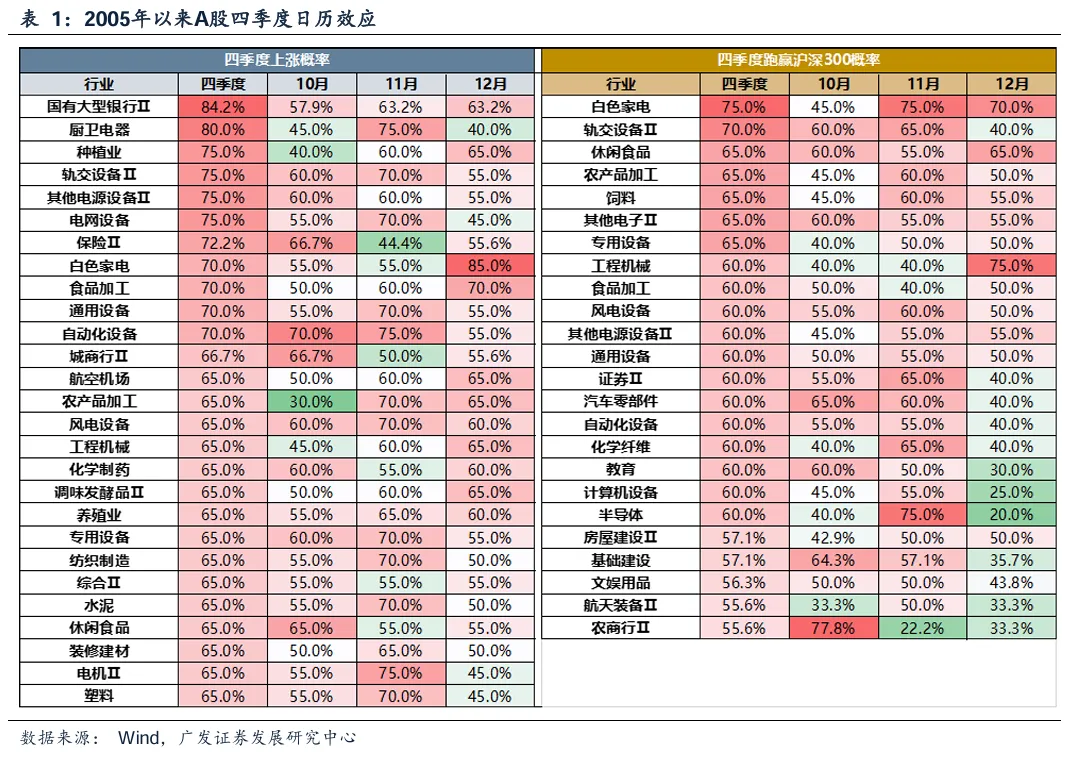
Group 1 - The overall sentiment among brokerages is discussing holding stocks or cash during the holiday, as well as the calendar effect in October [1][5] - The strategy team from JianTou believes that liquidity tends to contract before the National Day holiday, but this is often a "sentimental contraction" [1] - The team from Huaxi suggests that as the holiday approaches, external funds may slow down entering the market, leading to a potential short-term adjustment in A-shares and Hong Kong stocks [1][5] Group 2 - The Guangfa strategy team found that since 2005, cyclical industries have over a 65% probability of rising in the fourth quarter, with more than 60% probability of outperforming the CSI 300 index [1][6] - Key sectors such as optical modules, PCBs, innovative pharmaceuticals, and colored metals are maintaining healthy trends, while sectors like automotive parts and robotics are experiencing relative stagnation [1][6] - The CITIC strategy team emphasizes that resource security, corporate overseas expansion, and technological competition remain crucial structural market clues [4] Group 3 - The market is expected to see a new upward momentum in October, driven by the upcoming third-quarter report trading window and significant policy expectations [5] - The strategy from Yinxing indicates that the market's risk appetite may increase due to the concentration of important meetings and events in October [5] - The strategy team from Zhongtai highlights that the current market levels still have strong support, and long-term capital remains inclined to invest [6]
日历效应系列一:国庆节的先抑后扬
Soochow Securities· 2025-09-27 14:02
Group 1 - The report highlights that the National Day holiday has a significant calendar effect, with a tendency for the market to decline before the holiday and rise afterward, indicating a pattern in trading behavior and economic cycles [1][9][8] - Statistical analysis shows that the win rates and median returns for the Shanghai Composite Index are generally negative in the days leading up to the holiday, while they turn positive in the days following it, particularly with a win rate exceeding 80% in the first five days after the holiday [1][9][10] - The report suggests that the best buying opportunity occurs in the two days before the National Day holiday, followed by a rapid market rebound post-holiday, supported by increased trading volume [2][3][4] Group 2 - The report identifies that sectors such as food and beverage, and pharmaceuticals show strong performance before the holiday, while post-holiday, there is an increased focus on large financial sectors [4][12][13] - It notes that the market dynamics shift from large-cap stocks outperforming small-cap stocks before the holiday to small-cap stocks showing greater elasticity and performance after the holiday [3][4][25] - The underlying factors influencing these trends include risk expectations related to the holiday, quarterly settlement demands, and changes in investor behavior due to holiday breaks [2][3][4]
缩量回调,节前扔不扔?
Ge Long Hui· 2025-09-26 09:38
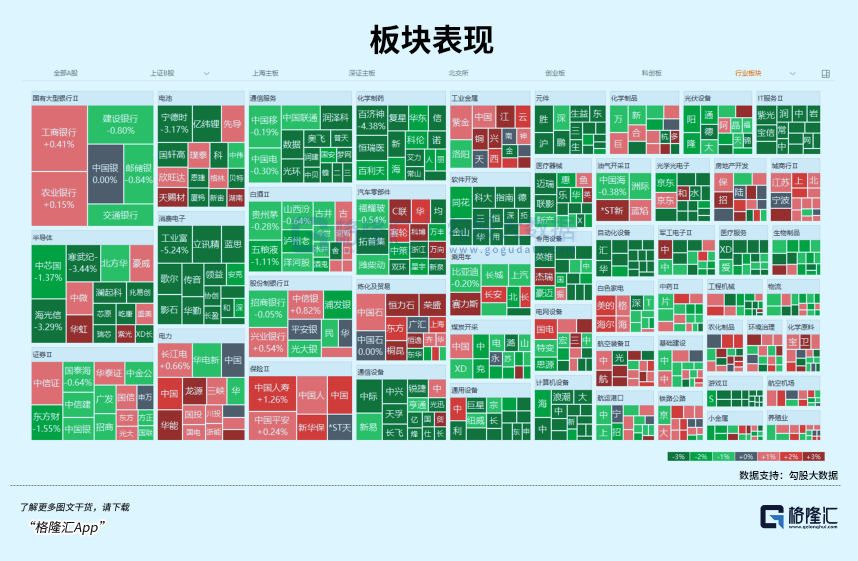
Market Overview - The three major indices experienced a collective pullback, with the Shanghai Composite Index down 0.65%, the Shenzhen Component down 1.76%, and the ChiNext Index down 2.60% [1] - The trading volume in the Shanghai and Shenzhen markets exceeded 2.1 trillion, a decrease of over 200 billion compared to the previous day [2] - The market is showing increased divergence as the holiday approaches, with trading volume relatively dull compared to last week, but volatility is on the rise [3] Sector Performance - The market saw a broad adjustment, with most industry sectors declining. Wind power equipment, chemical fiber, fertilizer, and insurance sectors showed gains, while technology sectors such as gaming, consumer electronics, electronic components, internet services, communication equipment, and software development faced significant declines [6] - Technology stocks experienced a widespread retreat, particularly in computing power sectors, with companies like Zhongheng Electric, Lianang Micro, and Qingshan Paper hitting their daily limit down. Major stocks like Inspur Information and Industrial Fulian also saw substantial drops [8] - Copper-related stocks performed well against the trend, with companies like Jingyi Co. achieving three consecutive limit-up days, and Jiangxi Copper and Tongling Nonferrous Metals also rising. This was influenced by supply concerns following a landslide at the Grasberg mine in Indonesia, which announced "force majeure" due to production stoppage [9] Investment Sentiment - As the National Day holiday approaches, investors face a classic dilemma of whether to hold stocks or cash. The market is experiencing increased volatility and accelerated sector rotation [19] - The market's profitability is declining, with only 32% of stocks rising this week, marking a low point in the current uptrend [21] - Historical data indicates that the probability of index declines in the five trading days leading up to the National Day holiday is 60%, suggesting a cautious outlook for the near term [21] Future Outlook - The technology sector has been a major contributor to the recent index gains, but the current crowded positioning indicates a demand for adjustment. The TMT sector has contributed 42% to the overall A-share index increase since June 23, with a trading volume share of 37% [25] - Given the historical trend of poor performance before the National Day holiday, there is a likelihood of profit-taking, and sectors with strong bottom support signals, such as banking and insurance, may be more favorable [26] - The market is expected to remain in a downward trend with a solid base, and while the medium to long-term upward momentum is still sufficient, more definitive trends may emerge post-October [27]





突发调整,什么原因?日历效应提前启动?
Sou Hu Cai Jing· 2025-09-24 01:12
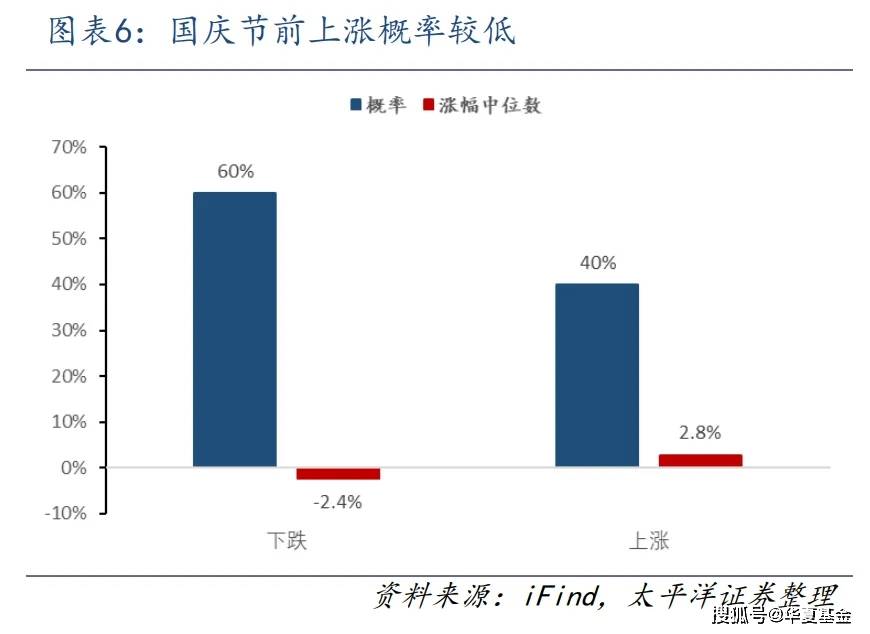
Market Overview - On September 23, the A-share market experienced a day of volatility, with the Shanghai Composite Index closing down 0.18% and the Shenzhen Component Index down 0.29%, while the ChiNext Index rose by 0.21% [1][2] - Despite a late rally in the three major indices, over 4,200 stocks in the market declined [2] Market Adjustment Reasons - The recent market decline is attributed to technical demand and profit-taking pressure rather than substantial negative news [3] - Historical patterns indicate that after the last four Federal Reserve rate cuts, the market typically undergoes a downward adjustment before entering a new upward trend, suggesting a similar pattern may be occurring now [3] Analysis from Shenwan Hongyuan - Shenwan Hongyuan's report indicates that the A-share market has not yet escaped a minor adjustment phase, highlighting three main issues: 1. Insufficient cost-performance ratio, with short-term indicators at high levels and the ChiNext's profitability effect relative to the CSI 300 at a low point [4] 2. Expectations have largely been re-anchored, with a return to long, medium, and short-term economic conditions and cost-performance perspectives [5] 3. The structural main line for further index increases remains unclear, with the market returning to a volatile state while waiting for new catalysts [5] Pre-holiday Market Sentiment - As the National Day holiday approaches, there is a noticeable shift towards risk aversion, with investors opting to secure profits [6] - Historical data shows a 60% probability of index declines in the five trading days leading up to the holiday, leading to a tendency for investors to realize gains to avoid uncertainties during the holiday [6] Short-term Market Dynamics - The market is currently in a phase of consolidation, with declining trading volumes and a retreat from previous upward trends [10] - The technology sector is showing signs of differentiation, with recent gains driven by high-level positive news, indicating a lack of incremental capital in the market [10] Long-term Market Outlook - The overall market is expected to remain stable, with no significant downward trends anticipated, supported by long-term fundamentals such as interest rate conditions, policy support, and industry development [11] - Despite short-term fluctuations, the A-share market retains a favorable long-term valuation, particularly outside of a few technology sectors [11]
日历看债系列之三:机构行为的季节性及时点观察
Huachuang Securities· 2025-09-04 08:26
1. Report Industry Investment Rating No information provided in the content. 2. Core Viewpoints of the Report - The seasonal characteristics and calendar effects of bond market institutional behavior are important areas of bond market microstructure research. By combining the calendar effects with the bond investment patterns of different institutions, investors can seize structural opportunities, improve investment win - rates, and enhance return levels [6][9][14]. - Among different institutions, bank wealth management is most significantly affected by seasonality, followed by commercial banks and insurance companies, while the seasonality of public funds is relatively weak [6]. 3. Summaries According to Relevant Catalogs Bank Wealth Management - **Wealth Management Scale**: The scale of bank wealth management shows a seasonal pattern of "shrinking at the end of the quarter and growing at the beginning of the quarter". Quarterly, the scale surges most significantly in the second and third quarters. Annually, the first quarter is mainly affected by the Spring Festival, and the fourth quarter enters a seasonal off - peak. Weekly, the significant scale changes are concentrated in the last week of the quarter - end month and the first week of the quarter - beginning month [16][19][20]. - **Wealth Management Bond Allocation**: The bond - allocation intensity of wealth management increases in months of large - scale growth and the year - end "pre - emptive" period. It decreases at the end of the quarter and before the Spring Festival. The months with large bond - allocation proportions are April, July, August, May, November, and October [24][25]. - **Implications for Bond Investment**: In the bond - allocation months of the second and third quarters, short - term products such as certificates of deposit, short - term financing bonds, and short - term policy - bank bonds within 1 year are the main allocation varieties. In the year - end "pre - emptive" stage, the bond - allocation term is extended. Attention should be paid to the investment opportunities of varieties that wealth management focuses on and has pricing power [28][36]. Commercial Banks - **Seasonal Patterns of Liabilities and Supervision**: The liability growth of commercial banks mainly occurs in the first half of the year, with a "good start" in the first quarter. Deposits usually grow at the end of the quarter and decline at the beginning of the quarter. Bank bond allocation is restricted by performance growth, regulatory assessment, and the seasonality of fiscal bond issuance [7][41]. - **Large Banks**: Bond - allocation increases when the deposit - loan gap is high and the supply of interest - rate bonds is large. At the end of the quarter after the large - scale supply of long - term bonds, pay attention to the opportunities of steepening the treasury bond curve through "buying short and selling long" and be vigilant about the additional adjustment pressure on long - term varieties. When the bond market is continuously adjusting, large banks may sell old bonds to realize floating profits at the end of the quarter [55][58][64]. - **Rural Commercial Banks**: Bond - allocation is large in the first quarter due to the "good start" and in the year - end pre - emptive stage. In the second half of the year, they allocate bonds evenly in non - quarter - end months. Tracking the behavior of rural commercial banks is a good leading indicator to judge whether the year - end pre - emptive market will start [65][72][75]. Insurance - **Seasonal Influencing Factors**: Insurance premium income has an obvious "good start" at the beginning of the year. In the past two years, the reduction of the预定 interest rate has led to super - seasonal growth. Some insurance companies may adjust their positions at the end of the quarter to improve solvency assessment indicators due to the "Solvency II" assessment [79][80][85]. - **Insurance Bond - Allocation Seasonality**: Bond - allocation peaks usually occur in March and December. In the past two years, due to the reduction of the预定 interest rate, there has been super - seasonal bond - allocation in August and September [89]. - **Implications for Bond Investment**: Pay attention to the opportunity of narrowing the spread between 30 - year local bonds and treasury bonds in March. Also, focus on the opportunity of narrowing the spread between 30 - 10 - year treasury bonds after the reduction of the预定 interest rate [92][95][98]. Public Funds - **General Situation**: Public funds' bond investment follows the market and has relatively weak seasonality. However, some products and individual time points show certain seasonal characteristics [100]. - **Money Market Funds**: Affected by the end - of - quarter assessment of banks and liquidity management needs, the scale of money market funds declines at the end of the quarter and recovers slowly after the quarter. Pay attention to the opportunity of declining yields of certificates of deposit during the bond - allocation windows in mid - March, late June, and late December [4]. - **Amortized - cost - method Bond Funds**: During the open - period peak, pay attention to the opportunity of narrowing the spread of policy - bank bonds with corresponding maturities [4][10]. - **Bond - type Funds**: The second quarter is the peak period of bond - allocation throughout the year. Pay attention to the opportunity of narrowing the spread between 5 - year old policy - bank bonds and 2 - 5 - year secondary capital bonds. At the end of the year, there is a "pre - emptive" behavior, and attention should be paid to varieties with good trading attributes such as 10 - year China Development Bank bonds, 30 - year treasury bonds, and 5 - year secondary capital bonds [4][10].
国泰海通|金工:综合量化模型和日历效应,8月大概率小市值风格占优、价值风格占优
国泰海通证券研究· 2025-08-04 14:50
Group 1: Market Strategy Insights - The report indicates that small-cap stocks are likely to outperform in August, supported by a quantitative model signal of 0.5, suggesting an overweight position in small-cap stocks [1] - Year-to-date, the small-cap strategy has yielded a return of 15.74%, outperforming the equal-weight benchmark return of 11.79% by 3.95% [1] - The value-growth rotation strategy shows a quantitative model signal of -0.33, indicating a shift towards value stocks, with a year-to-date return of 11.11% and an excess return of 7.63% [2] Group 2: Factor Performance Tracking - Among eight major factors, volatility and value factors have shown positive returns this month, while liquidity and momentum factors have shown negative returns [2] - Year-to-date, volatility and quality factors have performed well, whereas liquidity and large-cap factors have underperformed [2] - The report highlights that the beta, investment quality, and momentum factors have positive returns this month, while residual volatility, mid-cap, and long-term reversal factors have negative returns [2] Group 3: Covariance Matrix Update - The report updates the factor covariance matrix as of July 31, 2025, which is crucial for predicting stock portfolio risks [3] - The covariance matrix is constructed using a multi-factor model that combines factor covariance and stock-specific risk matrices for accurate estimation [3]

兴业证券:8月有哪些值得关注的“日历效应”?
智通财经网· 2025-07-31 11:59
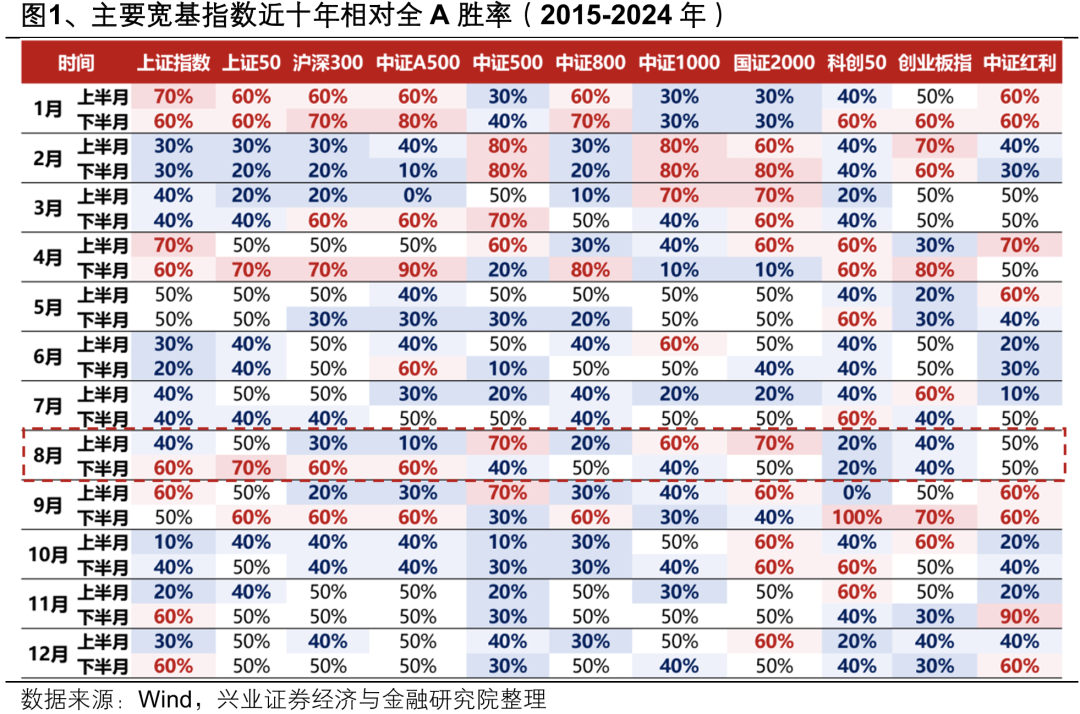
Group 1 - The core viewpoint of the report indicates that in August, the small-cap style has a higher win rate in the first half, while the large-cap style performs better in the second half, driven by earnings announcements [1] - The report highlights that the win rate of dividend-paying stocks is increasing after the peak dividend distribution period, as the market shifts focus towards stable earnings assets [4][6] - The industries with higher win rates in August are primarily concentrated in coal, petrochemicals, and military sectors, influenced by seasonal demand and supply constraints [6][10] Group 2 - The report notes that the performance of small-cap stocks is favored in early August due to fewer earnings disclosures, leading to lower market focus on earnings [1] - As companies begin to disclose their earnings in the latter half of August, the focus on earnings increases, benefiting large-cap stocks with more earnings certainty [1] - The report emphasizes that the high temperatures in July and August lead to increased electricity demand, positively impacting resource sectors like coal and petrochemicals [6][10]

今天!时隔288个日夜,上证综指再摸3600点!……
对冲研投· 2025-07-23 09:36
Core Viewpoint - The article highlights the recent surge of the Shanghai Composite Index reaching 3600 points for the first time since October 2022, indicating a strong performance in cyclical sectors such as steel, coal, and petrochemicals, which contradicts the belief that dividend assets lack "sharpness" [1][2]. Group 1: Market Dynamics - The current market is characterized by a significant presence of institutional investors, with the top five institutions holding nearly 40% of the total market capitalization, which exceeds 15 trillion yuan [2]. - The recent rally from 3100 to 3400 points has been primarily driven by institutional funds rather than retail investors, marking a shift from previous market behaviors [2]. Group 2: Future Trends - Insurance funds are expected to play a crucial role in the market's performance in the second half of the year, especially following a recent policy change that increases the long-term investment assessment weight for insurance capital to 70% [3]. - The cyclical dividend sectors are anticipated to outperform due to three main logical frameworks: mean reversion, calendar effects, and anti-involution logic [3][4]. Group 3: Sector Performance - Historical data shows that from 2016 onwards, the third quarter has seen high success rates for steel, coal, and petrochemical sectors, with average returns of 10.17%, 5.19%, and 4.71% respectively, driven by seasonal demand peaks [4]. - Recent government initiatives to focus on key industries such as steel and petrochemicals signal a structural adjustment, which is expected to lead to a rally in resource stocks, reminiscent of past supply-side reforms [4].

“七翻身”能否上演?胜率、逻辑与策略全奉上
天天基金网· 2025-07-04 11:13
Core Viewpoint - The article discusses the "July Rebound" phenomenon in the A-share market, highlighting its historical patterns and potential investment opportunities based on behavioral finance and market trends [1][2]. Historical Performance - Over the past 15 years (2010-2024), the average return of the A-share index in June was -1.1%, while in July it rebounded to 0.9%, indicating a typical "bottoming-out and rebound" pattern [2]. - The success rate of the July rebound over the past 15 years was only 60%, with notable exceptions such as a more than 15% decline in July 2015 due to a liquidity crisis [2]. Structural Characteristics - The July market typically exhibits structural characteristics, with high success rates in sectors like military, new energy, and resource industries such as steel, chemicals, and non-ferrous metals, driven by policy expectations and industry cycles [2]. Driving Forces Behind July Rebound - The July rebound is supported by three main factors: liquidity recovery, policy signals from the Central Political Bureau meeting, and the onset of mid-year earnings reports, which can enhance market sentiment and structural opportunities [5]. Investment Opportunities - In July, focus on sectors with earnings forecast discrepancies and recovery potential, including non-US export chains, price increase chains, AI chains, and financial sectors [6]. - The military sector is expected to benefit from policy and event-driven catalysts, particularly during the transition from the 14th to the 15th Five-Year Plan [6]. - The technology sector, especially AI, is anticipated to continue its upward trend due to favorable valuations and market sentiment [6]. - Resource sectors are likely to see improvements due to seasonal demand and price increases in the third quarter [6].