公用事业

Search documents
72只股涨停 最大封单资金8.56亿元
Zheng Quan Shi Bao Wang· 2025-07-14 08:15
截至收盘,上证指数报收3519.65点,上涨0.27%;深证成指收于10684.52点,下跌0.11%;创业板指下 跌0.45%;科创50指数下跌0.21%。 不含当日上市新股,今日可交易A股中,上涨个股有3179只,占比58.78%,下跌个股有2064只,平盘个 股165只。其中,收盘股价涨停的有72只,跌停股有20只。 证券时报·数据宝统计显示,涨停个股中,主板有66只,创业板4只,科创板2只。以所属行业来看,上 榜个股居前的行业有机械设备、医药生物、公用事业行业,上榜个股分别有10只、7只、6只。 涨停股中,ST华通、*ST恒久等8只股为ST股。连续涨停天数看,*ST新潮已连收5个涨停板,连续涨停 板数量最多。从收盘涨停板封单量来看,汇通集团最受资金追捧,收盘涨停板封单有9426.01万股,其 次是京运通、上纬新材等,涨停板封单分别有8641.12万股、5300.60万股。以封单金额计算,上纬新 材、汇通集团、京运通等涨停板封单资金较多,分别有8.56亿元、5.80亿元、4.01亿元。(数据宝) 两市涨停股一览 | 代码 | 简称 | 收盘价(元) | 换手率(%) | 涨停板封单(万股) | 封单资金 ...


海外高频 | 关税豁免到期,发达市场多数下跌(申万宏观·赵伟团队)
赵伟宏观探索· 2025-07-14 07:05
Group 1 - Developed markets experienced a decline, with the S&P 500 down 0.3% and the Dow Jones Industrial Average down 1.0% [2][4] - The 10-year U.S. Treasury yield rose by 8 basis points to 4.4%, while the dollar index increased by 0.9% to 97.87 [2][4] - Emerging markets showed mixed performance, with indices like the Ho Chi Minh Index and the Korea Composite Index rising by 5.1% and 4.0% respectively, while the Brazilian IBOVESPA and Indian SENSEX30 fell by 3.6% and 1.1% [4][9] Group 2 - The U.S. announced an increase in tariffs on 14 countries, effective August 1, with rates as high as 50% on copper products [2][65] - The June FOMC meeting minutes revealed a division among Federal Reserve officials regarding the impact of tariffs on inflation, with some believing it would have a temporary effect while others anticipated a more lasting impact [2][81] - Eurozone retail sales fell by 0.7% month-on-month in May, indicating a slowdown in consumer confidence [2][84] Group 3 - The U.S. fiscal deficit for 2025 reached $804.4 billion, up from $772.5 billion in the same period last year, with total expenditures at $4.4 trillion [69][70] - The demand for U.S. Treasury auctions remained robust, with a bid-to-cover ratio of 3.08 for 4-week bills and 2.61 for 10-year notes, indicating strong interest from investors [67][68] - Commodity prices generally increased, with WTI crude oil rising by 2.9% to $68.5 per barrel and COMEX gold up by 0.8% to $3,359.8 per ounce [48][54]


红利也往香江去
远川投资评论· 2025-07-14 02:37
Core Viewpoint - Insurance capital has been actively acquiring shares in listed companies, with 19 instances recorded in the first half of 2025, indicating a strong demand for stable investment opportunities [1][2]. Group 1: Investment Trends - The companies favored by insurance capital are primarily in sectors such as banking, environmental protection, transportation, and public utilities, characterized by low valuations and substantial dividend payouts [2][10]. - The shift in investment strategy reflects a broader trend of long-term funds moving from fixed-income assets to equity markets due to declining long-term interest rates [7][10]. - High dividend stocks are regaining investor attention as they provide stable cash flow and lower price volatility compared to other equity assets [7][10]. Group 2: Dividend Strategy - The diversity of dividend strategies is evident, with companies opting for either high dividend payouts or more cost-effective dividend distributions [3][4]. - High dividend-paying companies are typically found in mature industries, where growth opportunities are limited, leading to a focus on returning profits to shareholders [5][10]. - The China Securities Dividend Index, which tracks the top 100 high dividend stocks in A-shares, currently shows an overall dividend yield of approximately 5.5%, significantly higher than the 10-year government bond yield of 1.67% [9][10]. Group 3: Central Enterprises and Market Dynamics - Insurance capital is increasingly targeting Hong Kong-listed central enterprises, which exhibit stable earnings and high dividend yields [16][21]. - The valuation of Hong Kong stocks has historically been lower than that of A-shares, making them more attractive from a dividend yield perspective [17][18]. - The Hong Kong Central Enterprise Dividend ETF (513910) has a dividend yield of 7.94%, even after accounting for a 20% dividend tax, outperforming similar A-share assets [21][28]. Group 4: Policy and Management Improvements - Recent improvements in the management efficiency of central enterprises, driven by policies such as the inclusion of cash dividends in market value management metrics, have led to a systematic revaluation of these companies [27][28]. - The proportion of institutional investors in central enterprises has increased by 3 percentage points year-on-year in the first quarter of 2025, indicating growing confidence in these entities [26]. Group 5: Strategic Insights - The investment behavior of insurance capital mirrors that of Berkshire Hathaway, focusing on stable, high-dividend yielding assets that are essential to the economy [31][33]. - The Hong Kong Central Enterprise Dividend ETF (513910) is positioned as an optimal choice for investors seeking to benefit from both dividend income and the potential gains from central enterprise reforms [34].

策略周聚焦:新高确认牛市全面启动
Huachuang Securities· 2025-07-14 02:15
Group 1 - The recent surge in the A-share market indicates the confirmation of a bull market, with the Shanghai Composite Index breaking through previous high points and showing significant trading volume, suggesting a recovery from earlier declines [1][8][6] - The impact of tariffs announced by Trump is viewed as limited, with historical examples indicating that trade wars do not significantly affect economic performance, as seen during the 1930 trade war [1][17][20] - The bull market is expected to generate three wealth effects: stabilizing expectations, supporting consumption, and restoring financing functions, with increased retail participation in the stock market [1][25][39] Group 2 - Historical analysis shows that sectors tend to rotate after new highs, with financials, cyclical resources, and military industries frequently leading the market, while manufacturing and consumer sectors rely more on their own trends [2][43][44] - Potential rotation directions in the current market include non-bank financials and cyclical resource sectors, with expectations for real estate stabilization being crucial for economic recovery [3][7] - The report highlights that the current bull market is characterized by a significant inflow of funds into the stock market, driven by increased retail investor activity and policy support [1][25][39]
高盛周末宏观电话 - 现已提供
Goldman Sachs· 2025-07-14 00:36
Investment Rating - The report maintains a positive outlook on the S&P 500 index, with price return forecasts raised to 6,600 points by the end of the year and 6,900 points by mid-next year, indicating a potential increase of approximately 10% from current levels [17][18]. Core Insights - The anticipated increase in tariffs by the U.S. could raise the effective tariff rate by about 5 percentage points, with a potential realization of approximately 3 percentage points by the end of the year [1][3]. - The report highlights a pause in the trend of a weakening dollar, influenced by foreign holdings of U.S. assets and potential economic data releases that could lead to a stronger dollar [5][7]. - There is a divergence in profit growth predictions for 2026, with Goldman Sachs expecting an acceleration in economic activity and a search for underperforming stocks as tariff uncertainties dissipate [19]. Summary by Sections Tariff Actions and Economic Impact - The U.S. has announced potential tariffs ranging from 25% to 50% on various countries, with specific implications for sectors like copper and electronics, which could see significant impacts on import values [2][3][4]. - The tariffs on Brazilian goods are set at 50%, but the overall impact on Brazil's GDP growth is estimated to be around 0.4 percentage points, indicating limited effects on the broader economy [15]. Market Predictions and Economic Conditions - The S&P 500 index's price return forecast has been adjusted upwards due to expectations of Federal Reserve rate cuts, lower bond yields, and improved fundamentals for large-cap stocks [17][19]. - The current market breadth is narrow, with a potential for a 10% correction in the next 6-12 months, suggesting caution for investors [18]. Sector Recommendations - The report recommends focusing on specific growth sectors such as software, services, and media entertainment, while also considering cyclical lagging industries like materials and utilities as the Fed begins to cut rates [20]. - Alternative asset management companies are noted as underperforming compared to bank stocks, with potential capital shifts towards private equity if the stock market remains resilient [20].
环保公用事业行业周报(2025、07、13):零碳园区建设全面启动,加速产业绿色低碳转型-20250713
CMS· 2025-07-13 12:03
Investment Rating - The report maintains a "Recommendation" rating for the environmental and public utility sector [2] Core Viewpoints - The construction of zero-carbon parks has officially started, accelerating the green and low-carbon transformation of industries [10] - The national maximum electricity load reached 1.465 billion kilowatts on July 4, 2025, an increase of approximately 200 million kilowatts from the end of June and nearly 150 million kilowatts year-on-year, indicating strong electricity demand growth [6][10] - The report recommends specific companies such as Sheneng Co., Guodian Power, and China Nuclear Power, while suggesting attention to Zhongmin Energy and Funiu Co. [6] Summary by Sections Key Event Interpretations - The National Development and Reform Commission and other agencies issued a notice to support the construction of zero-carbon parks, marking the beginning of standardized implementation [10] - The approval of a cross-grid trading mechanism aims to optimize electricity resource allocation and support power supply during peak summer periods in 2025 [14] Market Performance Review - The environmental and public utility sector indices increased by 3.17% and 1.11% respectively, with the environmental sector outperforming the market [19] - Year-to-date, the environmental sector has risen by 11.72%, leading over the CSI 300 and ChiNext indices [19] Key Data Tracking - As of July 11, 2025, the price of Qinhuangdao 5500 kcal thermal coal was 630 CNY/ton, up 1.61% from July 4, 2025 [34] - The average price of LNG at the port was 12.94 USD/MMBtu (4829 CNY/ton), reflecting a 3.80% increase from July 3, 2025 [52] - The weighted average electricity price in Guangdong reached a peak of 350.77 CNY/MWh on July 9, 2025, a 31.4% increase [56] Industry Key Events - The implementation of market-oriented pricing for renewable energy projects in Shanxi Province aims to enhance the high-quality development of renewable energy [64] - The establishment of a carbon peak pilot project in Yancheng City focuses on monitoring and analyzing carbon emissions across various sectors [65]
全球航空业ETF收跌超2%,领跌美股行业ETF
news flash· 2025-07-11 22:41
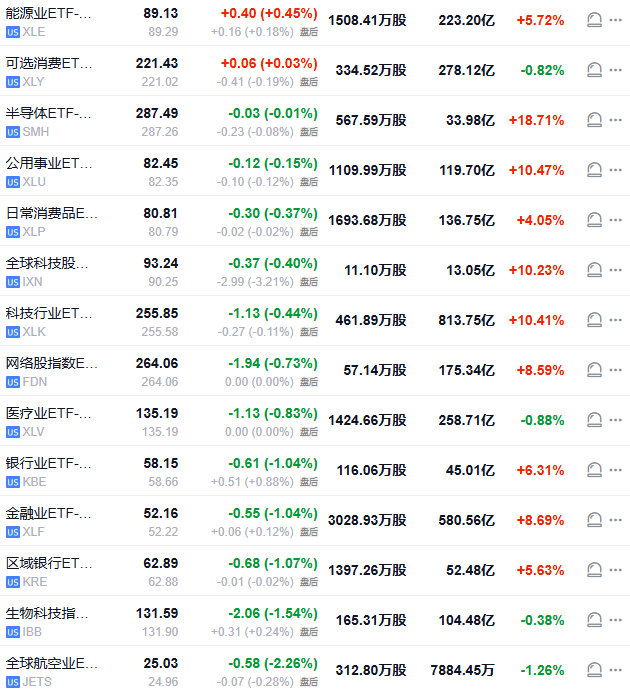
Group 1: Market Performance - Energy sector ETF increased by 0.45%, closing at 89.13 with a volume of 15.08 million shares and a market cap of $22.32 billion, reflecting a 5.72% increase [1][2] - Consumer discretionary ETF rose by 0.03%, closing at 221.43 with a volume of 3.35 million shares and a market cap of $27.81 billion, showing a slight decline of 0.82% [1][2] - Global airline ETF decreased by 2.26%, closing at 25.03 with a volume of 3.13 million shares and a market cap of $78.84 million, indicating a 1.26% decline [1][2] Group 2: Sector Specifics - Biotechnology index ETF fell by 1.54%, closing at 131.59 with a volume of 1.65 million shares and a market cap of $10.45 billion, down by 0.38% [1][2] - Regional bank ETF declined by 1.07%, closing at 62.89 with a volume of 1.40 million shares and a market cap of $5.25 billion, reflecting a 5.63% increase [1][2] - Financial sector ETF dropped by 1.04%, closing at 52.16 with a volume of 30.29 million shares and a market cap of $58.06 billion, showing an 8.69% increase [1][2]
银行板块历史新高之际:写写红利与回报
天天基金网· 2025-07-11 11:22
Core Viewpoint - The A-share banking sector has been experiencing significant growth, with the China Securities Banking Index outperforming both gold and the Nasdaq 100 since the beginning of 2024, indicating its status as a high-yield asset globally [2]. Group 1: Reasons for Banking Sector Growth - The banking sector's rise is attributed to multiple factors, including high dividends, improved return on equity (ROE), and substantial inflows from passive index funds, particularly in the context of the Shanghai and Shenzhen 300 Index [6][10]. - The valuation recovery is a key driver, as the price-to-book (PB) ratio has decreased faster than ROE from 2021 to 2023, suggesting significant room for valuation correction [11]. - The introduction of policies to alleviate real estate financing pressures has reduced systemic risk concerns, thereby improving the asset quality outlook for banks [14]. Group 2: Institutional Investment Trends - By the end of 2024, core institutional investors, including active public funds, passive funds, insurance capital, and northbound funds, held 23.9% of the free-floating market value of bank stocks [18]. - Passive funds and northbound capital have been the primary contributors to the increased holdings in banking stocks, with active funds also showing a trend of rising positions [19]. Group 3: Evolution of Dividend Investment Logic - The past few years have seen a shift in investment logic towards high-dividend assets, which have provided a psychological safety net for investors amid declining interest rates [23]. - The performance of dividend assets has shown resilience, particularly during market downturns, with banking and non-banking sectors demonstrating relative stability [29]. - The relationship between dividend yield and stock price movements is expected to evolve, with a growing emphasis on the sustainability of dividends based on free cash flow rather than solely on historical yields [31][34]. Group 4: Free Cash Flow as a New Investment Strategy - Free cash flow is identified as a critical metric for assessing a company's ability to sustain dividends, with a focus on the stability and growth potential of earnings [35]. - The development of the National Free Cash Flow Index has provided a new tool for investors, emphasizing the importance of free cash flow in selecting high-quality stocks [41]. - Historical performance data indicates that the free cash flow index has outperformed traditional dividend indices, highlighting its effectiveness as an investment strategy [42][47].

分红到来!解读800红利低波的出色持有体验
Xin Lang Ji Jin· 2025-07-11 08:50
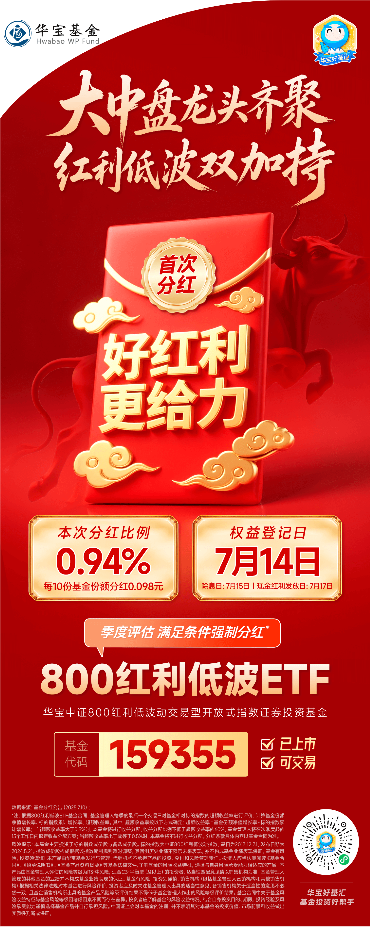
Group 1 - The 800 Dividend Low Volatility ETF (159355) announced its first dividend of the year, distributing 0.098 yuan per ten shares, with a dividend ratio of 0.94% [1] - The fund will distribute dividends quarterly when the excess return relative to the benchmark index exceeds 0.5%, showcasing its investment and operational strength [1][3] - Key dates for the dividend include the record date on July 14, ex-dividend date on July 15, and cash distribution date on July 17 [1] Group 2 - The 800 Dividend Low Volatility Index has shown strong performance over the past three years, with a return of 45.16% and a lower annualized volatility of 14.17% compared to other indices [4] - The index focuses on high-dividend, low-volatility quality companies, aiming to provide a stable long-term investment experience [3][4] - The index's diversified industry distribution helps mitigate risks associated with over-concentration in any single sector, with the top three industries being banking, utilities, and transportation [7][8] Group 3 - The index is designed to include large and mid-cap stocks from the CSI 800 Index, emphasizing companies with sustainable dividend capabilities [5][7] - The balanced industry distribution, with a 30% cap on any single industry, reduces overall investment portfolio risk [7][8] - The index's performance indicates resilience in volatile market conditions, appealing to investors focused on risk-reward ratios [8]
早盘直击 | 今日行情关注
申万宏源证券上海北京西路营业部· 2025-07-11 01:59
Group 1 - The A-share market closed above the 3500-point mark, indicating a continued recovery in market risk appetite, with the Shanghai Composite Index breaking the high point from November 8, 2024 [1][3] - The recent market uptrend is a response to the U.S. adjusting tariff rates for 14 countries, suggesting that the market has become desensitized to tariff impacts and has formed sufficient expectations regarding these changes [1] - Key support factors for the ongoing rise in A-shares include the sustained low interest rate environment and the potential for early interest rate cuts by the Federal Reserve [1] Group 2 - The outlook for July suggests that the A-share market may continue to experience event-driven thematic trading, with a high likelihood of sector rotation between high and low-performing segments [2] - The focus on expanding domestic demand and consumption is a key task for 2025, with expectations for policy support in the consumer sector, particularly in areas like dairy products, IP consumption, leisure tourism, and medical aesthetics [2] - The trend of robot localization and integration into daily life is expected to continue into 2025, with opportunities arising in sensor, controller, and robotic hand sectors as products evolve from humanoid to functional robots [2] Group 3 - The market saw over 2900 stocks rise, with significant gains in sectors such as real estate, oil and petrochemicals, steel, non-bank financials, and coal, while sectors like automotive, media, military, electronics, and utilities faced declines [3] - The military industry is anticipated to see a rebound in orders by 2025, with signs of recovery already evident in Q1 reports across various military sub-sectors [2] - The innovative drug sector is expected to reach a turning point in fundamentals by 2025, following a period of adjustment, with positive net profit growth observed for three consecutive quarters since Q3 2024 [2]