农副食品

Search documents
投资于物和投资于人紧密结合,潜力巨大
2 1 Shi Ji Jing Ji Bao Dao· 2025-12-16 12:03
Group 1 - The central economic work conference emphasizes the need to stabilize investment and expand domestic demand as a priority for the upcoming year, with a focus on combining "investment in people" and "investment in things" to unlock significant potential [1][6] - The government plans to increase the scale of central budget investments and optimize the management of local government special bonds to stimulate private investment [1][6] - The upcoming year marks the beginning of the "15th Five-Year Plan," which will accelerate the launch of various strategic emerging industries and future industry projects, supported by ample financial tools and special bond reserves [1][6] Group 2 - In November, the social financing scale increased by 24,885 billion yuan, exceeding market expectations, with a notable contribution from non-standard financing and corporate bond financing rather than traditional credit demand [2][3] - The contribution of credit to social financing decreased in November, with new RMB loans amounting to 4,053 billion yuan, reflecting insufficient effective demand in the macroeconomic environment [2][3] - Corporate loans in November totaled 6,100 billion yuan, primarily driven by an increase in bill financing, indicating a shift in financing sources as companies focus on settling accounts near year-end [3] Group 3 - Non-standard financing saw a year-on-year increase of 1,328 billion yuan in November, while corporate bond financing rose by 1,788 billion yuan, highlighting the importance of off-balance-sheet financing in the current economic context [3][4] - The M1 growth rate declined due to a high base effect, while M2 growth also decreased, influenced by the reduction in credit and its impact on derived deposits [4] - The central economic work conference has shifted its focus from social financing and M2 to economic growth and price recovery, indicating a change in policy priorities [4] Group 4 - In November, the industrial added value for large-scale enterprises grew by 4.8% year-on-year, with a cumulative growth of 6.0% from January to November, reflecting a strong performance in the supply side of the economy [5][6] - Fixed asset investment from January to November showed a year-on-year decline of 2.6%, with significant growth in equipment purchases indicating a trend towards modernization and digitalization in industrial production [5][6] - The government is expected to implement policies supporting large-scale equipment updates in 2024, with additional funding of approximately 150 billion yuan allocated for this purpose [6] Group 5 - In November, the total retail sales of consumer goods reached 43,898 billion yuan, growing by 1.3% year-on-year, although this represented a decline compared to October [7] - The central economic work conference has proposed actions to boost consumption, including plans to increase urban and rural residents' income and optimize the supply of quality goods and services [7] - The resilience of foreign trade has contributed to stable economic growth, but challenges remain for the upcoming year, necessitating measures to maintain exchange rate stability and support exports [7]
11月经济数据点评:中游供需矛盾进一步改善
Huachuang Securities· 2025-12-16 10:10
Group 1: Supply and Demand Analysis - The supply-demand gap for the midstream sector improved, with the demand-investment growth rate difference rising to 7.6% in November from 6.4% in October[1] - Midstream demand growth was 8.9% in November, down from 9.3% in October, while midstream investment growth fell to 1.3%[3] - The demand-investment growth rate difference for midstream has been increasing since May 2024 and turned positive in March 2025[3] Group 2: Future Projections - Historical data suggests that the midstream demand-investment growth rate difference is likely to remain positive, indicating potential price stabilization in the next two years[2] - The midstream PPI (Producer Price Index) is expected to stop declining and start rising, with a notable month-on-month increase of 0.04% in November, the first positive change since June 2024[4] - If the midstream PPI stabilizes, the year-on-year PPI is likely to continue rising, positively impacting midstream ROE (Return on Equity)[4] Group 3: Economic Data Overview - November's industrial value-added growth rate was 4.8%, with a slight month-on-month increase of 0.44%[20] - Retail sales growth in November was 1.3%, down from 2.9% in October, indicating weak consumer demand[22] - Real estate sales area decreased by 17.3% year-on-year in November, showing ongoing challenges in the property market[27]
兼评11月PMI数据:制造业和建筑业低位回升,服务业转弱
KAIYUAN SECURITIES· 2025-11-30 08:43
Group 1: Manufacturing Sector - November manufacturing PMI increased to 49.2%, up 0.2 percentage points from the previous month, but still below the seasonal average of 50.0%[14] - PMI for production rose by 0.3 percentage points to 50.0%; new orders improved by 0.4 percentage points to 49.2%[14] - Industrial raw material prices rebounded, with PMI purchase prices at 53.6% and factory prices at 48.2%, both up from previous values[22] Group 2: Non-Manufacturing Sector - November non-manufacturing PMI fell to 49.5%, down 0.7 percentage points, marking the first time this year below the expansion threshold[32] - Construction PMI improved slightly to 49.6%, with new orders index rising by 0.2 percentage points[24] - Policy-driven financial tools are less effective than in 2022, impacting service sector performance negatively[24] Group 3: Economic Indicators - Special bond issuance progress reached approximately 91.0% by the end of November, a significant increase of 10.1 percentage points from October[24] - Small enterprises showed a notable recovery in PMI, increasing by 2.0 percentage points, benefiting from improved US-China trade relations[22] - PPI is expected to narrow its year-on-year decline to around -2.0% in November, with a month-on-month increase of approximately 0.2%[22]
【广发宏观王丹】9月经济的中观面拆解
郭磊宏观茶座· 2025-10-09 04:06
Core Viewpoint - The manufacturing PMI for September indicates a marginal improvement in the economy, with a month-on-month increase of 0.4 points, although the absolute level remains below 50, suggesting ongoing challenges in economic conditions [1][5][6]. Economic Characteristics - The manufacturing PMI rose to 49.8 in September, with 8 out of 15 sub-sectors showing expansion, while 7 sectors contracted [1][6]. - The improvement in economic conditions is attributed to several macro factors, including the implementation of "two heavy" projects, increased consumer demand during the holiday season, AI-related policies, and resilient export orders [1][9]. Sector Performance - Industries experiencing a downturn include raw materials (black and non-ferrous metals, chemicals), certain equipment manufacturing sectors, and textiles [2][16]. - Leading sectors in terms of absolute economic performance include petroleum refining, computer communication electronics, automotive, and agricultural products, driven by cost reductions, AI trends, policy benefits, and holiday consumption [2][17]. Emerging Industries - New generation information technology and energy-saving environmental sectors show the highest economic performance, linked to demand growth from AI computing power and green transformation projects [18]. - The new energy vehicle sector has seen a month-on-month increase in economic performance, aligning with retail data trends [18]. Construction Industry Insights - The construction sector, particularly civil engineering, has seen a significant drop, with a 4.2-point decrease in PMI, falling below the 50 mark for the first time outside of the Spring Festival month since March 2013 [3][19]. - Despite the downturn, new orders in the construction sector have increased for two consecutive months, indicating potential recovery as funding for new policy projects begins to flow [19][22]. Service Industry Trends - The service sector PMI decreased by 0.4 points to 50.1, with high activity in online information technology services and financial services, while travel-related services saw seasonal declines [26][27]. - The financial services sector remains robust, with a business activity index above 60, reflecting high market activity [26].


2025年9月PMI分析:生产带动PMI回升,供需缺口继续扩大
Yin He Zheng Quan· 2025-09-30 09:17
Group 1: PMI and Economic Indicators - In September 2025, the Manufacturing Purchasing Managers' Index (PMI) rose to 49.8%, an increase of 0.4 percentage points from the previous month, indicating an improvement in manufacturing sentiment[1] - The production index for September was reported at 51.9%, up from 50.8% in August, reflecting a significant rebound in production activity[2] - The supply-demand gap widened to 2.2 percentage points, indicating that production continues to outpace demand[2] Group 2: Price and Inventory Trends - The PMI for factory prices and raw material purchase prices decreased to 48.2% and 53.2%, respectively, with a notable drop in factory prices attributed to changes in consumer subsidy policies[3] - The average price of rebar, hot-rolled coils, and wire rods fell by 1.83%, 1.48%, and 4.1% month-on-month, reaching 3264 CNY/ton, 3406 CNY/ton, and 3205 CNY/ton respectively[3] - Finished goods inventory index increased by 1.4 percentage points to 48.2%, indicating a tight balance in inventory levels[4] Group 3: Business Performance by Size - Large enterprises saw an increase in their index by 0.5 percentage points to 50.8%, while small enterprises rose by 1.6 percentage points to 48.2%[4] - Medium-sized enterprises experienced a slight decline of 0.1 percentage points to 48.8%[4] - The construction sector's business activity index rose to 49.3%, but both housing and civil engineering indices remained below 50%, indicating ongoing challenges[4] Group 4: Future Outlook - The September PMI rebound and production expansion suggest economic resilience, but the continuous contraction in PMI over six months highlights underlying economic pressures[5] - The fluctuation in inventory indices indicates that the economy has not yet stabilized to provide firms with consistent expectations[5] - Future export pressures and the impact of subsidy policies on production and pricing remain critical factors for economic health[7]
【广发宏观王丹】8月利润反弹的背后原因分析
郭磊宏观茶座· 2025-09-27 08:19
Core Viewpoint - The industrial enterprises above designated size in August showed signs of recovery in revenue and profit, with revenue growth of 1.9% year-on-year and a significant profit increase of 20.4% compared to the previous year, indicating a potential stabilization in the industrial sector [1][7][8]. Revenue and Profit Trends - In August, the revenue of industrial enterprises increased by 1.9% year-on-year, marking a 1.0 percentage point acceleration from the previous month. Cumulatively, the revenue growth for the first eight months remained at 2.3%, consistent with prior values, ending a four-month slowdown [1][6][7]. - The profit total for August saw a substantial year-on-year increase of 20.4%, a recovery from a decline of 1.5% in the previous month. The cumulative profit growth for the first eight months turned positive at 0.9% [1][8][25]. Price and Volume Dynamics - The improvement in revenue in August was primarily driven by price increases, with a structure characterized by "volume contraction and price increase." The Producer Price Index (PPI) improved from -3.6% to -2.9% year-on-year, supporting profit margins [2][10][11]. - The revenue profit margin for January to August was 5.24%, showing a slight year-on-year decline of 0.06 percentage points, but significantly better than the declines observed in June and July [2][10][11]. Industry Performance Disparities - Profit growth varied significantly across industries, with notable increases in sectors such as non-ferrous metals, utilities, essential consumer goods, electrical machinery, and transportation equipment. Conversely, industries like coal, black metal mining, petrochemicals, and light manufacturing experienced the largest profit declines [3][15][16]. - In August, profit growth improvements were concentrated in upstream industries, with coal, steel, and non-metallic minerals showing low-level recoveries. The beverage and tea industry saw a significant rebound in profits due to seasonal demand [3][18]. Inventory and Debt Levels - As of the end of August, nominal inventory for industrial enterprises grew by 2.3% year-on-year, while actual inventory saw a decline of 0.8 percentage points, reflecting a continuous reduction trend [4][19][20]. - The asset-liability ratio for industrial enterprises remained stable at 58%, with a slight increase of 0.1 percentage points month-on-month. Capital expenditure showed a small rebound in August, indicating potential growth in investment despite low capacity utilization [4][22]. Future Outlook - The profit growth for industrial enterprises is expected to remain supported in the coming months due to low profit bases from the previous year. If sustained, this could mark the first return to positive profit growth since 2022 [5][25]. - However, the current operational conditions of enterprises are not yet solid, with ongoing uncertainties in price trends and profit structures, necessitating continued policy support to enhance cash flow and profit recovery [5][26].

国家统计局:1—8月原材料制造业利润增长较快,消费品制造业利润由降转增
Zheng Quan Shi Bao Wang· 2025-09-27 01:56
Core Insights - The profit of raw material manufacturing industries has seen rapid growth, while the profit of consumer goods manufacturing has shifted from decline to growth [1] Group 1: Raw Material Manufacturing - From January to August, the profit of raw material manufacturing industries increased by 22.1% year-on-year, accelerating by 10.0 percentage points compared to January to July [1] - This growth contributed 2.5 percentage points to the overall profit growth of industrial enterprises above a designated size [1] - The steel industry turned from loss to profit, achieving a total profit of 83.7 billion yuan [1] - The non-ferrous metal industry saw a profit increase of 12.7%, which is an acceleration of 5.8 percentage points compared to January to July [1] Group 2: Consumer Goods Manufacturing - From January to August, the profit of consumer goods manufacturing shifted from a decline of 2.2% in January to July to a growth of 1.4% [1] - The beverage and tea, as well as agricultural and sideline food industries, experienced rapid profit growth rates of 19.9% and 11.8% respectively [1] - These sectors collectively contributed 1.0 percentage point to the overall profit growth of industrial enterprises above a designated size [1]
国泰海通宏观:总量需加力,结构有亮点
Ge Long Hui· 2025-09-15 13:23
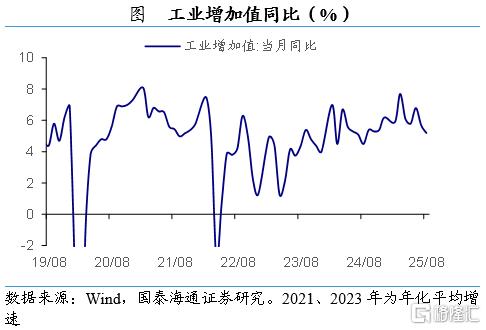
Economic Overview - The domestic economy continued to slow down in August, with a mix of resilience in production and pressure on demand, leading to increased internal differentiation [2][3] - Industrial value-added growth year-on-year was 5.2% in August, down from 5.7% in July, indicating a slight decline but still at a relatively high level [4][6] - The overall economic trend is expected to maintain a slow and stable trajectory with structural optimization, but demand recovery will take time [2][3] Production Sector - The production growth rate showed a slight decline, primarily due to external demand pressures and some upstream industries experiencing production cuts [4][6] - The production-sales rate decreased from 97.1% to 96.6%, indicating a marginal improvement in domestic consumption capacity [4] - Policy-related industries, such as transportation equipment and non-ferrous metals, showed resilience, while export and consumer-related sectors faced significant pressure [6][7] Service Sector - The service sector's production index grew by 5.6% year-on-year in August, down 0.2 percentage points from July, reflecting a slowdown [7] - High-value-added industries like information technology and finance showed growth, while leasing and business services faced challenges due to weak corporate expansion intentions [7] Employment - The urban survey unemployment rate rose slightly to 5.3% in August, primarily due to seasonal pressures from the influx of recent graduates into the labor market [9] Consumption Sector - Retail sales growth year-on-year was 3.4% in August, down 0.3 percentage points from July, indicating a need for stronger consumption recovery [12][15] - Dining consumption showed signs of recovery, while retail sales growth for goods slowed down, reflecting a mixed performance across different categories [14][15] - Essential consumption categories faced declines, while some upgraded consumption categories showed resilience, supported by seasonal demand and policy measures [15] Investment Sector - Fixed asset investment growth was 0.5% year-on-year for January to August, with August showing a significant decline of 7.1% compared to July [16][19] - Investment in manufacturing, infrastructure, and real estate all experienced negative growth, necessitating policy support to break the downward cycle [16][20] - The real estate sector continued to face fundamental pressures, with sales area and sales value both declining significantly year-on-year [20]

山东兖州:工业经济量质齐升彰显发展热度
Zhong Guo Fa Zhan Wang· 2025-09-05 06:14
Core Insights - The industrial economy in Yanzhou District, Jining City, Shandong Province, has shown robust growth with a 10.4% increase in industrial added value and a total industrial output value of 44.41 billion yuan in the first seven months of the year [1] - The district has implemented significant investment projects in technological transformation and digital upgrades, with a total investment of 455 billion yuan in 113 projects and 108 billion yuan in 137 digital transformation projects [1][2] - The district's industrial investment in technological upgrades reached 7.7 billion yuan, marking a 25.5% increase, reflecting the positive impact of national policies supporting digital transformation and green upgrades [2] Industrial Development - Yanzhou District is focusing on key industrial chains, including automotive parts, coal power, specialized equipment, salt chemicals, agricultural products, and modern medicine, to enhance industrial resilience and vitality [2] - The district has established a "total chain leader" work system to facilitate collaboration among upstream and downstream enterprises, aiming to uncover new opportunities for industrial development [2] - A total of 47 enterprise issues have been identified, with 36 resolved, and 1,529 acres of land indicators allocated to support local businesses [2] Technological Innovation - The district has prioritized industrial economy as a "number one project," emphasizing digital transformation, low-carbon integration, and coordinated upgrades across various industries [3] - Specific projects are being implemented to strengthen the industrial base, with a focus on rubber chemicals, paper packaging, equipment manufacturing, and health food sectors [3] - Several enterprises have been recognized for their innovation capabilities, with 9 companies selected for the 2025 Shandong Province Enterprise Technology Innovation Project [2]

月度前瞻 | 8月经济:“景气”分水岭?(申万宏观·赵伟团队)
赵伟宏观探索· 2025-09-02 16:36
Demand - External demand is expected to be better than internal demand in the short term, with August exports projected to maintain resilience at around 5.1% despite some downward pressure due to "transshipment tariffs" and "reciprocal tariffs" [2][11][100] - Internal demand shows signs of weakness, primarily due to limited use of subsidy funds, with retail sales expected to grow by 4.4% year-on-year in August [2][26][100] - Service consumption and investment are performing relatively well, driven by high travel activity and increased private investment in the service sector, with overall investment growth expected to remain stable at 1.6% [3][11][100] Supply - Production remains robust, with the manufacturing PMI rising to 49.4% in August, indicating continued high production levels, particularly in export-oriented sectors [4][43][100] - Industries with high external demand dependency, such as textiles and specialized equipment, are experiencing significant production index increases, while sectors like agriculture and automotive are lagging [4][50][100] - Industrial output is projected to grow by 5.8% year-on-year in August, supported by strong performance in the "export chain" [5][55][100] Inflation - PPI is expected to show improvement due to rising commodity prices and low base effects, with the main raw material purchase price index increasing by 1.8% to 53.3% [6][64][100] - CPI is anticipated to decline further, influenced by weak food prices and low downstream PPI, with an expected year-on-year drop of 0.4% in August [8][80][100] Outlook - The economic narrative for August centers around "resilient external demand and weak internal demand," with a focus on the effectiveness of incremental policies and the recovery of internal demand [9][91][100] - Overall, nominal GDP is projected to grow by 3.6% and real GDP by 4.8% year-on-year in August [9][91][100]