
债券

Search documents
超长端债市呈“慢涨快跌”格局
Qi Huo Ri Bao· 2025-12-30 18:43
Core Viewpoint - The bond market is experiencing a recovery due to expectations of a loose monetary environment at the end of the year, although volatility remains high and the market lacks a clear direction [1][4]. Group 1: Market Conditions - The bond market sentiment has improved, supported by a loose funding environment and year-end allocation expectations, providing short-term bullish opportunities for traders [1]. - The current bond market is characterized by significant volatility, influenced heavily by market sentiment and expectations, particularly as institutions face profit-taking pressures at year-end [1]. - The long-end government bond yields have limited upward space, with the key position for the 10-year government bond yield remaining at 1.85% [3]. Group 2: Economic Fundamentals - The domestic economy is in a wave-like operation phase, with internal momentum recovery being a slow variable, and the economic data showing a structural characteristic of "strong production, weak domestic demand" [3]. - The economic fundamentals are still in a bottoming phase, with increasing pressure on the demand side in the fourth quarter, leading to a weak short-term entity financing demand [3]. Group 3: Monetary Policy - The monetary policy remains "moderately loose," with interbank liquidity expected to maintain a balanced and loose pattern, alleviating concerns about year-end liquidity [4]. - The market anticipates an increase in the scale of central bank purchases of government bonds, as the total net injection of MLF and reverse repos decreases [4]. Group 4: Future Outlook - The bond market is expected to face significant pressure in 2026, with global economic visibility likely to improve, potentially impacting domestic bond markets negatively [5]. - The domestic economic fundamentals are expected to exert pressure on the bond market, with a low likelihood of a repeat of the inflationary trends seen in 2006 or 2017 [5]. - The macro environment's continued warming may lead to a preference for equity markets over bonds, with increasing supply of long-end bonds and limited demand from banks and insurance companies [5][6]. Group 5: Policy Framework - The fiscal policy is expected to continue its expansionary stance, emphasizing actual spending and structural improvements, with a projected slight increase in the narrow deficit ratio to 4.2% [6]. - Monetary policy tools such as reserve requirement ratio cuts and interest rate reductions remain options, with a focus on flexible and efficient implementation [6][7]. - The bond market is likely to exhibit characteristics of "top and bottom" with amplified volatility, particularly in the long-end segment, while the central bank's support for year-end liquidity will bolster the mid-short end of the bond market [7].

2025年债市启示录:框架的贫
ZHONGTAI SECURITIES· 2025-12-30 14:33
Group 1: Report's Industry Investment Rating - The industry rating is "Overweight", indicating an expected increase of over 10% compared to the benchmark index in the next 6 - 12 months [50] Group 2: Report's Core View - 2025 was a more "uncomfortable" year for the bond market than 2017, with a worse investment and holding experience. The market should shift from "asset pricing research" to "liability behavior research" and avoid being confined by existing frameworks [3][7] - The traditional bond - market research frameworks are not reliable, as they are mostly established in the past few years and do not adapt well to rapid changes. The focus should be on trading and liability behavior research [45][46] Group 3: Summary by Directory 1. Technology Bull Disrupting Bond Bull (February) - The first bond - market adjustment from February to March was due to the "liability shortage", which was actually the prelude of the year's adjustment. The technology - stock rally diverted funds from fixed - income to equities, and it was also a link between the 2024 "924 stock - bond seesaw" and the 2025 July stock - bond seesaw [7] - The view of "stock - bond double bull" was a fallacy, and the industry's attitude towards technology - stock positions began to change, affecting the stock - bond balance strategy [8][10] 2. Liability Shortage and Seasonal Anomaly (March) - Seasonal patterns in the bond market failed in March, November, and December. This was caused by the seasonality of bank - deposit maturities and the reversal of wealth - management institutions' performance - chasing behavior [11] 3. Trade Disturbance Interlude (April) - The bond - market rally in April was mainly due to the oversold rebound after large banks sold OCI bonds for profit settlement, not trade disturbances. Comparing 2025 with 2018, asset - pricing models overly relying on export forecasts are not robust [14][16] - As of November, exports were a significant positive contributor to GDP, and there are high expectations for next - year's exports [17] 4. Starting Point of Story Reconstruction (June) - Signs of bond - market adjustment could be seen in the equity market in June, such as the failure of the real - estate recovery in the second quarter, the increase of bond - fund duration to a high - level, and investors' misunderstanding of the equity market [19] - The market should change its subjective value judgment on data, and previous interest - rate decline stories were not reliable, such as "Japanization" and "de - globalization" [21] 5. Anti - Involution: Building High and Entertaining Guests (July) - The "anti - involution" market started with policy - catalyzed price "reflexivity". After July, commodity prices rose, and inflation expectations improved, which led to bond - market adjustment [22] - Later, only the new - energy sector could support price "anti - involution", while commodity prices in other sectors fell back, but bond yields did not [23] 6. Which is Primary: Trading or Fundamentals? (September) - In September, the expected improvement in supply - demand from "anti - involution" did not materialize, and two investment logics were in a "voting competition": one based on the micro - trading structure and the other affected by market "news" [25] - Bond trading is primary, and over - emphasizing research frameworks while ignoring trading itself is inappropriate [29] 7. Bond Market Recovery with Limited Impact from Bond Buying (October) - In October, the bond market had a small recovery due to loose expectations and a second - round of trade disturbances. However, several events indicated that the market did not have a long - term valuation recovery [30] - Trading institutions were optimistic and increased duration, while banks' liability - side behaviors showed "redemption during recovery", and bonds with maturities under 10 years were more stable [30][31] - The total bond - investment funds were stable, with banks' bond investments moving from off - balance - sheet to on - balance - sheet. This led to discussions on "bond - market supply - demand" from November to December [33][34] 8. Bond - Market Supply - Demand Issues Becoming Systematized (November) - In November, as the bond market fell after the October recovery, economic data weakened, and the stock - bond seesaw effect failed. The market began in - depth research on "liability behavior" [35] - Insurance - premium structure changes, bank EVE limitations, and the rigidity of interest - rate bond issuance affected bond supply - demand, especially for long - term interest - rate bonds [35] 9. New - Year Opening, Allocation - Oriented Institutions' Linear Allocation, and Withdrawal of Trading - Oriented Institutions (December) - In December, the bond market fluctuated after an initial sharp decline due to concentrated long - term bond supply. Short - term bonds were strong due to central - bank support, accelerated year - end fiscal expenditure, and large - bank net lending [37][38] - Long - term bonds had significant long - short divergence. The mainstream view is that long - term bond supply - demand issues and spread - widening risks exist, and the long - end New - Year market is not worth expecting [40][44] Bond - Market "Traditional Framework" Failure Theory: Leveraging Thinking is "Knowledge Debt" - Most so - called "traditional frameworks" in the bond market are not reliable, as they are newly established and do not adapt well to rapid changes. Over - abstracted bond - market methodologies can lead to "cognitive overload" [46] - The bond market should learn from 2025 and shift from "asset pricing research" to "liability behavior research" in 2026 [48]
2025年12月债市回顾及2026年1月展望:把握年初利率季节性窗口,顺势布局
Yin He Zheng Quan· 2025-12-30 14:30
1. Report Industry Investment Rating No information about the report industry investment rating is provided in the content. 2. Core Viewpoints of the Report - In December 2025, bond market yields oscillated and then trended upward, with a term - structure differentiation. The 10 - year Treasury yield rose 2BP, and the 1 - year Treasury yield fell 5BP. The term spread widened by 7BP to 51BP [1][8]. - In January 2026, focus on the 2025 GDP performance and the possibility of a Q1 economic start, the potentially active front - loading of supply, the possibility of central bank reserve requirement ratio cuts and flexible and cautious interest rate cuts, and the opening of the seasonal interest rate downward window and institutional net - increase support for the start - of - the - year [4][76]. - The bond market interest rate is expected to oscillate downward in January. It is recommended to actively seize the opportunity to enter the market when the interest rate oscillates downward, and also pay attention to the opportunity of narrowing the spread of ultra - long bonds [5][77]. 3. Summary According to the Directory 3.1 Bond Market Review - In December, affected by factors such as the central bank's precise liquidity care, loose funds, and repeated disturbances of interest rate cut expectations, the bond market yield oscillated and then trended upward. There was term - structure differentiation, with the 10 - year Treasury yield rising 2BP and the 1 - year Treasury yield falling 5BP. The term spread widened to 51BP [1][8]. - The yield curve of Treasury bonds in December was overall bull - steep, with the decline of the medium - and short - term generally larger. The implied tax rate of China Development Bank bonds rose overall [9]. - Overseas, the US inflation repair was less than expected. The Fed cut interest rates in December, but there were still large internal differences. The US bond yield trended upward, and the Sino - US interest rate spread inverted slightly widened. The US dollar against the RMB exchange rate declined [10]. - Weekly, the bond market yield first rose and then fell in the first week, declined overall in the second week, continued to decline in the third week, and oscillated and rebounded in the fourth week [17]. 3.2 This Month's Outlook and Strategy 3.2.1 Bond Market Outlook - **Fundamentals**: Pay attention to the improvement of inflation (CPI's moderate recovery and PPI's continuous positive month - on - month growth), the resilience of exports under high - base effects and its support for PMI, the decline of real estate supply and demand data, and the 2025 GDP growth rate and the possibility of a 2026 economic start. If the weak fundamental recovery continues, the upward market expectations may reverse [2][21]. - **Supply**: The 2025 deficit rate may remain at 4%, with the quotas of Treasury bonds and special bonds increasing. It is estimated that the net supply of government bonds in January will be about 1.24 trillion yuan, mainly due to more special bond issuances. The overall supply pressure has increased compared with the same period in 2025 [2][38]. - **Funds**: At the end of the year, the central bank clearly cared about cross - year liquidity, and the funds were loose recently. Although the liquidity may be under pressure due to factors such as the front - loading of government bond issuance and a large certificate of deposit maturity scale, it is expected that the bond market funds in January will fluctuate in a balanced manner, and the interest rate is likely to decline seasonally after the Gregorian New Year. Pay attention to the possibility of the central bank increasing Treasury bond purchases [3][51]. - **Policy**: The December economic meeting pointed out the policy direction for 2026. It is expected that reserve requirement ratio cuts and more flexible and cautious interest rate cuts are likely to be implemented in the first quarter to cooperate with fiscal efforts. More flexible tools can be expected next year [3][61]. - **Institutional Behavior**: In December, various institutional allocation portfolios continued to increase holdings but slightly converged, and trading portfolios turned to small - scale net purchases. In January, focus on the opening of the traditional interest rate downward window, the possibility of allocation forces increasing positions before the Spring Festival, the possibility of trading portfolios entering the market flexibly, and the opportunity of narrowing the spread of ultra - long bonds [3][65]. 3.2.2 Bond Market Strategy - In January, focus on the 2025 GDP performance and the Q1 economic start, the potentially active front - loading of supply, the possibility of central bank reserve requirement ratio cuts and flexible and cautious interest rate cuts, and the opening of the seasonal interest rate downward window and institutional net - increase support for the start - of - the - year [4][76]. - In terms of interest rates, the funds in January are likely to return to a balanced state after the cross - year under the central bank's care. There is room for the central bank's Treasury bond trading operations and reserve requirement ratio cuts. It is recommended to actively seize the opportunity to enter the market when the interest rate oscillates downward. For the short - end, the short - end interest rate has limited odds for short - term returns. For the long - end, the current 1.85% has reappeared allocation value. For ultra - long bonds, pay attention to the opportunity of narrowing the spread if the market conditions are favorable [5][77]. 3.3 January Important Economic Calendar The report provides the expected values of important economic indicators to be announced in January, including PPI, CPI, M2, new RMB loans, and other data [80].
国泰海通|策略:新年初迎配置窗口,建议超配风险资产——国泰海通资产配置月度方案(202601)
国泰海通证券研究· 2025-12-30 14:28
Core Viewpoint - The report suggests that the Federal Reserve is expected to lower interest rates as anticipated and may exceed expectations in expanding its balance sheet, which could reduce policy uncertainty and market volatility for investors, presenting opportunities in global equities and commodities. The recommendation is to overweight AH shares and US stocks, as well as gold and industrial commodities by January 2026 [1]. Group 1: Strategic Asset Allocation (SAA) - The company has developed an "all-weather" asset allocation framework consisting of Strategic Asset Allocation (SAA), Tactical Asset Allocation (TAA), and Major Event Review Adjustments to guide investment decisions [1]. - SAA aims to diversify macro risks and set long-term allocation benchmarks to ensure portfolio stability [1]. Group 2: Tactical Asset Allocation (TAA) - TAA employs quantitative methods to identify assets with superior short-term risk-return characteristics and adjusts portfolio weights accordingly to enhance returns [1]. Group 3: Equity Allocation - The company is relatively optimistic about equities, recommending a 47.50% equity allocation for January 2026, with specific allocations: 10.00% to A-shares, 10.00% to Hong Kong stocks, 17.50% to US stocks, 2.50% to European stocks, 5.00% to Japanese stocks, and 2.50% to Indian stocks [2]. - Factors supporting Chinese equity performance include an upcoming economic work conference, expected expansion of the fiscal deficit, and a more proactive economic policy [2]. - The "Goldilocks" scenario is emerging, favoring US stock performance, with resilient economic conditions and decreasing inflationary pressures supporting corporate earnings expectations [2]. Group 4: Bond Allocation - The company maintains a neutral stance on bonds, recommending a 37.50% bond allocation for January 2026, with allocations: 10.00% to long-term government bonds, 10.00% to short-term government bonds, 7.50% to long-term US Treasuries, and 10.00% to short-term US Treasuries [3]. - The bond market may see renewed interest as risk appetite increases, despite existing imbalances in financing demand and credit supply [3]. - The Federal Reserve's cautious monetary policy guidance suggests that US Treasury yields may fluctuate, with a potential moderate decline in yield levels [3]. Group 5: Commodity Allocation - The company is optimistic about commodities, recommending a 15.00% commodity allocation for January 2026, with allocations: 8.00% to gold, 2.00% to oil, and 5.00% to industrial commodities [4]. - Gold is recommended for overweighting due to its strong resilience and safe-haven attributes amid rising geopolitical uncertainties and ongoing central bank purchases [4]. - Industrial commodities are expected to benefit from improved demand forecasts and sustained trading momentum, particularly driven by sectors like construction, electric grids, and electric vehicles [4].

长债波段操作为主:债海观潮,大势研判
Guoxin Securities· 2025-12-30 13:53
Group 1 - The report indicates that in December, the yield rates of most bond varieties declined, with all interest rate bonds experiencing a decrease in yield rates, while credit bond spreads widened for most varieties [3][10][19] - The U.S. economy is showing signs of a slowdown, with the CPI inflation remaining moderate, and both European and Japanese inflation stabilizing [3][39][43] - Domestic economic growth continued to slow down in November, with a year-on-year GDP growth rate of approximately 4.1%, a decrease of 0.2 percentage points from October [3][49][53] Group 2 - The monetary policy review for the fourth quarter removed references to "low price levels" and emphasized ongoing challenges in the economy, such as the imbalance between supply and demand [3][103] - The report highlights that the current bond market is likely to experience greater volatility, suggesting a focus on long-term bond trading strategies [3][34][135] - The report notes that the "fixed income plus" strategy involves a combination of fixed income assets with other risk assets to enhance returns, with a focus on maintaining a balance between risk and return [105][106][120] Group 3 - The report provides insights into the performance of "fixed income plus" funds, indicating a significant increase in the allocation to equity assets, with stock allocation reaching 10.3% by the end of Q3 2025 [3][129] - The total scale of "fixed income plus" funds reached 27,826 billion, with an average fund size of 2 billion [125][126] - The report emphasizes that the performance of "fixed income plus" funds tends to be better during bull markets in the A-share market, with historical returns showing significant variability [114][118]
【笔记20251230— 债农:抢跑开始了吗?】
债券笔记· 2025-12-30 12:18
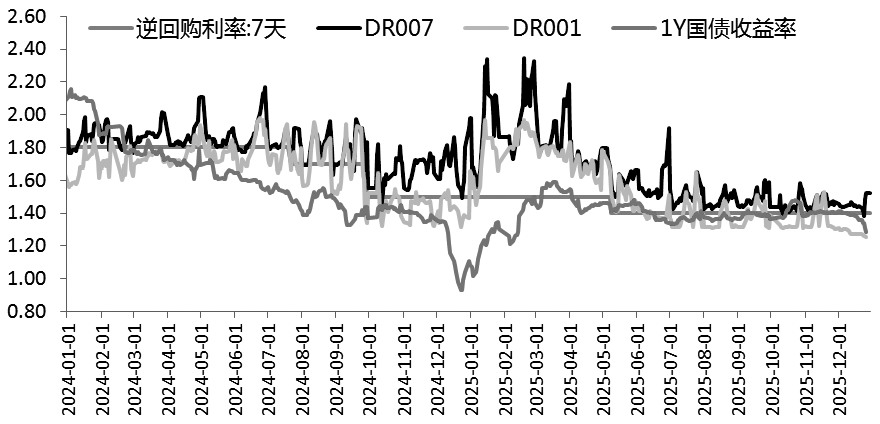
Core Viewpoint - The article emphasizes that "expectation differences" are the basis for trading decisions, as without these differences, there are no discrepancies or volatility in the market [1]. Market Overview - The market is experiencing mixed movements with expectations of a better PMI and a balanced, slightly loose funding environment [3]. - The central bank conducted a 3,125 billion yuan reverse repurchase operation, with 593 billion yuan maturing today, resulting in a net injection of 2,532 billion yuan [3]. - Funding rates remain stable, with DR001 around 1.24% and DR007 slightly increasing to approximately 1.69% due to year-end factors [3]. - The stock market showed fluctuations but ultimately closed flat, while the bond market anticipates a better PMI, leading to an overall rise in interest rates [3]. Bond Market Insights - The 10-year government bond yield opened slightly higher at 1.86% and fluctuated within a narrow range, with the lowest point reaching 1.85% before rising again in the afternoon due to concerns over upcoming PMI data [3]. - The article notes that the recent surge in lithium carbonate futures prices, which increased over 66%, has led to losses for industrial companies, highlighting the disconnect between futures hedging and spot market prices [3]. Trading Sentiment - The article discusses the sentiment among bond traders, suggesting that the "running ahead" may refer to preemptively exiting positions, indicating a potential miscalculation regarding the expected decline in interest rates in December [3]. - The stock market is also mentioned to be engaging in speculative activities, with references to seasonal trading patterns [3].
债海观潮,大势研判长债波段操作为主
Guoxin Securities· 2025-12-30 11:10
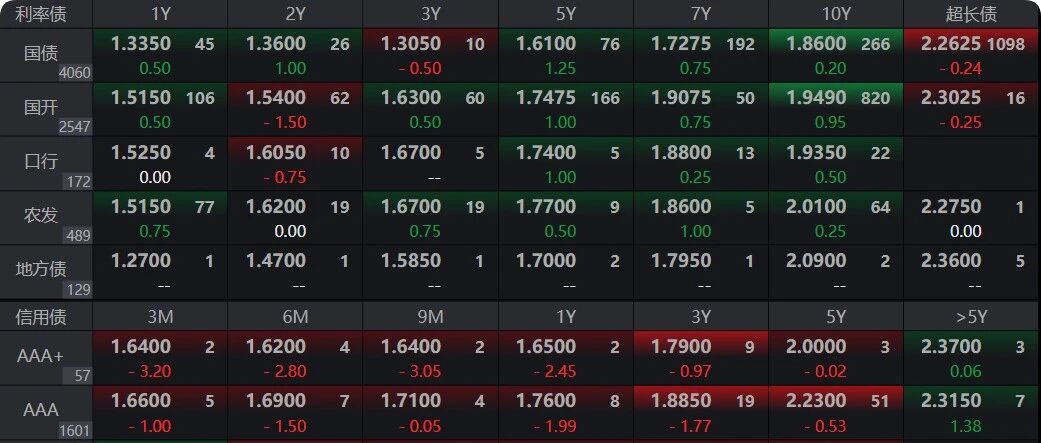
Group 1 - The report indicates that in December, the yield rates of most bond varieties declined, with all interest rate bonds experiencing a decrease in yield rates. In the credit bond sector, most credit bond varieties saw widening credit spreads, while the total amount of defaults significantly decreased in December [3][10][30] - The overseas economic fundamentals show a slowdown in the US economy, with a mild performance in CPI inflation. Both European and Japanese inflation rates have stabilized [3][39][43] - Domestic economic growth continued to slow down in November, with a year-on-year GDP growth rate of approximately 4.1%, a decrease of 0.2 percentage points from October. The forecast for GDP growth in Q4 2025 is about 4.3%, indicating a further decline from Q3 [3][49][91] Group 2 - The monetary policy review indicates that the fourth quarter monetary policy meeting removed references to "low inflation" and emphasized the challenges posed by the imbalance between supply and demand in the economy [3][103] - The report highlights that the "fixed income plus" strategy involves a combination of fixed income assets with other risk assets to enhance returns, with common assets including stocks, convertible bonds, derivatives, and commodities [105][106] - The performance of "fixed income plus" funds has shown a significant increase in equity allocation, with stock assets accounting for 10.3% of the total, while bond assets remain dominant at 85.4% [129]
1月债市调研问卷点评:1月债市怎么看?
ZHESHANG SECURITIES· 2025-12-30 08:34
Report Industry Investment Rating - Not provided Core Viewpoints - Standing at the end of December and looking forward to January, investors' judgments on the future bond market trend are relatively concentrated: they maintain a preference for medium - and short - term interest - rate bonds and adopt a defensive approach overall. The intensity and rhythm of fiscal policy and the supply pressure of government bonds have become the core concerns of investors [1]. - According to the bond market survey questionnaire results released at the end of December, there are five mainstream expectations for the January bond market: investors' expectations for the upper and lower limits of long - term Treasury yields are neutral, showing a range - bound state; "Short - term strength and long - term weakness" is the mainstream expectation for the overall bond market trend; in bond market operations, the mainstream views are to hold cash and wait or keep positions basically stable; fiscal stimulus and government bond issuance are the most concerned core issues, and monetary policy and the capital market remain key concerns; investors' preference for medium - and short - term interest - rate bonds has increased [2]. Summary by Related Catalog 1. 1 - month Bond Market Outlook - **Survey Background**: A bond market questionnaire was released on December 26, 2025, and 123 valid questionnaires were received by 8:00 on December 29, covering various institutional and individual investors [9]. - **Long - term Treasury Yield Expectations** - **10 - year Treasury (250016)**: 50% of investors think the lower limit of the yield will fall in the 1.75% - 1.80% (inclusive) range, and 56% think the upper limit will fall in the 1.85% - 1.90% range. Current investors' expectations for the rise of the 10 - year Treasury interest rate have gradually increased compared with the November survey results [12][13]. - **30 - year Treasury (250006)**: 37% of investors think the lower limit of the yield will fall in the 2.15% - 2.20% (inclusive) range, and 44% think the upper limit will fall in the 2.25% - 2.30% range. Since December, the 30 - year Treasury yield has shown an overall oscillating trend, and investors expect it to oscillate downward in the next month [14]. - **Expectations for Monetary Policy** - **2026 Policy Adjustments**: 67% of investors think there will be one reserve requirement ratio cut in 2026, and 69% think there will be one interest rate cut [18]. - **Q1 2026 Policy**: 68% of investors think there will be a reserve requirement ratio cut in Q1 2026, but opinions on whether to cut interest rates vary, showing an overall expectation of "biased towards easing, but the path is undetermined" [20]. - **Market Buying Power after New Year**: 45% of investors think the bond market's major logic will remain unchanged after the New Year, and the buying power will remain weak. The overall expectation of the bond market's capital situation after the New Year is "cautious overall, with structural differences" [23]. - **January Bond Market Trends**: Investors do not have a strong consensus on a single direction for the January bond market. The expectation shows a pattern of "cautiously optimistic, structure - dominated", and "short - term strength and long - term weakness" is the most mainstream market expectation [25]. - **Current Bond Market Operations**: In December, most investors were neutral in actual operations. Holding cash and waiting to add positions after a callback and keeping positions basically stable were still the mainstream views. The proportion of those who could start adding positions decreased slightly, and the proportion of those who reduced duration to control risks increased [27]. - **January Bond Market Pricing Logic**: Fiscal stimulus and government bond issuance have become the most concerned core issues, with the proportion rising from 14% in the November survey to 27%. The focus of bond market investors has shifted to "fiscal policy" [28]. - **Preferred Bond Types in January**: Investors' preference for medium - and short - term interest - rate bonds has increased, and their preference for interbank certificates of deposit has also rebounded. The preference for ultra - long - term interest - rate bonds and secondary capital bonds has decreased, indicating that investors may pay more attention to liquidity protection and short - term certainty [32].
信用债周报:成交规模继续增长,信用利差分化-20251230
BOHAI SECURITIES· 2025-12-30 08:13
Report Industry Investment Rating No information provided in the given content. Core Viewpoints - The issuance guidance rates announced by the National Association of Financial Market Institutional Investors during the period from December 22 to December 28, 2025, showed a differentiated trend, with most high - grade rates declining and most medium - and low - grade rates rising, with an overall change range of - 3 BP to 2 BP [1][15][63]. - The issuance scale of credit bonds decreased compared with the previous period. Corporate bonds remained at zero issuance, the issuance amounts of corporate bonds and private placement notes decreased, while the issuance amounts of medium - term notes and commercial paper increased. The net financing of credit bonds decreased compared with the previous period [1][13][63]. - In the secondary market, the trading volume of credit bonds increased compared with the previous period. The trading volumes of corporate bonds, corporate bonds, medium - term notes, and private placement notes increased, while the trading volume of commercial paper decreased [1][19][63]. - The yields of most credit bonds declined during this period. The credit spreads of medium - and short - term notes, corporate bonds, and urban investment bonds were differentiated, with most 1 - year and 7 - year spreads widening and most 3 - year and 5 - year spreads narrowing [1][22][63]. - From the perspective of absolute return, the shortage of supply and relatively strong allocation demand will promote the continued recovery of credit bonds. In the long run, the yields are still in a downward channel, and the idea of increasing allocation during adjustments is still feasible. From the perspective of relative return, although the compression space of credit spreads at all tenors is insufficient, the probability of unilateral callback in the short term is also small. Therefore, it is still possible to achieve the coupon strategy through credit downgrade and extending the duration [1][63]. Summary by Directory 1. Primary Market Situation 1.1 Issuance and Maturity Scale - From December 22 to December 28, 2025, a total of 211 credit bonds were issued, with an issuance amount of 254.432 billion yuan, a 2.51% decrease compared with the previous period. The net financing of credit bonds was 42.433 billion yuan, a decrease of 18.343 billion yuan compared with the previous period [13]. - Corporate bonds had zero issuance, with a net financing of - 6.252 billion yuan, an increase of 0.498 billion yuan compared with the previous period. Corporate bonds issued 74 bonds, with an issuance amount of 49.363 billion yuan, a 46.55% decrease compared with the previous period, and a net financing of 15.757 billion yuan, a decrease of 29.511 billion yuan compared with the previous period. Medium - term notes issued 66 bonds, with an issuance amount of 109.469 billion yuan, a 30.15% increase compared with the previous period, and a net financing of 78.532 billion yuan, an increase of 37.169 billion yuan compared with the previous period. Commercial paper issued 60 bonds, with an issuance amount of 90.117 billion yuan, a 23.36% increase compared with the previous period, and a net financing of - 44.152 billion yuan, a decrease of 25.187 billion yuan compared with the previous period. Private placement notes issued 11 bonds, with an issuance amount of 5.483 billion yuan, a 52.24% decrease compared with the previous period, and a net financing of - 1.452 billion yuan, a decrease of 1.312 billion yuan compared with the previous period [13]. 1.2 Issuance Interest Rates - The issuance guidance rates announced by the National Association of Financial Market Institutional Investors were differentiated, with most high - grade rates declining and most medium - and low - grade rates rising, with an overall change range of - 3 BP to 2 BP. By tenor, the 1 - year variety had an interest rate change range of - 2 BP to 0 BP, the 3 - year variety had an interest rate change range of - 3 BP to 2 BP, the 5 - year variety had an interest rate change range of - 3 BP to 2 BP, and the 7 - year variety had an interest rate change range of - 2 BP to 1 BP. By grade, the key AAA - grade and AAA - grade varieties had an interest rate change range of - 3 BP to - 1 BP, the AA + - grade variety had an interest rate change range of - 1 BP to 2 BP, the AA - grade variety had an interest rate change range of 0 BP to 2 BP, and the AA - - grade variety had an interest rate change range of 0 BP to 1 BP [15]. 2. Secondary Market Situation 2.1 Market Trading Volume - From December 22 to December 28, 2025, the total trading volume of credit bonds was 1.030617 trillion yuan, a 7.72% increase compared with the previous period. Corporate bonds, corporate bonds, medium - term notes, commercial paper, and private placement notes traded 28.754 billion yuan, 446.075 billion yuan, 347.636 billion yuan, 145.597 billion yuan, and 62.555 billion yuan respectively [19]. 2.2 Credit Spreads - In medium - and short - term notes, the credit spreads of each variety were differentiated. The 1 - year credit spreads widened; among the 3 - year notes, the credit spreads of AA - grade and AA - - grade widened, while the spreads of AAA - grade and AA + - grade narrowed; the 5 - year credit spreads narrowed; among the 7 - year notes, the credit spread of AAA - grade narrowed, while the spread of AA + - grade widened [22]. - In corporate bonds, the credit spreads of each variety were differentiated. The 1 - year AAA - grade credit spread narrowed, while the spreads of other varieties widened; among the 3 - year notes, the credit spreads of AAA - grade and AA + - grade narrowed, while the spreads of AA - grade and AA - - grade widened; the 5 - year credit spreads narrowed; among the 7 - year notes, the credit spread of AAA - grade narrowed, while the spreads of other varieties widened [27]. - In urban investment bonds, the credit spreads of each variety were differentiated. The 1 - year credit spreads widened; the 3 - year credit spreads narrowed; among the 5 - year notes, the credit spreads of AAA - grade and AA + - grade narrowed, while the spreads of AA - grade and AA - - grade widened; among the 7 - year notes, the credit spread of AAA - grade narrowed, while the spreads of other varieties widened [37]. 2.3 Term Spreads and Rating Spreads - For AA + medium - and short - term notes, the 3Y - 1Y term spread narrowed by 1.20 BP, the 5Y - 3Y term spread narrowed by 3.20 BP, and the 7Y - 3Y term spread widened by 3.22 BP. The 3Y - 1Y term spread was at a low - to - middle historical percentile (21.6%), the 5Y - 3Y term spread was at a low - to - middle historical percentile (34.5%), and the 7Y - 3Y term spread was at a historical median (41.9%). In terms of rating spreads, the (AA - )-(AAA) spread of 3 - year medium - and short - term notes widened by 3.00 BP, the (AA)-(AAA) spread widened by 3.00 BP, and the (AA + )-(AAA) spread widened by 2.00 BP [47]. - For AA + corporate bonds, the 3Y - 1Y term spread narrowed by 3.69 BP, the 5Y - 3Y term spread widened by 3.12 BP, and the 7Y - 3Y term spread widened by 8.55 BP. The 3Y - 1Y term spread was at a historical low (12.2%), the 5Y - 3Y term spread was at a low - to - middle historical percentile (36.3%), and the 7Y - 3Y term spread was at a historical median (42.9%). In terms of rating spreads, the (AA - )-(AAA) spread of 3 - year corporate bonds widened by 6.00 BP, the (AA)-(AAA) spread widened by 6.00 BP, and the (AA + )-(AAA) spread remained unchanged from the previous period [52]. - For AA + urban investment bonds, the 3Y - 1Y term spread narrowed by 0.72 BP, the 5Y - 3Y term spread narrowed by 1.67 BP, and the 7Y - 3Y term spread widened by 2.25 BP. The 3Y - 1Y term spread was at a low - to - middle historical percentile (20.3%), the 5Y - 3Y term spread was at a low - to - middle historical percentile (31.2%), and the 7Y - 3Y term spread was at a historical median (46.8%). In terms of rating spreads, the (AA - )-(AAA) spread of 3 - year urban investment bonds narrowed by 1.00 BP, the (AA)-(AAA) spread widened by 1.00 BP, and the (AA + )-(AAA) spread remained unchanged from the previous period [54]. 3. Credit Rating Adjustment and Default Bond Statistics 3.1 Credit Rating Adjustment Statistics - From December 22 to December 28, 2025, a total of 2 companies had their ratings (including outlooks) adjusted, both of which were upgrades. They were Wenzhou Transportation Development Group Co., Ltd. and Guangxi Energy Group Co., Ltd. [60]. 3.2 Default and Extension Bond Statistics - There were no credit bond defaults during the period from December 22 to December 28, 2025. One issuer, Bohai Leasing Co., Ltd., had its credit bonds extended, namely "18 Bojin 03" and "18 Bozu 05", with a total bond balance of 823 million yuan at the time of extension [62]. 4. Investment Viewpoints - The overall idea is to continue to be optimistic about the credit bond market in the long term, but pay attention to short - term fluctuations. In terms of configuration, the coupon strategy can be moderately optimistic, and the trading strategy can be kept optimistic. When selecting bonds, focus on the trend of interest - rate bonds and the coupon value of individual bonds. At the same time, it is possible to achieve the coupon strategy through credit downgrade and extending the duration according to one's own capital characteristics, but pay attention to the rhythm [1][63].
利率债年度复盘:2025:非典型震荡市
CAITONG SECURITIES· 2025-12-30 07:54
Report Industry Investment Rating No relevant content provided. Core Viewpoints of the Report - 2025 is an atypical volatile bond market. From the perspective of fund product net value and interest - rate bond yield changes, it is a bear market, while from the perspective of credit bonds, it is a bull market [3][6]. - There are four direct reasons for the poor experience in the bond market in 2025: the overdraft effect at the end of last year, less - than - expected monetary easing, intensified supervision, and increased risk appetite [3][9]. - There are four underlying macro - logical reasons: the after - effect of the "924" policy and broad fiscal support for economic stability, repeated Sino - US trade frictions but resilient exports, the continuation of Fed rate cuts and de - dollarization along with policies boosting the risk appetite of the stock and commodity markets, and profound changes in institutional behavior in a low - interest - rate environment [3][14]. - The bond market in 2025 is divided into four stages, with different driving factors and yield changes in each stage [3]. Summary According to the Directory 1. Four Direct Reasons and Macro - logical Reasons for the Atypical Volatile Market Direct Reasons - **Overdraft effect at the end of last year**: At the end of 2025, the expectation of broad monetary policy and the pre - emptive allocation before the New Year led to a "fast - bull" market. In late November 2025, the market's expectation of a reserve requirement ratio cut increased, and the bond yield dropped rapidly after the Politburo meeting and the Central Economic Work Conference [9]. - **Less - than - expected monetary easing**: The market expected significant interest rate cuts and reserve requirement ratio cuts at the beginning of the year, but only one round of cuts occurred in May, and other tools were used to maintain liquidity [9][10]. - **Intensified supervision**: In early August, the government announced the resumption of VAT on new government and financial bonds, and in September, a draft of new regulations on public funds was released, increasing the redemption fee and causing concerns in the market [10]. - **Increased risk appetite and the stock - bond seesaw**: After the reciprocal tariffs, expectations of domestic policy stimulus, tariff cuts, a weakening US dollar, and other factors led to an increase in risk assets. The implementation of anti - involution policies also boosted the commodity market [10]. Macro - logical Reasons - **Policy support for economic stability**: The "924" policy in 2024 and broad fiscal measures supported economic stability, with the GDP in the first half of 2025 growing by 5.3% year - on - year [14]. - **Resilient exports despite trade frictions**: Sino - US trade frictions had two unexpected turns, but China's exports remained resilient, and the bond market's reaction to trade frictions gradually became dull [14]. - **Boosted risk appetite**: Fed rate cuts, de - dollarization, and domestic policies such as the anti - involution policy and the development of the AI industry increased the risk appetite in the stock and commodity markets [19]. - **Changed institutional behavior**: In a low - interest - rate environment, the enthusiasm of institutional investors for bond investment decreased, and the market's cautious attitude restricted the downward space for interest rates [22]. 2. Four - stage Review of the 2025 Bond Market Stage One (January 1 - March 17) - The 10 - year Treasury yield rose from 1.6% to 1.9%. The market mainly traded around the correction of the broad - money expectation, with many negative factors such as Sino - US trade issues, a tech boom, and tightened liquidity [28]. Stage Two (March 18 - June 30) - The 10 - year Treasury yield first dropped significantly and then fluctuated, ranging from 1.6% to 1.9%. The market focused on the loosening of liquidity and Sino - US trade frictions, and the impact of trade frictions gradually weakened [34]. Stage Three (July 1 - September 30) - The 10 - year Treasury yield rose from 1.6% to around 1.9%. The market was mainly affected by the anti - involution policy, a booming equity market, and strict regulations [42]. Stage Four (October 1 - Present) - The 10 - year Treasury yield fluctuated weakly in the range of 1.8% - 1.85%. The bond market was insensitive to trade frictions, and the expectation of monetary easing was not strong [48].