出口

Search documents
基本面高频数据跟踪:房产成交回落
GOLDEN SUN SECURITIES· 2025-07-14 11:32
Report Industry Investment Rating No relevant content provided. Core View of the Report The report updates the high - frequency data of the national economic fundamentals from July 7th to July 11th, 2025. It shows that the overall high - frequency index of fundamentals is stable, while different sectors have different trends, such as a decline in real estate sales, an increase in infrastructure investment growth rate, and a narrowing increase in export growth rate [1][9]. Summary by Directory Total Index: Fundamental High - Frequency Index Stable - The current Guosheng fundamental high - frequency index is 126.6 points (previous value was 126.5 points), with a year - on - year increase of 5.2 points (previous value was also an increase of 5.2 points), and the year - on - year increase rate remains unchanged. The long - short signal of interest - rate bonds remains unchanged, with a signal factor of 4.7% (previous value was 4.8%) [1][9]. Production: Electric Furnace Operating Rate Declines - The industrial production high - frequency index is 125.9 (previous value was 125.8), with a year - on - year increase of 4.9 points (previous value was also an increase of 4.9 points), and the year - on - year increase rate remains unchanged. The electric furnace operating rate drops to 57.1% from 59.0% [1][9][15]. Real Estate Sales: Property Transactions Decline - The high - frequency index of commercial housing sales is 44.0 (previous value was 44.1), with a year - on - year decrease of 6.4 points (previous value was also a decrease of 6.4 points), and the year - on - year decline rate remains unchanged. The transaction area of commercial housing in 30 large and medium - sized cities is 19.6 million square meters, down from 37.8 million square meters [1][9][29]. Infrastructure Investment: Petroleum Asphalt Operating Rate Declines - The high - frequency index of infrastructure investment is 119.3 (previous value was 119.0), with a year - on - year increase of 3.4 points (previous value was an increase of 3.0 points), and the year - on - year increase rate expands. The operating rate of petroleum asphalt plants is 32.7%, up from 31.7% [1][9][39]. Export: Export Container Freight Rate Index Continues to Decline - The export high - frequency index is 144.0 (previous value was 144.1), with a year - on - year increase of 4.4 points (previous value was an increase of 4.7 points), and the year - on - year increase rate narrows. The CCFI index drops to 1314 points from 1343 points [1][9][45]. Consumption: Passenger Car Manufacturers' Retail and Wholesale Decline - The consumption high - frequency index is 119.6 (previous value was 119.5), with a year - on - year increase of 2.1 points (previous value was an increase of 1.9 points), and the year - on - year increase rate expands. Passenger car manufacturers' retail is 39,660 units, down from 95,374 units; wholesale is 38,757 units, down from 154,429 units [1][9][57]. CPI: Fruit Prices Continue to Decline - The CPI monthly - on - monthly forecast is 0.0% (previous value was - 0.1%). The average wholesale price of 7 kinds of key - monitored fruits is 7.3 yuan/kg, down from 7.4 yuan/kg [1][9][65]. PPI: Copper and Aluminum Prices Decline - The PPI monthly - on - monthly forecast is 0.1% (previous value was 0.0%). The spot settlement price of LME copper is 9,769 US dollars/ton, down from 10,047 US dollars/ton; the spot settlement price of LME aluminum is 2,587 US dollars/ton, down from 2,598 US dollars/ton [1][9][74]. Transportation: Flight Numbers Continue to Rise - The transportation high - frequency index is 128.8 (previous value was 128.6), with a year - on - year increase of 8.6 points (previous value was an increase of 8.5 points), and the year - on - year increase rate expands. The number of domestic flights (excluding Hong Kong, Macao, and Taiwan) is 14,401 flights, up from 13,985 flights [2][10][87]. Inventory: Soda Ash Inventory Increases - The inventory high - frequency index is 160.8 (previous value was 160.6), with a year - on - year increase of 9.5 points (previous value was an increase of 9.6 points), and the year - on - year increase rate narrows. The soda ash inventory is 185.6 million tons, up from 178.9 million tons [2][10][93]. Financing: 6M State - owned Joint - stock Bank Draft Rediscount Rate Decreases - The financing high - frequency index is 231.5 (previous value was 230.9), with a year - on - year increase of 29.5 points (previous value was an increase of 29.4 points), and the year - on - year increase rate expands. The 6M state - owned joint - stock bank draft rediscount rate is 0.91%, down from 1.01% [2][10][103].
【UNFX课堂】外汇市场新常态:宏观数据主导,通胀成关键变量
Sou Hu Cai Jing· 2025-07-12 07:26
Group 1 - The global foreign exchange market is experiencing a shift where macroeconomic data, particularly inflation indicators, are becoming the primary drivers of currency movements, overshadowing political rhetoric such as tariff threats [1] - The recent performance of the US dollar illustrates this data-driven characteristic, as its strength is more attributed to fundamental support like rising US Treasury yields rather than political statements [2] - The Canadian dollar is under multiple pressures, including political uncertainty from US tariff threats and upcoming domestic employment data that may reveal economic weaknesses, leading to potential downward risks [3] Group 2 - The euro is facing a unique challenge as its strength, while enhancing its status as a strategic asset, is also eroding the competitiveness of European exporters amid global demand weakness and new tariff risks [4] - The European Central Bank is in a delicate policy dilemma due to the rapid appreciation of the euro, which has implications for its monetary policy considerations [4][5] - The current foreign exchange market is in a cautious wait-and-see mode, with pricing strategies becoming more precise, and the next major movement will depend on whether inflation data alters Federal Reserve policy expectations [6]
中国6月通胀数据分化,政策效果待观察
Hua Tai Qi Huo· 2025-07-10 05:35
Report Industry Investment Rating - No information provided Core Viewpoints - The passing of the "Big Beautiful" tax and spending bill in the US marks a shift from the "tight fiscal expectation + neutral monetary" phase in the first half of the year to a policy phase of "easy to loosen, hard to tighten." In China, the Central Financial and Economic Commission's meeting has reignited market inflation trading [3]. - The inflation trading this round is not smooth. Overseas, the core is the inflation expectation dominated by currency, while in China, it is the supply - side. Further details of production reduction policies are needed to determine the main line of inflation trading [3]. - Attention should be paid to corresponding commodity sectors. Domestically, the black and new - energy metal sectors are most sensitive to the supply - side. Overseas, the energy and non - ferrous sectors benefit significantly from inflation expectations [4]. - For commodities and stock index futures, it is recommended to allocate long positions in industrial products on dips [5]. Summary by Related Catalogs Market Analysis - In July, a Politburo meeting in China is awaited. In May, domestic investment data weakened, especially in the real estate sector, which may drag down fiscal revenue and the entire real - estate chain. Exports were also under pressure, while consumption showed resilience. China's June manufacturing PMI rebounded, and the CPI turned positive year - on - year, with the core CPI rising 0.7% year - on - year, driven by industrial consumer goods. The PPI decreased 3.6% year - on - year in June, with the decline widening by 0.3 percentage points [2]. - Since July, policies to address low - price and disorderly competition in industries such as photovoltaics, lithium batteries, automobiles, and steel are expected to heat up, and some commodity prices have recovered. The low base of PPI in the second half of 2024 may boost the year - on - year PPI reading in the second half of this year [2]. - The US will impose tariffs ranging from 25% to 40% on imports from 14 countries including Japan and South Korea starting from August 1. The US and Japan will continue tariff negotiations, and the EU aims to reach a trade agreement with the US by August 1. The US Commerce Secretary plans to talk with China in early August [2]. Macro - inflation Trading - The "Big Beautiful" tax and spending bill in the US may increase the US government's debt by $3.4 trillion in the next decade, leading to a shift in US policies. In China, the Central Financial and Economic Commission's meeting has re - heated market inflation trading [3]. - Overseas, the US one - year inflation expectation in June dropped from 3.2% to 3.0%, a five - month low. However, the Fed's path to restarting easing is not smooth, and although the "Big Beautiful" bill has passed, Treasury bond issuance will still absorb market liquidity [3]. - In China, the core of inflation trading is on the supply - side. The 2025 Central Financial and Economic Commission meeting is different from the 2015 one, and more details of production reduction policies are needed to determine the main line of inflation trading [3]. Commodity Sectors - Domestically, the black and new - energy metal sectors are most sensitive to the supply - side. Overseas, the energy and non - ferrous sectors benefit significantly from inflation expectations [4]. - The black sector is still dragged down by downstream demand expectations. The supply shortage in the non - ferrous sector remains unresolved. In the energy sector, the short - term geopolitical premium has ended, and the medium - term supply is expected to be relatively loose. OPEC+ will increase production by 548,000 barrels per day in August, higher than expected [4]. - The EIA expects the Brent crude oil price to be $69 per barrel in 2025 (previously $66). The price of agricultural products has limited fluctuation in the short term due to the absence of weather disturbances [4]. Strategy - For commodities and stock index futures, it is recommended to allocate long positions in industrial products on dips [5]. Important News - The Chinese government supports enterprises in stabilizing employment positions, including expanding the scope of special loans for stabilizing and expanding employment, increasing the proportion of unemployment insurance refunds for enterprises, and allowing enterprises in difficulty to apply for deferred payment of social insurance premiums [7]. - In June, China's CPI turned positive year - on - year after four consecutive months of decline, mainly due to the recovery of industrial consumer goods prices. The year - on - year decline of PPI widened in June, but prices in some industries are showing signs of stabilization and recovery [7]. - Trump has determined that tariffs will be implemented on August 1, 2025. The US and Japan will continue tariff negotiations, and the EU aims to reach a trade agreement with the US by August 1. The US plans to talk with China in early August [2][7]. - COMEX copper futures maintained a 9.6% increase, and Trump intends to impose a 50% tariff on copper. The investigation of the pharmaceutical and semiconductor sectors will be completed by the end of the month [7]. - The US one - year inflation expectation in June dropped from 3.2% to 3.0%, a five - month low, and the three - year inflation expectation remained stable at 3% [7]. - US API crude oil inventories increased by more than 700,000 barrels last week. The EIA expects the Brent crude oil price to be $69 per barrel in 2025 and $58 per barrel in 2026 [7]. - Trump has approved the shipment of more defensive weapons to Ukraine and is considering further sanctions against Russia. He is also considering supporting a new bill for severe sanctions against Russia [7][8].
轻工行业2025年度中期投资策略:新消费蔚然成风,传统盘踵事增华
Changjiang Securities· 2025-07-06 15:26
Group 1: Core Insights - The report highlights the rise of emotional consumption in the IP derivative products sector, driven by the increasing willingness to pay for emotional value and the rapid spread of modern media [7][26][32] - The new tobacco trend is gaining momentum, with companies like Philip Morris International leading the transition towards a "smokeless future," indicating a global shift in the tobacco industry [8] - Innovations in supply and channel transformations are providing new opportunities for domestic brands in the personal care sector, with companies like Baiya and Dengkang leveraging differentiated products to enhance brand growth [9] Group 2: Industry Summaries - The home furnishing sector is expected to maintain a weak but stable state, with a focus on high-dividend investments in leading companies as supply gradually exits the market [10] - The paper industry is anticipated to see a gradual balance between supply and demand, with a potential recovery in the cycle as new supply pressures ease [11] - In the packaging industry, high-dividend stocks like Yutong Technology and Yongxin Co. are favored, with expectations of improved profitability in the metal packaging sector due to industry consolidation [12] Group 3: Electric Two-Wheelers and Exports - The electric two-wheeler market is projected to experience significant short-term growth, with companies like Yadi Holdings expected to see a net profit increase of over 55% in the first half of 2025 [13] - Despite uncertainties in tariff policies, there are opportunities for growth in the export sector, particularly for labor-intensive light industrial products that are unlikely to return to the U.S. market [14]



波动中布局成长确定性,出口链叙事逻辑渐明
Xinda Securities· 2025-07-06 08:33
Investment Rating - The industry investment rating is "Positive" [2] Core Viewpoints - The report emphasizes the growth certainty amidst fluctuations in the light industry manufacturing sector, particularly focusing on the export chain narrative becoming clearer [2] - The report highlights the stability in paper prices and the potential recovery in the pulp and paper sector, with specific companies recommended for investment [2][3] - The report discusses the impact of new tariffs on exports from Vietnam to the U.S. and suggests that this may lead to a recovery in order placements [3] - The report notes the challenges in the new tobacco sector due to increased compliance scrutiny in the U.S. and suggests potential beneficiaries of this trend [4] - The report outlines the performance of various sectors including e-commerce, electrical lighting, and home furnishings, indicating growth opportunities and strategic expansions [7][9][10] Summary by Sections Pulp and Paper - Pulp prices are stabilizing with South American bleached eucalyptus pulp prices at $500-510 per ton, and domestic pulp mills are facing rising costs [2] - Companies like Sun Paper and Xianhe are recommended for their integrated pulp and paper operations and profitability improvements [2] Exports - The recent tariff agreement between the U.S. and Vietnam is expected to enhance order placements and stabilize the export chain [3] - Companies with strong global layouts and those facing short-term performance pressures are highlighted for potential investment [3] New Tobacco - The U.S. FDA is increasing compliance checks, leading to a significant drop in e-cigarette shipments, which may benefit compliant companies [4] E-commerce - "Jiao Ge Peng You" reported impressive sales during the 618 shopping festival, indicating a successful technology-driven retail strategy [7] Electrical Lighting & Smart Home - Bull Group's international strategy is yielding results with significant sales in Germany, while other companies are exploring high-end markets [9] Home Furnishings - The launch of new product systems by "Bei Wo" and the anticipated restart of national subsidies are expected to boost consumer confidence in home furnishings [10] Consumer Products - The report notes a divergence in growth trends within the personal care sector, with certain brands showing strong performance [11] Gold and Jewelry - The demand for boutique gold jewelry is strengthening, with stable gold prices expected to support overall industry recovery [12][13] Two-Wheel Vehicles - Tao Tao Vehicle's strong profit forecast indicates growth potential in the electric vehicle sector [14] Cross-Border E-commerce - Companies like Xiao Shang Pin Cheng and Ji Hong are expected to perform well as tariff uncertainties diminish [15] Packaging - Yongxin and Yutong Technology are projected to maintain steady growth, with a focus on functional and differentiated materials [16]
前高后低,伺机而动
Xin Da Qi Huo· 2025-07-04 08:31
1. Report Industry Investment Rating No relevant content provided. 2. Core Views of the Report - The domestic economy is expected to be high in the first half and low in the second half. Policy support is in place, but domestic demand remains weak. The GDP growth target of around 5% for 2025 is expected to be achieved with relative ease [9][10]. - Fiscal policy will mainly rely on existing measures with limited incremental input, while monetary policy will continue with reserve requirement ratio cuts and interest rate cuts. Additional fiscal policies may be launched under special circumstances [2]. - There are three major external disturbances in the second half of the year: tariff negotiations, the OBBB Act, and the timing of the Fed's interest rate cuts [2]. - The outlook for major asset classes varies. Stocks are expected to have a bottom - line support with small - cap stocks outperforming; bond yields are expected to reach new lows; the RMB exchange rate is expected to appreciate following the US dollar index; and commodities' performance will depend on event and policy rhythms [2]. 3. Summary by Directory 3.1 Domestic Economy: Policy Support, Weak Domestic Demand - **Economic Overall Trend**: The economy is expected to be high in the first half and low in the second half. To counter the impact of exports, policies are targeted at consumption, infrastructure, and manufacturing. In the first half, with pre - emptive policy implementation, consumption, infrastructure, and manufacturing showed good growth, and the GDP growth rate in Q1 was 5.4%, with Q2 expected to be above 5%. In the second half, exports are likely to decline, and the probability of additional policies is low [9][10]. - **Consumption**: The increase in social retail sales is mainly supported by policies. After excluding the impact of the "trade - in" policy, the overall consumption has not improved significantly compared to 2024. Income expectations remain poor, and employment expectations are lower than income expectations. The consumption in Q3 is expected to maintain relatively high - speed growth, while there will be significant downward pressure in Q4 [11][16][17]. - **Real Estate**: The real estate market has basically reached the bottom, and the probability of a further sharp decline in the second half is low. However, the driving force for recovery is insufficient, and it is expected to continue to operate at the bottom, with a slight upward trend under optimistic expectations [19][21]. - **Infrastructure**: Infrastructure is expected to remain at a high level. The main sources of funds are two - fold policy funds and local government special bonds. In Q3, infrastructure will still have strong support, and it may decline in Q4 but remain at a high level overall. The new policy - based financial instruments may be introduced in September or October [34][35]. - **Exports**: Exports were high in the first half but are likely to decline in the second half due to factors such as over - drawn demand and the downward risk of the US economy [37][38]. - **Manufacturing**: Manufacturing is highly dependent on policy support. With the implementation of the equipment renewal policy, most of the funds have been allocated, and manufacturing is expected to remain at a high level at least in Q3 [40]. 3.2 Policy: Limited Fiscal Policy, Increased Monetary Policy - **Fiscal Policy**: The fiscal policy will mainly rely on existing measures with limited incremental input. The probability of introducing incremental fiscal policies is low unless there is a significant external shock. Key meetings in the second half of the year need to be monitored [42][43]. - **Monetary Policy**: Monetary policy will continue with reserve requirement ratio cuts and interest rate cuts. Based on historical experience and the current high real - interest - rate level, it is reasonable to expect an interest rate cut of 20bp this year [44][46]. 3.3 Three Major External Disturbances in the Second Half of the Year - **Tariff Negotiation Disturbance**: The outcomes of the US tariff negotiations on July 9 and the China - US tariff negotiations on August 12 will basically determine the export trend in the second half of the year [48]. - **OBBB Act Disturbance**: The OBBB Act will have an impact on the US economy and indirectly affect the domestic economy. The Senate version of the bill will increase the US debt, and if temporary measures are made permanent, the debt increase will be even greater. The bill may lead to a steeper yield curve and higher 10 - year US Treasury yields [49][51]. - **Fed Policy Rate Changes**: The first interest rate cut is expected to occur in September or later. The number of expected interest rate cuts within the year may be slightly overestimated considering the US economic resilience and Powell's style [54]. 3.4 Outlook for Major Asset Classes in the Second Half of the Year - **Stocks**: Stocks have a bottom - line support. Although they will face fundamental pressure, the Fed's interest rate cuts and domestic monetary policy will provide support. Small - cap stocks are expected to outperform [55]. - **Bonds**: Bond yields are expected to reach new lows. The bond market will be supported by the economic trend, and with lower supply pressure and a high probability of interest rate cuts, bond yields are expected to decline [58]. - **RMB Exchange Rate**: The US dollar index is expected to decline, and the RMB will appreciate following the US dollar index, which will help ease the pressure on export enterprises [60]. - **Commodities**: The performance of commodities will depend on event and policy rhythms. External tariff negotiations and domestic policy implementation schedules will affect commodity prices. Gold is expected to strengthen with support from the US debt issue and the approaching Fed interest rate cuts [63][64].
【广发宏观郭磊】穿越减速带,布局新均衡:2025年中期宏观环境展望
郭磊宏观茶座· 2025-07-04 06:30
Group 1 - The recent overseas economy can be understood as a combination of "fiscal expansion dividends" and "de-globalization costs," leading to a relatively mild global economic "slowdown zone" in the short term, with limited risks of rapid changes in growth trends [1][6][30] - The optimal strategy for the Chinese economy is to focus on internal growth dynamics to enhance risk resistance, with broad-based growth characteristics improving macroeconomic stability and asset price stability [2][8][37] - The effectiveness of domestic policies initiated in the last quarter of the previous year peaked in the first half of this year, with signs of economic slowdown emerging by the end of the second quarter [3][9][10] Group 2 - Infrastructure construction rates are a key variable to observe, with recent performance in materials like asphalt and cement indicating weaker financing compared to narrow infrastructure growth, suggesting a need for local government investment to accelerate [4][11][12] - The necessity to optimize supply has significantly increased due to slowing exports, with "anti-involution" policies expected to improve supply-demand ratios in key industries [5][13][14] - The framework suggests that during periods of actual growth in the "slowdown zone," it is advisable to reduce configurations based on win rates and increase those based on odds, focusing on high dividend, low volatility sectors [6][15][16] Group 3 - The supply-demand ratio is crucial for determining whether the fundamentals can improve, with recent years showing a trend of imbalance leading to lower price centers and higher real interest rates [7][16][17] - Improving the supply-demand ratio requires achieving rebalancing across three sectors: local government investment normalization, rationalization of incremental investments through anti-involution, and stabilizing household balance sheets [8][18][56] - The global competition hinges on who can provide growth certainty, with the U.S. focusing on permanent tariffs and tax cuts, while China leverages its strong supply chain and large market space [9][19][20] Group 4 - The mid-term impact on major asset classes includes the regionalization of global supply chains and the weakening of U.S. dollar credit, affecting commodities, gold, and alternative assets [21][22] - The framework may overlook risks such as uncertainties in external trade relations and geopolitical issues, which could complicate the impact on major asset classes [22][22]


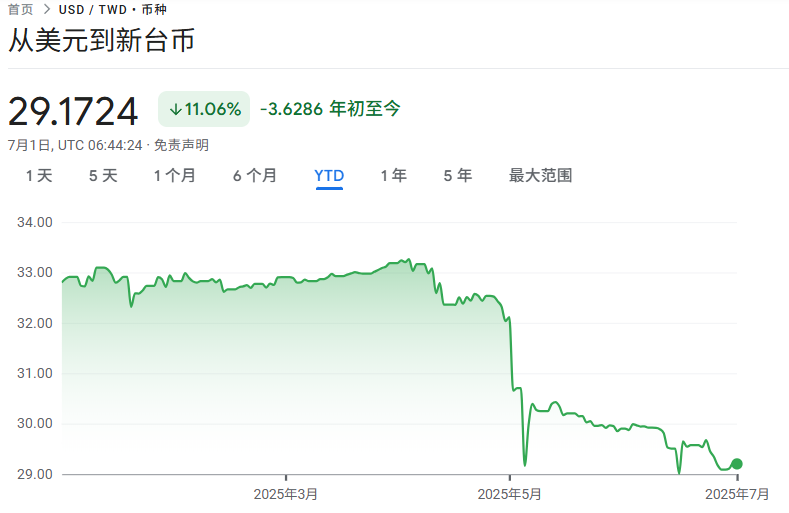
挑战监管容忍度,新台币大跌后再度飙升!
Hua Er Jie Jian Wen· 2025-07-01 07:46
Core Viewpoint - The recent volatility of the New Taiwan Dollar (NTD) poses challenges to regulatory tolerance, with significant fluctuations impacting local businesses and the financial market [1][4][5]. Group 1: NTD Volatility - The NTD experienced a significant increase of 2.5% against the USD, marking the largest single-day gain since early May, bringing its year-to-date appreciation to 12%, the strongest among Asian currencies [1][4]. - The previous trading day saw the NTD plummet by 2.5%, the largest single-day drop since 2001, indicating a pattern of extreme volatility [4][5]. - Analysts suggest that the fluctuations reflect a delicate balance for regulators between maintaining exchange rate stability and responding to the weakening USD [4][5]. Group 2: Impact on Local Businesses - The recent volatility coincides with local companies preparing to release their semi-annual reports, which could directly affect the financial performance of firms, including life insurance companies and exporters [4][5]. - The surge in the NTD was driven by significant dollar sales from local exporters and foreign capital inflows, prompting public banks to intervene by purchasing USD to stabilize liquidity [5][6]. Group 3: Regulatory Response - Regulatory authorities are increasingly concerned about the NTD's appreciation, which poses risks to Taiwan's export-dependent economy and pressures life insurance companies holding USD-denominated assets [6][7]. - The Financial Supervisory Commission (FSC) has implemented measures allowing life insurance companies to increase foreign exchange reserves to offset potential losses from NTD appreciation [7][8]. - The central bank has also intensified warnings regarding currency purchases by local trading companies and has taken steps to limit foreign capital speculation on the NTD, demonstrating a commitment to stabilizing the exchange rate [8].
行业周报:均衡配置,兼顾业绩确定性和估值合理性-20250629
Xinda Securities· 2025-06-29 07:48
The provided content does not contain any quantitative models or factors, nor does it include any related construction processes, formulas, evaluations, or backtesting results. The documents primarily focus on industry analysis, company updates, and market trends across various sectors such as light manufacturing, exports, new tobacco products, home furnishings, and others. There is no mention of quantitative models or factors in the provided text.
7月起,国内或将出现5大趋势,普通家庭必须提早准备!
Sou Hu Cai Jing· 2025-06-29 05:56
Group 1 - The core viewpoint is that making money is becoming increasingly difficult due to various economic factors [3][5] - The ongoing US-China trade war has led to a significant reduction in orders for domestic export companies, resulting in layoffs and salary cuts [3] - The real estate market remains sluggish, with a notable decline in housing demand affecting 56 related industries, including construction materials, decoration, furniture, and home appliances [3] Group 2 - Since 2022, housing prices across the country have entered a long-term adjustment phase, with an average decline of 30% [7] - Major cities like Shanghai and Shenzhen are now experiencing price drops, which were previously limited to lower-tier cities [7] - It is expected that housing prices will continue to show a trend of "steady decline" in the second half of the year, with a potential correction in high-price cities [7] Group 3 - Bank deposit interest rates have been continuously decreasing, with a drop from 3.15% to 1.8% for three-year deposits, representing a decline of over 40% [9] - The groups most affected by this trend are middle-aged and elderly individuals with significant bank deposits and families relying on interest income [9] - There is an expectation of further reductions in deposit rates, pushing those who previously relied on interest income to seek employment [9] Group 4 - The government plans to accelerate the construction of affordable housing, with a target of 6 million units over the next five years, averaging 1.2 million units annually [12] - The pricing of affordable housing will be significantly lower than that of surrounding market-rate homes, reducing the purchasing cost for low-income families [12] - The influx of affordable housing is expected to divert demand from the market housing sector, increasing downward pressure on housing prices [12] Group 5 - The era of artificial intelligence is already underway, with various industries adopting AI technologies to replace traditional labor [13] - High-end restaurants are using robots for food delivery, and service companies are implementing AI customer service solutions [13] - The trend indicates a gradual reduction in labor-intensive job opportunities as more manufacturing companies adopt industrial robots [13]