
Qi Huo Ri Bao Wang

Search documents
投资热情高涨 二季度黄金需求上升
Qi Huo Ri Bao Wang· 2025-07-31 19:24
Core Insights - Global gold demand increased in Q2 2025, driven by strong investment interest amid high gold prices and geopolitical uncertainties [2][3] Investment Demand - Total global gold demand reached 1249 tons in Q2 2025, a 3% year-on-year increase [2] - Gold ETF investments were a key driver, with inflows of 170 tons, contrasting with outflows in Q2 2024 [2] - Asia's contribution to gold ETF inflows was significant, with 70 tons, matching North America's 73 tons [2] - Gold bar and coin investments rose by 11% year-on-year to 307 tons, with China leading at 115 tons (up 44%) and India at 46 tons [2] Central Bank Purchases - Central banks added 166 tons of gold in Q2 2025, although the pace of purchases has slowed [3] - 95% of surveyed central banks expect to increase gold reserves in the next 12 months [3] Jewelry Demand - Global gold jewelry demand fell by 14% year-on-year in Q2 2025, nearing 2020 pandemic lows [3] - China and India saw declines of 20% and 17% respectively in jewelry demand [3] - Despite lower demand, the value of global jewelry consumption rose to $36 billion in Q2 2025 [3] Supply Dynamics - Total gold supply increased by 3% year-on-year to 1249 tons, with mine production reaching a historical high [3] - Recycled gold supply grew by 4% but remained relatively subdued due to high gold prices [3] China's Gold Market - China's retail gold investment and consumption reached 518 tons in H1 2025, a 5% increase [5] - Q2 2025 demand in China hit 245 tons, up 28%, marking the highest Q2 since 2013 [5] - Gold ETF inflows in China reached 464 billion yuan (approximately $65 million) in Q2 2025, with total assets under management soaring by 116% to 152.5 billion yuan (approximately $21.3 billion) [5] Future Outlook - Jewelry consumption in China is expected to face continued pressure from low consumer confidence and high gold prices [7] - Strong investment demand for gold is anticipated to persist, supported by geopolitical and economic risks [7] - Potential interest from Chinese investors may rise if interest rate cuts occur and the People's Bank of China continues to purchase gold [7]
6月债券市场共发行各类债券87939.5亿元
Qi Huo Ri Bao Wang· 2025-07-31 18:59
Core Insights - The People's Bank of China released the financial market operation data for June 2025, indicating significant activity in the bond market [1] Group 1: Bond Market Issuance - In June, the total issuance of various bonds reached 87,939.5 billion yuan [1] - The breakdown of bond issuance includes: - Government bonds: 15,903.9 billion yuan - Local government bonds: 11,753.2 billion yuan - Financial bonds: 10,738.7 billion yuan - Corporate credit bonds: 14,257.3 billion yuan - Credit asset-backed securities: 247.2 billion yuan - Interbank certificates of deposit: 34,569.3 billion yuan [1] Group 2: Bond Market Custody Balance - As of the end of June, the total custody balance of the bond market was 188.5 trillion yuan [1] - The custody balance in the interbank market was 166.7 trillion yuan - The custody balance in the exchange market was 21.9 trillion yuan [1]
我国7月制造业PMI出炉经济总体产出保持扩张
Qi Huo Ri Bao Wang· 2025-07-31 18:59
Group 1 - The manufacturing Purchasing Managers' Index (PMI) for July is reported at 49.3%, indicating a slight contraction, while the non-manufacturing business activity index and composite PMI output index are at 50.1% and 50.2%, respectively, suggesting overall economic expansion in China [1] - The production index remains in the expansion zone at 50.5%, despite a 0.5 percentage point decline from the previous month, indicating ongoing manufacturing activity [1] - Extreme weather conditions, including heatwaves and floods, have impacted outdoor construction and daily life, affecting market demand [1] Group 2 - Analysts suggest that the stabilization and recovery of manufacturing market prices are primarily driven by the basic raw materials sector, with recent price index trends showing improved market price coordination [2] - The Producer Price Index (PPI) is expected to turn positive month-on-month in July, with a year-on-year decline narrowing to approximately -3.0%, influenced by rising prices of coal and steel [2] - Manufacturing enterprises continue to face operational pressures, and while measures to counteract excessive low-cost competition may alleviate supply-demand mismatches, the sustainability of these effects depends on a consistent recovery in demand [2] Group 3 - The Central Political Bureau of the Communist Party of China emphasizes the need for stable and flexible economic policies to promote employment, businesses, and market expectations, aiming to achieve the annual economic and social development goals [3] - With the implementation of various policies aimed at expanding domestic demand, investment and consumption activities in China are expected to steadily recover [3] - Positive factors such as high-end manufacturing, green transformation, and digital upgrades are anticipated to gradually improve the manufacturing sector's prosperity, supporting the goal of around 5.0% economic growth for the year [3]
7月制造业PMI指数回落至49.3%!分析人士:下半年有望稳步回升
Qi Huo Ri Bao Wang· 2025-07-31 12:01
Core Insights - The manufacturing PMI for July 2025 is reported at 49.3%, indicating a decline of 0.4 percentage points from the previous month, reflecting a downturn in manufacturing activity [1] Manufacturing PMI Breakdown - The production index stands at 50.5%, down 0.5 percentage points, while the new orders index is at 49.4%, down 0.8 percentage points, indicating continued expansion in production but a slowdown in market demand [2] - The raw material inventory index is at 47.7%, down 0.3 percentage points, and the employment index is at 48.0%, up 0.1 percentage points, suggesting challenges in workforce levels [1][2] - The supplier delivery time index is at 50.3%, up 0.1 percentage points, indicating stable supply chain conditions [1] Price Index and Market Dynamics - The price index has risen, with the main raw material purchase price index at 51.5%, up 3.1 percentage points, and the factory price index at 48.3%, up 2.1 percentage points, indicating an overall improvement in manufacturing market prices [2] Large Enterprises and New Growth Drivers - Large enterprises maintain expansion with a PMI of 50.3%, down 0.9 percentage points, and their production and new orders indices at 52.1% and 50.7%, respectively, indicating a stable operational environment [2] - Emerging sectors such as equipment manufacturing and high-tech manufacturing show PMIs of 50.3% and 50.6%, respectively, both above the critical point, indicating ongoing growth in these areas [2] Market Expectations and Future Outlook - The production and business activity expectation index is at 52.6%, up 0.6 percentage points, reflecting increased confidence among manufacturing enterprises regarding market developments [2] - Analysts suggest that despite a decline in domestic demand, future policies aimed at boosting consumption and investment may lead to a recovery in economic activity [3] - The focus on new pillar industries and the stabilization of the capital market are expected to support the equity market, particularly in technology and consumer sectors [3]
美国“大而美”法案对大宗商品市场有哪些影响?
Qi Huo Ri Bao Wang· 2025-07-31 07:44
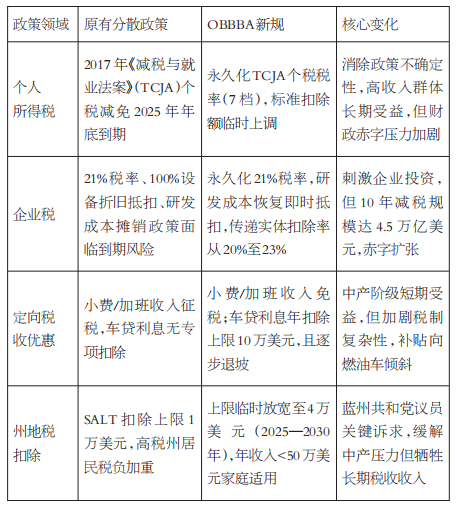
Tax Policy - The "One Big Beautiful Bill Act" (OBBBA) permanently lowers the corporate tax rate to 20% and extends R&D expense deductions and equipment depreciation benefits [2] - The standard deduction for personal income tax is increased to $1,500 for married couples filing jointly, and the tip tax and overtime tax exemptions are restored until 2028 [2] - The estate and gift tax exemption limits are raised, reducing the tax burden on high-income families [2] Social Welfare - Medicaid eligibility is tightened, requiring unemployed adults to complete 80 hours of work or community service monthly, expected to cut $1 trillion in spending over 10 years, affecting 11.8 million people [3] - The Supplemental Nutrition Assistance Program (SNAP) expands work requirements, leading to a reduction of approximately $186 billion in spending, impacting over 40 million low-income individuals [3] - Clean energy subsidies are eliminated, including the $7,500 tax credit for electric vehicles, and support for wind and solar projects is gradually terminated, shifting focus to fossil fuels [3] Defense and Border Security - The defense budget is increased by $150 billion, focusing on shipbuilding, missile defense systems, and nuclear deterrence [4] - Over $160 billion is allocated for border security, including funding for border wall construction and immigration enforcement [4] Debt Ceiling Adjustment - The federal debt ceiling is raised from $36.1 trillion to $41.1 trillion, allowing for deficit expansion over the next decade [5] Economic Impact - The OBBBA is projected to increase the federal deficit by approximately $3.4 trillion over the next 10 years, with the debt-to-GDP ratio rising from 117% to 130% [14] - Interest payments are expected to surge to $2.2 trillion by 2034, consuming 5.3% of GDP and squeezing funding for education and research [14] Industry and Market Impact - The elimination of electric vehicle subsidies poses a direct threat to companies like Tesla, potentially impacting sales and revenue, while traditional energy and defense sectors may benefit from the bill's provisions [19] - The bill's focus on fossil fuels and military spending is likely to support the traditional energy market while creating challenges for the renewable energy sector [19] Commodity Market Reactions - The increase in fiscal deficit and debt-to-GDP ratio is expected to drive up gold prices, with historical data indicating a 15% average annual increase when debt-to-GDP exceeds 120% [25] - The termination of electric vehicle tax credits may lead to increased gasoline consumption, providing short-term support for WTI oil prices [26] - The reduction of clean energy subsidies is anticipated to benefit traditional energy prices, which may indirectly support prices of vegetable oils through biodiesel [27] - Industrial metals are expected to see increased demand due to anticipated inflation and a weaker dollar, with copper prices nearing $10,000 per ton [28]

美欧利差缩窄 为何欧元贬值?
Qi Huo Ri Bao Wang· 2025-07-31 07:44
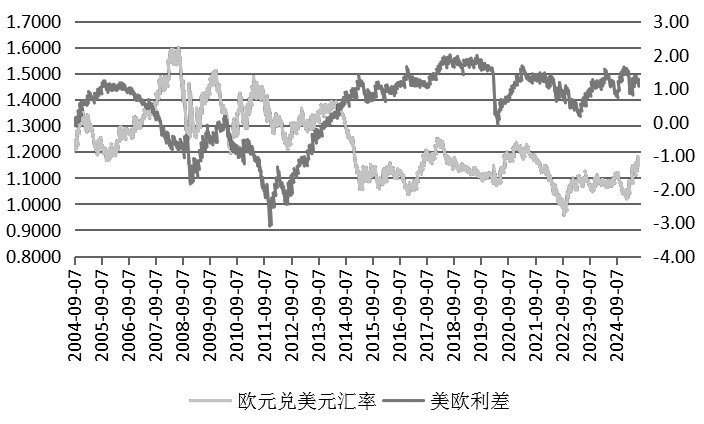
Group 1 - The European Central Bank has decided to maintain interest rates, yet the euro has depreciated significantly against the dollar, primarily due to the market interpreting the recent US-EU tariff agreement as a major concession from the Eurozone, which could have a substantial negative impact on its economy [1] - The Eurozone's economic growth in the first quarter showed slight acceleration, driven by increased investment and net exports, with investment contributing 0.3 percentage points and net exports contributing 1.07 percentage points to GDP, a reversal from negative contributions in the previous year [2] - The German Federal Senate has passed a reform bill that exempts defense spending exceeding 1% of GDP from debt brake restrictions, marking a shift from cautious fiscal policy to active expansion, which is expected to support economic growth in Germany and the Eurozone [2] Group 2 - The Eurozone faces significant challenges in relying on fiscal expansion for economic growth due to structural low-growth traps and deteriorating external conditions, with weak domestic demand and high pressure on exports to the US [3] - The recent US tariff policy is expected to have a more severe impact on the Eurozone economy than previously anticipated, with the weighted average tariff rate on EU exports to the US projected to rise from approximately 1.5% to 15.2%, potentially reducing economic growth by 0.2 to 0.4 percentage points over the next year [5] - Concerns over tariff impacts have led to capital outflows from the Eurozone, despite a narrowing of the interest rate differential between the US and Eurozone, which typically would support the euro's value [6][8]
玻璃、纯碱产业在预期与现实的平衡中寻找出路
Qi Huo Ri Bao Wang· 2025-07-31 06:17
近期,玻璃、纯碱期货价格波动加剧。在"反内卷"政策的影响下,玻璃、纯碱产业正经历着深刻的市场 变革。这轮由政策预期主导的市场波动,既让部分企业暂时缓解了经营压力,也暴露了行业供需格局中 的深层次问题,产业链各环节都在预期与现实中寻找新的平衡。针对供需调整、产业驱动因素、企业应 对策略等话题,期货日报记者通过对湖北、河北、山东等地的产业企业的电话调研,深入剖析"反内 卷"背景下玻璃、纯碱行业的真实生态与发展趋势。 把握"反内卷"政策机遇 从情绪驱动到现实检验 近期,在玻璃、纯碱市场,政策与供需预期的博弈,成为市场走势的核心驱动因素。从产能淘汰政策的 推进,到下游需求结构的动态变化,再到短期追涨行为与长期行业整合趋势的交织,市场参与者的情绪 在乐观与谨慎之间频繁切换。对玻璃、纯碱产业企业而言,如何在价格起伏中坚守理性,在诸多不确定 性里锚定经营决策的确定性,已成为当下亟待解决的问题。 "'反内卷'政策的核心,是解决违背经济运行规律的低质量、同质化竞争问题。"中信寰球商贸有限公司 玻璃、纯碱期现业务总经理范国圣表示,这一政策信号的释放,迅速在玻璃、纯碱市场掀起波澜。 2025年6月,玻璃与纯碱价格处于历史低位,玻璃 ...
从风险对冲到产业转型的理性破局
Qi Huo Ri Bao Wang· 2025-07-31 06:14
短期风险对冲只能解燃眉之急,行业真正的可持续发展仍需依赖基本面的实质性改善。 当前政策预期为市场注入短期情绪动力,但要实现从"预期回暖"到"实质反转"的跨越,还需三大支撑: 政策细则的精准落地,包括老旧装置退出清单的明确、环保技改补贴的兑现;下游需求的企稳回升,既 需要房地产竣工面积的实际增长,也依赖光伏装机规模的持续扩大;产能结构的深度优化,推动高成本 产能加速出清与天然碱法替代进程。 王铭之表示,市场终将回归理性,能穿越周期的永远是务实者。"在行业洗牌中脱颖而出的企业,往往 是那些在狂热时保持冷静、在悲观时提前布局的市场主体。"他说。 "反内卷"政策为玻璃、纯碱市场注入的并非简单的价格上涨动力,而是倒逼产业升级的转型契机。这轮 由政策预期推动的市场行情,既暴露了行业长期存在的供需失衡、产能结构僵化等深层问题,也推动企 业在波动中探索更理性的生存法则。在政策预期与市场现实的持续博弈中,玻璃、纯碱企业正从短期风 险管理到长期产业转型,逐步勾勒出"反内卷"背景下的破局路径。 政策暖风下的市场波动,让风险管理成为企业生存的"必修课"。调研中期货日报记者发现,利用期货期 权等工具管理风险已成为行业共识,为企业筑起了 ...
小鼎能源:以产融结合推动聚酯产业链价值提升
Qi Huo Ri Bao Wang· 2025-07-31 06:04
Group 1: Core Insights - The integration of futures markets with physical trade is becoming a key tool for companies to manage risks, particularly in the polyester industry [1][2] - Xiaoding Energy has developed a business model centered on basis trading, supported by risk management and guided by industry chain services, achieving continuous growth in trade volume for five consecutive years [1][2] - The company’s innovative use of futures tools and deep integration with upstream and downstream sectors has allowed it to create a development model characterized by "futures-spot linkage and controllable risks" [1][2] Group 2: Industry Dynamics - The polyester industry is undergoing structural changes in 2024, driven by fluctuations in crude oil supply and demand, leading to a shift in pricing logic [2][3] - Domestic PX production is expected to increase by approximately 12% year-on-year in 2024, while processing profits for PX are projected to drop below $300 per ton, indicating a shift in profit distribution from PX production to downstream sectors [2][3] - The competition among integrated manufacturers is intensifying, with PTA and polyester production capacities growing at an annual rate of 10%, leading to a concentration of profits among leading firms [2][3] Group 3: Business Model Innovation - Xiaoding Energy is transitioning from traditional arbitrage models to innovative service models, focusing on basis trading, supply chain finance, and risk management [3][4] - The company has adopted basis trading as its core business model, allowing for flexible pricing based on market conditions, which enhances operational autonomy for enterprises [3][4] - Xiaoding Energy has established a comprehensive futures-spot integration system covering raw material procurement, product sales, and inventory turnover, incorporating various business models such as basis trading and price hedging [4][6] Group 4: Value Creation and Market Position - The company’s innovative approach injects new vitality into the industry chain, addressing the dual challenges of profit contraction and credit risk faced by trading firms during industry adjustments [3][6] - Xiaoding Energy's strategies have improved supply chain resilience and operational efficiency for downstream clients, allowing them to maintain stable production loads and enhance product quality [6][7] - The integration of financial tools with the real economy is seen as essential for seizing opportunities in complex markets, with Xiaoding Energy positioning itself as a pivotal enterprise in this integration process [8]
国家统计局:去年“三新”经济增加值占GDP比重为18.01%
Qi Huo Ri Bao Wang· 2025-07-31 03:37
Core Insights - The "Three New" economy in China achieved a value-added of 242,908 billion yuan in 2024, reflecting a growth of 6.7% compared to the previous year, which is 2.5 percentage points higher than the GDP growth rate [1] - The "Three New" economy accounted for 18.01% of GDP, an increase of 0.43 percentage points from the previous year [1] Group 1: New Industries - New industries are defined as economic activities formed by applying new technological achievements and emerging technologies at a certain scale [1] - These include industries directly spawned by the industrialization of new technology applications, traditional industries adopting modern information technology, and new industries arising from the differentiation, upgrading, and integration of industries due to technological advancements [1] Group 2: New Business Formats - New business formats emerge in response to diversified, varied, and personalized product or service demands, relying on technological innovation and application [1] - This includes business activities conducted with the support of the internet, innovations in business processes, service models, or product forms, and the provision of more flexible and personalized services [1] Group 3: New Business Models - New business models involve the integration and reorganization of various internal and external factors of a business to achieve user value and sustainable profitability [2] - This is characterized by the fusion of the internet with industrial innovation, the incorporation of hardware into services, and the provision of one-stop services for consumption, entertainment, leisure, and other services [2] Group 4: Measurement of Value-Added - The value-added of the "Three New" economy measures the increase in value created by all resident units engaged in "Three New" economic production activities within a specific period [2]