Qi Huo Ri Bao

Search documents
PTA 偏弱运行
Qi Huo Ri Bao· 2025-10-15 22:35
Core Viewpoint - The polyester industry chain has been under price pressure since early September, with PTA futures showing weak performance and prices stabilizing around 4500 yuan/ton after the National Day holiday [1] Supply Side - As of early October, PTA weekly capacity utilization has increased by approximately 7 percentage points compared to the end of August, reaching 77.84%. PX weekly capacity utilization rose to 88.23%, up about 3.6 percentage points, while polyester capacity utilization remained stable at 87.8%, a rise of about 1.14 percentage points [1][3] - Several major facilities are still offline, with uncertain restart dates. Facilities that are currently offline include the 1.2 million ton facility at Sanfangxiang, the 1.2 million ton facility at Taiwan Chemical, and the 2.25 million ton facility at Yisheng Dalian, among others. The restart of these facilities is pending [3] - There are expectations for maintenance in October for the 1 million ton facility at Sichuan Energy Investment and the 2.5 million ton facility at Dushan Energy, which may limit the overall increase in PTA capacity utilization [3] Demand Side - As of early October, demand from the weaving terminal remains strong, with improved inquiry atmosphere for autumn and winter home textiles and apparel fabrics. However, foreign trade orders are still relatively low [4] - The average capacity utilization for long filaments is approximately 91.39%, for short fibers is about 86.96%, and for bottle flakes is around 71.16%, all showing slight increases compared to August [4] - The overall demand performance during the National Day holiday was weak, with manufacturers primarily focusing on fulfilling previous orders rather than actively procuring raw materials [4] Market Outlook - The PTA market is expected to continue a dual increase in supply and demand in October, with more uncertainties on the supply side compared to the demand side. Attention should be paid to the dynamics of facility restarts and maintenance, which may adjust supply expectations [4] - The cost side shows limited supply-demand contradictions for PX, with weak crude oil prices. PTA futures prices are expected to maintain a weak oscillation trend, with the main contract operating in the range of 4400 to 4800 yuan/ton and spot processing fees between 100 to 300 yuan/ton [4]
期债 宽幅震荡
Qi Huo Ri Bao· 2025-10-15 21:51
Group 1: Market Overview - The bond market faced overall pressure in Q3, with a significant "see-saw" effect between stocks and bonds. In July, the bond market was under pressure due to the implementation of "anti-involution" policies and expectations of new policies, while commodities and the stock market rose. In August, the "anti-involution" trading cooled down, commodity prices fell, but the stock market remained strong, leading to further weakness in the bond market. In September, the stock market experienced high volatility, and futures bonds fluctuated widely [1] Group 2: Manufacturing Sector - The manufacturing PMI for September was reported at 49.8%, a marginal improvement of 0.4 percentage points from August, indicating a slight recovery in manufacturing activity. The production index rose to 51.9%, the highest in nearly six months, while the new orders index increased to 49.7%, suggesting improved market demand. The new export orders index also saw a recovery, rising by 0.6 percentage points to 47.8% [2][3] Group 3: Price and Inventory Dynamics - The factory price index continued to contract, while the raw material purchase price index remained in the expansion zone, indicating pressure on corporate profit margins. In September, the raw material inventory index rose to 48.5%, reflecting proactive stocking behavior driven by production expansion. The finished goods inventory index increased to 48.2%. Large enterprises maintained a PMI of 51.0%, while medium and small enterprises showed slight declines [3] Group 4: Trade Performance - In September, exports grew by 8.3% year-on-year, surpassing expectations, while imports increased by 7.4%, also exceeding forecasts. The growth in exports was primarily driven by non-U.S. markets, with significant increases in exports to ASEAN and the EU. The structure of exports improved, with mechanical and electrical products maintaining a stable share of over 60% [4] Group 5: Outlook for Q4 - Looking ahead to Q4, despite challenges such as high base effects and trade frictions, exports are expected to maintain positive growth supported by demand from ASEAN, the EU, and Africa. The overall bond market is entering a phase of clearing negative sentiment, but a trend-driven market will depend on renewed expectations for monetary easing. The current economic fundamentals remain resilient, limiting the likelihood of comprehensive interest rate cuts in the short term [5]
临时拨款法案未获通过美联邦政府继续“停摆”
Qi Huo Ri Bao· 2025-10-15 18:08
Core Points - The U.S. Senate failed to pass a new temporary funding bill for the eighth time, leading to the federal government shutdown entering its third week [1] - The shutdown began on October 1 after the Senate could not reach an agreement on key issues such as healthcare-related spending before the end of the fiscal year on September 30 [1] - President Trump continues to pressure Democrats to change their stance on healthcare-related spending [1] Summary by Categories - **Government Shutdown** - The federal government has been in a shutdown for three weeks due to the Senate's inability to pass a temporary funding bill [1] - The shutdown was triggered by a lack of agreement on core issues between the Republican and Democratic parties [1] - **Legislative Actions** - The Senate voted on a temporary funding bill proposed by Republicans, which had already passed the House, but failed to secure the necessary 60 votes [1] - This marks the eighth voting attempt on the funding bill [1] - **Impact on Federal Employees** - According to a statement from the U.S. Department of Justice, 4,108 federal employees have been laid off since the government shutdown began [1] - The Office of Management and Budget announced plans to continue layoffs and is preparing for the ongoing shutdown [1]
旺季不旺 螺纹钢维持偏弱走势
Qi Huo Ri Bao· 2025-10-15 05:32
Core Viewpoint - The steel market, particularly rebar, is experiencing weakened demand and price fluctuations due to ongoing adjustments in the real estate sector, leading to increased inventory pressure and a lack of significant improvement in demand [1][2]. Group 1: Rebar Market Dynamics - The traditional peak season for rebar, known as "Golden September and Silver October," has diminished, with inventory levels during the National Day holiday exceeding historical averages [1]. - Rebar prices are showing weak fluctuations, while raw material prices remain strong, indicating a lack of negative feedback in the supply chain [1]. - Steel mills are implementing production control measures to alleviate inventory pressure, resulting in lower rebar production levels this year [1]. Group 2: Hot Roll and Steel Billet Risks - The main risks for hot-rolled steel in Q4 include a decline in domestic demand and pressure on exports, with downstream orders for cold-rolled galvanized products shrinking [2]. - Hot-rolled steel inventory levels are higher than the same period last year, indicating potential oversupply [2]. - Steel billet exports have surged, reaching a historical high of 1.76 million tons in August, but production profits are now negative, raising concerns about future output [2]. Group 3: Raw Material and Cost Dynamics - High pig iron production is supporting raw material prices, with coal and iron ore prices outperforming finished steel since August [3]. - Rebar production profits are currently low, with long-process profits below 100 yuan per ton and short-process profits around -100 yuan per ton [3]. - The cost support for rebar remains intact due to healthy fundamentals in the raw material sector, despite the lack of significant upward momentum in rebar prices [3]. Group 4: Macro Factors and Market Sentiment - The market is closely monitoring macroeconomic factors, including upcoming political meetings and monetary policy decisions, which could influence rebar prices [3]. - There is a notable contradiction between weak demand and strong cost support for rebar, but the situation has not yet reached a level of negative feedback that would significantly impact prices [3]. - Overall, the rebar market is expected to maintain a weak and fluctuating trend, with caution advised regarding potential volatility due to changing market expectations [3].
市场人士:原油市场面临多重压力
Qi Huo Ri Bao· 2025-10-15 00:36
Core Viewpoint - The current oil market is facing multiple pressures including increased supply, bleak demand outlook, and reduced geopolitical risks [1][2][3] Group 1: Supply Dynamics - OPEC+ has decided to increase production by 137,000 barrels per day in November, gradually unwinding a previous cut of 1.65 million barrels per day [1] - Countries like Brazil and Guyana are also seeing a continuous rise in oil supply [1] - The International Energy Agency (IEA) predicts a supply surplus of over 2 million barrels per day in the fourth quarter [2] Group 2: Demand Outlook - The global oil demand is entering a seasonal consumption lull, exacerbated by escalating US-China trade tensions, which have led to pessimistic expectations for global economic growth and oil demand [1][2] - The end of the demand peak season has resulted in insufficient demand pressure on the market [2] - The US government's potential shutdown and fluctuating tariff policies may further reduce oil demand [1][2] Group 3: Geopolitical Factors - The recent ceasefire agreement in Gaza and Israel's withdrawal from Gaza have significantly reduced the geopolitical risk premium in oil prices [1] - The market is currently in a "TACO" trading phase, with high uncertainty in macro and geopolitical factors affecting oil prices [3] Group 4: Price Trends - The international oil price is expected to remain weak in the short term, with predictions of further declines in the fourth quarter [3] - OPEC+'s commitment to increase production is seen as a "sword of Damocles" hanging over international oil prices, with potential adjustments to their production plans being a key focus for the market [1][3]
中泰期货:螺纹钢维持偏弱走势
Qi Huo Ri Bao· 2025-10-15 00:33
Core Viewpoint - The steel market, particularly rebar, is experiencing weak demand and inventory pressure due to the ongoing adjustments in the real estate sector, leading to a subdued performance during the traditional peak seasons [1][4]. Group 1: Rebar Market Dynamics - The demand for rebar is expected to remain weak as new construction and construction area data continue to adjust downward, prompting steel mills to implement production control measures [1][4]. - Despite low rebar production levels, the supply-demand structure still faces pressure, with a notable shift in production towards hot-rolled coils and steel billets due to profit differentials [1][2]. - As of October 10, the average daily molten iron output from 247 steel enterprises remains above 2.4 million tons, indicating high production levels despite the weak demand [1]. Group 2: Hot-Rolled Coil Risks - The main risks for hot-rolled coils in Q4 include a potential decline in domestic demand and export pressures, with downstream orders for cold-rolled galvanized products shrinking [2]. - Current hot-rolled coil inventory levels and accumulation rates are higher than the same period last year, indicating a potential oversupply situation [2]. - The EU's plans to reduce steel import quotas and impose a 50% tariff, along with escalating trade tensions between China and the U.S., add uncertainty to steel exports [2]. Group 3: Steel Billet Export Trends - In August, China's steel billet exports reached 1.76 million tons, marking a historical high with a 12% month-on-month increase and a 230% year-on-year increase [2]. - However, steel billet production profits have turned negative, raising concerns about potential production declines in the future [2]. - The high energy consumption associated with steel billet exports is seen as a waste of domestic processing capabilities, leading to increased competition in the market [2]. Group 4: Raw Material Price Support - High molten iron production has supported raw material prices, with coal and iron ore prices performing better than finished steel products since August [3]. - As of October 13, rebar long-process profits are below 100 yuan per ton, while short-process profits in Jiangsu are around -100 yuan per ton, indicating pressure on steel mill profitability [3]. - The lack of a significant downward correlation between raw material and finished product prices suggests that cost support for rebar remains, limiting downside potential [3]. Group 5: Macro Factors and Market Sentiment - The rebar market is currently facing a contradiction between weak demand and strong costs, but this has not yet reached a level of negative feedback that would significantly impact prices [4]. - Concerns over escalating trade tensions and expectations from upcoming important meetings may lead to increased market volatility [4]. - Overall, the rebar market is expected to maintain a weak and fluctuating trend under various constraints, with potential for short-term weakness driven by market sentiment [4].
基本面利空因素基本释放完毕 甲醇有望触底反弹
Qi Huo Ri Bao· 2025-10-15 00:31
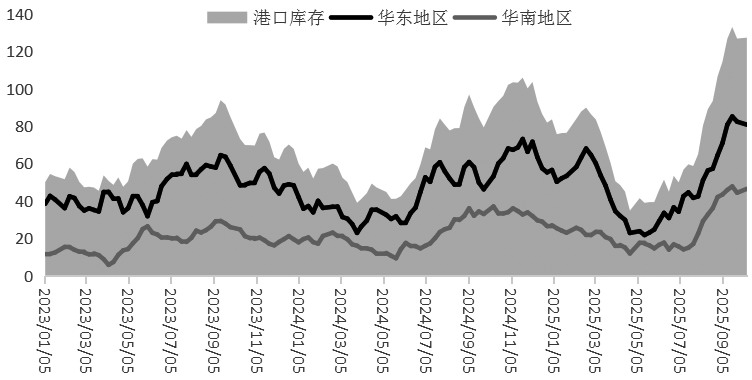
Core Viewpoint - The methanol market is expected to face downward pressure on prices in the short term due to macroeconomic factors, but a rebound may occur once negative influences are exhausted [1] Supply Side Analysis - Methanol production rates are anticipated to decline in Q4, with a slight decrease in import volumes expected [1] - As of October 9, the national methanol operating rate was 80.38%, a slight decrease of 1.1 percentage points year-on-year, with a weekly production of approximately 1.87 million tons [3] - Factors such as industrial gas restrictions and environmental inspections are likely to significantly limit methanol production in the Southwest and North China regions, respectively, leading to a strong expectation of supply decline in Q4 [3] Demand Side Analysis - The operating rate for coal-to-olefins remains high at 88%, supported by the restart of facilities from companies like Shenhua and Ningxia Baofeng [6] - Traditional downstream industries for methanol show limited demand, with weak purchasing intentions from enterprises post-National Day [5] - As of October 9, the operating rates for downstream products such as formaldehyde and dimethyl ether were relatively stable, with some showing slight increases compared to the previous year [5] Inventory and Pricing Trends - Domestic methanol inventory has reached historical highs, with port inventories at 1.273 million tons as of October 9, a year-on-year increase of 40.96% [4] - The increase in inventory is attributed to low domestic prices and high import volumes, with imports reaching a record high of 1.7598 million tons in August, a year-on-year increase of 44.08% [4] - Despite the high inventory levels, the overall profitability of production companies remains acceptable due to low costs, although some production routes are experiencing losses [3] Market Outlook - The methanol market is expected to enter a destocking phase as supply declines and imports are projected to decrease [6] - However, recent significant drops in international crude oil prices may continue to exert downward pressure on methanol prices in the short term [6]

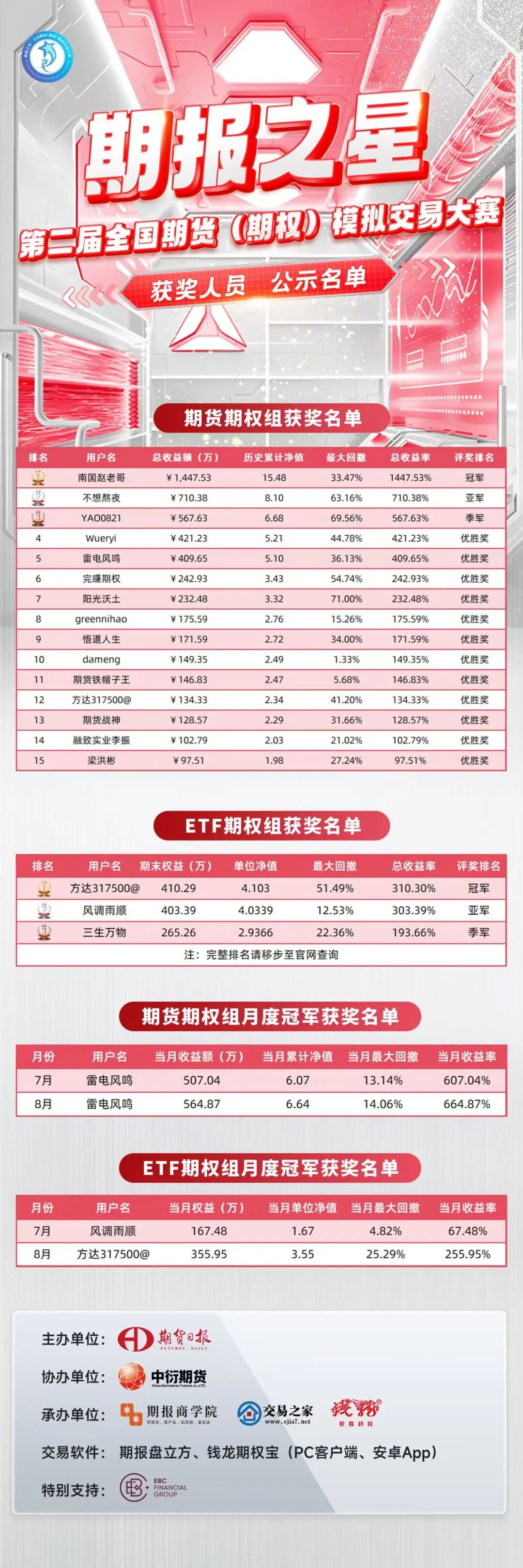
逾2300人参赛!第二届“期报之星” 大赛圆满收官,冠军收益率达1447.53%
Qi Huo Ri Bao· 2025-10-15 00:18
Group 1 - The second "Star of Futures" national futures (options) simulation trading competition concluded on September 30, 2025, with a total of 29 winners across two categories, including a champion with a remarkable return of 1447.53% [1] - The total number of participants exceeded 2300, marking a 64.29% increase from the previous competition, attributed to various innovations by the organizing committee [1] - A new ETF options category was introduced, enhancing the competition's diversity and providing participants with more options [1][2] Group 2 - The competition maintained a strong educational component, featuring eight distinguished mentors in the futures trading field who provided diverse professional guidance through live broadcasts [2] - The "Achievement System" from the previous competition was retained, allowing participants to unlock achievements and earn rewards by meeting specific criteria [2] - The competition's atmosphere was described as highly engaging, with participants applying learned strategies in a simulated trading environment, thereby improving their trading skills [2] Group 3 - The event received support from EBC Financial Group, Qianlong Technology, and Panlifang, with the organizing committee committed to continuous innovation and establishing the "Star of Futures" as a recognized brand in investor education [3] - The competition introduced a monthly champion reward mechanism to further motivate participants and provide them with a sense of achievement in shorter time frames [1][2]
棕榈油上攻动能不足
Qi Huo Ri Bao· 2025-10-15 00:07
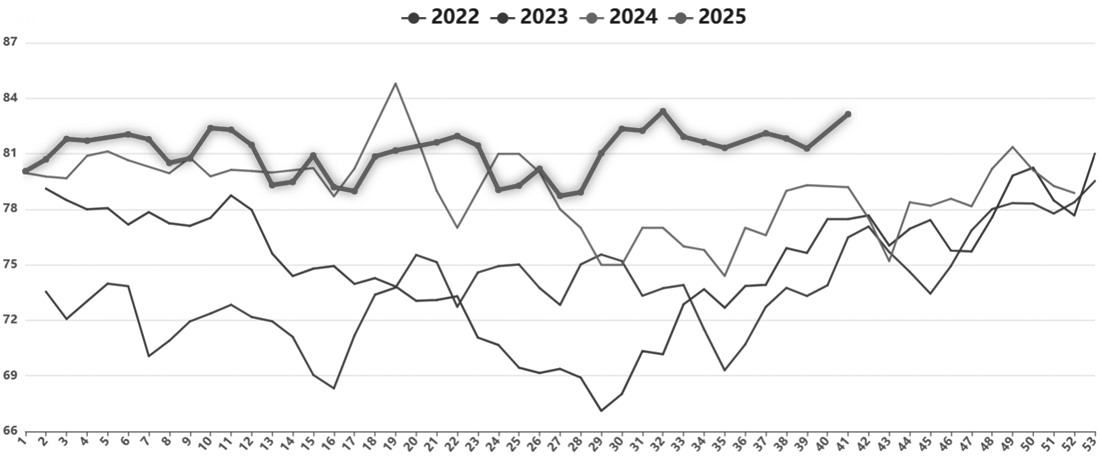
9月底以来,棕榈油期价先扬后抑。后市来看,马来西亚棕榈油局(MPOB)9月供需报告的利空影响叠加原油价格回落削弱生柴需求预期,棕榈油 价格上攻动能不足。 MPOB9月供需报告对棕榈油市场形成阶段性利空压力。具体来看,报告显示,马来西亚棕榈油9月产量小幅下降,但仍高于预期。9月棕榈油产量 环比减少0.73%,至184.12万吨,但沙巴和沙捞越地区因降雨改善实现增产。尽管市场预期减产,但实际产量仍高于机构预测的179万~181万吨, 反映出产区整体供应保持韧性。 从需求端看,马来西亚棕榈油出口疲软与国内消费收缩并存。其中,出口量环比仅增7.7%,至142.8万吨,低于市场预期的145万~150万吨,主要 因中国买船衔接不畅及印度转向豆油采购所致。国内消费同比锐减33.2%,至33.35万吨,或与斋月后需求回落及生物柴油掺混政策执行放缓有关。 综合来看,马来西亚棕榈油库存超预期累积,供需格局维持宽松。9月月末库存环比激增7.2%,至236.1万吨,远超市场预期的215万~220万吨,创 2024年12月以来新高,标志着马来西亚棕榈油市场从供需紧平衡转向宽松。 据相关报道,印尼能源部长巴赫利尔·拉哈达利亚10月7日宣 ...
烧碱供需矛盾加剧
Qi Huo Ri Bao· 2025-10-14 23:41
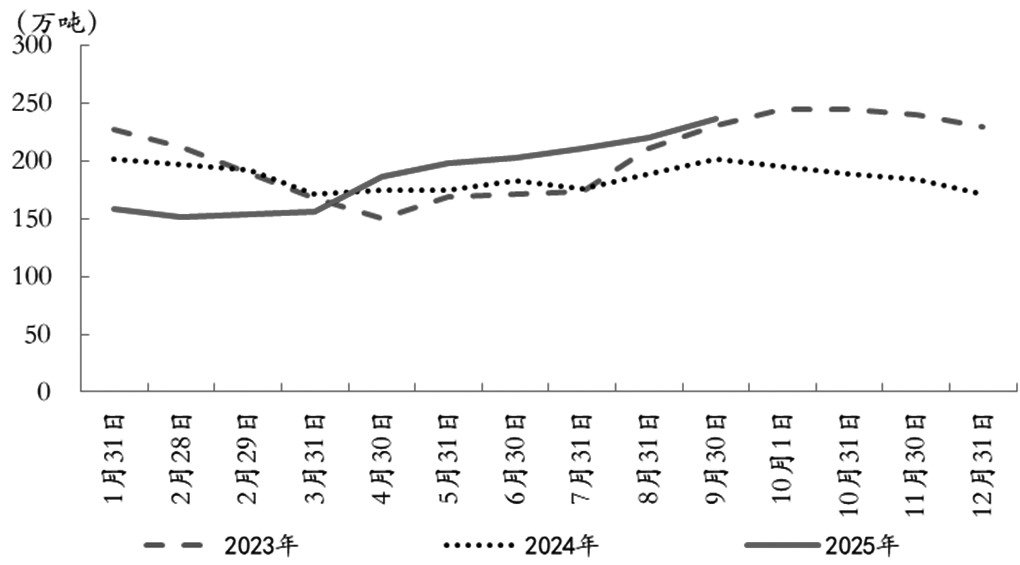
Core Viewpoint - The price of caustic soda has declined significantly since September, driven by an exacerbation of supply-demand imbalances, with supply growth outpacing demand growth [1][3]. Supply Side - Caustic soda prices fell from 2738 CNY/ton at the beginning of September to 2400 CNY/ton after the National Day holiday, marking a cumulative decline of 12.34% [1]. - The average price of 32% ion membrane caustic soda in Shandong dropped from 870 CNY/ton to 800 CNY/ton during the same period [1]. - Domestic caustic soda production capacity is expanding significantly, with production at historical highs and inventories above last year's levels [1]. - By 2025, new domestic caustic soda capacity may exceed 2 million tons, with over 1 million tons of new installations already operational in the first three quarters of 2023 [1]. - Current caustic soda inventories stand at 421,200 tons, with most periods of the year seeing inventories above 400,000 tons, indicating persistent supply pressure [1]. Demand Side - The operating rate of alumina, the largest downstream consumer (28% share), increased from 75% to 85%, providing some support to caustic soda prices [3][6]. - However, the pace of increase in operating rates has slowed, and uncertainties regarding future installations may limit expected support [3]. - Non-alumina demand, particularly from the viscose staple fiber sector, has seen an increase in operating rates to 89.82%, but further increases are unlikely [3][6]. - The paper industry’s operating rate rose from 61% to 72%, but this increase may have peaked, limiting additional demand for caustic soda [6]. Export and Cost Factors - Caustic soda exports increased significantly, with 21,350 tons exported in August and a total of 224,660 tons from January to August, a year-on-year increase of 73,000 tons [7]. - However, international conditions may hinder further export growth due to Southeast Asia's capacity expansion and rising shipping costs [7]. - The price of raw salt remains stable, but coal prices have risen, increasing production costs for caustic soda [9]. - The profit margin for the "chlor-alkali + PVC" sector remains negative at around -70 CNY/ton, which may continue to compress profits and provide some cost support for caustic soda prices [9]. Overall Market Outlook - The downward trend in caustic soda prices is likely to continue, primarily due to high supply levels [9]. - The operating rates of alumina and other non-alumina sectors are expected to stabilize or decline, maintaining the oversupply situation [9]. - Potential positive variables include environmental restrictions, seasonal maintenance, and pre-production stockpiling in the alumina sector [9].