
Qi Huo Ri Bao

Search documents
烧碱 下行空间收窄
Qi Huo Ri Bao· 2025-11-27 01:48
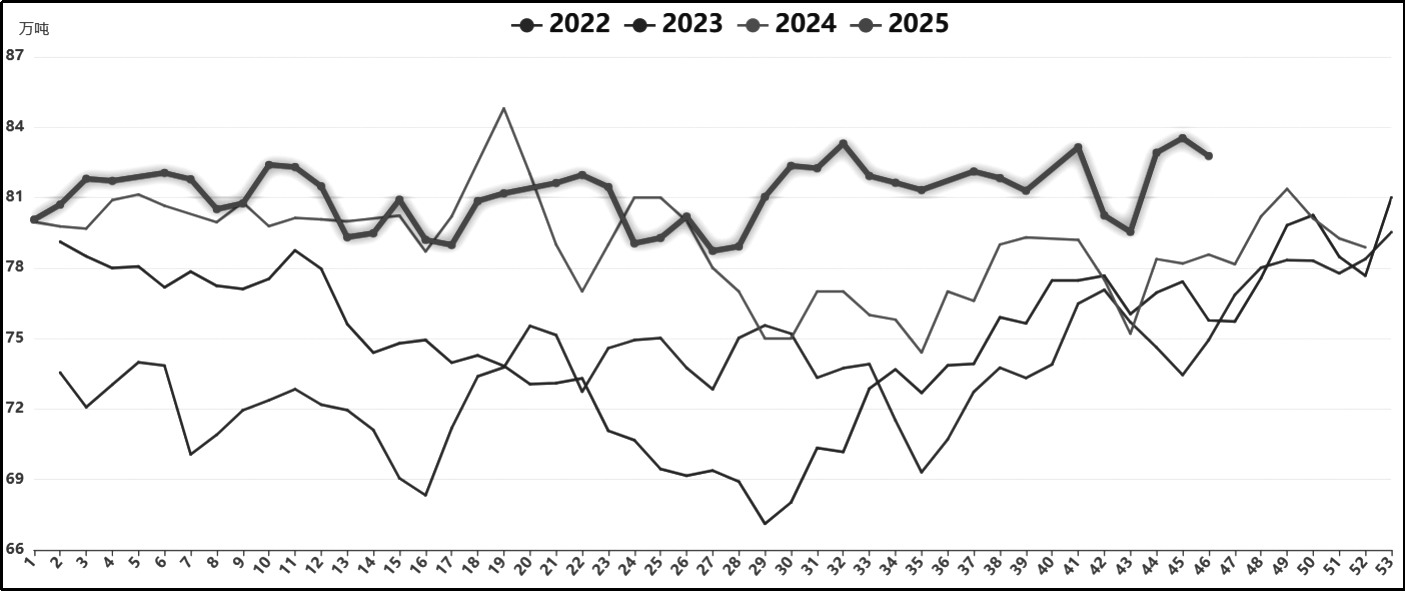
最近3个月,烧碱期货价格震荡下行,主力2601合约从2784元/吨下跌至2224元/吨,跌逾20%。 供应压力增加 图为国内氧化铝企业开工率 非铝需求方面,目前粘胶短纤企业开工率在90%左右,自9月份以来一直维持高开工率状态。不过,从季节性来看,粘胶短纤企业12月大概率会减产。纸浆 方面,目前我国阔叶浆企业开工率已经出现季节性回落,11月最低开工率为51%,环比下降逾20个百分点。氢氧化锂企业11月第四周开工率为37.38%,较月 初高点下降4个百分点。综合来看,虽然当前主力下游需求仍处于高位,但是后期有季节性走弱预期,且部分非铝需求已经明显下降,因此未来需求给价格 带来的支撑会逐步走弱。 出口存在不确定性 2025年1—9月,我国烧碱出口量约为294.45万吨,给上半年的期货和现货价格带来了一定的支撑。但是,东南亚产能扩张和海运费用上涨将削弱我国烧碱的 价格优势,四季度出口增量或有限,截至11月新的出口订单数量寥寥,因此出口给烧碱价格带来的支撑也会走弱。 2025年,烧碱新增产能集中投放,全年新增产能预计超过200万吨。前三季度,山东氢力新能源、青岛海湾、湖北宜化等企业新增产能超过100万吨,四季度 河北临 ...

供需错配 铜价仍有上涨空间
Qi Huo Ri Bao· 2025-11-26 23:26
Group 1: Market Overview - Since late October, domestic and international commodity prices have experienced fluctuations, with copper and gold prices showing high volatility after strong performance earlier [1] - The potential for a Federal Reserve interest rate cut in December, driven by concerns over the job market, may stimulate a new upward trend in copper prices [1] - Supply shortages are a solid foundation for rising copper prices, particularly due to tight copper ore supply constraining refined copper production [1] Group 2: Copper Supply Dynamics - In 2025, global copper mine supply growth is expected to fall short of projections, with a predicted decline of 0.12% year-on-year [2] - The top twenty copper mines are projected to see a 6.5% year-on-year decrease in production in Q3 2025, primarily due to external disruptions and internal factors affecting most companies [2] - Significant production increases are anticipated from specific mines, such as Oyu Tolgoi and Las Bambas, while others like Kamoa-Kakula and Grasberg are facing production declines due to various incidents [2][3] Group 3: Future Production Challenges - The global copper mine output is unlikely to see substantial growth in 2026, with increases mainly coming from the resumption of Grasberg and the ramp-up of Oyu Tolgoi [3] - The average ore grade is continuously declining, and mining costs are rising, while new mine development cycles take 6 to 10 years, limiting the potential for rapid output increases [3] - Factors such as resource protectionism and rising development costs are likely to hinder copper mine production from meeting expectations, providing long-term support for copper prices [3] Group 4: Smelting and Refining Pressures - Copper mine shortages are constraining the expansion of refined copper output, with many smelters facing raw material inventory depletion and significant operational pressures [4] - Despite plans for new smelting capacity in China and the Democratic Republic of the Congo, delays are expected in their deployment [4] - Increased activity in overseas smelting plant tenders indicates a proactive approach to securing raw materials, but this further exacerbates the copper supply shortage [4] Group 5: Emerging Demand Drivers - Despite a significant rise in copper prices, traditional copper demand is being suppressed, while emerging sectors like photovoltaic, energy storage, and AI are driving strong demand growth [5] - The photovoltaic industry is projected to require approximately 217.3 to 220 thousand tons of copper due to anticipated global solar installation growth [5] - The energy storage market in China is expected to continue its rapid growth, with significant increases in installed capacity projected through 2027 [6] Group 6: Investment Outlook - The Federal Reserve's potential interest rate cut is expected to boost asset prices, including copper, which is increasingly viewed as a critical resource in the AI era [6] - The demand for copper foil is expected to rise significantly, indicating substantial potential for further price increases [6] - Downstream purchasing companies can utilize micro copper futures to hedge against rising procurement costs [6]
贸易企业利用“现货+期权”模式降本增效
Qi Huo Ri Bao· 2025-11-26 16:09
Core Viewpoint - The article discusses how Haitong Futures, through its subsidiary Haitong Resource Management, utilizes innovative "spot + options" business models to provide effective risk management services to Zhejiang Dingchi Energy Co., helping the company stabilize operations and achieve trade growth despite market volatility [1][2]. Group 1: Business Model and Strategy - Haitong Resource tailored a risk management solution centered on "cumulative put options" for Zhejiang Dingchi Energy, allowing the company to lock in sales prices and enhance operating profits [2]. - The collaboration led to a significant increase in trade volume, with Zhejiang Dingchi's average monthly trade volume rising to approximately 6,000 tons, a year-on-year increase of about 50% [2]. Group 2: Financial Performance - The transaction involving the purchase of RB2501 linear payout cumulative put options resulted in a profit of 123,000 yuan, contributing to the overall increase in sales profits for the company [2]. - By the end of 2024, the cumulative project cooperation scale reached 95,000 tons, with an effective nominal principal of approximately 350 million yuan, completing 62 transactions in over-the-counter derivatives [2]. Group 3: Market Insights and Future Outlook - The innovative approach of converting spot holdings into a "spot + options" holding model allows companies to secure high-price pre-sales during price increases and enhance profits during price declines [3]. - Haitong Resource emphasizes the importance of understanding the personalized needs of enterprises to design targeted trading strategies, contributing to the stability and high-quality development of the real economy [3].
衍生品助黄金零售企业破解经营困局
Qi Huo Ri Bao· 2025-11-26 16:07
Core Insights - The gold jewelry market in China is experiencing a significant decline in demand, with a reported consumption of 278 tons in the first three quarters of 2025, representing a 25% year-on-year decrease [1] - Despite high international gold prices, retail companies in the gold jewelry sector are facing structural challenges, including a "store closure wave" and pressure on inventory management and profitability [1][4] - The pricing mechanism in the gold jewelry supply chain exposes retailers to risks due to price fluctuations, leading to a dual challenge of high prices reducing operational efficiency and suppressing consumer demand [2] Industry Performance - Major gold jewelry retailers, such as Chow Tai Fook and Luk Fook, have reported significant store closures, with Chow Tai Fook closing 296 stores and Chow Sang Sang reducing 333 stores in the first nine months of the year [1] - The retail sector is under pressure from high costs and low consumer demand, impacting profitability and operational strategies [1][4] Risk Management Strategies - A "laddered" risk management solution has been designed for gold jewelry retailers, incorporating put option protection strategies and zero-cost collar strategies to mitigate price fluctuation risks [2][3] - The put option strategy offers a safety net for retailers against price declines while allowing them to benefit from price increases, although it comes with high premium costs [2][3] - The zero-cost collar strategy provides downside protection while capping upside potential, allowing retailers to manage their financial exposure effectively without initial costs [3] Market Outlook - The gold market is expected to remain in a long-term bullish trend due to factors such as central bank purchases, geopolitical risks, and production cost support [2] - The industry is encouraged to explore market-based compensation mechanisms and innovative pricing models to adapt to the current economic environment [4]

中信期货2026年度策略会成功召开
Qi Huo Ri Bao· 2025-11-26 09:14
Group 1: Conference Overview - The 2026 Strategy Conference by CITIC Futures was successfully held on November 26, 2025, in Shanghai, focusing on the theme "Sailing Forward" [1] - The conference featured one main forum and eight sub-forums, discussing macroeconomic trends, equity, bonds, commodities, exchange rates, and overseas markets [1] - The event gathered investors from various sectors, promoting an exchange of ideas and insights [1] Group 2: Economic Outlook - The Vice President of the China Macroeconomic Society, Zhu Baoliang, projected a 5% economic growth for China in 2025, supported by growth policies and export activities [2] - Challenges such as insufficient domestic demand, a sluggish real estate market, and increasing local government debt were highlighted, indicating potential overcapacity in the economy [2] - Recommendations for 2026 include maintaining a stable economic growth target of around 5%, implementing proactive fiscal policies, and enhancing market confidence [2] Group 3: Global Economic Insights - CITIC Securities' Chief Macro Analyst, Cui Rong, noted that 2025's tariff disruptions would lead to a clearer global economic environment in 2026, with reduced uncertainties in geopolitics and monetary policies [3] - The forecast includes a cautious outlook on global financial market liquidity and lower returns on risk assets compared to 2025, despite a continued boom in AI technology [3] - Concerns regarding the fragility of AI financing cycles and potential economic risks related to the U.S. midterm elections were also mentioned [3] Group 4: Market and Asset Allocation - CITIC Futures' Deputy Director, Zeng Ning, expressed an optimistic macro outlook for 2026, driven by a sustained easing of global liquidity and fiscal expansions in the U.S. and Europe [4] - The asset allocation strategy suggests a balanced approach, with an emphasis on precious metals and commodities, while adjusting positions based on supply and demand dynamics [4] - Expectations for oil prices indicate a potential downward pressure on price levels, suggesting a cautious approach to oil investments [4]
美元指数缺乏持续走强动能
Qi Huo Ri Bao· 2025-11-26 01:42
Core Viewpoint - The strengthening of the US dollar index is primarily supported by external factors, including the weakening of non-US currencies and a temporary alleviation of employment concerns [6]. Group 1: Factors Supporting Dollar Strength - The collective weakening of non-US currencies has provided passive support for the dollar index, with the Japanese yen and British pound both under pressure due to respective economic conditions and policy decisions [1]. - Expectations for interest rate cuts have cooled, reinforcing the resilience of the dollar. Despite a rate cut in October, hawkish signals from the Federal Reserve have led to a significant reduction in the market's expectations for further cuts in December [2]. - The pause in the release of key economic data due to the government shutdown has alleviated short-term employment concerns, with recent ADP employment data showing marginal improvement, thus supporting the dollar index [3]. Group 2: Additional Supporting Factors - Concerns regarding the independence of the Federal Reserve have temporarily eased, following the Supreme Court's decision to hear a case related to potential dismissals within the Fed, which has calmed market fears [5]. - Increased risk aversion has driven demand for the dollar as a safe-haven asset, particularly following a pullback in US tech stocks and tightening liquidity conditions [5]. Group 3: Limitations on Future Dollar Strength - The risks in the employment market have not fundamentally eased, with key employment data yet to be released, and the potential for downward revisions in previously reported job numbers [7]. - There remains room for a return to rate cut expectations, particularly if a dovish candidate is appointed as the next Fed chair, which could negatively impact the dollar index [7]. - The support from non-US currencies is not robust, as the Japanese yen's depreciation may prompt government intervention, which could weaken its support for the dollar index [7]. - Technical resistance is evident near the 100-point mark for the dollar index, requiring additional positive factors for further upward movement [7]. Group 4: Short-term Outlook - In the short term, the dollar index is expected to maintain a high-level oscillation, with upcoming employment data and the appointment of a new Fed chair candidate serving as critical tests for its resilience [8].
利空突袭,集运指数(欧线)期货近月合约大跌!后市如何应对?
Qi Huo Ri Bao· 2025-11-26 01:08
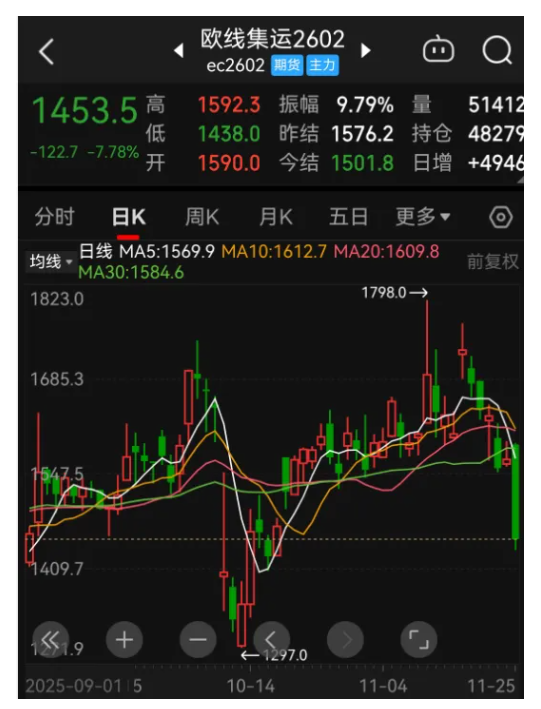
Core Viewpoint - The container shipping index (European route) futures have significantly declined, with the main contract EC2602 dropping nearly 8% to 1453.5 points, indicating a bearish sentiment in the market due to weak spot market conditions [1][3]. Group 1: Market Conditions - The container shipping market is overshadowed by weak spot market performance, leading several shipping companies to collectively lower their December pricing, with Hapag-Lloyd reducing rates to $2235/FEU, and others following suit [3]. - The current willingness of shipping companies to maintain prices shows divergence, with Maersk's pricing expectations not being strong, contributing to a pessimistic market outlook [3][4]. - The December shipping market may experience a "peak season that is not strong," influenced by the later timing of the 2026 Chinese New Year, which could delay shipping volumes [4]. Group 2: Price Trends and Predictions - Historical trends indicate that the spot market for container shipping saw a continuous decline from early December last year until late February this year, raising concerns about a similar pattern occurring this year [4]. - The current fluctuation in spot freight rates mirrors last year's patterns, with potential price increases being limited despite some improvement in shipping volumes [4]. - The supply of shipping capacity for January is expected to be abundant, with confirmed capacity for the first two weeks reaching 306,000 TEU and 346,000 TEU, respectively, which may lead to aggressive pricing strategies among shipping companies [4]. Group 3: Futures Contracts and Pricing Strategies - The near-term futures contracts are expected to follow the fluctuations in spot market rates, with shipping companies having pricing expectations for the traditional peak season from December to January [5]. - The potential for a price war among shipping companies exists, particularly if they attempt to stockpile goods before the holiday season [4][5]. - The main contract EC2602 is closely linked to the EC2512 contract, with the pricing strategies of shipping companies in late December likely to influence market expectations for January and February [5]. Group 4: Geopolitical Factors - The market is closely monitoring geopolitical developments and the progress of the Red Sea's reopening, which could impact future shipping routes and overall market sentiment [6]. - Recent statements from Maersk regarding the potential resumption of operations in the Suez Canal indicate a cautious optimism, but safety concerns in the region remain a significant risk [6].
无最优解,却有适配道!实盘高手的双向盈利逻辑揭秘啦!
Qi Huo Ri Bao· 2025-11-26 00:45
Group 1 - The core strategy of "Linglong Twin" is consistency in trading, emphasizing the importance of a fixed strategy for long-term success [2] - The trader focuses on high volatility and liquid commodities, applying trend-following strategies primarily in these markets [2] - The trader's approach involves technical analysis, entering trades after confirming trends through specific price movements [2] Group 2 - "Linglong Twin" experienced significant challenges during the transition from arbitrage to trend trading, facing a period of consecutive losses [3] - The trader adopted a scientific approach to overcome setbacks, including rigorous backtesting and strict risk management [3] - A pivotal moment in the trader's career was the realization of effective money management principles, which led to a more structured trading process [3] Group 3 - The trader's philosophy centers on the idea that there is no optimal trading solution, advocating for a pragmatic approach to balancing risk and reward [4] - Strict risk management practices are emphasized, including the necessity of stop-loss orders and objective position sizing based on strategy backtesting [4] - The trader's approach to profit-taking varies based on the nature of the funds, with a focus on securing profits from pressured capital while allowing idle funds to grow [4] Group 4 - "Xiran Investment" has a core philosophy of identifying ten to fifteen uncorrelated return streams to achieve low drawdown and stable profits [7] - The company focuses on finding market "errors," particularly in high-volume and high-volatility products, to capitalize on mispriced opportunities [7] - Multi-crystalline silicon has emerged as a key focus due to its significant price fluctuations and its role as a leading product in the "anti-involution" market trend [8] Group 5 - The company employs a multi-directional arbitrage strategy during competitions, particularly between multi-crystalline silicon and industrial silicon [9] - Options trading is utilized flexibly based on volatility, enhancing returns while managing risks through a combination of futures and options strategies [9] - The company has developed a comprehensive research framework based on industry communication, despite not conducting on-site investigations [8]
铝 偏强运行为主
Qi Huo Ri Bao· 2025-11-26 00:36
Group 1 - Aluminum prices have shown limited pullback after breaking the 22,000 yuan/ton mark in mid-November, with a bullish outlook expected to continue [1] - The domestic electrolytic aluminum production capacity is capped at 45 million tons, with current operational capacity at 44.434 million tons, indicating limited room for future capacity increases [2] - The low proportion of aluminum ingots in the current supply structure, with only 22.3% of production being ingots, tightens delivery supplies and supports low inventory levels [2] Group 2 - Demand for electrolytic aluminum is primarily driven by construction (30%), transportation (20%), and electricity (16%), with the real estate market currently in a recovery phase [3] - The automotive sector has shown robust performance, with October production and sales of vehicles increasing by 12.1% and 8.8% year-on-year, respectively [3] - New energy vehicles (NEVs) have a significantly higher aluminum consumption per vehicle compared to traditional fuel vehicles, with NEV production and sales in October rising by 21.1% and 20.0% year-on-year [4] Group 3 - The photovoltaic industry continues to drive demand for electrolytic aluminum, with a 39.48% year-on-year increase in cumulative installed capacity as of October [4] - Social inventory of electrolytic aluminum stood at 612,000 tons as of November 24, showing a decrease from the previous week and remaining low compared to last year [5] - Overall, the stable supply and growing demand from emerging industries like NEVs and photovoltaics suggest a favorable outlook for aluminum prices [5]
利空突袭 集运指数(欧线)期货近月合约大跌!后市如何应对
Qi Huo Ri Bao· 2025-11-26 00:27
Core Viewpoint - The shipping index (European line) futures have significantly declined, with the main contract EC2602 dropping nearly 8% to 1453.5 points, reflecting a weak spot market and a lack of price support from shipping companies [1][2] Group 1: Market Trends - The shipping market is expected to experience a "weak peak season" in December, influenced by a late Chinese New Year in 2026, which may lead to delayed shipments [3] - Shipping companies collectively lowered their December prices, with Hapag-Lloyd reducing rates to $2,235/FEU, and others like CMA CGM and OOCL also cutting prices [1] - The current spot freight rate fluctuations are similar to last year's trends, with peak rates occurring in early December [3] Group 2: Future Outlook - The near-term contract EC2512's performance will depend on the actual pricing strategies of major shipping companies in December, particularly their willingness to raise prices [5] - The supply of shipping capacity for January is robust, with confirmed slot sizes reaching 306,000 TEU and 346,000 TEU for the first two weeks, indicating potential for price competition among shipping companies [3] - The future performance of the long-term contract will be influenced by geopolitical developments and the progress of the Red Sea's reopening, which is currently facing safety challenges [6][7]