CJS(600176)

Search documents
再议玻纤行情-这一轮巨石和复材的高度可以看到多少
2026-02-11 15:40
Summary of Conference Call on Glass Fiber Industry Industry Overview - The glass fiber industry is experiencing a tight supply-demand situation, particularly in the electronic fabric market, with upstream manufacturers like Shenmai potentially shutting down some production capacities by 2026 due to shortages in LCD production capacity [1][3] - The price of AI electronic fabrics continues to rise, leading traditional production lines to shift towards AI production, exacerbating shortages of traditional electronic fabrics [1][5] Key Insights and Arguments - The electronic fabric market is expected to see significant price increases, similar to the situation in Q4 2025 for storage chips, with potential price hikes of nearly 10% anticipated in Q1 [1][3] - Major players like China Jushi, which is the global leader in traditional electronic fabrics, have a production capacity exceeding 1.1 billion meters and are projected to reach profit peaks similar to the last boom cycle [1][6] - China Jushi's profit per meter is estimated at around 5 yuan, with expected sales of 1.2 billion meters this year, potentially contributing 6 billion yuan in profits from traditional electronic fabrics alone [2][7] Future Projections - The glass fiber industry is expected to maintain high prosperity in 2026, with both AI and traditional electronic fabrics continuing to rise in price, driven by strong demand in high-end sectors like wind power and thermoplastics [1][6] - China Jushi's target market value has been revised upwards to 150 billion yuan, reflecting its strong profit potential [2][8] - International Composite Materials is also expected to see an increase in its market value, revised to a range of 56 to 66 billion yuan, due to increased supply of new products and price increases [4][8] Other Important Insights - The main bottleneck in the glass fiber industry lies in weaving machines, with Toyota's limited production capacity affecting delivery capabilities [5] - Companies like Zhongtai Technology and Honghe Technology are expected to perform well, while others like Chaohai and Shandong Boxian may see slower growth due to their lack of involvement in high-elasticity electronic fabric businesses [9]

国泰海通|建材:AI转产驱动下的传统布超预期提价
国泰海通证券研究· 2026-02-11 14:02
Core Viewpoint - The article maintains a "buy" rating, highlighting accelerated price increases for traditional fiberglass electronic fabrics since February, confirming previous reports that machine capacity shifts to AI electronic fabrics have led to supply shortages in traditional fabrics, thereby enhancing profitability for leading fiberglass companies [1]. Group 1: Price Increases and Supply Shortages - Traditional electronic fabric prices have surged in February, with the first week of February seeing prices for 7628 electronic fabric ranging from 4.9 to 5.45 yuan per meter, an increase of 0.5 to 0.6 yuan per meter compared to the previous month [1]. - The announcement by Taiyao Technology on February 10 indicated a reduction in E-glass supply due to high demand for low-dielectric fabrics, further exacerbating the supply shortage of traditional fabrics [1][2]. Group 2: Inventory Levels and Production Capacity - Current inventory levels for leading traditional electronic fabric companies are only two weeks, significantly lower than the normal inventory level of 1 to 1.5 months, primarily due to the shift in weaving machine production to AI specialty fabrics [2]. - Planned expansions for traditional electronic fabric production include 85,000 tons from International Composite Materials and 100,000 tons from China Jushi in Huai'an, with the latter expected to contribute 1 to 1.5 billion meters of electronic fabric capacity [2]. Group 3: AI Electronic Fabric Demand - The shortage of traditional fabrics and the strong demand for AI electronic fabrics are interconnected, with 2026 expected to be a year of realization for AI electronic fabric demand [3]. - The demand for CTE fabrics has been driven by the packaging board needs of AI chips and consumer electronics, with limited suppliers contributing to a high degree of scarcity [3]. - The overall increase in demand for low-dielectric fabrics is expected to remain strong, with significant growth anticipated in 2026 as AI electronic fabrics enter a phase of realization [3].


同花顺手游太无聊
Datayes· 2026-02-11 12:28
Core Viewpoint - The article discusses recent developments in various sectors, highlighting significant technological advancements in space exploration, financial incentives in the tech industry, and market trends in materials and inflation data. Group 1: Space Exploration - The successful sea landing test of the Long March 10A rocket marks a significant breakthrough in technology, crucial for the recovery of low-orbit satellites and future landing operations [1] - The successful maximum dynamic pressure escape flight test of the Dream Chaser manned spacecraft indicates a major milestone in China's lunar exploration program [2] Group 2: Financial Incentives and Market Trends - Ant Group's promotional campaign offering new users a 16.8 yuan red envelope reflects a competitive landscape in the tech sector, with various platforms engaging users through incentives [4] - The glass fiber sector saw a notable increase in stock prices, driven by supply reductions from major producers due to rising demand [4] Group 3: Economic Indicators - January's CPI growth was 0.2% year-on-year, below expectations, while the core CPI reached its highest level in six months at 0.3% [9][15] - PPI data showed a slight improvement at -1.4%, with certain sectors like non-ferrous metals and AI-related industries experiencing price increases [15] Group 4: Stock Market Performance - On February 11, the A-share market showed mixed results, with the Shanghai Composite Index up by 0.09% and the Shenzhen Component down by 0.35% [17] - The glass fiber concept stocks surged, with several companies hitting the daily limit up, indicating strong market interest [17] Group 5: Industry Dynamics - The electric power sector is undergoing significant reforms, aiming to establish a unified national electricity market by 2030, which will enhance market participation and efficiency [20] - The AI sector is being prioritized for commercial applications, with government initiatives to foster growth and innovation in various industries [23]


玻纤电子布行业更新:AI转产驱动下的传统布超预期提价
GUOTAI HAITONG SECURITIES· 2026-02-11 11:31
Investment Rating - The report maintains an "Overweight" rating for the fiberglass electronic cloth industry, indicating a projected increase of over 15% relative to the CSI 300 index within the next 12 months [4][10]. Core Insights - The acceleration in price increases for traditional fiberglass electronic cloth since February, combined with reduced supply of E-glass products announced by Taiyao Technology, has led to a continued expectation of tight supply for traditional cloth, enhancing profitability for leading fiberglass companies [2][4]. - The report highlights that the tight supply of traditional electronic cloth is primarily driven by two factors: unexpected price increases in February and a significant reduction in E-glass supply due to production shifts towards low-dielectric cloth [4]. - The report anticipates that 2026 will be a year of realization for AI electronic cloth, with strong demand expected to translate into financial performance for companies with comprehensive product structures and leading customer certifications [4]. Summary by Sections Price Trends and Supply Dynamics - Traditional electronic cloth prices have risen significantly, with the first week of February seeing prices between 4.9-5.45 RMB/m, an increase of 0.5-0.6 RMB/m compared to previous rounds of price hikes [4]. - The inventory levels for traditional electronic cloth are currently low, estimated at only two weeks, compared to a normal level of 1-1.5 months, indicating a supply shortage exacerbated by production shifts [4]. Company Recommendations - Recommended stocks include China Jushi, Kingboard Laminates, and China National Building Material, with expectations of increased profitability driven by price hikes in traditional electronic cloth [4]. - The report notes that the production capacity expansions planned for 2026 include significant increases from companies like International Composites and China Jushi, which are expected to alleviate some supply pressures [4]. Market Outlook - The report suggests that the demand for AI electronic cloth will remain strong, with specific segments like CTE cloth and low-dielectric cloth experiencing high demand due to their applications in AI chips and consumer electronics [4]. - Overall, the report indicates that companies with strong cost management and innovative product offerings are likely to outperform the industry as the market evolves in 2026 [4].

电子布涨价持续!催生又一家千亿市值A股公司
2 1 Shi Ji Jing Ji Bao Dao· 2026-02-11 10:53
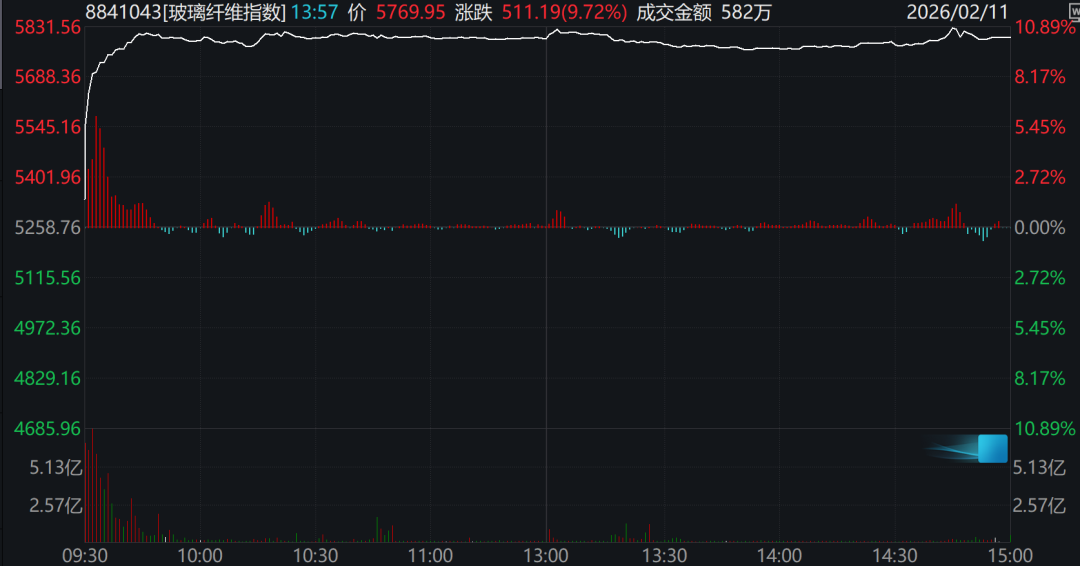
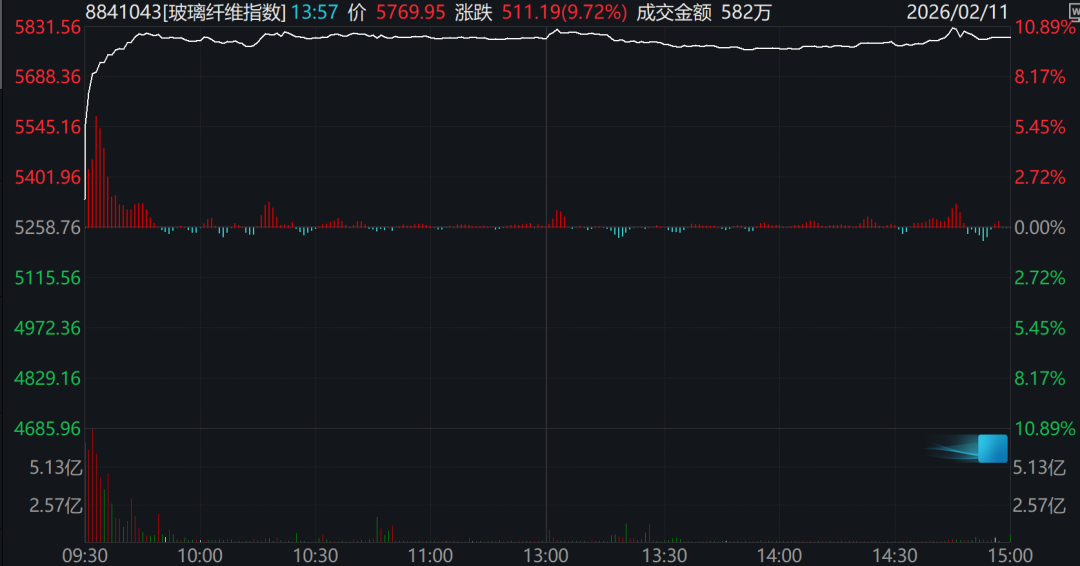
Group 1 - The Wind fiberglass index surged over 10% on February 11, leading the A-share market, with several companies hitting the daily limit up, including China Jushi, International Composites, and others [2] - China Jushi's market capitalization exceeded 100 billion yuan, reaching 102.7 billion yuan due to the stock price increase [2] Group 2 - The electronic cloth industry, crucial for manufacturing copper-clad laminates (CCL) and printed circuit boards (PCB), has experienced four rounds of price increases since 2025, with recent significant price hikes indicating a tight supply situation [4][5] - Institutions are optimistic about the sustainability of electronic cloth price increases into 2026, driven by high demand for high-end products and supply constraints [5][6] Group 3 - The demand for electronic cloth is expected to grow due to recovery in sectors like home appliances, new energy vehicles, and consumer electronics, alongside AI technology advancements [6] - The global AI server market is projected to grow from $125.1 billion in 2024 to $222.7 billion by 2028, with generative AI servers increasing their market share significantly [6] Group 4 - Electronic cloth is essential for high-performance applications, acting as a "shield" for chips, and is critical in high-computing scenarios like AI servers and satellite communications [7] - Companies like International Composites and Zhongcai Technology have reported significant profit growth for 2025, attributing this to rising prices of fiberglass products and increased demand driven by AI [7][8]


玻纤概念股盘初直线拉升
Di Yi Cai Jing· 2026-02-11 10:34
国际复材20%涨停,山东玻纤、中材科技、中国巨石、九鼎新材涨停,长海股份涨超10%。 (本文来自第一财经) ...


电子布成AI时代关键材料,低介电产品供不应求,赛道红利持续释放,头部企业成长空间全面打开
Xin Lang Cai Jing· 2026-02-11 10:16
Group 1 - International Composite Materials (301526) is a core supplier of electronic-grade glass fiber and products in China, focusing on high-performance glass fiber material research and production, with a full industry chain layout advantage in electronic cloth [1][21] - The company’s main business includes electronic-grade glass fiber yarn, electronic cloth, and composite material products, widely used in copper-clad laminates (CCL) and printed circuit board (PCB) manufacturing, featuring electrical insulation and fire resistance [1][21] - The company is focusing on high-end products such as low-dielectric electronic cloth, suitable for high-speed PCB scenarios like AI servers and data centers, with production capacity and technical strength among the industry leaders [1][21] Group 2 - Honghe Technology (603256) is a leading enterprise in the global mid-to-high-end electronic-grade glass cloth segment, breaking international monopolies in ultra-thin and extremely thin electronic cloth [2][22] - The company’s main business focuses on the research, production, and sales of electronic-grade glass fiber yarns and fabrics, with applications covering various electronic devices including mobile phones, computers, and AI servers [2][22] - As a core supplier to global top copper-clad board manufacturers, the company has a significant competitive advantage in high-end PCB manufacturing, especially in AI computing-related high-speed PCB fields [2][22] Group 3 - China National Materials (002080) is a comprehensive leader in the new materials sector, leveraging state-owned enterprise resources to maintain industry leadership in glass fiber and wind power blades [3][23] - The company’s main business includes glass fiber and products, wind power blades, and lithium battery separators, with glass fiber being a core segment [3][23] - The company’s subsidiary, Taishan Glass Fiber, developed the first generation of low-dielectric fine yarn and electronic cloth, which won a global leading ICT manufacturer’s "Technology Breakthrough Award" [3][23] Group 4 - China Jushi (600176) is the absolute leader in the global glass fiber industry, with production capacity and technical strength at the forefront globally [4][24] - The company has built a full industry chain advantage from glass fiber yarn to electronic cloth, with products widely used in construction, electronics, and automotive sectors [4][24] - The company’s electronic cloth production capacity ranks among the top globally, with significant cost advantages in self-developed low-dielectric glass fiber (TLD-glass) [4][24] Group 5 - Jinan Guojin (002636) is a key player in the copper-clad board industry, with a complete electronic materials industry chain layout [5][25] - The company focuses on the research and production of copper-clad boards and related materials, maintaining a stable market share in East China [5][25] - The company’s electronic-grade glass fiber cloth is a core raw material for copper-clad boards, enabling effective cost reduction through in-house production [5][25] Group 6 - Hongchang Electronics (603002) is an important enterprise in the domestic electronic-grade epoxy resin and copper-clad board sector, covering core upstream and downstream segments of electronic cloth [6][26] - The company has established long-term partnerships with major domestic PCB manufacturers, focusing on the production and sales of electronic-grade epoxy resin, copper-clad boards, and semi-cured sheets [6][26] - The company benefits indirectly from the development of the electronic cloth industry through its copper-clad board business [6][26] Group 7 - Filihua (300395) is a leading enterprise in the global quartz glass materials sector, being the only company in China to achieve mass production of high-end quartz electronic cloth (Q cloth) [7][27] - The company’s main business focuses on the research, production, and sales of quartz glass and products, with applications in high-end fields such as semiconductors and optical communications [7][27] - The company’s third-generation quartz cloth has a dielectric constant as low as 2.3, making it a core enhancement material for M9 copper-clad boards [7][27] Group 8 - Changhai Co., Ltd. (300196) is an important enterprise in the domestic glass fiber and composite materials industry, focusing on high-end electronic cloth business through its subsidiaries [8][28] - The company’s main business includes glass fiber yarn, glass fiber products, and composite materials, with a stable production capacity layout in East China [8][28] - The company’s subsidiary, Guangyuan New Materials, focuses on producing low-dielectric electronic cloth and electronic yarn, entering the high-end PCB materials market [8][28] Group 9 - Jiuding New Materials (002201) is one of the leading enterprises in the domestic electronic cloth industry, with deep accumulation in glass fiber and composite materials [9][30] - The company’s main business includes glass fiber products, composite materials, and wind power blades, with electronic cloth being a core segment [9][30] - The company is continuously advancing the research and development of special glass fibers and electronic cloth, with significant revenue growth expected in the second quarter of 2025 [9][30] Group 10 - Shandong Glass Fiber (605006) is an important enterprise in the domestic glass fiber industry, with electronic cloth being a key focus area [10][31] - The company leverages the glass fiber industry cluster advantage in Shandong, steadily expanding its production capacity [10][31] - The company is focusing on mid-to-high-end electronic cloth products, adapting to the upgrading needs of the PCB industry [10][31]


又一家千亿市值A股公司诞生
2 1 Shi Ji Jing Ji Bao Dao· 2026-02-11 09:53
Group 1 - The A-share fiberglass sector experienced a significant surge, with multiple companies hitting the daily limit up, and the fiberglass index rising over 10% on February 11 [2] - China Jushi's market capitalization surpassed 100 billion yuan, reaching 102.7 billion yuan due to the stock price increase [2] Group 2 - Institutions are optimistic about the continuous price increase of electronic cloth, which is essential for manufacturing copper-clad laminates (CCL) and printed circuit boards (PCB) used in high-end fields like communication devices and automotive electronics [3][4] - The electronic cloth industry has undergone four rounds of price increases since 2025, with recent price hikes reflecting a tightening supply situation [3][4] Group 3 - Analysts predict that the price increase of electronic cloth will persist into 2026 due to strong demand for high-end products and supply constraints [4] - The anticipated supply gap in the electronic cloth market is expected to continue, with limited new production capacity and increasing demand from sectors like home appliances and electric vehicles [4] Group 4 - The global AI technology upgrade is driving demand for high-performance, multi-layer printed circuit boards, which in turn boosts the need for electronic cloth [5] - The global AI server market is projected to grow from $125.1 billion in 2024 to $158.7 billion in 2025, with electronic cloth playing a critical role in supporting high data transmission rates [5] Group 5 - The recent price increase of electronic cloth is attributed to the demand from high-performance computing scenarios, leading to significant improvements in the financial performance of leading electronic cloth manufacturers [6] - Companies like International Composites and Zhongcai Technology have reported substantial profit growth for 2025, driven by rising prices of fiberglass products [6] Group 6 - China Jushi is expected to achieve high growth in 2025, with a reported revenue of 3.323 billion yuan in the first three quarters of the previous year, reflecting a year-on-year increase of 77.27% [6] - The company is actively developing low dielectric and low thermal expansion products, indicating ongoing innovation in its product line [7]
又一家千亿市值A股公司诞生
21世纪经济报道· 2026-02-11 09:44
Core Viewpoint - The electronic cloth industry is experiencing significant price increases driven by high demand for advanced products and supply constraints, leading to substantial growth in the market and company valuations [5][6][7]. Group 1: Market Performance - On February 11, the Wind fiberglass index surged over 10%, with several companies, including China Jushi, International Composites, and others, hitting their daily price limits [3]. - China Jushi's market capitalization exceeded 100 billion yuan, reaching 1,027 million yuan [3]. Group 2: Price Trends and Demand - The electronic cloth sector has undergone four rounds of price increases since 2025, with recent hikes attributed to rising copper prices and strong demand for high-end products [5][6]. - Institutions predict that the price increases for electronic cloth will continue into 2026 due to ongoing supply-demand imbalances and limited new production capacity [6][7]. Group 3: AI and High-Performance Applications - The demand for electronic cloth is being driven by the expansion of AI technologies, particularly in high-performance servers, which require advanced printed circuit boards (PCBs) [7]. - Electronic cloth is critical in high-performance applications, contributing 20% to 30% of PCB costs and enhancing data transmission speeds [7]. Group 4: Company Performance and Projections - Companies like International Composites and Honghe Technology have forecasted significant profit increases for 2025, citing rising prices for fiberglass products driven by AI demand [8]. - China Jushi reported a revenue increase of 77.27% year-on-year for the first three quarters, indicating strong growth potential for 2025 [9].

集体飙涨!600176市值突破千亿大关
证券时报· 2026-02-11 09:02
今日(2月11日),沪指在4100点上方窄幅震荡整理,创业板指等弱势下探;港股震荡上扬,恒生科技指数一度涨超1%。 具体来看,沪指盘中窄幅震荡上扬,创业板指走势疲弱。截至收盘,沪指微涨0.09%报4131.98点,深证成指跌0.35%,创业板指跌1.08%,科创综指跌 0.79%,沪深北三市合计成交约2万亿元,较此前一日减少逾1200亿元。 A股市场超3200股飘绿,短剧游戏、影视股等集体下挫,海看股份、幸福蓝海等跌超10%,横店影视跌停;有色板块强势,钨概念股亮眼,翔鹭钨业、章 源钨业均涨停并创出新高;化工板块拉升,百川股份近11个交易日斩获8板,醋化股份连续两日涨停; 玻纤概念集体爆发,国际复材20%涨停,中国巨石 (600176)涨停,市值突破千亿元大关 。值得注意的是,光线传媒今日拉升,盘中一度大涨近17%,收盘涨约5%,全日成交138.8亿元,居A股成交额第 三位。 港股方面,紫金黄金国际涨超9%,哔哩哔哩涨逾5%,腾讯音乐、小米集团、金蝶国际涨逾4%;泡泡玛特跌逾5%,中国人寿跌近4%。 有色板块强势 有色板块盘中强势拉升,钨概念股表现亮眼。中钨高新午后涨停,翔鹭钨业、章源钨业双双涨停并创出新高, ...