LZLJ(000568)

Search documents
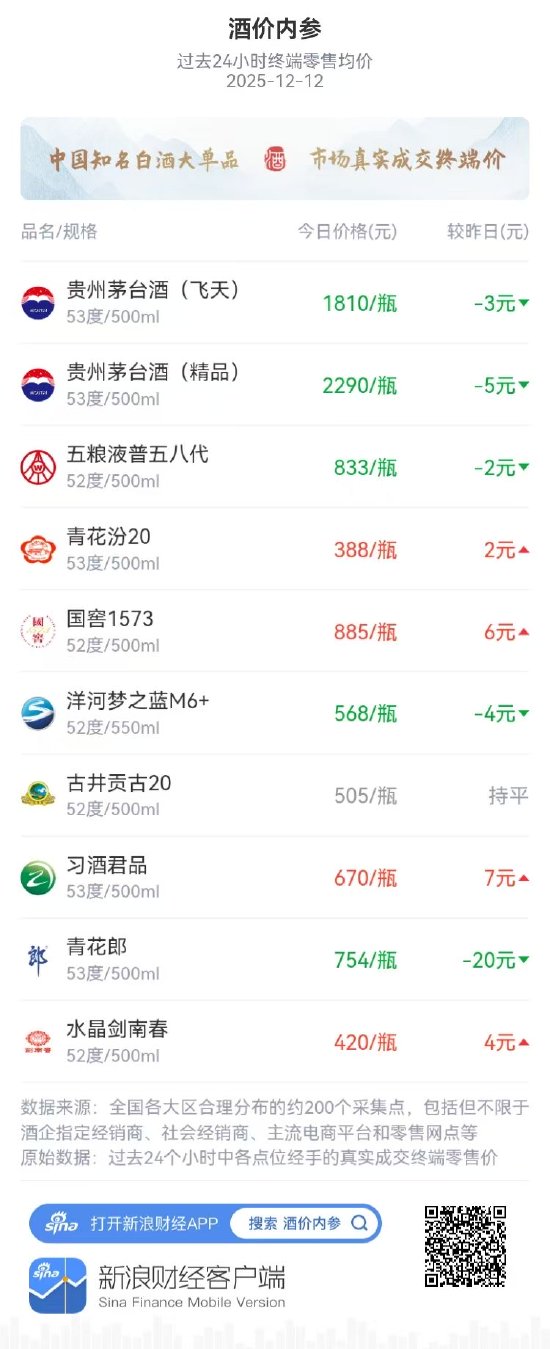
酒价内参12月12日价格发布,国窖1573上涨6元
Xin Lang Cai Jing· 2025-12-12 01:31
Core Viewpoint - The white liquor market is experiencing a downward trend in retail prices, with significant structural differentiation among brands, as indicated by the latest data from Sina Finance's "Wine Price Reference" [1][6]. Price Trends - The average retail price of the top ten white liquor products has decreased to 9,123 yuan, down 15 yuan from the previous day, reflecting a continued weak market overall [1][6]. - Notable price changes include: - Qinghua Lang: down 20 yuan per bottle - Feitian Moutai: down 3 yuan per bottle - Premium Moutai: down 5 yuan per bottle - Yanghe Dream Blue M6+: down 4 yuan per bottle - Wuliangye Pu 58th generation: down 2 yuan per bottle - Xijiu Junpin: up 7 yuan per bottle - Guojiao 1573: up 6 yuan per bottle - Shuijing Jian Nan Chun: up 4 yuan per bottle - Qinghua Fen 20: up 2 yuan per bottle - Guqing Gong Gu 20: unchanged [1][7][8]. Industry Developments - In a recent meeting, Moutai Group's chairman emphasized the need to consolidate market advantages amid ongoing industry adjustments and market decline, signaling a shift from passive to active competition for market share [2][8].




酒价内参12月12日价格发布,洋河梦之蓝M6+下跌4元
Xin Lang Cai Jing· 2025-12-12 01:31
Core Insights - The overall retail price of the top ten Chinese liquor products continues to decline, with a total packaged price of 9,123 yuan, down 15 yuan from the previous day, indicating a weak market trend with notable internal structural differentiation [1][6][7] - Data for the "Liquor Price Reference" is collected from approximately 200 sampling points across various regions, ensuring objective and traceable pricing information for well-known liquor brands [1][6] Price Trends - The price of Qinghua Lang has significantly decreased by 20 yuan per bottle, leading the market decline after a previous rapid increase [7] - Prices for Feitian Moutai and Premium Moutai have continued to slightly decline, down 3 yuan and 5 yuan per bottle, respectively [7] - Other brands such as Yanghe Dream Blue M6+ and Wuliangye Pu 58th generation have also seen price drops of 4 yuan and 2 yuan per bottle, respectively [7] - Conversely, some brands have shown price increases, with Xijiu Junpin rising by 7 yuan per bottle, and Guojiao 1573 increasing by 6 yuan [7][8] Strategic Developments - In response to the ongoing industry adjustment and market downturn, Moutai Group's chairman has emphasized the need to "continuously consolidate market advantages," indicating a shift from merely pursuing price benchmarks to actively competing for market share [2][8]


酒价内参12月12日价格发布,五粮液普五八代下跌2元
Xin Lang Cai Jing· 2025-12-12 01:31
Core Insights - The overall retail price of the top ten Chinese liquor products continues to decline, with a total packaged price of 9,123 yuan, down 15 yuan from the previous day, indicating a weak market trend with notable internal structural differentiation [1][6][7] - The data for "Liquor Price Reference" is collected from approximately 200 sampling points across various regions, ensuring an objective and traceable representation of market prices [1][6] Brand Performance - The price of Qinghua Lang has significantly decreased by 20 yuan per bottle, leading the market decline after a previous rapid increase [7] - Prices for Feitian Moutai and Premium Moutai have continued to slightly decline, down 3 yuan and 5 yuan per bottle respectively [7] - Yanghe Dream Blue M6+ saw a price drop of 4 yuan per bottle, while Wuliangye Pu 58th generation decreased by 2 yuan per bottle [7] - Some brands have shown resilience, with Xijiu Junpin increasing by 7 yuan per bottle, and Guojiao 1573 rising by 6 yuan per bottle [7] - Other brands like Shuijing Jian Nan Chun and Qinghua Fen 20 increased by 4 yuan and 2 yuan respectively, while Guqingong Gu 20 remained stable [7][9][10] Strategic Developments - In response to the ongoing industry adjustment and market decline, Moutai Group's chairman has emphasized the need to consolidate market advantages, shifting the focus from merely pursuing price benchmarks to actively competing for market share [2][8]
17只白酒股下跌 贵州茅台1411.99元/股收盘
Bei Jing Shang Bao· 2025-12-11 13:48
Core Viewpoint - The overall market experienced a decline on December 11, with the Shanghai Composite Index dropping by 0.70% to 3873.32 points, indicating a bearish sentiment in the market [1] Industry Summary - The liquor sector closed at 2181.08 points, down 2.12%, with 17 liquor stocks experiencing declines [1] - Notable individual stock performances include: - Kweichow Moutai closed at 1411.99 CNY per share, up 0.66% - Wuliangye closed at 111.90 CNY per share, up 0.25% - Shanxi Fenjiu closed at 179.13 CNY per share, down 0.38% - Luzhou Laojiao closed at 121.40 CNY per share, down 0.99% - Yanghe Brewery closed at 62.43 CNY per share, down 0.87% [1] - Pacific Securities noted that the current adjustment in the liquor sector has been significant, with pessimistic expectations reflected in stock prices, leading to valuations entering historically low ranges [1]
一杯佳酿窥得科技变革
Xin Hua Cai Jing· 2025-12-11 02:15
《时光知味第四季》系列节目是由新华社品牌工作办公室指导,中国经济信息社监制的微纪录片栏目。 节目依托真实史料,聚焦泸州老窖发展历史上的重大事件和精彩瞬间,在一份份泛黄的报纸里,寻找那 些被折叠的时代,细述那些鲜为人知的故事。相关史料均来自中国国家图书馆及泸州老窖博物馆。 这一期,我们将以1985年1月14日《人民日报》刊发的《泸州曲酒厂去年大增产》为引,回溯1980至 1989年间中国酒业的发展轨迹,在时代叙事中展现行业奋进图景与品牌奋进力量。 1985年1月14日,《人民日报》刊发《泸州曲酒厂去年大增产》。文章中写道:"1984年,四川泸州曲酒 厂久负盛名的泸州老窖曲酒大幅度增产,全年生产曲酒五千五百七十吨,实现利润五百一十万元,分别 超额16%和52%完成了年计划。同时制成老窖曲酒新品种——泸州老窖特曲三十八度低度酒,正源源不 断地投放市场。"这篇看似普通的报道背后,实则记录着历史背景下的时代革新。 20世纪80年代初期,万象更新、生机涌动。在改革开放春风拂动下,中国大地迸发创新活力,各行各业 以"敢为天下先"的勇气掀起浪潮。白酒作为传统产业,走出了独特的科技创新之路,堪称观察中国产业 转型升级的典型样本 ...
解密主力资金出逃股 连续5日净流出553股



Zheng Quan Shi Bao Wang· 2025-12-10 09:46
Core Insights - A total of 553 stocks in the Shanghai and Shenzhen markets have experienced net outflows of main funds for five consecutive days or more as of December 10 [1] - ST Jinglan has the longest streak of net outflows, with 23 days, followed by Aier Eye Hospital with 22 days [1] - The largest total net outflow amount is from Changcheng Military Industry, which has seen a cumulative outflow of 2.123 billion yuan over 12 days [1] Summary by Category Stocks with Longest Net Outflow Duration - ST Jinglan: 23 days of net outflow [1] - Aier Eye Hospital: 22 days of net outflow [1] - Sairisi: 7 days of net outflow [1] Stocks with Largest Net Outflow Amount - Changcheng Military Industry: 2.123 billion yuan over 12 days [1] - Aier Eye Hospital: 1.706 billion yuan over 22 days [1] - Sairisi: 1.370 billion yuan over 7 days [1] Stocks with Highest Net Outflow Proportion - *ST Zhengping: 26.44% decline over the last 5 days [1] - Aier Eye Hospital: 14.30% decline over 22 days [1] - Sairisi: 11.26% decline over 7 days [1] Additional Notable Stocks - Keda Xunfei: 1.209 billion yuan net outflow over 12 days with a 2.75% decline [1] - Dongfang Precision: 1.171 billion yuan net outflow over 7 days with a 10.92% decline [1] - Huaying Technology: 939 million yuan net outflow over 5 days with a 7.32% decline [1]
17只白酒股上涨 贵州茅台1402.80元/股收盘
Bei Jing Shang Bao· 2025-12-10 09:23
Core Viewpoint - The liquor sector shows resilience with a slight increase in stock prices, while the overall market experiences a minor decline, indicating a potential recovery in demand and performance for leading companies in the industry [1] Industry Summary - The Shanghai Composite Index closed at 3900.50 points, down 0.23%, while the liquor sector index closed at 2228.24 points, up 0.78% [1] - Among the liquor stocks, 17 companies saw price increases, with Kweichow Moutai closing at 1402.80 CNY per share, up 0.13% [1] - Other notable stock performances include Wuliangye at 111.62 CNY (up 0.67%), Shanxi Fenjiu at 179.81 CNY (up 0.30%), Luzhou Laojiao at 122.62 CNY (up 0.41%), and Yanghe at 62.98 CNY (up 1.43%) [1] Company Summary - CITIC Securities predicts that with economic data bottoming out and stimulus policies intensifying, the second quarter of 2026 may see a stabilization and recovery in sales and performance for leading liquor companies [1] - The industry is experiencing increased differentiation, with leading companies strengthening their advantages as smaller firms exit the market; over 100 regulated liquor companies have withdrawn from the market in the first half of 2025 [1] - Leading enterprises are leveraging their financial strength and supply chain control to innovate in channels and products, reinforcing a "stronger gets stronger" dynamic that will enhance their long-term competitiveness [1]
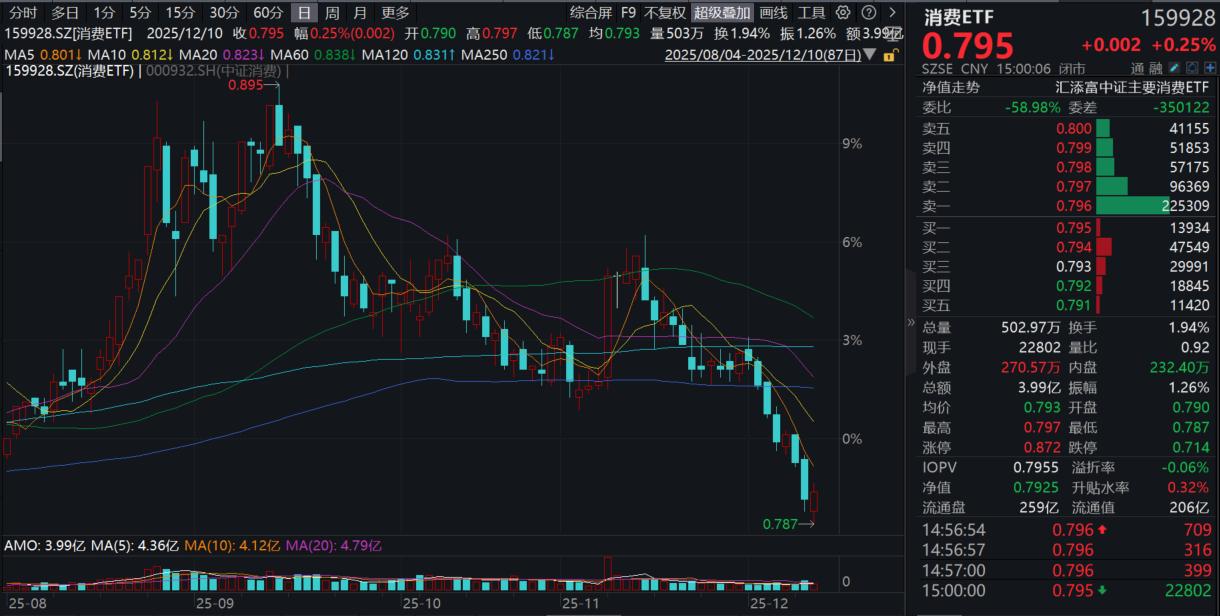
11月CPI同比上涨0.7%,某地产龙头冲击涨停!消费ETF(159928)、港股通消费50ETF(159268)双双收红!茅台回归指导价,段永平仍看多
Xin Lang Cai Jing· 2025-12-10 09:06
Group 1: Market Performance - On December 10, A-shares rebounded with slight gains in the consumer sector, as the Consumer ETF (159928) rose by 0.25% with a total trading volume of 399 million yuan [1] - The Consumer ETF (159928) saw a net inflow of over 170 million yuan in the past 10 days, and as of December 9, its latest scale exceeded 20.5 billion yuan, leading its peers significantly [1] Group 2: Economic Indicators - The National Bureau of Statistics reported that consumer spending continues to recover, with the Consumer Price Index (CPI) slightly decreasing by 0.1% month-on-month and increasing by 0.7% year-on-year. The core CPI, excluding food and energy prices, rose by 1.2% year-on-year [3] Group 3: Real Estate and Alcohol Industry - Real estate stocks showed unusual upward movement in the afternoon, with a leading real estate company nearing a trading limit, influenced by recent mortgage-related news [6] - In the alcohol sector, the price of 25-year Flying Moutai bottles dropped to 1,500 yuan, a decrease of 15 yuan from the previous day. The wholesale reference price for the original box remained unchanged at 1,520 yuan [6] Group 4: Valuation and Investment Opportunities - The valuation of the Consumer ETF (159928) remains attractive, with a TTM price-to-earnings ratio of 19.32, which is at the 2.84% percentile over the past decade, indicating it is cheaper than 97% of the historical time [8] - The white liquor sector is facing price pressure, with high inventory and weak demand challenges. However, the current adjustment in stock prices has reflected pessimistic expectations, suggesting long-term investment value [10] Group 5: Consumer Trends - There is a growing emphasis on expanding service consumption, which is expected to accelerate as China's GDP per capita exceeds 13,000 USD. This shift indicates significant growth potential in sectors like culture, leisure, and health [11] - Recent data shows positive trends in consumer spending, with notable increases in luxury goods sales and hotel industry performance, indicating a recovery in consumer sentiment [12]



大成基金齐炜中旗下基金亏18%,高位持有中国中免被质疑
Sou Hu Cai Jing· 2025-12-10 07:50
Group 1 - The global macroeconomic environment has gradually improved since 2025, leading to a steady upward trend in the A-share market, with major indices like the CSI 300 and ChiNext Index rising over 20% [2] - The technology, consumer, and new energy sectors have been the main drivers of this market rally, with daily trading volume increasing by approximately 15% compared to the same period last year [2] - Equity funds have benefited from asset value growth and optimized investment strategies, with average returns for equity mixed funds exceeding 25% this year, and some thematic funds, such as those focused on artificial intelligence and high-end manufacturing, seeing gains over 40% [2] Group 2 - The Dachen Yuexiang Life Mixed A fund, managed by Qi Weizhong, has underperformed despite the bullish market, with a return of -12.18% since its inception on December 10, 2021 [5] - The fund's heavy allocation to traditional consumer sectors like liquor and duty-free has not performed well, as these sectors face demand ceilings, while emerging consumption areas have not been adequately represented in the portfolio [5] - The fund's performance has been negatively impacted by the weakening competitive edge of some leading companies in its holdings, while new consumer brands have rapidly gained market share [5] Group 3 - The Dachen Consumption Selected Stock A fund has also struggled, with a return of -18.82% since its inception on May 24, 2021, and a year-to-date return of 16.55% [18] - The fund has seen a consistent decline in its asset size, with net assets decreasing to 2.69 billion yuan by September 30, 2025, due to ongoing redemptions [30] - The fund's investment strategy has been criticized for not adapting to the significant changes in the consumer industry, necessitating a reassessment of its thematic focus and investment approach [5][30]


大成基金齐炜中旗下消费精选股票A亏18%,高位持有中国中免被质疑
Xin Lang Cai Jing· 2025-12-10 02:08
Group 1 - The global macroeconomic environment has gradually improved since 2025, with corporate profit expectations and favorable policies driving the A-share market upward, with major indices like the CSI 300 and ChiNext Index showing cumulative gains exceeding 20% [3][42] - The technology, consumer, and new energy sectors have emerged as the main leaders in the market rally, with trading activity significantly increasing, as evidenced by a 15% year-on-year growth in average daily trading volume [3][42] - Equity funds have benefited from asset value growth and optimized investment strategies, with average returns for mixed equity funds surpassing 25% this year, and several thematic funds, such as those focused on artificial intelligence and high-end manufacturing, achieving gains over 40% [3][42] Group 2 - The Dachen Consumer Selected Stock A fund has underperformed, with a cumulative return of -18.82% since its inception, despite the overall bullish market conditions [3][22][61] - The fund's performance has been hindered by a heavy allocation to traditional consumer sectors like liquor and duty-free, which are facing demand ceilings, while emerging consumption areas such as instant retail and experience economy have not been adequately represented in the portfolio [8][47][56] - The fund's holdings in leading companies have seen a weakening of their competitive advantages, while new consumer brands have rapidly gained market share, indicating a need for the fund to reassess its thematic positioning and investment strategy [8][56][58] Group 3 - The Dachen Yuexiang Life Mixed A fund, established on December 10, 2021, has a current net asset value of 146 million yuan, with a unit net value of 0.8782 as of December 5, 2025, reflecting a significant underperformance compared to its peers [8][47][58] - The fund's net asset value has decreased by 5.12% in the latest reporting period, indicating ongoing challenges in attracting new investments, as evidenced by consistent redemptions across multiple quarters [57][58] - The fund's investment strategy has included significant positions in stocks like Kweichow Moutai and Luzhou Laojiao, which have seen substantial price declines during the holding periods, further contributing to the fund's poor performance [10][52][70]