供需关系

Search documents
中辉期货豆粕日报-20251110
Zhong Hui Qi Huo· 2025-11-10 03:05
1. Report Industry Investment Ratings No specific industry - wide investment ratings are provided in the report. 2. Core Views of the Report - **Overall**: Different futures varieties have distinct market outlooks. Some lack upward drivers, some are in a state of supply - demand imbalance, and some are affected by international trade policies and weather conditions [1]. - **Specific to each variety**: - **Bean meal**: Lacks continuous upward drivers. The Brazilian rainfall forecast is good, and the US - China trade negotiation results regarding soybean import tariffs are still unresolved. Spot oil mills have a reduced sales pressure and a price - holding mentality. Caution is needed when chasing long positions [1][3]. - **Rapeseed meal**: Follow the trend of bean meal. High port inventory and the off - season of downstream consumption put pressure on the market, but the unresolved Sino - Canadian trade issue supports the far - month contracts. Recent statements from Canada have cooled the market's expectation of tariff improvement. The rebound space of the main and near - month contracts may be limited [1][5]. - **Palm oil**: Enters a phase of weakening supply - demand. Malaysian palm oil is expected to accumulate inventory in October and November. Import profit inversion may lead to insufficient imports in December and January, and the price is in low - level consolidation [1][7]. - **Soybean oil**: Short - term supply is sufficient, with domestic inventory higher than the five - year average. The US - China tariff issue has not fully resolved the cost problem of US soybean imports. There is a lack of strong upward drivers, and the recent increase is regarded as a short - term rebound [1]. - **Rapeseed oil**: The oil mill's operating rate is low, and there is a mentality of hoarding and price - holding in the market. It has entered the consumption peak season, but the spot market has high prices with few transactions. The cooling expectation of Sino - Canadian trade relations has led to a stop - falling rebound, but the short - term weakness has not been completely reversed [1]. - **Cotton**: The supply is pressured by the increase in cotton output from the US and other Northern Hemisphere countries. Although Brazil is accelerating exports, India's MSP provides some support for international cotton prices. The domestic new cotton harvest is almost completed, with commercial inventory exceeding the same - period level. Downstream demand is weak, but the sales progress is fast, and short - term low - buying opportunities can be considered [1][11]. - **Red dates**: The market has a large - scale harvest, and the new - season output is becoming more certain. High - inventory old dates and limited downstream acceptance of new products may lead to a weakening and volatile market. Short - selling operations should be carried out carefully according to the purchase price and progress [1][14]. - **Live pigs**: The supply pressure in Q4 remains high. The market should be vigilant about the short - term rebound risk of the 01 contract. It is recommended to short - sell on rebounds for near - month contracts. Attention can be paid to the 03 contract in the off - season and the reverse - spread arbitrage opportunities in the far - month contracts [1][17]. 3. Summaries According to Relevant Catalogs Bean Meal - **Market data**: The futures price of the main contract closed at 3015 yuan/ton, down 0.36% from the previous day. The national average spot price was 3097.71 yuan/ton, down 0.63%. The national average soybean crushing profit was - 114.2989 yuan/ton, down 8.69 yuan/ton [2]. - **Inventory situation**: As of October 31, 2025, the national port soybean inventory was 962.9 million tons, a decrease of 10.20 million tons from the previous week; the soybean inventory of 125 oil mills was 710.79 million tons, a decrease of 40.50 million tons (5.39%); the bean meal inventory was 115.3 million tons, an increase of 9.84 million tons (9.33%) [3]. Rapeseed Meal - **Market data**: The futures price of the main contract closed at 2497 yuan/ton, up 0.24% from the previous day. The national average spot price was 2626.84 yuan/ton, down 0.36%. The national average rapeseed spot crushing profit was - 353.023 yuan/ton, an increase of 3.39 yuan/ton [4]. - **Inventory situation**: As of October 31, the coastal area's main oil - mill rapeseed inventory was 0 million tons, a decrease of 0.6 million tons from the previous week; the rapeseed meal inventory was 0.71 million tons, unchanged from the previous week; the unexecuted contract was 0.71 million tons, a decrease of 0.3 million tons from the previous week [5]. Palm Oil - **Market data**: The futures price of the main contract closed at 8660 yuan/ton, down 0.82% from the previous day. The national average price was 8640 yuan/ton, down 0.58%. The import cost was 8857 yuan/ton, down 52 yuan/ton [6]. - **Inventory situation**: As of October 31, 2025, the national key - area palm oil commercial inventory was 59.28 million tons, a decrease of 1.43 million tons (2.36%) from the previous week [7]. Cotton - **Market data**: The futures price of the main contract (CF2601) closed at 13580 yuan/ton, down 0.18% from the previous day. The CCIndex (3218B) spot price was 14859 yuan/ton, up 0.26%. The national cotton commercial inventory was 284.78 million tons, an increase of 52 million tons [8]. - **International situation**: In the US, 73 million tons of new cotton have been inspected, with a progress of about 25%. In India, the daily new - cotton listing volume is about 14,000 tons. In Pakistan, the new - cotton listing volume as of the end of October was 688,000 tons, a 3% year - on - year increase. In Brazil, the 2025 cotton processing progress is 63.67%, slower than last year [9]. - **Domestic situation**: The new - cotton picking progress is 95.3%, the inspection volume exceeds 2.4 million tons, the delivery progress is 90.4%, and the sales progress is 18.3%. The national commercial inventory has increased, and the downstream demand is weak, but the export is expected to stabilize [10]. Red Dates - **Market data**: The futures price of the main contract (CJ2601) closed at 9590 yuan/ton, down 1.18% from the previous day. The inventory of 36 sample enterprises was 9541 tons, an increase of 193 tons from the previous week [12]. - **Production area situation**: In Xinjiang, the red dates have started to be harvested on a large scale. The acquisition prices in different regions are relatively stable. The market's expectation of a new - season production reduction has been adjusted [14]. Live Pigs - **Market data**: The futures price of the main contract (1h2601) closed at 11865 yuan/ton, down 0.63% from the previous day. The national average spot price of live pigs was 12010 yuan/ton, unchanged from the previous day. The national sample enterprises' monthly live - pig inventory was 3844.62 million tons, an increase of 5.61 million tons (0.15%); the monthly live - pig slaughter volume was 11.9653 million heads, an increase of 1.2677 million heads (11.85%) [15]. - **Supply and demand situation**: In the short term, the planned slaughter volume in November has decreased, but the overall slaughter pressure may still be high. In the medium term, the live - pig slaughter volume in Q1 2026 is expected to increase linearly. In the long term, the capacity reduction of breeding sows is not obvious. The downstream demand is gradually stabilizing [16][17].
现在不买房,5年后可能真的买不起?看懂这4个信号再决定
Sou Hu Cai Jing· 2025-11-09 19:14
Group 1: Market Trends - The real estate market is experiencing a subtle change, with increased interest in properties in Guangzhou's Zhujiang New Town and a rise in improvement-oriented buyers [1] - Global monetary policy, particularly the Federal Reserve's interest rate cuts, is expected to lead to an increase in asset prices, including real estate [2][3] - The supply-demand imbalance, with limited quality properties available, is likely to drive up housing prices in the coming years [3][7] Group 2: Economic Indicators - The easing of US-China trade tensions and domestic economic stimulus measures are contributing to an economic recovery, which is expected to benefit the real estate market [5][6] - Historical patterns indicate that economic recovery often coincides with real estate market recovery, suggesting potential upward pressure on housing prices [6] Group 3: Supply and Demand Dynamics - There is a significant housing shortage in China, with a record high of 4.7 million units needed, indicating persistent demand for housing [7] - The reduction in land supply for new housing developments is expected to lead to decreased housing availability in the next 1-2 years, further exacerbating the supply-demand gap [7] Group 4: Buying Conditions - Current conditions for purchasing homes are favorable, with low mortgage rates and improved affordability for buyers [10] - The overall purchasing threshold is at a low point, making it easier for buyers to qualify for loans and take advantage of low rates [10][11] Group 5: Recommendations for Buyers - For first-time buyers, it is advisable to act decisively rather than wait for the lowest price, as current conditions favor early purchases [13] - Improvement-oriented buyers should focus on high-quality properties in core urban areas to ensure value retention and potential appreciation [13] - Investors are encouraged to be selective and focus on prime assets in major cities, avoiding less desirable locations [13] Group 6: Conclusion - The current period is viewed as a potential optimal window for home buying, with various economic and market factors suggesting that waiting could lead to higher prices in the future [15]


粕类周报:粕类周报贸易关系影响增加,粕类盘面大幅震荡-20251107
Yin He Qi Huo· 2025-11-07 14:47
1. Report Industry Investment Rating No relevant information provided. 2. Core Viewpoints of the Report - The international soybean market has fully reflected the positive factors, and the subsequent upward momentum may be limited. However, there are also many uncertainties, and the downward space is expected to be limited if the overall market demand does not decline significantly [3]. - The domestic soybean meal futures market shows a volatile trend. The near - term contracts are relatively strong due to the loss of soybean crushing profit, the lack of competitiveness of US soybeans compared with Brazilian soybeans, and the tight supply in the long - term domestic market. The current domestic spot market has a relatively loose supply - demand situation, with high inventory and general trading volume [3]. - The domestic rapeseed meal futures market shows a relatively strong trend, mainly affected by the uncertainty of Canadian rapeseed supply. However, the high inventory of granular rapeseed meal limits the price increase space [4]. - For trading strategies, it is recommended to take a bearish view on the long - term contracts for unilateral trading, expand the MRM spread for arbitrage, and adopt the strategy of selling wide straddles for options [4]. 3. Summary by Relevant Catalogs 3.1 Comprehensive Analysis and Trading Strategies 3.1.1 Comprehensive Analysis - The US soybean market shows a high - level volatile trend. The improvement of export prospects has been fully reflected in the price. Further upward movement requires more positive changes in supply. The South American market is under pressure. Brazilian soybean export volume is expected to increase, and the price increase space is limited. Argentina also faces price pressure due to large production [3]. - The domestic soybean meal futures market has a near - term strong and long - term weak pattern. The near - term strength is due to factors such as crushing profit loss and tight long - term supply. The domestic spot market has a loose supply - demand relationship and high inventory [3]. - The domestic rapeseed meal futures market is affected by the uncertainty of Canadian rapeseed import, but the high inventory of granular rapeseed meal restricts the price increase [4]. 3.1.2 Strategies - Unilateral: Adopt a bearish view on the long - term contracts. - Arbitrage: Expand the MRM spread. - Options: Sell wide straddles [4]. 3.2 Core Logic Analysis 3.2.1 US Soybeans: Export Prospects Improve, and the Market Remains at a High Level - The US soybean futures market continues to show a high - level volatile trend. The export prospects have improved, but the price increase space is limited without a significant decline in supply. The US soybean harvest progress is expected to be fast, and the single - yield estimate has been slightly adjusted. The soybean crushing profit has declined, and the export is still slow with high uncertainty [8]. 3.2.2 South America: Sowing Slows Down, and Prices Decline - The South American soybean price shows a downward trend. The Brazilian soybean price has declined, and the new - crop price is relatively firm due to the slow sowing progress. The Brazilian soybean sowing is affected by weather, the demand is general, the crushing profit is low, and the export volume is expected to remain high. The Argentine new - crop sowing has started, and the supply is expected to decrease with limited market impact [11]. 3.2.3 Trade Relations: Changes Increase, and Soybean Meal Fluctuates at a High Level - The domestic soybean meal futures market shows a high - level volatile trend. The oil mill operating rate is expected to decline, the inventory pressure is large, and the crushing profit is average. The demand is good due to high livestock and poultry inventory, but the further inventory accumulation space is limited. The reduction of tariffs on US soybeans does not make them competitive, and the long - term soybean import is expected to decrease [14]. 3.2.4 Market Supply: Loose, and Demand Remains at a Low Level - The domestic rapeseed meal futures market shows a relatively strong trend. The market is affected by the uncertainty of Canadian rapeseed import. The supply of rapeseed for crushing is low, the inventory is low, and the demand is general. The high inventory of granular rapeseed meal makes the market supply - demand relationship relatively loose, and the price increase space is limited [17]. 3.3 Fundamental Data Changes 3.3.1 International Market - The data includes US soybean weekly sales, export inspection volume, monthly crushing volume, and weekly crushing profit; Brazilian and Argentine soybean monthly export and crushing volume [20][23]. 3.3.2 Foreign Premium - It shows the FOB prices of US Gulf, Brazil, and Argentina soybeans and the CNF price of rapeseed [25]. 3.3.3 Macro: Exchange Rate & International Shipping - It involves the exchange rates of the US dollar against the Chinese yuan, Brazilian real, and Argentine peso, and the shipping freight rates of Panamax vessels on different routes [32][38]. 3.3.4 Supply - The data includes soybean and rapeseed import volume and weekly crushing volume [40]. 3.3.5 Demand - It shows the weekly提货量 of soybean meal and rapeseed meal [42]. 3.3.6 Inventory - The data includes the inventory of soybeans, rapeseed, soybean meal, and rapeseed + rapeseed meal [45].
成本端有一定支撑 锰硅期货市场继续下行空间有限
Jin Tou Wang· 2025-11-07 06:10
Market Overview - As of November 6, the number of manganese silicon futures warehouse receipts recorded 12,758, remaining stable compared to the previous trading day. However, there was a cumulative increase of 4,658 receipts over the past week, representing a growth rate of 57.51%. In contrast, there was a cumulative decrease of 42,103 receipts over the past month, indicating a decline of 76.74% [1]. Supply and Demand Dynamics - In the Yunnan production area, the official entry into the dry season has led to a significant increase in electricity costs from 0.37 yuan/kWh during the wet season to 0.5 yuan/kWh. Additionally, six silicon manganese thermal furnaces have been shut down for maintenance since October 31, while three furnaces are operating at reduced capacity, collectively affecting daily output by 880 tons [1]. - According to recent data, the latest bidding price for silicon manganese alloy from a steel mill in East China is 5,798 yuan/ton, including tax and discounts [2]. Institutional Insights - According to Everbright Futures, despite a reduction in production in the main manganese silicon production areas last week, overall output remains relatively stable. The demand from sample steel mills is still at a relatively low level, with limited willingness to sell at low prices. The cost side remains firm, with a slight decrease in manganese ore shipments, and miners are showing a strong willingness to maintain prices. Inventory pressure is evident, with 63 sample enterprises accumulating stock exceeding 300,000 tons, reaching a peak not seen since April 2024. Overall, market sentiment has been somewhat boosted, but the fundamental driving force remains limited, necessitating ongoing attention to market sentiment changes, with expectations of a predominantly volatile market in the short term [3]. - Guoxin Futures notes that the manganese silicon industry chain is characterized by overall overcapacity and the introduction of new production capacity, alongside relatively loose manganese ore supply and low steel demand, leading to a predominantly weak supply-demand dynamic. However, with manganese silicon prices at low levels and production profits being poor, there is limited room for further market decline. The recent rise in coal prices suggests a potential for a moderate bullish outlook on manganese silicon [4].
《有色》日报-20251107
Guang Fa Qi Huo· 2025-11-07 06:05
1. Report Industry Investment Rating No relevant content provided. 2. Core Views of the Report Copper - Overseas liquidity is tight and the US dollar index is high, suppressing copper prices. After the interest rate cut and tariffs are implemented, the market may enter a macro "vacuum period" in November. The next macro nodes are likely to be the December FOMC meeting, the domestic Politburo meeting, and the Central Economic Work Conference. The long - term supply - demand contradiction supports the upward shift of the bottom center of copper prices, while short - term rapid increases may suppress demand [2]. Aluminum - Alumina prices are expected to continue weak and volatile. Aluminum prices are expected to face a game between event - driven factors and weak fundamentals in the short term. Attention should be paid to whether the 21,500 yuan/ton pressure level can be effectively broken through. If inventory accumulates, there is a risk of price correction to the 20,500 - 20,800 yuan/ton range [4]. Aluminum Alloy - The ADC12 price is expected to maintain a strong and volatile trend under the dual effects of rigid cost support and a tight supply - demand balance. Key factors to monitor include scrap aluminum supply, procurement costs, and inventory reduction progress [5]. Zinc - Against the backdrop of concerns about a short squeeze in LME zinc, Shanghai zinc oscillated at a high level. In the short term, zinc prices are expected to be volatile and strong, but the fundamentals may limit the upward momentum. The key for upward breakthrough lies in better - than - expected demand and improved non - recessionary interest rate cut expectations, while downward breakthrough may occur if refined zinc inventory accumulates [7]. Tin - The supply of tin ore remains tight, and the demand is weak. Market sentiment has improved, and the fundamentals are strong. Low - position long orders can be held, and a strategy of buying on dips can be adopted. The follow - up focus is on macro changes and the supply recovery in Myanmar in the fourth quarter [8]. Nickel - The macro sentiment is weak, and the cost is still supported by firm ore prices. However, the overall fundamentals are dull, and the medium - term supply is expected to be loose, which restricts the upward space of prices. The price is expected to oscillate within a range, with the main contract reference range of 118,000 - 124,000 yuan/ton [10]. Stainless Steel - Policy and macro drivers are weakening, and the fundamental structure has not improved significantly. Supply - side pressure from steel mills' production schedules and social inventory remains, and demand is insufficient. The short - term price is expected to be weak and volatile, with the main contract reference range of 12,500 - 13,000 yuan/ton [12]. Lithium Carbonate - In the short term, strong fundamentals provide support for prices. However, the trading logic has shifted, and the current news and capital drivers are stronger than the fundamentals and valuation logic. Prices are expected to be volatile, with the main contract reference range of 78,000 - 82,000 yuan/ton [14]. 3. Summary by Relevant Catalogs Copper - **Price and Basis**: SMM 1 electrolytic copper price increased by 0.77% to 85,995 yuan/ton. The spot - futures spread and other indicators also showed certain changes [2]. - **Fundamental Data**: In October, electrolytic copper production was 1.0916 million tons, a month - on - month decrease of 2.62%. In September, imports were 0.3343 million tons, a month - on - month increase of 26.50% [2]. Aluminum - **Price and Basis**: SMM A00 aluminum price increased by 0.28% to 21,360 yuan/ton. Alumina prices showed regional differences, with northern prices stabilizing and southern prices falling [4]. - **Fundamental Data**: In October, alumina production was 7.7853 million tons, a month - on - month increase of 2.39%, and electrolytic aluminum production was 3.7421 million tons, a month - on - month increase of 3.52% [4]. Aluminum Alloy - **Price and Basis**: SMM aluminum alloy ADC12 price remained unchanged at 21,350 yuan/ton. The refined - scrap price difference of some varieties changed [5]. - **Fundamental Data**: In October, the production of recycled aluminum alloy ingots was 0.645 million tons, a month - on - month decrease of 2.42%. The production of primary aluminum alloy ingots in September was 0.286 million tons, a month - on - month increase of 1.06% [5]. Zinc - **Price and Basis**: SMM 0 zinc ingot price remained unchanged at 22,500 yuan/ton. The import profit and loss and other indicators changed [7]. - **Fundamental Data**: In October, refined zinc production was 0.6172 million tons, a month - on - month increase of 2.85%. In September, imports were 0.0227 million tons, a month - on - month decrease of 11.61% [7]. Tin - **Spot Price and Basis**: SMM 1 tin price increased by 0.53% to 282,800 yuan/ton. The LME 0 - 3 spread decreased by 39.23% [8]. - **Fundamental Data**: In September, tin ore imports were 8,714 tons, a month - on - month decrease of 15.13%. SMM refined tin production in September was 10,510 tons, a month - on - month decrease of 31.71% [8]. Nickel - **Price and Basis**: SMM 1 electrolytic nickel price decreased by 0.37% to 120,500 yuan/ton. The import profit and loss and other indicators changed [10]. - **Supply and Inventory**: China's refined nickel production in October was 35,900 tons, a month - on - month increase of 0.84%. Refined nickel imports were 38,164 tons, a significant increase compared to the previous value [10]. Stainless Steel - **Price and Basis**: The price of 304/2B (Wuxi Hongwang 2.0 coil) remained unchanged at 12,800 yuan/ton. The spot - futures spread decreased by 12.64% [12]. - **Fundamental Data**: In October, the production of 300 - series stainless steel crude steel in China (43 companies) was 1.8217 million tons, a month - on - month increase of 0.38%. The production in Indonesia (Qinglong) was 0.4235 million tons, a month - on - month increase of 0.36% [12]. Lithium Carbonate - **Price and Basis**: SMM battery - grade lithium carbonate average price decreased by 0.12% to 80,400 yuan/ton. The inter - month spread and other indicators changed [14]. - **Fundamental Data**: In October, lithium carbonate production was 92,260 tons, a month - on - month increase of 5.73%. Demand was 126,961 tons, a month - on - month increase of 8.70% [14].
《黑色》日报-20251107
Guang Fa Qi Huo· 2025-11-07 05:54
Report Industry Investment Ratings No relevant content provided. Core Viewpoints - For the steel industry, the steel market is slightly stronger, with a decline in hot metal production, which is bearish for iron ore. Steel production has decreased, apparent demand has fallen, and inventory reduction has slowed. There is a negative feedback in the iron element chain, with the supply of iron elements expected to be weaker than that of carbon elements. For the 1 - month contract, pay attention to the support levels of 3000 for rebar and 3200 for hot - rolled coils. The long - coking coal and short - hot - rolled coil arbitrage can continue to be held [2]. - For the iron ore industry, the iron ore futures showed a low - level oscillating trend. Supply increased while demand decreased, with high - level hot metal production falling back and steel mills' replenishment demand weakening. The steel price decline, hot metal reduction, and inventory increase continue to suppress iron ore. Unilateral short positions are recommended when the price is high, with the range referring to 750 - 800, and the long - coking coal and short - iron ore arbitrage is recommended [4][6]. - For the coke industry, the coke futures showed an oscillating rebound. The third round of price increases by mainstream coke enterprises was implemented, and there is still an expectation of further increases. However, the decline in hot metal production and weak steel prices put pressure on price increases. The inventory is slightly decreasing, and the demand and supply are tight. It is recommended to speculatively buy the coke 2601 contract at low prices (range: 1700 - 1850) and conduct long - coking coal and short - coke arbitrage [7]. - For the coking coal industry, the coking coal futures also showed an oscillating rebound. The domestic coking coal market is strong, but the supply is expected to increase slightly. The demand for replenishment has weakened. It is recommended to buy the coking coal 2601 contract at low prices in the short - term (range: 1250 - 1350) and conduct long - coking coal and short - coke arbitrage [7]. Summary by Directory Steel Industry Steel Prices and Spreads - Rebar: Spot prices in East, North, and South China all showed small changes. Futures contracts also had price increases, with the 01 contract rising by 13 yuan/ton[2]. - Hot - rolled coils: Spot prices in different regions remained stable, and futures contracts had small price increases, with the 01 contract rising by 3 yuan/ton[2]. Cost and Profit - Steel billet price increased by 20 yuan/ton, while the slab price remained unchanged. Profits in different regions and for different production processes declined, with the East China hot - rolled coil profit dropping by 26 yuan/ton[2]. Output - The daily average hot metal output decreased by 2.1 tons (- 0.9%), and the output of the five major steel products decreased by 18.5 tons (- 2.1%)[2]. Inventory - The inventory of the five major steel products decreased by 10.2 tons (- 0.7%), the rebar inventory decreased by 10.0 tons (- 1.7%), and the hot - rolled coil inventory increased by 3.9 tons (0.9%)[2]. Transaction and Demand - The building materials trading volume increased by 1.6 tons (17.4%), but the apparent demand for the five major steel products decreased by 49.5 tons (- 5.4%), and the apparent demand for rebar and hot - rolled coils also declined[2]. Iron Ore Industry Iron Ore - related Prices and Spreads - The cost of some iron ore warehouse receipts increased slightly, and the basis of some 01 contracts also changed. The 5 - 9 spread increased by 1.0 yuan/ton (5.0%)[4]. Spot Prices and Price Indexes - The prices of some iron ore varieties in Rizhao Port increased slightly, and the prices of iron ore swaps and indexes also had small increases[4]. Supply - The 45 - port arrival volume increased by 1189.3 tons (58.6%) week - on - week, while the global shipment volume decreased by 174.6 tons (- 5.2%)[4]. Demand - The daily average hot metal production of 247 steel mills decreased by 2.1 tons (- 0.9%), and the 45 - port daily average desulfurization volume decreased by 16.2 tons (- 4.8%)[4]. Inventory Changes - The 45 - port inventory increased by 171.6 tons (1.2%), and the imported ore inventory of 247 steel mills decreased by 229.3 tons (- 2.5%)[4]. Coke and Coking Coal Industry Coke - related Prices and Spreads - Coke futures prices increased, with the 01 contract rising by 24 yuan/ton (1.34%). The coking profit declined, with the weekly steel - union coking profit dropping by 11 yuan/ton[7]. Coking Coal - related Prices and Spreads - Coking coal futures prices increased, with the 01 contract rising by 22 yuan/ton (1.7%). The sample coal mine profit increased by 34 yuan/ton (6.4%)[7]. Supply - The daily average coke output of all - sample coking plants decreased by 1.0 tons (- 1.5%), and the daily average output of 247 steel mills decreased by 0.1 tons (- 0.3%)[7]. Demand - The hot metal production of 247 steel mills decreased by 2.1 tons (- 0.9%)[7]. Inventory Changes - The total coke inventory decreased by 13.0 tons (- 1.4%), and the coking coal inventory showed a mixed trend, with an overall median increase[7].
广发期货《有色》日报-20251107
Guang Fa Qi Huo· 2025-11-07 05:17
1. Report Industry Investment Ratings There is no information provided in the report about industry investment ratings. 2. Core Views Copper - Overseas liquidity is tight, and the strong US dollar index suppresses copper prices. The market may enter a macro "vacuum period" in November, and subsequent attention should be paid to the Fed's interest - rate cut rhythm and Sino - US tariff situation. - The shortage of copper ore supply remains unchanged. If the prices of by - products such as sulfuric acid continue to fall, there may be a phased reduction in smelting production. The psychological price ceiling of downstream users for copper is gradually rising. - In the long - term, the supply - demand contradiction supports the upward movement of the copper price bottom. In the short - term, excessive price increases may inhibit demand. [2] Aluminum - The alumina market shows regional differentiation. The northern market shows signs of bottoming out, while the southern market continues to decline. The supply pressure has not been substantially relieved, and the demand side faces multiple pressures. - The recent rise in the aluminum price is mainly driven by events, with potential risks of short - term range corrections. Attention should be paid to the actual production progress of Indonesian electrolytic aluminum projects, the supply recovery progress of Guinean bauxite, and the inventory depletion rhythm. [4] Aluminum Alloy - The casting aluminum alloy market followed the aluminum price to rise, but the downstream acceptance of high prices is limited, and the supply of scrap aluminum is short, leading to a contraction in industry supply. - The demand side shows a mild recovery, and the ADC12 price is expected to maintain a strong and volatile trend under the dual effects of cost support and supply - demand balance. [5] Zinc - Against the background of concerns about LME zinc squeezing, the Shanghai zinc price oscillated at a high level. The supply is generally loose, but the subsequent increase in supply may be limited, and attention should be paid to the inflection point signal of supply changing from loose to tight. - The demand side has no unexpected performance. The low overseas inventory supports the zinc price, and the domestic zinc supply is relatively loose. The zinc price is expected to be volatile and strong in the short - term and may maintain a range - bound trend. [7] Tin - The supply of tin ore remains tight, and the improvement in supply is limited this year. The demand side is still weak, and although some consumption is driven by AI and the photovoltaic industry, it is difficult to make up for the decline in traditional consumption. - The market sentiment has improved, and the long - term low - position orders can be held. The follow - up should focus on macro changes and the supply recovery in Myanmar. [8] Nickel - The Shanghai nickel market oscillated and repaired slightly. The macro - market sentiment is weak, and attention should be paid to the 2026 RKAB approval in Indonesia. - The refined nickel production is still at a high level, with new projects put into production and some projects planning to reduce production. The nickel ore supply in the Philippines is affected by the rainy season, while that in Indonesia is relatively loose. The price of ferronickel is under pressure, and the overall fundamentals are flat, with the price expected to fluctuate within a range. [10] Stainless Steel - The stainless - steel market oscillated narrowly, with weak market information. The macro - driving force is weakened, and the nickel ore supply in the Philippines is reduced, while that in Indonesia is relatively loose. - The ferronickel price is under pressure, and the chromium - iron market is weakly stable. The supply pressure remains, and the demand is not significantly boosted. The short - term price is expected to be weakly volatile. [12] Lithium Carbonate - The lithium - carbonate market was generally strong. The production increased slightly last week, mainly driven by lithium - spodumene and mica. The downstream demand is more optimistic than expected, but the news - side uncertainty and capital impact may put pressure on the price. - The price is expected to be volatile, with the main contract reference range of 78,000 - 82,000 yuan/ton. [14] 3. Summary by Relevant Catalogs Copper Price and Basis - SMM 1 electrolytic copper price increased by 660 yuan/ton to 85,995 yuan/ton, with a daily increase of 0.77%. - The import profit and loss improved by 21.88 yuan/ton to - 500 yuan/ton. [2] Fundamental Data - In October, the electrolytic copper production was 109.16 million tons, a month - on - month decrease of 2.62%. In September, the import volume was 33.43 million tons, a month - on - month increase of 26.50%. - The domestic mainstream port copper - concentrate inventory decreased by 5.2 million tons to 62.61 million tons, a week - on - week decrease of 7.67%. [2] Aluminum Price and Spread - SMM A00 aluminum price increased by 60 yuan/ton to 21,360 yuan/ton, with a daily increase of 0.28%. - The import profit and loss improved by 98.7 yuan/ton to - 2349 yuan/ton. [4] Fundamental Data - In October, the alumina production was 778.53 million tons, a month - on - month increase of 2.39%. The electrolytic aluminum production was 374.21 million tons, a month - on - month increase of 3.52%. - The Chinese electrolytic aluminum social inventory increased by 0.3 million tons to 62.2 million tons, a week - on - week increase of 0.48%. [4] Aluminum Alloy Price and Spread - SMM aluminum alloy ADC12 price remained unchanged at 21,350 yuan/ton. - The refined - scrap price difference of Foshan crushed primary aluminum decreased by 37 yuan/ton to 1729 yuan/ton, a decrease of 2.10%. [5] Fundamental Data - In October, the recycled aluminum alloy ingot production was 64.5 million tons, a month - on - month decrease of 2.42%. In September, the primary aluminum alloy ingot production was 28.6 million tons, a month - on - month increase of 1.06%. - The weekly social inventory of recycled aluminum alloy ingots increased by 0.1 million tons to 5.58 million tons, a week - on - week increase of 1.82%. [5] Zinc Price and Spread - SMM 0 zinc ingot price remained unchanged at 22,500 yuan/ton. - The import profit and loss improved by 525.27 yuan/ton to - 4212 yuan/ton. [7] Fundamental Data - In October, the refined zinc production was 61.72 million tons, a month - on - month increase of 2.85%. In September, the import volume was 2.27 million tons, a month - on - month decrease of 11.61%. - The Chinese zinc ingot seven - region social inventory decreased by 0.28 million tons to 15.87 million tons, a week - on - week decrease of 1.73%. [7] Tin Spot Price and Basis - SMM 1 tin price increased by 1500 yuan/ton to 282,800 yuan/ton, with a daily increase of 0.53%. - The LME 0 - 3 premium decreased by 25.5 dollars/ton to 39.5 dollars/ton, a decrease of 39.23%. [8] Fundamental Data - In September, the tin ore import was 8714 tons, a month - on - month decrease of 15.13%. The SMM refined tin production was 10,510 tons, a month - on - month decrease of 31.71%. - The SHEF inventory increased by 153 tons to 5919 tons, a week - on - week increase of 2.65%. [8] Nickel Price and Basis - SMM 1 electrolytic nickel price decreased by 450 yuan/ton to 120,500 yuan/ton, a decrease of 0.37%. - The futures import profit and loss decreased by 374 yuan/ton to - 1701 yuan/ton, an increase of 28.18%. [10] Supply and Inventory - The Chinese refined nickel production was 35,900 tons, a month - on - month increase of 0.84%. The import volume was 38,164 tons, a month - on - month increase of 124.36%. - The SHFE inventory increased by 676 tons to 36,751 tons, a week - on - week increase of 1.87%. [10] Stainless Steel Price and Basis - The price of 304/2B (Wuxi Hongwang 2.0 coil) remained unchanged at 12,800 yuan/ton. - The spot - futures price difference decreased by 55 yuan/ton to 380 yuan/ton, a decrease of 12.64%. [12] Fundamental Data - The Chinese 300 - series stainless - steel crude - steel production (43 enterprises) was 182.17 million tons, a month - on - month increase of 0.38%. The Indonesian 300 - series stainless - steel crude - steel production (Qinglong) was 42.35 million tons, a month - on - month increase of 0.36%. - The 300 - series social inventory (Wuxi + Foshan) decreased by 0.32 million tons to 48.89 million tons, a week - on - week decrease of 0.65%. [12] Lithium Carbonate Price and Basis - SMM battery - grade lithium carbonate average price decreased by 100 yuan/ton to 80,400 yuan/ton, a decrease of 0.12%. - The SMM electric - carbon - industrial - carbon price difference remained unchanged at 2200 yuan/ton. [14] Fundamental Data - In October, the lithium carbonate production was 92,260 tons, a month - on - month increase of 5.73%. The demand was 126,961 tons, a month - on - month increase of 8.70%. - The total lithium carbonate inventory in October was 84,234 tons, a month - on - month decrease of 10.90%. [14]
五矿期货农产品早报-20251107
Wu Kuang Qi Huo· 2025-11-07 05:01
Report's Investment Rating for the Industry - Not provided in the content Core Views of the Report - For soybean meal, it is expected to rise in the short - term following the import cost, with improving profit margins stimulating purchases. In the medium - term, the outlook of ample global soybean supply remains unchanged, and the strategy is to sell on rebounds [3] - For palm oil, the high - yield in Malaysia and Indonesia suppresses the market. It may reverse the current supply - surplus and inventory - building situation from the fourth quarter to the first quarter of next year. The strategy is to view it as range - bound with a downward bias until Malaysian palm oil exports improve, and turn bullish if there are signs of production decline [5] - For sugar, due to strengthened import controls on syrup and premixed powder, Zhengzhou sugar prices have rebounded, but the external market is weak. It is advisable to wait for the rebound to fade and then look for short - selling opportunities [9] - For cotton, the fundamental situation is weak with poor demand and high domestic production this year. The short - term cotton price is expected to continue to fluctuate [12] - For eggs, the downward trend of egg prices has been broken. In the short - term, the market is expected to consolidate strongly. It is recommended to wait and see or engage in short - term trading, and pay attention to the upper - level pressure in the medium - term [15][17] - For pigs, the overall strategy is to sell on rallies. Cautious investors can use reverse - spread positions instead [19] Summary by Related Catalogs Soybean/M粕类 Market Information - On Thursday, CBOT soybeans declined due to profit - taking and expectations of global bumper harvests. Brazilian soybean premiums slightly decreased. Domestic soybean meal spot prices rose by 10 yuan, with weak trading but good pick - up. The oil mill operating rate was 52.4%, up from the previous day. MYSTEEL estimated the domestic soybean crushing volume this week to be 2.0964 million tons, compared with 2.2534 million tons last week. As of October 30, the Brazilian soybean planting rate was 47%, lower than 54% in the same period last year, affected by irregular rainfall [2] Strategy Views - Import costs are expected to move in a range. Domestic soybean and soybean meal inventories are high, squeezing profit margins, but as the de - stocking season approaches, there is some support [3] Palm Oil Market Information - ITS and AMSPEC data showed that Malaysian palm oil exports in October increased by 4.31% - 5.19% compared with the previous month. SPPOMA data indicated that Malaysian palm oil production increased by 5.55% in October and 6.8% in the first five days of November. Domestic oils rebounded on Thursday following the optimistic sentiment in the commodity market. Palm oil prices are constrained by high production in Malaysia and Indonesia [4] Strategy Views - High production in Malaysia and Indonesia suppresses the palm oil market. The current supply - surplus and inventory - building situation may reverse. The strategy is to be bearish until exports improve and turn bullish on signs of production decline [5] Sugar Market Information - On Thursday, Zhengzhou sugar futures fluctuated narrowly. Brazilian and Indian sugar production forecasts were released, with Brazilian sugar production expected to be higher and Indian net sugar production expected to be 30.95 million tons after deducting ethanol production [8] Strategy Views - Strengthened import controls on syrup and premixed powder have driven up Zhengzhou sugar prices, but the external market is weak. It is advisable to wait for the rebound to fade and then short - sell [9] Cotton Market Information - On Thursday, Zhengzhou cotton futures continued to fluctuate. Spinning mill operating rates remained flat week - on - week and were lower than in previous years. Xinjiang cotton purchase prices declined slightly [11] Strategy Views - Weak demand and high domestic production this year lead to a weak fundamental situation. The short - term cotton price is expected to continue to fluctuate [12] Eggs Market Information - National egg prices were partly stable and partly rising. Supply was sufficient, and market demand was stable. Downstream traders' purchasing enthusiasm increased slightly [14] Strategy Views - Low replenishment and high culling have led to expectations of a peak - to - decline in inventory. With the improvement of sentiment, the market is expected to consolidate strongly in the short - term [15][17] Pigs Market Information - Domestic pig prices were mixed. Northern farmers were reluctant to sell at low prices, and the slaughter volume decreased slightly. Southern prices may stop falling and stabilize [18] Strategy Views - Group farms have completed a high proportion of their plans, but the spot price increase was less than expected. The overall strategy is to sell on rallies, and cautious investors can use reverse - spread positions instead [19]
国投期货农产品日报-20251106
Guo Tou Qi Huo· 2025-11-06 12:28
Report Investment Ratings - **Beans 1**: ★★★ (Predicted trending up) [1] - **Soybean Oil**: ☆☆☆ (Predicted trending down) [1] - **Palm Oil**: ☆☆☆ (Predicted trending down) [1] - **Soybean Meal**: ★★☆ (Holding long, clear upward trend) [1] - **Rapeseed Meal**: ★★☆ (Holding long, clear upward trend) [1] - **Rapeseed Oil**: ☆☆☆ (Predicted trending down) [1] - **Corn**: ☆☆☆ (Predicted trending down) [1] - **Pigs**: ☆☆☆ (Predicted trending down) [1] - **Eggs**: ★★★ (Predicted trending up) [1] Core Views - The market for high - protein soybeans is optimistic due to tight supply and government procurement. The overall soybean and soybean meal market is affected by import costs and trade policies. Palm oil may stage a temporary stabilization. The strategy for rapeseed meal is bullish, and the view on rapeseed oil shifts to neutral. Corn prices are in a weak bottom - range oscillation. Pig prices are likely to have a second bottoming next year. Egg futures' near - term contracts are strong, waiting for short - selling opportunities in Q4. [2][3][4][5][6][7][8] Section Summaries **Beans 1** - Beans 1 showed strong performance, breaking through previous highs. Cofco's soybean procurement and the tight supply of high - protein soybeans due to adverse weather have led to an optimistic market outlook. Short - term focus is on policy guidance. [2] **Soybeans & Soybean Meal** - US soybeans led the decline in the domestic market. The import tax rate for US soybeans is 13%, making commercial imports unprofitable. The current soybean meal price is driven by rising import costs and expected destocking in Q1 next year. Attention should be paid to the resumption of USDA reports and potential long - entry opportunities after Sino - US trade eases. [3] **Soybean Oil & Palm Oil** - Palm oil rebounded, with the oil - tank ratio and soybean - palm oil spread changing. After recent declines, palm oil's downward momentum has eased. The market will focus on USDA reports. There is a possibility of short - term stabilization for palm oil. [4] **Rapeseed Meal & Rapeseed Oil** - Rapeseed meal prices rose, and the strategy remains bullish. Rapeseed oil's view shifted from bearish to neutral, with a focus on changes in imports. The market is watching Australian rapeseed arrivals and Canadian trade policies. [5] **Corn** - Dalian corn futures rose 0.75% at the end of the session. Northeast corn supply growth has slowed, while Shandong's supply has increased. The import tax rate for US corn has changed. The market should watch for new Sino - US trade agreements and changes in Northeast farmers' selling enthusiasm. [6] **Pigs** - Pig spot prices are weakly stable, and futures are consolidating. The number of breeding sows decreased in October, but the later supply is still increasing. The second - round fattening will increase future supply pressure. Pig prices are likely to have a second bottoming next year. [7] **Eggs** - Egg futures' near - term contracts hit new highs, and spot prices rose slightly. The October laying - hen inventory decreased slightly, and chick replenishment was low. The market is waiting for short - selling opportunities in Q4. [8]
商品日报(11月6日):PX午盘拉涨超3%创两个月新高 沥青触及逾一年新低日线“六连阴”
Xin Hua Cai Jing· 2025-11-06 10:26
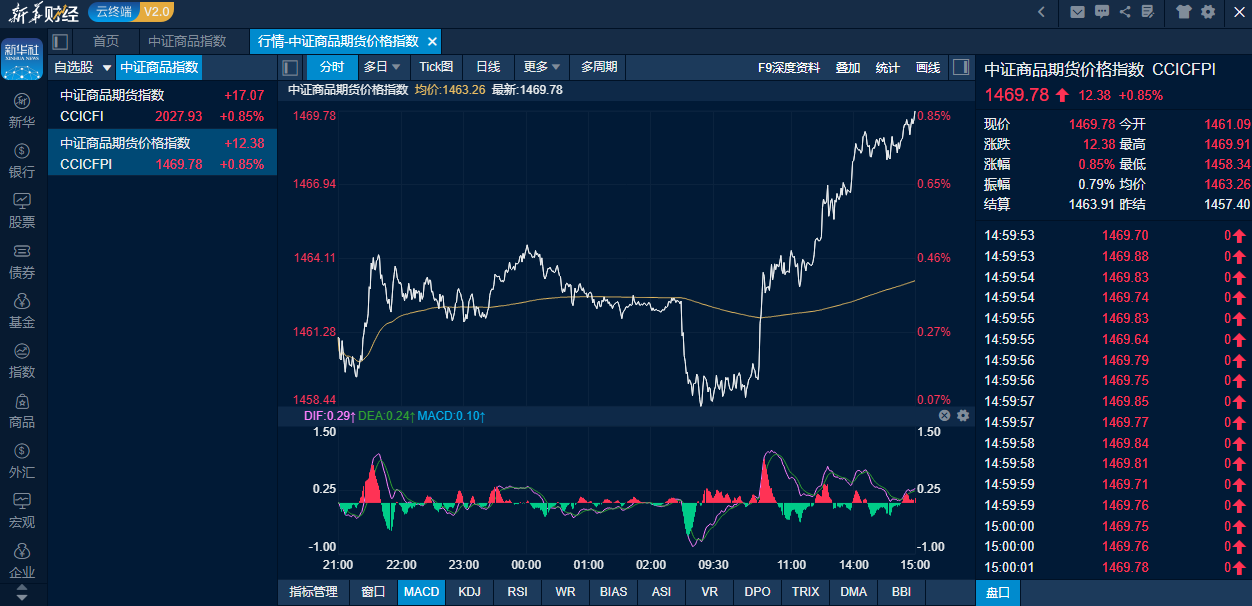
Group 1: Market Overview - The domestic commodity futures market stabilized on November 6, with most varieties rebounding. The China Securities Commodity Futures Price Index closed at 1469.78 points, up 12.38 points or 0.85% from the previous trading day [1] - The China Securities Commodity Futures Index closed at 2027.93 points, also up 17.07 points or 0.85% from the previous trading day [1] Group 2: Chemical Sector - The chemical sector showed significant rebound signs, with paraxylene (PX) leading the market with a 3.05% increase, reaching a two-month high. Improved supply-demand expectations were the main drivers for PX's price increase [2] - The demand for PX is supported by a recovery in new orders from weaving enterprises and a reduction in inventory levels for weaving and polyester products [2] Group 3: Coking Coal and Coke - Coking coal and coke futures rose, with coking coal and coke main contracts recording increases of 2.38% and 2.07%, respectively. The tightening supply is a major bullish factor for the coking market [3] - As of November 6, the capacity utilization rate of coking coal mines was 83.8%, down 1 percentage point week-on-week, indicating a reduction in supply [3] Group 4: Shipping Index - The shipping index for Europe experienced a significant decline of nearly 4%, with a drop of 3.91% at the close. This was attributed to market adjustments following previous price increases and high capacity levels [4] - The main contract for the shipping index saw a reduction of 5660 contracts, with a net outflow of over 200 million yuan, indicating a retreat of bullish sentiment [4] Group 5: Asphalt and Other Chemical Products - The asphalt market continued to show weakness, hitting a new low not seen since September of the previous year, with a 2.05% decline. The drop was influenced by falling oil prices and seasonal demand reductions [5] - Other chemical products like polyethylene continued to show weakness, although the decline in prices moderated towards the end of the trading day [5]