中央经济工作会议召开

Search documents
国民经济延续稳中有进态势 新动能稳步成长
Zheng Quan Shi Bao· 2025-12-15 18:31
Economic Performance - In November, China's economy continued to show a steady and progressive development trend, characterized by stable production growth, expanded market sales, resilient foreign trade, stable employment and prices, and strong social welfare support [1] - The industrial added value above designated size increased by 4.8% year-on-year in November, while the service production index rose by 4.2% [1] - The total retail sales of consumer goods grew by 1.3% year-on-year, and the total import and export value increased by 4.1% [1] New Economic Drivers - The new economic drivers have been continuously strengthening, with high-tech manufacturing value-added increasing by 9.2% and digital product manufacturing value-added growing by 9.3% from January to November [1][2] - The production of industrial robots and integrated circuits saw significant increases of 29.2% and 10.6%, respectively [1] Consumption and Investment Trends - There has been a rapid growth in service consumption, particularly in cultural and sports services, with retail sales in these categories increasing by over 10% year-on-year [2] - However, fixed asset investment decreased by 2.6% year-on-year, indicating a widening decline, and the growth rate of total retail sales of consumer goods is also slowing down [3] Policy Outlook - The recent Central Economic Work Conference outlined comprehensive plans for economic work in 2026, emphasizing the need for increased counter-cyclical and cross-cyclical adjustments to promote qualitative and effective improvements in the economy [3]
国信证券荀玉根:投资增速回正靠AI和股市
Xin Lang Cai Jing· 2025-12-15 14:35
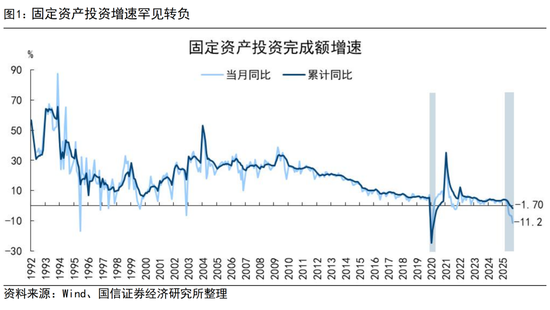
Core Conclusion - Fixed asset investment growth in China may experience its first annual negative growth since data collection began, with declines in real estate, infrastructure, and manufacturing investments [1][2][36] - To reverse the negative investment growth, reliance on the AI+ sector is essential, and the capital market must play a larger role [1][2][22] - Recommendations include accelerating the pace of technology IPOs, actively attracting long-term capital from the stock market, and increasing support for diversified financing tools like science and technology bonds [1][2][28][30][31] Investment Trends - Investment growth has been a key driver of China's economic growth, historically outpacing overall GDP growth [1][36] - The current situation marks a rare instance of negative investment growth, with a projected annual decline of -1.0% [2][36] - The decline is primarily driven by three major sectors: manufacturing, real estate, and infrastructure, which together account for over 70% of total investment [2][36] Real Estate Sector - The real estate sector has seen a significant slowdown, with cumulative investment down by -14.7% year-on-year in the first ten months of the year, and monthly growth dropping to -23.1% [6][39] - Demand-side factors include a demographic shift leading to a decrease of approximately 4.5 million eligible homebuyers compared to peak levels, and suppressed purchasing intentions due to falling housing prices [6][39] - Supply-side issues include ongoing debt risks for property companies, with approximately 524.4 billion due this year, limiting their investment capacity [6][39] Infrastructure Sector - Infrastructure investment has weakened, with a year-on-year decline of -12.1% in October [8][41] - Contributing factors include reduced funding capabilities due to a cooling land finance system and a lack of project reserves during the transition between the 14th and 15th Five-Year Plans [8][41] - Local governments are prioritizing risk prevention and debt repayment over new projects, reflecting a cautious fiscal approach [8][41] Manufacturing Sector - Manufacturing investment has shown signs of fatigue, with a year-on-year decline of -6.7% in October [10][43] - Factors include declining corporate profitability, with the median return on invested capital (ROIC) for non-financial A-share companies dropping to 2.9% from 3.7% the previous year [10][43] - The "anti-involution" policy has led to reduced capacity expansion among enterprises, while some are shifting investments abroad due to "de-globalization" trends [10][43] Historical Investment Recovery Insights - Historical data shows that previous investment recoveries were driven by demand shifts, with notable low points in 2006, 2015, and 2020 [12][45] - The 2008 recovery was fueled by a government-led stimulus plan focusing on large-scale infrastructure projects [14][47] - The 2015 recovery involved supply-side structural reforms and targeted demand stimulation through housing policy adjustments [16][51] - The 2020 recovery was characterized by a focus on new economic drivers amid the pandemic, with significant investments in high-tech sectors [18][55] Future Investment Strategies - The current investment recovery requires a focus on the AI+ sector, which presents vast opportunities and aligns with national strategic goals [22][56] - The government’s role in the economy is evolving, transitioning from direct involvement to a more supportive role that encourages private investment [26][60] - Recommendations for enhancing investment include improving the IPO process for tech companies, increasing long-term capital from the stock market, and expanding the use of science and technology bonds [28][30][31]


权益缩量调整,工业品反弹
Tebon Securities· 2025-12-15 14:21
Market Analysis - The A-share market experienced a volume contraction with the technology index leading the decline, as the Shanghai Composite Index fell by 0.55% to 3867.92 points, the Shenzhen Component Index dropped by 1.10% to 13112.09 points, and the ChiNext Index decreased by 1.77% to 3137.80 points, indicating a shift in market sentiment towards defensive sectors [2][5] - The total market turnover was 1.79 trillion, a decrease of 15.3% from the previous trading day, reflecting a growing cautious sentiment among investors [2][5] Sector Performance - Consumer and financial sectors showed strength, with the dairy index surging by 4.41% following a national medical insurance meeting that raised expectations for increased demand for infant formula [5] - The insurance sector also performed well, with the Insurance Select Index rising by 3.09%, driven by a reduction in risk factors for insurance capital and a shift towards defensive market styles [5] - In contrast, the technology sector faced significant declines, with indices for electronics, communications, computers, media, and machinery dropping between 1.35% and 2.40%, reflecting concerns over a potential saturation in AI computing demand [5] Bond Market - The government bond futures market continued to adjust, with the 30-year contract hitting a new low for the year, closing down 0.99% at 111.53 [10] - The central bank maintained a loose liquidity environment, conducting a net injection of 86 billion through reverse repos, indicating a "short-term tight, long-term loose" operational strategy [10] Commodity Market - Precious metals continued to show strength, with gold futures rising by 1.92% to 983.16 yuan per gram, supported by expectations of further monetary easing following a 25 basis point rate cut by the Federal Reserve [10] - Industrial commodities rebounded, with significant increases in aluminum oxide and coking coal prices, suggesting a potential recovery in sectors previously affected by "involution" competition [10][12] Investment Strategy - The report suggests maintaining a balanced allocation in technology and consumer sectors, as the central economic work conference emphasizes the importance of AI and domestic demand expansion [7][15] - The focus on "anti-involution" policies may provide opportunities in industrial commodities, with a recommendation to monitor the implementation of related policies [10][15] Trading Hotspots - Key investment themes include high dividend stocks, commercial aerospace, nuclear fusion, AI applications, and consumer sectors, with a focus on their respective market dynamics and potential growth drivers [13][15]
北交所策略专题报告:坚持内需主导,关注政策催化北证消费新机遇
KAIYUAN SECURITIES· 2025-12-15 12:45
Group 1 - The report emphasizes the importance of domestic demand as the primary driver for economic growth in 2026, with a focus on implementing consumption-boosting initiatives and enhancing the domestic market [11][12][13] - The contribution rate of domestic demand to economic growth from 2021 to 2024 is projected to be 86.4%, with final consumption accounting for an average contribution rate of 56.2% [12][13] - The report highlights the shift in the retail industry towards quality and service-driven growth, as discussed in the National Retail Innovation Development Conference [15][16] Group 2 - The North Exchange's consumer services sector saw a weekly increase of 0.44%, with food and beverage sector rising by 3.32% [25][31] - As of December 13, 2025, there are 25 companies related to the consumer services sector in the North Exchange's queue, with an average revenue of 1.242 billion yuan and an average net profit of 140.35 million yuan for 2024 [47][48] - Notable companies in the consumer services sector include Yizhi Moyu, which has a market value of 3.555 billion yuan and a net profit of 62.34 million yuan for 2025 Q1-Q3 [24][35] Group 3 - The Consumer Price Index (CPI) for November 2025 increased by 0.7% year-on-year, primarily driven by rising food prices [36][38] - The average wholesale price of pork is reported at 17.65 yuan per kilogram, while the average price of eggs is at 7.43 yuan per kilogram, reflecting market conditions [40][41] - The report indicates that the average price of fresh milk in major producing provinces is 3.02 yuan per kilogram, remaining stable compared to the previous week [46] Group 4 - The report outlines the significant sales performance during the "Double 11" shopping festival, with home appliances, digital devices, and clothing being the top three categories by sales volume [19][21] - The "Double 12" shopping event is set to further stimulate consumer spending, with various platforms launching promotional activities [18][22] - The report identifies 20 related stocks in the North Exchange for the "Double 12" event, covering categories such as home appliances, personal care, and food and beverages [23][24]
人民日报评论员:抓住关键,完成明年经济工作的重点任务
Xin Hua She· 2025-12-15 12:40
新华社北京12月15日电 人民日报12月16日评论员文章:抓住关键,完成明年经济工作的重点任务 ——论学习贯彻中央经济工作会议精神 经济工作千头万绪,抓住关键,就能做到纲举目张,以重点带动全局。中央经济工作会议着眼于 确保"十五五"开好局、起好步,部署了"八个坚持"的重点任务,为做好明年经济工作提供了行动 指引、明确了主攻方向。 坚持内需主导、坚持创新驱动、坚持改革攻坚、坚持对外开放、坚持协调发展、坚持"双碳"引 领、坚持民生为大、坚持守牢底线,这"八个坚持",围绕建设强大国内市场、加紧培育壮大新动 能、增强高质量发展动力活力等重点领域和关键环节作出针对性部署,既注重着力解决老问题, 也重视发力应对新挑战,体现出鲜明的问题导向和目标导向。这里以"坚持内需主导"和"坚持'双 碳'引领"为例进行深入分析,以深化理解和把握。 市场是当今世界最稀缺的资源,强大国内市场是中国式现代化的战略依托。会议总结我们党做好 新形势下经济工作"五个必须"的规律性认识,排在首位的就是"必须充分挖掘经济潜能"。会议科 学分析我国经济形势,指出国内供强需弱矛盾突出,这是对问题的清醒认识和准确把握。会议 把"坚持内需主导,建设强大国内市场 ...
公用事业行业跟踪周报:中央经济工作会议召开,双碳地位提升、建设能源强国-20251215
Soochow Securities· 2025-12-15 12:40
Investment Rating - The report maintains an "Overweight" rating for the utility sector [1] Core Insights - The Central Economic Work Conference has elevated the status of dual carbon goals and the construction of an energy powerhouse, emphasizing the need for comprehensive green transformation and energy system upgrades [4] - Key industry data shows a stable increase in electricity consumption and generation, with a notable rise in renewable energy capacity [4][13][21] Industry Data Summary Electricity Consumption - Total electricity consumption from January to October 2025 reached 8.62 trillion kWh, a year-on-year increase of 5.1%, with growth rates for various sectors: primary industry +10.5%, secondary industry +3.7%, tertiary industry +8.4%, and urban-rural residential +6.9% [13][14] Power Generation - Cumulative power generation from January to October 2025 was 8.06 trillion kWh, reflecting a year-on-year increase of 2.3%. The breakdown includes: thermal power -0.4%, hydropower +1.6%, nuclear power +8.7%, wind power +7.6%, and solar power +23.2% [21][22] Electricity Prices - The average electricity purchase price in November 2025 was 401 RMB/MWh, down 2% year-on-year but up 2.8% month-on-month [36][41] Coal Prices - As of December 12, 2025, the price of thermal coal at Qinhuangdao port was 745 RMB/ton, a decrease of 6.17% year-on-year and 5.10% week-on-week [44][47] Hydropower Conditions - As of December 12, 2025, the water level at the Three Gorges Reservoir was 172.03 meters, with inflow and outflow rates showing a year-on-year decrease of 7.7% and 7.56%, respectively [52][58] Installed Capacity - New installed capacity from January to September 2025 included: thermal power +5,668 MW (up 69.5%), hydropower +716 MW (down 10.1%), nuclear power +153 MW, wind power +6,109 MW (up 56.2%), and solar power +24,027 MW (up 49.3%) [4][45] Investment Recommendations - Focus on green electricity, with recommendations for companies such as Longyuan Power, Zhongmin Energy, and Three Gorges Energy. Emphasis on the transformation of thermal power and the potential of hydropower and nuclear power for stable returns [4]
公募基金权益指数跟踪周报(2025.12.08-2025.12.12):政策预期兑现,把握结构机会-20251215
HWABAO SECURITIES· 2025-12-15 11:52
Report Industry Investment Rating - No information provided in the content Core Viewpoints of the Report - Last week (2025.12.08 - 2025.12.12), the market showed a high - opening and low - closing trend. There is still a lack of a strong main line in the market. Externally - oriented sectors are stronger than domestically - oriented sectors, but the former's stock prices are at a high level with intensified gaming, and the latter lacks continuous data improvement and reversal momentum. After multiple macro - events, the market may enter a volatile consolidation phase with limited index - level opportunities [3][12]. - Overseas, short - term macro - positive factors being exhausted may pressure high - valuation and crowded AI assets, especially considering the possible interest rate hike by the Bank of Japan next week. However, the Fed's restart of quantitative easing provides re - inflation guidance for the US economy, and the prospect of global manufacturing recovery is still worthy of attention [12]. Summary by Relevant Catalogs 1. Weekly Market Observation - Equity Market Review and Observation - Market Performance: Last week, among major broad - based indexes, the BeiZheng 50, ChiNext Index, and KeChuang 50 led the gains, while the Micro - cap Stock Index, Dividend Index, and Shanghai Composite 50 led the losses. Market liquidity showed a structural shortage, with technology sectors such as computing power being relatively dominant. At the end of the year, funds further concentrated on leading tech stocks. In terms of themes, commercial aerospace, cross - strait integration, and some newly - listed stocks were active. The average daily trading volume of the entire A - share market was 1938.5 billion yuan, showing a month - on - month increase [12]. - Market Structure: Externally - oriented sectors (e.g., AI, non - ferrous metals) are stronger than domestically - oriented sectors (e.g., real estate, consumption). The former's stock prices are at a high level with intensified gaming, and the latter lacks continuous data improvement and reversal momentum [3][12]. - Macro - events: - Central Economic Work Conference: Held from December 10th to 11th, it continued the general tone of "seeking progress while maintaining stability", focused more on quality improvement and efficiency enhancement as well as policy coordination. Fiscal policy is "more proactive", and monetary policy is "moderately loose" [5][13]. - Fed Rate Cut: The Fed cut interest rates by 25 basis points in the December FOMC meeting, the third cut this year. After the cut, the market focused on the uncertainty of the future interest rate cut path, which may lead to some funds taking profits and rotating from high - valuation tech stocks, intensifying market differentiation [5][13]. - Bank of Japan Rate Hike: The market's expectation of a rate hike by the Bank of Japan has significantly increased. Although last year's hawkish rate hike had an impact on the global market, this time the expectation has been well - communicated, and the market has priced it relatively fully, so the impact on the global market is expected to be relatively limited [5][14]. 2. Active Equity Fund Index Performance Tracking - Overall Performance: | Index Classification | Last Week | Last Month | Since the Beginning of This Year | Since Inception | | --- | --- | --- | --- | --- | | Strategy - Theme | Active Stock Fund Preferred | 0.65% | - 0.46% | 39.07% | 40.20% | | Investment Style | Value Stock Fund Preferred | - 1.14% | - 2.33% | 18.76% | 18.85% | | | Balanced Stock Fund Preferred | 0.28% | - 0.98% | 30.74% | 27.88% | | | Growth Stock Fund Preferred | 1.57% | 0.60% | 54.47% | 40.59% | | Industry - Theme | Pharmaceutical Stock Fund Preferred | - 0.83% | - 1.84% | 36.66% | 18.38% | | | Consumption Stock Fund Preferred | - 0.54% | - 2.37% | 11.10% | 3.95% | | | Technology Stock Fund Preferred | 2.40% | 0.57% | 48.07% | 50.39% | | | High - end Manufacturing Stock Fund Preferred | 3.10% | - 0.89% | 35.14% | 28.62% | | | Cyclical Stock Fund Preferred | - 0.09% | 0.53% | 27.27% | 18.28% | [15] - Index Positioning and Benchmarks: - Active Stock Fund Preferred: Selects active equity funds based on performance competitiveness and style stability in value, balanced, and growth styles, with the style distribution roughly balanced according to the CSI Active Stock - type Fund Index. The performance benchmark is the Active Stock Fund (930980.CSI) [16][17]. - Value Stock Fund Preferred: Includes deep - value and quality - value styles. Selects 10 funds of deep - value, quality - value, and balanced - value styles to form the index. The performance benchmark is the CSI 800 Value Index (H30356.CSI) [20]. - Balanced Stock Fund Preferred: Fund managers of this style balance stock valuation and growth. Selects 10 relatively balanced and value - growth style funds to form the index. The performance benchmark is the CSI 800 (000906.SH) [22]. - Growth Stock Fund Preferred: Aims to seize the opportunities of performance and valuation double - click during a company's high - growth stage. Selects 10 funds of active - growth, quality - growth, and balanced - growth styles to form the index. The performance benchmark is the 800 Growth (H30355.CSI) [24][25]. - Pharmaceutical Stock Fund Preferred: Selects funds based on the intersection market value ratio of fund equity holdings and the constituent stocks of the CITIC Pharmaceutical Index. Constructs an evaluation system in the sample that meets the industry theme, with 15 funds selected to form the index. The performance benchmark is the pharmaceutical - theme fund index (fitted by Huabao Fund Research and Investment Platform) [25][29]. - Consumption Stock Fund Preferred: Selects funds based on the intersection market value ratio of fund equity holdings and the constituent stocks of relevant CITIC consumption - related indexes. Constructs an evaluation system in the sample that meets the industry theme, with 10 funds selected to form the index. The performance benchmark is the consumption - theme fund index (fitted by Huabao Fund Research and Investment Platform) [29]. - Technology Stock Fund Preferred: Selects funds based on the intersection market value ratio of fund equity holdings and the constituent stocks of relevant CITIC technology - related indexes. Constructs an evaluation system in the sample that meets the industry theme, with 10 funds selected to form the index. The performance benchmark is the technology - theme fund index (fitted by Huabao Fund Research and Investment Platform) [35]. - High - end Manufacturing Stock Fund Preferred: Selects funds based on the intersection market value ratio of fund equity holdings and the constituent stocks of relevant CITIC high - end manufacturing - related indexes. Constructs an evaluation system in the sample that meets the industry theme, with 10 funds selected to form the index. The performance benchmark is the high - end manufacturing - theme fund index (fitted by Huabao Fund Research and Investment Platform) [37]. - Cyclical Stock Fund Preferred: Selects funds based on the intersection market value ratio of fund equity holdings and the constituent stocks of relevant CITIC cyclical - related indexes. Constructs an evaluation system in the sample that meets the industry theme, with 5 funds selected to form the index. The performance benchmark is the cyclical - theme fund index (fitted by Huabao Fund Research and Investment Platform) [37][38].
11月经济数据点评:化解供强需弱矛盾需进一步扩大内需
Western Securities· 2025-12-15 11:52
Economic Growth Trends - In November, industrial value added grew by 4.8% year-on-year, slightly down from 4.9% in October[1] - The service production index increased by 4.2% year-on-year in November, a decrease from 4.6% in October[1] - Overall economic growth momentum has weakened, with both industrial and service sectors falling below 5% growth since Q4[1] Consumer Spending and Retail Performance - Social retail sales grew by only 1.3% year-on-year in November, down from 2.9% in October[1] - Online retail sales increased by 1.5% year-on-year in November, significantly lower than the 4.9% growth in October[1] - The "Double Eleven" shopping festival saw reduced consumer engagement, impacting retail performance[1] Investment and Real Estate Market - Fixed asset investment fell by 2.6% cumulatively from January to November, with a 12% decline in November alone[2] - Real estate development investment dropped by 30.3% year-on-year in November, indicating a worsening trend[2] - The sales area of commercial housing decreased by 17.3% year-on-year in November, with sales revenue down by 25.1%[2] Policy Recommendations - The central economic work conference emphasized the need for stronger domestic demand to address the supply-demand imbalance[3] - Plans for 2026 include more proactive fiscal and monetary policies to stimulate consumption and stabilize investment[3] - Risks include potential trade frictions and continued declines in the real estate market, which may affect policy effectiveness[3]
南华期货天然橡胶产业周报:美联储降息与国内会议召开助暖宏观,印尼天气扰动带来支撑-20251215
Nan Hua Qi Huo· 2025-12-15 11:10
第一章 核心矛盾及策略建议 1.1 核心矛盾 天然橡胶上周泰国南部和越南东南部天气扰动消退减弱浅色系支撑,而印尼、马来西亚持续降雨引发局地洪 涝,叠加下游刚性需求,深色胶支撑较强,周内持续反弹,深浅色价差有回缩。目前天然橡胶库存尤其是青 岛保税区库存维持累库,老全乳去库,深浅库存比持续走高。汽车配套需求较强,但一定程度受"以旧换新"补 贴和新能源补贴退坡带来的零售促销与需求前置影响,后续增长或承压;轮胎产销和出口环比下降,下游库 存压力仍高,交投情绪较弱。长期固定资产投资和房地产投资持续下滑,内需增长承压且出口阻碍仍存,长 期需求预期偏弱。美联储12月如预期降息25基点,美联储主席表态和美国就业疲软共同利好后续降息预期; 国内货币政策稳定续做,市场流动性担忧较小;中央经济工作会议、全国发展和改革工作会议召开,明确促 投资、扩内需、稳财政以及"反内卷"等重要内容,市场氛围偏暖有助橡胶估值抬升。橡胶系随情绪维持区间震 荡,后市预计维持宽幅震荡格局,其中浅色胶相对偏强看待。 南华期货天然橡胶产业周报 ——美联储降息与国内会议召开助暖宏观,印尼天气扰动带来支撑 边舒扬(投资咨询证号:Z0012647) 研究助理: 黄 ...
【周观点】重申汽车行业价格行为监管,继续看好汽车板块
东吴汽车黄细里团队· 2025-12-15 11:08
Investment Highlights - The automotive sector has shown positive performance this week, with the SW motorcycle and other segments leading with a gain of 1.7% [4][13] - The top five stocks covered this week include Chunfeng Power, Xusheng Group, Great Wall Motors, Hengshuai Co., and Desay SV [4][13] Industry Core Changes - On December 12, 2025, the State Administration for Market Regulation released the "Guidelines for Compliance with Pricing Behavior in the Automotive Industry (Draft for Comments)" [6][13] - The Central Economic Work Conference was held to optimize the implementation of the "Two New" policies [6][13] - Longxin General announced a partnership with Zhiyuan Robotics, focusing on industrial manufacturing and intelligent mobility, aiming to accelerate the development of L2 and L3 product lines [6][13] - Hezhima Intelligent and Yuanrong Qixing have reached a deep cooperation agreement to promote the mass production of advanced driver assistance technologies [6][13] - WeRide and Uber announced a partnership with the Dubai Roads and Transport Authority (RTA) to officially launch Robotaxi services through the Uber app in Dubai [6][13] Current Automotive Sector Configuration - The automotive industry is perceived to be at a new crossroads, with the electric vehicle (EV) boom nearing its end and the intelligent vehicle sector entering a phase of innovation [9][14] - Three main investment opportunities are identified: - **AI Intelligent Vehicle Main Line**: Focus on Robotaxi and Robovan, with key players including Tesla, Xiaopeng Motors, and Horizon Robotics [9][14] - **Upstream Supply Chain Key Stocks**: Include B-end vehicle OEMs like BAIC Blue Valley and GAC Group, as well as core suppliers in testing, chips, and sensors [9][14] - **AI Robotics Main Line**: Focus on selected components from companies like Top Group and Junsheng Electronics [9][14] Market Performance Overview - The automotive sector ranked 9th in A-shares and 14th in Hong Kong this week, with motorcycles and other segments performing the best [18][21] - The overall automotive sector has shown stability, with the SW motorcycle and other segments leading in performance [21][28]