
债券

Search documents
【债市观察】债市低波横盘交投情绪谨慎 十债困于1.80%
Xin Hua Cai Jing· 2025-11-17 03:02
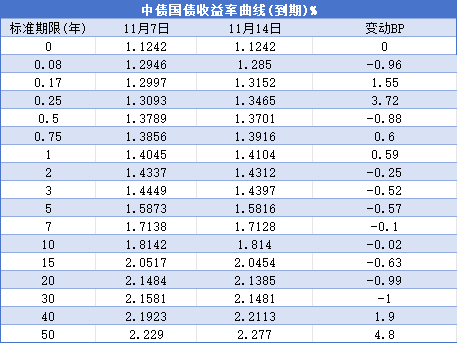
Core Viewpoint - The bond market experienced marginal tightening in liquidity last week, with the 10-year government bond yield closing at 1.805%, showing a slight decrease of 0.1 basis points, and the overall market remains in a sideways trend awaiting clearer signals [1][4]. Market Review - The yield changes for various maturities from November 7 to November 14, 2025, were as follows: 1-year (+0.59 BP), 2-year (-0.25 BP), 3-year (-0.52 BP), 5-year (-0.57 BP), 7-year (-0.1 BP), 10-year (-0.02 BP), 30-year (-1 BP), and 50-year (+4.8 BP) [2][3]. - The 10-year government bond yield fluctuated between 1.8% and 1.8125% during the week, ultimately closing at 1.805% [4]. Primary Market - A total of 100 bonds were issued last week, amounting to 726.87 billion yuan, including 6 government bonds worth 309.32 billion yuan, 21 policy bank bonds worth 132.48 billion yuan, and 73 local government bonds worth 285.07 billion yuan [7]. - For the upcoming week (November 17 to November 21), 60 bonds are planned for issuance, totaling 400.66 billion yuan [7]. International Market - The U.S. government shutdown ended, leading to concerns about economic impacts and a downward adjustment in expectations for a Federal Reserve rate cut in December. The 10-year U.S. Treasury yield rose to 4.15%, an increase of approximately 5 basis points for the week [8][10]. Monetary Policy - The People's Bank of China (PBOC) conducted a total of 1.122 trillion yuan in 7-day reverse repos last week, resulting in a net injection of 626.2 billion yuan [12]. - The PBOC plans to conduct an 800 billion yuan reverse repo operation on November 17 to maintain liquidity in the banking system [12]. Institutional Perspectives - Tianfeng Securities noted that the bond market remains in a narrow trading range, with both bulls and bears exercising caution. The potential for a seasonal rally at year-end may not materialize due to uncertainties in the banking sector and insurance liabilities [19]. - Huaxi Securities suggested that with financial data indicating a need for broader monetary easing, the likelihood of a rate cut by year-end or early next year is increasing, with the possibility of the PBOC prioritizing bond purchases to create a more accommodative environment [20]. - Industrial perspectives from Xingye Securities indicated that the current state of the bond market may not change soon, and investors should remain patient for improved opportunities [21].

几乎所有因素都“利好”,美国债市有望创2020年以来“最佳表现”
Hua Er Jie Jian Wen· 2025-11-17 01:33
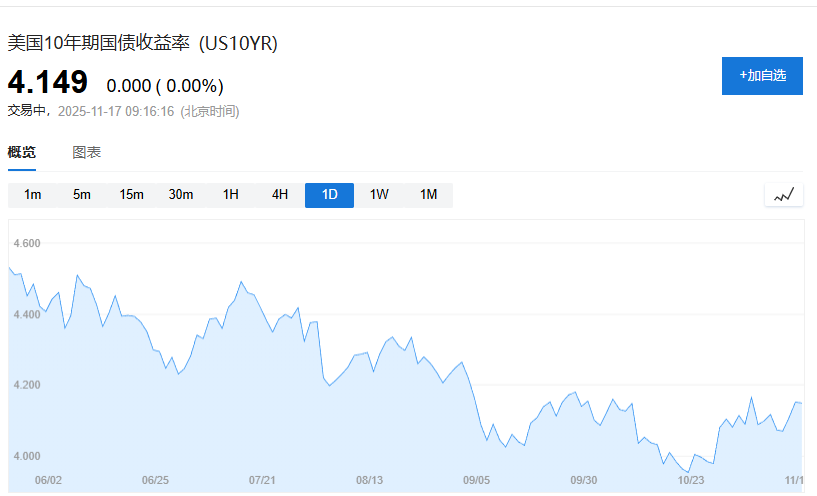
Core Viewpoint - The U.S. bond market is experiencing its best performance since 2020, driven by multiple favorable factors including Federal Reserve rate cuts, moderate economic slowdown, and easing inflation pressures [1][2]. Group 1: Market Performance - The Bloomberg U.S. Aggregate Bond Index has achieved a return of approximately 6.7% year-to-date, marking a potential best annual performance since 2020 [1]. - The 10-year U.S. Treasury yield has decreased by nearly 0.5 percentage points this year, closing at 4.149% last Friday [3]. Group 2: Federal Reserve Actions - The Federal Reserve's rate cuts have become the core driver of the bond market's rise, as bonds issued at higher rates become more valuable when market expectations shift towards lower rates [2]. - The labor market cooling has prompted the Federal Reserve to cut rates twice this year, with the possibility of further cuts [2]. Group 3: Economic Concerns - Despite concerns over the U.S. budget deficit impacting yields, the decline in interest rates has largely overshadowed these worries [6]. - The U.S. budget deficit for fiscal year 2025 is projected at $1.8 trillion, remaining stable compared to 2024, which could pose future challenges for the bond market [9]. Group 4: Investor Sentiment - Investors are optimistic about the continuation of favorable conditions, believing that despite rising uncertainties, there is still room for further rate declines [9]. - The additional yield spread of investment-grade corporate bonds relative to Treasuries fell to 0.72 percentage points in September, the lowest since the late 1990s, indicating potential overvaluation in the corporate bond market [8].
中金2026年大类资产展望:超配中国股票与黄金 标配美股与美债
智通财经网· 2025-11-17 00:40
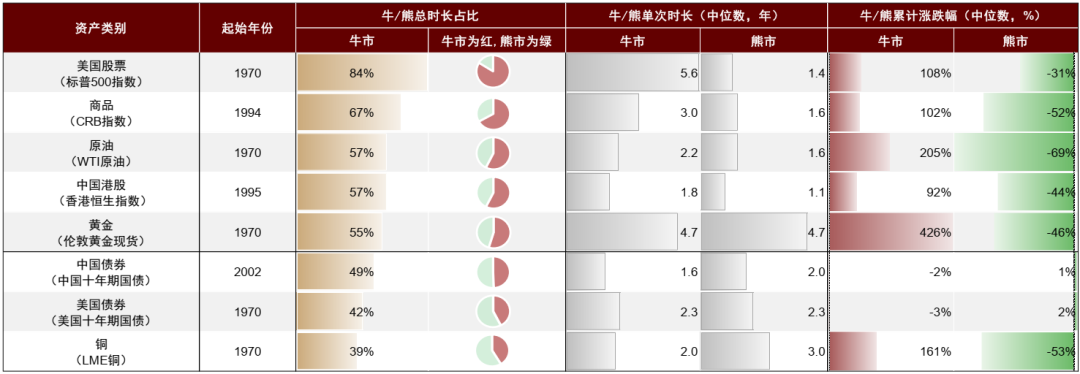
Group 1 - The article discusses the importance of identifying market tops for Chinese stocks and gold, emphasizing that economic and policy signals are crucial for making accurate predictions [1][10][40] - It highlights that the U.S. stock market has a long bull market duration, while Chinese stocks experience more frequent bull-bear switches, making timing more critical for Chinese stocks [5][10] - The analysis indicates that gold's bull and bear markets are lengthy with low switching frequency, suggesting that identifying tops is also significant for gold [1][5] Group 2 - Four key factors are identified that could potentially alter the bull market trends for stocks and gold in 2026: growth direction, tightening policies, high valuations, and geopolitical shocks [2][39] - The current economic conditions in China are characterized as a "weak recovery," while the U.S. is moving towards "stagflation," which could impact the performance of stocks and gold differently [2][41] - The article suggests that while there are no immediate signals indicating a top for the current bull markets, high valuations for gold may lead to increased volatility in the future [26][36][40] Group 3 - The asset allocation recommendation includes overweighting Chinese stocks and gold, while maintaining a neutral position in U.S. stocks and bonds, and adjusting commodity exposure to neutral [3][4] - The rationale for these recommendations is based on the ongoing AI technology wave and liquidity conditions benefiting Chinese stocks, while gold is supported by the current monetary policy environment [3][4] - The article notes that despite potential volatility, there are no clear signals indicating a market top for Chinese stocks or gold at this time [25][36]
货币慢发力养成记
HUAXI Securities· 2025-11-16 13:58
Economic Overview - In early November, the first batch of Q4 fundamental data showed inflation recovery but other indicators like credit, fixed asset investment, and real estate sales were below expectations, highlighting a "weak reality" challenge[1] - The central bank has signaled a cautious "loose monetary" stance, indicating that the marginal effectiveness of further easing has declined significantly[1] Monetary Policy Adaptation - From 2022 to 2025, the central bank's approach has shifted from "preemptive" to "reactive," with rate cuts occurring after risk confirmation rather than before[2] - Current economic conditions suggest that industrial value-added and service production indices need to reach approximately 5.2% year-on-year in November-December to offset October's slowdown and meet the annual growth target of 5%[2] Bond Market Strategy - In the short term, the bond market is expected to focus on spread opportunities until a clear direction in interest rates emerges, prioritizing the relative value between different bond types[3] - The expectation for "loose monetary" policy to continue is still present, with potential rate cuts anticipated at the end of the year or early next year[3] Financial Product Trends - The scale of financial products saw a slight decrease of 307 billion yuan, bringing the total to 33.36 trillion yuan, reflecting typical seasonal fluctuations[29] - The proportion of negative returns in financial products has decreased, with the overall negative return rate dropping to 1.77% for the past week[36] Leverage and Risk Indicators - The average leverage ratio in the interbank market has decreased from 107.53% to 107.08%, indicating a tightening of leverage conditions[55] - The average leverage level for non-bank institutions also fell from 113.22% to 112.18%, suggesting a broader trend of deleveraging[55]
债券策略周报20251116:年内债券投资思路-20251116
Minsheng Securities· 2025-11-16 13:20
Group 1 - The report suggests that in the absence of strong expectations for short-term interest rate cuts, both long-term government bond yields and short-term deposit rates are unlikely to decline significantly. The market currently does not anticipate easing of short-term funds or a reduction in LPR [1][8][37] - It is recommended to focus on two strategies for portfolio construction: 1. Opt for slightly lower duration for defensive positioning, waiting for a rate adjustment of around 5 basis points before considering extending duration; 2. Maintain a market-neutral or slightly longer duration stance, with risk exposure suggested to be placed in active bonds where spreads can compress, such as government bonds and ultra-long government bonds [1][8][40] Group 2 - For bond selection, the report emphasizes prioritizing long-term interest rate bonds, particularly focusing on 250215. If there is a higher frequency demand for duration adjustment, 25T6 should be considered. For higher yield bonds like 25T5 and 25T3, attention should gradually decrease as spreads compress further [2][10][12] - In the context of credit bonds, the report notes that the spread between 3-5 year credit bonds and government bonds is already low, indicating limited room for further compression. It is suggested to focus on mid-term government bonds for short-term capital gains, while mid to long-term credit bonds may offer better value for long-term holding [3][13] Group 3 - The report indicates that the current overall IRR level of government bond futures is slightly higher than the funding rate, with most futures contracts being relatively expensive compared to cash bonds. The strategy of focusing on the compression of spreads between government bonds and government-backed bonds is recommended [4][14] - The report highlights that the bond market has maintained a volatile trend, with government bonds showing stronger performance. Despite weak financial and economic data in October, interest rates have not significantly declined, and the market sentiment towards bonds remains cautious [15][20]
信用债市场周度跟踪(2025.11.10-2025.11.16):收益率多小幅下行,中长端信用利差小幅走阔-20251116
Shenwan Hongyuan Securities· 2025-11-16 08:23
Group 1: Report Information - Report title: "Yield Mostly Declines Slightly, Medium- and Long-Term Credit Spreads Widen Slightly - Weekly Tracking of the Credit Bond Market (2025.11.10 - 2025.11.16)" [2] - Analysts: Huang Weiping, Yang Xuefang, Zhang Jinyuan [3] - Research support: Cao Xuan [3] - Report date: November 16, 2025 [3] Group 2: Industry Investment Rating - Not provided in the report Group 3: Core Viewpoints - The primary market shows a decline in the net supply of ordinary credit bonds and secondary and perpetual (two - tier) bank bonds compared to the previous period [4]. - In the secondary market, yields mostly decline slightly, credit spreads generally widen, and 1 - year bonds perform well. The turnover rates of ordinary credit bonds and two - tier bank bonds both decrease [4]. - The bond market enters a policy and data vacuum period. With the unimplemented public offering redemption fee new regulations and the possible continuation of residents' deposit transfer to the equity market, attention should be paid to the coupon value of credit bonds in the volatile market [4]. - In terms of credit strategies, the 1 - 3 - year period still has carry - trade space and cost - effectiveness, and investors can also moderately focus on 3 - 5 - year high - grade bonds, but should remain cautious about extending credit duration [4]. Group 4: Summary by Directory 4.1 Primary Market 4.1.1 Ordinary Credit Bonds - Net financing decreases compared to the previous period, and subscription enthusiasm rises. The issuance of industrial bonds and urban investment bonds both decline slightly, and the net financing of urban investment bonds turns negative [4][7][11]. - The net financing of each enterprise nature is positive. The weighted issuance term is 2.98 years, a slight decrease from the previous period. The weighted issuance term of urban investment bonds increases, while that of industrial bonds decreases [16][17]. 4.1.2 Bank Two - Tier Bonds - Five small and medium - sized bank two - tier bonds are issued, and the net financing scale decreases compared to the previous period. The net financing of secondary capital bonds turns positive, while that of perpetual bonds decreases significantly [4][25][27]. 4.2 Secondary Market 4.2.1 Yields and Credit Spreads - Yields mostly decline slightly, and credit spreads, except for 1 - year bonds, generally widen. 3/5/7 - year weak - quality varieties see larger yield declines, while 10 - year AAA - grade ordinary credit bonds have a relatively large upward amplitude in yields [4][35][37]. - In terms of credit spreads, 1 - year bonds, except for medium - and high - grade urban investment bonds, all narrow, with low - grade bonds performing better. 5/7/10 - year medium - and high - grade bonds mostly widen, but the 5 - year AA - grade medium - term note performs best [4]. 4.2.2 Turnover Rate - The turnover rates of ordinary credit bonds and two - tier bank bonds both decrease [4] 4.3存量债分布 - Current yields are mostly distributed within 2.2% [34]
周观:何时是窄幅波动下债市的合适布局时机?(2025年第44期)
Soochow Securities· 2025-11-16 07:33
Group 1: Report General Information - The report is a fixed - income weekly report dated November 16, 2025, focusing on the bond market and related data [1] Group 2: Report Industry Investment Rating - No industry investment rating information is provided in the report Group 3: Report Core Views - The 10 - year Treasury bond active coupon yield is expected to remain in the range of 1.75% - 1.85% until the end of the year. There may be a better layout opportunity in the first quarter of next year when betting on interest rate cuts. A potential fund redemption fee new rule in early December could lead to a pulse - like rise in interest rates, presenting a good entry opportunity [13] - The US 12 - month interest rate cut probability has decreased, and US Treasury yields have collectively risen. The NFIB small - business optimism index in October was lower than expected, and the number of initial jobless claims in the week of November 8 decreased [15][20][21] Group 4: Summary by Directory 4.1 One - Week Views - **Domestic Bond Market**: From November 10 - 14, 2025, the 10 - year Treasury bond active coupon yield decreased by 0.1bp from 1.8060% to 1.8050%. The bond market was in a narrow - range fluctuation. Two factors restricted the interest rate from breaking through the range: market expectations of the weakening fundamentals and the higher probability of interest rate cuts in the first quarter of next year [9][13] - **US Bond Market**: The NFIB small - business optimism index in October was 98.2%, lower than the expected 98.3%. The number of initial jobless claims in the week of November 8 decreased from 228,000 to about 225,000. The probability of a December interest rate cut decreased, and US Treasury yields rose. The 10 - year US Treasury yield rose 4bp to 4.12%, and the 2 - year yield rose 2bp to 3.59% [15][20][21] 4.2 Domestic and Overseas Data Aggregation 4.2.1 Liquidity Tracking - Open - market operations from November 10 - 14, 2025, had a net injection of 781 billion yuan. Interest rate bonds' total issuance, total repayment, and net financing showed certain changes compared to the previous week [27] 4.2.2 Domestic and Overseas Macroeconomic Data Tracking - Commodity prices such as steel and LME non - ferrous metals had mixed rises and falls. The total floor area of commercial housing transactions showed a downward trend [50][51] 4.3 Local Bond One - Week Review 4.3.1 Primary Market Issuance Overview - From November 10 - 14, 2025, 73 local bonds were issued, with a total issuance amount of 285.066 billion yuan, a net financing of 242.792 billion yuan. The top five provinces in terms of issuance amount were Jiangsu, Zhejiang, Liaoning, Jilin, and Beijing [76][78] 4.3.2 Secondary Market Overview - The local bond stock was 54.01 trillion yuan, with a trading volume of 31.0134 billion yuan and a turnover rate of 0.57%. The top three provinces with active trading were Hubei, Guangdong, and Shandong [90] 4.3.3 This Month's Local Bond Issuance Plan - Some provinces and regions have planned local bond issuances from November 17 - 21, 2025 [98] 4.4 Credit Bond Market One - Week Review 4.4.1 Primary Market Issuance Overview - A total of 311 credit bonds were issued, with a total issuance of 268.14 billion yuan, a total repayment of 236.697 billion yuan, and a net financing of 31.443 billion yuan, a decrease of 59.068 billion yuan compared to the previous week [94] 4.4.2 Issuance Interest Rates - The short - term financing bill's latest issuance interest rate was 1.7115%, up 7.53bp; the medium - term note was 2.1127%, down 1.53bp; the corporate bond was not provided; the corporate bond was 2.2449%, up 2.72bp [106] 4.4.3 Secondary Market Transaction Overview - The total credit bond trading volume was 538.76 billion yuan, with different trading volumes for different ratings and bond types [107] 4.4.4 Maturity Yields - The maturity yields of national development bonds generally decreased, while those of credit bonds such as short - term financing bills, medium - term notes, corporate bonds, and urban investment bonds showed different trends [108][109][111] 4.4.5 Credit Spreads - The credit spreads of short - term financing bills and medium - term notes showed a differentiated trend, while those of corporate bonds and urban investment bonds generally widened [115][118][120] 4.4.6 Rating Spreads - The rating spreads of short - term financing bills, medium - term notes, corporate bonds, and urban investment bonds generally narrowed [124][127][131] 4.4.7 Trading Activity - The top five most actively traded bonds for each bond type were listed, and the industrial industry had the largest weekly bond trading volume [136][137] 4.4.8 Subject Rating Changes - There were no bonds with upgraded ratings or outlooks, and no bonds with downgraded ratings or outlooks this week [138][139]
被抛售的全球主权债:债务困境与长债的重新定价
Xin Lang Cai Jing· 2025-11-16 01:53
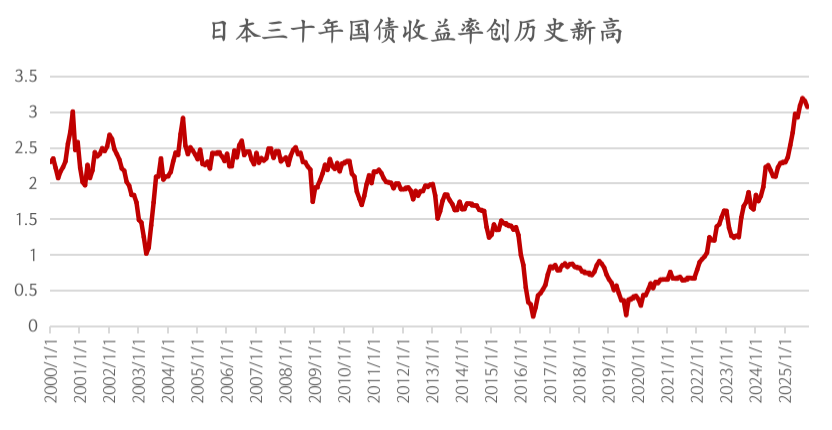
Group 1: Sovereign Debt Market Overview - The sovereign debt market in 2025 has seen the highest yields for 30-year government bonds in Germany, France, and the Netherlands since the 2011 Eurozone crisis, with UK yields reaching the highest level since 1998 [1] - A new vicious cycle is emerging where concerns over sovereign debt are driving up yields, increasing borrowing costs for governments, and leading to larger fiscal deficits and more bond issuance [1] Group 2: Japan's Bond Market Dynamics - Japan's 30-year government bond yields have reached their highest level since issuance in 1999, rising nearly 100 basis points since the beginning of the year [2] - The volatility in Japan's bond market is attributed to the Bank of Japan's monetary policy adjustments, including the end of negative interest rates and a significant reduction in bond purchases [4][5] - Concerns over Japan's fiscal situation have intensified, with political instability further exacerbating market fears [6] Group 3: European Sovereign Debt Concerns - Germany's bond yields have surged due to increased defense spending and the loosening of fiscal constraints, while France faces political turmoil affecting its budget proposals [7][8] - The UK has seen its 30-year bond yields rise to 5.75%, the highest since 1998, driven by expectations of increased taxation and government spending to address fiscal challenges [8] Group 4: Global Interest Rate Trends - Despite entering a rate-cutting cycle, long-term sovereign bond yields continue to rise, indicating a market re-evaluation of sovereign creditworthiness [10] - The persistent high inflation in major economies, particularly the US, has led to a "Higher for Longer" narrative for long-term rates, impacting developed nations' bond yields [10][11] - Concerns over fiscal sustainability and political instability in Europe are contributing to upward pressure on long-term yields, particularly in the UK [11]
中国再抛2700亿美债!累计减持达2.7万亿,中日达成一致?
Sou Hu Cai Jing· 2025-11-15 10:11
Core Viewpoint - China's recent reduction of U.S. Treasury holdings reflects deeper economic strategies and considerations, with significant implications for both domestic and global financial markets [1][3]. Group 1: China's Reduction of U.S. Treasury Holdings - In August 2025, China reduced its U.S. Treasury holdings by $270 billion, bringing its total to $780 billion, the lowest level since 2009 [1]. - Since the peak of $1.32 trillion in 2013, China has cumulatively reduced its U.S. Treasury holdings by approximately $2.7 trillion, a decline of over 60% [1][3]. - Japan, the largest holder of U.S. Treasuries, also reduced its holdings by about $185 billion in 2025, raising speculation about a coordinated reduction between China and Japan [3]. Group 2: Reasons Behind the Reduction - Concerns over asset safety are paramount, as the U.S. federal debt surpassed $37 trillion in 2025, with a debt-to-GDP ratio exceeding 130%, raising doubts about long-term repayment capabilities [3]. - The risk of U.S. dollar depreciation is significant, with the Federal Reserve having cut interest rates by 250 basis points since 2024, leading to a more than 10% decline in the dollar index over the past 18 months [3]. - There is an increasing demand for asset diversification, as China aims to optimize its foreign exchange reserve structure by increasing allocations to gold, euros, and yen [4]. - Yield considerations are also important, as the 10-year U.S. Treasury yield was around 3.2% in October 2025, while yields on bonds from emerging markets could reach 6% [4]. Group 3: Impacts on China - Reducing reliance on U.S. Treasuries and increasing allocations to gold and other assets can enhance the overall return on foreign exchange reserves and mitigate risks associated with asset concentration [5]. - Funds from the reduction of U.S. Treasuries can be redirected to invest in other sovereign bonds, equity investments, or support domestic infrastructure and key industry development [5]. - There may be short-term adjustment costs, as large-scale reductions could lead to a decline in U.S. Treasury prices, affecting the market value of remaining holdings [7]. Group 4: Impacts on the U.S. - A decrease in Chinese purchases of U.S. Treasuries could lead to higher financing costs for the U.S. government due to reduced demand [7]. - The reduction may indirectly affect trade relations between China and the U.S., although the high degree of economic complementarity suggests limited impact [7]. - The market may interpret China's actions as a signal of concerns regarding the U.S. economy or debt sustainability, potentially affecting investor confidence [7]. Group 5: Global Financial Market Implications - Large-scale reductions by China could lead to volatility in U.S. Treasury prices, influencing global asset prices and potentially triggering a "run" effect if market expectations shift [8]. - The reduction reflects a trend towards diversification of global reserve currencies, potentially accelerating changes in the international monetary system [8]. - If other major holders follow China's lead, it could result in larger market fluctuations, which is why countries typically adjust their holdings gradually [8]. Group 6: Insights for Investors - The reduction indicates a shift in the global investment environment, suggesting that investors should consider diversifying their asset allocations to mitigate systemic risks [9]. - Strategic adjustments at the national level often precede market recognition, providing insights for investors, such as China's increased gold holdings as a recognition of its value as a safe asset [9]. - The complexity of financial market changes necessitates a comprehensive analysis of various factors rather than overemphasizing a single event [10]. Group 7: Future Trends - In the short term, a moderate reduction in U.S. Treasury holdings is likely to continue, as they remain a significant part of China's foreign exchange reserves [12]. - In the medium term, China may further diversify its foreign exchange reserve structure by increasing allocations to gold and bonds from developed countries [12]. - Long-term trends may see a decreased reliance on U.S. Treasuries as the international use of the renminbi expands, with its share in global payments rising to 3.2% in the first half of 2025 [14].

债市“科技板”半年考:1.38万亿资金加速涌入科创领域
Zhong Guo Jing Ying Bao· 2025-11-14 19:20
Core Insights - The article highlights the rapid growth of the "Technology Board" in China's bond market, driven by policy support and market demand for technology innovation bonds (科创债) [2][3][4] - A total of 1,186 technology innovation bonds were issued from May 7 to November 6, with a cumulative issuance scale of 1.38 trillion yuan, representing 81% of the annual issuance scale [3][4] - The issuance of technology innovation bonds is seen as a key mechanism to enhance financing for technology enterprises, thereby promoting industrial upgrading and economic high-quality development [9][10] Policy Support - The "Technology Board" was established to facilitate the issuance of technology innovation bonds by financial institutions, technology enterprises, and private equity investment institutions [3][5] - Regulatory bodies have expanded the range of issuers, broadened the use of funds, and simplified the issuance process to stimulate market activity [4][5] - The issuance of technology innovation bonds is aligned with national strategic goals, focusing on sectors like artificial intelligence, semiconductor manufacturing, and renewable energy [5][6] Market Dynamics - The current low-interest-rate environment and the scarcity of quality assets have led to increased investor interest in technology innovation bonds, with 85% of these bonds experiencing oversubscription [4][6] - Commercial banks have emerged as the main issuers, accounting for 17.6% of the total issuance scale, while technology enterprises are also utilizing these bonds for direct financing of R&D projects [6][7] - The successful issuance of technology innovation bonds has allowed companies to lower financing costs and better align their debt structure with long-term funding needs [6][7] Future Trends - The article anticipates a diversification of issuers, innovation in bond terms, and the continued expansion of technology innovation bond ETFs [10][11] - The introduction of convertible bonds linked to the future growth of technology enterprises is expected to enhance the attractiveness of these financial instruments [10][11] - The ongoing development of technology innovation bonds is projected to improve the financing ecosystem for technology companies, addressing common challenges such as long R&D cycles and unstable cash flows [11]
