有色

Search documents
国泰海通 · 晨报0901|宏观、策略、海外策略、化妆品
国泰海通证券研究· 2025-08-31 13:59
Macro Analysis - The increase in tariffs has only raised the average U.S. import tax rate by 6.6 percentage points as of June 2024, which is lower than market expectations. The low proportion of taxable goods and changes in import structure are key reasons for this outcome [2][3] - U.S. companies are currently bearing approximately 63% of the tariff costs, while consumers are responsible for less than 40%. This cost distribution may change as inventory is depleted and trade policy uncertainties decrease [3] - If the average U.S. import tax rate rises by 10% within the year, it could push the PCE year-on-year growth rate to 3.1% and the core PCE to 3.4%, assuming stable demand [3] Market Strategy - The Chinese stock market is expected to continue rising, with the index likely to reach new highs. Factors supporting this outlook include accelerated economic transformation, declining risk-free interest rates, and capital market reforms [6][7] - There is an anticipated expansion in market trends, with increased allocations towards mid-cap stocks and undervalued blue-chip stocks. The improvement in traditional industries and a focus on domestic demand are also contributing to this positive outlook [8][9] Industry Comparison - Emerging technology is seen as a primary investment focus, while cyclical financial sectors are viewed as potential dark horses. The Hong Kong stock market is expected to rebound [9][10] - Recommendations include sectors such as AI applications, consumer goods, and high-end equipment, with a particular emphasis on companies benefiting from technological upgrades and policy support [10] Foreign Investment Trends - Following the Fed's shift towards rate cuts, foreign capital may return to Hong Kong stocks, which have seen a historical low in foreign investment allocation. Recent signs indicate a potential stabilization in foreign capital flows [13][14] - Foreign investment preferences in Hong Kong are heavily weighted towards technology and financial sectors, with a notable focus on companies with strong fundamentals and profitability [14][15] Investment Recommendations - The beauty and personal care sector is expected to see significant growth, with a recommendation for selective investment in companies demonstrating product and channel innovation [17][18] - The first half of 2025 showed a revenue increase of 7.2% and a net profit growth of 1.9% in the beauty sector, with personal care outperforming cosmetics and medical aesthetics [18][19]


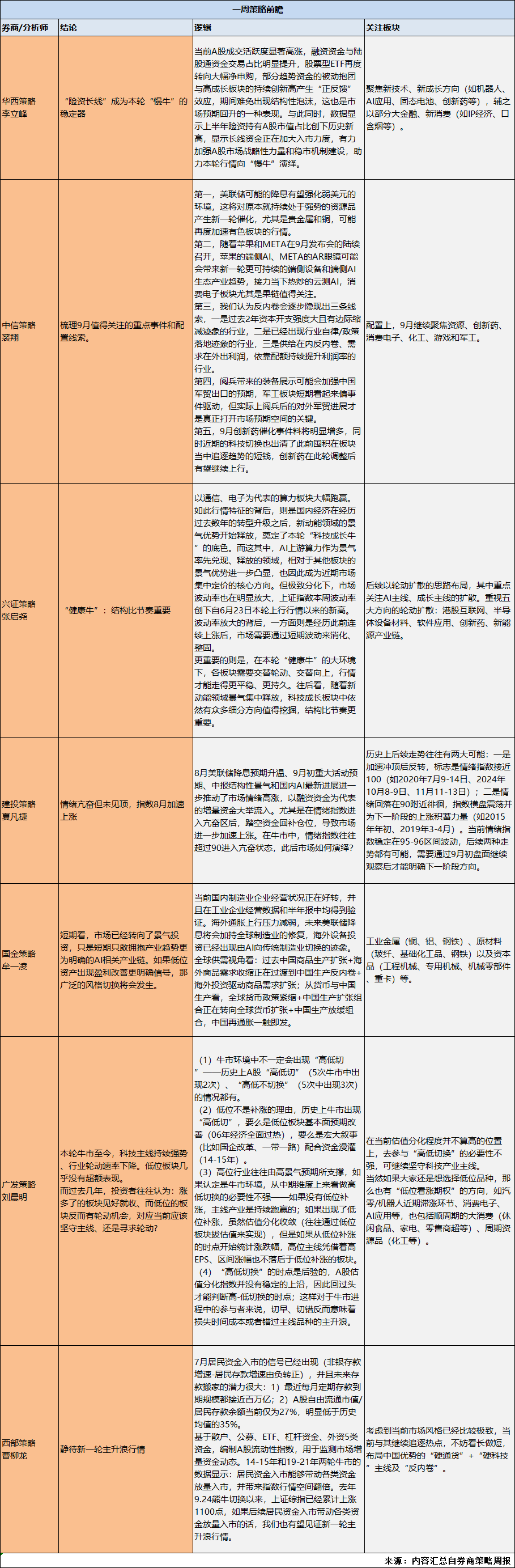
A股分析师前瞻:“高低切换”有无必要?“低位看涨期权”的方向又有哪些?
Xuan Gu Bao· 2025-08-31 13:04
Core Viewpoint - Major broker strategy analysts remain optimistic about the future index trends, emphasizing the importance of sector rotation for a stable and lasting market performance [1][2]. Group 1: Market Trends and Sector Rotation - The "healthy bull" market environment requires alternating upward movements across sectors to ensure a smoother and more sustainable market [1]. - The technology growth sector continues to show strength, with many sub-sectors worth exploring, particularly in new momentum areas [1][5]. - Analysts highlight five key areas for rotation: Hong Kong internet, semiconductor equipment and materials, software applications, innovative pharmaceuticals, and the new energy industry chain [1][5]. Group 2: Long-term Investment and Market Dynamics - Data indicates that the proportion of insurance capital holding A-shares reached a historical high in the first half of the year, reflecting increased long-term capital inflow into the market [1][4]. - The current market is characterized by a significant increase in trading activity, with financing and cross-border capital trading ratios rising notably [4]. - The potential for a "slow bull" market is supported by the strategic strength of long-term capital, which enhances market stability [1][4]. Group 3: Sector Focus and Investment Strategies - Analysts suggest that the necessity for "high-low switching" is not strong at the current valuation levels, advocating for a continued focus on the technology sector [3][4]. - For those interested in low-position stocks, options such as low-position call options in sectors like automotive parts, robotics, consumer electronics, and AI applications are recommended [3][4]. - The upcoming events in September, including major product launches from companies like Apple and META, are expected to catalyze new trends in the technology sector, particularly in AI and consumer electronics [4][5]. Group 4: Economic Indicators and Future Outlook - The current economic environment shows signs of improvement in domestic manufacturing, with overseas inflationary pressures easing, which may support global manufacturing recovery [5][6]. - The potential for a new wave of capital inflow from residents is significant, as recent data indicates a shift in savings towards the stock market [6]. - Historical data suggests that increased resident capital entering the market can lead to substantial index growth, with the Shanghai Composite Index having risen significantly since the last market transition [6].
主板上行仍将延续,但如何增强实际获得感?
鲁明量化全视角· 2025-08-31 04:20
Group 1 - The core viewpoint indicates that the main board's upward trend will continue, but there is a need to enhance the actual sense of gain for investors [1][4] - The market showed strong performance last week, with the CSI 300 index rising by 2.71%, the Shanghai Composite Index by 0.84%, and the CSI 500 index by 3.24% [3] - Economic data remains stable, with the official manufacturing PMI for August indicating a relatively low level of economic activity, suggesting that the recent market heat is not closely tied to domestic fundamentals [3][4] Group 2 - The main board and small-cap sectors are both recommended to maintain high positions, with the main board showing superior performance [2][4] - The strategy has successfully identified top-performing sectors in August, achieving an 18% increase, with notable selections in communication, electronics, and non-ferrous metals [4] - The core strategy has ranked in the top 8% of the equity market simulation, demonstrating strong performance in the current market environment [8]

金融期货早评-20250829
Nan Hua Qi Huo· 2025-08-29 02:10
Report Industry Investment Ratings No relevant content provided. Core Views - The stock market is in a phased shock interval with high trading volume, leading to significant shock amplitude. Short - term trading is influenced by the STAR 50 index, and funds are the main disturbing factor. Traders prefer blue - chip stocks. It's advisable to hold positions and take risk - avoidance measures before a clear consensus is formed [4]. - The bond market may need to repeatedly test the bottom due to the influence of the stock - bond seesaw, but there's no need to be overly pessimistic as stock market risks increase after reaching a high level [4]. - For the shipping index (European line) futures, the possibility of a shock - and - decline trend is relatively large, and attention should be paid to the risk of a low - level rebound of some contracts [6]. - Precious metals are expected to be strong in the medium - to - long - term and may maintain a strong state in the short - term. It's recommended to pay attention to the impact of the US PCE data on Friday night [10]. - Copper prices are expected to be mainly volatile, with both upward and downward pressures [13]. - Aluminum is expected to be shock - strong, alumina shock - weak, and cast aluminum alloy shock - strong [15]. - Zinc is expected to be strong at the bottom in the short - term [16]. - Nickel and stainless steel are in a situation of long - short game, waiting for clear signals [18]. - Tin is expected to be slightly strong [20]. - Carbonate lithium is in a state of correcting over - valuation and oscillating adjustment. In the short - term, there may be a rebound opportunity, and in the medium - to - long - term, it's advisable to short at high prices [22]. - Industrial silicon and polysilicon are in an oscillating adjustment phase, and it's recommended to wait and see or trade based on an oscillating strategy [24]. - Lead is expected to be in a narrow - range shock [25]. - For steel products, the upward driving force is insufficient, and the short - term market may be bearish [26]. - Iron ore is expected to oscillate, with limited downward space in the short - term [27]. - Coking coal and coke are expected to maintain a high - level wide - range shock pattern in the short - term [28]. - Ferrosilicon and ferromanganese are recommended to go long lightly at the 60 - day moving average [29]. - For crude oil, it's recommended to short at high prices, paying attention to rhythm and risk control [32]. - LPG is expected to be weak and shock, with the spot price rising to catch up [33]. - PTA - PX is following the decline of commodity sentiment, and it's recommended to short the processing fee and conduct 1 - 5 reverse arbitrage [36]. - MEG - bottle chips are following the decline of commodity sentiment but showing resistance to decline. It's recommended to go long on dips in the short - term and conduct covered call option operations in the medium - to - long - term [37]. - PP is expected to maintain a short - term shock pattern [39]. - PE is recommended to go long on dips, but attention should be paid to the demand recovery situation [41]. - Pure benzene and styrene are in an oscillating decline, and for styrene, short - sellers should pay attention to stop - profit [43]. - Fuel oil is facing a situation where the downward driving force remains unsolved [44]. - Low - sulfur fuel oil is recommended to be long - allocated as its valuation is low and the driving force is upward [45]. - Asphalt is in an oscillating consolidation phase, mainly following cost fluctuations [46]. - Rubber is expected to be in an interval shock, and it's recommended to expand the spread between light and dark rubber at low levels [49]. - Urea is in a pattern of having both support and suppression, and the 01 contract is expected to oscillate between 1650 and 1850 [50]. - For soda ash, the supply - strong and demand - weak pattern remains unchanged [52]. - For glass, the market is in a weak balance state, and attention should be paid to policy guidance and short - term sentiment changes [53]. Summary by Directory Financial Futures Macro - Domestic policies focus on promoting service consumption, and overseas markets show economic and employment resilience in the US. Attention should be paid to the upcoming US non - farm payroll report and price index [1]. - The Fed's policy shows marginal loosening signs, and the US dollar index is in a shock - consolidation pattern. The US dollar - RMB exchange rate is expected to be more likely to depreciate [2]. Stock Index - The stock market is in a phased shock interval with high trading volume and significant shock amplitude. Short - term trading is affected by the STAR 50 index, and funds are the main disturbing factor [4]. Treasury Bonds - The bond market is affected by the stock - bond seesaw and may need to repeatedly test the bottom, but there's no need to be overly pessimistic [4]. Shipping Index - The shipping index (European line) futures are affected by the reduction of spot cabin quotes and geopolitical risks, and the possibility of a shock - and - decline trend is relatively large [6]. Commodities Precious Metals - Gold and silver are expected to be strong, and attention should be paid to the US PCE data on Friday night. It's recommended to go long on dips [8][10]. Copper - Copper prices are expected to be mainly volatile, with both upward and downward pressures due to factors such as the US dollar index and demand [13]. Aluminum Industry Chain - Aluminum is expected to be shock - strong, alumina shock - weak, and cast aluminum alloy shock - strong, each with different influencing factors such as supply, demand, and cost [14][15]. Zinc - Zinc is expected to be strong at the bottom in the short - term, with support from inventory and potential demand improvement [16][18]. Nickel and Stainless Steel - Nickel and stainless steel are in a long - short game situation, and attention should be paid to factors such as nickel ore supply, nickel iron price, and stainless steel demand [18][19]. Tin - Tin is expected to be slightly strong, supported by supply - side tightness and inventory decline [20]. Carbonate Lithium - Carbonate lithium is in a state of correcting over - valuation and oscillating adjustment. In the short - term, there may be a rebound opportunity, and in the medium - to - long - term, it's advisable to short at high prices [21][22]. Industrial Silicon and Polysilicon - Industrial silicon and polysilicon are in an oscillating adjustment phase, and it's recommended to wait and see or trade based on an oscillating strategy [24]. Lead - Lead is expected to be in a narrow - range shock, with limited upward space and sufficient downward support [25]. Black Metals Rebar and Hot - Rolled Coil - The supply and demand of five major steel products both increase, but the inventory accumulates, and the short - term market may be bearish [26]. Iron Ore - Iron ore is expected to oscillate, with limited downward space in the short - term due to support from coking coal and macro - sentiment [27]. Coking Coal and Coke - Coking coal and coke are expected to maintain a high - level wide - range shock pattern in the short - term, affected by factors such as supply, demand, and policy [28]. Ferrosilicon and Ferromanganese - Ferrosilicon and ferromanganese are facing supply pressure, and it's recommended to go long lightly at the 60 - day moving average [29]. Energy and Chemicals Crude Oil - The international crude oil market is in a multi - empty game, and it's recommended to short at high prices, paying attention to rhythm and risk control [30][32]. LPG - LPG is expected to be weak and shock, with the spot price rising to catch up, affected by supply, demand, and inventory factors [32][33]. PTA - PX - PTA - PX is following the decline of commodity sentiment, and it's recommended to short the processing fee and conduct 1 - 5 reverse arbitrage [34][36]. MEG - Bottle Chips - MEG - bottle chips are following the decline of commodity sentiment but showing resistance to decline. It's recommended to go long on dips in the short - term and conduct covered call option operations in the medium - to - long - term [37]. PP - PP is expected to maintain a short - term shock pattern, affected by supply and demand factors [37][39]. PE - PE is recommended to go long on dips, but attention should be paid to the demand recovery situation [40][41]. Pure Benzene and Styrene - Pure benzene and styrene are in an oscillating decline, and for styrene, short - sellers should pay attention to stop - profit [41][43]. Fuel Oil - Fuel oil is facing a situation where the downward driving force remains unsolved, affected by supply, demand, and inventory factors [44]. Low - Sulfur Fuel Oil - Low - sulfur fuel oil is recommended to be long - allocated as its valuation is low and the driving force is upward [45]. Asphalt - Asphalt is in an oscillating consolidation phase, mainly following cost fluctuations, affected by supply, demand, and policy factors [46]. Rubber and 20 - Rubber - Rubber is expected to be in an interval shock, and it's recommended to expand the spread between light and dark rubber at low levels, affected by supply, demand, and weather factors [48][49]. Urea - Urea is in a pattern of having both support and suppression, and the 01 contract is expected to oscillate between 1650 and 1850 [50]. Glass, Soda Ash, and Caustic Soda - Soda ash has a supply - strong and demand - weak pattern, and glass is in a weak balance state, both affected by supply, demand, and policy factors [52][53].
A股大牛市:波动与应对
Guotou Securities· 2025-08-28 12:33
Core Insights - The report discusses the historical patterns of A-share bull markets, highlighting that each bull market typically experiences two significant waves of volatility, with an average duration of 20-40 trading days and a pullback range of 10%-20% [1][7] - The adjustments during these bull markets are primarily influenced by liquidity and sentiment rather than fundamentals, with concerns over market overheating, regulatory tightening, and external risks temporarily interrupting the bull market progression [1][7] - The report categorizes bull market volatility into four types based on their driving factors: institutional dividend and profit-driven bull, policy-driven recovery bull, liquidity and leverage bull, and liquidity-driven bull transitioning to fundamental bull [1][11][25][39] Group 1: Institutional Dividend and Profit-Driven Bull (2005-2007) - This bull market was characterized by stock reform and macroeconomic prosperity, leading to a "Davis Double Play" effect, with volatility primarily stemming from concerns over market bubbles and monetary tightening [11][19] - The first wave of volatility was triggered by fears of excessive "hot money" and rising inflation, leading to a rotation from large-cap value stocks to small-cap growth stocks [11][19] - The second wave of volatility, known as the "530 Stock Disaster," resulted in a shift towards defensive sectors and large-cap stocks after a significant tax increase on stock transactions [19][20] Group 2: Policy-Driven Recovery Bull (2008-2009) - This bull market was fueled by a massive stimulus plan, with volatility arising from skepticism about policy effectiveness and external economic factors [25][29] - The first wave of volatility was marked by doubts regarding the impact of the "Four Trillion" plan and the ongoing global financial crisis, yet there was no significant style rotation during this period [25][29] - The second wave of volatility was influenced by a downturn in overseas markets, but the dominant sectors remained cyclical and manufacturing without major style shifts [29][35] Group 3: Liquidity and Leverage Bull (2014-2015) - This bull market lacked fundamental support, relying heavily on leverage and reform expectations, with volatility driven by regulatory actions on margin trading [39][43] - The first wave of volatility was initiated by the China Securities Regulatory Commission's crackdown on margin trading, leading to a shift from large financial stocks to growth sectors [39][43] - The second wave of volatility saw renewed regulatory focus on curbing excessive leverage, prompting a rotation back to growth stocks from value stocks [39][51] Group 4: Liquidity-Driven Bull Transitioning to Fundamental Bull (1999-2001) - This period began with a technology-driven bull market fueled by internet speculation and increased liquidity, followed by a transition to a fundamental bull market supported by rising energy prices [55][60] - The initial liquidity-driven phase faced economic slowdowns and deflationary pressures, leading to concerns about growth sustainability [55][60] - The transition to a fundamental bull market was marked by a gradual recovery in economic indicators and a shift in market focus towards cyclical sectors as the economy stabilized [60][62]
冠通期货早盘速递-20250828
Guan Tong Qi Huo· 2025-08-28 10:17
Group 1: Hot News - Next month, the Ministry of Commerce will introduce several policies and measures to expand service consumption, using fiscal and financial means to optimize and enhance service supply capacity and stimulate new service consumption volume. The Ministry of Commerce and relevant departments have jointly formulated "Several Policy Measures to Promote Service Exports", and relevant documents will be publicly issued soon [2] - Shanghai has issued an implementation opinion on accelerating the renovation of urban villages, prioritizing the renovation of villages with urgent public needs and many urban safety and social governance hidden dangers. The renovation of urban villages should solicit the opinions of villagers, and the initial shareholding ratio of the town collective economic organization in the cooperative renovation should generally not be less than 10% [2] - In July, the profits of industrial enterprises above designated size decreased by 1.5% year-on-year, with the decline narrowing by 2.8 percentage points compared to June and narrowing for two consecutive months. Among them, the profits of high-tech manufacturing increased by 18.9% from a 0.9% decline in June, driving the profit growth rate of all industrial enterprises above designated size to accelerate by 2.9 percentage points compared to June, showing a significant leading role [2] - As of August 27, among 89 blast furnaces of 23 sample steel enterprises surveyed, 2 new blast furnaces were under maintenance, with a newly added maintenance volume of 4340m³ and a daily average impact on hot metal production of about 10,300 tons. Currently, a total of 16 blast furnaces of steel enterprises in Tangshan are under maintenance, with a daily average impact on hot metal of about 47,400 tons, and the capacity utilization rate is 88.83%. Steel mills will gradually shut down and maintain blast furnaces at the end of the month as required. It is expected that 16 new blast furnaces will be under maintenance, with a daily average impact on hot metal production of about 116,600 tons (including previously maintained blast furnaces). The capacity utilization rate will drop to 78.13%, a decrease of 10.7% compared to the current level (August 27) and a decrease of 6.84% compared to the same period last year [3] - Goldman Sachs expects the oil surplus to intensify, with an average daily surplus of 1.8 million barrels from the fourth quarter of 2025 to the fourth quarter of 2026. By the end of 2026, global oil inventories will increase by nearly 800 million barrels. It is expected that the Brent crude oil price will fall to just over $50 by the end of 2026 [3] Group 2: Key Focus - Key commodities to focus on are urea, polysilicon, PVC, Shanghai copper, and plastic [4] Group 3: Night Session Performance - Night session performance by sector: Non-metallic building materials 2.81%, precious metals 27.04%, oilseeds 12.20%, non-ferrous metals 21.32%, soft commodities 2.52%, coal, coke, and steel ore 14.43%, energy 3.18%, chemicals 12.11%, grains 1.22%, and agricultural and sideline products 3.17% [4] Group 4: Large Asset Performance - Equity: The Shanghai Composite Index had a daily decline of 1.76%, a monthly increase of 6.36%, and an annual increase of 13.38%. The S&P 500 had a daily increase of 0.24%, a monthly increase of 2.24%, and an annual increase of 10.20%. Other indices also had their respective performance [7] - Fixed income: The 10-year treasury bond futures had a daily increase of 0.08%, a monthly decrease of 0.43%, and an annual decrease of 0.83%. Other treasury bond futures also had corresponding performance [7] - Commodities: The CRB commodity index had a daily increase of 0.76%, a monthly increase of 0.32%, and an annual increase of 1.35%. WTI crude oil had a daily increase of 0.96%, a monthly decrease of 7.74%, and an annual decrease of 11.21%. Other commodities also showed different trends [7] - Others: The US dollar index had a daily decrease of 0.05%, a monthly decrease of 1.86%, and an annual decrease of 9.48%. The CBOE volatility index had no daily change, a monthly decrease of 12.56%, and an annual decrease of 15.73% [7]
长江期货市场交易指引-20250828
Chang Jiang Qi Huo· 2025-08-28 08:20
Industry Investment Ratings Macro Finance - Index Futures: Bullish in the medium to long term, recommend buying on dips [1] - Treasury Bonds: Hold and wait [1] Black Building Materials - Coking Coal: Range trading [1] - Rebar: Range trading [1] - Glass: Weakening with oscillations [1] Non - Ferrous Metals - Copper: Recommend holding a moderate long position at low levels [1] - Aluminum: Recommend buying on dips after a pullback [1] - Nickel: Recommend waiting or shorting on rallies [1] - Tin: Range trading [1] - Gold: Range trading [1] - Silver: Range trading [1] Energy and Chemicals - PVC: Oscillating [1] - Soda Ash: Short 01 contract and long 05 contract for arbitrage [1] - Caustic Soda: Oscillating [1] - Styrene: Oscillating [1] - Rubber: Oscillating [1] - Urea: Oscillating [1] - Methanol: Oscillating [1] - Polyolefins: Wide - range oscillations [1] Cotton Textile Industry Chain - Cotton and Cotton Yarn: Oscillating [1] - Apples: Oscillating [1] - Jujubes: Oscillating [1] Agricultural and Livestock - Hogs: Short on rallies [1] - Eggs: Short on rallies [1] - Corn: Wide - range oscillations [1] - Soybean Meal: Range oscillations [1] - Oils and Fats: Oscillating with a bullish bias [1] Core Views The report provides trading strategies and market analysis for various futures products across different industries. It takes into account factors such as supply and demand, cost, macro - economic policies, and international events to assess the market trends of each product and gives corresponding investment suggestions. Summary by Industry Black Building Materials - **Double Coking Coal**: Expected to oscillate. Coal prices continue to decline, with production gradually resuming after rainfall. Downstream is cautious, and it is recommended to trade within the range, with JM2601 focusing on [1110 - 1250] and J2601 on [1610 - 1780] [5] - **Rebar**: Expected to oscillate. Futures prices are in a narrow - range oscillation. Fundamental data shows changes in demand, production, and inventory. It is recommended to trade within the range, with RB2510 focusing on [3100 - 3200] [5] - **Glass**: Near - month contracts may decline slightly, and it is recommended to take a short - term bearish view. The main 01 contract is recommended to wait and see, focusing on the 1150 - 1200 range breakthrough. High inventory is the main factor suppressing prices [6] Non - Ferrous Metals - **Copper**: Expected to oscillate at a high level. Positive news from the Jackson Hole meeting and domestic policies boost copper prices. Although there are some constraints in the short - term supply and demand, there is potential for price increases in the future. It is recommended to hold a moderate long position at low levels, with the short - term operating range at 79500 - 81000 yuan/ton [8][9] - **Aluminum**: Expected to oscillate at a high level. The price of bauxite is supported, and the production capacity of electrolytic aluminum is increasing. With the arrival of the demand peak season and marginal improvement in inventory, it is recommended to buy on dips [8][9][10] - **Nickel**: Expected to oscillate weakly. The nickel industry has an oversupply situation in the medium to long term, and it is recommended to wait or short on rallies [12] - **Tin**: Expected to oscillate. Supply improvement is limited, and demand is weak in the off - season. It is recommended to trade within the range, with the reference range of the SHFE Tin 09 contract at 25.9 - 27.6 million yuan/ton [13] - **Silver and Gold**: Expected to oscillate. Powell's dovish speech and other factors support precious metal prices. It is recommended to buy on dips after a price correction, with the reference range of the SHFE Silver 10 contract at 8900 - 9600 and the SHFE Gold 10 contract at 765 - 810 [13][14] Energy and Chemicals - **PVC**: Expected to oscillate weakly. High inventory, uncertain export sustainability, and large upstream production pressure lead to a weak supply - demand situation. It is recommended to pay attention to the 5100 level pressure on the 01 contract [15][16][17] - **Caustic Soda**: Expected to oscillate. Spot price increases slow down, and there is a short - term correction. It is recommended to pay attention to the 2650 level support on the 01 contract [17][18] - **Styrene**: Expected to oscillate weakly. Supply and demand are under pressure, and it is recommended to pay attention to the 7300 level pressure [19][20] - **Rubber**: Expected to oscillate. New rubber supply is slow, and inventory is decreasing. It is recommended to pay attention to the 15400 - 16500 range [20][21] - **Urea**: Expected to be neutral. Supply is increasing, demand is scattered, and inventory is accumulating. It is expected to be weak first and then strong, with the support level at 1680 - 1720 [22] - **Methanol**: Expected to oscillate weakly. Supply is increasing, demand has some positive factors, but port inventory is accumulating rapidly [23] - **Polyolefins**: Expected to oscillate. The cost of coal - based olefins provides strong support, supply and demand show different trends for polyethylene and polypropylene, and inventory is decreasing. It is recommended to pay attention to the 7200 - 7500 range for L2601 and 6900 - 7200 for PP2601 [24][25] - **Soda Ash**: It is recommended to short the 01 contract and long the 05 contract for arbitrage. The spot market is weak, and there is a large inventory pressure in the short term, while the far - month contract may be relatively strong [26][27][28] Cotton Textile Industry Chain - **Cotton and Cotton Yarn**: Expected to oscillate. Global cotton supply and demand are improving, but new cotton production is expected to increase significantly, and it is recommended to prepare for hedging [29] - **Apples**: Expected to oscillate. Early - maturing apples are on the market, and the inventory of Fuji apples is stable. It is expected to maintain a high - level oscillation based on low inventory and growth factors [30] - **Jujubes**: Expected to oscillate. The growth of jujubes is in the expansion period, and it is expected that the price will oscillate upward in the near future [30] Agricultural and Livestock - **Hogs**: Overall under pressure. There is a short - term expectation of price increases at the end of the month, but the supply is large in the medium to long term. It is recommended to take profit on short positions on 11 and 01 contracts and wait for rallies to add short positions, and also pay attention to the long 05 and short 03 arbitrage [32][33][34] - **Eggs**: It is recommended to short on rallies. The current supply is sufficient, and the long - term high supply situation may be difficult to reverse. It is recommended to wait for rallies to short on the main 10 contract or hold put options, and take a bearish view on the 12 and 01 contracts [34] - **Corn**: Expected to oscillate within a range. The supply is sufficient in the short term, and new corn production is expected to be good. It is recommended to wait for rallies to short on the 11 contract and take profit on the 11 - 1 reverse arbitrage [35][36] - **Soybean Meal**: Expected to have limited upside. Domestic arrivals are abundant from September to October, and prices are under pressure, but there is support at the bottom. It is expected to trade within the [3030, 3130] range in the short term [35][38] - **Oils and Fats**: Expected to oscillate at a high level. The fundamentals of palm oil, soybean oil, and rapeseed oil are mixed. It is recommended to trade within the range, with the support and pressure levels for the 01 contracts of soybean oil, palm oil, and rapeseed oil as mentioned, and also pay attention to the long palm oil 1 - 5 spread arbitrage strategy [39][40][41][42][43][44][45]
光大证券晨会速递-20250828
EBSCN· 2025-08-28 01:46
Group 1 - The core view of the report highlights the growth potential of 汇聚科技 (Hui Ju Technology) driven by AI computing demand and the automotive industry's shift towards smart technology, leading to a "buy" rating for the company [2] - The report indicates that the manufacturing sector is experiencing a recovery in profitability due to the "anti-involution" policy, which has improved profit margins and reduced the decline in industrial profits [3] - The construction and building materials sector is identified as undervalued, with potential for price increases in cyclical products like cement and glass as demand recovers in the upcoming peak construction season [4] Group 2 - 成都银行 (Chengdu Bank) reported a revenue of 12.27 billion with a year-on-year growth of 5.9% and a net profit of 6.62 billion, reflecting a strengthening in revenue and profit growth [5] - 中国平安 (Ping An Insurance) achieved a revenue growth of 1.0% and a new business value increase of 39.8%, maintaining a "buy" rating for both A and H shares [7] - 荣盛石化 (Rongsheng Petrochemical) has seen a downward adjustment in profit forecasts due to declining oil prices, but maintains a "buy" rating based on ongoing new material projects [8] - 东华能源 (Donghua Energy) has adjusted its profit forecasts downward due to low industry sentiment but continues to be rated as a "buy" due to its leading position in the PDH sector [9] - 川恒股份 (Chuanheng Co.) reported a significant revenue increase of 35.28% to 3.36 billion, with a net profit growth of 51.54%, maintaining a "buy" rating [10] - 南大光电 (Nanda Optoelectronics) experienced steady growth in its precursor materials, with a projected net profit increase for the next three years, maintaining an "increase" rating [11] - 紫金矿业 (Zijin Mining) reported a net profit of 23.29 billion, a 54% increase, with expectations for continued growth in the coming years [12] - 北方稀土 (Northern Rare Earth) achieved a revenue increase of 45.24% to 18.866 billion, with a remarkable net profit growth of 1951.52%, maintaining an "increase" rating [13] - 奥特维 (Aotwei) reported significant growth in semiconductor equipment revenue, with a projected net profit for the next three years, maintaining a "buy" rating [14] - 安培龙 (Amperelong) achieved a revenue growth of 34.4% to 550 million, with a projected increase in net profit for the next three years, maintaining a "buy" rating [16] - 中国中车 (CRRC) reported a revenue increase of 33.0% to 119.76 billion, with a net profit growth of 72.5%, maintaining an "increase" rating [17] - 博俊科技 (Bo Jun Technology) reported revenue and profit growth in the first half of 2025, maintaining a "buy" rating [18] - 泰胜风能 (Taisheng Wind Power) achieved a revenue growth of 38.83% to 2.299 billion, with a projected net profit increase for the next three years, maintaining a "buy" rating [19] - 威迈斯 (Weimais) reported a revenue increase of 14% in Q2 2025, with a projected net profit for the next three years, maintaining a "buy" rating [20] - 安科瑞 (Ankery) achieved a revenue growth of 1.54% to 539 million, with a projected net profit increase for the next three years, maintaining a "buy" rating [21] - 金风科技 (Goldwind) reported a revenue increase of 41.26% to 28.537 billion, with a projected net profit increase for the next three years, maintaining a "buy" rating [22] - 天孚通信 (Tianfu Communication) adjusted its profit forecasts slightly downward but maintains a "buy" rating due to growth in AI-related products [23] - 京东方精电 (BOE Technology Group) adjusted its profit forecasts downward but maintains a "buy" rating based on future growth potential [24] - 珀莱雅 (Proya) reported a revenue growth of 7.2% to 5.36 billion, with a net profit increase of 13.8%, maintaining a "buy" rating [25] - 新产业 (New Industry) reported a slight revenue decline but is expected to benefit from overseas expansion, maintaining a "buy" rating [26] - 盟科药业 (Mengke Pharmaceutical) reported a revenue of 66.97 million, with improved margins and a maintained "buy" rating [27] - 华大智造 (BGI Genomics) reported a slight revenue decline but is expected to benefit from domestic substitution and global expansion, maintaining a "buy" rating [28] - 爱尔眼科 (Aier Eye Hospital) reported a revenue increase of 9.12% to 11.507 billion, maintaining a positive outlook for future growth [29] - 博济医药 (Boji Pharmaceutical) reported a revenue increase of 5.88% but a decline in net profit, maintaining an "increase" rating [30] - 青岛啤酒 (Qingdao Beer) reported a revenue increase of 2.1% to 20.49 billion, with a net profit increase of 7.2%, maintaining a "buy" rating [31] - 颐海国际 (Yihai International) reported a slight revenue increase, maintaining a "buy" rating based on growth potential in B-end and overseas markets [32] - 海底捞 (Haidilao) reported a revenue decline but maintains a high dividend ratio, with a "buy" rating [33] - 美丽田园医疗健康 (Beautiful Garden Medical Health) reported significant revenue growth, maintaining a "buy" rating [34] - 永新股份 (Yongxin Co.) reported steady growth but adjusted profit forecasts downward due to competitive pressure, maintaining a "buy" rating [35]
郑州市印发落实碳排放双控制度体系工作方案
Zhong Guo Chan Ye Jing Ji Xin Xi Wang· 2025-08-28 00:26
Core Viewpoint - Zhengzhou Municipal Government has issued a work plan to implement a dual control system for carbon emissions, aiming to achieve carbon peak and carbon neutrality goals while promoting green transformation of development methods [1] Group 1: Overall Requirements and Key Tasks - The plan outlines differentiated control measures during different phases, focusing on intensity control during the "14th Five-Year Plan" period and total control post-carbon peak [1] - The "14th Five-Year Plan" period will emphasize establishing a comprehensive carbon emission statistical accounting system and enhancing management levels in key energy-consuming and carbon-emitting sectors [1][2] - Post-carbon peak, the focus will shift to total control, reinforcing management measures towards carbon neutrality and implementing product carbon footprint management systems [1] Group 2: Institutional Planning - The plan includes ten key tasks, such as improving carbon emission planning systems, establishing carbon emission target decomposition and budget management systems, and developing a digital intelligent carbon control system [2] - Carbon emission indicators will be integrated into the city's economic and social development plans, with intensity reduction targets replacing energy consumption intensity constraints during the "14th Five-Year Plan" period [2] Group 3: Statistical Accounting and Target Management - The plan aims to enhance the timeliness and quality of carbon emission data through annual and quick reporting systems, and by compiling energy balance sheets [3] - It will focus on key industries such as electricity, steel, and construction, establishing monitoring and early warning mechanisms for carbon emissions [3] Group 4: Digital Carbon Management - Zhengzhou will develop a digital carbon management platform, creating a dynamic accounting model library and promoting various carbon management scenarios [4] - The initiative encourages enterprises and parks to establish digital carbon management centers, aiming for a comprehensive digital governance system for carbon emissions [4]
降息!放水!9月楼市真的要启动了吗?
Sou Hu Cai Jing· 2025-08-27 21:08
Economic Indicators - In July, the total electricity consumption reached 1.02 trillion kWh, a year-on-year increase of 8.6%, indicating structural changes in the economy [1][3] - Industrial electricity consumption accounts for nearly 60%, while traditional high-energy-consuming sectors such as chemicals, steel, non-ferrous metals, and building materials saw a collective decline in electricity usage [1][3] - High-tech manufacturing, electronic devices, biomedicine, and industrial robotics experienced electricity consumption growth rates exceeding 10% [3] Transportation and Financing - Railway freight volume has shown positive growth for six consecutive months, with July's freight volume reaching 452 million tons, a year-on-year increase of 4.5% [3] - The balance of domestic and foreign currency loans remained above 272 trillion yuan, with a year-on-year growth of 6.7%, indicating sustained financing willingness [3] Monetary Policy Expectations - The market widely anticipates a 25 basis point interest rate cut by the Federal Reserve, which would alleviate global funding cost pressures and expand China's monetary policy space [6] - Historical experience suggests that the LPR may be lowered by 10-15 basis points on September 22, aiming for a balance between stable exchange rates and supporting the real estate market [6] Real Estate Market Dynamics - Domestic policies are entering a sensitive phase, with intentions to stabilize the real estate market becoming evident [8] - Potential policy paths include urban village renovations, updating dilapidated housing, and supporting improvement demand, all pointing towards a high-quality housing market [8] - The relaxation of purchase restrictions in Beijing and the potential for similar actions in Shanghai and Shenzhen may lead to a rebound in core city real estate markets if combined with interest rate cuts [8][10] Long-term Real Estate Trends - Historical patterns indicate that stock markets often rise before real estate markets, suggesting a potential correlation in the current cycle [10] - Despite concerns about population peaks and high vacancy rates, the continuous expansion of money supply supports the long-term upward trend in core city housing prices [11] - The urbanization rate in China has just crossed 66%, with population and resources still concentrating in major cities, reinforcing the demand for real estate [11] Investment Strategies - The current low down payment ratios and mortgage rates present favorable conditions for homebuyers, making it a rational choice to sell properties in non-core areas and invest in prime locations [13] - The potential for housing prices in top cities to increase by 3-5 times over the next two decades is supported by the natural results of compounding and deepening urbanization [13] - Investors are advised to focus on "hardcore assets" such as properties near subway stations, quality school districts, and industrial clusters, which provide liquidity support and resilience [18]