地产

Search documents
国泰海通:DRAM存储器延续上涨态势 AI算力需求井喷持续拉动电子产业链景气
Zhi Tong Cai Jing· 2025-11-06 13:09
Core Insights - The demand for AI applications and inference computing power is surging, leading to a significant increase in the demand for high-performance storage chips, with DRAM spot prices rising by 9.8% month-on-month, continuing an accelerating upward trend [1][5] - The semiconductor sales in China increased by 15.0% year-on-year in September, indicating further improvement in growth rates and sustained high levels of prosperity in the semiconductor and electronics industries [1][5] Industry Performance - The electronic industry continues to show high prosperity, with improved export demand [2][3] - AI computing power demand is driving the electronic industry chain's prosperity, with tight supply and demand conditions for DRAM storage prices leading to continued price increases [3][5] - The Shanghai Container Freight Index (SCFI) has significantly increased month-on-month, reflecting improved expectations for export demand due to positive developments in US-China trade negotiations [3] Downstream Consumption - Real estate sales are struggling, with a 39.9% year-on-year decline in transaction area for commercial housing in 30 major cities, and significant drops in first, second, and third-tier cities [4] - Durable goods consumption is under pressure, with a 9.0% year-on-year decline in retail sales of passenger cars and a notable decrease in air conditioning production for both domestic and foreign markets [4] - Agricultural prices are showing signs of improvement, with live pig prices rising by 4.1% month-on-month due to better supply-demand dynamics [4] Technology & Manufacturing - The demand for high-performance storage chips is being driven by the surge in AI applications and inference computing power, with DRAM spot prices continuing to rise [5] - Construction demand remains weak, influenced by environmental regulations, leading to a tightening of supply in the steel industry and a rebound in steel prices [5] Upstream Resources - Coal prices remained stable month-on-month due to tight supply ahead of safety inspections, while industrial metal prices are experiencing narrow fluctuations [7] Logistics and Transportation - Passenger transport demand is showing signs of recovery, with a 2.1% month-on-month increase in long-distance travel demand [9] - Port throughput has improved month-on-month, reflecting positive developments in export expectations [9]

10月高频数据跟踪
LIANCHU SECURITIES· 2025-11-06 11:33
Production Side - In October, the operating rates for full steel and semi-steel tires were 59.85% and 66.58%, respectively, showing a decline compared to the previous month[3] - The average operating rates for electric furnaces and rebar were 60.58% and 41.90%, both lower than the previous month[3] - The capacity utilization rates for coking, glass, cement clinker, and cold-rolled steel continued to improve, recorded at 79.99%, 78.61%, 59.46%, and 98.41% respectively[3] Demand Side - The average transaction area of commercial housing in 30 cities increased by 1.34% month-on-month but decreased by 24.49% year-on-year[4] - The average transaction area of land in 100 cities decreased by 20.55% month-on-month and 15.85% year-on-year[4] - The average daily sales of passenger cars were 65,118 units, a decrease of 22.89% compared to the previous month[4] Price Side - The wholesale price index for agricultural products increased by 1.79% month-on-month, with slight increases in vegetable and fruit prices[6] - The average price of gasoline and diesel saw year-on-year declines of 2.28% and 4.29% respectively[6] - The price of rebar decreased by 1.24% month-on-month, while the price of copper and aluminum increased by 4.05% and 0.60% respectively[6] Risks - Risks include domestic policy implementation falling short of expectations and overseas policies exceeding expectations[7]
小登有分歧,老登在分化
远川投资评论· 2025-11-06 07:06
Group 1 - The article discusses the ongoing debate in the A-share market regarding the future of high-growth technology stocks versus undervalued domestic demand sectors, highlighting the contrasting views of fund managers [2] - Fund managers are increasingly cautious about the AI sector's high valuations, with some suggesting a diversified investment approach to mitigate potential volatility [4][5] - The article notes that while some fund managers are focusing on domestic consumption, others are still optimistic about the real estate sector as a recovery opportunity, despite current market challenges [17][22] Group 2 - The performance of fund managers who missed the tech rally varies, with some expressing regret while others maintain a focus on domestic demand, particularly in the service sector [12][14] - The article emphasizes the importance of domestic consumption as a long-term investment theme, with fund managers like Zhang Kun heavily investing in traditional sectors like liquor [14][23] - The real estate sector is viewed as a potential recovery area, but current data shows it struggling to stabilize, leading to a cautious outlook among investors [23][26]


宏观日报:黑色中游复产,关税冲突暂缓-20251106
Hua Tai Qi Huo· 2025-11-06 05:27
Industry Investment Rating - No information provided Core Viewpoints - In the production industry, most blast furnaces that were under maintenance at the end of October resumed production on November 1st. A heavy - pollution weather level - II emergency response was launched on November 3rd, with many implementing a 30% sintering production limit. As of November 5th, 14 out of 89 blast furnaces in 23 sample steel enterprises were under maintenance, and some enterprises planned to moderately reduce production. The daily average impact on molten iron production was about 39,100 tons, with a capacity utilization rate of 83.19%, an increase of 0.28% from last week and a decrease of 5.07% from the same period last year. Also, starting from 13:01 on November 10, 2025, the 24% additional tariff on US - imported goods will be suspended for one year, while the 10% tariff will be retained [1]. - In the service industry, the "15th Five - Year Plan" proposal suggests the steady development of futures, derivatives, and asset securitization. The strategic position of derivatives has been significantly elevated, and the futures industry is accelerating its transformation and upgrading [1]. Summary by Directory Upstream - In the chemical industry, the price of natural rubber has declined [2]. - In the agricultural industry, the price of palm oil has dropped [2]. - In the non - ferrous metals industry, the price of copper has slightly decreased [2]. Midstream - In the chemical industry, the PX operation rate is at a high level, and the polyester operation rate has slightly increased [3]. - In the energy industry, the coal consumption of power plants is at a low level [3]. Downstream - In the real estate industry, the sales of commercial housing in second - and third - tier cities have seasonally declined [4]. - In the service industry, the number of domestic flights has slightly increased, and the movie box office is in the off - season [4]. Key Industry Price Indicators | Industry Name | Indicator Name | Value | YoY | | --- | --- | --- | --- | | Agriculture | Spot price of corn | 2152.9 yuan/ton | 0.20% | | Agriculture | Spot price of eggs | 6.2 yuan/kg | - 0.32% | | Agriculture | Spot price of palm oil | 8652.0 yuan/ton | 2.24% | | Agriculture | Spot price of cotton | 14834.5 yuan/ton | - 0.08% | | Agriculture | Average wholesale price of pork | 18.2 yuan/kg | 1.28% | | Non - ferrous metals | Spot price of copper | 85431.7 yuan/ton | - 2.67% | | Non - ferrous metals | Spot price of zinc | 22486.0 yuan/ton | 0.96% | | Non - ferrous metals | Spot price of aluminum | 21450.0 yuan/ton | 1.29% | | Non - ferrous metals | Spot price of nickel | 121050.0 yuan/ton | - 1.20% | | Ferrous metals | Spot price of rebar | 3138.0 yuan/ton | - 1.60% | | Ferrous metals | Spot price of iron ore | 801.9 yuan/ton | - 1.80% | | Ferrous metals | Spot price of wire rod | 3305.0 yuan/ton | - 1.05% | | Ferrous metals | Spot price of glass | 14.0 yuan/square meter | 1.30% | | Non - metals | Spot price of natural rubber | 14466.7 yuan/ton | - 3.29% | | Non - metals | China Plastic City price index | 777.5 | - 0.10% | | Energy | Spot price of WTI crude oil | 60.6 dollars/barrel | 0.68% | | Energy | Spot price of Brent crude oil | 64.4 dollars/barrel | 0.06% | | Energy | Spot price of liquefied natural gas | 4288.0 yuan/ton | - 2.01% | | Energy | Coal price | 820.0 yuan/ton | 1.36% | | Chemical | Spot price of PTA | 4555.4 yuan/ton | 0.01% | | Chemical | Spot price of polyethylene | 7011.7 yuan/ton | - 1.13% | | Chemical | Spot price of urea | 1597.5 yuan/ton | - 1.84% | | Chemical | Spot price of soda ash | 1203.6 yuan/ton | - 0.53% | | Chemical | National cement price index | 136.7 | 0.18% | | Real estate | Building materials composite index | 112.0 points | - 0.94% | | Real estate | National concrete price index | 90.9 points | - 0.13% | [37]
英大证券晨会纪要-20251106
British Securities· 2025-11-06 02:48
Group 1 - A-shares demonstrate resilience amidst global market fluctuations, supported by long-term funds like insurance and pension investments, alongside company buybacks [2][9][10] - The dual drivers of industrial upgrades and policy benefits are providing support to the market, with expectations for stable growth emerging from important year-end meetings [2][9] - Micro-level changes in industries, such as the continuous penetration of new energy vehicles and substantial progress in semiconductor localization, are reshaping profit expectations for listed companies [2][10] Group 2 - Recent market activity shows a mixed sentiment, with shrinking trading volumes indicating that investor enthusiasm has not fully recovered, and the technology sector's divergence may limit index recovery [3][10] - The investment strategy suggests a balanced allocation approach, focusing on technology growth sectors like AI, semiconductors, and robotics, as well as high-dividend defensive sectors such as banking and utilities [3][10] - The cyclical style, including sectors like photovoltaic, battery, energy storage, and rare earths, is expected to benefit from policy changes aimed at optimizing industry structures and improving profitability [3][10] Group 3 - The recent surge in Hainan Free Trade Zone stocks is attributed to the imminent launch of the free trade port operations, expected to officially start on December 18 this year [8] - The new energy sector is anticipated to experience a technical rebound, driven by ongoing global efforts to achieve carbon neutrality and the demand for lithium batteries, photovoltaics, and wind energy [7][10]
澳门知名娱乐场英皇宫殿停运,老板是英皇杨受成!大堂曾铺满78公斤千足黄金,开业时成龙、刘德华捧场
Mei Ri Jing Ji Xin Wen· 2025-11-05 11:29
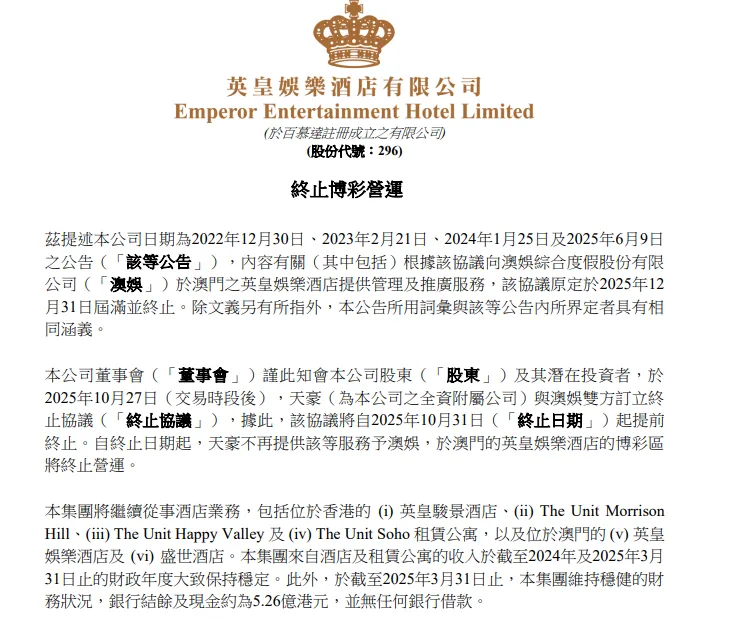
Core Viewpoint - The recent closure of the Emperor Palace Casino in Macau marks a significant shift in the local gaming landscape, with implications for the Emperor Group and its financial health [1][2][9]. Group 1: Company Operations - Emperor Palace Casino ceased operations on October 30, 2023, at 23:59, following a termination agreement between its subsidiary, Tianhao, and AUB [2][9]. - The Emperor Entertainment Hotel will continue its hotel business, including properties like the Emperor Scenic Hotel in Hong Kong, despite the casino closure [10]. - The casino was known for its lavish opening in 2006, featuring a lobby adorned with 78 kilograms of gold, and had generated approximately HKD 1.2 billion in revenue for the fiscal year ending March 31, 2007 [10]. Group 2: Financial Performance - Emperor International reported a total revenue of HKD 1.375 billion for the fiscal year ending March 31, 2025, a 41.5% increase from the previous year, but the net loss increased from HKD 20.28 billion to HKD 48.4 billion, a 138% rise [13][15]. - As of March 31, 2023, Emperor International had HKD 16.6 billion in overdue bank loans, raising concerns about its ongoing viability [15]. - The company has been actively selling assets to improve its financial situation, including properties in Hong Kong and London, with significant price reductions [16][18]. Group 3: Industry Context - The closure of the Emperor Palace Casino is part of a broader trend, as other operators like AUB and Melco International have also announced the cessation of operations at satellite casinos [5][6]. - The gaming industry in Macau is facing increased competition and regulatory scrutiny, impacting the profitability of existing casinos [10].

澳门知名娱乐场英皇宫殿宣布停运,老板为英皇掌门人杨受成;曾以大堂铺满78公斤黄金闻名
Sou Hu Cai Jing· 2025-11-05 08:31
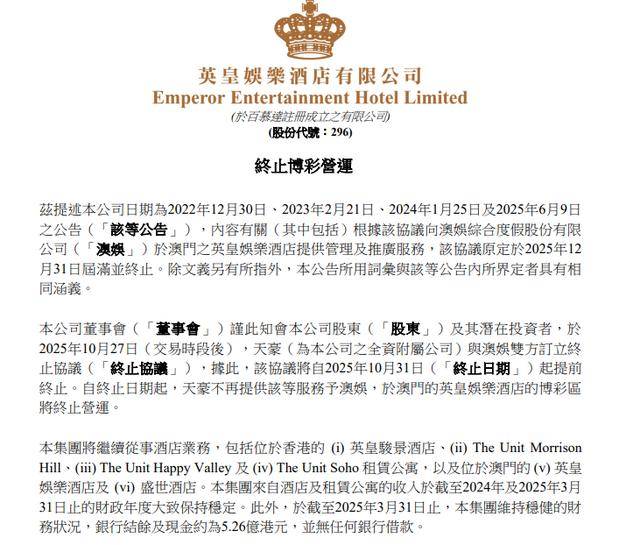
Core Viewpoint - The recent closure of the Emperor Palace Casino in Macau marks a significant shift in the local gaming industry, reflecting ongoing challenges faced by the Emperor Group and its subsidiaries [1][3][6]. Group 1: Company Operations - Emperor Entertainment Hotel announced the termination of its gaming operations at the Emperor Palace Casino, effective October 30, 2023, following an agreement with its subsidiary, Tianhao, and Aoyou [1][6]. - The Emperor Palace Casino, which opened on January 20, 2006, was once a prominent player in Macau's gaming sector, generating approximately HKD 1.2 billion in revenue for the fiscal year ending March 31, 2007 [9]. - Despite the closure of the casino, Emperor Entertainment Hotel plans to continue its hotel operations, maintaining stable income from its hotel and rental apartment businesses [9]. Group 2: Financial Challenges - Emperor International reported a significant increase in losses, with the loss rising from HKD 20.28 billion to HKD 48.4 billion year-on-year, marking a 138% increase [13]. - The company faces a severe debt crisis, with HKD 16.6 billion in bank loans overdue or in violation of terms, raising concerns about its ongoing viability [14]. - To address its financial situation, the Emperor Group has been actively selling properties, including residential projects in Hong Kong and properties in Macau, to improve liquidity [16][17]. Group 3: Market Impact - Following the announcement of the casino's closure and the financial difficulties faced by Emperor International, the stock prices of Emperor Group and its subsidiaries experienced a significant decline [16]. - The company's recent financial struggles can be traced back to previous operational failures, including the closure of its cinema business in 2022, which had accumulated substantial debts [17].

帮主郑重:7000亿"活水"来袭,市场要沸腾了?
Sou Hu Cai Jing· 2025-11-05 01:42
Core Viewpoint - The central bank is set to inject 700 billion yuan through a buyout-style reverse repurchase operation, marking one of the largest operations this year, aimed at ensuring liquidity in the market for three months [1][3]. Group 1: Central Bank Operations - The operation has a term of 91 days, indicating a focus on maintaining stable liquidity through the year-end [3]. - The use of multiple price bidding allows more institutions to access funds, enhancing the distribution of liquidity [3]. - The buyout-style reverse repurchase provides greater flexibility in fund usage, showcasing a strategic approach to liquidity management [3]. Group 2: Market Implications - The liquidity injection is expected to lead to three major benefits: increased cash availability for banks, enhanced lending capacity, and alleviated pressure on the bond market, potentially stabilizing yields [3]. - The stock market sentiment is likely to improve, particularly benefiting sectors sensitive to funding [3]. - Investment focus can be directed towards banks and brokerage sectors, as well as real estate and infrastructure chains that are sensitive to funding rates [3].
英大证券晨会纪要-20251104
British Securities· 2025-11-04 05:30
Core Insights - The report indicates a market style shift from high-valuation growth stocks to low-valuation weighted stocks, reflecting a clear trend of capital migration towards more stable and lower-risk investments [2][3][10] Market Overview - On Monday, the three major indices in the A-share market showed a rebound after a dip, with significant gains in heavyweight sectors such as coal, oil, banking, and steel, contrasting with the underperformance of the ChiNext and Sci-Tech 50 indices [2][5][9] - The overall market sentiment was active, with a total trading volume of 21,071 billion, and the Shanghai Composite Index closing at 3,976.52 points, up 0.55% [6][12] Sector Performance - The cultural media sector saw substantial gains, with a year-to-date increase of 42.75% in the first half of 2023, although it experienced a 15.58% pullback in the third quarter [7] - The Hainan Free Trade Zone concept stocks surged due to the announcement of the full island closure operation set to officially start on December 18, 2023 [8] Future Market Trends - The current "elephant dance" market signals a positive macroeconomic outlook, indicating a recovery in market confidence regarding economic fundamentals [3][10] - The report suggests a more balanced market style in the fourth quarter, with a focus on "technology growth," "cyclical sectors," and "stable dividend core assets" for better cost-performance ratios [3][11] - Investment strategies should focus on technology growth sectors, high-dividend defensive stocks, and cyclical styles, while being cautious of overhyped growth stocks lacking solid performance backing [11]
美股2026年度策略 | 高处如何布局?
Sou Hu Cai Jing· 2025-11-04 05:27
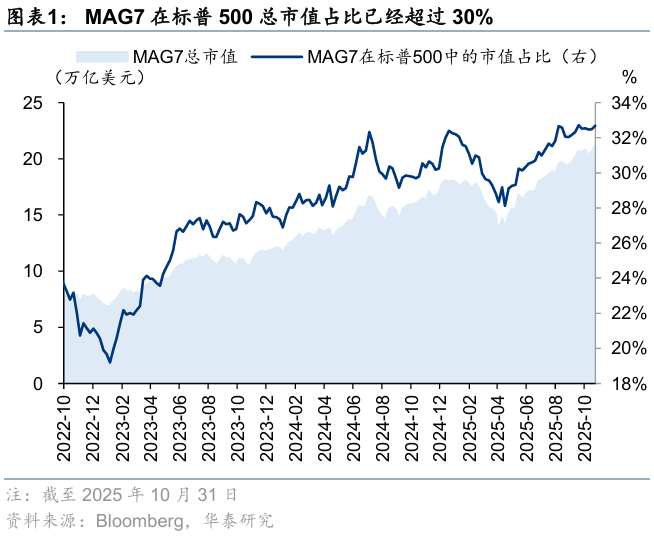
Group 1: Market Overview - The liquidity easing trend is expected to continue until the first half of 2026, with a focus on cyclical economic recovery in the second half of the year [1][5] - The U.S. stock market has experienced a K-shaped divergence, with the MAG7 companies contributing significantly to market capitalization growth [2][6] - As of October 31, 2025, the MAG7 companies accounted for over 30% of the S&P 500's total market capitalization, contributing nearly 50% of the market's expansion since 2023 [6][10] Group 2: Technology Sector Analysis - The current technology market is reminiscent of the late 1990s, with a concentration on high-quality large-cap stocks, raising concerns about potential market bubbles [3][22] - The EPS growth contribution from top tech stocks has been substantial, with MAG7's EPS growth reaching 24.7% [23][34] - Speculative trading has increased, with leverage in the stock market nearing levels seen during the 2020 QE period [34][35] Group 3: Economic Projections - The U.S. economy is expected to maintain a K-shaped divergence, but the driving factors may become more balanced compared to the past [4][57] - Bloomberg forecasts a 13.7% EPS growth for the S&P 500 in 2026, with a slowdown in capital expenditure growth for MAG7 [57][59] - Traditional economic recovery is anticipated to accelerate, supported by reduced trade policy uncertainty and monetary easing [57][63] Group 4: Investment Strategy Recommendations - Investors are advised to focus on profitable leading companies in the tech sector while gradually increasing exposure to cyclical sectors as the year progresses [5][64] - Historical data suggests that cyclical sectors tend to perform well after the end of a rate-cutting cycle, with significant positive returns expected [64][66] - Global diversification is recommended, with particular attention to developed markets like Germany and Switzerland, and emerging markets such as Saudi Arabia, South Korea, and India [65][67]