
原油

Search documents
综合晨报-20260122
Guo Tou Qi Huo· 2026-01-22 02:20
Report Summary 1. Report Industry Investment Ratings - Not provided in the given content. 2. Core Views of the Report - Short - term geopolitical tensions and a weakening dollar support oil prices, but inventory accumulation limits the upside potential [2]. - Precious metals are likely to remain strong in the medium - term, with short - term adjustments to fix overbought technical indicators [3]. - Most commodities are expected to show a pattern of short - term fluctuations, and investors need to pay attention to supply - demand changes, geopolitical risks, and policy impacts [2][3][4]. 3. Summary by Commodity Categories Energy - **Crude Oil**: The US strengthens military deployment in the Middle East. Kazakhstan's oil production may be suspended. The IEA raises the 2026 demand forecast, with reduced first - quarter supply surplus. Venezuelan exports are slow, and oil price rebound is limited [2]. - **Fuel Oil & Low - Sulfur Fuel Oil**: Geopolitical factors are dominant. High - sulfur fuel oil is supported in the short - term but pressured in the medium - term. Low - sulfur fuel oil has winter demand support but faces supply pressure [22]. - **Asphalt**: Military actions in the Middle East and oil price rebounds drive asphalt up. There are concerns about future raw material shortages [23]. Metals - **Precious Metals**: Overnight, precious metals fluctuated downward. The medium - term strength remains unchanged, with short - term adjustments [3]. - **Base Metals** - **Copper**: Overnight, LME copper fell. The US market premium cooled, and a short - position strategy is recommended in the domestic market [4]. - **Aluminum**: Overnight, Shanghai aluminum continued to fluctuate. The 23,800 - yuan level is supported, and it's advisable to wait and see [5]. - **Zinc**: Supply - side pressure is limited, but high prices have a negative impact on consumption. Zinc is expected to fluctuate at a high level in the short - term, with a medium - term short - selling strategy [8]. - **Lead**: The lead price fluctuates between 17,000 - 17,800 yuan/ton. Low - buying is recommended [9]. - **Nickel and Stainless Steel**: Shanghai nickel fluctuates at a high level. The negative feedback risk of stainless - steel consumption is increasing, but the short - term is still dominated by policy sentiment, and a long - position strategy is maintained [10]. - **Tin**: Overnight, tin prices opened high and closed low. A strategy of selling call options at a high level is recommended [11]. - **Carbonate Lithium**: It has risen sharply, but the downstream acceptance is low. The price is in a high - level shock, and risk prevention is needed [12]. - **Industrial Silicon**: The futures fluctuate. The supply reduction expectation is controversial, and the demand has no clear increase. The price is expected to fluctuate, and the implementation of major factory production cuts should be tracked [13]. - **Polysilicon**: The market is light. Production is expected to decline, and the futures fluctuate around 50,000 yuan/ton. Wait for the exchange's guidance [14]. - **Iron and Steel** - **Rebar & Hot - Rolled Coil**: Night - session steel prices rebounded slightly. Rebar demand is weak, and hot - rolled coil de - stocking is slow. The market will fluctuate in a range [15]. - **Iron Ore**: The global shipping volume decreased, and the domestic arrival volume declined. The port inventory is increasing. It is expected to fluctuate in the short - term [16]. - **Coke**: The price rebounded slightly. The supply is abundant, and it is likely to follow a weak - shock pattern [17]. - **Coking Coal**: The price rebounded slightly. The supply is abundant, and it is likely to follow a weak - shock pattern [18]. - **Manganese Silicon**: The price fluctuated downward. Manganese ore prices rose, and iron - water production decreased. A short - selling strategy on rebounds is recommended [19]. - **Silicon Iron**: The price fluctuated downward. Affected by policies, the demand is resilient, and a short - selling strategy on rebounds is recommended [20]. Chemicals - **Urea**: The spot price is weakly stable. Production increases, demand starts, and the long - term decline space is limited [24]. - **Methanol**: The futures fluctuate strongly. Demand decreases, inventory accumulates, but there is support from reduced imports in Q1, and it is expected to be in a stalemate [25]. - **Pure Benzene**: The night - session price rose. Supply decreases, demand increases, and the short - term trend is strong [26]. - **Styrene**: Some domestic producers' sales are good, and the supply is tight, providing support [27]. - **Polypropylene, Plastic & Propylene**: Supply and demand are both weak. Some markets have supply shortages, but downstream demand is weak [28]. - **PVC & Caustic Soda**: PVC is weak, and there is a possibility of capacity reduction. Caustic soda is also weak with high inventory [29]. - **PX & PTA**: There is pressure in the short - term, but there are opportunities for PX processing spreads and month - spreads in Q2 [30]. - **Ethylene Glycol**: Supply is expected to increase domestically and decrease overseas. There is a short - term inventory accumulation expectation, but improvement is expected in Q2 [31]. - **Short - Fiber & Bottle Chips**: Short - fiber follows cost fluctuations, and bottle - chip processing spreads have improved, but long - term capacity pressure exists [32]. Agricultural Products - **Grains and Oils** - **Soybeans & Soybean Meal**: US soybeans fluctuate strongly at the bottom. South American weather is improving, and the focus is on export and weather [36]. - **Soybean Oil & Palm Oil**: US bio - fuel policies are positive for soybean oil. Indonesian palm oil policies are uncertain, and Malaysian palm oil supply - demand improves marginally [37]. - **Rapeseed Meal & Rapeseed Oil**: The external market rises, the domestic supply is tight in the short - term, and the price is expected to fluctuate at the bottom [38]. - **Soybean No.1**: The price of domestic soybeans fell. Pay attention to policy and spot guidance [39]. - **Corn**: The supply is relatively sufficient. The futures are expected to fluctuate, and pay attention to sales progress and auctions [40]. - **Livestock and Poultry** - **Pigs**: The futures fell for three consecutive days. The short - term rebound may end, and there may be a low point next year [41]. - **Eggs**: The futures fluctuate. The long - term fundamental improvement is expected, and a long - position strategy is recommended on dips [42]. - **Other Agricultural Products** - **Cotton**: US cotton fell, and Zheng cotton fluctuates at a high level. The demand is stable, and the supply reduction policy has uncertainties [43]. - **Sugar**: International production varies, and domestic production progress is different. The short - term price faces pressure [44]. - **Apples**: The futures price回调. The focus is on demand, and the de - stocking speed may be affected [45]. - **Timber**: The price is low. Low inventory provides support, and it's advisable to wait and see [46]. - **Paper Pulp**: The futures fell slightly. The demand is weak, inventory accumulates, and it's advisable to wait and see [47]. Others - **Container Shipping Index (European Line)**: Spot prices are expected to decline, and near - term contracts have limited downside. The market will enter an observation period before the Spring Festival, and the focus of far - term contracts is the resumption of navigation [21]. Financial Instruments - **Stock Index**: A - share indexes rose, and the short - term trend is expected to be upward. The medium - term trend depends on the transition to profit - driven [48]. - **Treasury Bonds**: 30 - year treasury bond futures rose. Pay attention to potential curve - flattening opportunities and market warming signals [49].
特朗普:美国从委内瑞拉获取了5000万桶原油
中国能源报· 2026-01-22 01:54
Core Viewpoint - The article highlights that the United States acquired 50 million barrels of crude oil from Venezuela last week, as stated by President Trump during the World Economic Forum in Davos [1]. Group 1 - The acquisition of 50 million barrels of crude oil from Venezuela indicates a significant development in U.S.-Venezuela relations and the global oil market [1].


银河期货每日早盘观察-20260122
Yin He Qi Huo· 2026-01-22 01:29
Report Industry Investment Rating No relevant content provided. Core Viewpoints of the Report The report provides a comprehensive analysis of various futures markets, including financial derivatives, agricultural products, black metals, non - ferrous metals, shipping, and energy chemicals. It assesses the supply - demand situation, price trends, and offers trading strategies for each sector, taking into account factors such as geopolitical events, seasonal patterns, and policy changes. Summary by Category Financial Derivatives - **Core Viewpoint**: The stock index shows differentiation and resilience. Although the ETF trading volume of broad - based indexes is abnormal, it does not affect market activity. The CSI 500 index is relatively strong, and the stock index is expected to fluctuate. [20][21] - **Trading Strategy**: Short - term grid operation for single - side trading; IM\IC long 2606 + short ETF cash - and - carry arbitrage; double - selling strategy for options. [22] Agricultural Products - **Protein Meal**: Supply - side pressure is high, and the market rebounds slightly. It is recommended to take a bearish view on single - side trading, expand the MRM spread in arbitrage, and use the strategy of selling wide - straddle options. [24][25] - **Sugar**: International sugar prices are expected to oscillate at the bottom in the short term, and Zhengzhou sugar is expected to be weak in the short term but with limited downward space. It is advisable to wait and see for arbitrage and options. [28][29] - **Oilseeds and Oils**: The US biofuel policy is expected to boost the market. Oils are expected to fluctuate in the short term, and it is recommended to use high - selling and low - buying interval operations for single - side trading and wait and see for arbitrage and options. [31][32] - **Corn/Corn Starch**: The US corn is expected to oscillate at the bottom in the short term, and the domestic corn spot is stable in the short term but under pressure in the long term. For single - side trading, a bullish view on the US 03 corn after stabilization and short - selling on the domestic 03 corn at high prices; for arbitrage, widen the spread between 05 corn and starch and conduct a 35 - starch reverse spread. [33][34][35] - **Hogs**: Supply pressure increases, and the spot price continues to decline. It is recommended to take a bearish view on single - side trading and use the strategy of selling wide - straddle options. [36][37][38] - **Peanuts**: The spot price is stable, and the market oscillates at the bottom. For single - side trading, go long on the 05 contract at low prices; for options, sell the pk603 - C - 8200 option. [39][40] - **Eggs**: As the Spring Festival approaches, the spot price rises, but the upward space of the 03 contract is limited. It is recommended to go long on the 5 - month far - month contract for single - side trading and wait and see for arbitrage and options. [43][44][45] - **Apples**: The pre - festival sales are good, and the price is firm. For single - side trading, go long on the May contract at low prices and short - sell the October contract at high prices; for arbitrage, go long on the May contract and short - sell the October contract. [47][48][49] - **Cotton - Cotton Yarn**: The short - term cotton price is expected to oscillate in the range, and it is recommended to wait and see for arbitrage and options. [51][52] Black Metals - **Steel**: Demand is marginally weakening, and steel prices continue to oscillate. For single - side trading, the steel price stabilizes in the short term and oscillates at the bottom; for arbitrage, short - sell the coil - coal ratio at high prices and continue to hold the short - selling of the coil - screw spread. [54][55] - **Coking Coal and Coke**: The fundamentals are lackluster, and the market sentiment is weakening. It is recommended to wait and see for single - side trading and partially take profit on the previous strategy of selling out - of - the - money call options for options. [56][57] - **Iron Ore**: Market expectations are fluctuating, and ore prices are running weakly. It is recommended to take a bearish view on single - side trading and wait and see for arbitrage and options. [59][60][61] - **Ferroalloys**: After adjustment, the bottom support is strong. For single - side trading, consider ferroalloys as long - position options when the price is low; for options, sell put options at high prices. [62][63] Non - Ferrous Metals - **Gold and Silver**: Due to the turning of risk events, gold and silver prices retreat. For single - side trading, short - term investors in Shanghai gold can take profit at high prices, and long - term investors can hold with the 5 - day moving average as support; for options, buy out - of - the - money call options for Shanghai gold and take profit at high prices. [65][66][67] - **Platinum and Palladium**: TACO pushes up the US dollar index, and precious metal prices are under pressure. It is recommended to wait and see for single - side trading, arbitrage, and options. [68][69] - **Copper**: The upward momentum weakens, and copper prices consolidate at a high level. It is recommended to wait and see for single - side trading, arbitrage, and options. [71][72][73] - **Alumina**: It mainly oscillates weakly. It is recommended to pay attention to the trading activity after the price continues to fall. [77] - **Electrolytic Aluminum**: Market sentiment fluctuates, and aluminum prices oscillate and stabilize. For single - side trading, it is expected to be strong in the medium term; it is recommended to wait and see for arbitrage and options. [79][80] - **Cast Aluminum Alloy**: It oscillates at a high level with the sector. For single - side trading, it oscillates and stabilizes; it is recommended to wait and see for arbitrage and options. [81] - **Zinc**: Pay attention to changes in domestic social inventories. It is recommended to wait and see for single - side trading, arbitrage, and options. [83][84][85] - **Lead**: Pay attention to capital sentiment. For single - side trading, go long lightly at low prices near the 17000 - 17200 support level; it is recommended to wait and see for arbitrage and options. [88][89] - **Nickel**: Optimistic sentiment remains, and nickel prices consolidate at a high level. For single - side trading, take a long - position view with a low - buying strategy; it is recommended to wait and see for arbitrage and options. [92] - **Stainless Steel**: Supply and demand are tight, and prices are firm. For single - side trading, take a long - position view with a low - buying strategy; it is recommended to wait and see for arbitrage. [95][96] - **Industrial Silicon**: Production - cut news is spreading, but coking coal drags down the market. It is expected to oscillate strongly in the short term. [96][97] - **Polysilicon**: Spot trading is at a standstill. Pay attention to the meeting this week. It is recommended to wait and see. [98][99] - **Lithium Carbonate**: It is running at a high level. Be cautious in operation. For single - side trading, buy at low prices; it is recommended to wait and see for arbitrage and options. [101][102][104] - **Tin**: Pay attention to capital conditions. For single - side trading, go long after the callback stabilizes; for options, sell out - of - the - money put options. [106][107][108] Shipping - **Container Shipping**: Spot freight rates continue to decline, and the geopolitical situation has escalated. For single - side trading, wait and see due to many short - term disturbances; for arbitrage, hold the 6 - 10 positive spread. [109][110] Energy Chemicals - **Crude Oil**: Cold snaps in Europe and the US drive up oil prices. It is expected to oscillate widely. It is recommended to wait and see for arbitrage and options. [112] - **Asphalt**: Demand is declining, and geopolitics is still the main driver. For single - side trading, the main 03 contract oscillates strongly; for arbitrage, pay attention to the BU4 - 6 positive spread. [114][115][116] - **Fuel Oil**: The cost oscillates. Pay attention to the supply rhythm of high - and low - sulfur fuel oils. For single - side trading, it oscillates strongly, and beware of geopolitical risks; for arbitrage, pay attention to the FU59 positive spread. [117][118] - **LPG**: Propane still has support. It is expected to oscillate widely. It is recommended to wait and see for arbitrage and options. [119][120] - **Natural Gas**: TTF/JKM is strong in the short term, and HH is in a short - squeeze situation. For single - side trading, hold the short positions in the third - quarter TTF or JKM contracts and consider adding positions for aggressive investors; for options, sell out - of - the - money call options of TTF or JKM. [122][123][125] - **PX&PTA**: Polyester production cuts are increasing. It is expected to oscillate widely. It is recommended to wait and see for arbitrage and options. [127][128] - **BZ&EB**: The transaction of South Korean pure benzene to the US Gulf is good, and the supply of styrene decreases due to accidental plant shutdowns. It is expected to oscillate strongly in the short term. For options, sell put options. [128][129][130] - **Ethylene Glycol**: Seasonal inventory accumulation is obvious, and the price is falling weakly. For single - side trading, it is expected to oscillate weakly; for options, sell call options. [131][133] - **Short - Fiber**: Supply is sufficient, and terminal demand is weakening. It is expected to oscillate widely. It is recommended to wait and see for arbitrage and options. [134][135] - **Bottle Chips**: Maintenance accelerates in late January. It is expected to oscillate widely. It is recommended to wait and see for arbitrage and options. [136][138] - **Propylene**: Supply pressure is relieved. It is expected to oscillate at a high level. It is recommended to wait and see for arbitrage and options. [140][141][142] - **Plastic PP**: Hold long positions. For single - side trading, hold long positions in the L 2605 and PP 2605 contracts. [144][145] - **Caustic Soda**: The price is weakening. It is expected to have a weak trend. It is recommended to wait and see for arbitrage and options. [146][147][148] - **PVC**: It oscillates weakly. It is expected to oscillate strongly in the short term. [149][150] - **Soda Ash**: The futures price is falling. It is recommended to short - sell at an appropriate time. It is expected to have a weak trend. [151][152][153] - **Glass**: The futures price is falling. It is recommended to short - sell at an appropriate time before the Spring Festival. [155][156] - **Methanol**: Geopolitical tensions ease, and it oscillates narrowly. For single - side trading, short - sell in the short term; for arbitrage, pay attention to the 59 positive spread; for options, sell put options on the callback. [161][162] - **Urea**: It oscillates. It is recommended to operate cautiously. [163][164] - **Pulp**: The pulp price oscillates weakly. Hold short positions. It is recommended to wait and see for arbitrage and options. [166][167][169] - **Logs**: The spot price is stable and slightly strong. For single - side trading, it is recommended to wait and see, and aggressive investors can buy a small amount near the low point of last month; for arbitrage, close the LG03 - 05 reverse spread and switch to a positive spread. [170][171] - **Offset Printing Paper**: Inventory is high, and the rebound of cultural paper is weak. For options, sell the OP2602 - C - 4200 option. [173][174] - **Natural Rubber and No. 20 Rubber**: The import volume of Indian - standard rubber decreases significantly. It is recommended to wait and see for single - side trading, arbitrage, and options. [175][177] - **Butadiene Rubber**: Domestic automobile inventory accumulates both monthly and yearly. For single - side trading, wait and see; for arbitrage, hold the BR2605 - RU2605 spread with a stop - loss at - 4000. [179][180]
多极化世界格局逐步演变:申万期货早间评论-20260122
申银万国期货研究· 2026-01-22 01:11
Core Viewpoint - The article discusses the evolving multipolar world order, highlighting the geopolitical tensions and their impact on various markets, particularly focusing on commodities like oil, lithium carbonate, and precious metals [1][2][4]. Group 1: Geopolitical Developments - The U.S. has officially exited the World Health Organization after a year of submitting its application, which reflects a significant shift in international relations [1]. - Tensions surrounding Greenland's sovereignty have been emphasized, with Denmark firmly stating it will not negotiate with the U.S. on this matter [1]. Group 2: Commodity Market Insights - **Oil**: The SC night market saw a 1.22% increase, with geopolitical risks diminishing as Trump adopts a wait-and-see approach regarding Iran. The OPEC report predicts stable demand for oil from member countries, with daily demand expected to rise to 43 million barrels by 2026 [2][15]. - **Lithium Carbonate**: The weekly production of lithium carbonate increased by 70 tons to 22,605 tons, with strong terminal demand. However, the price surge may suppress end-user demand in the short term [3][25]. - **Precious Metals**: Gold prices continue to rebound due to rising geopolitical uncertainties, while silver and platinum are supported by supply-demand gaps. The macroeconomic environment, including easing inflation pressures in the U.S., is expected to support the long-term upward trend of precious metals [4][20]. Group 3: Financial Market Trends - The stock market is experiencing a shift from valuation-driven growth to profit-driven growth, with expectations of continued upward movement supported by supply-side reforms and economic recovery [12]. - The bond market shows a slight increase in long-term yields, with the central bank maintaining a stable monetary policy while indicating potential for further easing [13]. Group 4: Industry-Specific Developments - **Artificial Intelligence**: The core industry scale of AI in China is expected to exceed 1.2 trillion yuan by 2025, with significant advancements in humanoid robots and 6G technology trials [9]. - **Agricultural Products**: Brazil's soybean harvest is progressing, with expectations of increased production, while domestic pressures on soybean prices remain due to high inventory levels [30]. Group 5: Shipping and Logistics - The shipping index is experiencing downward pressure as Maersk reduces prices to attract cargo ahead of the Chinese New Year, indicating a potential decline in freight rates [34].

五矿期货能源化工日报-20260122
Wu Kuang Qi Huo· 2026-01-22 01:04
Report Industry Investment Rating No relevant content provided. Core Views of the Report - For crude oil, it is recommended to take profit on the heavy oil crack spread and go long on crude oil at low levels within the shale oil break - even cost range [1]. - For methanol, considering the low current valuation and the marginal improvement in the pattern next year, there is limited downside space. Due to the geopolitical instability in Iran, there is a feasibility of going long at low levels [2]. - For urea, with the import window opened by the current internal - external price difference and the expected increase in production at the end of January, it is advisable to take profit at high levels [5]. - For rubber, with its weak seasonality, it is expected to continue to decline after consolidation. Adopt a short - selling strategy when RU2605 breaks below 16000, and partially build positions for the strategy of buying NR main contract and short - selling RU2609 [10]. - For PVC, the domestic supply is strong while the demand is weak. In the short term, there is an expectation of short - term export rush due to the cancellation of export tax rebates on April 1. In the medium term, maintain a short - selling strategy [13]. - For pure benzene and styrene, it is advisable to go long on the non - integrated profit of styrene before the first quarter [16]. - For polyethylene, OPEC+ plans to suspend production growth in the first quarter of 2026, and the overall inventory may decline from a high level, which supports the price [18]. - For polypropylene, in the context of weak supply and demand, the overall inventory pressure is high. In the long term, the contradiction has shifted from cost - driven decline to production mismatch. It is advisable to go long on the PP5 - 9 spread at low levels [21]. - For PX, it is expected to maintain an inventory - building pattern before the maintenance season. After the Spring Festival, both supply and demand with downstream PTA are strong. Pay attention to the opportunity of going long at low levels following crude oil [24]. - For PTA, it is expected to enter the Spring Festival inventory - building stage. After the Spring Festival, there is still room for valuation increase. Pay attention to the opportunity of going long at low levels [27]. - For ethylene glycol, the current overall load is still high, and the inventory - building cycle at ports will continue. In the medium term, there is an expectation of further compressing profits and reducing production [30]. Summary by Related Catalogs Crude Oil - **Market Information**: INE main crude oil futures closed up 2.30 yuan/barrel, or 0.52%, at 440.80 yuan/barrel. High - sulfur fuel oil futures rose 20.00 yuan/ton, or 0.79%, to 2542.00 yuan/ton, and low - sulfur fuel oil futures rose 12.00 yuan/ton, or 0.39%, to 3090.00 yuan/ton. In the weekly data of Fujeirah port, gasoline inventory increased by 0.09 million barrels to 7.07 million barrels, diesel inventory decreased by 0.23 million barrels to 2.50 million barrels, fuel oil inventory decreased by 1.69 million barrels to 8.77 million barrels, and total refined oil inventory decreased by 1.82 million barrels to 18.33 million barrels [1]. - **Strategy View**: Take profit on the heavy oil crack spread and go long on crude oil at low levels within the shale oil break - even cost range [1]. Methanol - **Market Information**: Regional spot prices in Jiangsu decreased by 9 yuan/ton, in Lunan increased by 5 yuan/ton, in Henan increased by 5 yuan/ton, in Hebei decreased by 30 yuan/ton, and in Inner Mongolia decreased by 12.5 yuan/ton. The main futures contract rose 10.00 yuan/ton to 2209 yuan/ton, and MTO profit increased by 12 yuan [1]. - **Strategy View**: Considering the low current valuation and the marginal improvement in the pattern next year, there is limited downside space. Due to the geopolitical instability in Iran, there is a feasibility of going long at low levels [2]. Urea - **Market Information**: Regional spot prices in Shandong, Henan, Hebei, Hubei, Jiangsu, and Northeast remained unchanged, while in Shanxi it decreased by 10 yuan/ton. The overall basis was reported at - 29 yuan/ton. The main futures contract rose 4 yuan/ton to 1779 yuan/ton [4]. - **Strategy View**: With the import window opened by the current internal - external price difference and the expected increase in production at the end of January, it is advisable to take profit at high levels [5]. Rubber - **Market Information**: Rubber prices rebounded in a volatile manner. Bulls are optimistic due to seasonal expectations and demand expectations, while bears are pessimistic due to weak demand. As of January 15, 2026, the operating rate of all - steel tires in Shandong tire enterprises was 62.84%, up 2.30 percentage points from last week and 2.78 percentage points from the same period last year. The operating rate of semi - steel tires in domestic tire enterprises was 74.35%, up 6.35 percentage points from last week but down 4.09 percentage points from the same period last year. As of January 11, 2026, the total social inventory of natural rubber in China was 125.6 tons, a month - on - month increase of 2.4 tons [7][8]. - **Strategy View**: With its weak seasonality, it is expected to continue to decline after consolidation. Adopt a short - selling strategy when RU2605 breaks below 16000, and partially build positions for the strategy of buying NR main contract and short - selling RU2609 [10]. PVC - **Market Information**: The PVC05 contract fell 64 yuan to 4743 yuan. The spot price of Changzhou SG - 5 was 4500 (- 60) yuan/ton, the basis was - 243 (+ 4) yuan/ton, and the 5 - 9 spread was - 118 (0) yuan/ton. The overall PVC operating rate was 79.6%, flat month - on - month. Factory inventory was 31.1 tons (- 1.7), and social inventory was 114.4 tons (+ 3) [12]. - **Strategy View**: The domestic supply is strong while the demand is weak. In the short term, there is an expectation of short - term export rush due to the cancellation of export tax rebates on April 1. In the medium term, maintain a short - selling strategy [13]. Pure Benzene and Styrene - **Market Information**: The spot price of pure benzene in East China remained unchanged at 5675 yuan/ton, and the active contract closed at 5805 yuan/ton, also unchanged. The spot price of styrene fell 50 yuan/ton to 7350 yuan/ton, and the active contract closed at 7203 yuan/ton, down 92 yuan/ton. The upstream operating rate was 70.86%, down 0.06%. Jiangsu port inventory decreased by 3.17 tons [15]. - **Strategy View**: It is advisable to go long on the non - integrated profit of styrene before the first quarter [16]. Polyethylene - **Market Information**: The main contract closed at 6666 yuan/ton, up 26 yuan/ton, and the spot price was 6640 yuan/ton, up 15 yuan/ton. The upstream operating rate was 81.56%, up 1.23% month - on - month. Production enterprise inventory decreased by 4.51 tons, and trader inventory remained unchanged [17]. - **Strategy View**: OPEC+ plans to suspend production growth in the first quarter of 2026, and the overall inventory may decline from a high level, which supports the price [18]. Polypropylene - **Market Information**: The main contract closed at 6485 yuan/ton, up 24 yuan/ton, and the spot price was 6575 yuan/ton, up 10 yuan/ton. The upstream operating rate was 76.61%, down 0.01% month - on - month. Production enterprise inventory decreased by 3.67 tons, trader inventory decreased by 1.08 tons, and port inventory decreased by 0.05 tons [19]. - **Strategy View**: In the context of weak supply and demand, the overall inventory pressure is high. In the long term, the contradiction has shifted from cost - driven decline to production mismatch. It is advisable to go long on the PP5 - 9 spread at low levels [21]. PX - **Market Information**: The PX03 contract fell 26 yuan to 7206 yuan. The PX CFR remained unchanged at 888 US dollars. The Chinese PX load was 89.4%, down 1.5% month - on - month, and the Asian load was 80.6%, down 0.6% month - on - month. From mid - to early January, South Korea's PX exports to China were 21.5 tons, a year - on - year decrease of 6.8 tons [23]. - **Strategy View**: It is expected to maintain an inventory - building pattern before the maintenance season. After the Spring Festival, both supply and demand with downstream PTA are strong. Pay attention to the opportunity of going long at low levels following crude oil [24]. PTA - **Market Information**: The PTA05 contract rose 10 yuan to 5154 yuan, and the East China spot price rose 70 yuan to 5085 yuan. The PTA load was 76.9%, down 1.3% month - on - month. Social inventory (excluding credit warehouse receipts) on January 16 was 204.5 tons, a month - on - month increase of 4 tons [26]. - **Strategy View**: It is expected to enter the Spring Festival inventory - building stage. After the Spring Festival, there is still room for valuation increase. Pay attention to the opportunity of going long at low levels [27]. Ethylene Glycol - **Market Information**: The EG05 contract rose 15 yuan to 3689 yuan, and the East China spot price fell 31 yuan to 3570 yuan. The ethylene glycol load was 74.4%, up 0.3% month - on - month. Port inventory decreased by 0.7 tons [29]. - **Strategy View**: The current overall load is still high, and the inventory - building cycle at ports will continue. In the medium term, there is an expectation of further compressing profits and reducing production [30].
金十数据全球财经早餐 | 2026年1月22日
Jin Shi Shu Ju· 2026-01-21 23:01
特朗普:股市下跌微不足道,股市将翻倍 瑞典养老金巨头清仓大部分美债 国投白银LOF:1月22日开市起停牌至收市 男生普通话版 下载mp3 女声普通话版 下载mp3 粤语版 下载mp3 西南方言版 下载mp3 东北话版 下载mp3 上海话版 下载mp3 今日优选 特朗普将很快宣布新美联储主席人选,但担心其上任后就"不忠" 格陵兰岛潜在协议曝光:小块割地供美军建基地 美国最高法院或拒绝特朗普罢免美联储理事库克的请求 黄仁勋被曝计划1月下旬访华 市场盘点 周三,特朗普称已就格陵兰岛问题形成了未来协议的框架,不会征收原定于2月1日生效的关税,美元指数突破横盘走势,最终收涨0.23%,报98.77;基准的 10年期美债收益率最终收报4.245%,对美联储政策利率敏感的2年期美债收益率收报3.597%。 现货黄金延续周二涨势,但因特朗普透露格陵兰岛问题似乎迎来转机,黄金涨幅收窄,最终收涨1.38%,报4828.90美元/盎司;现货白银由涨转跌,最终收 跌1.57%,报93.09美元/盎司。 消息称,哈萨克斯坦两个油田将再暂停生产七至十天,国际油价因供应趋紧上涨。WTI原油最终收涨1.98%,报60.81美元/桶;布伦特原 ...

能化维持偏弱对待
Tian Fu Qi Huo· 2026-01-21 12:07
Report Industry Investment Rating - The industry of energy and chemicals is maintained with a weak outlook [1] Core Viewpoints of the Report - The geopolitical premium in crude oil due to the Iran situation is facing a correction, and supply surplus is driving the price down. Chemicals are generally under pressure due to high supply, high inventory, and weak demand [2][3] Summary by Relevant Catalogs Crude Oil - Logic: The Iran geopolitical sentiment peaked on January 14 and reversed on January 15. The premium is being unwound, and supply surplus is pushing the price down [2][3] - Technical analysis: Daily and hourly charts show a downward structure. Hold short - positions with a stop - loss at 447, and there is a chance for a second short - entry [3][4] Asphalt - Logic: Weak supply - demand fundamentals in the off - season, the Venezuela situation is cooling, and the cost center is likely to shift down as the geopolitical premium in crude oil fades [8] - Technical analysis: Hourly chart shows a short - term oscillation. Temporarily hold off on trading [8] Styrene - Logic: Recent supply - demand improvement supports the price, but there are signs of a potential peak. After a breakdown, focus on short opportunities in pure benzene [10] - Technical analysis: Hourly chart shows a short - term upward structure with a potential top. The short - term support is at 7200 (03 contract). Temporarily hold off on trading and wait for a breakdown to short on rebounds [10][12] Pure Benzene - Logic: The price is pushed up by hedging purchases, but high inventory and potential pressure from crude oil price drops mean not to chase high prices [13] - Technical analysis: Hourly chart shows a short - term upward structure with a potential top. The short - term support is at 5580 (03 contract), and the 15 - minute support is at 515. Temporarily hold off on trading and look for short opportunities on rebounds after a 15 - minute breakdown [13] Rubber - Logic: No supply - side speculation before the new tapping season, weak demand due to high tire inventory, and high imports in Qingdao. It moves passively and weaker than synthetic rubber [16] - Technical analysis: Daily chart shows a medium - term oscillation, and the hourly chart shows a short - term decline. Look for short opportunities after a rebound, with a short - term pressure at 15900 [16] Synthetic Rubber - Logic: The cost - end crude oil may peak soon, and the driving logic for the previous rise is breaking down. The supply of butadiene is high, and synthetic rubber will face cost pressure [19][22] - Technical analysis: Daily chart shows a medium - term upward structure, and the hourly chart shows a short - term decline. Hold short - positions with a stop - loss at 11950 and look for a second short - entry at night [22] PX - Logic: The price rose due to early - stage capital inflow but is now facing a short - term correction due to increased supply, weak downstream acceptance, and a lower cost center. Wait for a second low - entry opportunity in the medium - term [26] - Technical analysis: Daily chart shows a medium - term upward structure, and the hourly chart shows a short - term decline. Temporarily hold off on trading during this short - term decline [26] PTA - Logic: High supply, weak downstream acceptance in the off - season, and a lower cost center lead to a short - term correction [27] - Technical analysis: Daily chart shows a medium - term upward structure, and the hourly chart shows a short - term decline. Temporarily hold off on trading [29] PP - Logic: The olefin industry chain has a weak fundamental outlook. It lacks a long - side driver and is suitable for a hedging strategy of long aromatics (PX, PTA) and short olefins [31] - Technical analysis: Hourly chart shows a short - term decline. Temporarily hold off on trading and look for short opportunities after a rebound [31] Methanol - Logic: Geopolitical premium is being unwound, high domestic supply, falling coal prices, high port inventory, and negative demand feedback [34] - Technical analysis: Daily and hourly charts show a decline. Look for short - entry opportunities on rebounds with a stop - loss at 2255 [34] PVC - Logic: High supply, high inventory, and weak demand. The differential electricity price policy in Shaanxi may reduce calcium carbide production, and the cancellation of export tax - rebate has a short - term positive and long - term negative impact [38] - Technical analysis: Daily chart shows a medium - term decline, and the hourly chart shows a short - term oscillation. Temporarily hold off on trading and look for short opportunities on rebounds in the 15 - minute cycle [38] Ethylene Glycol - Logic: High supply, weak demand in the off - season, and increasing port inventory lead to a downward - driving fundamental situation [39] - Technical analysis: Daily and hourly charts show a decline. Hold short - positions with a take - profit at 3770 [41] Plastic - Logic: The olefin industry chain has a weak fundamental outlook. It lacks a long - side driver and is suitable for a hedging strategy of long aromatics (PX, PTA) and short olefins [44] - Technical analysis: Daily and hourly charts show a decline. Wait for a rebound and then a short - entry signal [44] Soda Ash - Logic: High production, high inventory, and weak demand. There may be a rush - to - export market before April, but the export pressure will increase after April. Look for short opportunities after a rebound [46] - Technical analysis: Hourly chart shows a short - term decline. Temporarily hold off on trading and look for short opportunities on rebounds in the 15 - minute cycle [46] Caustic Soda - Logic: High supply, high inventory, and weak demand. The supply pressure remains high, and the downward trend is hard to reverse [50] - Technical analysis: Hourly chart shows a short - term decline. Temporarily hold off on trading and do not bottom - fish before the structure turns bullish [50]
金属普涨 伦沪锡涨逾5% 碳酸锂涨超7% 沪金突破1100元/克
Sou Hu Cai Jing· 2026-01-21 08:31
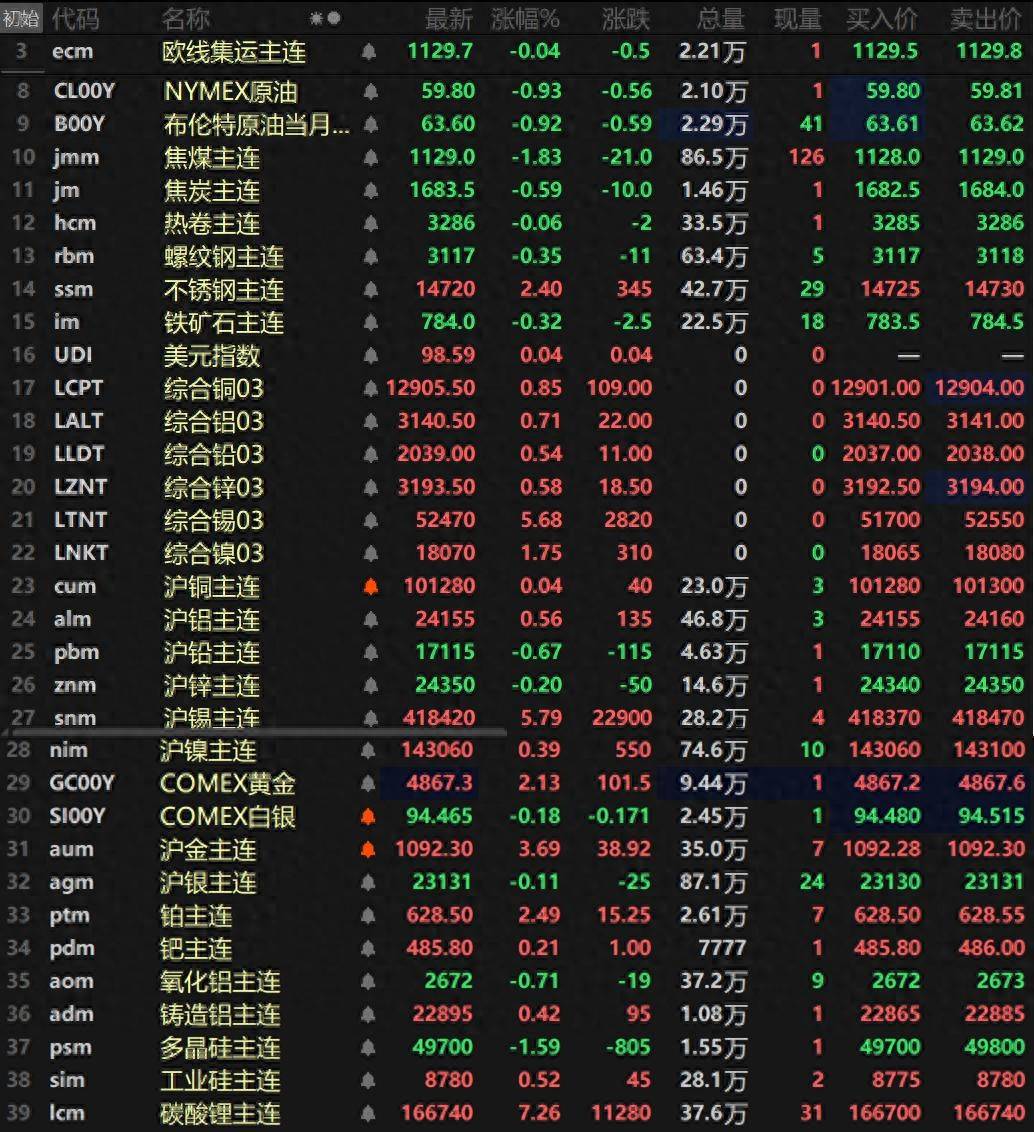
Metal Market - Domestic base metals experienced a general increase, with Shanghai lead and zinc both declining by 0.67% and 0.2% respectively. Shanghai tin led the gains with a rise of 5.79%, while other metals saw increases of less than 1% [1] - In the external market, base metals also showed positive performance, with London tin rising by 5.68% and nickel increasing by 1.75%. Other metals had gains of less than 1% [1] - Precious metals saw significant movements, with COMEX gold rising by 2.13% to a peak of $4891.1 per ounce, nearing the $4900 mark, setting a new historical high. COMEX silver fell by 0.18%, while domestic gold rose by 3.69% to a peak of 1101.92 yuan per gram, also setting a new historical high. Domestic silver decreased by 0.11% [1] Macro Environment - The Ministry of Industry and Information Technology announced plans to promote collaborative innovation in advanced materials across the entire supply chain, aiming to enhance the innovation capacity and development efficiency of the new materials industry [3] - The number of 5G users in China has exceeded 1.2 billion, with 483.8 million 5G base stations built, covering all towns and 95% of administrative villages. The country is also advancing in 6G technology, having completed the first phase of technical trials and starting the second phase [4] - The People's Bank of China conducted a net injection of 122.7 billion yuan through reverse repos, maintaining the operation rate at 1.40% [5] Oil Market - Both domestic and international oil prices fell, with U.S. oil down by 0.93% and Brent oil down by 0.92%. The U.S. President indicated that Venezuelan oil could help lower U.S. oil prices, while EIA forecasts a moderate recovery in crack spreads by 2026, with increasing refined oil inventories exerting short-term downward pressure on crude oil prices [8]
光大期货能化商品日报(2026年1月21日)-20260121
Guang Da Qi Huo· 2026-01-21 03:52
1. Report Industry Investment Rating There is no information about the industry investment rating in the provided report. 2. Core Viewpoints of the Report - The overall trend of the energy - chemical commodities market is volatile. Factors such as geopolitical issues (e.g., Trump's tariff threats over Greenland), weather conditions, and supply - demand relationships in different sectors are influencing the prices of various commodities [1][3][5]. - For specific commodities, the prices of crude oil, fuel oil, asphalt, polyester, rubber, methanol, polyolefins, and polyvinyl chloride are all expected to be in a state of oscillation in the short - term [1][3][5]. 3. Summary by Relevant Catalogs 3.1 Research Views - **Crude Oil**: On Tuesday, WTI February contract closed up $0.90 to $60.34 per barrel, a 1.51% increase; Brent March contract closed up $0.98 to $64.92 per barrel, a 1.53% increase; SC2603 closed at 442.5 yuan per barrel, up 4 yuan per barrel, a 0.91% increase. Trump's tariff threats over Greenland and cold weather in the US are affecting the oil price. The market should pay attention to the persistence of cold weather and potential well - freezing phenomena, as well as the linkage between oil and gas prices [1]. - **Fuel Oil**: On Tuesday, the main contract of fuel oil (FU2603) on the Shanghai Futures Exchange closed down 1.72% at 2512 yuan per ton; the main contract of low - sulfur fuel oil (LU2603) closed down 0.23% at 3078 yuan per ton. The supply of low - sulfur fuel oil is sufficient in January, and the downstream demand is supported. The high - sulfur fuel oil market structure has strengthened slightly, but the inflow of Venezuelan resources may have a negative impact. The absolute prices of FU and LU are likely to follow the oil price, with FU having higher volatility [3]. - **Asphalt**: On Tuesday, the main contract of asphalt (BU2602) on the Shanghai Futures Exchange closed down 0.03% at 3139 yuan per ton. The concern about the raw material has eased slightly this week. The unrest in Iran is the main driver of asphalt price fluctuations. The demand will shrink with the arrival of rain and snow, and the market is in a game between "weak demand reality" and "strong cost expectation" [3]. - **Polyester**: TA605 closed at 5144 yuan per ton on Tuesday, up 2.27%; EG2605 closed at 3674 yuan per ton, down 2.16%. The production and sales of polyester yarn in the Yangtze River Delta are weak. Some polyester devices have been restarted or shut down for maintenance. PX supply has shrunk, and its price has support. TA is expected to follow the raw material price, and EG is expected to oscillate at a low level [3][5]. - **Rubber**: On Tuesday, the main contract of natural rubber (RU2605) closed down 125 yuan per ton to 15620 yuan per ton, and the main contract of 20 - number rubber (NR) closed down 105 yuan per ton to 12550 yuan per ton. The overseas production season is coming to an end, tire companies are restocking, and the price of rubber is expected to oscillate widely in the short - term [5]. - **Methanol**: On Tuesday, the spot price in Taicang was 2198 yuan per ton. The domestic supply is at a high - level oscillation, and the Iranian supply is low. The MTO operating load has weakened. The methanol price is expected to maintain a bottom - level oscillation, and the market will focus on the restart plan of Ningbo Fude's device [5]. - **Polyolefins**: On Tuesday, the mainstream price of East China drawstring PP was 6330 - 6500 yuan per ton. In January, the supply will decrease slightly, and the demand will weaken in the second half of the month. The inventory is expected to rise, and the polyolefin price will continue to oscillate at the bottom [7]. - **Polyvinyl Chloride (PVC)**: On Tuesday, the price of PVC in East, North, and South China changed little. The supply is at a high - level oscillation, the domestic demand is slowing down, and the price is expected to maintain a bottom - level oscillation [7][8]. 3.2 Daily Data Monitoring - The report provides the daily data of various energy - chemical commodities, including spot price, futures price, basis, basis rate, and their changes. For example, the spot price of crude oil (SC) was 432.10 yuan per barrel on January 20, the futures price was 442.60 yuan per barrel, and the basis was - 6.40 yuan per barrel [9]. 3.3 Market News - Trump threatened to impose additional 10% tariffs on imports from multiple European countries starting from February 1st, and 25% from June 1st if no agreement on Greenland is reached. These tariff threats may lead to a slowdown in global economic growth and a reduction in oil demand. The EU is formulating a plan to support Arctic security, and European leaders oppose Trump's tariff threats and will counter - attack if the tariffs are implemented [11]. 3.4 Chart Analysis The report presents a series of charts to analyze the prices, basis, inter - period contract spreads, inter - variety spreads, and production profits of various energy - chemical commodities, including the main contract prices, basis, spreads between different contracts, and spreads between different varieties of crude oil, fuel oil, asphalt, and other commodities [12][27][35][49][55]. 3.5 Team Member Introduction - The research team includes the deputy director of the research institute, Zhong Meiyan, with over a decade of research experience in the futures derivatives market; the energy - chemical research director, Du Bingqin, with in - depth research on the energy industry; the natural rubber/polyester analyst, Di Yilin, who is good at data analysis; and the methanol/propylene/pure benzene PE/PP/PVC analyst, Peng Haibo, with rich experience in energy - chemical spot - futures trading [61][62][63][64].
天?寒冷美国天然??幅拉升,芳烃给出检修计划价格
Zhong Xin Qi Huo· 2026-01-21 01:38
Group 1: Report Industry Investment Rating - Not provided in the content Group 2: Core Views of the Report - The prices of oil and gas are rising, and due to the cold snap, coal prices are also strong, providing cost support for chemicals. Chemicals also have some industry benefits. Before the Spring Festival, there is an expectation of spring maintenance, and the market anticipates the possible "Golden March and Silver April" consumption peak after the Spring Festival. The futures prices have limited adjustment space and will generally fluctuate [2]. - Crude oil still has the possibility of geopolitical risks, and chemicals should be treated with a fluctuating mindset [3]. Group 3: Summary by Variety Crude Oil - **View**: Geopolitical premium fluctuates, and oil prices continue to oscillate. Supply pressure persists, but geopolitical premium may fluctuate. It should be viewed as oscillating in the short - term [3][6]. - **Main Logic**: Global on - land crude oil inventories have been accumulating, overseas refined oil inventories are under pressure, and the supply surplus pattern remains. The shutdown of Kazakhstan's Tengiz oilfield supports the Western market. Geopolitics is the short - term focus, and previous military actions between Iran and Israel had little impact on oil supply. If relevant tail risks materialize, oil prices are likely to rise and then fall. If the Iranian situation eases, oil prices may approach the lower limit of the oscillation range [6]. Asphalt - **View**: The high valuation of asphalt is gradually being revised downward, and it is expected to oscillate weakly in the medium - term [3][6][7]. - **Main Logic**: OPEC+ will suspend production increases in Q1, and the partial lifting of sanctions on Venezuela will increase its oil production and exports. The current asphalt market is still trading the reduction of discounts due to the US selling Venezuelan oil at the current price, which supports asphalt costs. However, it will lead to abundant long - term supply, which is a major negative for asphalt. The US - Iran situation has not further escalated, and the decline in crude oil has led to the downward revision of asphalt's high valuation. The supply and demand of asphalt are both weak, and inventory accumulation pressure is high [6]. High - Sulfur Fuel Oil - **View**: The geopolitical premium of fuel oil has declined, and it is expected to oscillate. Venezuelan oil production growth expectations will long - term pressure high - sulfur fuel oil, and short - term attention should be paid to the geopolitical situation in the Middle East [3][7]. - **Main Logic**: OPEC+ will suspend production increases, and the US is helping Venezuela increase oil production, leading to a strong expectation of a surge in heavy - oil supply, which pressures high - sulfur fuel oil in the long - term. The US - Iran situation has temporarily cooled, and the geopolitical premium of fuel oil has significantly declined. Although Iraq may resume fuel - oil power generation in the short - term, high floating storage in the Asia - Pacific region and the replacement of fuel - oil power generation by natural gas and photovoltaics in the Middle East are long - term negatives for high - sulfur fuel oil. The three driving forces supporting high - sulfur fuel oil are showing a cooling trend, but the expansion of the asphalt - fuel oil spread may increase the processing demand for fuel oil [7]. Low - Sulfur Fuel Oil - **View**: The futures price of low - sulfur fuel oil fluctuates widely and is expected to oscillate. It is affected by the substitution of green fuels and high - sulfur fuels, with limited demand space, but its current valuation is low and it follows crude - oil fluctuations [3][9]. - **Main Logic**: The futures price of low - sulfur fuel oil follows crude - oil fluctuations. The expected release of Venezuelan oil has led to an increase in the Brent - Dubai crude oil spread and a rebound in the low - high sulfur spread. Low - sulfur fuel oil has strong product attributes and is supported. However, it faces negative factors such as a decline in shipping demand, green - energy substitution, and high - sulfur substitution. The export tax - refund rate of low - sulfur fuel oil has an advantage over refined oil, and the pressure of reducing oil and increasing chemicals is likely to be transmitted to low - sulfur fuel oil, resulting in a trend of increasing supply and decreasing demand [9]. PX - **View**: The bottom of polyester load is relatively confirmed, and PX's profitability has stabilized. In the short - term, PX prices will seek upward drivers without new negatives, and PXN is expected to remain in the range of [300, 350] dollars/ton [10][11]. - **Main Logic**: Crude - oil prices oscillate in a range, naphtha remains stagnant, and PX strengthened significantly in the afternoon. Macroeconomic利好 policies were successively introduced, boosting market sentiment. There were rumors of individual factories' far - month maintenance plans, which stimulated the market. The bottom of polyester's new - year start - up is confirmed, and PTA's good profitability supports the upstream, so PX's profitability has stabilized after half a month of correction [11]. PTA - **View**: Funds have flowed in again, and TA's profit has expanded. It is expected to oscillate strongly in the short - term, and the TA05 - 09 maintains a positive - spread logic [11][12]. - **Main Logic**: International oil prices are tepid, the commodity - market sentiment is positive, and TA rose rapidly in the afternoon with a large increase in positions and inflow of funds. Fundamentally, the low point of downstream polyester load is confirmed, and demand has bottomed out. Without new negatives, prices are expected to be warm in the short - term. With the rapid rise of futures prices, the basis is expected to be weak overall [12]. Pure Benzene - **View**: Port de - stocking is obvious, and pure benzene oscillates strongly. Short - term high inventory may limit the increase, but there will be a quarterly improvement [13][15]. - **Main Logic**: The East - China pure - benzene port has de - stocked for the first time in two months. Low - price pure benzene and strong downstream styrene have created a market waiting for a rise. Downstream profit - locking has pushed up the price of pure benzene. There is a possibility of the US canceling the 15% tariff on South Korean pure benzene. In the chemical industry, pure benzene, with a relatively low valuation, has become a long - position choice for funds [15]. Styrene - **View**: Supply and demand are tight, and styrene has been oscillating strongly recently. If there is no unexpected significant increase in supply or major negative news from crude oil, it will continue to oscillate strongly in the short - term under the repeated stimulation of exports [16]. - **Main Logic**: The strength of styrene comes from export disturbances, geopolitical disturbances leading to rising crude - oil prices, and a positive overall commodity atmosphere. The expected inventory accumulation in January has been reversed, and the non - integrated device profit is relatively high. Before the restart of Sinochem Quanzhou in late January, the supply - demand pattern is favorable [16]. Ethylene Glycol - **View**: The main - port inventory continues to accumulate, and ethylene glycol is in a difficult situation. In the short - term, prices will remain in a range, and the long - term inventory - accumulation pressure is still large, so the rebound height is limited [17][18]. - **Main Logic**: Overseas imports are still large, and there is obvious seasonal inventory - accumulation pressure. Domestic supply is shrinking slowly, some port inventories are tight, and polyester factories are gradually reducing production, making it difficult to reverse the weak pattern [18]. Short - Fiber - **View**: Short - fiber moderately follows the rise, and profits are compressed. Prices will follow the upstream for adjustment, and processing fees are under some pressure [19][20]. - **Main Logic**: Upstream polyester raw materials have risen sharply, and short - fiber sales have improved slightly. However, due to the strong short - term cost, short - fiber profits are under pressure, and the absolute price is expected to moderately follow the rise [20]. Polyester Bottle - Chip - **View**: Supply continues to compress, and processing fees have a repair expectation. The absolute value will follow the raw materials, and the support for processing fees at the bottom has increased [21]. - **Main Logic**: Upstream polyester raw materials rose in the afternoon, and polyester bottle - chips followed the cost increase. The trading atmosphere was good, and the price of polyester bottle - chips will mainly follow the upstream in the short - term, with support for processing fees at the bottom [21]. Methanol - **View**: The inland area remains weak, and there is a long - short game in the coastal area. Methanol will oscillate in a range in the short - term [24]. - **Main Logic**: The inland market has a pattern of strong supply and weak demand, and producers are actively reducing prices to clear inventory. Coastal port high - inventory pressure is significant, and the shutdown of the Zhejiang Xingxing device has further weakened the MTO external - procurement demand. Short - term negatives are stronger than the positives of overseas macro uncertainties [24]. Urea - **View**: New orders at low prices have improved, and urea has stabilized and oscillated. The market has no substantial guiding information, and the trading rhythm is adjusted according to prices. In the short - term, the fundamentals have little change, and it will oscillate [25]. - **Main Logic**: The daily production of urea remains at a high level, and the supply of goods is sufficient. The demand for compound fertilizers and other industries is relatively rigid, and the agricultural demand in the Jiangsu and Anhui regions is also advancing. After several days of price decline, new orders at low prices have improved, and the market has temporarily stabilized [25]. LLDPE (Plastic) - **View**: Maintenance has slightly decreased, and plastic will oscillate. In the short - term, it will oscillate [29]. - **Main Logic**: Oil prices oscillate, and the supply - surplus pattern remains. The low production in Kazakhstan supports the Western market, and geopolitics is the short - term focus. Fundamentally, the pressure has been released, and after the rebound, the profits of various production methods have been repaired. Maintenance has decreased recently, and demand is in the off - season. However, considering the expected macro - consumption policy support and the improvement in inventory and downstream confidence, the downside space is limited [29]. PP - **View**: Maintenance and macro - expectations still provide support, and PP should be viewed as oscillating. It will oscillate in the short - term [30]. - **Main Logic**: Oil prices oscillate, and the supply - surplus pattern remains. The low production in Kazakhstan supports the Western market, and geopolitics is the short - term focus. The profits of various PP production methods have been repaired, and the upside space is limited. The downstream is in the off - season, and trading volume has decreased recently. However, considering the expected macro - consumption policy support and short - term maintenance support, the downside space is limited [30]. PL - **View**: Supply has tightened, and PL will oscillate. It will oscillate in the short - term [31]. - **Main Logic**: The PDH maintenance expectation still provides support. Individual domestic devices have stopped, and the market supply has tightened again. However, downstream follow - up is weak, suppressing the overall buying rhythm. Enterprises mainly maintain stable prices for sales, and the actual - order price range has little change. Short - term powder profits fluctuate slightly, and downstream demand support in the off - season is limited [31]. PVC - **View**: "Rushing for exports" provides support, and the downside space should be carefully considered. It is expected to oscillate. The cancellation of export tax - refunds and the expected increase in the external - market price may promote short - term export - rushing, but in the long - term, the fundamentals are still under pressure, and the market will be oscillating [34]. - **Main Logic**: At the macro - level, the export tax - refund for PVC will be cancelled on April 1st. At the micro - level, short - term "rushing for exports" may promote de - stocking, but long - term supply - demand expectations are still under pressure. Profits have improved, boosting the production willingness of marginal enterprises. Downstream start - up is seasonally weak, and restocking willingness is poor. Upstream price increases are not conducive to export orders, and the sustainability of this week's export orders needs to be observed. The supply of calcium carbide has decreased while demand has increased, and its price may be boosted. The supply - demand of caustic soda is weak, and its profit is squeezed, and the price is under pressure [34]. Caustic Soda - **View**: It has a low valuation and weak expectations, and it is running weakly. Inventory pressure is large, and with stable costs, profits may still be squeezed, and the market will run weakly [35]. - **Main Logic**: The weak reality of caustic soda continues, and inventory is still accumulating. Alumina marginal - device profits are poor, and production cuts may be slow. Weiqiao's caustic - soda inventory is high, and the purchase price has been lowered again. The commissioning of 4.8 million tons of alumina in Guangxi in Q1 2026 will marginally boost caustic - soda demand. Non - aluminum start - up is weakening, and the restocking willingness of the middle and lower reaches is not high. Upstream start - up has changed little, and caustic - soda production remains at a historical high. The "rushing for exports" of epichlorohydrin supports the price of liquid chlorine, and the short - term cost of caustic soda may be stable [35]. Group 4: Variety Data Monitoring Energy and Chemical Daily Indicator Monitoring - **Inter - period Spreads**: Data on the inter - period spreads of various varieties such as Brent, Dubai, PX, PTA, MEG, etc. are provided, including the latest values and changes [36]. - **Basis and Warehouse Receipts**: Data on the basis and warehouse receipts of varieties like asphalt, high - sulfur fuel oil, low - sulfur fuel oil, etc. are given, including the latest values and changes [37]. - **Inter - variety Spreads**: Data on the inter - variety spreads of different combinations such as PP - 3MA, TA - EG, L - P, etc. are provided, including the latest values and changes [38]. Chemical Basis and Spread Monitoring - Not detailed in the content, only the variety names are listed. Commodity Index - **Comprehensive Index**: The comprehensive index is 2414.16, down 0.15%. The commodity 20 index is 2773.48, down 0.23%. The industrial - products index is 2308.47, down 0.34% [281]. - **Energy Index**: On January 20, 2026, the energy index was 1099.40, with a daily decline of 0.37%, a 5 - day decline of 2.59%, a 1 - month increase of 2.61%, and a year - to - date increase of 1.18% [283].